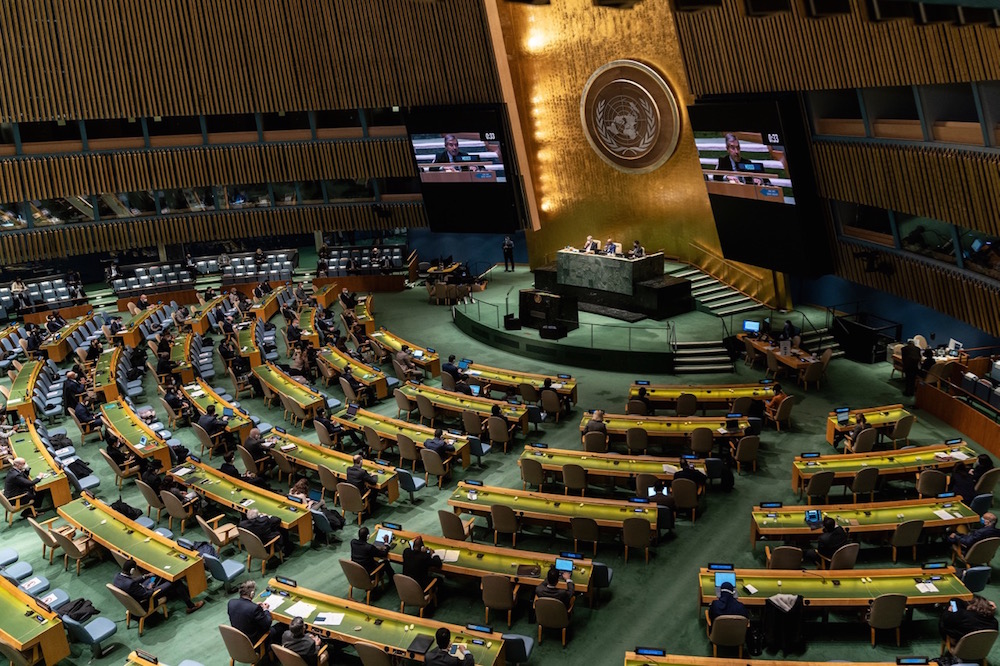
Archive for the 'UN' Category

Animated video clip on work of UN Special rapporteur on Human Rights Defenders

March 8, 2022

On 7 February 2022, the UN Special Rapporteur on Human Rights Defenders released an animated video explaining how to raise concerns about threats to HRDs and human rights abuses by governments and businesses.

Communications are the main tool used to addressed attacks, such as criminalization, smear campaign, threats and killings. Communications will remain confidential for up to 60 days, giving governments and businesses the time to respond to the allegations. The SR also makes two official country visit every year, and writes two thematic reports.

The UN Special Rapporteur has a mission to promote and protect the work of Human Rights Defenders (HRDs). Find out how she does this, and how you can send information about a Human Rights Defender at risk.

See also: https://humanrightsdefenders.blog/2021/05/20/special-rapporteur-mary-lawlor-starts-new-website/

Visit: https://srdefenders.org/

Follow: https://twitter.com/MaryLawlorhrds

Draft Resolution on Human Rights Defenders in 49th session of Human Rights Council gets support from civil society

March 4, 2022

On 4 March 2022 Forum Asia published an Open Letter to States on the Draft Resolution on Human Rights Defenders, which has been signed by an impressive number of NGOs:

“At its current session, the UN Human Rights Council will be discussing a draft resolution on human rights defenders operating in conflict and post-conflict situations.  This is a useful and timely focus providing a means to give effect to a range of recommendations including those contained in the report of the Special Rapporteur on Human Rights Defenders in 2020.

[see also: https://humanrightsdefenders.blog/2022/02/21/guide-to-49th-session-of-human-rights-council-with-human-rights-defenders-focus/]

It is important for the Council to adopt a resolution that reflects the gravity and the reality of the situation defenders face every day and is tailored to addressing the specific protection needs they face. Our organisations call on members of the UN Human Rights Council to ensure that the resolution adopted by the Council clearly:

  • Acknowledges the critical role of human rights defenders in conflict and post-conflict situations, including those who report on gross and systematic human rights violations or systematic targeted violations against particular populations and communities as these can serve to provide an early warning of escalating conflict;
  • Acknowledges the precariousness that human rights defenders can experience working in conflict and post-conflict situations due to the disruption to basic supplies and services and increased security risks, all of which compound the risks associated with defending human rights;
  • Recognises the intersectional dimensions of discrimination, violations and abuses against specific groups of human rights defenders, including women human rights defenders, indigenous peoples, people of African descent, children, people belonging to minorities, defenders working on issues related to sexual orientation, gender identity and expression, older persons and rural and marginalized communities, and calls on States to pay particular attention to the protection needs of different groups in conflict and post-conflict situations integrating an age and gender responsive approach;
  • Outlines the elements that constitute a safe and enabling environment and restates that States have the obligation to create and safeguard such an environment including in conflict and post-conflict situations;
  • Includes in that overview the need to urgently lift all undue restrictions on the rights to freedom of association and collective bargaining, peaceful assembly and expression, including restrictive ‘NGO Laws’, foreign agent and foreign funding laws, counter-terrorism laws, ‘fake news’ laws and those specifically targeting women and LGBTQ+ organizations and defenders;
  • Expresses deep concern at the invocation of countering terrorism and extremism as a justification to target, threaten, or limit the activities and access to funding sources of human rights defenders operating in conflict or post-conflict areas, both online and offline;
  • Stresses that the use of digital surveillance tools must be regulated to ensure they are not used for violating human rights, including by targeting human rights defenders or journalists, and that mobile networks and internet access must not be shut down;
  • Calls for the development of protection mechanisms and support for human rights defenders in such contexts in line with the best practice identified by the Special Rapporteur. These should address the fact that, in some cases, state and non-state actors orchestrate ways  to make defenders appear to be supporting hostilities, and that attacks against defenders constitute “collateral damage” during hostilities;
  • Recognises that impunity and failure to protect and provide effective remedy prevails in several conflict and post-conflict situations, including in regard to attacks against human rights defenders, all of which can fuel further conflict;
  • Acknowledges the role of women human rights defenders and women peacebuilders in the prevention, in mediation and the resolution of conflicts, and recognizes the link between their involvement and the effectiveness and long-term sustainability of those efforts;
  • Recognizes that women human rights defenders are targeted for violence and subjected to intimidation and retaliation because of their efforts to ensure women’s rights, including sexual and reproductive health rights and for their demanding accountability for pervasive sexual violence and feminicides;
  • Calls on States to reaffirm the positive, important, and legitimate role played by child human rights defenders for the promotion of human rights in conflict and post-conflict situations, and the role of organisations advocating for the protection of the rights of older persons in these contexts;
  • Calls on States to act on their responsibility to protect against human rights abuses by non-State actors, including businesses, including in times of conflict when oversight of the operations of businesses can be weaker and human rights defenders can stand unprotected as they resist corporate abuse;
  • Calls on States to monitor and report on the implementation of this resolution in a comprehensive and systematic way and share updates on challenges faced and progress made during relevant UN dialogues and debates.

We ask States to actively support the drafting of a resolution that recognizes the essential work of human rights defenders operating in conflict and post-conflict situations, outlines means to ensure their work is enabled despite the situation of conflict and uncertainty that may prevail, and formulates concrete asks of States, companies and all other actors with the power to protect and promote the right to defend rights. We also call on States to resist efforts that undermine and weaken the resolution.”

Signed,

  • Access Now
  • African Centre for Democracy and Human Rights Studies (ACDHRS)
  • Al Mezan Centre for Human Rights
  • Al-Haq – Law in the Service of Man
  • Amnesty International
  • Amnesty International Norway
  • ARTICLE 19
  • Asian Forum for Human Rights and Development (FORUM-ASIA)
  • Association for Progressive Communications (APC)
  • Cairo Institute for Human Rights Studies (CIHRS)
  • Center for Reproductive Rights
  • Centro de Estudios Legales y Sociales (CELS)
  • Centro de Justicia y Paz – Cepaz
  • Centro para los Defensores y la Justicia (CDJ)
  • CIVICUS: World Alliance for Citizen Participation
  • Commonwealth Human Rights Initiative (CHRI)
  • DefendDefenders (East and Horn of Africa Human Rights Defenders Project)
  • Egyptian Initiative for Personal Rights (EIPR)
  • Freedom House
  • FRI – The Norwegian Organisation for Sexual and Gender Diversity
  • Gulf Centre for Human Rights
  • Human Rights House Foundation
  • Human Rights Watch
  • IFEX
  • International Commission of Jurists (ICJ)
  • International Service for Human Rights (ISHR)
  • KIOS Foundation
  • Mwatana for Human Rights
  • Norwegian Helsinki Foundation
  • Peace Brigades International
  • Protection International
  • Rafto Foundation for Human Rights
  • Rainforest Foundation Norway
  • Save the Children
  • Sexual Rights Initiative
  • UN Association of Norway
  • World Organisation Against Torture (OMCT)

Human Rights High Commissioner Bachelet urges support for environmental defenders

March 2, 2022
United Nations
Protect the defenders of the planet, UN rights chief urges
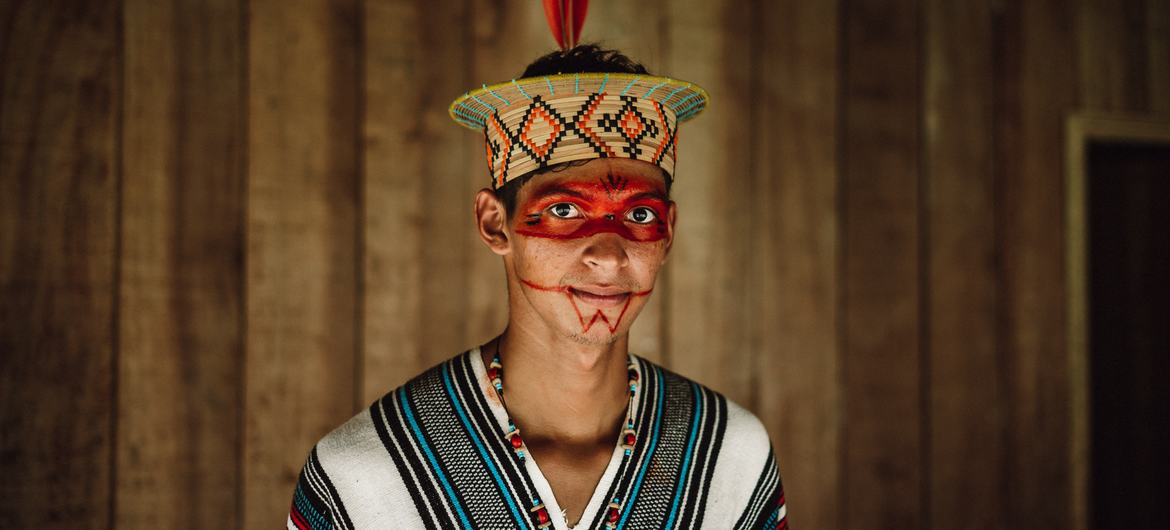
Poyowari Piyãko, a young activist, poses in his home in the Apiwtxa village, which belongs to the Ashaninka indigenous people, in northern Brazil.

Poyowari Piyãko, a young activist, poses in his home in the Apiwtxa village, which belongs to the Ashaninka indigenous people, in northern Brazil. © UNICEF/Alécio Cézar

The world must be made a safer place for people working to protect the planet, who sometimes pay with their own lives for their activism, UN Human Rights High Commissioner Michelle Bachelet said on Tuesday 1 March 2022.  “Protecting the environment goes hand-in-hand with protecting the rights of those who defend it,” she told the UN Human Rights Council in Geneva, which is holding its annual month-long session. 

Ms. Bachelet revealed how speaking out and standing up for environmental rights can come at enormous cost as activists have been killed or subjected to abuse, threats and harassment.   

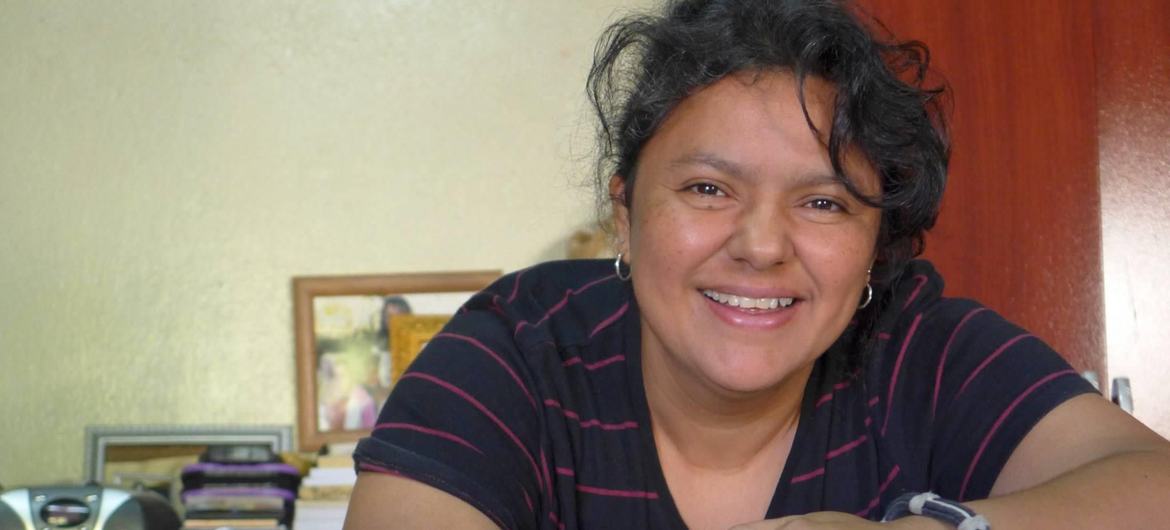
“At particular risk are people who speak out against deforestation, extractives, loss of cultural heritage or identity, or large scale-agribusinesses and development projects – including those intended to produce clean energy, such as mega dams,” she said.  Many environmental human rights defenders are also indigenous peoples, or members of local communities or minority groups – or those representing them.   Berta Caceres, an environmental activist from Honduras, was assassinated in March 2016.  She was recognized posthumously as a UN Champion of the Earth laureate for her tireless campaign for the rights of indigenous people.

Berta Caceres, an environmental activist from Honduras, was assassinated in March 2016. She was recognized posthumously as a UN Champion of the Earth laureate for her tireless campaign for the rights of indigenous people. © UNEP

She said entire communities may face threats and intimidation when someone speaks out on their behalf.  Ms. Bachelet underlined that States have an obligation to respect and protect the rights of environmental human rights defenders, and the communities they represent.  Authorities must also prevent and ensure accountability for attacks.  These actions are in line with a Council resolution adopted last year which upholds the right to a healthy environment, she said.  See also: https://humanrightsdefenders.blog/2021/10/26/aarhus-convention-gets-new-mechanism-to-protect-environmental-defenders/ and

“In addition, it is critical that States effectively regulate businesses and hold them accountable for human rights violations,” she said, while corporations also have a similar duty, as outlined in the UN Guiding Principles on Business and Human Rights. 

Ms. Bachelet advised that prior to undertaking any climate project, both governments and businesses must carry out human rights risk assessments.  

“If indigenous peoples’ rights are at risk of being adversely affected by such projects, it is crucial that their free, prior and informed consent is obtained,” she said. 

The UN rights chief also reported on some of the global work of her staff.  “All around the world, my Office is committed to supporting States, businesses and environmental human rights defenders in all of their efforts to protect our planet,” she said. 

For example, over 200 human rights defenders in the Pacific region have been trained to help boost sustainable development, business and human rights in the context of climate change.  

In Southeast Asia, OHCHR is monitoring cases of harassment, arrest, killings and disappearances of environmental human rights defenders, while

https://yubanet.com/world/protect-the-defenders-of-the-planet-un-rights-chief-urges/working with governments towards ending punitive measures levelled against activists. 

https://news.un.org/en/story/2022/03/1113022

Women human rights defenders in conflict and post-conflict situations; side event 8 March

March 2, 2022

Women human rights defenders are crucial agents and leaders of change. However, due to their gender, they face particular obstacles and security risks. What are these gendered obstacles and risks? How can women human rights defenders best be supported and protected by States and other actors?
ISHR, the Ministry for Foreign Affairs of Finland and the Permanent Mission of Norway invite you to join a virtual event on the side of the Human Rights Council’s 49th session: 
“Supporting women human rights defenders in conflict and post-conflict situations” takes place on Tuesday 8 March 2022 11:30am – 12:30pm (CET)
See also: https://humanrightsdefenders.blog/2020/08/03/roadmap-to-women-peace-and-security-wps-agenda-2020/

Opening statement:  Pekka Haavisto, Minister for Foreign Affairs, Finland

Panellists: 

Mary Lawlor, UN Special Rapporteur on the Situation of Human Rights Defenders

Ilwad Elman, Director of Program & Development, Elman Peace & Human Rights Centre [see also: https://humanrightsdefenders.blog/2020/09/17/fartuun-adan-and-ilwad-elman-from-somalia-named-2020-aurora-prize-winners/]

Horia Mosadiq, Human rights activist and Executive Director, Conflict Analysis Network (CAN)

Pooja Patel, Programme Director, International Service for Human Rights

Moderation:  Heidi Hautala, Vice-President, Member of Parliament, European Parliament.

Download the flyer here and click here to join the event.

More about the contributions of women human rights defenders to peace and security: ISHR report.

See also: https://www.trueheroesfilms.com/themes/

https://mailchi.mp/ishr/749qlxejj6-33413?e=d1945ebb90

New timely book on refugee flows

February 28, 2022

With massive new flows starting in the wake of the Russian attack on Ukraine, the new book announced on 28 February 2022 by UNHCR –People Forced to Flee: History, Change and Challenge – is most timely.

People Forced to Flee draws on the lessons of history to probe how we can improve responses to forced displacement. Tracing the roots of asylum from early history to contemporary times, the book shows how the 1951 Convention relating to the Status of Refugees turned the centuries-old ideals of safety and solutions for refugees into global practice. It highlights the major achievements in protecting people forced to flee since then, while exploring serious setbacks along the way.

Published at a time when over 84 million people in the world are forcibly displaced, it examines international responses to forced displacement within borders as well as beyond them, and the principles of protection that apply to both: reviewing where they have been used with consistency and success, and where they have not. At times, the strength and resolve of the international community seems strong, yet solutions and meaningful solidarity are often elusive.

Most forced displacement is experienced in low- and middle-income countries and persists for generations. People forced to flee face barriers to improving their lives, contributing to the communities in which they live, and realising solutions. Responding better is not only a humanitarian necessity but a development imperative.

The book shows how this work gained momentum with the international affirmation in December 2018 of the Global Compact on Refugees; and it illustrates how it is being supported by a growing group of partners encompassing forcibly displaced people, local communities and authorities, national governments, international agencies, non-governmental organisations and the private sector.

People Forced to Flee also examines how increased development investments in education, health and economic inclusion are helping to improve socio-economic opportunities both for forcibly displaced people and their hosts. Alongside this are greater investments in data, evidence and analysis pointing to what works best. And it discusses the wide array of financing mechanisms that can support sustainable responses.

As noted by Filippo Grandi, the UN High Commissioner for Refugees, in his foreword, the book highlights with great clarity the enormous challenges to preventing, mitigating, and finding solutions to forced displacement. “The drivers of displacement are unrelenting; the demands placed on humanitarian funding are growing,” Grandi notes. Yet he adds that while “the challenges are enormous, history has repeatedly demonstrated the potential for, and power of, positive change”.

The book is published by Oxford University Press in hardback or in digital format via this microsite.

People Forced to Flee: History, Change and Challenge, takes up the mantle of a series of UNHCR publications, stretching back to 1993, that were previously entitled The State of the World’s Refugees. This book was written by Ninette Kelley.

https://www.unhcr.org/news/press/2022/2/621c851f4/new-book-explores-past-present-future-protecting-people-forced-flee.html

Basic intro to the UN Human Rights Council

February 23, 2022

On 22 February 2022 Imogen Foulkes (a journalist reporting from Geneva for SWI swissinfo.ch as well as the BBC) published a piece: “What can the Human Rights Council do for you?”

Next week the spring session of the UN Human Rights Council begins [see also my: https://humanrightsdefenders.blog/2022/02/21/guide-to-49th-session-of-human-rights-council-with-human-rights-defenders-focus/]. Geneva will be inundated with the world’s top diplomats and human rights activists, who will wade their way through mountains of reports.  Foulkes brief survey helps to see the essence:

It’s too easy, sometimes, to be overwhelmed by all the paperwork and protocol of the human rights council. The 47 council members sit, day after day, in the vast council chamber, listening to those endless reports, and waiting for their two minutes to speak. 

Of course, the content of the reports is utterly serious; from possible war crimes and crimes against humanity in Syria, Yemen, or Myanmar, to the plight of child soldiers, to violence against women, and racial discrimination. Our world continues, day after day, to flout the human rights standards we’ve all signed on to defend. 

But the very quantity of those reports, the way multiple human rights crises are addressed in a single day, before moving on to the next litany of cruelty and misery, can be exhausting, and, somehow, desensitising. I, and my journalist colleagues at the UN in Geneva, often find it difficult to interest our editors in what the human rights council is doing. Not least because, when those editors ask “so, once they’ve passed the resolution condemning x or y country, what happens then?” our answer has to be “not much”. The council has no power to impose sanctions, it cannot prosecute, its investigators can never apprehend someone they know to be a war criminal, and drag him or her to the International Criminal Court. 

So what’s the point of it? That’s the question we try to answer in this week’s edition of Inside Geneva. We talk to human rights investigators, and to human rights defenders, people who bring their own testimonies of atrocities to the UN, often at great risk to themselves, and, often, because the UN is their last and only hope. 

Andrew Clapham, who is currently a member of the UN team investigating violations in South Sudan, tells us that “The idea that someone has listened to your story, and you have taken your case to the United Nations is incredibly important.” 

But is that enough? Is the UN’s human rights work simply a form of counselling, a way for victims of violations to talk through their trauma? 

Feliciano Reyna, a human rights defender from Venezuela, explains that the UN’s regular reviews of a country’s record, from its upholding of the convention against torture, on women’s rights or the rights of the child, allow human rights defenders to participate – they come to Geneva to present their version of what’s happening in their country. This process, Feliciano tells Inside Geneva has been “absolutely key in advancing our work on human rights and putting Venezuela on the international and local agenda”. 

We also talk to Collette Flanagan, whose son Clinton was shot and killed by Dallas police in 2013. Together with many other US mothers who have lost a child to police violence, Collette brought her case to the UN, because, she told us, her attempts at home to get answers for what had happened to her son, who was unarmed, were “dismissed by…the police department, we couldn’t get any answers to what happened to our child.” 

See also her piece: What does the Human Rights Council mean to victims of atrocities?

Collette’s campaigning resulted, eventually in the UN’s report on the treatment of people of African descent. Presenting that report last year, UN Human Rights Commissioner Michelle Bachelet drew a direct link between slavery and the violence and discrimination inflicted on people of African descent today. She said there was “an urgent need to confront the legacies of enslavement” and called for “amends for centuries of violence and discrimination”, including “formal acknowledgment and apologies, truth-telling processes and reparations in various forms”. 

For Collette, the report was a hugely important sign that even the most powerful country on earth, with its oft repeated promise of “liberty and justice for all”, is not above international scrutiny. 

“The United States is a democracy,” Collette says. “And we are supposed to uphold life, liberty and freedom for every citizen. And that is not happening in the United States. And if those things are not happening in the United States then that is an egregious attack on democracy and human rights and freedom. How can the United Nations not be involved?” 

One of the most disturbing investigations currently underway by UN human rights officers is the Fact Finding Mission on Myanmar, which is examining, among other things, the treatment of the Rohingya Muslim community by Myanmar’s ruling military regime. 

In 2016 and 2017 over a million Rohingya fled appalling violence. When human rights officer Ilaria Ciarla arrived in the refugee camps in Bangladesh to take witness accounts, among them from mothers whose babies had been killed before their eyes, she tells Inside Geneva her initial reaction was “incredulity… is this possible? How can human beings do such horrible things to other human beings?” 

Australian lawyer Chris Sidoti also served on the Fact Finding Mission, and highlights the inherent weakness in the human rights council’s inability to legally hold perpetrators to account. “I still know that the Myanmar butchers who are responsible for what happened may never individually be brought to justice,” he says. 

But, he explains, those UN investigations are quietly growing some teeth. Names of perpetrators, and all the evidence to convict them, is available to courts, national or international, who do have the power to try and convict. 

“We are seeing court cases in the top international courts now, dealing with Myanmar,” he notes. “The International Court of Justice is using our report. The International Criminal Court is using our report.” 

And for Khin Ohmar, who has devoted her life to the struggle for democracy in her native Myanmar, this is a milestone. “Oh yes, that is what I have been working for, there is no other way. We have allowed this military to enjoy blanket impunity for so long, and that must stop,” she says. “These perpetrators [must be] held to account by law, and there is no domestic law available, so now we need international law to hold them to account for all the crimes they have committed against the people of Myanmar.” 

https://www.swissinfo.ch/eng/what-can-the-human-rights-council-do-for-you-/47368266

Guide to 49th session of Human Rights Council – with human rights defenders focus

February 21, 2022

The 49th session of the UN Human Rights Council, from 28 February – 1 April 2022, will consider issues including the protection of human rights defenders, freedom of religion or belief, protection and promotion of human rights while countering terrorism, the right to food and adequate housing, among others. It will also present an opportunity to address grave human rights situations in States including Nicaragua, Venezuela, China, Syria, South Sudan, Sri Lanka, Iran, the Democratic People’s Republic of Korea, Myanmar, Eritrea, among many others. Here’s an overview of some of the key issues on the agenda. The ISHR has issued again its excellent Guide to the upcoming session and I have extracted from it the issues most directly related to human rights defenders:

Protection of human rights defenders

On 11 March 2022, the UN Special Rapporteur will present her report on the work of human rights defenders to address corruption. At the 49th session of the HRC, Norway will present a thematic resolution on human rights defenders in conflict and post-conflict situations. A group of NGOs have produced a list of 25 recommendations related to key concerns that should be addressed in the resolution. These include recommendations related to the removal of legislation that impinges upon the ability of defenders to do their work, including counter-terrorism legislation; the development of protection measures that take into account the specific needs of particular groups of defenders and the precarious nature of their situation in conflict and post-conflict contexts, and specific measures to support human rights defenders in such contexts, including in regard to the provision of cloud-based solutions for storage of documentation, flexible and reliable funding and swift responses in the case of the need for relocation of human rights defenders and their families. ISHR joins these calls and to impress upon the Council the need for a strong commitment to acknowledging and taking action to protect human rights defenders working in such contexts.  In addition, we call on all UN members to monitor and report on their implementation of the resolution in a comprehensive way, sharing updates on challenges faced and progress made during relevant UN dialogues and debates.   

Reprisals

Reports of cases of intimidation and reprisal against those cooperating or seeking to cooperate with the UN not only continue, but grow. Intimidation and reprisals violate the rights of the individuals concerned, they constitute violations of international human rights law and undermine the UN human rights system.

The UN has taken some action towards addressing this critical issue including:

  • an annual report by the Secretary General;
  • a dedicated dialogue under item 5 to take place every September;
  • The appointment of the UN Assistant Secretary General on Human Rights as the Senior Official on addressing reprisals.

Despite this, ISHR remains deeply concerned about reprisals against civil society actors who try to engage with UN mechanisms, and consistent in its calls for all States and the Council to do more to address the situation. See also: https://humanrightsdefenders.blog/tag/reprisals/

During the 48th session, the Council adopted a resolution on reprisals. The text was adopted by consensus for the first time since 2009 and invites the UN Secretary General to submit his annual report on reprisals and intimidation to the UN General Assembly. Once again the resolution listed key trends including that acts of intimidation and reprisals can signal patterns, increasing self-censorship, and the use of national security arguments and counter-terrorism strategies by States as justification for blocking access to the UN. The resolution also acknowledged the specific risks to individuals in vulnerable situations or belonging to marginalised groups, and called on the UN to implement gender-responsive policies to end reprisals. The Council called on States to combat impunity by conducting prompt, impartial and independent investigations and ensuring accountability for all acts of intimidation or reprisal, both online and offline, by condemning all such acts publicly, providing access to effective remedies for victims, and preventing any recurrence.

Item 5 of the Human Rights Council’s agenda provides a key opportunity for States to raise concerns about specific cases of reprisals, and for governments involved in existing cases to provide an update to the Council on any investigation or action taken toward accountability to be carried out. The President should also update the Council on actions taken by the President and Bureau to follow up on cases and promote accountability under this item.

Other thematic debates

At this 49th session, the Council will discuss a range of topics in depth through dedicated debates with mandate holders. The debates with mandate holders include: 

  • The Special Rapporteur in the field of cultural rights 
  • The Special Rapporteur on freedom of religion or belief
  • The Special Rapporteur on torture
  • The Special Rapporteur on the right to privacy

In addition, the Council will hold dedicated debates on the rights of specific groups including the Special Rapporteur on minority issues

In addition, the Council will hold dedicated debates on interrelation of human rights and human rights thematic issues including:

  • The Special Rapporteur on the promotion and protection of human rights while countering terrorism
  • The Special Rapporteur on human rights and the environment

Country-specific developments

China: High Commissioner Bachelet has still not released her Office’s report on grave human rights violations in the Uyghur region, six months after announcing its upcoming publication, and three months since her spokesperson indicated it would only be a matter of ‘weeks’. Further delays risk entrenching the Chinese government’s sense of impunity, and will harm the credibility of, and confidence in her Office’s capacity to address grave violations, some of which could amount to atrocity crimes. States should urge the High Commissioner to promptly publish her report, and present it to the Human Rights Council as a matter of utmost priority.  This includes ensuring sustained pressure around China’s abuse of national security in discourse and law, and on the widespread and systematic use of enforced disappearance under ‘Residential Surveillance at a Designated Location’ (RSDL). See also: https://humanrightsdefenders.blog/2022/02/05/chinas-residential-surveillance-at-a-designated-location-needs-to-disappear/

Burundi: The Commission of Inquiry on Burundi (CoI) concluded its work at the 48th HRC session in October 2021 while a new resolution establishing a mandate of UN Special Rapporteur on Burundi was adopted, resolution 48/16. The resolution tasks the mandate with monitoring the human rights situation in the country, making recommendations for its imp­ro­ve­ment, and re­por­ting to the Human Rights Council. While the Spe­cial Rapporteur will be unable to continue the entirety of the investigative work carried out by the CoI, they will “collect, examine and assess” information on human rights deve­lop­ments. Ahead of HRC48 more than 40 organisations, including ISHR, urged the Council to continue its scrutiny and further work towards justice and accountability in Burundi. See also: https://humanrightsdefenders.blog/2021/07/03/germain-rukuki-burundi-human-rights-defender-out-of-jail/

The UN Human Rights Office (OHCHR) will ensure that evidence col­lec­ted by the CoI is “consolidated, preserved, accessible and usable in support of ongoing and future accountability efforts” including efforts to hold Bu­rundian officials responsible for atrocities in front of the International Criminal Court (ICC). The Burundian government should resume its engagement with the Council and grant the Special Rap­porteur, who will be appointed in March 2022, access to the country for an official visit.

France: Following an urgent call by ISHR and the Comité Adama, UN experts sent two communications to the French government on 15 and 26 November 2021 asking for measures to ensure that human rights defenders, including people of African descent, enjoy a safe environment in which to carry out their legitimate work for human rights and justice. The lack of investigation in the case of Adama Traoré’s death and the judicial harassment against his sister Assa Traoré for her activism is a sign of broader systemic racism against Black people in policing and criminal justice in France. 

ISHR urges the HRC to continue its scrutiny and calls on France to ensure a prompt, transparent, and impartial investigation into the case of Adama Traoré; end the judicial harassment of Assa Traoré for her activism; accept the requests of the UN Special Rapporteur on Racism and the Working Group on People of African Descent to visit the country; end impunity for police violence; and ensure truly free and impartial investigations into the death or injury of anyone at the hands of the police, especially people of African descent.

Egypt: The joint statement delivered by States in March 2021 at the 46th session of the HRC played a critical role in securing the conditional release of several human rights defenders and journalists arbitrarily detained throughout 2021 and 2022. Regrettably, these releases do not reflect any significant change in Egypt’s systematic attacks on civic space and human rights defenders, including arbitrary detention, torture, ill-treatment, enforced disappearances and criminalisation of the exercise of the rights to freedom of expression, association, assembly or public participation. On 3 February 2022, 175 parliamentarians from across Europe urged the HRC to establish a “long overdue monitoring and reporting mechanism on Egypt”. ISHR joined more than 100 NGOs from around the world in urging the HRC to create a monitoring and reporting mechanism on the ever-deteriorating human rights situation in Egypt. Continued, sustained and coordinated action on Egypt at the HRC is more necessary than ever. The HRC should follow up on the 2021 State joint statement and heed the calls of civil society and parliamentarians. See also: https://humanrightsdefenders.blog/2022/01/11/the-arabic-network-for-human-rights-information-has-shut-down/

Nicaragua: A year after Council resolution 46/2, civil society reporting indicates no meaningful action has been taken by Nicaragua to implement any of the Council’s recommendations to the government. Instead, it has deepened its crackdown on human rights defenders and any form of dissent, and further closed civil society space ahead of the November 2021 electoral process. The government’s absolute disregard for cooperation with international and regional mechanisms, including the treaty bodies, is an additional sign that the government does not intend to revert course on the country’s human rights crisis. ISHR, jointly with the Colectivo 18/2, urges the Human Rights Council to establish an independent mechanism to investigate grave human rights violations since April 2018 in Nicaragua, as well as their root causes. The mechanism should verify alleged grave violations, identify perpetrators, and preserve evidence, with a view to long-term accountability processes. See also my post of today: https://humanrightsdefenders.blog/2022/02/21/nicaragua-death-in-detention-and-sham-trial/

Saudi Arabia: According to ALQST’s 2021 annual report, for a short time in early 2021, intense global pressure on Saudi Arabia’s leaders to improve their dismal human rights record resulted in some minor reforms and concessions, yet, when the pressure eased, the Saudi authorities resumed their habitual pattern of abuses with renewed intensity. A number of high-profile women human rights defenders and prisoners of conscience were conditionally released, but they remain under severe restrictions which means that while they are released, they are not yet free. Saudi authorities continue to crackdown on freedom of expression and hand down lengthy prison sentences to human rights defenders. Saudi Arabia is sensitive regarding its reputation and susceptible to international pressure.

Sudan: On 5 November 2021, the Human Rights Council held a special session to address the ongoing situation in the Republic of Sudan and mandated an Expert on human rights in Sudan to monitor and report on the situation until the restoration of its civilian-led Government. The HRC must extend the reporting mandate of the Expert as the human rights situation is deteriorating. The military is closing the civic space for women’s rights groups and women human rights defenders, including by stigmatising women’s rights groups as terrorists or drug abusers. The recent arrests of women human rights defenders are part of a systemic attack against WHRDs in Sudan. The military and security forces are using social media and traditional media to defame women protesters. Women’s rights groups and WHRDs are facing a new wave of attacks that include framing charges to prolong the detention of WHRDs and defame the women’s rights movement. The military reinstated the authorities of the former regime’s security forces in December 2021 in the emergency order number 3. The new emergency order gave Sudanese security complete impunity and protection from accountability for any form of violations on duty.  Sudanese security forces have a well-documented history of sexual abuse and torture of women detainees. WHRDs in detention are at risk of maltreatment, torture, and sexual violence. 

Venezuela is back under the microscope with updates from the Office of the High Commissioner and from the Council’s fact-finding mission on the country both scheduled for 17th March. Attention on the human rights situation in the country follows hot on the heels of the Universal Periodic Review of Venezuela that took place at the end of January.  The Council session is taking place at a time that Venezuelan civil society continues facing restrictions and attacks on their work. The head of human rights organisation, Fundaredes, has now been arbitrarily detained for 224 days. The Council session is an opportunity for States to express concern about the restrictions on civil society, and to enquire about the implementation of prior recommendations made to Venezuela by both OHCHR and the Mission. Despite being a Council member, Venezuela has yet to allow the Council’s own fact-finding mission access to the country, something the Council as a whole should denounce. 

The High Commissioner will provide an oral update to the Council on 7 March. The Council will consider updates, reports on and is expected to consider resolutions addressing a range of country situations, in some instances involving the renewal of the relevant expert mandates. These include:

  • Oral update and interactive dialogue with the Special Rapporteur on Eritrea
  • Oral update and interactive dialogue with the High Commissioner on the Tigray region of Ethiopia 
  • Interactive Dialogue on the High Commissioner’s written update on Sri Lanka
  • Interactive dialogue on the High Commissioner’s report on  Nicaragua
  • Interactive dialogue on the High Commissioner’s report on Afghanistan
  • Interactive Dialogue on the High Commissioner’s report on ensuring accountability and justice in the Occupied Palestinian Territory, including East Jerusalem
  • Oral updates and interactive dialogues with the High Commissioner and fact-finding mission on Venezuela 
  • Oral update bv the High Commissioner and interactive Dialogue with the Special Rapporteur on the Democratic People’s Republic of Korea
  • Enhanced Interactive Dialogue on the OHCHR’s report on Belarus
  • Interactive Dialogue on the High Commissioner’s report, enhanced interactive dialogue on the Secretary-General’s report, and interactive dialogue on the Special Rapporteur’s report on Myanmar
  • Interactive Dialogue on the Special Rapporteur’s report on Iran
  • Interactive Dialogue on the Commission of Inquiry’s report on Syria 
  • Interactive Dialogue on the Special Rapporteur’s report on the Palestinian territories occupied since 1967
  • Interactive Dialogues on the High Commissioner’s report and Commission on Human Rights’ report on South Sudan
  • Interactive Dialogue with the High Commissioner on Ukraine
  • High-level Interactive Dialogue with the Independent Expert on Central African Republic
  • Oral updates and enhanced interactive dialogue with the High Commissioner and the team of international experts on the Democratic Republic of the Congo
  • Oral update by the Special Rapporteur on Cambodia 
  • Interactive Dialogue on the Independent Expert’s report on Mali 
  • Interactive Dialogue on the fact-finding mission’s report on Libya

Appointment of mandate holders

The President of the Human Rights Council will propose candidates for the following mandates: 

  1. Three members of the Expert Mechanism on the Rights of Indigenous Peoples (one from the Pacific, one from Central and South America and the Caribbean, and one from Central and Eastern Europe, the Russian Federation, Central Asia and Transcaucasia); 
  2. The Special Rapporteur on the promotion and protection of human rights in the context of climate change; 
  3. The Special Rapporteur on the situation of human rights in Afghanistan; 
  4. The Special Rapporteur on the situation of human rights in Burundi; 
  5. The Special Rapporteur on the situation of human rights in the Palestinian territories occupied since 1967; 
  6. A member of the Working Group on Arbitrary Detention, from Western European and other States; 
  7. A member of the Working Group on Enforced or Involuntary Disappearances, from Asia-Pacific States; 
  8. A member of the Working Group on the issue of human rights and transnational corporations and other business enterprises, from Asia-Pacific States;
  9. A member of the Working Group on the use of mercenaries as a means of violating human rights and impeding the exercise of the right of peoples to self-determination, from Latin American and Caribbean States (an unforeseen vacancy that has arisen due to a resignation).

Resolutions to be presented to the Council’s 49th session

At the organisational meeting on 14 February the following resolutions were announced (States leading the resolution in brackets):

  1. Human rights of persons belonging to minorities (Austria, Mexico, Slovenia)
  2. Combating intolerance, negative stereotyping and stigmatization of, and discrimination, incitement to violence and violence against, persons based on religion or belief (Pakistan on behalf of the OIC) 
  3. Human rights situation in the Occupied Palestinian Territory, including East Jerusalem, and the obligation to ensure accountability and justice (Pakistan on behalf of the OIC) 
  4. Cultural rights (Cuba)
  5. The negative impact of unilateral coercive measures on the enjoyment of human rights (Azerbaijan on behalf of NAM)
  6. Right to work (Egypt, Greece, Indonesia, Mexico, Romania)
  7.  Situation of human rights in the Islamic Republic of Iran – mandate renewal (Iceland, Moldova, North Macedonia, UK) 
  8. Rights of the child (GRULAC and EU)
  9. Human rights defenders (Norway)
  10. Adequate housing as a component of the right to an adequate standard of living, and the right to non-discrimination in this context (Germany, Brazil, Finland, Namibia)
  11. Situation of human rights in the Syrian Arab Republic – mandate renewal (France, Germany, Italy, Jordan, Kuwait, Netherlands, Qatar, Turkey, UK, USA)
  12. Situation of human rights in South Sudan – mandate renewal (Albania, Norway, USA, UK)
  13. Mandate of the Special Rapporteur on the promotion and protection of human rights and fundamental freedoms while countering terrorism – mandate renewal (Mexico)
  14. Prevention of genocide (Armenia)
  15. Situation of human rights in Belarus – mandate renewal (EU)
  16. Situation of human rights in the Democratic People’s Republic of Korea (DPRK)- mandate renewal (EU) 
  17. Situation of human rights in Myanmar – mandate renewal (EU)
  18. Freedom of religion or belief (EU)
  19. Technical assistance and capacity-building for Mali in the field of human rights (Africa Group)
  20. Technical assistance and capacity-building for South Sudan (Africa Group) 
  21. Role of states in countering the negative impact of disinformation on human rights (Ukraine)

During this session, the Council will adopt the UPR working group reports on Myanmar, Greece, Suriname, Samoa, Hungary, Saint Vincent and the Grenadines, Papua New Guinea, Tajikistan, United Republic of Tanzania, Eswatini, Antigua and Barbuda, Trinidad and Tobago, Thailand and Ireland.

During each Council session, panel discussions are held to provide member States and NGOs with opportunities to hear from subject-matter experts and raise questions. 7 panel discussions and 1 thematic meeting are scheduled for this upcoming session:

To stay up-to-date: Follow @ISHRglobal and #HRC49 on Twitter, and look out for our Human Rights Council Monitor.

See also: https://humanrightsdefenders.blog/2021/10/19/48th-session-of-the-human-rights-council-outcomes/

https://ishr.ch/latest-updates/hrc49-key-issues-on-agenda-of-march-2022-session/

Human Rights Defenders at Polish-Belarus border under pressure

February 18, 2022

Poland must probe into harassment of human rights defenders at Belarus border

Poland must investigate all allegations of harassment of human rights defenders, including media workers and interpreters, at the border with Belarus, and grant access to journalists and humanitarian workers to the border area ensuring that they can work freely and safely, UN human rights experts* said on 16 February 2022.

“I am receiving several reports of harassments from human rights defenders who assist migrants and document human rights violations against them at the Polish-Belarusian border, and I am deeply concerned at this practice,” said Mary Lawlor, the Special Rapporteur on the situation of human rights defenders.

Jakub Sypiański, a volunteer interpreter assisting migrants and asylum-seekers, was reportedly stopped by armed soldiers when driving home in November 2021. The soldiers, who were in an unmarked vehicle, did not identify themselves nor explain their actions. They forced open the car door, took the keys out of the ignition and tried pulling him out by his legs.

“Most of the migrants at the border do not speak Polish,” said Mary Lawlor. “Interpreters play a vital role in ensuring their human rights are protected both at the border and in immigration detention centres.”

At around the same time, armed soldiers reportedly harassed journalists covering the arrival of migrants and asylum seekers. Soldiers who did not identify themselves stopped, searched and handcuffed photojournalists Maciej Moskwa and Maciej Nabrdalik outside a military camp. The soldiers searched their equipment, scrutinising their photos, and documented their phone messages and incoming calls.

Journalists Olivia Kortas and Christoph Kürbel, along with two local Polish residents, were allegedly harassed by soldiers while filming a documentary about the human rights situation of migrants at the border.

“Reports that these journalists are being persecuted for documenting such human rights violations are appalling,” said Irene Khan, the Special Rapporteur on the right to freedom of opinion and expression. “Their work is crucial for everyone’s access to information about the situation unfolding at the border. If they are not allowed to do their job, there are very serious consequences for the human rights of migrants”.

“Interpreters and journalists, along with medics, lawyers and others who peacefully work for the protection of human rights or who provide humanitarian aid, are human rights defenders, according to the UN Declaration on Human Rights Defenders. Poland should bear this in mind and ensure that they are able to carry out their legitimate work in a safe and enabling environment and with full access to the border area,” said Lawlor.

The experts are in contact with the Polish authorities on the matter.

The experts’ call was endorsed by: Mr. Felipe González Morales, Special Rapporteur on the human rights of migrants, and Ms. Elina Steinerte (Chair-Rapporteur), Ms. Miriam Estrada-Castillo (Vice-Chair), Ms. Leigh Toomey, Mr. Mumba Malila, and Ms. Priya Gopalan, Working Group on arbitrary detention.

https://www.devdiscourse.com/article/law-order/1924185-poland-must-probe-into-harassment-of-human-rights-defenders-at-belarus-border

https://news.un.org/en/story/2022/02/1112032

Towards a fairer selection of NGOs to participate in the UN human rights debate

February 14, 2022
This image has an empty alt attribute; its file name is international-un-ecosoc-ngos-committee-participation-getty.jpg
A plenary meeting at the 76th Session of the General Assembly, at the UN Headquarters, in New York, USA, 21 January 2022, Lev Radin/Pacific Press/LightRocket via Getty Images

NGOs that seek to participate fully at the UN – making statements and organising events to highlight injustice and provide recommendations – have to get accredited.  The “Committee on NGOs” manages the process – as  the gateway for NGOs into the United Nations. If you’re a State with a mind to block NGOs, membership of the Committee is perfect. This is where you can sit and control who comes in. By asking questions of NGO applicants, members of the Committee can push their accreditation for many years.  For more on this see: https://humanrightsdefenders.blog/2018/02/09/the-saga-of-the-anti-ngo-committee-in-the-un-continues/

Currently there are 70 organisations that have faced over four years of deferrals.  Two human rights organisations have been deferred for over ten years.  Some  NGOs  have also been accused by Committee members of having terrorist sympathies: baseless accusations against which the NGOs have been denied appeal.  

In four short months there’s  a chance to change things. Elections to the Committee on NGOs will be held in April 2022. The 54 members of the UN’s Economic and Social Council (ECOSOC) vote to fill the 19 seats on the Committee across all regional groups. 

A joint letter by a massive number of NGOs of 10 February 2022 makes the point:

To: Member States of the UN General Assembly

Excellencies:

We are five months out from elections to the ECOSOC Committee on Non-Governmental Organisations for the 2023-2026 term. These are key elections for all those who value the expertise of civil society and seek to ensure the UN can benefit from it.

The Secretary General has called civil society the UN’s ‘indispensable partners”. Member States recently committed to boosting partnerships ‘to ensure an effective response to our common challenges’. In recommending approval of the participation of non-governmental organisations in a range of UN bodies and processes, the Committee on NGOs plays a key role in facilitating such partnerships. It is essential that the members of the Committee are committed to fulfilling such a task fairly and judiciously.

With this in mind, we would like to request the following, that:

1/ States with an interest in facilitating and safeguarding civil society access to and participation in UN processes stand for election to the Committee.

2/ Candidates make public the reasons for their candidacy and their commitment to fulfil their responsibilities as members of the Committee, as per ECOSOC Resolution 1996/31.

3/ All regions put up competitive slates, as the Asia-Pacific and GRULAC regions did in the last elections for the Committee in 2018. Competitive elections are important to create buy-in to the process and encourage states to be accountable for their commitments.

4/ All regions make public candidacies at least two months before the elections to allow for proper consideration of candidates.

5/ All ECOSOC members vote (and be encouraged to vote) only for candidates with positive track records in regard to civil society access and participation. Candidates could be assessed in regard to indicators such as support for relevant UN resolutions, such as those on civil society space and human rights defenders; on responses to cases of intimidation and reprisals; and on national level initiatives to safeguard civic space, press freedom – online as offline – and the right to defend human rights.

6/ ECOSOC members should consider introducing term limits for membership of the Committee on NGOs, among other reforms encouraging openness and accountability. As with other UN bodies, states should be required to leave the Committee for a specific interval of time after serving for a maximum agreed period. Term limits would encourage greater diversity in membership over time and encourage states to step up as candidates.

The Committee on NGOs is entrusted with the task of facilitating civil society access so that the expertise and experience of civil society partners can enrich and inform UN debates. It needs members that are committed to fulfilling the Committee’s mandate in a fair, transparent, non-discriminatory, expeditious and apolitical manner. It falls on all member states – as potential candidates and / or electors – to ensure that the Committee membership is fit for purpose.

Please elect to stand up for civil society!

Yours sincerely,

In addition to the letter, individuals can undertake additional steps. You can engage with States on all the campaign objectives!

  • On competitive elections and voting with integrity: See here for a model email for sending to those who get to vote, ECOSOC members.  Check here whether your State is going to vote. 
  • On candidates: Does your state have a positive record on promoting civil society but isn’t running? See here for a model email to encourage them. 

https://ishr.ch/action/campaigns/openthedoor2ngos/

Working Together

https://www.hrw.org/news/2022/02/16/letter-members-uns-general-assembly-regarding-ecosoc-committee-ngos

At least 78 human rights defenders killed in Colombia in 2021

January 17, 2022

On 13 January 2022, Reuters and others reported that at least 78 human rights defenders were killed in Colombia in 2021 according to the U.N. Office of the High Commissioner for Human Rights (OHCHR), adding that more cases were still being verified.

Violence against human rights defenders, environmentalists and community activists – known collectively in Colombia as social leaders – has become a big challenge for President Ivan Duque’s government amid international criticism and demands that it do more to stop the killings.

The government accuses left-wing guerrillas from the National Liberation Army, ex-members of the FARC rebels who reject a 2016 peace deal, and criminal groups, some comprised of former right-wing paramilitaries, of attacking activists as they seek control of drug trafficking networks and illegal mining areas.

The U.N. Office of the High Commissioner for Human Rights (OHCHR) said it received 202 reports human rights leaders killed in Colombia last year. Of these 78 were confirmed as killed, 39 cases were still being verified, and 85 were inconclusive.

The Colombian Ombudsman documented 145 murders of social leaders and human rights defenders during 2021. See: https://www.parisbeacon.com/29669/.

See also: https://humanrightsdefenders.blog/2021/09/13/global-witness-2020-the-worst-year-on-record-for-environmental-human-rights-defenders/

https://www.reuters.com/world/americas/about-80-rights-defenders-killed-colombia-2021-un-2022-01-13/

https://www.i24news.tv/en/news/international/latin-america/1642096591-un-78-human-rights-activists-killed-in-colombia-during-2021