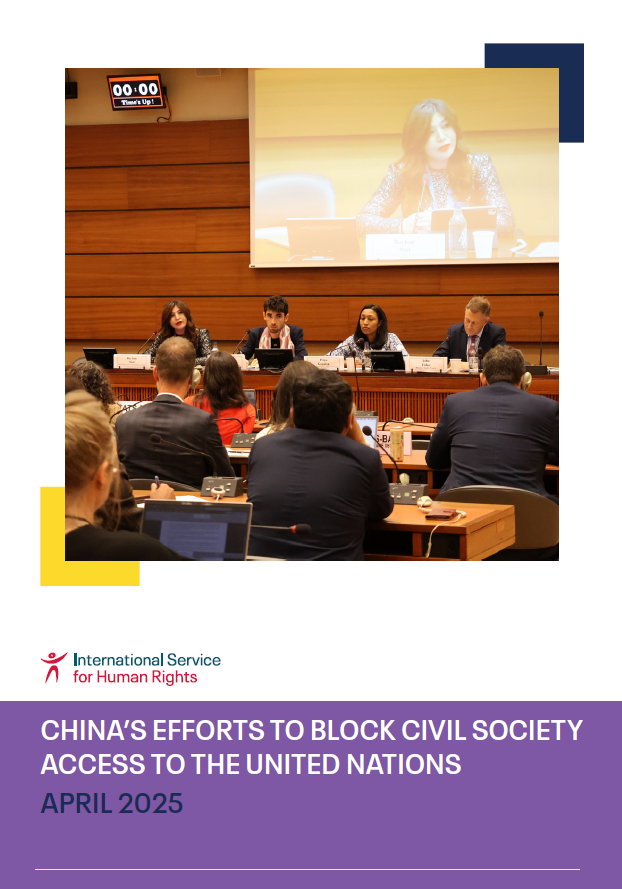
In a new report, ISHR analyses China’s tactics to restrict access for independent civil society actors in UN human rights bodies. The report provides an analysis of China’s membership of the UN Committee on NGOs, the growing presence of Chinese Government-Organised NGOs (GONGOs), and patterns of intimidation and reprisals by the Chinese government.
In the report, published on 28 April 2025 the International Service for Human Rights (ISHR) uncovers the tactics deployed by the Chinese government to restrict access to UN human rights bodies to independent civil society actors and human rights defenders, and intimidate and retaliate against those who do so.
These tactics include using its membership of the UN Committee on NGOs to systematically defer NGO applications, increasing the presence of GONGOs to limit space for independent NGOs and advance pro-government narratives, systematically committing acts of intimidation and reprisals against those seeking to cooperate with the UN, weaponising procedural tactics to silence NGO speakers and threatening diplomats not to meet with them, and opposing reform initiatives and efforts at norm-setting on safe and unhindered civil society participation at the Human Rights Council.
These tactics strongly contrast China’s stated commitment to being a reliable multilateral leader. They stem from the Chinese Party-State’s primary foreign policy objective of shielding itself from human rights criticism and enhancing its international image by restricting and deterring critical civil society voices, crowding out civil society space with GONGOs, and stalling and diverting reform initiatives.
While China is the focus of this report, the issues addressed are systemic. Based on this report’s findings, ISHR puts forward a set of targeted recommendations to UN bodies and Member States, aimed at protecting civil society space from interference and restrictions. The recommendations are designed to strengthen UN processes and prevent any State from manipulating international mechanisms to suppress independent voices. These include:
Reforming the Committee on NGOs to increase transparency, limit abuse of deferrals, and ensure fair access to UN bodies for independent NGOs;
Strengthening protection mechanisms against reprisals, including rapid response to incidents inside UN premises, public accountability for perpetrators, and consistent long-term follow-up on unresolved cases;
Curbing the influence of GONGOs by distinguishing clearly between independent and State-organised NGOs, and better documenting their presence and impact; and,
Strengthening measures at the Human Rights Council and other UN bodies to make civil society participation safer, more inclusive, and less vulnerable to obstruction
The report has been featured prominently in a global investigation by the International Consortium of Investigative Journalists (ICIJ) launched on 28 April 2025.
The 58th regular session of the UN Human Rights Council ran from February 24 to April 4, 2025, resulting in 32 Resolutions and 14 Universal Period Review adoptions.
The session included a high-level segment attended by over 100 dignitaries, thematic panels addressing the rights of specific vulnerable groups, interactive dialogues, and debates on country-specific reports. This session also marked key anniversaries of the Beijing Declaration and the Convention on the Elimination of All Forms of Racial Discrimination. The Human Rights Council plays a crucial role in addressing global violations and continues to serve as a platform for activists and victims of violations. In the face of multiple intersecting crises and conflicts, democracy erosion, and authoritarianism on the rise, Council decisions continue to wield considerable power to improve civil society conditions, particularly in fragile contexts where civic actors are particularly affected by widespread human rights violations and abuses, while offering unique opportunities for the negotiation of higher human rights standards.
I have on the past used other such reports by the ISHR and the UHRG (see below) but thought that this time I should highlight other NGOs:
CIVICUS contributed to the outcomes of the Council session through engagement on key Resolutions, delivery of statements, and organisation of events. We sounded the alarm on the global erosion of civic space and the growing repression of civil society across multiple regions.
Regional Developments: Africa
A strong Resolution on South Sudan was adopted, extending the mandate of the Commission on Human Rights in South Sudan (CHRSS).
Regional Developments: Asia Pacific
A Resolution on Myanmar’s human rights situation was adopted by consensus amid escalating violence and widespread impunity.
Regional Developments: Americas
The Resolution on Nicaragua renewed the mandate of the Group of Human Rights Experts (GHREN) on Nicaragua.
Regional Developments: Europe
Key resolutions were adopted on Ukraine and Belarus, continuing international monitoring mechanisms.
Regional Developments: Middle East
Resolutions on Iran and Syria were adopted, with mixed results on addressing severe human rights concerns.
Several important thematic resolutions were adopted during the session.
Civil Society Challenges
Ahead of the 58th session, CIVICUS raised attention on the increasing restrictions imposed on civil society. CIVICUS engaged in key side events during HRC58, spotlighting democracy, child human rights defenders, and intersectional approaches to civic space.
A detailed post-session report is available via this link.
The International Commission of Jurists (ICJ):
The International Commission of Jurists (ICJ), together with partner organizations, participated actively in the 58th session. Civil society’s critical engagement is essential in calling on the Council and its member States to respond to the plight of victims of human rights violations. In this regard, the ICJ was pleased to ensure that our partner from the African Albinism Network delivered our joint statement on the tenth anniversary of the mandate of the Independent Expert on the enjoyment of human rights by persons with Albinism. Maintaining effective access to the UN in Geneva for civil society is key to ensure that people can themselves participate or be represented in the discussions at the Council that concern them directly. With regard to this, the ICJ denounces all attempts to undermine civil society participation, including the intimidation of human rights defenders during side events, observed again at this HRC session.
At the outset, the ICJ welcomes the adoption of a number of important resolutions renewing, extending or creating mandates under the HRC purview, among which the following were adopted without a vote:
a resolution extending the mandate of the Independent International Commission of Inquiry on the Syrian Arab Republic for a period of one year;
a resolution establishing an open-ended intergovernmental working group for the elaboration of a legally-binding instrument on the promotion and protection of the human rights of older persons;
a resolution renewing the mandate of the Special Rapporteur on the promotion and protection of human rights and fundamental freedoms while countering terrorism for a period of three years;
a resolution renewing the mandate of the Special Rapporteur on the right to food for a period of three years;
a resolution extending the mandate of the Special Rapporteur on the situation of human rights in Myanmar for a period of one year;
a resolution renewing the presence of the Office of the High Commissioner in Seoul, for a period of two years with the same resources and extending the mandate of the Special Rapporteur on the situation of human rights in the Democratic People’s Republic of Korea(DPRK) for a period of one year.
While regretting the failure to adopt them by consensus, the ICJ also welcomes the adoption of other important resolutions by a majority of the votes:
a resolution extending the mandate of the Commission of Inquiry on Ukraine for a period of one year;
a resolution renewing the mandate of the Special Rapporteur on the situation of human rights in Belarus for a period of one year and extending the mandate of the Group of Independent Experts on the Situation of Human Rights in Belarus for a period of one year;
a resolution renewing the mandate of the Group of Human Rights Experts on Nicaragua for a period of two years;
a resolution extending the mandate of the Special Rapporteur on the situation of human rights in the Islamic Republic of Iran for a period of one year and deciding that the Independent International Fact-Finding Mission on the Islamic Republic of Iran should continue for one year with an updated mandate to address the recent and ongoing violations of human rights; and
a resolution extending the mandate of the independent human rights expert tasked with undertaking the monitoring of the human rights situation in Haiti, for a renewable period of one year.
This session discussed armed conflicts whose intensity had continued to increase, including in Gaza, Ukraine, the DRC and Myanmar.
……Unsurprisingly, the situation in the Occupied Palestinian Territory was one of the most-discussed throughout the 58th session. Many countries voiced strong support for the Palestinian people and their human rights, with many calling for a two-State solution based on Israel’s withdrawal to its pre-1967 borders and with East Jerusalem as Palestine’s capital. The ICJ commends the many States who intervened during the negotiations and adoption of the resolutions on the situation in the OPT to emphasize the need for accountability, and who voiced their support for the International Criminal Court and the International Court of Justice and their respective recent decisions on Israel/Palestine. The resolution adopted at this session titled “the human rights situation in the Occupied Palestinian Territory, including East Jerusalem, and the obligation to ensure accountability and justice” invited the General Assembly to consider establishing an ongoing international, impartial and independent mechanism to assist in the investigation and prosecution of persons responsible for the most serious crimes under international law committed by all parties in the Occupied Palestinian Territory, including East Jerusalem, and Israel since 2014.
Earlier in the year, on 7 February 2025, the Council had already held a special session to discuss the human rights situation in the east of the Democratic Republic of the Congo, where armed clashes between Congolese forces and the Rwanda-backed M23 movement had been ongoing, and had escalated since January 2025. The special session had resulted in the adoption of a resolution requesting the High Commissioner to urgently establish a fact-finding mission to report on events since January 2022. The resolution had also established an independent COI composed of three experts appointed by the HRC President to continue the work of the fact-finding mission. At the 58th session, the ICJ and many countries expressed grave concern about the human rights situation in the DRC, and during the Enhanced Interactive Dialogue with the High Commissioner and the Team of Experts at the end of the session many of the same themes and concerns heard during the special session were raised again.
Threats to Multilateralism
This 58th session took place in the context of increasing threats against multilateralism. In particular, this session started in the aftermath of the United States and Israel announcing that they would boycott the Council by not engaging with it. In addition, on 27 February – the day before the interactive dialogue with the Group of Human Rights Experts on Nicaragua, when the HRC was scheduled to discuss the serious human rights violations committed by the State apparatus, including executions, torture and arbitrary detentions – Nicaraguaannounced its decision to withdraw from the Council.
Accountability
The ICJ regrets the attempts by some countries at this session to undermine accountability mechanisms by presenting them as political tools purportedly interfering in the internal affairs of the States concerned and encroaching upon their sovereignty. The human rights organization recalls that such spurious arguments contradict the international human rights law obligations freely agreed upon and undertaken by States and disregard the fact that, as the 1993 Vienna Declaration states, “the promotion and protection of all human rights is a legitimate concern of the international community”.
With regards to the situation in Syria following the fall of the Assad regime, the need for accountability was high on the HRC’s agenda throughout the 58th session. ….In this regard, the ICJ particularly welcomes the adoption of the resolution on the situation in Syria, which encouraged the interim authorities to grant the COI necessary access throughout the country and to cooperate closely with the Commission. The ICJ also notes the authorities’ declared commitment to investigating the recent spate of violations and abuses, including through the newly established fact-finding committee to investigate the events in the west of the Syrian Arab Republic in March 2025. In this connection, the human rights organization called for investigations to be demonstrably independent, prompt, transparent and impartial…
As usual, a number of country situations were not on the agenda of the Council but would actually require much greater scrutiny. At the 58th session, the ICJ expressed particular concern on the situation in Tunisiaand Eswatiniamong others, where attacks on independent judges and lawyers are a key manifestation of deepening authoritarianism in these countries…
The impact of the liquidity crisis and the withdrawal of critical support was also discussed during informal negotiations on the resolution renewing the mandate of the Special Rapporteur on the promotion and protection of human rights and fundamental freedoms while countering terrorism. While in the end the resolution is short, there was much debate about specific phrasing concerning the resources provided to the mandate. The ICJ participated in the interactive dialogue with the Special Rapporteur, stressing the need for coordination and cooperation between civil society and regional systems to address counterterrorism laws that violate human rights and fundamental freedoms of civil society actors, highlighting in particular the situations in Venezuela and Eswatini. The ICJ reiterated the importance of the Special Rapporteur being adequately resourced in order to fully address these challenges.
Dr. Sabiha Baloch is a woman human rights defender and member of the Baloch Yakjehti Committee (BYC), a network focused on advocating for the human rights and interests of the Baloch people in Pakistan. Dr. Sabiha Baloch has faced reprisals due to her work, including attacks against her family. Notably, her work as a woman human rights defender has led to the abduction of her brother and relative, who were subsequently released after several months in detention. Dr. Sabiha Baloch has been an integral part of peaceful campaigns against extra judicial killings, enforced disappearances and arbitrary arrests in Balochistan. She was part of the Baloch Long March and the Baloch National Gathering in 2024, which faced severe State reprisals, including violence and arrests. Since March 2025, following the arrest of several leading human rights defenders and members of the BYC, Dr. Sabiha Baloch has continued to document and highlight violations, and demand the release of detained colleagues and protesters.
On 5 April 2025, Pakistani authorities arrested the father of Baloch woman human rights defender Beebow Baloch. He is currently detained at the Hudda District Prison in Balochistan under Section 3 of the Maintenance of Public Order Act (MPO). The woman human rights defender Beebow Baloch has also been held at the same prison under the MPO since her arrest on 22 March 2025.
On 7 April 2025, Pakistani authorities arrested woman human rights defender Gulzadi Baloch in Quetta, Balochistan, with disturbing reports of excessive violence being used during the arrest. For several hours following her arrest, there was no information about her fate or whereabouts, causing serious concerns for her physical and mental safety. She is presently held at the Hudda district prison under the regressive Maintenance of Public Order (MPO) Act, which severely restricts access to bail.
The NGO Frontline demands that Baloch human rights defenders in Pakistan are protected from reprisals, and end their ongoing persecution and punishment in the State, including for exercising their right to free expression and peaceful dissent, under the guise of national security.
Led by Norway, the resolution crucially covers new grounds and further develops States’ obligations to protect human rights defenders in the digital age. It also considers the needs expressed by human rights defenders during the consultative process leading to its negotiation and approval.
For the first time and in a major win for the human rights defenders movement, the resolution includesa reference to the Declaration +25 and is very much in line with its content.
‘The Declaration +25 is a ground-breaking initiative,’ said Phil Lynch, Executive Director at ISHR. ‘Civil society organisations worldwide have united to produce this authoritative articulation of the international legal framework for the protection of human rights defenders. We are very pleased that the Human Rights Council recognised it,’ Lynch added.
For example, the resolution calls on States to forgo the use of biometric mass surveillance and to refrain from or cease the use or transfer of new and emerging technologies, including artificial intelligence applications and spyware to actors that are not liable to operating these in full compliance with international human rights law.
Initially, the resolution included a reference to transnational repression but this was removed in the final version.
‘While we welcome the reference to types of transnational repression referred to in the resolution, we stress that transnational repression is not only about actions taken by a State, but also its proxies, to deter, silence or punish people and groups who engage in dissent, critique or human rights advocacy from abroad, in relation to that State,’ said ISHR’s Lynch and civil society partners in their end of session statement.
Indeed, transnational repression includes acts targeted directly against human rights defenders, journalists or activists, as well as acts targeting them indirectly by threatening their families, representatives or associates. Particularly vulnerable are nationals or former nationals, members of diaspora communities and those living in exile. ISHR will continue to push for States to publicly recognise and acknowledge this form of harassment.
Another lost opportunity is the lack of explicit recognition of the positive role of child human rights defenders in promoting human rights and fostering change in societies, including their active role in the digital space. The resolution also doesn’t tackle the specific challenges and risks they face because of their age and their civic engagement, as highlighted by the Special Rapporteur on human rights defenders in her 2024 report.
The resolution fell short of reaffirming States commitments from UNGA A/RES/78/216, to enhance protection measures for child defenders and to provide a safe, enabling and empowering environment for children and young people online and offline.
The negotiation of the resolution was a hard and long process: 12 informal sessions were needed to agree on a text. In a regrettable move, some States presented amendments to the tabled text trying to undermine and weaken it. The text was finally adopted without a vote.
OHCHR is now mandated to convene three regional workshops and a report to assess risks created by digital technologies to human rights defenders and best practices to respond to these concerns.
Watan News on 30 March 2025 came with a rather remarkable story about the UAE’s covert efforts to damage Qatar and Saudi Arabia’s reputations through paid campaigns using African NGOs Human rights sources in Geneva. Whether this is all true or not I cannot say, but it is worth reporting on.
Watan writes that “human rights circles in Geneva’ have revealed the United Arab Emirates’ involvement in leading coordinated incitement campaigns against its adversaries, using African organizations in exchange for financial bribes to attack Abu Dhabi’s opponents and whitewash its own dire human rights record. According to the source, Abu Dhabi’s campaign aims to bring in so-called “victims,” such as migrant workers, to testify before the UN Human Rights Council in an effort to damage Qatar’s international reputation.
Reliable reports indicate that the UAE has continuously funded this campaign over the past three years. Several human rights organizations and active institutions in Geneva have reportedly received large sums of money to support anti-Qatar activities. The funds are reportedly channeled through the UAE Embassy in Geneva and a key intermediary, Issa Al-Arabi, a Bahraini national who acts as a liaison for the UAE in supporting various rights groups at the UN.
According to the source, the campaign is being executed by the Rencontre Africaine pour la Défense des Droits de l’Homme (African Meeting for the Defense of Human Rights) under the leadership of Nishkarsh Singh, along with the Tomoko Development and Cultural Union (TACUDU) led by Fazal-ur-Rehman, and the International Network for Human Rights (INHR).
Another UN source said that the UAE’s campaign is coordinated by key figures within the diplomatic and human rights community in Geneva and Washington, primarily operating within the INHR network.
This organization plays a major role in organizing human rights events at the UN, with a team of participating legal and diplomatic experts.
Notable individuals involved include:
Biro Diawara – A veteran human rights activist in Geneva for over 20 years, representing African civil society including journalists, parliamentarians, religious leaders, and human rights defenders. He has strong ties to African delegations in New York, Geneva, and the continent, with a focus on Sudan, West Africa, and his native Guinea.
Clément N. Voule – Former UN Special Rapporteur on the Rights to Freedom of Peaceful Assembly and of Association. After completing his term in the summer of 2024, he joined the Geneva Human Rights Institute in September. A Togolese international lawyer, he specializes in human rights and security sector reform and holds multiple roles within Geneva’s human rights community.
Jane Galvão – Director of Resource Mobilization at INHR and Global Health Advisor. With over 20 years of experience managing health programs, she has worked on infectious diseases and women’s and children’s health, managing over $750 million in funding for organizations like UNITAID and WHO.
Eric N. Richardson – Founding President of INHR. A former U.S. diplomat and attorney, he led the U.S. team at the UN Human Rights Council in Geneva from 2013 to 2016. With experience in countries like China, North Korea, Libya, Tunisia, New Zealand, and Israel, he now focuses on mediation efforts with Amnesty International and teaches law at the University of Michigan and UC Berkeley.
John Shyamana – Expert in Social and Economic Rights, New York. With over 30 years of experience, he specializes in child policy, labor rights, and social welfare, having worked with the U.S. Congress and state legislatures on legislative and advocacy efforts.
Kumar – Senior Human Rights Advisor, Washington D.C. Former Advocacy Director for Amnesty International USA. With more than two decades of experience, he has championed human rights and humanitarian causes worldwide, particularly in Asia, Afghanistan, and Myanmar.
Jeff Landsman – Managing Director and Treasurer at INHR. A certified financial planner and seasoned international buyer, he oversees the institute’s financial operations and strategic planning.
Asel Alimbayeva – Program Officer and Director, INHR Geneva. Fluent in English, French, Russian, and Kazakh. She has worked at the UN Office in Geneva and Kazakhstan’s Permanent Mission, leading social media and HR operations at the institute.
Pedro Cherinos Terrones – Legal Advisor, Lima. A Peruvian lawyer specializing in international trade, business law, human rights, and compliance with international law.
Sean Wessing – AI and Innovation Specialist, Bologna. Holds dual Master’s degrees from SAIS–Johns Hopkins and Bologna Business School. Leads fundraising and AI governance projects at INHR.
Zaf Haseem – Videographer and Reconciliation Specialist, Asia. A conflict mediator who has worked in Sri Lanka, Burma, Indonesia, and the Central African Republic, using film as a training tool for peacebuilding.
UAE’s Smear Campaign Targeting Qatar and Saudi Arabia
Diplomatic sources indicate that the UAE is recruiting African civil society organizations to conduct media and human rights attacks against Qatar. These efforts are expected to intensify during the UN Human Rights Council sessions in June and September 2025, with a major campaign planned for the September session. Additionally, the UAE is reportedly preparing similar activities within the African Union Commission, targeting both Qatar and Saudi Arabia as part of its escalating geopolitical rivalry in Africa.
These developments underscore rising regional tensions in Africa, where the UAE is leveraging human rights tools and diplomatic influence to advance its political agenda.
They also raise serious concerns about the independence of some Geneva-based human rights organizations, which are increasingly being used as instruments of political influence rather than neutral advocacy.
During the 58th regular session of the Human Rights Council, ISHR delivered a statement during the Interactive Dialogue with the Special Rapporteur on Human Rights Defenders affirming that human rights, peace and security are deeply interconnected, and the importance of the international system to human rights defenders.
The international system – to which many human rights defenders turn for justice, solidarity and accountability – is under attack.
Already weakened by double standards by States from all regions, human rights and the rule of law are being destroyed by a cabal of authoritarian leaders and unaccountable corporations. We thank the Special Rapporteur and other experts for their 27 February statement on this issue.
It was gratifying to see the rapid solidarity of many States with Ukraine following Friday’s White House confrontation with one such authoritarian. It is disheartening that the shortsighted response of many of those same States to the existential human rights funding crisis is to increase security spending by reducing development assistance. Human rights, peace and security are deeply interconnected.
Of course, no single State can fill the US gap or counter its influence, but a diverse group of States with a shared interest in universal rights and the rule of law must do so. Human rights defenders globally need your increased political and financial support, now. Our common interests are not served by lawlessness and raw power.
Madame Rapporteur, thank you for endorsing the Declaration on Human Rights Defenders +25. Read with the 1998 Declaration, it elaborates authoritative standards on the rights of defenders, and State and non-State actors’ obligations to respect and protect them.
Finally, alongside 196 organisations, ISHR calls on States to support a strong Norway-led resolution on human rights defenders and technology at this session.
A group of UN Special Rapporteurs condemned the criminal prosecution of 85-year-old human rights defender Mark Kuperman, who has a disability and uses a wheelchair.
Kuperman, a prominent Russian human rights advocate, faces severe “terrorism” charges and is being targeted for his anti-war views and human rights work. A celebrated human rights defender, Kuperman is the head of the Public Human Rights Center in Sakhalin region and in 2022, was awarded the Moscow Helsinki Group’s human rights prize.
On 4 April 2024, the Sakhalin Investigative Committee initiated a criminal case against Kuperman on charges of “extremism.” When the investigation concluded in early December 2024, the case was unexpectedly reopened on 20 December 2024, and the authorities escalated the charges to “public calls for terrorist activities” under article 205, part 2 of the Russian Criminal Code. These charges stem from a draft document Kuperman received from a colleague and allegedly shared with his team in January 2023, discussing potential scenarios for Russia’s democratic development and the role of the West in supporting future democratic institutions.
The experts voiced serious concerns about the impact of judicial harassment on Kuperman, especially considering his advanced age, disability, and deteriorating health. The court proceedings, set to start immediately, could endanger his life and well-being, particularly if he is detained.
“It is appalling to prosecute an older human rights defender with a first-degree disability on unsubstantiated charges of “terrorism”, brought against him just to punish him for his criticism of the war against Ukraine,” the experts said.
“Russian authorities rushing the case to trial and denying Kuperman adequate time to prepare his defence demonstrates once again the lack of judicial independence and instrumentalisation of the judicial system to silence the independent and dissenting voices in Russia.”
The Yuzhno-Sakhalinsk City Court set an unreasonably short five-working-day deadline for Kuperman to study the case files, without providing any procedural accommodations and ignoring his disability, cognitive decline, chronic pain, movement restrictions, and weak vision. On 24 January, the investigator arbitrarily ended the review process, hindering Kuperman’s defence preparation and blocking his ability to request case dismissal due to lack of evidence. Additionally, the Russian security services (FSB) apparently installed listening devices in his apartment, preventing his confidential communication with his lawyer, as Kuperman is unable to leave his apartment due to his physical impairment.
“This case fits the broader pattern of using counter-extremism and counter-terrorism legislation in Russia to target human rights defenders, anti-war activists, and political opponents for exercising their freedom of expression,” the experts added. “Kuperman’s private discussions and human rights work have been criminalised, undermining the integrity of legal proceedings and violating due process. All charges against Kuperman should be dropped.”
On the fifth anniversary of the “Xiamen Gathering” crackdown, 34 civil society organisations (on 10 February 2025) across the world reaffirm their solidarity with Chinese human rights defenders and lawyers persecuted for advocating for human rights:
26 December 2024 marked the fifth anniversary of the crackdown on the “Xiamen gathering”, a private gathering that about 20 Chinese human rights defenders and lawyers convened in Xiamen, China in December 2019 to discuss the situation of human rights and civil society in China. In the weeks after, Chinese authorities interrogated, harassed, detained and imprisoned every participant who was not able to leave China then and subjected almost all of them, including some families and friends, to travel bans, up to the present day, under the pretext of national security.
Among those detained were legal scholar Xu Zhiyong and human rights lawyer Ding Jiaxi. Both are leading human rights defenders who spearheaded the “New Citizens’ Movement”, empowering citizens as rights-bearers to advocate for a more equal, rights-respecting and free society, and to combat corruption, wealth inequality and discrimination in access to education. In 2014, Xu and Ding were both sentenced to four years and three and a half years in prison, respectively, for participating in the New Citizens’ Movement and charged with “gathering a crowd to disturb public order”.
From 26 December 2019, and over the weeks that followed, the Chinese authorities forcibly disappeared both under Residential Surveillance at a Designated Location (RSDL), a criminal procedure allowing secret detention for up to six months without access to legal counsel or family. RSDL is considered by UN Special Procedures experts to constitute secret detention and a form of enforced disappearance, and may amount to torture or other ill-treatment. While held under RSDL, both men were subjected to torture and other ill-treatment, before being charged with the national security crime of “subversion of State power”. They were subsequently convicted in a secret trial and handed severe prison sentences of 14 and 12 years, respectively, in April 2023. Despite multiple calls from the UN High Commissioner for Human Rights Volker Türk and from UN Special Procedures’ experts as recently as November 2024, China has failed to address these grave violations.
These cases are emblematic of a broader and alarming trend of persecution of human rights defenders and lawyers in China. Authorities systematically employ RSDL, harsh national security charges, torture and other ill-treatment, prolonged detention, travel bans and harassment to silence dissent and dismantle independent civil society. The use of vague charges such as “subversion of State power” or “picking quarrels and provoking trouble” has become a routine tactic to criminalise human rights work, despite UN human rights experts’ repeated call for them to be repealed. Victims often face prolonged pre-trial detention, lack of due process, restricted access to lawyer and adequate healthcare, and torture or other ill-treatment aimed at extracting forced ‘confessions’.
This systematic repression is further reflected in the cases of human rights lawyers Xie Yang and Lu Siwei, feminist activist Huang Xueqin, labour activist Wang Jianbing, and citizen journalist Zhang Zhan, all of whom are currently subjected to arbitrary detention or imprisonment . UN Special Procedures’ experts have recently described these cases as part of “recurring patterns of repression, including incommunicado detention and enforced disappearance aimed at […] silencing human rights defenders and dissenting or opposing views critical of the Government”.
As we commemorate the fifth anniversary of the crackdown, we, organisations and activists from all over the world, continue to stand in solidarity with all human rights defenders and lawyers in China who courageously advocate for justice despite knowing the risks of doing so.
We urge the Chinese government to:
Immediately and unconditionally release all human rights defenders and lawyers arbitrarily detained or imprisoned for their human rights work, including Xu Zhiyong and Ding Jiaxi;
End the systematic crackdown on civil society, including harassment, unjustified detention, enforced disappearance, and imprisonment of human rights defenders and lawyers;
Amend laws and regulations, including national security legislation, the Criminal Law and the Criminal Procedure Law, to bring them fully in line with international human rights standards;
Rescind the travel bans imposed on the gathering participants as well as their friends and families immediately.
Signatories:
Alliance for Citizens Rights
Amnesty International
Asian Lawyers Network (ALN) (Japan)
CIVICUS: World Alliance for Citizen Participation
Free Tibet (United Kingdom)
Human Rights in China
India Tibet Friendship Society Nagpur Maharashtra (India)
International Bar Association’s Human Rights Institute (IBAHRI)
International Campaign for Tibet
International Federation for Human Rights (FIDH), within the framework of the Observatory for the Protection of Human Rights Defenders
International Service for Human Rights (ISHR)
International Tibet Network
Judicial Reform Foundation (Taiwan)
Lawyers for Lawyers (Netherlands)
LUNGTA – Active for Tibet (Belgium)
PEN America (United States)
Safeguard Defenders (Spain)
Swiss Tibetan Friendship Association (Switzerland)
Taiwan Association for Human Rights (Taiwan)
The 29 Principles (United Kingdom)
The Network of Chinese Human Rights Defenders
The Rights Practice (United Kingdom)
Tibet Justice Center (United States)
Tibet Solidarity (United Kingdom)
Voluntary Tibet Advocacy Group (V-TAG) (Netherlands)
World Organisation Against Torture (OMCT), within the framework of the Observatory for the Protection of Human Rights Defenders
Acción Solidaria (Venezuela)
Amnistía Internacional Chile (Chile)
CADAL (Argentina)
Centro de Derechos Humanos Fray Francisco de Vitoria OP, A.C. (Mexico)
CONTIOCAP – Coordinadora Nacional de Defensa de Territorios Indígenas Originarios Campesinos y Áreas Protegidas en Bolivia (Bolivia)
Movimiento Autónomo de Mujeres (Nicaragua)
Red Nacional de Organismos Civiles de Derechos Humanos Todos los Derechos para todas, todos y todes (Mexico)
The fourth anniversary of the military coup in Myanmar is a time to mourn the loss of thousands of innocent lives at the hands of a brutal 2025military regime while celebrating the heroism of those who continue to stand up for human rights in a country under siege, a UN expert said on30januaary
“It is also a time for the international community to provide the people of Myanmar a genuine partnership to help end this nightmare,” said Tom Andrews, Special Rapporteur on the human rights situation in Myanmar.
Andrews said four years of military oppression, violence and incompetence have cast Myanmar into an abyss.
“Junta forces have slaughtered thousands of civilians, bombed and burned villages, and displaced millions of people. More than 20,000 political prisoners remain behind bars. The economy and public services have collapsed. Famine and starvation loom over large parts of the population,” the Special Rapporteur said.
“The junta’s plans, including holding sham elections this year in a backdrop of escalating armed conflict and human rights violations, are a path to ruin,” Andrews said.
He said it was not possible to hold a legitimate election while arresting, detaining, torturing and executing leaders of the opposition and when it is illegal for journalists or citizens to criticise the junta.
“Governments should dismiss these plans for what they are – a fraud,” Andrews said.
He lauded pro-democracy activists, journalists, doctors, human rights defenders and citizens from all walks of life who have risked their lives to fight for Myanmar’s future.
“The resilience and courage of Myanmar’s people continue to amaze and inspire others around the world. I am heartened by the courageous efforts of those documenting the junta’s crimes, caring for those injured by the attacks, providing food and shelter to those displaced, and teaching children whose education was upended by the coup. These heroic efforts are compelling indicators that Myanmar’s best days lie ahead,” the expert said.
Andrews said action by member states including targeted sanctions and a crackdown on the arms trade by Singapore have contributed to a one-third drop in the volume of weapons and military supplies the junta has been able to purchase through the formal banking system since the year ending March 2023.
“When governments muster the political will, they help save lives and support freedom in Myanmar,” the Special Rapporteur said, calling for stronger action from the international community. “The failure of the Security Council to take action requires that UN Member States who support human rights coordinate strong, sustained actions that can deny the junta the means to continue its brutality against the people of Myanmar.”
He urged governments to back efforts to hold perpetrators of grave human rights violations accountable, including in the International Criminal Court (ICC), and by supporting the democratic movement and civil society as they build the foundation for a strong justice system and transitional justice processes.
“Impunity has enabled a decades-long cycle of violence and oppression in Myanmar. Ultimately, this sad chapter of Myanmar’s history must end with junta leaders being prosecuted for their crimes,” Andrews said.
At the upcoming 58th session of the UN Human Rights Council, Norway will present a draft resolution on human rights defenders and new and emerging technologies.
ISHR has prepared the attached letter urging States to actively support the adoption of a resolution that recognises updated frameworks to protect human rights defenders in the digital era, addresses the growing risks of cybercrimes, online harassment, surveillance, and the suppression of free expression through censorship and disinformation.
ISHR will be collecting NGO signatories until 7 February 2025. Please sign the letter using this link. Please feel free to circulate the link to sign on the letter to your civil society networks. We will be circulating the final version with signatories for publishing and sending it to Geneva missions on 10 February .
Please note that ISHR is not able to take on comments/edits on this letter. We invite interested NGOs to send their inputs directly to the drafters of the resolution – the Permanent Mission of Norway in Geneva.


 Hans Thoolen on Human Rights Defenders and their awards