World Report 2021, Human Rights Watch’s 31st annual review of human rights practices and trends around the globe, reviews developments in more than 100 countries.
In his introductory essay, Executive Director Kenneth Roth calls on the incoming US administration to more deeply embed respect for human rights as an element of domestic and foreign policy to counter the “wild oscillations in human rights policy” that in recent decades have come with each new resident of the White House. Roth emphasizes that even as the Trump administration mostly abandoned the protection of human rights, joined by China, Russia and others, other governments—typically working in coalition and some new to the cause—stepped forward to champion rights. As it works to entrench rights protections, the Biden administration should seek to join, not supplant, this new collective effort.
On 8 January, 2021 RFE/RL’s Tatar-Bashkir Service reports on a worrying development in Russia: On 28 December, Russia said it had placed five people — three journalists who contribute to RFE/RL and two human rights activists — on the Justice Ministry’s registry of “foreign mass media performing the functions of a foreign agent.” Previously, only foreign-funded NGOs had been placed on the registry, in keeping with Russia’s passage of its controversial “foreign agents law” in 2012. The law was later expanded to include media outlets and independent journalists [SEE: https://humanrightsdefenders.blog/2019/11/19/russias-foreign-agents-bill-goes-in-overdrive/]
The three listed individuals affiliated with RFE/RL are Lyudmila Stavitskaya and Sergei Markelov, freelance correspondents for the North Desk of RFE/RL’s Russian Service; and Denis Kamalyagin, editor in chief of the online news site Pskov Province and a contributor to RFE/RL’s Russian Service.
On December 29, the ministry expanded the list again, adding the Nasiliu.net human rights center, which deals with domestic violence cases. The additions bring the total number of individuals or entities listed to 18, the majority of them affiliated with RFE/RL.
Two international rights organisations have expressed concerns:
“The UN Human Rights Office regrets the inclusion of the five individuals in the foreign agents list, which targets human rights defenders and journalists and appears to be aimed at limiting their freedom of expression and speech,” Liz Throssell, a spokeswoman for the UN Human Rights Office, said in a comment to RFE/RL on January 8.
The Office of the OSCE Representative on Freedom of the Media added in a separate comment that the move “narrows the space for freedom of expression, freedom of the media, and free flow of information in the Russian Federation.“
The Justice Ministry did not explain on what grounds it included the recent additions of the five individuals and one entity to the registry.
In 2017, Human Rights Watch, a U.S.-based rights group, called the law “devastating” for local NGOs, saying more than a dozen had been forced to close their doors.
RFE/RL has said it is “reprehensible” that professional journalists were among the first individuals singled out by Russia as “foreign agents.”
The Council of Europe also has expressed concerns over situation, saying that the foreign agent law in general — “stifles the development of civil society and freedom of expression.”
By Rob Harris on actionnewsjax of 8 January 2021 reports on Amnesty International denouncing FIFA President Gianni Infantino’s for appearing in a promotional video for the Saudi Arabian government in which he claims the kingdom has made important changes. The slick 3½-minute PR campaign was posted on Twitter by the Saudi ministry of sport on Thursday, featuring Infantino participating in a ceremonial sword dance and sweeping shots of the palaces of Diriyah.
“It’s an amazing scenery, it’s an incredible history,” Infantino says in part. “This is something that the world should come and see.“ The video, which also features Infantino praising how “a lot has changed” in Saudi Arabia, was filmed while on a trip that saw him meet with the crown prince,
“It should be abundantly clear to everyone at FIFA that Saudi Arabia is attempting to use the glamour and prestige of sport as a PR tool to distract from its abysmal human rights record,” Amnesty International said in a statement to The Associated Press.
FIFA did not say if Infantino challenged Prince Mohammed on human rights issues in Saudi, given the governing body’s own code.
Scrutiny over Infantino’s links to Saudi Arabia in 2018 led to FIFA offering assurances that no nation would be allowed to fund its plans for new competitions. That followed a global uproar that saw Western businesses turn away from the crown prince and the sovereign wealth fund following outcry over Saudi writer Jamal Khashoggi’s slaying and dismemberment by government agents inside the kingdom’s consulate in Turkey.
FIFA said Infantino used his meetings to discuss how football can be a “vector of core social values, such as inclusion, solidarity and tolerance.” Amnesty did welcome Infantino’s support for women’s football in Saudi Arabia.
On Wednesday morning 6 January 2021 an Israeli military court convicted Palestinian Human Rights Defender Issa Amro for peacefully protesting and civil disobedience. The Israeli military judge announced the verdict in a hearing attended by representatives of British, European, EU and Canadian consulates. Amnesty International issued a statement calling to drop all the “politically motivated” charges.
“Today Israel announced that Palestinians are not allowed to peacefully protest the Israeli occupation without a permit from the occupier,” Amro stated. “This conviction is the military system against the Palestinian nonviolent resistance. It aims to suppress my voice and end all activism against the Israeli occupation.” Amro’s Israeli lawyer Gaby Lasky added that “The military court is just an organ of occupation. The [indictment for nonviolent protest] is an example of how the courts are used in order to deter the important voices of human rights defenders.”
Amro is a founder of the Youth Against Settlements group in Hebron, which organises non-violent activism against the illegal Israeli settlements in Hebron and the discriminatory restrictions placed on Palestinians by the Israeli authorities in the city. Amro first appeared in an Israeli military court in 2016 on 18 charges, ranging from “insulting a soldier” to “participating in a march without a permit”. Some of the charges dated back to 2010.
The indictment, first presented in 2016, included 18 charges related to Amro’s community organizing deemed “baseless,” “politically motivated” or “physically impossible” by Amnesty. The military judge convicted Amro on six counts: three counts of “participating in a rally without a permit,” two counts of “obstructing a soldier,” and one count of “assault.” These surround Amro’s participation in the peaceful “Open Shuhada Street” demonstration in 2016; Amro’s participation in the nonviolent “I Have a Dream” demonstration from 2013 in which participants wore masks of Obama and Martin Luther King; one count of obstruction relates to a nonviolent sit-in protest in 2012 calling to re-open the old Hebron municipality building; one count of “assault” by “shoving someone” related to a previously-closed case from 2010, an incident for which the indictment had included an obstruction charge (acquitted) for Amro yelling “I am being assaulted” in the Israeli police station prior to Amro being carried out to an ambulance on a stretcher.
In 2019, UN Special Rapporteurs called for Amro’s protection and expressed “concern” over the charges. In 2017[see: https://humanrightsdefenders.blog/2019/04/11/un-rapporteurs-intervene-again-for-palestinian-human-rights-defender-issa-amro/]; thirty-five U.S. House Representatives and four Senators including Bernie Sanders sent letters highlighting that some charges were not internationally recognizable offenses and that Amnesty would consider Amro a “prisoner of conscience” if convicted. Issa Amro is the co-founder and former coordinator of the Hebron-based Youth Against Settlements initiative. In 2010, he was declared “Human Rights Defender of the year in Palestine” by the UN OHCHR and he is formally recognized by the European Union. He won the One World Media Award in 2009 for his involvement in B’Tselem’s camera distribution project. He was a guest of the U.S. State Department in 2011 and has spoken at the UN Human Rights Council on numerous occasions. The sentencing is scheduled for 8 February.
Saleh Higazi, Amnesty International’s Middle East and North Africa Deputy Director, said: “The Israeli authorities must end their campaign of persecution against Palestinian activist Issa Amro, who is a prominent voice against Israel’s regime of discrimination and systematic human rights violations against Palestinians in the Occupied Palestinian Territories, particularly in Hebron.”
Thai authorities on 1 January 2021 made their 38th arrest of a pro-democracy activist in recent weeks under the country’s tough lèse majesté law as authorities crack down on the country’s unprecedented protest movement. That law, Section 112 of the Thai criminal code, forbids defamation of the king and provides for three to 15 years’ imprisonment for violations.The law had been dormant since King Maha Vajiralongkorn succeeded his father, King Bhumibol Adulyadej, who died in 2016. The Thai government, though, is now using it to try to stamp out continuing protests calling for the government to resign, a new constitution and reform of the monarchy
Thailand’s authorities must stop targeting pro-democracy protesters with draconian legal action and instead enter into dialogue, according to the UN’s special rapporteur for freedom of assembly, who warned the country risks sliding into violence. Clément Voule said he had written to the Thai government to express alarm at the use of the fierce lese-majesty law against dozens of protesters, including students as young as 16.
“It is legitimate for people to start discussing where their country is going and what kind of future they want,” Voule said of the protests. “Stopping people from raising their legitimate concerns is not acceptable.”
So far, 37 people face charges of insulting the monarchy for alleged offences ranging from wearing traditional dress deemed to be a parody of the royals to giving speeches arguing that the power and wealth of the king should be curbed.
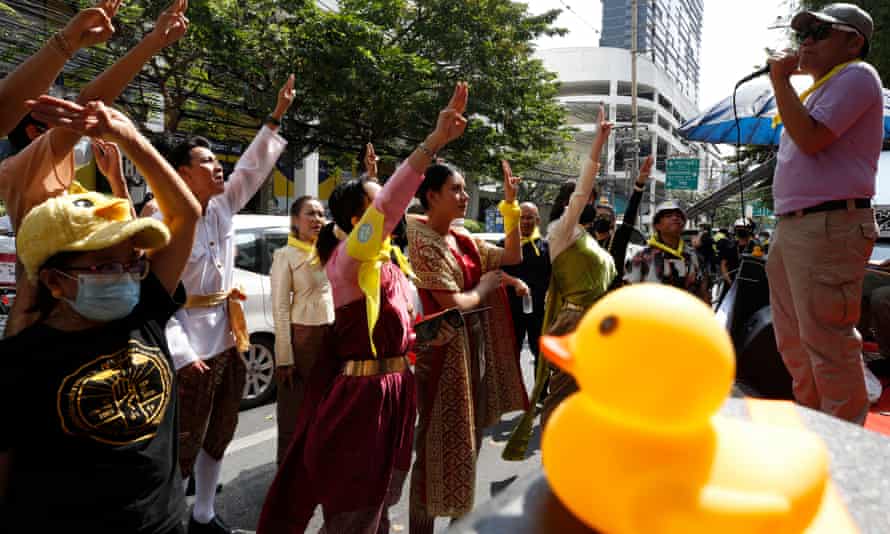
Anti-government protesters flash a three-finger salute – a gesture used adopted by protesters from the Hunger Games films – as they gather in support of people detained under the lese-majesty law at a police station in Bangkok. Photograph: Narong Sangnak/EPA
Prominent protest leaders face an unusually high number of charges. This includes the student activists Parit Chiwarak, also known as Penguin, (12 charges) and Panusaya Sithijirawattanakul (six charges) and the human rights lawyer Anon Nampa (eight charges), who have given speeches calling for the power of the royals to be curbed.
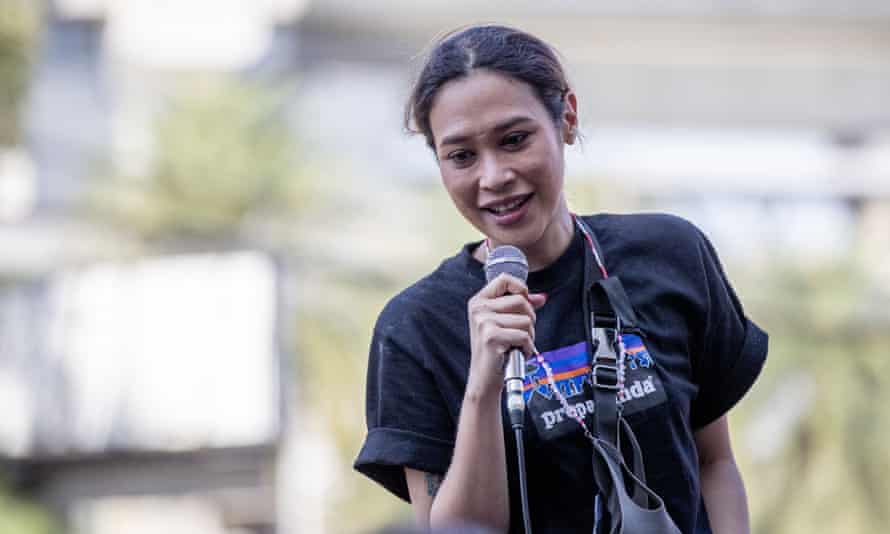
The pro-democracy protest fundraiser Inthira Charoenpura speaks from a stage outside Bang Khen police station in Bangkok. Photograph: Gemunu Amarasinghe/AP
Protesters – who have faced various other charges over recent months, including sedition – declined to participate in a government reconciliation panel in November, rejecting it as an attempt to buy time. The recent cases come after months of demonstrations in which protesters have made unusually frank and public calls for reform to the monarchy.
Benja Apan, 21, one of 13 people facing charges over a demonstration outside the German embassy in Bangkok, said legal action was unlikely to deter protesters from coming out in the new year. “I actually think it will bring more people out, because it is not fair,” she said.
The human rights group Amnesty International has launched a campaign calling on PM Prayut Chan-o-cha to drop charges pressed on a number of activists for their role in the pro-democracy movement and to repeal, or at least amend, Thailand’s draconian lèse majesté law. According to the campaign, at least 220 people, including minors, face criminal charges for relating to their actions in the pro-democracy movement. Activists are calling on government and monarchy reform, raising issues considered taboo and unprecedented in Thai society. Thailand must amend or repeal the repressive laws it is using to suppress peaceful assembly and the expression of critical and dissenting opinions.
Amnesty International is calling on people to take action and send a letter to the prime minister, calling on the Thai government to change their approach when handing the ongoing protests to protect human rights. Sample letter by AI’s campaign calls on Prayut to:
Immediately and unconditionally drop all criminal proceedings against protesters and others charged solely for exercising their rights to freedom of peaceful assembly and expression
Cease all other measures, including harassment, aimed at dissuading public participation in peaceful gatherings or silencing voices critical of the government and social issues
Amend or repeal legislation in order to ensure it conforms with Thailand’s international human rights obligations on freedom of peaceful assembly and expression, and to train state officials to carry out their duties confirming to Thailand’s obligation to respect, protect and fulfil the peaceful exercise of the rights to freedom of peaceful assembly and expression.
On Saturday 19 December 2020 Maya Taylor in The Thaiger had already reported that the United Nations High Commission for Human Rights has expressed shock and dismay at Thailand’s use of its strict lèse majesté law against a 16 year old pro-democracy activist. The UN High Commissioner for Human Rights’ spokesperson Ravina Shamdasani has called on Thailand to refrain from using the law against those exercising their right to freedom of speech, as she expressed alarm that a minor was being charged under the law. “It is extremely disappointing that after a period of 2 years without any cases, we are suddenly witnessing a large number of cases, and – shockingly – now also against a minor. We also remain concerned that other serious criminal charges are being filed against protesters engaged in peaceful protests in recent months, including charges of sedition and offences under the Computer Crime Act. Again, such charges have been filed against a minor, among others.”
“The UN Human Rights Committee has found that detention of individuals solely for exercising the right to freedom of expression or other human rights constitutes arbitrary arrest or detention. We also urge the government to amend the lèse majesté law and bring it into line with Article 19 of the ICCPR on the right to freedom of expression.”
Thailand’s Foreign Ministry spokesman has played down the UN High Commissioner for Human Rights’ criticisms over the kingdom’s enforcement of the Lese Majeste law.
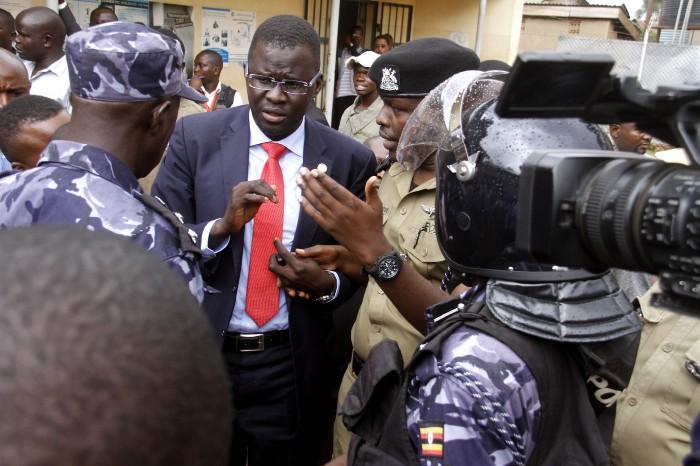
Nicholas Opiyo is confronted outside a magistrate court in 2018 after attempting to prosecute Uganda’s chief of police. (Photo courtesy of Nicholas Opiyo)
In a message on its Facebook page, the Uganda Police Force stated that Opiyo was arrested by a “Joint Task team of Security and Financial Intelligence, on allegations of money laundering and related malicious acts. The investigations are progressing well and any new developments will be communicated in due course,” the message continued. “He remains in our custody at the Special Investigations Division.”
Opiyo, a strong ally of the LGBTI community in Uganda, is the executive director and lead attorney of Chapter Four Uganda, a human rights advocacy organization. As an attorney, he represented presidential candidate Robert Kyagulanyi (Bobi Wine) after Wine’s arrest before a campaign rally on Nov. 18. That arrest sparked widespread violence. Opiyo said Wine was arrested on a coronavirus violation, but “the actual reason really is that it is part of the broader attempt to stifle opposition campaigns.” He noted that Ugandan President Yoweri Museveni was also holding political rallies during the same period, but without police interference.
National Unity Platform Presidential candidate Robert Kyagulanyi Bobi Wine claimed Opiyo was arrested because he was looking into the aftermath of the November 18th protests in which over 50 people were killed. The protests were sparked by the arrest of the candidate. Bobi Wine said Opiyo was “abducted by security from restaurant in Kamwokya [a section of Kampala, the capital of Uganda], alongside other lawyers investigating murders of 18th & 19th, Nov. Thrown into private van with tinted glasses and driven at breakneck speed to unknown destination.”
The Uganda Police Force message about Opiyo was harshly criticized in hundreds of comments on Facebook, including remarks.
He was until March of 2017, a member of the Team of Expert to the United Nations Special Rapporteur on the Rights to Peaceful Assembly and Association. He is also a visiting scholar at the Centre for African Studies, Stanford University, CA, USA and the Global Health Program at the University of San Francisco (UCSF), California, USA.
Nicholas is the Board Chair of Action Aid Uganda, a member of the Human Rights Advisory Board BENETECH, a Silicon Valley human rights and tech company based in Palo Alto in California and African Middle Eastern Leadership Project (AMEL), a Washington, DC-based think and action group.
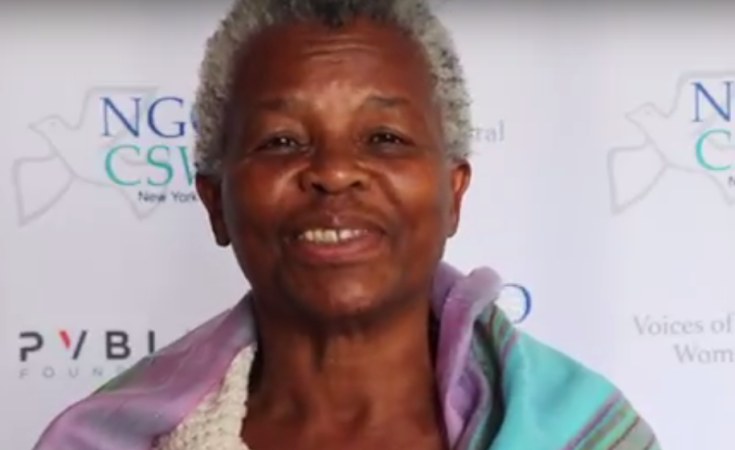
NGO CSW/NY/YouTube Sizani Ngubane, founder of the Rural Women’s Movement land rights group in South Africa. 23 December 2020 allAfrica.com
South African women’s land rights activist Sizani Ngubane (also known as uGogo) has died, according to the Rural Women’s Movement (RWM) – an organisation of which she was the director and founder. This sad news was brought by AllAfrica.com on 23 December.
Their work so far includes finding housing for evicted women and children, helping grow food on communal land for the hungry and sick, and campaigning for better legal protection of women’s land rights. Ngubane said the movement, which was launched in 1998, has now grown to 50,000 women.
The RWM statement, released via their Twitter account, read:
” We are saddened to share that our Founder and Director, uGogo Sizani Ngubane has passed on. She transformed countless lives. A lifelong freedom fighter, first against the brutal apartheid regime, uGogo, alongside other rural women, would later charge forward towards the promises of democracy.
“Tirelessly working for women’s land rights and equality, uGogo also laboured against gender-based violence and other challenges facing rural women. Originating in a non-partisan, women-led peace building movement, we have become a leader-full movement inspiring countless across KZN, South Africa, and the globe. “She was really beyond a special person. Fearless. Creative. Kind. Determined like no other. An unwavering belief in others and an endless reservoir of empathy and ubuntu.
“She will be missed deeply by all. Hamba kahle, Gogo.”
This tribute was followed by one from Nomboniso Gasa, in which she wrote: ” Mam’ Sizani Ngubane has died. She was a gentle giant. My heart’s breaking. Last time I spoke to her, she was fatigued from a govt hell-bent on destructive Bills, TCB & TKLB. Can’t imagine Rural Women’s movement – which she found in 1990 – without her energy, courage and vision.”
The Ennals Award ceremony was to be streamed live from Geneva on February 19, 2020, and the Martin Ennals Foundation said about Ngubane after it decided to recognise her work with a nomination: ” In South Africa, women face discrimination, the worst expression of which is widespread gender violence. In rural communities, they frequently have their land expropriated and are deprived of access to education and justice. Sizani Ngubane founded an organisation of more than 50,000 women from rural areas in her country and has fought successfully for over 40 years for the recognition of their rights.”
On hearing of her death, the MEA tweeted: ” A lifetime #HumanRights giant is gone. #SouthAfrica#WomenRights champion and #MartinEnnals finalist #SizaniNgubane has passed away. Generous, determined, loving, resilient, she was the very essence of a #HRD . She will be dearly missed.
Today – 19 December 2020 – marks one year since the Government of the Maldives arbitrarily shut down the longest serving human rights group in the country, the Maldivian Democracy Network (MDN) and arbitrarily confiscated all of its funds. Since then, the Government has not reversed any of its unconstitutional actions related to the dissolution of MDN.
We remind the Government of the Maldives that Article 30(b) of the country’s Constitution guarantees the right to establish societies and non-governmental organisations (NGOs). Article 43 affords everyone the right to fair administrative action that adheres to basic fairness and procedural propriety. MDN has been deprived of these rights through arbitrary action taken without due process.
An administrative decision was taken based on allegations of a criminal offence, depriving the organisation and the human rights defenders involved of their right to appeal in the criminal and civil processes initiated by the Government of the Maldives. The right to appeal is guaranteed by Article 56 of the Constitution. Furthermore, the organisation has not been given the right of reply or to defend itself against what is widely seen as a biased decision based on the interpretation of an academic research.
We are disappointed that the Parliament of the Maldives has refused to investigate the matter and hold the government accountable. We urge the Parliament not to use its mandate selectively, and call on it to conduct its affairs equally, uphold the Constitution and the rule of law.
The Government of the Maldives, by taking arbitrary and unconstitutional actions to silence civil society, has set a dangerous precedent that has resulted in a violent witch-hunt of human rights defenders and civil society organisations. We call on President Ibrahim Mohamed Solih to conduct a fair and open enquiry into these deplorable actions and stop the harassment of the human rights community in the Maldives, as several United Nations Member States recommended during the third Universal Periodic Review of the Maldives in November 2020[1].
Signed by:
The Asian Forum on Human Rights and Development (FORUM-ASIA)
CIVICUS
The International Federation for Human Rights (FIDH),
The Commonwealth Human Rights Initiative (CHRI)
The Maldivian Democracy Network (MDN) is a non-partisan civil society organisation based in the Canton of Geneva, Switzerland, operating under the Swiss civil code. MDN, registered in the Maldives from 2006 until December 2019, was one of the longest-running human rights groups in the country until the Government of Maldives forcefully shut down the organisation.
TRT World published a summary of a report by the South Asia Collective “India and Pakistan no different on how they treat minorities”. Please note that Turkish Radio and Television Corporation is the national public broadcaster of Turkey. One looks there in vain for information on human rights violations in Turkey itself. Still the report referred to (produced with the financial support of the European Union and the Norwegian Agency for Development Cooperation) is of interest:
The past ten years have been abysmal for minorities and civil rights activists in South Asian countries including India, Pakistan and Sri Lanka, according to the South Asia State of Minorities Report 2020.
Governments have introduced repressive laws that curb freedom of expression, persecute journalists and bar people from organising peaceful demonstrations, says the report published by the South Asia Collective, an international group of activists and NGOs. Some laws disproportionately target minorities such as Muslims in India and Sri Lanka, and Christians in Pakistan. One policy that transcends almost all the regional governments is their attempt to restrict the role of NGOs – especially if they receive funding from abroad.
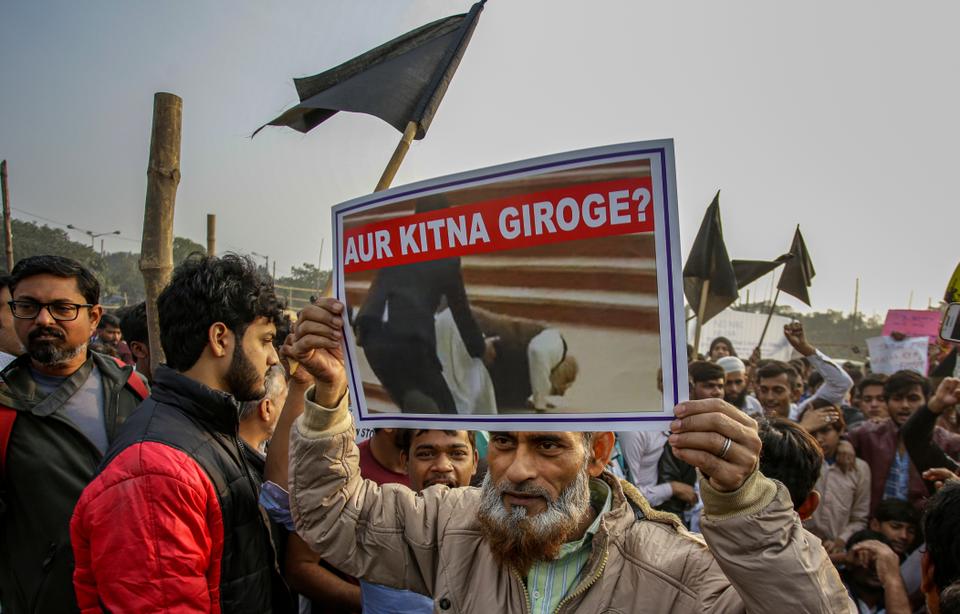
India, where minorities have faced state-sanctioned violence since the Hindu nationalist Bharatiya Janata Party (BJP) was re-elected last year, has handicapped foreign NGOs by setting limits on how they can spend money received from international donors. Most of the affected NGOs are the ones that work in areas which highlight abuse of power, government indifference towards the plight of minorities, and the brutality of security forces. [see also: https://humanrightsdefenders.blog/2020/07/06/istanbul-court-jails-four-human-rights-defenders-on-terror-charges-seven-acquitted/]
New Delhi’s discriminatory amendment to citizenship law has further alienated India’s Muslims. (AP Archive)
Other policy changes such as requiring NGOs to register with income tax authorities every five years are a similar tool of “administrative harassment”. ..
The intimidation is not limited to NGOs as journalists reporting on creeping BJP authoritarianism often feel the wrath of the state. “…between 25 March and 31 May 2020, at least 55 Indian journalists faced arrest, physical assaults, destruction of property, threats or registration of FIRs (police reports),” the report said.
New Delhi increasingly relies on internet controls to curb dissent. Internet shutdowns jumped to 106 in 2019 from only six in 2014 as authorities used different laws to control the flow of information. Kashmir faced a complete internet blackout for months after the Muslim-majority region’s nominal autonomy was withdrawn last year…
India is also using the draconian Unlawful Activities Prevention Act to target Dalits, a caste of Hindus who face widespread discrimination under the country’s hierarchical caste system… Changes in the Citizenship Act that target Muslim migrants and the brutal police reponse to subsequent protests — in which 22 people were shot dead in Utter Pradesh state in a single day — further illustrate the worsening status of minorities in India.
In neighbouring Pakistan, India’s archrival, minorities and those activists trying to help them, fare no better.
“NGOs and INGOs (international NGOs) are subject to extensive regulation involving multiple, lengthy procedures of registration, security clearance, and approvals for funding,” the report said.
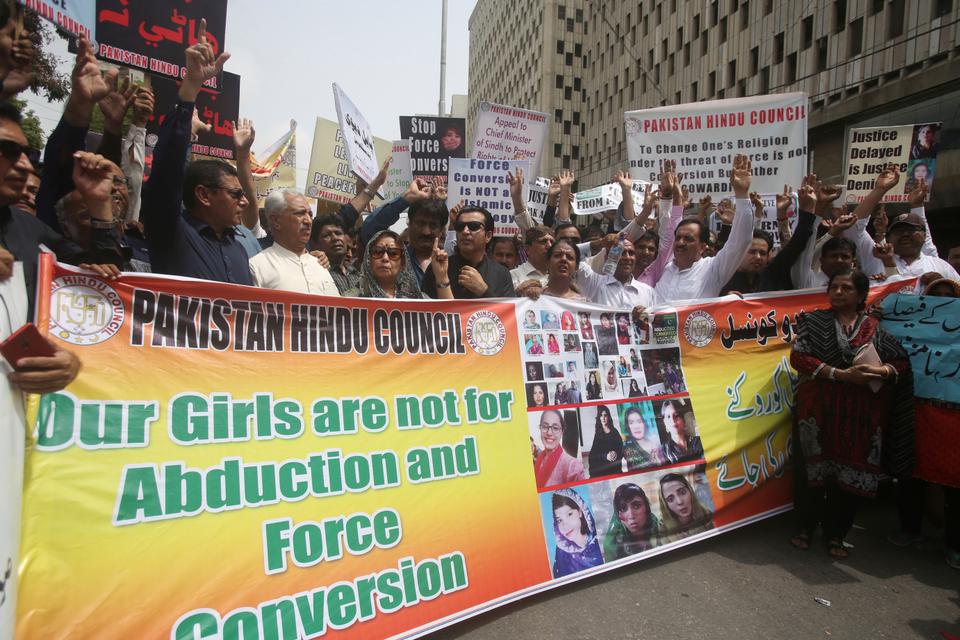
The Christians and Hindus in Pakistan regularly complain that young girls are forced to convert to Islam. (AP Archive)
In recent years, Islamabad has increased vigilance on NGOs which it fears might be working on a foreign agenda to promote dissent. What will particularly bother Pakistan’s policymakers is the report’s focus on how the country’s Blasphemy Law, meant to protect religious sentiments, continues to be misused against minorities.
“In reality, the law explicitly discriminates against Ahmadiyas since parts of it criminalise public expression of Ahmadiya beliefs and prohibit Ahmadiyas from calling themselves Muslims, praying in Muslim sites of worship and propagating their faith.” Just this week, a report by the United States Commission on International Rights Freedom pointed out that Pakistan accounts for nearly half of the incidents of mob violence against alleged blasphemers.
At times, people accused of blasphemy are killed in court in front of police and lawyers. Christians, another minority, are frequently targeted while authorities do little to protect them. For instance, a church constructed in the Toba Tek Singh district of Punjab province had to be sealed in 2016 after local Muslims agitated against it. This alienation doesn’t stop at the places of worship – young Chrsitan students are continuously harassed by their peers to convert to Islam, the report said.
Similarly, Sri Lanka witnessed rising levels of intolerance towards minorities in recent years, especially as successive governments tried to pacify extremist Buddhists to garner their votes. Muslims in Sri Lanka have felt a wave of discrimination and official apathy after the suicide attacks that killed more than 200 people last year. “After the Easter attacks, Muslims, particularly a large number of Muslim men, were arrested seemingly without reasonable cause.” Jingoistic government-aligned media has helped paint Muslims as the villain in Sri Lanka.
“The incitement of hatred and vitriol by media outlets continues unabated. For example, Muslim Covid-19 patients were identified by their faith, unlike other patients, and blamed by the media for spreading coronavirus.”
The number of detained journalists is still at a historically high level. Worldwide, a total of 387 journalists were held in connection with the provision of news and information at the start of December 2020, compared with 389 at the start of December 2019. This lack of variation follows a 12% rise in 2019. Overall, the number of detained (professional and non-professional) journalists has risen 17% in the past five years (from 328 in 2015).
3 journalists remain missing including Ibraimo Mbaruco, a reporter for Rádio Comunitária de Palma, a community radio station in Palma, a remote coastal town in northeastern Mozambique’s Cabo Delgado province, who has has been missing since 7 April 2020. In his last message, he said he was “surrounded by military.” His family has not seen or heard from him since then and nothing has been said by the Mozambican authorities, who try to prevent any media coverage of the attacks by Islamist insurgents that are common in that part of the province.

 Hans Thoolen on Human Rights Defenders and their awards