7 January 2024 Cyprus Mail reported that a demonstration will be held condemning the attack on the offices of refugee NGO Kisa.
Kisa’s offices were attacked on Friday, when an improvised explosive device went off outside their offices, smashing windows, destroying computers and photocopiers.
In their statement, the protest organisers said: “Kisa and its members have repeatedly received threats of various forms, against which the state authorities have shown unacceptable tolerance, which, together with government policies and their racist and xenophobic rhetoric on immigration issues, have not only allowed but also encouraged racist and fascist attacks against migrants and refugees, as well as their rights defenders, thus fostering fascism in society.”
Issuing a statement after the attack, the international NGO Amnesty International’s Cyprus Research Kondylia Gogou said: “Last night’s violent attack on anti-racist organisation Kisa is despicable and raises serious concerns over the safety of human rights defenders in the country. However, it did not happen in a vacuum. Racist violence is on the rise in Cyprus, and KISA and its volunteers have been the target of repeated threats, verbal attacks, and smear campaigns in connection with their work supporting refugees and migrants and denouncing hate crimes.”
According to Amnesty, authorities in Cyprus must send an unequivocal message that attacks on human rights defenders and NGOs will not be tolerated, and conduct a prompt, thorough, independent, and impartial investigation on the attack on the Kisa’s offices “that prioritises the hypothesis that the attack was related to their human rights and anti-racist work”.
In August and September 2023, racialised people including refugees and migrants were subjected to pogrom-like attacks in Chloraka and Limassol. Previously, in early 2023, racist attacks were carried out in Limassol and in January 2022 attacks were carried out in Chloraka. In 2023, the European Commission against Racism and Intolerance (ECRI) found that the public discourse in the country had become “increasingly xenophobic”.
In December 2020, further to an amendment to the law on associations, KISA was removed from the Registry of Associations, and proceedings for its dissolution were initiated. KISA’s appeal to challenge the decision before the country’s Appeal Court remains pending, and despite its registration as a non-profit company, KISA operates with many obstacles.
In the podcast, Amnesty International’s Tatyana Movshevich discovers the story behind the declaration and meets brave activists from Chile, the USA, Nepal, Ireland and Ghana, all of whom have been fighting for the rights of marginalized people — and risking their lives in the process.
“Every day, human rights defenders are risking their lives, sometimes at a significant personal cost. They experience violence and discrimination simply for defending the rights of others,” said Tatyana Movshevich, Amnesty International’s Campaigner.
“For this podcast I have interviewed five incredible human rights defenders and it was inspiring to hear about their work, but also distressing to realise the enormous dangers they are facing. During our interview, Anas Aremeyaw Anas, a journalist from Ghana, told me a chilling story of how his investigation into killings linked to ritual magic in Malawi had gone terribly wrong. And it was not the only time when Anas found himself in mortal danger because of his human rights work. Far from it.”
Every day, human rights defenders are risking their lives, sometimes at a significant personal cost.Tatyana Movshevich, Amnesty International’s Campaigner
Others featured in the podcast include Lorena Donaire, a water defender from Chile whose life was turned upside down as she was tackling the catastrophic results of a mega-drought; Monica Simpson, a queer activist and artist from the USA and Durga Sob, a Dalit woman and Nepalese feminist activist, who have both been confronting long-ignored issues of racism and caste-based discrimination; and Sean Binder, a migrant rights defender from Ireland whose freedom was compromised while he was volunteering on an idyllic Greek island. [see lso: https://humanrightsdefenders.blog/2021/11/17/greeces-mistaken-deterrence-migrants-and-aid-workers-facing-heavy-prison-sentences/]
International experts that took part in the series include Mary Lawlor, the UN Special Rapporteur on the situation of Human Rights Defenders, and Hina Jilani, women rights activist and co-founder of Pakistan’s first all-women law firm.
After 4.5 years, Isabel de Sola is getting ready to leave her position as Director of the Martin Ennals Foundation by the end of January. The Project Coordinator is envisioned to take over a sub-set of her responsibilities while collaborating with other members of the staff and Jury organizations.
The Award is approaching its 30th anniversary in 2024 – a moment which calls for a celebration of past achievements, as well as for some reflection on the future. The objective of the MEA 30th Anniversary project is to rally the Award’s friends and partners in Geneva to reinforce the message that protecting and bolstering HRDs is fundamental to the realization of UDHR and the HRDs Declaration.
The Martin Ennals Foundation is hiring a Project Coordinator to deliver on the 30th Anniversary project in 2024 and renew the Award for 2025. The Project Coordinator will be at the center of the Award’s activities, providing an essential link between the Board, Jury members, donors, consultants, and partners to the celebration in 2024-2025. An estimated 60% FTE is envisioned for this role, with peak periods at the nominations and Ceremony stages.
The Project Coordinator’s main responsibilities include:
Primary responsibility for the nominations process and coordination of the Jury for the selection of the 2024 Laureate. Maintenance of the Martin Ennals Award nominations database and oversight of the Jury voting process. Preparing and follow-up to Jury meetings – two or three during the year, as necessary.
Primary responsibility for the development and execution of the annual Award Ceremony. Liaises with the Ville de Geneve on a concept for the 2024 Ceremony, a new graphic identity, and the agenda of the event. Oversees organizational aspects of the Ceremony in consultation with the Ville de Geneve and event consultants.
Collaborates with consultants in the development and execution of an Award communication strategy aimed at raising the visibility of the Laureates and celebrating the MEA’s 30 years’ history.
Facilitates conduct of financial and administrative aspects of the Award project, including fundraising and advocacy-related activities together with the heads of departments and the Program Officer.
Supports fundraising for 2024-2025 and donor management, in collaboration with the relevant departments.
Supports the Program Officer in executing an advocacy strategy for MEA Laureates within Geneva-based advocacy and human rights policy development.
Contributes to monitoring and evaluating the 30th anniversary project, and annual narrative reporting for donors.
The Foundation is looking for a versatile and experienced project-manager who is passionate about human rights and rigorous in their planning and management style. The ideal candidate would bring inter alia, the following qualities and skills:
A master’s degree or +8 years of work experience in international relations, sustainable development, human rights, security policy, or related fields.
Familiarity with the international relations, human rights advocacy, and development cooperation ecosystem of Geneva.
Bilingual or professional fluency in both English and French.
A track-record in management of complex projects with many moving pieces. Ability to oversee several service providers and consultants simultaneously. Ability to budget and keep-track of financial aspects of the project.
Event planning experience.
Exposure to fundraising, monitoring and evaluation, or general reporting on projects.
The Project Coordinator will be offered a two-year contract with possibility of renewal.
To apply, please send your CV, a motivation letter, and a 300-word response to the following question to the MEF Board at barbara-lochbihler@gmx.de by February 2nd, 2024 cob:
“For the 30th anniversary celebration of the Award, the Martin Ennals Foundation and the City of Geneva will conduct a call-for-tender to identify a provider who can deliver a new graphic design for the Ceremony. How would you go about this task? Describe the steps you would take, a check-list of important items to consider, or your overall approach.”
Only short-listed candidates will be contacted for an interview in the month of February.
Following the decision of a judge in Guatemala City to authorize the immediate release of Virginia Laparra, former prosecutor of the Special Prosecutor’s Office against Impunity (FECI) on Tuesday, 3 January, Ana Piquer, Americas director at Amnesty International, said:
“Virginia Laparra should never have spent a day in jail. It’s great news that she can be reunited with her loved ones after nearly two years as a prisoner of conscience. Her release is a first step towards ending the terrible human rights violations she has faced in retaliation for her outstanding work as an anti-corruption prosecutor.”
“We lament, however, that Virginia Laparra remains convicted of a crime she did not commit and faces another unfounded trial, due to the regrettable use of criminalization against dozens of people who, like her, have led the fight against impunity. Amnesty International reiterates its call for the Guatemalan authorities to put an immediate end to the misuse of the criminal justice system to harass, intimidate and punish judges, prosecutors, human rights defenders and journalists”.
On 28 November 2022, Amnesty International named the former prosecutor as a prisoner of conscience, having found that her detention was solely due to her human rights work as head of FECI in Quetzaltenango, and requested her immediate and unconditional release. In May 2023, the United Nations Working Group on Arbitrary Detention declared that the detention of the former anti-corruption prosecutor was arbitrary and requested her immediate release. At the same time, the international mobilization of thousands of human rights activists on the case has not ceased.
“Amnesty International underscores the importance of international pressure in cases such as those of Virginia Laparra. Our movement in the Americas and around the world has not rested in demanding the release of the former prosecutor,” said Ana Piquer.
The unfounded criminal prosecution against Virginia Laparra took place in a context of attacks against dozens of people for their role in the investigation of high-profile cases of large-scale corruption and human rights violations. In 2022, there were 3,754 attacks against human rights defenders and at least 73 judicial workers, journalists and activists had to go into exile, according to data from Guatemala’s Human Rights Defenders Protection Unit (UDEFEGUA).
On 4 January 2024 ISHR published a massive, complete compilation of all recommendations issued by UN human rights bodies – including the UN Special Rapporteurs and Working Groups, the UN Treaty Bodies, and the Office of the High Commissioner for Human Rights – on the human rights situation in China since 2018. Recommendations are sorted by topic and community affected.
This repository compiles all recommendations issued by UN human rights bodies to the Government of the People’s Republic of China since 2018, the year of its third Universal Periodic Review (UPR).
This includes recommendations in: Concluding Observations issued by UN Treaty Bodies following reviews of China in 2022 (Committee on the Rights of Persons with Disabilities (CRPD)) and 2023 (Committee on Economic, Social and Cultural Rights (CESCR), Committee on the Elimination of Discrimination Against Women (CEDAW)), as well as in Decision 1 (108) on the Xinjiang Uyghur Autonomous Region (XUAR) by the Committee on the Elimination of Racial Discrimination (CERD) under its Early Warning and Urgent Action Procedure; communications and press releases by UN Special Procedures (Special Rapporteurs and Working Groups), including Opinions by the Working Group on Arbitrary Detention; press releases by the Office of the High Commissioner for Human Rights (OHCHR) as well as the OHCHR’s assessment of human rights in the XUAR.
These UN bodies are composed of independent, impartial experts, from all geographic regions.
The recommendations are categorised by key topic or community affected. Yet, this repository does not cover all topics, nor does it include all recommendations issued by the above-mentioned UN bodies.
This repository maintains the original language of the recommendation issued by a given UN body, with minor formatting changes. For the appropriate links please go to the original document.
This repository does not include recommendations to the Governments of Hong Kong and of Macao. Please click here for the repository of recommendations on Hong Kong, and here for the repository of recommendations on Macao.
The topics include very useful ones such as:
Chinese human rights defenders, lawyers and civil society organisations in mainland China
Uyghur region
Tibet
National security legal framework, judicial independence and due process
Surveillance, censorship and free expression
Reprisals, meaningful cooperation with the UN, and unrestricted access to the country for UN experts
Transnational repression
LGBTI rights
Business and human rights, including business activities overseas
Himself a survivor of the harsh journey across the Mediterranean Sea, Moses Von Kallon SOS Méditerranée’s Aquarius vessel in 2018 – a journey during which his rescue ship was turned away from Italian and Maltese waters. He told ISHR about how he started his organisation after Aquarius Supervivientes after settling in Spain and how he has wrestled with everyday racism. ‘Immigration is not a disease,’ he said, as he shared his hopes for a future where justice and free movement would be guaranteed to those who are forced to leave their homelands to find safety. Learn more about Moses and other human rights activists and defenders like him: https://ishr.ch/defender-stories/
An initiative of ProtectDefenders.eu, the EU Human Rights Defenders Mechanism implemented by international civil society
Human rights defenders have the right to carry out their legitimate work safely and to access support and protection when they are at risk, especially those who operate in the most difficult contexts. Their right to defend rights has been systematically enshrined by the European Union in its political guidelines, and statements, as well as in its financial programming and external actions. In fact, the European Union is a leading actor in the promotion and protection of human rights in the world and it is regarded by the human rights defenders’ community as an invaluable source of empowerment and legitimacy. [see the call of 2022:https://humanrightsdefenders.blog/2022/09/24/call-for-an-eu-visa-framework-for-at-risk-human-rights-defenders/]
Human rights defenders often carry out their work at great personal risk, and increasingly face killings, attacks, threats, and acts of intimidation because of their peaceful activities, in addition to being subjected to repression, restrictive legislation, and judicial harassment. For these at-risk human rights defenders, the possibility of accessing a visa to a European territory emerges as an essential security and protection tool, which empowers them to carry out their activities in their countries in a more secure and protected way. Visas and multiple-entry visas are widely regarded by the international human rights defenders community as a vital element of a comprehensive security strategy, one that enables defenders to consider the possibility to move in and out of their country in a way that allows them to manage the level of risk that they face as a result of their work, and to continue to work in their communities without forcing them to resort to permanent asylum paths when facing aggravated threats. However, despite political commitments and existing guidelines, the EU and its member states’ stated support for human rights defenders is not consistent with the current EU visa policies and practices, as human rights defenders at risk around the world lack consistent procedures to effectively and predictably access visas for the EU territory.
The community in support of human rights defenders, including the Consortium of organisations implementing the European Union Human Rights Defenders mechanism ProtectDefenders.eu,have systematically noted and documented with great concern the numerous, diverse, and blatant obstacles for defenders to access EU visas. ProtectDefenders.eu – which has supported 45,000+ human rights defenders and civil society organisations to continue their work in the most difficult situations since 2015 – encounters these obstacles also in relation to its daily operations delivering EU-funded programmes of practical support for human rights defenders. Every day, human rights defenders face an array of impediments that hinder their access to this essential security and protection tool, preventing them from accessing safe haven when necessary, as well as from engaging in existing opportunities for rest and respite and temporary relocation programmes, or carrying out essential international advocacy, mobilisation, or networking activities in the EU territory.
This lack of reliable, predictable, and coherent access for human rights defenders to EU visas unnecessarily aggravates the risk, isolation, and vulnerability they face as a result of their work – which is exacerbated for those defenders belonging to particularly threatened groups – such as women human rights defenders, LGBTI rights defenders, or indigenous rights defenders; for those facing spurious criminalisation processes aimed at impeding their mobility, or for those without secure access to basic travel documents. Major crises affecting human rights defenders and massive backlash against civil society notoriously reveal the gap in the effective implementation of the EU political commitments and guidelines related to visas, as recently illustrated by the demand for support from those human rights defenders and civil society members in Afghanistan in need of urgent evacuation. A more predictable, coordinated, and consistent policy on visas for human rights defenders – allowing for flexible and reactive protocols in critical situations, would reportedly have avoided, or at least mitigated the deficiencies of the EU response, or lack thereof.
With the exception of the positive examples of current good practices and initiatives implemented by some Member States, European institutions, or political actors in the EU, the EU as a whole has yet to make a serious effort to mainstream access to at-risk human rights defenders in their visa policies. The current legislative instruments and established practices fail to comply with the consistency required for the Union’s actions enshrined in the EU Treaties and attest to a lack of harmonisation, effort-sharing, and coordination among both the Member States and the European institutions.
ProtectDefenders.eu and the international civil society organisations participating in this initiative are convinced that with political will and clear guidelines, the EU can and should return to its political mandate in favour of human rights and human rights defenders, and lead on the implementation of concrete initiatives, good practises, and policy changes to ensure that at-risk human rights defenders can access European Union visas with guarantees, security, and predictability.
ProtectDefenders.eu and the international civil society organisations participating in this initiative are calling on all European Union actors to urgently implement all appropriate measures at all levels to develop and promote an enabling framework for human rights defenders to access visas for the EU, one that guarantees predictability, consistency, and protection for those who are most at-risk HRDs.
More specifically, ProtectDefenders.eu and the international civil society organisations participating in this initiative call on the EU stakeholders to:
propose a specific facilitated procedure for human rights defenders within the EU Visa Code, setting common criteria and defining the elements of a facilitated procedure;
include instructions in the EU Visa Handbook on granting facilitations to HRDs and their family members;
work towards amending the legal instruments on visas, particularly the Visa Code,
create an EU Directive to protect Human Rights Defenders (HRDs), outlining ways to support and protect them in accessing and staying in the EU, as well as meeting their support needs to continue their work. The Directive would provide a legal tool to grant HRDs at risk access and stay in the EU for a specified time.; and
introduce amendments to the Temporary Protection Directive that allow temporary protection status in the EU to be granted to defenders at risk.
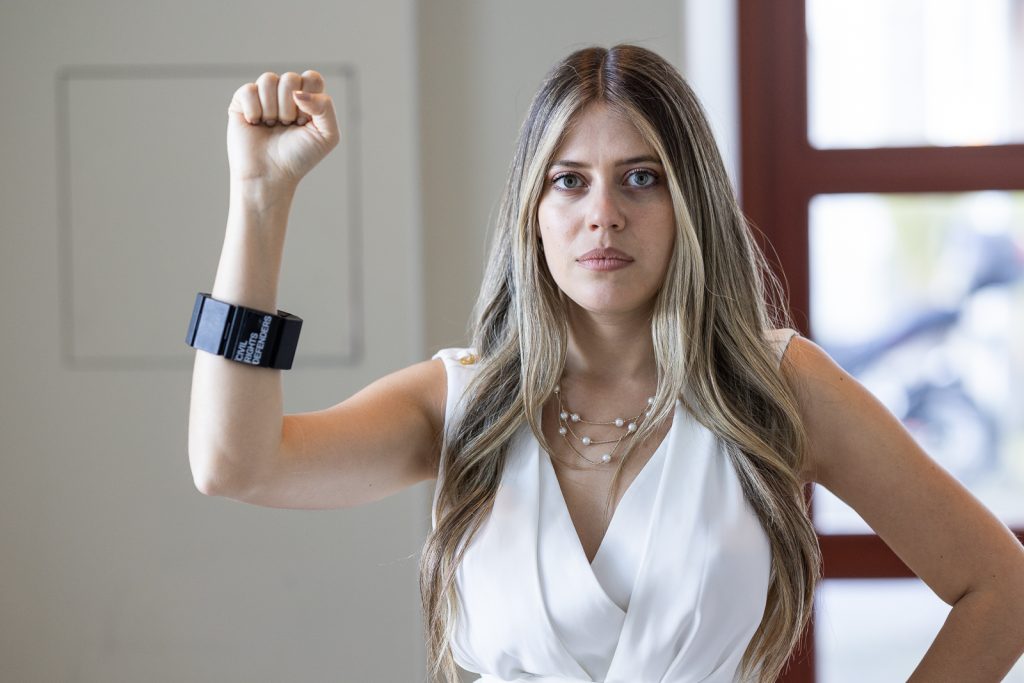
10 years ago, Civil Rights Defenders launched the Natalia Project, the world’s first assault alarm and community-based security system for human rights defenders. In the event of an attack, participants in the project can send out a distress signal so they can be located quickly and get help.
Natalia Project participant Génesis Dávila is the director and founder of Defiende Venezuela, a human rights organisation fighting for accountability and justice for victims of political persecution, people in arbitrary detention, and others who have been subjected to government-sanctioned attacks in Venezuela. In Venezuela being a human rights defender puts Génesis at risk of the very same political persecution she is trying to document.
“I face different threats on a daily basis. In general, they come from the Venezuelan regime. They harass human rights defenders because we try to protect people who are in danger and victims of human rights violations. This is something that puts us at great risk.” “It is really exhausting because then you don’t have space for other things. It’s the feeling of being chased all the time. It puts you under stress. You feel that you are never safe, wherever you are.”
In the case of an attack, the alarm is activated, and a distress signal goes off. Civil Rights Defenders and a network of human rights defenders can start investigating the situation within minutes.
“For me, my Natalia has been a game changer. It helped me feel safe. Just having this tiny device with me, knowing that there was someone on the other side of the world just waiting for my call, being ready to act if something happens gave me such a confidence. That changed everything.”
The Natalia Project device is built to be durable and easy to use and take wherever is needed.
“Everywhere I go, I bring my Natalia. If I’m about to fly somewhere, I check my passport, cellphone and my Natalia. It makes me feel safe. It’s my lucky charm.”
“Anyone who wants to support human rights can do it. You don’t have to be a lawyer, or someone waving a flag. You just need to advocate for human rights, and that will be enough.”
While the war rages in Gaza, the media focus is understandably on the conduct of the war and the many victims. Still, it is good to focus on the role of HRDs and that is what Front Line Defenders has done on 15 December 2023.
Front Line Defenders has been receiving reports from human rights defenders in Gaza, the West Bank and Israel on an ongoing basis in recent months, updating on the dire circumstances they have been facing since 7 October 2023.
Since its adoption, the U.N. established in 2000 a Special Rapporteur to report on the situation of HRDs, and more than 60 countries now have laws, policies, or protection mechanisms to protect HRDs.
Some countries, including the United States, sometimes sanction those who target HRDs with financial penalties and visa bans. Mechanisms like these are important, but they can be slow and used selectively, says Michael Breen of Human Rights First in Just Security of 9 December 2023.
Perpetrators often feel so protected from legal accountability that they openly threaten and attack HRDs. In 2022, more than 400 defenders were killed for their human rights work. This year the number killed is likely to be higher…In our work with HRDs, they often recommend public exposure of those who target them as one step that can be taken for their protection.
Breen states that It is on a reputational level that perpetrators can be most vulnerable and provides several examples.
“We are working with HRDs to create a more international approach of social accountability. We will share research on the social circles in which their attackers move, or that they want to join. We will be compiling lists of who has received awards from where, engaging with institutions about publicly rescinding awards, and otherwise publicly causing embarrassment to perpetrators.This is largely new territory for human rights NGOs, and we will work closely with HRDs in assessing any additional risks produced by socially targeting their attackers.“
———–
On 11 December 2023 Global Witness published a blog post: “Land and environmental defenders protect our planet – but they cannot halt climate change without access to justice“
“For more than a decade, we’ve been documenting and celebrating the hard-fought wins of land and environmental defenders worldwide. Together, their efforts not only help to prevent environmental destruction and human rights harms by companies, but also help to protect the environment from the worst effects of climate change.”
“Defenders globally continue to face reprisals after speaking out to protect the environment. At least 1,910 land and environmental defenders around the world have been killed since 2012, with 177 cases in 2022 alone. Of these killings last year, 88% occurred in Latin America – a region consistently found to be the most dangerous place in the world for activists.”
“Impunity is consistently named as a key driver behind attacks on defenders by the UN Special Rapporteur on the situation of human rights defenders, Mary Lawlor, whose office has repeatedly noted how failures to properly prosecute perpetrators have fueled further attacks. This is no coincidence. Every perpetrator who walks free sends a fatal message to defenders and activists worldwide.”
“The future of our planet depends on the continued stewardship of Indigenous people over their ancestral land, with Indigenous practices cited as protecting 80% of the world’s biodiversity. We simply cannot meet the 1.5°C limit and prevent devastating consequences on human life without the efforts of environmental defenders.”

 Hans Thoolen on Human Rights Defenders and their awards