Archive for the 'OMCT' Category

Russia: closing offices and attacking human rights defenders

March 17, 2016

An update on the situation human rights defenders in Russia is unfortunately needed too frequently. Recently the Martin Ennals Foundation condemned the attacks on its 2013 Laureate, the Joint Mobile Group (JMG) which is known for its courageous work in opening legal cases on behalf of victims of torture in Chechnya. On March 9th, they were travelling together with journalists and the group was physically attacked, their confidential notes stolen, and the vehicles they were in burned. Their offices in Ingushetia were also attacked. The international and local media have reported (see list at bottom of the post). This is part of an ongoing pattern of threats and intimidation directed against JMG.

Now, Human Rights Watch and others report that yesterday (16 March) Igor Kalyapin, head of the Committee for the Prevention of Torture, one of the founders and participants of the Joint Mobile Group, was attacked as he was leaving his hotel in Grozny. They also pelted him with eggs, and threw flour and bright antiseptic liquid on him, which stained his face and clothes.  “The attack on Igor Kalyapin shows again that it’s open season on human rights defenders in Chechnya,” said Hugh Williamson, of Human Rights Watch. “The authorities’ utter failure to hold anyone to account for a series of vicious attacks in recent years is like a bright green light for further attacks.

Read the rest of this entry »

Statement on Human Rights Defenders that the Observatory would have delivered orally to the UN (if time had allowed)

March 4, 2016

Severe time restraints made that several NGOs could not make their oral statement on 4 March 2016 during the Interactive Dialogue with the United Nations Special Rapporteur on the Situation of Human Rights Defenders in the UN Human Rights Council [see: https://thoolen.wordpress.com/2016/02/25/preview-of-the-upcoming-session-of-the-un-human-rights-council/].

Here follows the text of the statement that the World Organisation Against Torture (OMCT) and FIDH, within the framework of the Observatory for the Protection of Human Rights Defenders, would have delivered:

Read the rest of this entry »

Regional update for ASIA

February 29, 2016

A regional update on Asia is based on a submission to United Nations’ Human Rights Council by the Asian Legal Resource Centre (15 February) and a report of the Regional Consultation of Citizens’ Voices held in Kathmandu (25/26 February) held under the aegis of South Asians for Human Rights (SAHR).

The Asian Legal Resource Centre directs the attention of the Human Rights Council to the critical situation of human rights defenders in China, Bangladesh, and Thailand, who are facing dire threats to their person and profession: Read the rest of this entry »

Alarming criminalisation of human rights defenders in Latin America

February 27, 2016

The criminalization of human rights defenders in the context of the extraction of natural resources and megaprojects is becoming a very worrisome phenomenon in Latin America, denounces the Observatory in a report published today in Mexico. Entitled “The criminalization of human rights defenders in the context of industrial projects: a regional phenomenon in Latin America”, this document points to the role of businesses, civil servants, public prosecutors, judges, and the State. The report issued by OMCT and FIDH (in the context of their Observatory for Human Rights Defenders) on 25 February 2016 describes the specific cases of human rights defenders criminalized in eight Latin American countries (Brazil, Colombia, Ecuador, Guatemala, Honduras, Mexico, Nicaragua and Peru).


The report especially stresses two core issues common to all the countries studied: Read the rest of this entry »

Human Rights Defenders in India: democracy is not enough

February 23, 2016
India is often called the largest democracy on earth and it does merit praise for sticking to a fair degree of rule of law in spite of severe problems such as security and poverty. Still, regular and reliable reports on the fate of human rights defenders in India give us pause to think. What follows is a collection of just some recent cases, illustrating the well-argued piece by Srishti Agnihotri (a lawyer appearing in Trial Courts and the Delhi High Court, involved in research and advocacy on women and children) under the title “Who is defending the defenders in India: Human Rights” on 22 February 2016.

The article starts by mentioning the attack on Soni Sori (see more below on her). Reports suggest that oil paint mixed with chemicals was thrown on her face by unknown assailants. This attack, … and other reports of intimidation of persons such as lawyers and journalists working in the Jagdalpur area raises the question of the safety of human rights defenders and shows that there isn’t enough being done by the State machinery to defend the defenders….

Srishti Agnihotri then makes the interesting point that “it is not necessary to be correct to qualify as a human rights defender”. E.g. the criticism of Human Rights Defenders on a particular development project may not be legally correct. However, this does not and should not disentitle them to the protection of the State against violence and reprisals. The reason for this will become clear when we examine the role human rights defenders play in a society.

These Defenders face problems, in many parts of the world, and India is not an exception. Often the work being done by human rights defenders brings them in conflict with vested interests such as the land mafia, the mining lobby, or other corporations. A case in point is the story of Satyendra Dubey, an officer in the Indian Engineering Service, who lost his life due to exposing corruption in a highway construction project. At other times, the advocacy done by them requires them to be critical of the State action including in areas where there is considerable unrest….

This gives room for propaganda that human rights defenders or NGOs are ‘anti-development’ or even ‘anti-national’. It leads to them facing the wrath of more draconian security legislations, or attacks on them by vested interests. It is very easy to make the mistake of thinking ‘Why should we use state resources to protect those who are critical of the State? The obvious answer, is that the State may not always be correct. Given the great power state and corporate entities enjoy, their ability to make mistakes if unchecked is also correspondingly large. A hard reckoning of the work done by human rights defenders shows that they act as an essential check and balance on the State, and throw light on existing state-industry nexus, to protect the rights of people. The State derives its legitimacy from an implicit contract with its citizens, which necessitates a mechanism to check that the State adheres to this contract, and this is a function carried out by the human rights defenders. In this sense, human rights defenders are necessary for a healthy functioning democracy.

………

While there are general laws that can be (and are) used to protect these defenders, but those working for the enactment of a special law argue that the role of the law is also to play a certain ‘normative, expressive and educative’ function. By this, they mean that a special law to protect human rights defenders will also confer legitimacy on the work that they are doing, and create an enabling environment where they may do so peacefully.

Of course, the enactment of a special law is not adequate to ensure the protection of human rights defenders. It has to go hand in hand with better law and order, better legal services in areas where these defenders work, transparency in governance, toleration of dissent by the State machinery, and continued proactive action by the Focal Point for the protection of Human Rights Defenders, at the National Human Rights Commission.

This focal point is involved in providing assistance to such Rights defenders, and following alleged violations of their rights. Although there has been greater collaboration between the NHRC and Human Rights defenders, much needs to be done to ensure that defenders can work in a safe and enabling environment.

The Times of India of 10 February 2016 takes to task the State of Chhattisgarh – echoing Amnesty India  – that it should do more to protect a woman journalist, Malini Subramaniam, in Bastar. “This attack is another indicator of the increasingly hostile atmosphere in which journalists and human rights defenders operate in Chhattisgarh,” said Makepeace Sitlhou, Campaigner at Amnesty International India. Malini herself said: “This is not an attack on me as a person but as a journalist reporting incidents on the ground, something that they don’t want“. [The statement said, a group of over 20 people gathered outside the home of journalist Malini Subramaniam on February 7. They urged her neighbours to stone her house and chanted slogans suggesting that she was an agent for Maoist armed groups. Later that day, an anti-Maoist group released a public statement accusing her of presenting a distorted picture of Bastar and promoting Maoist ideology.]

On 21 February 2016 Saurav Datta in Catchnews poses the question “Why is Chhattisgarh govt scared of human rights defenders?“.  Isha Khandelwal, Shalini Gera and Nikita Agarwal, all in their late 20s, keep looking furtively behind their backs while packing her bags from Jagdalpur in western India’s Chhattisgarh district. They are afraid that a posse of policemen may descend upon them and subject them to custodial torture. They also fear that that they would be implicated under various provisions of the Chhattisgarh Special Security Act, a law roundly criticised by civil liberties activists as being dangerously oversweeping in its scope and ambit. The moot question here is – why should be a ragtag coalition of lawyers, operating on a shoestring budget, be subjected to state repression? The piece then goes into the background of the Indian system of legal aid and how the state administration undercuts all this in practice.

Frontline NEWlogo-2 full version - croppedhas covered a lot cases in India including in the State of Chhattisgarh such as those of Malini Subramaniam and the members of the Jagdalpur Legal Aid Group mentioned above (https://www.frontlinedefenders.org/node/29909 and https://www.frontlinedefenders.org/node/306160).


Front Line – on 22 February 2016 – also reported the attack on human rights defender Soni Sori who was assaulted on 20 February by three unidentified men as she travelled from Jagdalpur to her home. The perpetrators halted the vehicle and threw a black substance on her face, resulting in intense burning and her hospitalization. She is a human rights defender who advocates for the rights of indigenous peoples in India, with a focus on women’s rights. She works in Chhattisgarh, where the long-term conflict between Maoists and government security forces has greatly affected the indigenous people in the area.  During the attack, the perpetrators threatened to carry out a similar assault on the daughter of Soni Sori, lest the human rights defender halt the efforts she had undertaken to bring justice against a high-ranking police official from the Bastar district of Chhattisgarh. Soni Sori had recently been attempting to file a complaint against the police official in relation to their involvement in an alleged extra-judicial killing in the Mardum area of Bashar. In July 2015, the police official in question allegedly called for the “social exclusion” of the human rights defender and members of her family. [Soni Sori has previously been targeted by the authorities on several occasions https://www.frontlinedefenders.org/taxonomy/term/18892 and https://www.frontlinedefenders.org/node/29351]

On 8 January 2016, the Observatory for the Protection of Human Rights Defenders (a joint programme of the World Organisation Against Torture (OMCT) and the International Federation for Human Rights (FIDH), called on the Indian government to release on bail and stop the ongoing judicial harassment of Mr. Ajimuddin Sarkar.  Mr. Sarkar is a renowned human rights defender who has investigated cases of human rights violations perpetrated by the police and Border Security Forces (BSF), and who has been instrumental in denouncing several other human rights violations in Murshidabad district. He was arbitrarily arrested on 22 September 22 and only on 8 December, 2015 released on bail, since the de facto complainant filed an affidavit stating that she did not bring any allegation of rape against Mr. Sarkar and she had no knowledge of the related criminal case against him.  Mr. Sarkar is currently receiving medical treatment, both physical and psychological, as his mental and physical health conditions deteriorated significantly during the past months in detention.[The Observatory recalls that it is not the first time Mr. Sarkar has been intimidated, judicially harassed and ill-treated by the police – see background information].

See also my earlier: https://thoolen.wordpress.com/2016/01/17/india-human-rights-defenders-being-silenced-by-the-court/

Sources:

http://www.newsgram.com/who-is-defending-the-defenders-in-india-human-rights/ (first published at Kafila.org.)

Why is Chhattisgarh govt scared of human rights defenders?

http://timesofindia.indiatimes.com/city/raipur/Chhattisgarh-must-act-against-intimidation-of-woman-journalist-in-Bastar-Amnesty-says/articleshow/50934124.cms

http://www.omct.org/human-rights-defenders/urgent-interventions/india/2016/01/d23556/

Egypt: doctors protest police brutality but no human rights defenders can come and tell about it

February 15, 2016

While human rights organizations and the media around the world were remembering Egypt‘s Tahrir Square [https://thoolen.wordpress.com/2016/01/28/five-years-after-tahrir-square-there-is-stability-in-egypt-but-do-not-ask-at-what-price/] the space for demonstrations in Egypt itself was minimal. But a huge exception was made on 13 February 2016 when some 10.000 people gathered at noon in front of the Doctors Syndicate in Cairo. Heartening to see that the doctors have the courage to take up the case against police brutality. But you are unlikely to hear about this from an Egyptian human rights defender in person as they are systematically banned from traveling. Read the rest of this entry »

The plight of human rights defenders in China: just two weeks into the new year

January 13, 2016

Perhaps one should be ‘grateful’ that China on 3 January 2016 decided to detain the Swedish human rights campaigner Peter Dahlin (first foreigner to be detained for ‘endangering state security’) as this helped international media the take note of the extraordinary crackdown by Chinese president Xi Jinping who is now widely considered to be China’s most authoritarian leader in decades. Here a short overview of the most notable cases in the first two weeks of 2016:

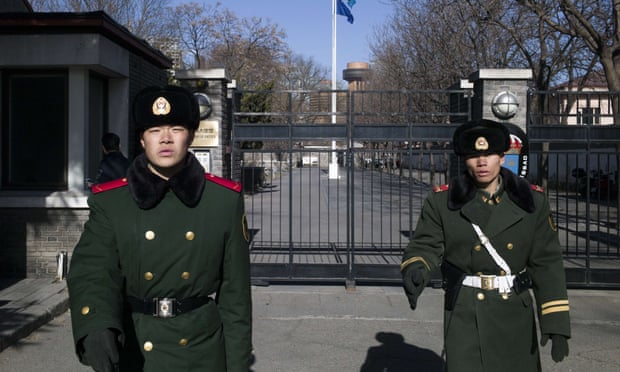
Paramilitary guards stand in front of the gates of Sweden’s embassy in Beijing on Wednesday
 Paramilitary guards stand in front of the gates of Sweden’s embassy in Beijing on Wednesday. Photograph: Fred Dufour/AFP/Getty Images

Read the rest of this entry »

Profile of Paul Mambrasar: defender of indigenous Papuans

December 28, 2015

OMCT, in its series “10 December – 10 Defenders”, carried the story of Paul Mambrasar from West Papua, the least populous province of Indonesia, where is torture used to crush and silence. Home to the world’s largest gold and third-largest copper mines, West Papua has abundant natural resources including timber and palm oil that make it a coveted region. This has generated continuing conflict and made it one of Asia’s sorest spots in terms of human rights violations. From the 1960s on, Indonesia has maintained heavy military presence, resorting to extrajudicial killings, torture and abuse to crack down on activists in an attempt to crush the Papuan independence movement, whether peaceful or violent, leaving locals deeply resentful and suspicious of the national Government.OMCT-LOGO

Indigenous Papuans marginalized in their homeland, suffer state violence and stigma, while their natural resources are exploited by others and compromise their ancestral way of living. The on-going conflict with separatists merely exacerbates discrimination against Papuans, who have been repressed by decades of institutional racism and Indonesian occupation. This is the vicious cycle of violence that Paul has to deal with in his daily fight for the respect of the human rights. “Torture worsens the distrust West Papuans have in the State which, by failing to uphold the rule of law, merely fuels more separatist sentiments,” sums up Paul, Secretary of the Institute of Human Rights Studies and Advocacy (Elsham), a non-governmental organization defending human rights in Wet Papua.

Paul’s challenging working environment is the result of decades of quasi-institutionalized abuses resulting in many layers of deep-felt and pervasive grievances of West Papuans against the Indonesian Government. He is, however, gradually managing to build networks in his country, also thanks to support from organizations such as OMCT, and gradually drawing attention to the regular violations committed.

Discrimination and marginalization of Papuan have therefore worsened the situation. Government policies have also contributed to the problem. The arrival of migrants, fostered by transmigration programmes, has upset the demographics and social and cultural heritage of the people of West Papua and exacerbated competition over land and resources. Compounded with the socially and environmentally destructive development projects pushed in the region by Indonesia, this has caused widespread social disruption and environmental damage, forcing Papuan tribal groups to relocate, according to researchers from Yale Law School cited by Elsham in a 2003 Sub-Commission on the Promotion and Protection of Human Rights session.

Unreported exactions keep occurring as foreign eyes and independent international observers are barred from West Papua. It is therefore only thanks to the work of local organizations and human rights defenders such as Paul, who runs Elsham’s office in West Papua and attends international advocacy meetings at the Human Rights Council in Geneva communicating regularly with donors, that the world can know what is happening there.

“Impunity has allowed the security force, the police and the army, free access to inflict fear and terror through torture and other physical abuses,” Paul explains his motivation. “In order for torture to end the Indonesia State must take a strong action to punish those involved in its practice.”

Despite these odds and the many challenges of his job including being under Indonesian intelligence surveillance as an “independence sympathizer”, Paul, 51, trusts that the human rights conditions in West Papua will improve.

[When the Dutch Government granted independence to Indonesia in 1949, Papua was not part of it. At the end of the Dutch colonial rule, Papua was first administered, and then absorbed, by Indonesia in 1969, following a sham “referendum” requested by the United Nations. This so‑called “Act of Free Choice” was in fact a vote by just over a thousand selected Papuans (out of a population of 800,000 at the time) who had been pressured to agree to integration within Indonesia. This vote has been the bone of contention between Papuans and the Republic of Indonesian. Papuans have ever since agitated for independence, and have been conducting a still ongoing, low-level guerrilla warfare against Indonesian forces, in turn engaged in bloody repression and unpunished human rights violations. Papuans – who are Melanesian and whose ancestors arrived in the New Guinea region tens of thousands of years ago – do not identify culturally with the Asians. They see their Papuan identity and indigenous culture based on customary subsistence-based agriculture threatened by the arrival of migrants who, in turn, see the traditional Papuan way of life as backward.]

In this context see also the CNN report on the closure of NGO offices: http://freewestpapua.org/2015/12/13/indonesian-government-forces-all-ngos-to-leave-west-papua/

— by Lori Brumat in Geneva

Source: Indonesia: Meet Paul: Restoring the human rights of indigenous Papuans amid on-going conflict / December 10, 2015 / Links / Human rights defenders / OMCT

Nigina Bakhrieva works to end torture in Tajikistan

December 27, 2015

OMCT in its series “10 December, 10 Defenders” focused on Nigina Bakhrieva in Tajikistan. Nigina Bakhrieva’s visceral sense of justice was passed on to by her parents, as she quickly demonstrated by following in the footsteps of her father – a prosecutor – in standing firmly for the rule of law. “It’s what I learned as I child, “ she says. “When I witness human rights abuses, I cannot be indifferent; I take action.OMCT-LOGO

And her career could not have been more ominous. Nigina started law school in Tajikistan, at the doorstep of Taliban-led Afghanistan, at the very outbreak of the bloody civil war that followed the country’s independence, graduating five years later, in 1997, as the war ended, leaving behind a devastated country with some 100,000 people killed and 1.2 million displaced. After teaching law at the Tajik state university, Nigina became a consultant providing capacity-building expertise for various organizations. Moving quickly into human rights, she went to work for the United Nations Tajikistan Office for Peace Building where she reviewed national legislation to make sure it conformed to international human rights standards.

Thus, while still as a budding lawyer and founder of the Bureau on Human Rights and Rule of Law of Tajikistan, Nigina helped to litigate with success Tajikistan’s first-ever human rights case before the United Nations Human Rights Committee – something unheard of in Tajikistan until then. Her work for the abolition of the death penalty in her country led to a moratorium being adopted in 2004.

In 2009, she created Nota Bene, which leads the Anti-Torture Coalition of 17 leading human rights organizations and activists in Tajikistan. The work initially seemed to pay off handsomely: at the beginning of 2014, Tajikistan had pledged to implement international human rights standards both in law and practice. The Government, however, has recently been limiting the scope of action in the country of human rights lawyers and organizations. It has indeed been made mandatory for non-governmental organizations to declare all foreign funding. What is more, limiting access to the legal profession and placing it under the Ministry of Justice has compromised its independence.

It is worrying that it has become nearly impossible to find lawyers in Tajikistan willing to accept to defend torture cases for fear of criminal prosecution,” reported the OMCT in the Observatory for the Protection of Human Rights Defenders on 30 November. http://www.omct.org/human-rights-defenders/urgent-interventions/tajikistan/2015/11/d23494/

As one of the few lawyers who have not given up on combatting the widespread use of torture and other forms of abuse, especially in the armed forces, Nigina is among the key players pushing for full transition of Tajikistan to the rule of law. “The work is hard”, she says. “Each time we re-live with the victims what they went through, and it is horrifying,”

For change to occur, though, the system must work and all actors must do their bit, she explains, detailing every step of the process: individuals must lodge complaints when they are subjected to torture or ill-treatment; the Government must follow a zero-tolerance-for-torture policy; the Prosecutor must respond to every complaint by thorough and effective investigation; courts must punish all those found guilty – not only the direct perpetrators, but also their superiors, who failed to prevent the crime; jail terms should be proportionate to the seriousness of the crime; finally, the Government should compensate all victims of torture.

— by Lori Brumat in Geneva

https://thoolen.wordpress.com/2015/01/13/human-rights-lawyer-kudratov-in-tajikistan-sent-9-years-to-penal-colony/

Source: Tajikistan: Meet Nigina: Towards a functioning system that leaves no room for torture / December 3, 2015 / Links / Human rights defenders / OMCT

Justin Bahirwe: a lawyer trying to reduce torture in the DRC

December 24, 2015


OMCT-LOGOOMCT did the following interview in its series “10 December, 10 Defenders” with Justin Bahirwe , a lawyer from the DRC.

When listening to a soft-spoken, articulate, impeccably dressed 34-year-old Justin, you would think he is promoting human rights in a peaceful, predictable, functioning State. You cannot tell he lives in Bukavu, in the eastern Democratic Republic of the Congo (DRC), a desolate place where the world’s deadliest conflict since WW2 has not relented for over two decades, killing some 5.4 million people, where tens of thousands of children are recruited as soldiers – if they do not die of diarrhoea or malaria – political opponents are killed, corruption is rampant and deeply-rooted, the infrastructure nonexistent and extreme poverty pervasive. Read the rest of this entry »