Archive for the 'MEA' Category

Ganji: Human rights in Iran improved, but still short of expectations

March 26, 2014


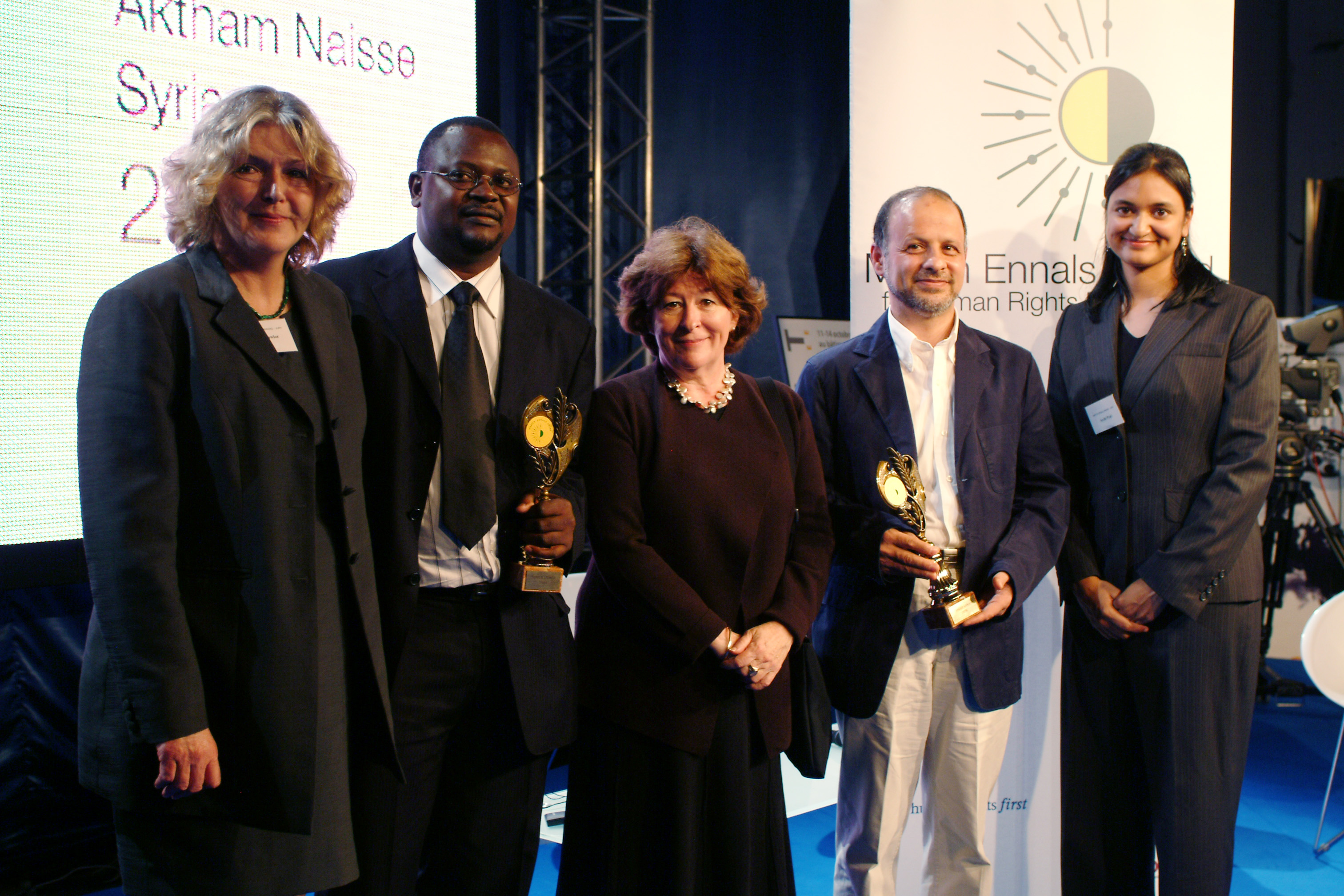
Remise du Prix Martin Ennals 2006

(Ganji – second from the right – at the MEA ceremony of 2006, where he received the award from UN High Commissioner Louise Arbour)

Al-Monitor of 25 March carries a lengthy interview with MEA Laureate Akbar Ganji in which Jahandad Memarian records many interesting insights, especially on the issue of sanctions and support to human rights defenders. The whole interview is certainly worth reading; here follow some long excerpts:

It is not an exaggeration to say that Akbar Ganji is the most celebrated dissident within the ranks of Iranian journalists since the inception of the Islamic Republic of Iran in 1979. A former supporter of the revolution, Ganji became disenchanted and turned into one of its most vocal critics. He is best known for his work as a journalist covering the 1998 murders of Iranian dissidents in Reformist newspapers, a series which came to be known as “the chain murders” that implicated top governmental officials. For his work revealing the murders of dissidents and attending a conference in Berlin that was condemned by hard-liners who were reeling after a Reformist victory in parliament, Ganji was arrested and served time in Tehran’s Evin Prison from 2001 to 2006. During his final year in prison, he went on a hunger strike that doctors urged him to end for concerns he would suffer permanent brain damage.

Ganji has won several international awards, including the World Association of Newspapers’ Golden Pen of Freedom Award, the Canadian Journalists for Free Expression’s International Press Freedom Award, the Martin Ennals Award for Human Rights Defenders and the Cato Institute Milton Friedman Prize for Advancing Liberty. In an exclusive interview via email with Al-Monitor, Ganji, based in New York, shared his thoughts about human rights and democracy in the context of President Hassan Rouhani’s administration.

Al-Monitor:  The UN secretary-general, Ban Ki-moon, has sharply criticized the Iranian president, Hassan Rouhani, saying, “He has not made any significant improvement” in ending human rights abuses since taking office. Nevertheless, Mahmoud Sadri — Iranian professor of sociology at the Federation of North Texas Area Universities — is optimistic about the new administration and has asked Iranian dissidents and intellectuals to take advantage of this historic opportunity. How do you evaluate the Rouhani administration?

Ganji:  The situation has improved from various aspects compared with the [Mahmoud] Ahmadinejad administration. However, it falls short of the expectations of democracy advocates and human rights activists. The Rouhani administration truly seeks to improve the state of human rights, but it has faced obstacles in Iran’s power hierarchy, including organizations that [Supreme Leader] Ayatollah [Ali] Khamenei oversees, such as the judiciary, law enforcement, etc., in addition to the Majles [parliament] that is controlled by the conservatives and some radical reactionaries.

…….Since his administration came to power, Rouhani has spoken with the supreme leader about freeing the Green Movement’s leaders (former Prime Minister Mir-Hossein Mousavi and former Majles speaker Mehdi Karoubi) and political prisoners, guaranteeing that nothing would happen, if they were freed.

Al-Monitor:  In January, you wrote a Huffington Post article titled “The Iran Nuclear Accord Is Good for Human Rights.” It seems to me whenever international pressure on the Iranian government increased, Iran improved its record. For example, Tehran released political prisoners ahead of Hassan Rouhani’s UN speech, including prominent human rights lawyer Nasrin Sotoudeh. Don’t you think such actions stem from international pressure? In the absence of this leverage — i.e., international pressure — Iran would continue human rights violations.

Ganji:  With regard to “external pressure on an undemocratic regime and improvement of human rights or increased oppression,” there is no law/rule that would address the cause-reaction relationships. At most, one can speak of “correlation.”[…] we need to know the following:

First, economic sanctions represent the collective punishment of a country’s people and do not necessarily lead to dictatorships’ downfall.

Second, long-term sanctions destroy the internal infrastructure of societies. ..Consequently, trust that is the basis of social capital is destroyed. Because of the sanctions, the oppressive regime’s increasing level of oppression, the internal destruction of society, is not visible. It is only in the aftermath of the dictatorship’s downfall that we will witness the visible spread of a wave of hatred, revenge and violence.

Third, in a life and death situation, the state of human rights, democracy and freedom completely falls by the wayside.

Fourth, consider Iraq’s example again. Before, the invasion al-Qaeda forces did not exist in Iraq, but they were born and bred as a result of the US sanctions and the US attack on Iraq. This story has been repeated in Libya and Syria. …..Iranian, US and European officials have professed that economic sanctions against Iran have affected Iran’s economy negatively. Last year, the economic growth rate fell to -5.8%. The inflation rate rose to 40%. The corruption rate climbed, and other negative outcomes followed. We should ask ourselves, what is the impact of recession on ordinary people’s lives?

The middle class, as a vehicle of democracy, has been transformed to the impoverished class, and its democratic movement may lose its agents. Democracy is the product of the balance of power between the government and civil society.

The transformation of the nuclear agreement from temporary to permanent, improvement of Iran’s relationship with Western governments, rekindling of ties between Iran and the United States, lifting of all the economic sanctions and alleviation of foreign threats can help empower the people through their mobilization and expansion of civil society. In that sense, the regime’s focus and its supporters will not be on discovering conspiracies of foreign governments and military attacks to destroy the regime. Let’s not forget that democracy and human rights have a direct relationship with economic development.

Al-Monitor:  You have opposed US aid to Iranian dissidents and human rights activists. What are your key criticisms against such aid? What actions should foreign countries.. take or avoid ?

Ganji:  The opposition that I have spoken about consists of groups and people that advocate regime change in Iran, so they can come to power. It is not possible for the leaders of a country to be indebted to other foreign governments, including the United States, Israel, Saudi Arabia, Russia and China. In that case, they will become the greater powers’ pawns. Look at the groups that have received financial aid from foreign governments in the past 35 years. What have they done? Do their terrorist and espionage activities constitute human rights activism, or are such activities considered criminal in all countries, including the United States and Israel, and are they strongly punished?

However, I support educational financial aid, including student scholarships and research fellowships for scholars. Just think about what would have happened if the $1.5 trillion that was spent on the wars in Afghanistan and Iraq would have been used toward education and development of the Middle East, and how that would have changed the region. Why do Western governments, the United States included, not grant scholarships to tens of thousands of talented and smart Iranian youth as students in social sciences?

Western governments should protest all human rights violations; they should give ethical and spiritual support to pro-democracy and human rights activists; they should file complaints at the UN Human Rights Council and ease the process of bringing perpetrators to justice. Moreover, Western powers should stop selling weapons of torture and oppression to dictatorial regimes. Ultimately, they should allocate financial resources to form independent labor unions and improve the state of human rights.

Ganji: Human rights improved, still short of expectations in Iran – Al-Monitor: the Pulse of the Middle East.

Read more:

https://thoolen.wordpress.com/tag/iran/

http://www.al-monitor.com/pulse/originals/2014/03/rouhani-reform-nuclear-iran-politics-student-human-rights.html#ixzz2x3K4G8RK

Chechen President Kadyrov tries to intimidate Joint Mobile Group

March 6, 2014

Igor Kalyapin – as President of the Joint Mobile Group [JMG] – is recipient of the 2013 Martin Ennals Award for Human Rights Defenders [http://www.martinennalsaward.org which contains an excellent short film on his work] as well as the 2011 Front Line Defenders new MEA_logo with textFrontline NEWlogos-1 condensed version - croppedAward [http://www.frontlinedefenders.org/node/16876].   In spite of this, he is continually subjected to a defamation campaign, the most recent incident taking place on 25 February 2014, at a meeting of the Civil Chamber of the Chechen Republic, where the Head of the Republic of Chechnya, Ramzan Kadyrov, accused Igor Kalyapin of being a “traitor of the nation” and a man who defends “bandits and drug addicts” and “promotes his personal interests”.

On 25 February 2014, Ramzan Kadyrov further accused the human rights defender of using human rights work to make a career. Kadyrov stated that there are ‘real’ human rights defenders in Chechnya and that the Republic does not need ‘Kalyapins’. This statement was broadcast by the state TV channel Vainakh. Kadyrov went on to list cases which are being investigated by Igor Kalyapin and the JMG (such as Islam Umarpashaev and Ruslan Kutaev – more information on these cases on: http://www.frontlinedefenders.org/.)

Human Rights Defender Daniel Dorsainvil and wife killed in Haiti – suspicious to say the least

February 19, 2014

In a recent post I referred to the worsening climate for Human Rights Defenders in Haiti (https://thoolen.wordpress.com/2013/10/28/haiti-judicial-harassment-against-human-rights-lawyers-continues/ and now we learn of the killing of one of the leading HRDs, Daniel Dorsainvil (or Dorsinvil) and his wife in the streets of Porte-au-Prince:

haiti_murder (Photo Credit: Facebook/Girldy Lareche Dorsinvil and Facebook/Daniel Dorsinvil)


Nicole Phillips in RYOT News of 18 February reports that on Saturday 8 February 2014, Daniel Dorsainvil and his wife Girldy Lareche were shot and killed by an unidentified man who fled the scene on a motorcycle.  The double homicide left three children without their parents, Read the rest of this entry »

Chair of Ennals Foundation calls on Museveni to veto anti-homo bill

February 13, 2014

The Chair of the Martin Ennals Foundation, Mrs Micheline Calmy Rey, has today called for President Museveni to veto the anti-homosexual bill passed by the Ugandan Parliament on 20 December 2013. The Martin Ennals Foundation has also called on the Ugandan government to take effective steps to protect LGBT persons from violence and discrimination. Kasha Jacqueline Nabagesera was awarded the Martin Ennals Award in 2011 for her activities in support of Lesbian, Gay, Bi-sexual and Transgender rights in Uganda.

via Welcome to Martin Ennals Awards – MEA.

My blog on Human Rights Defenders in 2013: a review

January 3, 2014

A bit of transparency to start the New Year: My blog on Human Rights Defenders was viewed about 19,000 times in 2013.  In 2013, I created 644 new posts, bringing the total archive of this blog to 1,056 posts. The busiest day of the year was December 20th with 929 views [most popular post: Mariah Carey needs better-informed staff and donate her 1 million fee to Human Rights Defenders in Angola].

For those interested in more details: Click here to see the complete report.

2014 heralds the age of images in human rights work

December 28, 2013

To illustrate the increased use of video and images in the human rights world, just scroll down and get a feel of the amount and variety through some examples, mostly from the end of this year:

Human Rights Watch produced an end-of-year 2013 overview.

The Asian Human Rights Commission (AHRC) is announces the latest issue of its weekly video news bulletin (episode number 10).

Amnesty International used a slick production to get attention for the fate of Syrian refugees in Europe (not explaining why other regions are not targeted by the way).

The UN High Commissioner for Human Rights used this video to address the world on Human Rights Day 2013;

Inspirational resilience: Celebrating Human Rights Defenders in Eurasia | Freedom House.

On Human Rights Day, US-based Freedom House recognized the work of HRDs in the Eurasia region with a slide show on: Kazakhstan, Russia, Belarus, Kyrgyzstan.

The International Service for Human Rights in Geneva presents its work with a video.

Human Rights First used YouTube to announce its fundraising live stream for the end of the year.

There are of course many more examples, quite a few referred to in this blog over the years, such as those of the MEA: http://www.martinennalsaward.org/ but  a special mention should be made of

the organisation Witness in the USA which has pioneered the use of video cameras in the hands of human rights defenders.

When the internet some 25 years ago made it possible to send and ‘publish’ almost unlimited amounts texts, the original euphoria in the human rights movement (whose main weapon is after all documentation) was quickly dampened somewhat when it also led to information overkill. Something similar is bound to happen with images which can now be ‘published’ and transmitted as easily as documents (but without the free-text search capacity). On the other hand there will be new possibilities and different ways of getting the human rights ‘stories’ across, especially on mobile devices used increasingly by younger generations.
The True Heroes Foundation – of which I am a founding Board member – wants to follow and use this development in a way that Human Rights Defenders derive maximum benefit from the new information and communication technology. It hopes to do so by making stories and images of HRDs the most eminent entry point for those seeking information on human rights in the near future. Keep following this blog and the website www.trueheroesfilms.org in the coming year for ….I am afraid …yet MORE information!!
With these thoughts, I WISH YOU ALL THE BEST FOR 2014.
Related articles

Kasha about the Ugandan law against homosexuality

December 23, 2013

The Ugandan parliament has now passed the bill that many feared would come one day. Although it does not foresee the death penalty anymore it still puts life jail terms on ‘aggravated homosexuality’. Back on 3 February 2013, Kasha Jacqueline Nabagesera, a Ugandan LGBT activist, who was the 2011 Laureate of the Martin Ennals Award for Human Rights, spoke with the Martin Ennals award about the risks and problems.

Eyad El-Sarraj, Palestinian Laureate of MEA 1998, dies at 69

December 18, 2013

Today, 18 December 2013,  Scoop News brings the sad news that Palestinian Human Rights Defender Dr. Eyad El-Sarraj, Palestinian psychiatrist and Commissioner-General of the Palestinian Independent Commission for Citizens’ Rights, passed away in Gaza a few hours ago. Born in Beersheva, Palestine on 27 April 1944, Dr El-Sarraj arrived with his family in Gaza in 1948 as a refugee. He grew up to become the first psychiatrist to practice in Gaza, beginning in 1977. Dr El-Sarraj went on to found and direct the Gaza Community Mental Health Programme [GCMHP], which he established in 1990 to promote the mental well-being of three major target groups in the Palestinian community: children, women, and victims of organized violence and torture. “We strongly believe that there is a correlation between human rights and mental health, because sound mental health cannot be gained under violent circumstances, and human rights will not be respected in a society exposed to ongoing trauma,” states the organisation’s strategy document. His human rights work was not without cost – in 1996 he was arrested and tortured for condemning torture and violation of human rights by the Palestinian Authorities.  In 1998 he received the Martin Ennals Award for Human Rights Defenders [MEA], in 1997 the Physicians for Human Rights Award, and in 2010 the Swedish labour movement’s  Olof Palme Prize. In the same year, Dr El-Sarraj was jointly awarded the Juan José López-Ibor prize in psychiatry, along with Professor Jules Angst, in recognition of his contribution to advancement of the rights and dignity of people with a mental illness, and his scientific research. Other notable activities include being a consultant to the Palestinian delegation at the Camp David 2000 Summit, and his appearance as an expert witness before the United Nations-mandated Goldstone Commission on the war crimes committed during Israel’s 2008-9 military offensive “Operation Cast Lead.” His evidence on the long-term psycho-social impacts of the conflict on civil society in Gaza was quoted in the final report. The light that Iyad El-Sarraj shone into some of the darkest corners of Palestine can not be dimmed by his death. “You are the window through which I can breathe,” one of his patients once told him. His legacy of hope, and a legion of Palestinians both taught and inspired by him, will continue his important work.  During his acceptance speech at the MEA ceremony he said, “Receiving this award reminded me of one of the persons I left behind in prison. He said to me: ‘Don’t forget me… please… don’t forget me’.” The best we can do now, is the same for El Sarraj: Don’t forget him… please… don’t forget him!

For more information and a video on El Sarraj and his work see: http://www.martinennalsaward.org/index.php?option=com_content&view=article&id=83&Itemid=107&lang=en

via Palestinian Human Rights Defender Dies at 69 | Scoop News.

Mona Seif reports on crackdown in Egypt including her brother’s case

December 6, 2013

By Mona Seif, founder of ‘No to Military Trials for Civilians’ and Final Nominee 2013 of the MEA reports in some detail the following:

Egyptian Activists Arrested in Growing Crackdown – Activist Alaa Abd El Fattah one of at least 27 people currently charged under Egypt’s new anti-protest law

Mona Seif, Egypt - Final Nominee MEA 2013

Mona Seif, Egypt – Final Nominee MEA 2013

Egypt is facing a growing crackdown on political protest and dissent. This week has seen the arrest of 27 political activists under the cover of a new law designed to effectively ban protest in Egypt. On November 26th the well-known and internationally respected activist group, No to Military Trials for Civilians, called for a demonstration in front of the Shoura Council (the Upper House of the Egyptian parliament) to protest the failure of the current draft constitution to legislate against the military court martials of civilians. The entirely peaceful protest was met with serious force by the police, who attacked demonstrators with a water cannon and tear gas while arresting as many people as they could. At least 51 people were arrested that day. Read the rest of this entry »

Pillay criticizes new anti-demonstration law in Egypt and …Mona Seif is arrested

November 27, 2013

(High Commissioner for Human Rights Navi Pillay. UN Photo/Sarah Fretwell)


The UN High Commissioner for Human Rights, Navi Pillay, had hardly pronounced herself on the new ‘demonstrations law’ in Egypt, issued on Sunday, and a number of high-profile demonstrators was arrested. Yesterday Mona Seif, the MEA Nominee of 2013, and a group of other human rights defenders were arrested when they were protesting in-front of the Shura Council against the suggested constitutional article that guarantees the continues referral of civilians to military trials. Observers believe that the authorities want to send a message in the context of the new law referred to above. Read the rest of this entry »