 reports that yesterday, 7 May 2014, human rights defender Mr Rashid Rehman was shot and killed in an attack on his office in Kutchery Square, Multan, Pakistan. Two other people were injured in the shooting, which was carried out by two unknown men. Rashid Rehman was a human rights lawyer and a coordinator of the Punjab office of the Human Rights Commission of Pakistan (HRCP) in Multan. The human rights defender advocated against the misuse of blasphemy laws in Pakistan and, since February 2014, had been working on the case of Junaid Hafeez, a lecturer at Bahauddin Zakariya University who is accused of blasphemy. It is reported that no lawyer was willing to take the case for a year because of fear of reprisals from extremist religious groups. The human rights defender was shot several times and pronounced dead on arrival at Nishtar Hospital. Read the rest of this entry »
Archive for the 'Front Line' Category
Human rights defender Rashid Rehman killed in Pakistan
May 8, 2014Saudi Arabia: persecution of human rights defenders continues as usual
April 25, 2014
reported two more cases of persecution of human rights defenders in Saudi Arabia. On 17 April 2014, the Specialized Criminal Court in Riyadh sentenced human rights defender Mr Fadel Al-Manasef to 15 years’ imprisonment, issued a travel ban against him for 15 years and fined him €19,300. Fadel Al-Manasef is a writer and blogger, and a founding member of Al Adalah Center for Human Rights, a Saudi Arabian NGO that documents and monitors human rights violations and provides supports to victims. He has been in detention since his arrest on 2 October 2011.
[In the same hearing, the judge dismissed two more cases against the human rights defender dating from 2009 and 2013. During the trial, Fadel Al-Manasef declared to the court that he had been subjected to torture and other forms of ill treatment during interrogations, however the court failed to address the allegations.] For more information: <https://www.frontlinedefenders.org/node/16118> .
On 15 April 2014, human rights defender Mr Waleed Abu Al-Khair was arbitrarily detained, while at the premises of the Specialized Criminal Court in Riyadh. The human rights defender was attending the fifth session of an ongoing trial against him at that court. Neither Waleed Abu Al-Khair’s family nor his lawyer have been informed of the reasons for the arrest. Waleed Abu Al-Khair is a lawyer and head of the Monitor of Human Rights in Saudi Arabia. The application to register the organisation as a human rights NGO was rejected.
[29 October 2013, the human rights defender was sentenced to 3 months in prison by a Jeddah court on charges including “organising illegal gatherings” and “insulting the judiciary”. Waleed Abu Al-Khair had been waiting to be informed of when the sentence would be carried out. In addition, in Riyadh, the human rights defender faces charges including: “striving to overthrow the state and the authority of the King”; “criticizing and insulting the judiciary”; “assembling international organizations against the Kingdom”; “creating and supervising an unlicensed organization, and contributing to the establishment of another”; and, “preparing and storing information that will affect public security”. see: <https://www.frontlinedefenders.org/node/25289> ]
China sentences four more human rights defenders for demonstrating
April 24, 2014The same day it was announced that Cao Shunli had been selected as one of the Final Nominees for the MEA 2014, Front Line reports the sentencing of 4 other human rights defenders in China. On 18 April 2014, human rights defenders Messrs Ding Jiaxi and Zhao Changqing were sentenced to 3.5 years and 2.5 years’ imprisonment respectively, while Messrs Li Wei and Zhang Baocheng were both given prison sentences of 2 years. The four human rights defenders were convicted of “illegal assembly” over their role in small-scale demonstrations associated with the New Citizens Movement. Read the rest of this entry »
Lawyers for Lawyers raises the alarm: Filipino lawyers at risk
April 24, 2014
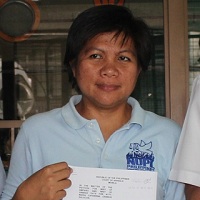
Cathy Salucon, Philippines via L4L
On 23 April 2014 Amsterdam-based Lawyers for Lawyers (L4L) and Lawyers’ Rights Watch Canada (LRWC) warn in an open letter to President Aquino of the Philippines for the continued labeling of lawyers as enemies of the state by the military. Since March, Atty. Maria Catherine L. Dannug-Salucon has been the subject of death threats, labeling, surveillance and verbal intimidation by military officers. Mrs Dannug-Salucon is reportedly on the Filipino military’s Watch List of so-called ‘Communist Terrorist’ supporters providing legal services. She has also been under the surveillance of the Intelligence Services of the Armed Forces. The surveillance is particularly worrisome in view of the killing – reportedly by members of the Intelligence Services – on 25 March 2014 of Mr. William Bugatti, a human rights defender who was also working as a paralegal for Atty. Dannug-Salucon.
Read the rest of this entry »
Intimidation against human rights defender Nasrullah Baloch in Pakistan
April 7, 2014describes a classical but fearsome case of intimidation of a human rights defender, Nasrullah Baloch, who is assisting the Supreme Court in Pakistan with cases of disappearances.
Nasrullah Baloch is the Chairperson of Voice of Baloch Missing Persons (VBMP) and has come to prominence for his work on cases of missing persons and extrajudicial killings. The human rights defender is also assisting the Supreme Court in the context of an investigation into mass graves in Balochistan. Nasrullah Baloch took part in the Supreme Court hearings concerning a number of disappeared persons on 25 March 2014. He also met with the head of the Norwegian Mission to discuss the cases. The hearings were attended by officers of the military and intelligence, who observed the exchange with the Norwegian diplomat Read the rest of this entry »
Death in detention of human rights lawyer Maen Al-Ghoneimi in Syria
April 2, 2014On 26 March 2014, the family of human rights defender Mr Maen Al-Ghoneimi was informed by the Damascus Military Police in Syria that he had died in detention two months earlier, on 14 January 2014. The police declared that he died of heart failure and delivered to the family the personal possessions of the human rights defender, but refused to disclose where he had been buried. Maen Al-Ghoneimi was a human rights lawyer and a member of the lawyers’ syndicate in Damascus. The human rights defender was an active participant in lawyers’ peaceful protests and sit-ins and provided legal aid to internally displaced people in Syria. Maen Al-Ghoneimi was arrested on 20 May 2013, and was then kept incommunicado until news of his death emerged. No charges had been brought against him. The family stated that he was in good health at the time of the arrest, and therefore believes that he may have been tortured or have become ill and denied medical treatment while in detention.
Front Line Defenders rightly demands a thorough, impartial and immediate investigation into the deaths of detained human rights defenders, including also Ayham Mostafa Ghazzoul https://www.frontlinedefenders.org/node/21602
Sadly, this fits too well with the special campaign I mentioned on 16 March https://thoolen.wordpress.com/2014/03/16/the-silenced-voices-of-syria-special-campaign-aimed-at-human-rights-defenders/
Example of harassment from Cameroon reads like a film scenario
April 1, 2014On 28 March 2014, human rights defender Mr Musa Usman Ndamba, a defender of the rights of the Mbororo community in Cameroon, appeared before the Bamenda Court of First Instance, and the trial was once again adjourned to the 23rd of May 2014. The trial of 28 March 2014 was the eighth such hearing in an ongoing trial against Musa Usman Ndamba led by a local wealthy landowner, Baba Ahmadou Danpullo, who has never attended any of the hearings. Meanwhile, two other defenders of the rights of the Mbororo, Messrs Abdulkarim Shehu and Mallam Yunusa are in detention whilst an arrest warrant has been issued for human rights defender Mr Fon Christopher Achobang. Musa Usman Ndamba is the Vice-President of Mbororo Social and Cultural Development Association (MBOSCUDA). Abdulkarim Shehu is a male nurse and social development worker, as well as founder and co-ordinator of the Angel of Hope Foundation, a health centre that caters for people with disabilities. Mallam Yunusa is an organiser of the Mbororo community of Banjah. Fon Christopher Achobang is a land rights campaigner and journalist sympathetic to the plight of the Mbororo.
Members of the community and their defenders have long been facing severe judicial and other harassment owing to disputes over their land. ……On 19 March 2014, authorities of the Catholic Church, led by a representative of the Archbishop of the Bamenda Archdiocese, directed a group of hired militias with a bulldozer to demolish the homes of the Mbororo in the Ndzah village. The community mobilised and stopped the demolition from taking place. However, during the stand-off both the representative of the Archbishop and Fon Christopher Achobang were injured. After the incident, at which he was not present, Abdulkarim Shehu reportedly took members of the police to the site to show them what had happened. Fon Christopher Achobang was forced to go into hiding after threats on his life following the incident. According to lawyers for the Mbororo Banjah community, the invasion took place in spite of a court case pending in the Bamenda Administrative Court with a Stay of Execution of the Order on the now disputed land, as a contested eviction notice had been issued the week before. Additionally, despite having been alerted to the impending invasion, government officials did nothing to stop it from going ahead, in complete violation of the law and the legal rights of the Mbororo community.
Front Line Defenders issued a previous urgent appeal regarding the ongoing judicial harassment against MBOSCUDA and Musa Usman Ndamba on 14 May 2013 http://www.frontlinedefenders.org/node/22662, while the UN Special Rapporteur on the situation of human rights defenders also sent a communication https://spdb.ohchr.org/hrdb/24th/public_-_AL_Cameroon_04.09.13_%284.2013%29.pdf to the Cameroonian government regarding the same.
Vacancy at Front Line (internship) for African Commission on Human Rights, Banjul
March 30, 2014The NGO Front Line Defenders has a vacancy for an internship at the African Commission on Human and People’s Rights (ACHPR) for 2014-2015, starting on 9 June. The purpose of the Internship is to support the work of the Special Rapporteur on Human Rights Defenders at the ACHPR. It is a 12 month position based in Banjul, the Gambia. Compensation is 950 $ per month. The deadline for applications is 18 April 2014. Applications can be sent by email to recruit[at]frontlinedefenders.org.
Cao Shunli’s story continues with struggle around independent autopsy
March 28, 2014
Vigil for Cao Shunli in March 2014 in Dublin – (c) Front Line
Didi Kirsten Tatlow reports in The New York Times of 28 March how the issue of Cao Shunli’s death in detention in China has not ended. A lawyer for Cao Shunli said her family wants an independent autopsy by pathologists from outside China, saying they do not trust local pathologists or the police to make an accurate report. “If we can we would like to invite an international expert or an international expert organization to come here to do an autopsy,” said the lawyer, Ms Wang Yu. “’The family has not requested an autopsy yet, though they want one, because they don’t trust anyone here to do a fair job,” [The Beijing Lawyers Association and the Beijing Municipal Justice Bureau seem to be putting pressure on the lawyer] Read the rest of this entry »
Human rights defender Mohammed Bedaiwi killed in Iraq
March 25, 2014reports that on 22 March 2014, human rights defender and director of Radio Free Iraq, Mr Mohammed Bedaiwi, was shot dead, allegedly by an officer of the Presidential Regiment, in Baghdad. Mohamed Bedaiwi was a professor at the University and, for the past two years, the director of the Baghdad office of Radio Free Iraq. The station broadcasts from Prague. Mohammed Bedaiwi was stopped at a checkpoint on his way to work. An argument began between an officer and the human rights defender, and other officers reportedly began to beat Mohammed Bedaiwi. The incident culminated in the killing of the human rights defender. Reports indicate that the officer has been arrested but his identity has not been disclosed, leading to fears that the case may end in impunity. Mohammed Bedaiwi was very well-known and local sources consider it unlikely that the officers did not recognise him. On 23 March 2014 over 40 media institutions, including newspapers, radio stations and satellite TV channels, refrained from publishing or broadcasting in protest at the killing of Mohammed Bedaiwi. There have also been vigils and marches around the Iraqi capital in honour of the human rights defender. The press syndicate has expressed its concern about the killing of a journalist by an armed officer of the Presidential Guard.
[Since 2003 approximately 274 media professionals have been killed in Iraq; in the last four months alone, 11 journalists have been killed]
 Hans Thoolen on Human Rights Defenders and their awards