Archive for the 'Civil Rights Defenders (NGO)' Category

March 8, 2024 was again International Women’s Day

March 8, 2024

Like every year, many organisations used the occasion to focus on the role of women human rights defenders. Here a selection of this year’s actions [for earlier posts see: https://humanrightsdefenders.blog/tag/international-womens-day/]:

Global Voices has released a special coverage called Empowering voices: Women in politics, which explores the state of women’s political participation around the world. 

Human Rights First referred to a new report reveals that WHRDs face increasing harassment and threats from a global movement against gender equality and LGBTQI+ rights. The Kvinna till Kvinna Foundation, a leading feminist women’s rights organization, released Hope and Resistance Go Together: The State of Women Human Rights Defenders 2023,  a report that found discouraging growth in harassment of WHRDs.  The foundation surveyed 458 women’s and queer rights activists and interviewed 25 activists representing WHRDs from 67 countries affected by violence or conflict.

They found that 75% reported facing harassment for their activism, a 15% increase from two years ago, and 25% of respondents have received death threats. Most harassment comes from government authorities, but increased harassment from far-right groups and anti-gender equality actors is also driving these startling statistics. Human Rights Defenders (HRDs) across the world face resistance and violence. In 2022, at least 401 HRDs were killed for their peaceful work. But some of the obstacles facing WHRDs are distinct. https://humanrightsfirst.org/library/recognizing-women-human-rights-defenders-on-international-womens-day/

Human Rights Watch on 7 March carried a piece by Macarena Sáez who says inter alia:

On this International Women’s Day, we march for the one in three women who experience physical or sexual violence in their lifetime. We cheer for countries like Argentina, Colombia, and Ireland that value our autonomy to choose to be pregnant and have legalized access to safe abortion, while protesting that abortion is still or again illegal in many places, including US states like Alabama and Texas. At the same time, we march to honor the women who marched before us, like the Mexican women who organized the first feminist congress in 1916 to push for family law reforms and their right to vote, and the Nigerians who waged their “Women’s War” against colonization and patriarchal laws in 1929. Their struggles sadly mirror the reality of many women around the world today – especially women who belong to historically marginalized groups – who continue to rally against violence and abuse.

Fearing the power of women’s solidarity and collective actions, governments have  stifled women’s speech through restrictions on movement, censorship, smear campaigns, and criminal prosecutions. In highly repressive contexts, like Afghanistan and Iran, women suffer arbitrary detention, and even enforced disappearance and torture, for their activism. Meanwhile, social media companies have not done enough to protect women from online violence, chilling women’s freedom of expression on and offline.    These barriers make it hard for women’s equality to become reality. Gender justice requires an enabling environment in which women can express themselves, speak and spread their political views, and participate in political and public life. Instead of repressing or tolerating the repression of women, governments should recognize our collective actions – and consequent power – and enshrine our rights in laws, policies, and practice. [https://www.hrw.org/news/2024/03/07/womens-voices-have-power-drive-change]

Amnesty International on 8 March highlighted three prominent women who reveal why sexual and reproductive rights are a major human rights issue : Charlotte Bunch, USA Leila Hessini, Algeria Marge Berer, UK [https://www.amnesty.org/en/latest/campaigns/2024/03/three-prominent-women-reveal-why-sexual-and-reproductive-rights-are-a-major-human-rights-issue/]

On 8 March 8, 2024 Almyra Luna Kamilla and Rosalind Ratana 
opined in IMHO on “Navigating the storms of repression: The resilience of young women rights defenders in Asia

[OPINION] Navigating the storms of repression: The resilience of young women rights defenders in Asia

In recent years, Asia has been witnessing rising authoritarianism and shrinking civic space. Among those in the frontlines of resistance are young women human rights defenders. As we celebrate International Women’s Day, let us demand for an enabling world where women human rights defenders can continue their noble pursuits without fear of reprisals.

In Thailand, the royal defamation law is being excessively used to silence criticisms against the monarchy. Meanwhile in Sri Lanka, economic and political mismanagement has sparked peaceful protests that are met with violence and intimidation. The fate of Asia’s political climate hangs by a thread as elections are held across many countries, including Bangladesh, Indonesia, India, South Korea, and Pakistan. Now more than ever, governments across the region are finding ways to solidify their power, putting an even tighter grip on civil society to the detriment of democracy and people’s fundamental rights and freedoms.

Despite such challenges, many are courageously speaking out and taking collective action to reclaim power for the people. This includes young women human rights defenders – or Youth WHRDs – who are claiming space to call out human rights violations and to demand accountability from oppressive governments. [https://www.rappler.com/voices/imho/young-women-rights-defenders-asia/]

The Alliance for Human Rights in Afghanistan (a coalition of 9 major NGOs) urgently appealed to the international community to significantly bolster its support and actively safeguard the human rights of Afghan women and girls, including Afghan women human rights defenders who face persecution for their peaceful campaigns for rights and basic freedoms.

In 2023, the Taliban further intensified its oppressive policies toward women, girls, the LGBTIQ+ community, and religious minorities. Afghan women and girls have seen their rights and prospects increasingly curtailed, from greater enforcement of restrictions on education – including a ban on girls attending secondary schools and universities – to intensifying exclusion of women from political and public life. Women have been banned from a growing list of forms of paid employment, and economic barriers, such as the ban on women registering organisations and undergoing vocational training, have contributed to a sharp decline in women’s participation in the labour market, impeding their right to make a living. This exacerbates financial insecurity, widens gender disparities, and further confines women to the private sphere. Lesbian, bisexual, and transgender women face severe threats, including torture, sexual violence, forced marriage, and death. Victims of gender violence, including those who identify as such, lack minimal legal and practical support. Obstacles to healthcare and education have exacerbated poverty and vulnerability among women and girls. In 2023, new discriminatory restrictions imposed by the Taliban included the closure of all beauty salons, blocking women from overseas travel for study, mandating female health workers in some areas to have a male chaperone while travelling or at work, and prohibiting women from entering a famous national park.

The oppressive environment extends to female activists, NGO leaders and journalists. Notable cases include the arrests of women’s rights activists Neda Parwani and Zholia Parsi, the enforced disappearance and subsequent discovery of Manizha Seddiqi in Taliban custody to date, the arrest of Matiullah Wesa, founder of an NGO advocating for girls’ education rights, and the arbitrary detainment of Ahmad Fahim Azimi and Seddiqullah Afghan—both dedicated girls’ education activists, among many others. Journalists reporting on the Taliban, facing arrests and threats, equally illustrate the difficulties encountered by the media, particularly women, when covering crimes against women or advocating for women’s rights. Collectively, these cases underscore the near-total denial of freedom of expression, gender equality, or any other internationally recognized right in Afghanistan under the Taliban.

Amid this growing oppression, segregation and fear, Afghan women human rights defenders have urged the international community to exert greater pressure on the Taliban. They call on international bodies to involve Afghan women in all negotiations with the Taliban and to facilitate direct meetings between women and the de facto authorities to address their concerns. Afghan women have also stressed the importance of advocacy for women’s rights by external actors based on the voices and realities of women inside Afghanistan. They call for coordinated efforts between organisations inside and outside the country to defend the rights of Afghan women and girls.

https://www.omct.org/en/resources/statements/afghanistan-lifting-afghan-women-from-the-shadows-into-the-light-in-the-face-of-the-taliban

The UN Special Rapporteur on the situation of human rights in Afghanistan, Richard Bennett, called on the Taliban to release women human rights defenders as the world marks International Women’s Day.

I reiterate my appeal to the Taliban to respect all the human rights of women and girls in Afghanistan, including to education, work, freedom of movement and expression, and their cultural rights, and I urge the meaningful and equal participation of Afghan women and girls in all aspects of public life. I call on the Taliban to immediately and unconditionally release all those who have been arbitrarily detained for defending human rights, especially the rights of women and girls.”

https://www.ohchr.org/en/statements/2024/03/afghanistan-un-expert-calls-taliban-release-women-human-rights-defenders

On 8 March, Civil Rights Defenders presented 4 woman human rights defenders and asked them to share their message to women around the world.


On International Women’s Day, the a group of NGOs (ALQST for Human Rights, Amnesty International, CIVICUS, European Saudi Organization for Human Rights (ESOHR), Front Line Defenders, Gulf Centre for Human Rights (GCHR), HuMENA for Human Rights and Civic Engagement, International Service for Human Rights (ISHR),MENA Rights Group, Salam for Democracy and Human Rights) renewed their call on Saudi Arabian authorities to release all women human rights defenders (WHRDs), women’s rights activists and their supporters who are detained in contravention of international human rights standards. The organisations further call on Saudi authorities to lift travel bans imposed on WHRDs and their relatives, and to abolish the male guardianship system. [https://ishr.ch/latest-updates/civil-society-reiterates-their-call-on-saudi-authorities-to-release-jailed-womens-rights-activists/]

The President of Georgia awarded severl with mesla of honor: co-founder of “Safari” organization Babutsa Pataraia, human rights defender Ana Arganashvili, founders of “National Network for Protection from Violence”: Eliso Amirejibi and Nato Shavlakadze and founder of “Vedzeb” organization Tamar Museridze.

https://www.interpressnews.ge/en/article/130159-in-connection-with-the-international-womens-day-the-president-awarded-five-female-human-rights-defenders-with-medals-of-honor

a few more addtions:

https://www.un.org/sg/en/content/sg/statement/2024-03-08/secretary-generals-remarks-the-observance-of-international-womens-day-delivered

https://www.eeas.europa.eu/delegations/indonesia/launch-women-human-rights-defenders-network-indonesia_en

https://www.unwomen.org/en/news-stories/speech/2024/03/speech-be-the-light-that-brings-hope-and-that-accelerates-progress-towards-an-equal-sustainable-and-peaceful-future

https://iucn.org/es/node/40738 [IUCN President and Director General’s Statement on International Women’s Day]

https://havanatimes.org/features/march-8-womens-day-with-less-rights-in-nicaragua/amp
https://bnnbreaking.com/breaking-news/human/global-women-human-rights-defenders-lead-the-charge-for-equality-and-justice

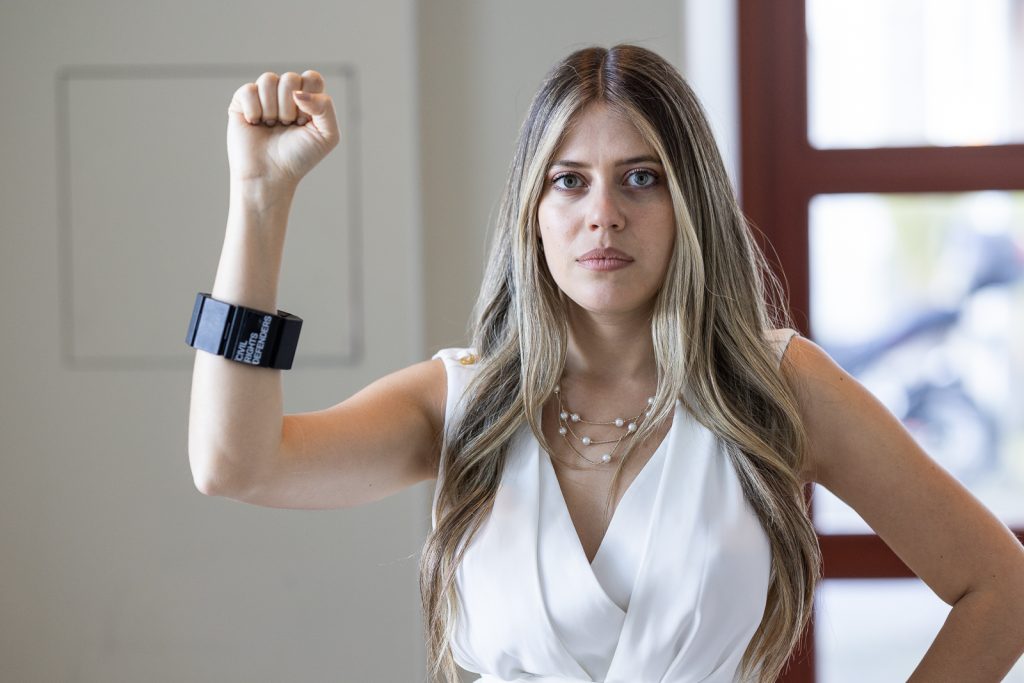
10 years Natalia bracelet

December 20, 2023
Génesis Dávila, participant in the Natalia Project.

On 18 December 2023 Civil Rights Defenders published an account of 10 years Natalia [see: https://humanrightsdefenders.blog/2014/04/24/the-natalia-gps-alarm-bracelet-wins-golden-egg-awards-in-stockholm/]

10 years ago, Civil Rights Defenders launched the Natalia Project, the world’s first assault alarm and community-based security system for human rights defenders. In the event of an attack, participants in the project can send out a distress signal so they can be located quickly and get help.

Natalia Project participant Génesis Dávila is the director and founder of Defiende Venezuela, a human rights organisation fighting for accountability and justice for victims of political persecution, people in arbitrary detention, and others who have been subjected to government-sanctioned attacks in Venezuela. In Venezuela being a human rights defender puts Génesis at risk of the very same political persecution she is trying to document.  

I face different threats on a daily basis. In general, they come from the Venezuelan regime. They harass human rights defenders because we try to protect people who are in danger and victims of human rights violations. This is something that puts us at great risk.” “It is really exhausting because then you don’t have space for other things. It’s the feeling of being chased all the time. It puts you under stress. You feel that you are never safe, wherever you are.”

In the case of an attack, the alarm is activated, and a distress signal goes off. Civil Rights Defenders and a network of human rights defenders can start investigating the situation within minutes.

For me, my Natalia has been a game changer. It helped me feel safe. Just having this tiny device with me, knowing that there was someone on the other side of the world just waiting for my call, being ready to act if something happens gave me such a confidence. That changed everything.”

The Natalia Project device is built to be durable and easy to use and take wherever is needed. 

Everywhere I go, I bring my Natalia. If I’m about to fly somewhere, I check my passport, cellphone and my Natalia. It makes me feel safe. It’s my lucky charm.” 

“Anyone who wants to support human rights can do it. You don’t have to be a lawyer, or someone waving a flag. You just need to advocate for human rights, and that will be enough.” 

CRD also runs an emergency fund, see: https://crd.org/emergency-fund/

Civil Rights Defender of the Year 2022 to LGBTI defenders Xheni Karaj and Frank Mugisha

April 21, 2022

On 21 April 2022 LGBTI+ activists and human rights defenders Frank Mugisha from Uganda and Xheni Karaj from Albania were awarded the Civil Rights Defender of the year award 2022.  For more on this award and its laureates, see: https://www.trueheroesfilms.org/thedigest/awards/F2D9088D-2A4E-4FFF-8EC8-7AF252D5B5E7.  

“Xheni Karaj, from Albania, and Frank Mugisha, from Uganda, are two of the world’s most courageous LGBTI+ activists and human rights defenders. Despite working in environments where homophobia is widespread, they continue fighting with impressive resilience, for every individual’s right to have their own sexual orientation and gender identity. They have both been instrumental in building LGBTI+ movements in their countries and inspire LGBTI+ activists all over the Balkan region and the African continent,” the Civil Rights Defenders Board of Directors writes in the motivation for the award.  

The right to one’s own sexuality and gender identity is a human right, but violence and discrimination against people from the LGBTI+ community is still a problem globally. Xheni Karaj, founder and Executive Director of Aleanca LGBT in Albania and Frank Mugisha, Executive Director of Sexual Minorities Uganda (SMUG) are working for LGBTI+ and human rights in countries where violence, discrimination, and homophobia is widespread. Due to the situation in both Uganda and Albania, many LGBTI+ people keep their sexual identity hidden out of fear for the consequences they might face if coming out in public. Through education, advocacy, and building a community for LGBTI+ persons, Frank Mugisha and Xheni Karaj are contributing to improving the lives of thousands. Their commitment to LGBTI+ rights has played a huge part in the progress for human rights in their regions.   

I am excited and happy about the award. This prize shows that LGBTI+ rights are part of universal human rights. For us, it is a recognition that we are involved in advancing human rights work,” says Frank Mugisha. 

“The award made us all feel very happy and appreciated and motivates us to continue with the good work we are doing. To get this acknowledgment also helps me realise that we are making a revolution in Albania. From being invisible, we have showed people that we exist. That we are proud of ourselves, and we should have the right to be free and tell our stories,” says Xheni Karaj.

Civil Rights Defenders’ Emergency Fund gives insight over 2021

March 18, 2022

Zinaida Muradova, Head of Rapid Response at Civil Rights Defenders

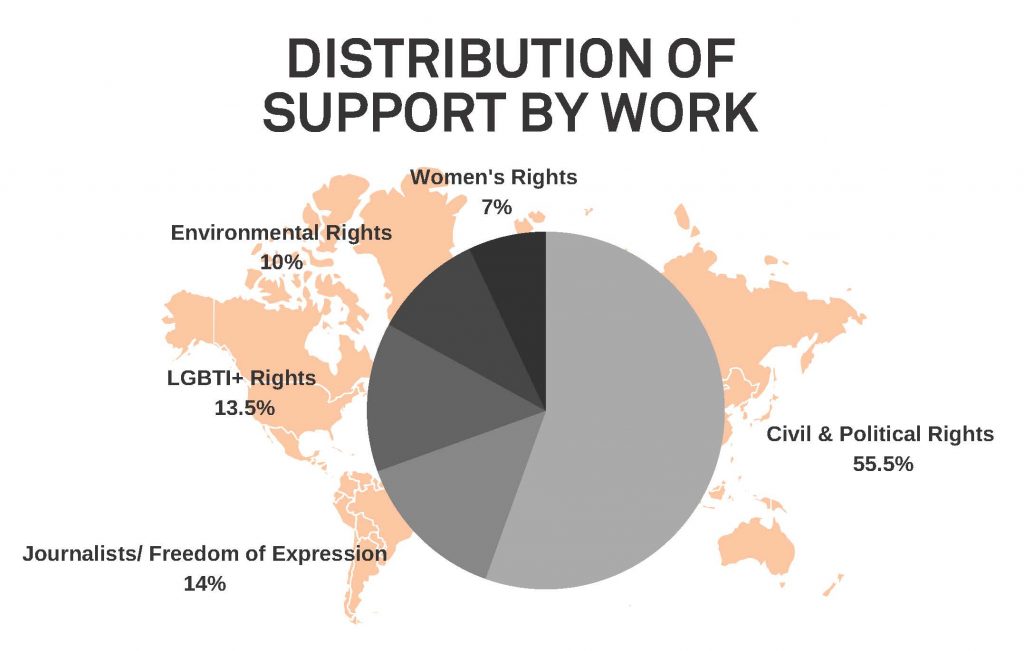
Defending human rights has become increasingly dangerous in many parts of the world. Many of those who do, face numerous risks and threats on a daily basis. When a threat towards a human rights defender escalates, Civil Rights Defenders’ Emergency Fund provides rapid assistance to strengthen the defender’s security as quickly as possible. 

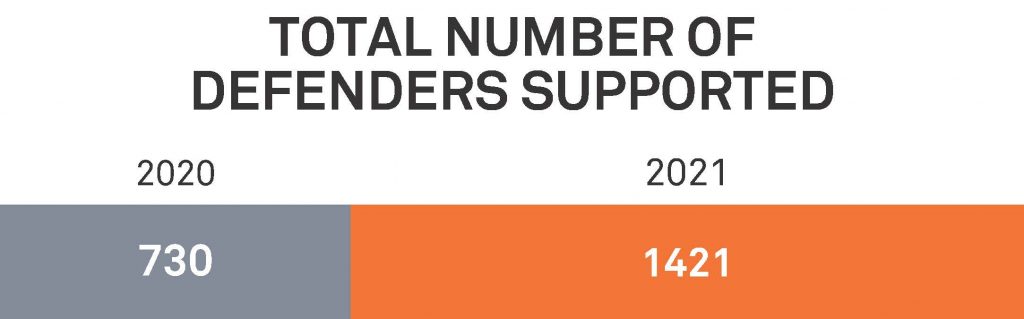
On 7 March 2022 it provided a breakdown of its use. The fund can, for example, provide legal aid or temporarily relocate people who suffer persecution, as well as provide preemptive efforts such as security trainings and digital security solutions. In 2021, the fund supported a total of 1421 human rights defenders in 30 countries. 

Emergency support doubled in 2021

In 2021, Civil Rights Defender’ Emergency Fund has received and processed the largest number of applications since the inception of the fund in 2012. We have supported a total of 1.421 Human Rights Defenders (HRD:s) and/or members of their families at risk through a total of 171 grants in 30 countries. The number of applications and granted support have thus both doubled compared to 2020.  

The world is becoming an increasingly dangerous place for human rights defenders, which is a significant explaining factor behind this increase. The CRD Emergency Fund has seen and reacted to the global backsliding of democracy and a number of emerging conflicts in 2021. The aftermath of the war between Armenia and Azerbaijan, the military coup in Burma, the spring protests in Colombia, the witch-hunt on civil society in Belarus, the civil war in Ethiopia and the Taliban’s takeover in Afghanistan are only a few of the conflicts that have deteriorated the security situation for human rights defenders in 2021. Many human rights defenders cannot continue their work for human rights and democracy without the support of the outside world.

Although the number of applications has doubled, so has the number of Emergency Fund applications granted. This increase is much thanks to the additional resources that Civil Rights Defenders has been able to put into processing fund applications. 

We are humbled to have been able to support so many human rights defenders in 2021. The need for emergency support is greater than ever, with the war in Ukraine the number of applicants is likely to keep increasing in the immediate future”, says Zinaida Muradova.

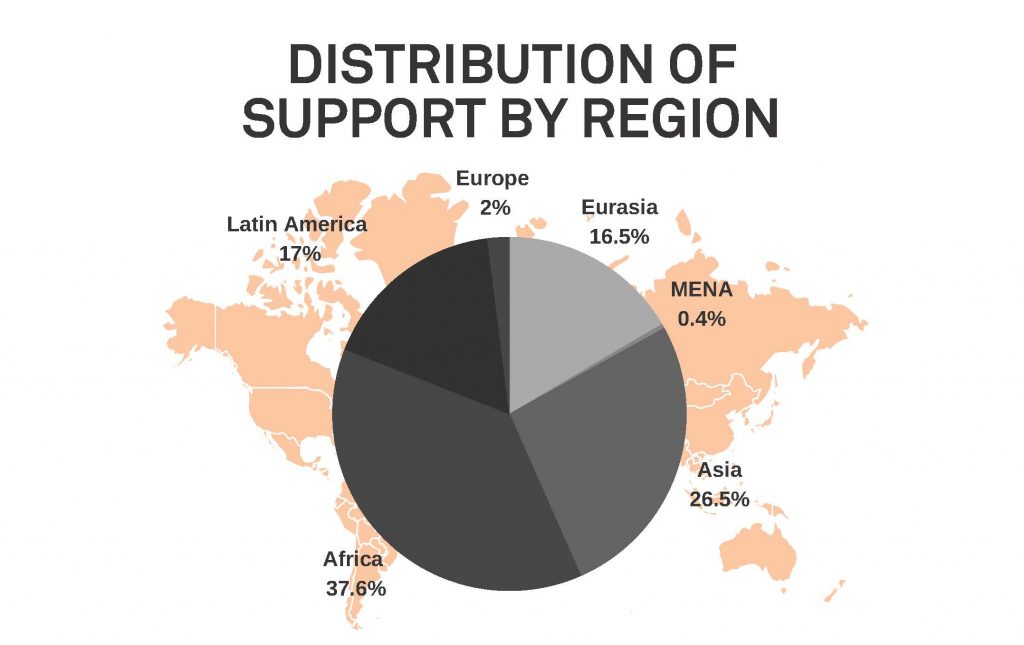
Emergency support to Burma and Asia has significantly increased in 2021, although the majority of human rights defenders who received emergency support continued to be from Africa. Additionally, the Emergency Fund continued to expand its global reach in five more regions – Eurasia, Europe, Africa, Latin America and MENA. In total, support was provided to human rights defenders in 30 countries during the course of 2021. 

Further advancing gender sensitivity 

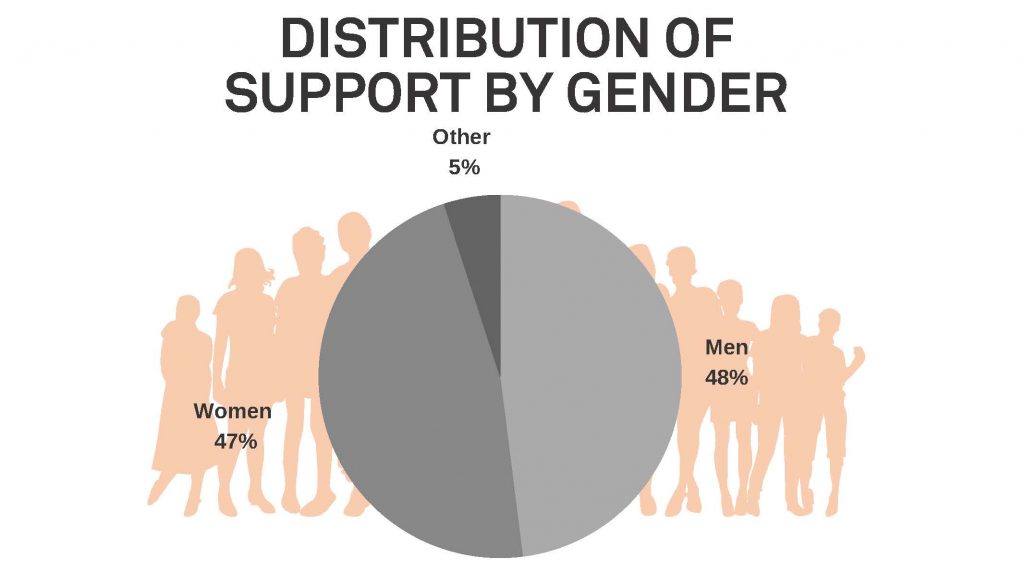
The Emergency Fund continued to build on gender work started in 2019 to ensure a good gender balance and representation amongst the beneficiaries of support. We have been working to increase the accessibility of the mechanism for the most vulnerable groups. We see an improvement in gender balance, for example the percentage of non-conforming people supported doubled compared to 2020.

An increasing demand for legal aid and psychological support  

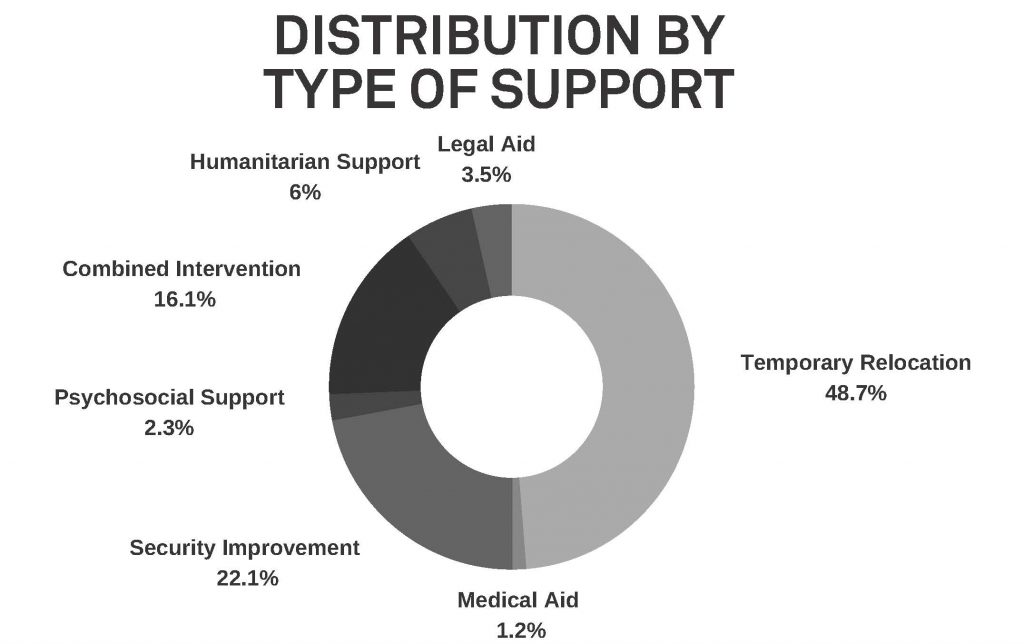
Despite the Covid 19 pandemic and continued strict restrictions on travel around the world, temporary relocations, where human rights defenders can reside safely for a short period, remained by far the most requested type of support in 2021. The majority of relocations were related to the major crises in countries mentioned above. Requests for preventive security measures to improve home, office or digital security, such as installing security cameras or digital security software, remained to be in high demand as well. Many HRD:s needed so called combined interventions, meaning a combination of several of the above mentioned support types. 

In 2021 The Emergency Fund has seen a noteworthy increase in requests for humanitarian and psychological support. Many HRDs also request legal aid due to an increasing trend of arbitrary arrests and charges.

Democracy and human rights cannot be achieved without human rights defenders. Through the Emergency Fund we ensure that they feel safe enough to continue their work which ultimately helps ensure that the fight for democracy can continue worldwide”, says Zinaida Muradova. 

See also: https://humanrightsdefenders.blog/2020/12/11/civil-rights-defender-of-the-year-award-2020-goes-to-naw-ohn-hla/

Human rights work seen as a market

February 27, 2022

For a rather unusual look at human rights as a “market”see the following:

On 25 February 2022 the annual “Human Rights Organizations Global Market Report 2022 report has been added to ResearchAndMarkets.com’s offering.

The global human rights organizations market is expected to grow from $16.60 billion in 2021 to $17.47 billion in 2022 at a compound annual growth rate (CAGR) of 5.3%. The growth is mainly due to the companies rearranging their operations and recovering from the COVID-19 impact, which had earlier led to restrictive containment measures involving social distancing, remote working, and the closure of commercial activities that resulted in operational challenges.

The market is expected to reach $20.53 billion in 2026 at a CAGR of 4.1%.

The human rights organizations market consists of revenue generated through human rights services by entities that are engaged in promoting causes associated with human rights either for a broad or a specific constituency.

Establishments in this industry address issues such as protecting and promoting broad constitutional rights and civil liberties of individuals and those suffering from neglect, abuse, or exploitation, promoting the interests of specific groups such as children, women, senior citizens, or persons with disabilities, improving relations between racial, ethnic, and cultural groups, and promoting voter education and registration.

The main types of human rights organizations are nongovernmental organizations, intergovernmental organizations, governmental organizations and international organizations. Governmental human rights organizations are run by government bodies and are involved in the protection of human rights and the reduction of human rights violations.

The different modes of donation include online, offline. The organization locations can be domestic, international and have various applications in areas such as all humans, children, women, disabled, LGBTQ, others.

Asia Pacific was the largest region in the human rights organizations market in 2021. North America was the second largest region in the human rights organizations market. The regions covered in this report are Asia-Pacific, Western Europe, Eastern Europe, North America, South America, Middle East and Africa.

The rise in hate crimes is expected to drive the human rights organizations market. Hate crime is a form of criminal violence upon a person or property, caused in whole or in part by an offender’s bias against a race, religion, disability, sexual orientation, ethnicity, gender, or gender identity.

As per the annual report of FBI published in 2019, physical attacks against individuals have risen, accounting for 61% of the 7,120 cases reported by law enforcement authorities nationally as hate crimes in the USA. Government and non-governmental organizations aim to curb the abuses that challenge people’s human rights, which further aids in the growth of the human rights organizations market. Increasing attacks against human rights defenders are anticipated to hinder the human rights organization market. Attacks against human rights organizations that strive to safeguard human rights are rising at an alarming rate.

For instance, in 2019, the Business and Human Rights Resource Center has tracked around 572 attack cases that were related to business-related activities. These attacks cause a sense of fear and timidness among individuals who work for human rights protection and challenges human rights protection activities, which thereby impedes the growth of the market. See alsO: https://humanrightsdefenders.blog/2022/02/18/business-network-on-civic-freedoms-and-human-rights-defenders-launches-new-website/

Organizations and human rights defenders are working towards protecting the digital human rights of individuals.

Companies” mentioned in the report inlcude:

  • Amnesty International
  • Human Rights Watch
  • Civil Rights Defenders
  • Human Rights Without Frontiers International
  • Physicians for Human Rights
  • Anti-Slavery International
  • Global Rights
  • UN Watch
  • European Centre for Minority Issues
  • International Federation for Human Rights

For more information about this report visit https://www.researchandmarkets.com/r/a3tco8

Myanmar: one year after the coup – only getting worse

February 2, 2022
A crowd of protesters wearing face masks, holding up an image of a woman, Aung San Suu Kyi.

On 1 February last year, the military seized power over Myanmar/Burma by overturning the election results and detaining State Counsellor Aung San Suu Kyi. The military is still controlling power by force and uses brutal violence against human rights defenders, civil society groups, and journalists in order to silence all forms of protest and dissent. More than 1,500 people have been killed by the military and over 8,000 people have been arrested.

The coup prompted mass protests and more than 1,500 people have been killed by the military. Over 8,000 people have been arrested in the harsh crackdowns. In a series of charges, Aung San Suu Kyi has been sentenced to several years in prison. Most recently, five new corruption charges against her were announced and in all she faces up to 164 years in jail. See also: https://humanrightsdefenders.blog/2021/09/30/rohingya-human-rights-leader-mohibullah-murdered-in-bangladesh-refugee/

Despite the military’s brutal response, people have come together to fight the dictatorship. Nationwide protests, boycotts, strikes, and coordinated civil disobedience movements have taken place. Journalists across the country have continued their work despite severe attacks by the military.  

A new report by Athan looks at how the military coup has affected journalists’ work and press freedom in the country. Throughout the country’s history, military coups have led to severe attacks on press freedom and the 2021 coup is no exception.  Since the launch of the coup, 141 journalists have been arrested and 13 have been sentenced to prison. On 10 December, photojournalists Ko Soe Naing and Ko Zaw Tun were arrested while taking photos of a nationwide silent strike. Ko Soe Naing was tortured to death at the interrogation centre four days later. Just a couple of weeks after that, editor of the Federal Journal, A Sai Kay (Aka) Sai Win Aung, was shot dead by the military in Lay Kay Kaw.  See also: https://humanrightsdefenders.blog/2021/05/11/three-democratic-voice-of-burma-journalists-and-two-activists-risk-refoulement-by-thailand/

According to Athan, the attacks on press freedom since the 2021 military coup have been the worst the country has seen.  “Journalists and news media require continuous support to sustain local media and its journalists in order to secure journalists’ careers and their safety, and to enable an environment for journalistic professionals and the industry,” says a representative from Athan about the report. 

On the one-year anniversary of the military coup in Myanmar, the High Representative on behalf of the European Union and the Foreign Ministers of Albania, Australia, Canada, New Zealand, Norway, Republic of Korea, Switzerland, the United Kingdom, and the United States, have made the following declaration:

….The European Union is deeply concerned by the continuing escalation of violence and the evolution towards a protracted conflict with regional implications. Since the military coup, the situation has continuously and gravely deteriorated. A large part of the population is now in a highly precarious situation, experiencing poverty, food shortages, displacement, and violence. ..

The European Union condemns in the strongest terms continuing grave human rights violations including torture, sexual and gender-based violence, the continued persecution of civil society, human rights defenders, and journalists, attacks on the civilian population, including ethnic and religious minorities by the Myanmar armed forces. Therefore, the EU calls for full accountability of the leaders responsible for the coup as well as of the perpetrators of violence and human rights violations. The EU also reiterates its firm demand for the immediate and unconditional release of all prisoners arbitrarily detained in relation to the coup and the return to power of democratically elected leaders.

As a matter of priority, the EU reiterates its calls for an immediate cessation of all hostilities, and an end to the disproportionate use of force and the state of emergency. The military authorities must ensure rapid, safe, and unhindered humanitarian access to all displaced persons and people in need, in all parts of the country. The European Union will continue to provide humanitarian assistance, in accordance with the principles of humanity, neutrality, impartiality, and independence and reiterates its call for the full and immediate respect of international humanitarian law…

In view of the escalating violence in Myanmar, increased international action is required in line with the already existing EU arms embargo on Myanmar. Since the military coup on 1 February 2021, the EU has imposed targeted sanctions on the Myanmar military, its leaders, and entities. In the absence of any swift progress of the situation in Myanmar, the EU stands ready to adopt further restrictive measures against those responsible for undermining democracy and the serious human rights violations in Myanmar.

It is a failed coup,” said Yanghee Lee, co-founder of the Special Advisory Group on Myanmar and former UN special rapporteur for human rights in the country in a CNN report of 1 February. “The coup has not succeeded in the past year. And that is why they are taking even more drastic measures to finish out the coup.” He reported on problems for human rights defenders already in 2015, see: https://humanrightsdefenders.blog/2015/03/19/myanmar-backsliding-by-prosecuting-human-rights-defenders-instead-of-perpetrators/

https://edition.cnn.com/2022/01/31/asia/myanmar-coup-anniversary-resistance-junta-intl-hnk-dst/index.html

Civil Rights Defender of the Year Award 2020 goes to Naw Ohn Hla

December 11, 2020
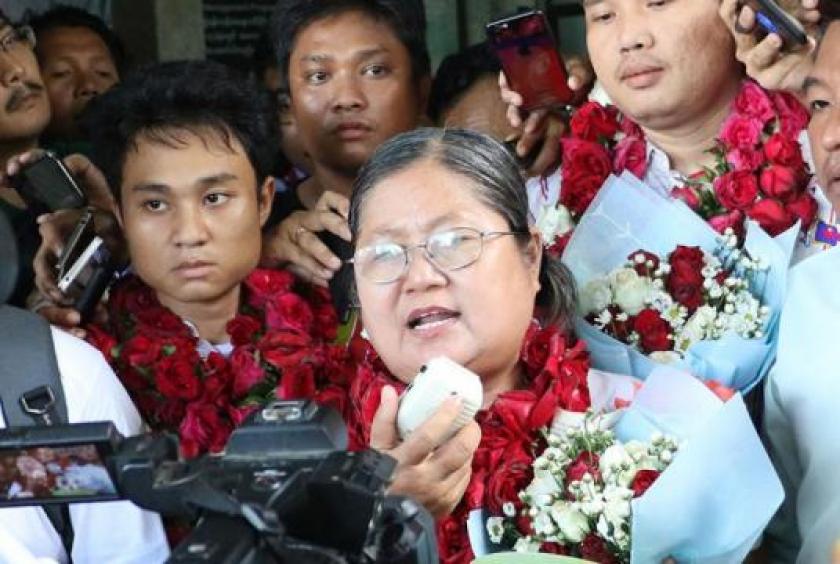
Naw Ohn Hla appears in court in Kyauktada Township in October last year on charges of organizing Kayin Martyr’s  Day. (Photo-Nay Myo Win)

Naw Ohn Hla appears in court in Kyauktada Township in October last year on charges of organizing Kayin Martyr’s Day. (Photo-Nay Myo Win) Published 11 December 2020

Naw Ohn Hla, chairperson of Democracy and Peace Women Network in Myanmar, has been presented with the Civil Rights Defender of the Year Award 2020 by Civil Rights Defenders based in Sweden. The award announcement was made on Human Rights Day on December 10.

Naw Ohn Hla is a Karen democracy activist, politician, human rights defender, environmental rights and land rights activist for decades. She has been active in campaigning against the Letpadaung mining project in northern Burma. Naw Ohn Hla is also serving as general secretary of the United Nationalities Democracy Party.

Naw Ohn Hla has received the award for her exceptional perseverance in the fight against oppression and for her continued courage to stand up to those in power, Civil Rights Defenders said in its statement.

We are standing by the victims of human rights violations. It is now encouraging to see that not only us but also the international community is standing by this. It also encourages us to do more,” said Naw Ohn Hla.

She said she would accept the award at the headquarters of Civil Rights Defenders in Sweden together with the 2021 award winner because this year sees the Covid-19 outbreak.

For more on the Civil Rights Defender of the Year Award see: https://www.trueheroesfilms.org/thedigest/ 

See also: https://humanrightsdefenders.blog/2017/01/25/civil-rights-defender-of-the-year-award-2017-goes-to-edmund-yakani-from-south-sudan/

https://elevenmyanmar.com/news/naw-ohn-hla-wins-civil-rights-defender-of-the-year-award-2020

https://en.wikipedia.org/wiki/Naw_Ohn_Hla

Thailand: joint statement by International NGOs on Pro-Democracy Protests

November 29, 2020

A group of 13 important human rights NGOs – in a joint statement – condemn the Thai police’s unnecessary and excessive use of force against peaceful protesters marching to the national parliament in Bangkok on November 17, 2020. They are concerned that authorities could employ similar measures when facing protesters who have declared they will march to the Siam Commercial Bank headquarters on November 25.

On November 17, police set out barriers and barbed wire to prevent a peaceful march organized by pro-democracy movements from reaching the parliament. Protesters planned to protest outside the parliament as members of parliament and senators debated seven different proposals for constitutional amendments, including an amendment proposed by the lawyers’ non-governmental organization iLAW (Internet Law Reform Dialogue), which was supported by the People’s Movement and its allies. Police refused to let protesters through the barriers, and when the demonstrators acted to breach those barriers, police crowd control units used water cannons laced with purple dye and an apparent teargas chemical, as well as teargas grenades and pepper spray grenades, to forcibly disperse thousands of demonstrators, including students, some of whom are children. Water cannons were first used at approximately 2:25 pm and police continued their efforts to disperse protesters, with constant use of water cannons, teargas and pepper spray into the evening.

Police also failed to prevent violence between pro-democracy protesters and royalist “yellow shirts” near the Kiak Kai intersection, near the parliament. Initially, riot police separated the two groups. However, video posted on social media later showed police officers informing the royalist protesters that they would withdraw and seconds later they vacated their position between the two groups. During the ensuing skirmishes, both sides were filmed throwing rocks and wielding clubs. Live broadcasts included sounds that appeared to be gunfire.

The Erawan Medical Centre reported that there were at least 55 protesters injured, mostly from inhaling teargas. It also reported that there were six protesters who suffered gunshot wounds. The injured included children: a kindergartener and elementary school students….

On November 18, the spokesperson for United Nations Secretary-General António Guterres “expressed concern about the [human rights] situation in Thailand … it’s disturbing to see the repeated use of less lethal weapons against peaceful protesters, including water cannons … it’s very important that the government of Thailand refrain from the use of force and ensures the full protection of all people in Thailand who are exercising a fundamental peaceful right to protest.”

We call on the Thai government to respect, protect and fulfill the right of demonstrators to peacefully protest, in line with Thailand’s international obligations under the ICCPR and customary international law. Specifically, Thailand should:

1.     Permit the People’s Movement march to proceed on November 25 and allow for non-violent protesters, including those who are children, to peacefully protest in front of the Siam Commercial Bank headquarters.

2.     Protect the rights of protesters, including those who are children, in accordance with the Human Rights Committee’s General Comment No. 37 on the Right of Peaceful Assembly.

3.     Facilitate the exercise of the right to peacefully assemble and refrain from dispersing assemblies by using weapons, including less-lethal weapons, against protesters in line with the United Nations Basic Principles on the Use of Force and Firearms by Law Enforcement Officials and UN and other guidance on less-lethal weapons.

4.     Protect protesters, including those who are children, from violence and interference by non-State actors, while also protecting the rights of counter-demonstrators.

5.     Take steps to ensure accountability for rights violations associated with the government’s crackdown on the protest movement and to ensure that those whose rights have been violated enjoy the right to an effective remedy, as guaranteed under ICCPR article 2(3).

Signed by:

Amnesty International

Article 19

ASEAN Parliamentarians for Human Rights

Asia Democracy Network

Asian Forum for Human Rights and Development (FORUM-ASIA)

Asian Network for Free Elections (ANFREL)

CIVICUS: World Alliance for Citizen Participation

Civil Rights Defenders

FIDH – International Federation for Human Rights

Fortify Rights 

Human Rights Watch

International Commission of Jurists

Manushya Foundation

———–

https://www.hrw.org/news/2020/11/25/statement-international-ngos-pro-democracy-protests-november-17-and-25-2020

Good example of authoritarian abuse of COVID-19 emergency: Hungary

April 7, 2020

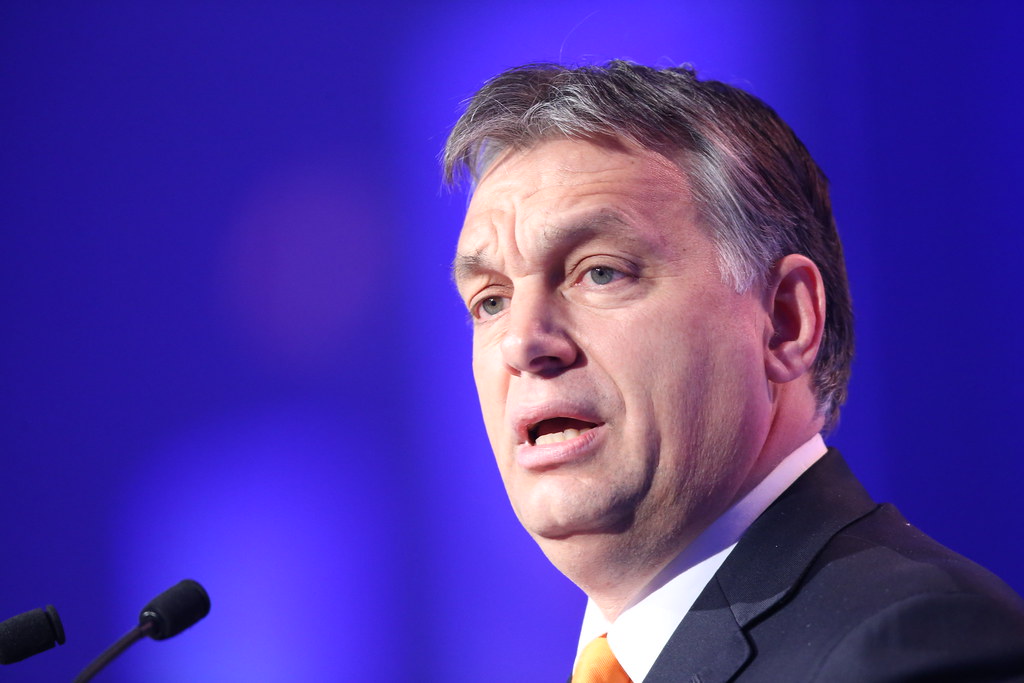
Hungary has defied calls by human rights defenders to respect human rights standards in tackling the COVID-19 outbreak.  Monday 30 March 2020, Hungary’s parliament passed a controversial Law on Protection against the Coronavirus, allowing Prime Minister Viktor Orban to rule by decree for an indefinite period [!], and to jail anybody deemed to be publishing ‘fake news’ by up to five years. In the days prior, Civil Rights Defenders condemned the bill on the grounds that it is an attack on the rule of law and democracy, and presents numerous threats to human rights in the country (see https://crd.org/2020/03/24/hungary-state-of-emergency-is-no-excuse-for-undermining-rule-of-law/).

In one of its first moves, the government tabled a bill outlawing legal gender recognition which is a serious and permanent attack on the rights of Trans people. The following day, on Tuesday, it hinted it would use emergency powers to push educational reform by perusing an appalling new curriculum that will rewrite history books by promoting national pride, and making anti-Semitic authors compulsory reading. Coupled with the restrictions on media freedoms, the freedom of expression and the indefinite emergency rule, these measures are a clear overreach of emergency powers and a grave threat to democracy.

20 EU Member States have reacted in a joint-statement that they are “deeply concerned about the risk of violations of the principles of rule of law, democracy and fundamental rights arising from the adoption of certain emergency measures”. However, the statement’s authors did not call out countries by name, thus creating a loophole for Hungary to shamelessly became a signatory itself [SIC and SICK].

https://crd.org/2020/04/07/hungary-ignores-calls-for-respect-of-human-rights/

Cuba and EU dialogue: five empty chairs show serious shortcomings

February 9, 2020
Cuban human rights defenders who participated to the project of presenting a report on EU’s agreement with Cuba. [Civil Rights Defenders]

The EU needs to change strategy if it wishes to stand for democracy in Cuba by opening up to independent civil society, write Anders L. Petersson and Erik Jennische (of the NGO Civil Rights Defenders) on 4 February 2020. On Saturday 1 February. five Cuban democracy activists were stopped at the airport in Havana as they were on their way to Brussels to speak at the European Parliament today. They were banned from leaving the country by the Cuban authorities. Instead, the seminar at the European Parliament was held with Cuban activists based outside the country, and five empty chairs – a vivid reminder of the current strategy’s shortcomings. [Instituto Patmos has shown that at least 226 activists were banned from travelling abroad during 2019]. The five democracy activists were supposed to present their ideas on what the EU could do to promote respect for human rights and democratisation in the country. Their proposals form part of a report by Civil Rights Defenders – a total 30 letters from Cuban democracy activists and organisations – as a contribution to the EU’s policy development.

Although the EU and Cuba in their Agreement recall “their commitment to the recognised principles of democracy”, Civil Rights Defenders regrets that the EU remained silent on the sham elections and the transfer of power that followed. Apparently, it was all acceptable under the new Agreement…..When Federica Mogherini visited Cuba for the last time as High Representative for Foreign Affairs in September 2019, she rather perplexingly concluded that “after completing its generational transition and adopting a new Constitution, Cuba now faces major challenges in carrying out its economic modernization”.

….Reflecting on the stories of harassed and imprisoned activists in Cuba, we cannot afford to make such surrender again. The EU needs to change strategy if it wishes to stand for democracy in Cuba. It needs to build a formal and open dialogue with Cuba’s independent civil society. Since the negotiations began on the Agreement in the spring of 2014, the EU has not invited civil society to a single formal discussion on the content of the Agreement or its implementation. When the EU and Cuba held its human rights dialogue in October 2019, the Cuban government took the liberty to decide which European and Cuban organisations could participate. The papers in the report of CRD hold a great number of proposals and ideas – the two core messages being:

  • That both European and Cuban civil societies need to be recognised as formal partners to the EU in its relations to Cuba.
  • That the EU needs to speak out on the absence of democracy in Cuba and denounce all human rights violations.

The EU can never contribute to positive change in Cuba via a dialogue with the Cuban government. The only way is to give legitimacy and support to the civil society that openly and peacefully supports democratisation. It is time for the EU to include civil society in its relations with Cuba.

See also: https://humanrightsdefenders.blog/2018/12/15/new-rule-of-law-and-human-rights-in-cuba-and-venezuela-and-eu-engagement/

One of the award-winning Cuban dissident who was detained this week announced that he has been released without charge but barred from a planned trip to Europe for a meeting on human rights. Guillermo Farinas, a 58-year-old psychologist, is a leading voice in the opposition to Cuba’s communist government and won the European Parliament’s Sakharov human rights prize in 2010. Farinas was arrested Tuesday in the central city of Santa Clara, where he lives, as he planned to go to the Spanish Embassy in Havana to pick up travel documents. He had been due to take part in a meeting of the human rights commission of the European Parliament. “The main reason for my arrest was to keep me from traveling to Europe,” Farinas told AFP.

In the meantime a number Cuban and latin solidarity groups in Belgium had a quite different view: “Campaign by MEPs against Cuba rejected in Belgium. Another instance of the Empire’s vulgar and interfering policy of subversion and discredit against the Cuban Revolution. Cuba is sovereign and independent, we won’t yield to anyone”. http://www.cubadebate.cu/noticias/2020/02/04/rechazan-en-belgica-nueva-campana-contra-cuba-de-eurodiputados/#.XjsNg2q23cd 


Five empty chairs remind of Cuba’s regime true nature

https://www.france24.com/en/20200207-cuban-dissident-freed-but-cannot-leave-country

https://www.euronews.com/2020/02/07/cuban-activists-blocked-from-attending-eu-meeting