In a new report of 6 June 2024, the Amnesty International insists the world governing body “must terminate any agreement to host the tournament if human rights are jeopardised or violated“.
Last year Fifa confirmed Spain, Portugal and Morocco will be co-hosts in 2030, with the opening three matches taking place in Uruguay, Argentina and Paraguay. Saudi Arabia is the sole bidder for the 2034 tournament. Amnesty says the Gulf kingdom has an “appalling human rights record and its bid carries a broad range of very serious risks”.
But it also warns the 2030 tournament “carries human rights risks primarily related to labour rights, discrimination, freedom of expression and assembly, policing, privacy and housing”. It adds that greenhouse gas emissions generated by travel related to the expanded 48-team tournament across three continents “are likely to be significant, despite Fifa’s stated commitment on climate change to halve carbon emissions by 2030 and be ‘net-zero’ by 2040”.
Amnesty claims Fifa has not responded to its requests to speak to consultants involved in human rights-based assessments of the bids.
Fifa has been approached for comment. It is set to formally confirm the hosts of the two tournaments later this year at a meeting of its congress. When unveiling its choices for hosting the World Cups, it said it was “fully committed” to ensuring the competitions were held to “sustainable event management standards and practices, safeguarding principles for the protection of children and adults at risk and to respecting internationally-recognised human rights in accordance with the United Nations Guiding Principles on Business and Human Rights”.
It has also said it will “conduct a targeted dialogue with bidders, to ensure complete, comprehensive bids are received and evaluated against the minimum hosting requirements….[It] will focus on the defined priority areas of the event vision and key metrics, infrastructure, services, commercial, and sustainability and human rights.”
Steve Cockburn, Amnesty’s Head of Labour Rights and Sports, said: “With only a single bid to host each tournament and major human rights concerns surrounding both, there are huge questions about Fifa’s willingness to stand by the pledges and reforms it has made in recent years, including exercising its right to reject any bid which does not meet its stated human rights requirements.
“History shows that the World Cup can be a source of dignity or exploitation, inclusion or discrimination, freedom or repression, making Fifa’s award of the hosting rights for the 2030 and 2034 tournaments among the most consequential decisions ever taken by a sporting organisation.”
Assessing the human rights risks related to the respective bids, Amnesty claims that in Spain, Morocco and Portugal “migrant workers are at risk of exploitation”, “excessive use of police forces is a proven risk” and “racial discrimination is an issue in all three countries”. It says an independent Fifa evaluation of Morocco’s previous bid – to host the 2026 World Cup – “noted its criminalisation of same-sex acts was particularly problematic” and that the country “restricts freedom of expression”.
It adds that “discrimination is deeply embedded in legislation and practices, and could impact fans, workers, players and journalists… women fans face the risk of unfair and disproportionate prosecution… and there have been sweeping arrests and imprisonment of journalists, human rights defenders, political activists.” Amnesty says reforms to prevent human rights violations related to the World Cup in Saudi Arabia would need “sweeping changes to labour laws to protect workers, and the release of activists and human rights defenders who’ve been unjustly imprisoned”.
Last year the Saudi Sports Minister rejected claims of ‘sportswashing’ and defended the country’s right to host the 2034 tournament, telling the BBC: “We’ve hosted more than 85 global events and we’ve delivered on the highest level. We want to attract the world through sports. Hopefully, by 2034, people will have an extraordinary World Cup.”
AI asked three older activists to reflect on their experiences, the changes they are campaigning for, and how being an older person gives them unique perspective and motivation.
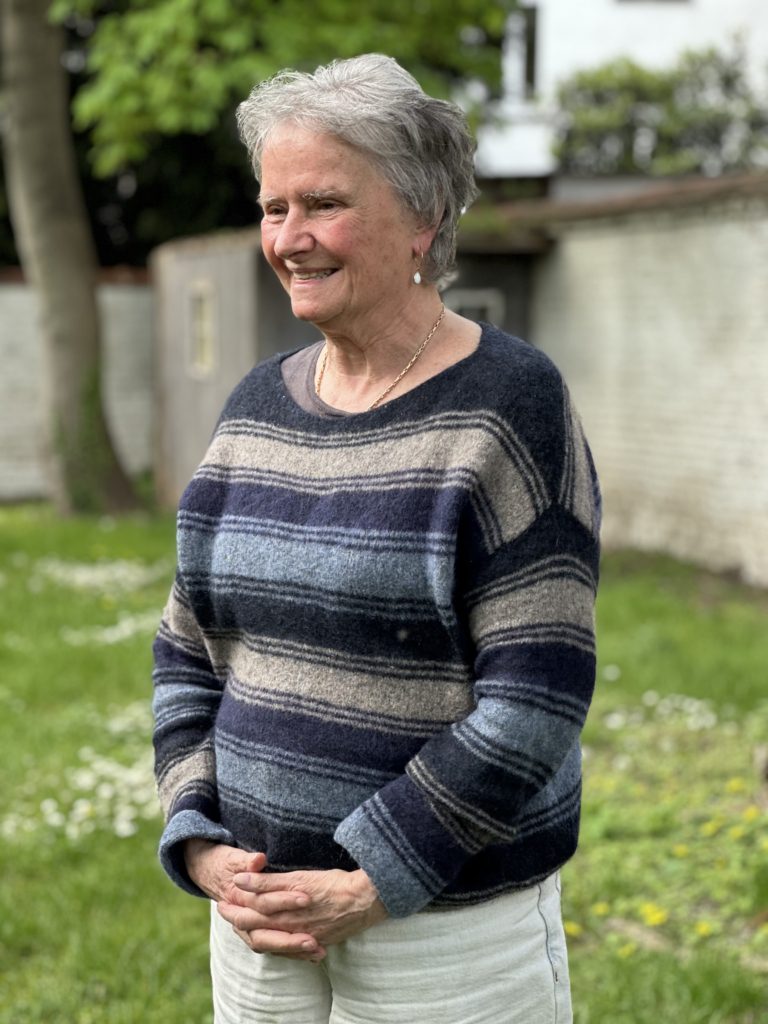
Cecile de Ryckel, 78, Belgium
Cecile is a lifelong activist working on anti-racism and climate change.
Why did you become an activist?
After a homelessness crisis amongst migrants in Belgium in 2015, my husband and I hosted two people from Ethiopia who the authorities had left to sleep in a city park. They told us that in Ethiopia they were small-scale farmers and grew food for their families. However, it was raining less frequently, and growing food was becoming more difficult. That was when I realized that climate change was one of the most important issues in the world today, and that it would have far-reaching consequences. Soon after that I participated in a citizens assembly discussing how best to address climate change and reduce carbon emissions. We learned how to mobilize people and change behaviours. I joined an advocacy collective, Grandparents for the Climate, and started working actively on the issue.
We have a responsibility to future generations to address this challenge today. It already has wide-ranging impacts on people of all ages. I remember when I was a child that we would joke that an older person was someone who “wouldn’t make it through the winter”, but today due to rising temperatures we sadly have to ask whether some older people can “make it through the summer”.
I recently saw how a group of older women won a landmark court case that the Swiss government’s weak climate change policy had violated their rights. This will help advance the cause greatly, for people of all ages.
Amina Musa, 72, Nigeria
Amina is an activist on behalf of victims of the armed conflict in north-east Nigeria and their families, including those who have been unlawfully killed or detained.
Why did you become an activist?
I became an activist nine years ago when Boko Haram forced us to leave our homes, and we found ourselves living in camps controlled by the Nigerian government. The military made baseless accusations that our sons were associated with Boko Haram. Our sons were blindfolded and arrested and held in dehumanizing conditions. I had no choice but to start campaigning for their release. As mothers, we came together and started a movement to seek justice. We are demanding that all those detained unlawfully be released immediately and that the government investigate the gross violations we have experienced. Some of our sons have been in detention for more than 10 years. We have had enough, we want justice.
I tell other older people that they should continue with their activism and bear with the challenges, and that our activism can also inspire younger people. I know it is not easy, but these causes are important. Age should not and will not deter us from making our society free from injustice.
Juan Jacobo Hernández, 82, Mexico
Juan is an activist on social issues and LGBTQ+ liberation.
Why did you become an activist?
In the 1960s, I was part of Mexican student movements. Then Stonewall happened: I had a boyfriend at the time who lived in New York, and he told me that I had to come and see it for myself. I witnessed the first LGBTQ+ rebellion: the first time gay men, trans people, lesbians were standing up and confronting the police. Coming back to Mexico, we started the Frente de Liberación Homosexual (Gay Liberation Front). I had learned a lot about how to make protests visible and how to make our voices heard. Finally, there was a space where we could be active, where we could do something. When I started my activism, we didn’t use the term “human rights” – but that’s what it has always been about. We held large demonstrations against political repression, for the abolition of the death penalty, and to fight restrictions on social protest. Persecution by the government was very real and close to us at the time – gay men and trans women were persecuted, raided by the police, extorted and beaten up.
Whenever we were out in the street, we felt that something bad could happen. We were struggling for our lives, for our security, for our right to be in the street without being beaten up, robbed or killed.
My whole life, I have never stopped being an activist. The AIDS epidemic collapsed the first phase of gay liberation. So many activists died and [as I grew older], I recognised the need to transmit my experience, knowledge and values [to the younger generation]. Since 1981 I’ve been part of Collective Sol, where we work to build and strengthen the capacity of small, grassroots organizations that are working on the most pressing LGBTQ+ issues they see today.
My life as an activist means I can look back and say I have witnessed three great moments in LGBTQ+ liberation. The first was when we formed political organizations, coming out of the shadows and breaking the silence. The second was the HIV/AIDS epidemic, the way it created a connection between LGBTQ+ liberation and people living with HIV, irrespective of whether they were LGBTQ+. This connection was powerful and drove the movement forward.
Mozilla is highlighting each year the work of 25 digital leaders using technology to amplify voices, effect change, and build new technologies globally through its Rise 25 Awards. On 13 May 2024 was the turn of Raphael Mimoun, a builder dedicated to making tools that empower journalists and human rights defenders. Aron Yohannes talked with Raphael about the launch of his app, Tella, combatting misinformation online, the future of social media platforms and more.
Raphael Mimoun: So I never worked in tech per se and only developed a passion for technology as I was working in human rights. It was really a time when, basically, the power of technology to support movements and to head movements around the world was kind of getting fully understood. You had the Arab Spring, you had Occupy Wall Street, you had all of these movements for social justice, for democracy, for human rights, that were very much kind of spread through technology, right? Technology played a very, very important role. But just after that, it was kind of like a hangover where we all realized, “OK, it’s not just all good and fine.” You also have the flip side, which is government spying on the citizens, identifying citizens through social media, through hacking, and so on and so forth — harassing them, repressing them online, but translating into offline violence, repression, and so on. And so I think that was the moment where I was like, “OK, there is something that needs to be done around technology,” specifically for those people who are on the front lines because if we just treat it as a tool — one of those neutral tools — we end up getting very vulnerable to violence, and it can be from the state, it can also be from online mobs, armed groups, all sort of things.
There’s so much misinformation out there now that it’s so much harder to tell the difference between what’s real and fake news. Twitter was such a reliable tool of information before, but that’s changed. Do you think that any of these other platforms can be able to help make up for so much of the misinformation that is out there?
I think we all feel the weight of that loss of losing Twitter. Twitter was always a large corporation, partially owned by a billionaire. It was never kind of a community tool, but there was still an ethos, right? Like a philosophy, or the values of the platform were still very much like community-oriented, right? It was that place for activists and human rights defenders and journalists and communities in general to voice their opinions. So I think that loss was very hard on all of us.
I see a lot of misinformation on Instagram as well. There is very little moderation there. It’s also all visual, so if you want traction, you’re going to try to put something that is very spectacular that is very eye catchy, and so I think that leads to even more misinformation.
I am pretty optimistic about some of the alternatives that have popped up since Twitter’s downfall. Mastodon actually blew up after Twitter, but it’s much older — I think it’s 10 years old by now. And there’s Bluesky. So I think those two are building up, and they offer spaces that are much more decentralized with much more autonomy and agency to users. You are more likely to be able to customize your feeds. You are more likely to have tools for your own safety online, right? All of those different things that I feel like you could never get on Threads, on Instagram or on Twitter, or anything like that. I’m hoping it’s actually going to be able to recreate the community that is very much what Twitter was. It’s never going to be exactly the same thing, but I’m hoping we will get there. And I think the fact that it is decentralized, open source and with very much a philosophy of agency and autonomy is going to lead us to a place where these social networks can’t actually be taken over by a power hungry billionaire.
What do you think is the biggest challenge that we face in the world this year on and offline, and then how do you think we can combat it?
I don’t know if that’s the biggest challenge, but one of the really big challenges that we’re seeing is how the digital is meeting real life and how people who are active online or on the phone on the computer are getting repressed for that work in real life. So we developed an app called Tella, which encrypts and hides files on your phone, right? So you take a photo or a video of a demonstration or police violence, or whatever it is, and then if the police tries to catch you and grab your phone to delete it, they won’t be able to find it, or at least it will be much more difficult to find it. Or it would be uploaded already. And things like that, I think is one of the big things that we’re seeing again. I don’t know if that the biggest challenge online at the moment, but one of the big things we’re seeing is just that it’s becoming completely normalized to grab someone’s phone or check someone’s computer at the airport, or at the border, in the street and go through it without any form of accountability. People have no idea what the regulations are, what the rules are, what’s allowed, what’s not allowed. And when they abuse those powers, is there any recourse? Most places in the world, at least, where we are working, there is definitely no recourse. And so I think that connection between thinking you’re just taking a photo for social media but actually the repercussion is so real because you’re going to have someone take your phone, and maybe they’re going to delete the photo, or maybe they’re going to detain you. Or maybe they’re going to beat you up — like all of those different things. I think this is one of the big challenges that we’re seeing at the moment, and something that isn’t traditionally thought of as an internet issue or an online digital rights issue because it’s someone taking a physical device and looking through it. It often gets overlooked, and then we don’t have much kind of advocacy around it, or anything like that.
What do you think is one action everybody can take to make the world and our lives online a little bit better?
I think social media has a lot of negative consequences for everyone’s mental health and many other things, but for people who are active and who want to be active, consider social networks that are open source, privacy-friendly and decentralized. Bluesky, the Fediverse —including Mastodon — are examples because I think it’s our responsibility to kind of build up a community there, so we can move away from those social media platforms that are owned by either billionaires or massive corporations, who only want to extract value from us and who spy on us and who censor us. And I feel like if everyone committed to being active on those social media platforms — one way of doing that is just having an account, and whatever you post on one, you just post on the other — I feel like that’s one thing that can make a big difference in the long run.
We started Rise25 to celebrate Mozilla’s 25th anniversary. What do you hope that people are celebrating in the next 25 years?
I was talking a little bit earlier about how we are building a culture that is more privacy-centric, like people are becoming aware, becoming wary about all these things happening to the data, the identity, and so on. And I do think we are at a turning point in terms of the technology that’s available to us, the practices and what we need as users to maintain our privacy and our security. I feel like in honestly not even 25, I think in 10 years, if things go well — which it’s hard to know in this field — and if we keep on building what we already are building, I can see how we will have an internet that is a lot more privacy-centric where communications are by default are private. Where end-to-end encryption is ubiquitous in our communication, in our emailing. Where social media isn’t extractive and people have actual ownership and agency in the social network networks they use. Where data mining is no longer a thing. I feel like overall, I can see how the infrastructure is now getting built, and that in 10,15 or 25 years, we will be in a place where we can use the internet without having to constantly watch over our shoulder to see if someone is spying on us or seeing who has access and all of those things.
Lastly, what gives you hope about the future of our world?
That people are not getting complacent and that it is always people who are standing up to fight back. We’re seeing it at. We saw it at Google with people standing up as part of No Tech for Apartheid coalition and people losing the jobs. We’re seeing it on university campuses around the country. We’re seeing it on the streets. People fight back. That’s where any change has ever come from: the bottom up. I think now, more than ever, people are willing to put something on the line to make sure that they defend their rights. So I think that really gives me hope.
Nikole Yanez is a computer scientist by training, and a human rights defender from Honduras. She is passionate about feminism, the impact of the internet and protecting activists. She was first drawn to human rights through her work as a reporter with a local community radio station. After surviving the coup d’état in Honduras in 2009, Nikole broadened her approach to focus her activism on technology. When she applied for the Digital Forensics Fellowship with the Amnesty Tech Security Lab in 2022, she was looking to learn more about cybersecurity and apply what she learnt with the organizations and collectives she works with regularly.
She highlighted her commitment to fostering a network of tech-savvy communities across Latin America in an interview with Elina Castillo, Amnesty Tech’s Advocacy and Policy Advisor:
I grew up in Honduras, where I lived through the coup d’état, which took place in 2009. It was a difficult time where rights were non-existent, and people were constantly afraid. I thought it was something you only read about in history books, but it was happening in front of my eyes. I felt myself just trying to survive, but as time went by it made me stronger and want to fight for justice. Despite the difficulties, people in my community remained hopeful and we created a community radio station, which broadcast stories about everyday people and their lives with the aim of informing people about their human rights. I was a reporter, developing stories about individual people and their fight for their rights. From there, I found a passion for working with technology and it inspired me to train to become a computer scientist.
I am always looking for ways to connect technology with activism, and specifically to support women and Indigenous people in their struggles. As much as technology presents risks for human rights defenders, it also offers opportunities for us to better protect ourselves and strengthen our movements. Technology can bring more visibility to our movements, and it can empower our work by allowing us to connect with other people and learn new strategies.
Is there one moment where you realized how to connect what you’ve been doing with feminism with technology?
In my work, my perspective as a feminist helps me centre the experiences and needs of marginalised people for trainings and outreach. It is important for me to publicly identify as an Afrofeminist in a society where there is impunity for gendered and racist violence that occurs every day. In Honduras we need to put our energy into supporting these communities whose rights are most violated, and whose stories are invisible.
For example, in 2006, I was working with a Union to install the Ubuntu operating system (an open-source operating system) on their computers. We realized that the unionists didn’t know how to use a computer, so we created a space for digital literacy and learning about how to use a computer at the same time. This became not just a teaching exercise, but an exercise for me to figure out how to connect these tools to what people are interested in. Something clicked for me in this moment, and this experience helped solidify my approach to working on technology and human rights.
There are not many women working in technology and human rights. I don’t want to be one of the only women, so my goal is to see more women colleagues working on technical issues. I want to make it possible for women to work in this field. I also want to motivate more women to create change within the intersection of technology and human rights. Using a feminist perspective and approach, we ask big questions about how we are doing the work, what our approach needs to be, and who we need to work with. Nikole Yanez Honduras Human Rights Defender
For me, building a feminist internet means building an internet for everyone. This means creating a space where we do not reproduce sexist violence, where we find a community that responds to the people, to the groups, and to the organizations that fight for human rights. This includes involving women and marginalised people in building the infrastructure, in the configuration of servers, and in the development of protocols for how we use all these tools.
In Honduras, there aren’t many people trained in digital forensics analysis, yet there are organizations that are always seeking me out to help check their phones. The fellowship helped me learn about forensic analysis on phones and computers and tied the learning to what I’m actually doing in my area with different organizations and women’s rights defenders. The fellowship was practical and rooted in the experience of civil society organizations.
How do you explain the importance of digital forensics? Well first, it’s incredibly relevant for women rights defenders. Everyone wants to know if their phone has been hacked. That’s the first thing they ask:, “Can you actually know whether your phone has been hacked?” and “How do I know? Can you do it for me? How?” Those are the things that come up in my trainings and conversations.
I like to help people to think about protection as a process, something ongoing, because we use technology all day long. There are organizations and people that take years to understand that. So, it’s not something that can be achieved in a single conversation. Sometimes a lot of things need to happen, including bad things, before people really take this topic seriously…
I try to use very basic tools when I’m doing digital security support, to say you can do this on whatever device you’re on, this is a prevention tool. It’s not just applying technical knowledge, it’s also a process of explaining, training, showing how this work is not just for hackers or people who know a lot about computers.
One of the challenges is to spread awareness about cybersecurity among Indigenous and grassroots organizations, which aren’t hyper-connected and don’t think that digital forensics work is relevant to them. Sometimes what we do is completely disconnected from their lives, and they ask us: “But what are you doing?” So, our job is to understand their questions and where they are coming from and ground our knowledge-sharing in what people are actually doing.
To someone reading this piece and saying, oh, this kind of resonates with me, where do I start, what would your recommendation be?
If you are a human rights defender, I would recommend that you share your knowledge with your collective. You can teach them the importance of knowing about them, practicing them, as well as encouraging training to prevent digital attacks, because, in the end, forensic analysis is a reaction to something that has happened.
We can take a lot of preventive measures to ensure the smallest possible impact. That’s the best way to start. And it’s crucial to stay informed, to keep reading, to stay up to date with the news and build community.
If there are girls or gender non-conforming people reading this who are interested in technical issues, it doesn’t matter if you don’t have a degree or a formal education, as long as you like it. Most hackers I’ve met become hackers because they dive into a subject, they like it and they’re passionate about it.Nikole Yanez Honduras Human Rights Defender.
Powerful governments cast humanity into an era devoid of effective international rule of law, with civilians in conflicts paying the highest price
Rapidly changing artificial intelligence is left to create fertile ground for racism, discrimination and division in landmark year for public elections
Standing against these abuses, people the world over mobilized in unprecedented numbers, demanding human rights protection and respect for our common humanity
The world is reaping a harvest of terrifying consequences from escalating conflict and the near breakdown of international law, said Amnesty International as it launched its annual The State of the World’s Human Rights report, delivering an assessment of human rights in 155 countries.
Amnesty International also warned that the breakdown of the rule of law is likely to accelerate with rapid advancement in artificial intelligence (AI) which, coupled with the dominance of Big Tech, risks a “supercharging” of human rights violations if regulation continues to lag behind advances.
“Amnesty International’s report paints a dismal picture of alarming human rights repression and prolific international rule-breaking, all in the midst of deepening global inequality, superpowers vying for supremacy and an escalating climate crisis,” said Amnesty International’s Secretary General, Agnès Callamard.
“Israel’s flagrant disregard for international law is compounded by the failures of its allies to stop the indescribable civilian bloodshed meted out in Gaza. Many of those allies were the very architects of that post-World War Two system of law. Alongside Russia’s ongoing aggression against Ukraine, the growing number of armed conflicts, and massive human rights violations witnessed, for example, in Sudan, Ethiopia and Myanmar – the global rule-based order is at risk of decimation.”
Lawlessness, discrimination and impunity in conflicts and elsewhere have been enabled by unchecked use of new and familiar technologies which are now routinely weaponized by military, political and corporate actors. Big Tech’s platforms have stoked conflict. Spyware and mass surveillance tools are used to encroach on fundamental rights and freedoms, while governments are deploying automated tools targeting the most marginalized groups in society.
“In an increasingly precarious world, unregulated proliferation and deployment of technologies such as generative AI, facial recognition and spyware are poised to be a pernicious foe – scaling up and supercharging violations of international law and human rights to exceptional levels,” said Agnès Callamard.
“During a landmark year of elections and in the face of the increasingly powerful anti-regulation lobby driven and financed by Big Tech actors, these rogue and unregulated technological advances pose an enormous threat to us all. They can be weaponized to discriminate, disinform and divide.”
Amnesty International’s report paints a dismal picture of alarming human rights repression and prolific international rule-breaking, all in the midst of deepening global inequality, superpowers vying for supremacy and an escalating climate crisis. Amnesty International’s Secretary General, Agnès Callamard
On 1 December 2023, Daouda Diallo, a human rights defender and secretary general of the Coalition Against Impunity and Community Stigmatization, was abducted by security forces in civilian clothes in Ouagadougou, capital of Burkina Faso, and taken to an unknown location. See: https://humanrightsdefenders.blog/2023/12/04/mea-laureate-2022-daouda-diallo-abducted/
On 28 March, 2024 Amnesty International (Index Number: AFR 60/7830/2024) reported that he was freed on 7 March 2024.
Hossam Bahgat is demanding an apology and remedy after a travel ban and freeze on his assets was reversed on 20 March 2024 (AFP/Mada Masr/file photo)
On 22 March 2024 MEE reported on a very interesting development in Egypt, where dozens of rights defenders have been affected by travel bans and asset freezes for over decade in a ‘politically motivated’ case [see also: https://humanrightsdefenders.blog/tag/hossam-bahgat/].
Egypt has announced the closure of a 13-year landmark case in which human rights defenders were accused of receiving illicit foreign funding – but those affected by the allegations are demanding justice. An investigative judge on Wednesday declared the closure of case 173/2011, known in the media as the “foreign funding case”, due to what he described as “insufficient evidence”.
The case has been widely denounced as a politically-motivated attack on Egypt’s civil society. Judge Ahmed Abdel Aziz Qatlan’s decision marks the end of a probe against 85 organisations. It also means an end to asset freezes and travel bans imposed on members of these organisations, he added.
Before the decision on Wednesday, accusations against most of the organisations implicated had already been dropped and this week’s decision only affects five organisations.
These were the Egyptian Initiative for Personal Rights (EIPR); the Arabic Network for Human Rights Information (ANHRI); the Arab Penal Reform Organisation; the Cairo Institute For Human Rights Studies; and Al-Nadeem Center for Rehabilitation of Victims of Violence.
Rights groups and human rights defenders have called for an apology and compensation for the defendants. Hussein Baoumi, foreign policy advocacy officer at Amnesty International, who had previously monitored the case as Amnesty’s Egypt researcher, said the closure of the case is a welcome step but is “long overdue”.
“The government must issue a public apology and compensate the human rights defenders for years of smearing and punitive measures, merely because they defended the rights of millions of people,” he told Middle East Eye.
Baoumi expressed cautious optimism about the government’s respect for the court decision. “It is too early to say if this marks a serious shift in the government’s crackdown on civil society,” he said. “Closing case 173 must be followed by lifting all travel bans and asset freezes against human rights defenders, all those arbitrarily detained must be released and the NGO law must be amended to bring it in line with Egypt’s obligations.”
Hossam Bahgat, director of the EIPR, has been under a travel ban and barred from accessing his bank account for eight years. Following the closure of the case, he said he felt “vindicated but not relieved”.
He demanded “an official and public apology and restitution for the psychological and material damage resulting from this bogus case”. Gamal Eid, the founder of the ANHRI, welcomed the decision to lift his travel ban but said he still hopes for “the return of all the innocent and oppressed people to their families and loved ones”, referring to the estimated 65,000 political prisoners still languishing in Egyptian jails.
The Cairo Institute for Human Rights (CIHRs) said on Friday: “The decision does not remedy the injustices suffered by the dozens of human rights defenders targeted by the case over the course of the previous decade. Egyptian authorities must issue a formal apology to the victims of this persecution and compensate them for the losses and hardship they have been forced to endure.“
Bahey eldin Hassan, CIHRs director, has been sentenced to 18 years in jail in absentia and his sentence remains in effect, the group said. Hassan and dozens of other human rights defenders are currently living in exile because they fear arrest if they return to Egypt.
CIHR also called on Egypt to put an end to its ongoing crackdown on civil society and human rights defenders, including Ibrahim Metwally, Ezzat Ghoneim, and Hoda Abdelmoniem, who are still behind bars in connection with their work.
CIHR is calling for a review of Egypt’s counter-terrorism legislation and penal code to safeguard the freedom of human rights defenders to carry out their jobs without fear of reprisals.
“Only through a comprehensive review of repressive Egyptian legislation, the releasing of the tens of thousands of peaceful political prisoners, and a genuine opening of public space, can Egyptian authorities demonstrate genuine political will to reform,” it said.
On 21 March 2024, Nikkei Asia carried the story on Kyrgyzstan taking a page from Russia in pushing for a ‘foreign agents’ law
Kyrgyz President Sadyr Japarov faces a high-stakes decision on whether to sign new legislation that critics warn will significantly impair how human rights defenders and independent media, among others, can work in his mountainous Central Asian state. On March 14, Kyrgyzstan’s parliament voted overwhelmingly in favor of a “foreign agents” bill that mirrors legislation adopted in Russia over a decade ago. The law is designed to control the activities of nonprofit and nongovernmental organizations that receive funding from abroad by compelling them to register as “foreign representatives,” leading to closer scrutiny of their activities by the authorities.
Japarov has a month from that date to sign it into law. Many observers have been vocal in their opposition and are urging the president to veto the bill. Syinat Sultanalieva, Central Asia researcher at Human Rights Watch, told Nikkei Asia that this law “would see the further and sharper shrinking of civil society,” a sector that has been under attack in Kyrgyzstan for more than a decade. BUT see: https://www.aol.com/kyrgyzstan-adopts-law-targeting-foreign-100124498.html
In the meantime the Prague based NGO, People in Need, speaks out against the Slovakian government’s proposed measures to curb critical media and NGOs, which would mirror tactics employed by autocrats and dictators in places ranging from Russia to Latin America, It has raised concerns about the erosion of civil liberties and the stifling of dissent. In a move reminiscent of authoritarian regimes, officials seek to designate these entities as “foreign agents,” a term often utilised to suppress opposition voices. The Fico government has already taken steps to cut NGO funding, raising further alarms about the independence of civil society activities. Additionally, Culture Minister Martina Šimkovičová and Justice Minister Boris Susko have initiated cuts to subsidy programmes, redirecting funds away from NGOs to other areas, citing concerns about transparency and favouritism in grant allocation. The government’s actions have prompted backlash from NGOs, with 90 organisations signing a petition against the minister’s decisions.
As an organisation with roots steeped in the freedom and civic movements of post-Cold-War Czechoslovakia, we are appalled to see the illiberal turn taken by the Slovak government. The Fico government’s proposal to impose a Russian-style foreign agents’ law is anathema to the shared goals of the Czech and Slovak people who fought to end the Russian subjugation of our homelands. This is of great concern and sadness to us at People in Need.
On 21 March 2024, a large group of civil society organisations jointly called on the president of Kyrgyzstan, Sadyr Japarov, to veto the amendments to the Law on Non-commercial Organisations, known as the law on ‘foreign representatives’ which clearly violates the country’s international human rights obligations and would be a devastating blow the civil society. [see also: https://humanrightsdefenders.blog/tag/foreign-agent-law/]
…We are writing to you on behalf of the undersigned civil society organisations from different countries to express support for Kyrgyzstan’s civil society and urge you to veto the amendments to the Law on Non-commercial Organisations, known as the law on ‘foreign representatives’, which parliament adopted on third reading on 14 March 2024. The proposed amendments fall seriously short of Kyrgyzstan’s international human rights obligations and risk delivering a devastating blow to its vibrant civil society. The amendments will impair civil society’s ability to carry out its important and legitimate work to the benefit of the people of Kyrgyzstan, and to promote public participation, transparency, accountability and good governance, thereby eroding democratic and human rights progress made by Kyrgyzstan with negative implications for its international reputation. Further, the proposed amendments will endanger international development and economic assistance programmes in the country, which will also undermine prospects for the achievement of sustainable development goals contrary to your government’s ambitious agenda in this area. Thus, we urge you to veto the amendments for the benefit of Kyrgyzstan and its people.
Both national and international human rights experts have concluded that the draft law on ‘foreign representatives’ clearly violates Kyrgyzstan’s international human rights obligations. For example, such conclusions were presented in a joint communication addressed to your government by three UN Special Rapporteurs, appointed by the UN Human Rights Council, of which Kyrgyzstan currently is a member. The three rapporteurs stated: ‘many provisions in the proposed law would be contrary to the international human rights obligations of the Kyrgyz Republic, including the right to the freedom of association, the right to freedom of opinion and expression, the right to non-discrimination and the right to privacy. If passed, this draft law could have a chilling effect on the operation of all associations in the Kyrgyz Republic, limiting their ability to advocate for human rights, provide social services, and contribute to the development of a robust and inclusive society.’
In an earlier legal assessment prepared at the request of Kyrgyzstan’s Ombudsperson, the OSCE Office for Democratic Institutions and Human Rights (ODIHR) found that the proposed provisions lack legitimate justification and do not meet the requirements of international human rights law for acceptable restrictions on the right to freedom of association. ODIHR also stressed that the key concepts of ‘foreign representatives’ and ‘political activities’ used in the draft law are inconsistent with the principle of legal certainty and predictability and ‘would allow unfettered discretion on the part of the implementing authorities’. ODIHR further found that the proposed provisions are contrary to the principle of non-discrimination and risk stigmatising organisations carrying out legitimate work and triggering mistrust, fear and hostility against them.
The draft law on ‘foreign representatives’ does not only violate your country’s international obligations but also contradicts provisions of the Constitution of the Kyrgyz Republic (including articles 36, 32, 24 and 29), which protect the right to freedom of association and other fundamental rights. In this way, the draft law challenges the legitimacy of the current Constitution, which was initiated by you and endorsed by citizens in a national referendum in 2021.
The proponents of the draft law on ‘foreign representatives’ have argued that it is aimed at ensuring the transparency of civil society organisations (CSOs). However, while transparency is an important issue, it is not a legitimate reason under international human rights law for imposing invasive, discriminatory, and stigmatising restrictions on CSOs. On the contrary, transparency can be ensured in ways that do not contradict international law nor hamper the work of CSOs. Moreover, all non-commercial organisations in Kyrgyzstan, including those that receive foreign funding, are already subjected to extensive state control and regularly report about their activities and finances to various state bodies, which ensures transparency of their work. In particular, amendments to the Law on Non-commercial Organisations, adopted in 2021, oblige non-commercial organisations to annually provide detailed information on their sources of funding, use of funds and assets for publication on the Tax Service’s website. This information is thus already publicly accessible.
Rather than increasing the transparency of non-commercial organisations, the draft law risks undermining civil society’s crucial role in assisting public bodies with the provision of support to vulnerable groups of the population, and also in promoting public sector transparency and accountability. Watchdog organisations have already warned of a significant decline in government transparency in Kyrgyzstan, preventing the exposure of wrongdoing and increasing the risk of corruption. This impairs foreign investments as well as economic growth and well-being in the country.
Kyrgyzstan’s international partners have warned that the adoption of the law on ‘foreign representatives’ would negatively affect development assistance programmes in the country. For example, in a joint statement issued on 14 March 2024, the Delegation of the EU to the Kyrgyz Republic and the Embassies of Canada, France, Germany, the United Kingdom, and the United States stated that the proposed provisions would ‘jeopardise our ability to provide assistance that improves the lives of the citizens and residents of the Kyrgyz Republic’. They stated that, if signed in its current form, the law ‘has the potential to hurt the most vulnerable who rely on the essential services – such as food, healthcare, and education – that non-profits and NGOs [non-governmental organisations] provide’. The UN Resident Coordinator in the Kyrgyz Republic pointed out that enacting the law would threaten civil society engagement in development initiatives and the achievement of UN Sustainable Development Goals (SDGs). Thus, the law contradicts the government’s aim of being among the top 30 countries in the realisation of SDGs by 2030.
The World Bank and the European Bank for Reconstruction and Development have also stressed the importance that they attach to CSO engagement for the success of their in-country operations, when commenting on NGO concerns about the draft law’s potential impact on the activities of international financial institutions in Kyrgyzstan.
As you know, as a beneficiary of the General Scheme of Preferences Plus (GSP+), the Kyrgyz Republic is required to effectively implement international human rights conventions, including the International Covenant on Civil and Political Rights (ICCPR) in return for trade benefits afforded by the EU. Thus, the adoption and enforcement of the law on ‘foreign representatives’ is likely to negatively affect these benefits. The European Commission’s recent GSP+ monitoring report on the Kyrgyz Republic highlighted shrinking space for civil society as a key area of concern and called for swift measures to reverse this negative trend in the light of the country’s ICCPR obligations. Moreover, in its resolution adopted in July 2023, the European Parliament called for a reassessment of Kyrgyzstan’s GSP+ benefits in view of recent developments, in particular draft legislation that runs counter to the country’s international human rights obligations.
We are aware that proponents of the draft law on ‘foreign representatives’ have argued that it is similar to the US Foreign Agent Registration Act (FARA). However, FARA differs from the proposed legislation in Kyrgyzstan in crucial respects. In particular, FARA is not targeted at non-commercial organisations that receive foreign funding. Instead, FARA requires persons who conduct certain activities ‘at the order’ or ‘under the direction or control’ of a foreign government or other foreign entity to register as an ‘agent of a foreign principal’ and periodically file supplementary information about their activities in this capacity. The purpose of FARA is to ensure the public disclosure of such information rather than to subject those registered under it to ongoing, invasive state control.
President Japarov, when you consider whether or not to sign the draft law on ‘foreign representatives’, you are deciding the fate of civil society in Kyrgyzstan. Will you opt for the path taken by authoritarian countries, where similar legislation has been used in campaigns to systematically dismantle independent civil society, with negative implications for the reputation, prosperity and well-being of these countries? Or for a more forward-looking, inclusive, and democratically-oriented approach under which CSOs are treated as important, respected partners who can work together with state bodies in addressing societal problems, and international partners retain their confidence in Kyrgyzstan’s commitment to sustainable development?
For the reasons outlined above, we urge you to refrain from signing the draft law on ‘foreign representatives’ and ensure that any new legislation impacting non-commercial organisations reflects Kyrgyzstan’s international human rights obligations and undergoes thorough and inclusive consultations with civil society, as well as national and international experts. When elaborating this type of legislation, it is crucial to take the opinions of CSOs directly affected by it into account.
Signed by the following organisations (listed in the order of signature):
International Partnership for Human Rights (IPHR), Belgium
IDP Women Association Consent, Georgia
Norwegian Helsinki Committee
Hungarian Helsinki Committee, Hungary
Legal Policy Research Centre, Kazakhstan
Public Association “Dignity”, Kazakhstan
Netherlands Helsinki Committee
Civil Rights Defenders, Sweden
Protection of Rights without Borders NGO, Armenia
Swedish OSCE-network
Helsinki Citizens’ Assembly – Vanadzor, Armenia
Center for Civil Liberties, Ukraine
Public Verdict, Russia
Turkmen Helsinki Foundation, Bulgaria
Crude Accountability, USA
Freedom Files, Poland
Human Rights Center “Viasna”, Belarus
Center for Participation and Development, Georgia
Human Rights Defence Center Memorial, Russia
Civic Assistance Committee, Russia
Austrian Helsinki Association
Bulgarian Helsinki Committee
Human Rights Center (HRC), Georgia
Macedonian Helsinki Committee
Sova Research Center, Russia
Promo LEX Association, Moldova
Helsinki Foundation for Human Rights, Poland
ARTICLE 19 Europe
FIDH (International Federation for Human Rights), within the framework of the Observatory for the Protection of Human Rights Defenders
World Organisation Against Torture (OMCT), within the framework of the Observatory for the Protection of Human Rights Defenders
The organisation released a statement to mark [South Africa’s] Human Rights Day on Thursday 21 March 2024. It said human rights defenders, such as the Abahlali baseMjondolo activists, continue to be threatened or killed for standing up for fighting for basic services or speaking against corruption.
“Currently, the movement’s general secretary Thapelo Mohapi is in hiding and facing threats because of his activism.“
Quintal says the attacks on those fighting for basic rights are a violation of human dignity.
“It is imperative that our government takes decisive action to ensure the protection of these individuals and enacts strong legislation to safeguard their rights…There is an urgent need for legislative measures to safeguard the lives of human rights defenders.”
Global Voices has released a special coverage called Empowering voices: Women in politics, which explores the state of women’s political participation around the world.
Human Rights First referred to a new report reveals that WHRDs face increasing harassment and threats from a global movement against gender equality and LGBTQI+ rights. The Kvinna till Kvinna Foundation, a leading feminist women’s rights organization, released Hope and Resistance Go Together: The State of Women Human Rights Defenders 2023, a report that found discouraging growth in harassment of WHRDs. The foundation surveyed 458 women’s and queer rights activists and interviewed 25 activists representing WHRDs from 67 countries affected by violence or conflict.
They found that 75% reported facing harassment for their activism, a 15% increase from two years ago, and 25% of respondents have received death threats. Most harassment comes from government authorities, but increased harassment from far-right groups and anti-gender equality actors is also driving these startling statistics. Human Rights Defenders (HRDs) across the world face resistance and violence. In 2022, at least 401 HRDs were killed for their peaceful work. But some of the obstacles facing WHRDs are distinct. https://humanrightsfirst.org/library/recognizing-women-human-rights-defenders-on-international-womens-day/
Human Rights Watch on 7 March carried a piece by Macarena Sáez who says inter alia:
On this International Women’s Day, we march for the one in three women who experience physical or sexual violence in their lifetime. We cheer for countries like Argentina, Colombia, and Ireland that value our autonomy to choose to be pregnant and have legalized access to safe abortion, while protesting that abortion is still or again illegal in many places, including US states like Alabama and Texas. At the same time, we march to honor the women who marched before us, like the Mexican women who organized the first feminist congress in 1916 to push for family law reforms and their right to vote, and the Nigerians who waged their “Women’s War” against colonization and patriarchal laws in 1929. Their struggles sadly mirror the reality of many women around the world today – especially women who belong to historically marginalized groups – who continue to rally against violence and abuse.
Fearing the power of women’s solidarity and collective actions, governments have stifled women’s speech through restrictions on movement, censorship, smear campaigns, and criminal prosecutions. In highly repressive contexts, like Afghanistan and Iran, women suffer arbitrary detention, and even enforced disappearance and torture, for their activism. Meanwhile, social media companies have not done enough to protect women from online violence, chilling women’s freedom of expression on and offline. These barriers make it hard for women’s equality to become reality. Gender justice requires an enabling environment in which women can express themselves, speak and spread their political views, and participate in political and public life. Instead of repressing or tolerating the repression of women, governments should recognize our collective actions – and consequent power – and enshrine our rights in laws, policies, and practice. [https://www.hrw.org/news/2024/03/07/womens-voices-have-power-drive-change]
On 8 March 8, 2024 Almyra Luna Kamilla and Rosalind Ratana opined in IMHO on “Navigating the storms of repression: The resilience of young women rights defenders in Asia”
In recent years, Asia has been witnessing rising authoritarianism and shrinking civic space. Among those in the frontlines of resistance are young women human rights defenders. As we celebrate International Women’s Day, let us demand for an enabling world where women human rights defenders can continue their noble pursuits without fear of reprisals.
In Thailand, the royal defamation law is being excessively used to silence criticisms against the monarchy. Meanwhile in Sri Lanka, economic and political mismanagement has sparked peaceful protests that are met with violence and intimidation. The fate of Asia’s political climate hangs by a thread as elections are held across many countries, including Bangladesh, Indonesia, India, South Korea, and Pakistan. Now more than ever, governments across the region are finding ways to solidify their power, putting an even tighter grip on civil society to the detriment of democracy and people’s fundamental rights and freedoms.
Despite such challenges, many are courageously speaking out and taking collective action to reclaim power for the people. This includes young women human rights defenders – or Youth WHRDs – who are claiming space to call out human rights violations and to demand accountability from oppressive governments. [https://www.rappler.com/voices/imho/young-women-rights-defenders-asia/]
The Alliance for Human Rights in Afghanistan(a coalition of 9 major NGOs) urgently appealed to the international community to significantly bolster its support and actively safeguard the human rights of Afghan women and girls, including Afghan women human rights defenders who face persecution for their peaceful campaigns for rights and basic freedoms.
In 2023, the Taliban further intensified its oppressive policies toward women, girls, the LGBTIQ+ community, and religious minorities. Afghan women and girls have seen their rights and prospects increasingly curtailed, from greater enforcement of restrictions on education – including a ban on girls attending secondary schools and universities – to intensifying exclusion of women from political and public life. Women have been banned from a growing list of forms of paid employment, and economic barriers, such as the ban on women registering organisations and undergoing vocational training, have contributed to a sharp decline in women’s participation in the labour market, impeding their right to make a living. This exacerbates financial insecurity, widens gender disparities, and further confines women to the private sphere. Lesbian, bisexual, and transgender women face severe threats, including torture, sexual violence, forced marriage, and death. Victims of gender violence, including those who identify as such, lack minimal legal and practical support. Obstacles to healthcare and education have exacerbated poverty and vulnerability among women and girls. In 2023, new discriminatory restrictions imposed by the Taliban included the closure of all beauty salons, blocking women from overseas travel for study, mandating female health workers in some areas to have a male chaperone while travelling or at work, and prohibiting women from entering a famous national park.
The oppressive environment extends to female activists, NGO leaders and journalists. Notable cases include the arrests of women’s rights activists Neda Parwani and Zholia Parsi, the enforced disappearance and subsequent discovery of Manizha Seddiqi in Taliban custody to date, the arrest of Matiullah Wesa, founder of an NGO advocating for girls’ education rights, and the arbitrary detainment of Ahmad Fahim Azimi and Seddiqullah Afghan—both dedicated girls’ education activists, among many others. Journalists reporting on the Taliban, facing arrests and threats, equally illustrate the difficulties encountered by the media, particularly women, when covering crimes against women or advocating for women’s rights. Collectively, these cases underscore the near-total denial of freedom of expression, gender equality, or any other internationally recognized right in Afghanistan under the Taliban.
Amid this growing oppression, segregation and fear, Afghan women human rights defenders have urged the international community to exert greater pressure on the Taliban. They call on international bodies to involve Afghan women in all negotiations with the Taliban and to facilitate direct meetings between women and the de facto authorities to address their concerns. Afghan women have also stressed the importance of advocacy for women’s rights by external actors based on the voices and realities of women inside Afghanistan. They call for coordinated efforts between organisations inside and outside the country to defend the rights of Afghan women and girls.
The UN Special Rapporteur on the situation of human rights in Afghanistan, Richard Bennett, called on the Taliban to release women human rights defenders as the world marks International Women’s Day.
I reiterate my appeal to the Taliban to respect all the human rights of women and girls in Afghanistan, including to education, work, freedom of movement and expression, and their cultural rights, and I urge the meaningful and equal participation of Afghan women and girls in all aspects of public life. I call on the Taliban to immediately and unconditionally release all those who have been arbitrarily detained for defending human rights, especially the rights of women and girls.”
On International Women’s Day, the a group of NGOs (ALQST for Human Rights, Amnesty International, CIVICUS, European Saudi Organization for Human Rights (ESOHR), Front Line Defenders, Gulf Centre for Human Rights (GCHR), HuMENA for Human Rights and Civic Engagement, International Service for Human Rights (ISHR),MENA Rights Group, Salam for Democracy and Human Rights) renewed their call on Saudi Arabian authorities to release all women human rights defenders (WHRDs), women’s rights activists and their supporters who are detained in contravention of international human rights standards. The organisations further call on Saudi authorities to lift travel bans imposed on WHRDs and their relatives, and to abolish the male guardianship system. [https://ishr.ch/latest-updates/civil-society-reiterates-their-call-on-saudi-authorities-to-release-jailed-womens-rights-activists/]
The President of Georgia awarded severl with mesla of honor: co-founder of “Safari” organization Babutsa Pataraia, human rights defender Ana Arganashvili, founders of “National Network for Protection from Violence”: Eliso Amirejibi and Nato Shavlakadze and founder of “Vedzeb” organization Tamar Museridze.
UN Report Unveils Strategies to Shield Child, Youth Human Rights Defenders
Emmanuel Abara Benson, on 6 March 2024, unveils in BNN a new UN report which highlights the challenges faced by young activists, advocating for global support and legal frameworks to safeguard their rights and efforts:
Amnesty International heralds a new UN report as a significant advancement for young activists worldwide, set to be introduced by UN Special Rapporteur Mary Lawlor during the 55th Session of the Human Rights Council on 12 March 2024. The document, titled “We are not just the future”: challenges faced by child and youth human rights defenders”, highlights the unique challenges faced by young activists, including oppression, age-based discrimination, and barriers to resources and legal aid.
The report by Mary Lawlor sheds light on the considerable obstacles child and youth defenders encounter, such as intimidation, threats, and attacks, both in physical and digital realms. Amnesty International’s Sara Vida Coumans emphasizes the overdue recognition of the distinct experiences and adversities young defenders face compared to their adult counterparts. The report also addresses the issue of “gatekeeping” by adult-led groups, which hampers the ability of young activists to access necessary resources and participate in decision-making processes.
Amnesty International has documented numerous instances of abuses against young human rights defenders. Examples include Fatima Movlamli from Azerbaijan and Mahmoud Hussein from Egypt, who faced intimidation and arbitrary detention, respectively, due to their activism. Moreover, the report mentions the plight of child climate defender Leonela Moncayo in Ecuador, who was intimidated with an explosive device outside her home, highlighting the risks young activists face. The organization calls for governments worldwide to heed the Special Rapporteur’s recommendations, particularly in providing legal aid and support for young defenders. See also: https://humanrightsdefenders.blog/2023/11/13/hrw-submission-to-special-rapporteur-focuses-on-child-and-youth-human-rights-defenders/
The document not only brings to the forefront the specific challenges faced by child and young human rights defenders but also underscores the importance of global support and legal frameworks to safeguard these individuals. By spotlighting the adverse impact of social media, the right to peaceful assembly, and the effects of climate change on young people, the report advocates for a more inclusive and supportive environment for young activists. Governments are urged to adopt the recommendations, recognizing the vital role of young defenders in advocating for human rights and democratic reforms.
This groundbreaking report marks a pivotal moment in the recognition and support of child and young human rights defenders. By highlighting the unique challenges they face and offering targeted strategies for protection, the UN and Amnesty International are paving the way for a more inclusive and equitable future for young activists. The global community’s response to these recommendations will be instrumental in ensuring that young voices are not only heard, but also protected in their brave efforts to defend human rights.





![[OPINION] Navigating the storms of repression: The resilience of young women rights defenders in Asia](https://www.rappler.com/tachyon/2024/03/women-rights-defenders-asia-mar-7-2024.jpg)
/bnn/media/media_files/7d7279a6fe08cbdd641cda8431af6038216be3c9c100f79beacc07763c194f26.jpg)
 Hans Thoolen on Human Rights Defenders and their awards