Seven UN human rights experts on Thursday 29 April 2021 demanded the release of a Nigerian atheist and humanist, Mubarak Bala, who has been detained without charge by the police for a year over alleged blasphemy.
The experts’ demand add to calls by many human rights groups, including Amnesty International, in the last one year for the release of the activist who faces death penalty if convicted under the law being operated in many parts of Northern Nigeria.
Mr Bala who is the president of Humanist Association of Nigeria, was arrested at his home in Kaduna State on April 28, 2020 over his Facebook post considered to be critical of Islam. His post reportedly caused outrage among Muslims in many parts of highly conservative northern part of the country.
The detainee whose arrest was prompted by a petition by a lawyer, S.S Umar, backed by some Islamic figures, was later transferred to the neighbouring Kano State.
His whereabouts remained unknown to his family and lawyer for many months before he was later granted access to them.
Delivering judgment in a fundamental human rights enforcement suit filed on his behalf, a judge of the Federal High Court in Abuja, Inyang Ekwo, on December 21, 2020, declared Mr Bala’s detention illegal and ordered his immediate release.
The court also ruled that the denial of his ability to choose his own legal representation, constituted gross infringements of his rights to personal liberty, fair hearing, freedom of thought, expression and movement.
It awarded damages of N250,000 damages in his favour.
Responding to the arbitrary arrest of prominent Vietnamese human rights defender Nguyen Thuy Hanh on 7 April , Ming Yu Hah, Amnesty International’s Deputy Regional Director for Campaigns, said: “The arrest of Nguyen Thuy Hanh is a blatant and politically-motivated attempt to silence one of the most respected human rights advocates in the country. Nguyen Thuy Hanh is an inspiring activist who has worked tirelessly to support unjustly detained persons in Viet Nam. Despite police beatings and years of harassment, she has remained steadfast in her efforts to help and support those in desperate need. Vietnamese jails are notoriously overcrowded and fail to meet minimum international standards. It is a travesty that Nguyen Thuy Hanh is being targeted for her humanitarian work in support of unjustly detained prisoners. She should be celebrated and supported for this work – not punished.
“We urge the Vietnamese authorities to immediately and unconditionally release Nguyen Thuy Hanh and to end their relentless attacks on human rights defenders and peaceful critics. Authorities must respect, protect, promote and fulfil the rights to freedom of expression, peaceful assembly, and association.” [see also yesterday’s: https://humanrightsdefenders.blog/2021/04/08/worries-about-rsf-laureate-pham-doan-trang-jailed-in-vietnam/
Nguyen Thuy Hanh is a human rights defender from Ha Noi. She founded the 50K Fund in 2017, through which she fundraised support for the families of unjustly detained persons across Viet Nam. In 2019 she won the Le Dinh Luong Human Rights Award an award given by the U.S.-based opposition party Viet Tan for her work supporting the families of prisoners of conscience.
She was arrested on 7 April 2021 and charged under Article 117 of the Criminal Code for “making, storing, or spreading information, materials or items for the purpose of opposing the State of the Socialist Republic of Viet Nam”, carrying a potential prison sentence of between five and 20 years.
Nguyen Thuy Hanh is also a vocal advocate for human rights with a popular Facebook account, where she frequently discusses human rights issues. She has faced multiple instances of harassment in retaliation for her peaceful human rights activism.
Nguyen Thuy Hanh nominated herself as an independent candidate for Ha Noi City in the 2016 National Assembly election. Since then, she has been subjected to harassment and intimidation on many occasions. Amnesty International recently called on the Vietnamese authorities to end their mounting crackdown on independent candidates and other critical voices ahead of the 2021 National Assembly election.
In January 2020, when police raided the village of Dong Tam in Ha Noi, leading to a deadly conflict, Nguyen Thuy Hanh fundraised for the family of a village leader who was killed by security forces. In retaliation, her bank account was frozen, with her bank reportedly telling Nguyen Thuy Hanh that police forced them to do so.
In June 2018, while engaging in a peaceful protest against the Law on Cybersecurity and the Law on Special Economic Zones, Nguyen Thuy Hanh was arrested and detained by police. She reported afterwards that she was severely beaten during the interrogation which resulted in injuries to her face. Police have also interrogated Nguyen Thuy Hanh on her work relating to the 50k Fund on many occasions.
Amnesty International’s 2016 report, Prisons Within Prisons, documented the widespread torture and other ill-treatment which prisoners of conscience are subjected to in Viet Nam.
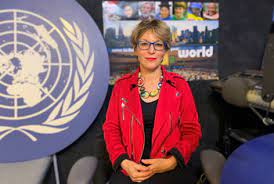
On 29 March 2021 Amnesty International announced the appointment of Dr. Agnès Callamard, a leading international human rights expert, as its new Secretary General, effective immediately.
As Secretary General, Dr. Callamard will be the Chief Executive of Amnesty’s International Secretariat and the principal spokesperson of the global Amnesty movement, which has some 10 million supporters, and offices in more than 70 countries.
“At a time when human rights are under unprecedented threat around the world, Dr. Callamard will lead, excite and rally the entire Amnesty movement to meet these challenges head-on,” said Sarah Beamish, Chair of the International Board, in announcing the appointment. “The combination of her intellectual acuity, her deep global human rights experience, and her courageous voice makes her highly qualified to front our movement. We are delighted she has accepted this challenge to take us boldly into our next phase.”
“Where governments and corporations seek to silence those who speak out against their abuses, to obfuscate the truth, and to undermine or reject human rights norms, the rigorous investigations and uncompromising campaigns of Amnesty International are more vital than ever.” Agnès Callamard
“I am honoured to take up the post of Secretary General and work alongside Amnesty’s supporters around the world so that together we defend and demand respect for all human rights for all,” Dr Callamard said.
Dr. Callamard, a French national, has built a highly distinguished career in the international human rights and humanitarian sectors, working across NGOs, academia, and the United Nations. Alongside her role as a United Nations independent human rights expert, she held the role of Director of the Global Freedom of Expression Project at Columbia University. Previously, she has been the Executive Director of the Freedom of Expression organization ARTICLE 19 and was the founder and Executive Director of HAP International (the Humanitarian Accountability Partnership).
Dr. Callamard worked with Amnesty International from 1995-2001, including as Chef de Cabinet for then-Secretary General Pierre Sané. She has led human rights investigations in more than 30 countries and published extensively on human rights, women’s rights, freedom of expression, refugee movements, and the methodology of human rights investigations.
Most recently, Professor Heyns was the was the Director of the Institute for International and Comparative Law in Africa at the University of Pretoria, and had also served as United Nations Special Rapporteur on extrajudicial, summary or arbitrary executions from 2010 to 2016. See: https://www.trueheroesfilms.org/thedigest/laureates/dfa7df54-3cb2-465c-9655-d139b5486591.
His friends and colleagues pay tribute to a giant of global human rights:
The Centre for Human RightsCHR, in its tribute, called him their “founding father, a trail-blazer, and a constant source of inspiration and encouragement. He was our dynamic initiator-in-chief. He played a pioneering role in positioning the Centre as a pan-African centre of excellence. Constantly brimming with new ideas and grand schemes, plans and projects, he propelled the Centre into new directions and challenged it to explore different dimensions. “To Christof, if something could be conceived, it could be achieved.”
On Monday, the CHR created a memorial page on Facebook in his memory which, within hours, contained hundreds of entries from all over the world. The reactions registered on Facebook, on WhatsApp groups and emails speak volumes about how highly Heyns the man, the mentor, the “rock star” and the lawyer was regarded.
Arnold Tsunga, chairperson of the Southern Africa Human Rights Defenders Network
“The sudden demise of Professor Christof Heyns is a real tragedy to us as a community of human rights activists in southern Africa. As a member of the United Nations Human Rights Committee his contribution to production of General Comment Number 37 on the right to peaceful assembly is invaluable at a time when we are experiencing democratic regression and authoritarian consolidation globally. He is irreplaceable and shall be sorely missed. May his soul rest in eternal peace.”
Raenette Taljaard, former politician and independent analyst
“Prof Christof Heyns was one of South Africa and the world’s great thought leaders and moral authorities on human rights. Beyond his contribution to academia, his work as a UN Special Rapporteur stands as a towering tribute to the right to life in a world where algorithms and lethal autonomous weapons can make life and death decisions that are core to who we are as humanity. His work will live on in the many principled human rights fighters and public intellectuals that have had the privilege to encounter him and to be mentored by him. He will be greatly missed.”
Jason Brickhill, human rights lawyer and former director of the Constitutional Litigation Unit at the Legal Resources Centre
“So very shocked and sad to hear that Christof Heyns has passed on. Such a gentle, wise and self-deprecating soul. I was lucky to be taught by him (about the African regional human rights system) and he supervised my master’s dissertation just over a decade ago. “He did so much to advance human rights in very real, meaningful ways, especially with his work on the African regional system (he was a true pan-Africanist!) and on the right to life at the UN. “He shared with me and other classmates his ‘struggle approach’ to human rights, which is still the foundation for how I think about the law’s role in the world. We will remember you, Christof, and carry with us the ideas that you shared.”
Faranaaz Veriava, head of the Basic Education Rights programme at SECTION27
“Around 1995 I was young and green in my first job, working in the Idasa Pretoria office. Ivor Jenkins, our director, talked me into meeting with a Moroccan delegation visiting the Centre for Human Rights at the University of Pretoria to discuss human rights law. Prof Christof Heyns hosted the delegation. I was probably terrible in that meeting but Prof Heyns was warm and encouraging and I became very interested in the work of the Centre. The next year I registered in the LLM programme at the centre which was a pioneering programme at the time for students all over Africa interested in human rights law. Later I would teach annually in that same programme. Much later, complete my doctorate through the UP law school and then teach at the law school myself. If Ivor Jenkins had not thrown me in at the deep end that day, I wonder if I would have any history with UP – a historically Afrikaans university – and that is now such a positive part of my life. RIP Prof Heyns, a warm and inspiring man and pioneer in human rights law.”
Alice Brown, former resident coordinator, Ford Foundation
“What sad news. I met Christof in the late 1980s through my work with the Ford Foundation. Christof was an innovative human rights academic who was a trailblazer for a number of important rights-focused training programs. In addition, in all my interactions with him over the years, I found him to be a very decent human being.”
Thuli Madonsela, former Public Protector, current law trust chair in social justice, University of Stellenbosch
“What a sad occasion. He was such a mensch, resolutely devoted to developing leaders to advance democracy and human rights in this continent. “The news of the passing of Christof Heyns hit me like a ton of bricks. I have known Christof for all my grown-up life. “A quintessential professional, Christoff invested a lot in developing leaders that are anchored in a sound knowledge and values system regarding human rights and democracy. He was passionate about the African continent and building scholarship in the continent on human rights, democracy and the rule of law. “The country, the continent and the entire world is poorer because of Christof Heyns’ untimely passing, yet richer because of the legacy he leaves behind. It is said leaders do not die, they multiply. Christof leaves pieces of himself among the many scholars he nurtured and policymakers he touched. May his great soul Rest In Peace.” Christof Heyns and the Outlaws — the rock and roll band of the Faculty of Law at the University of Pretoria. Formed in 2007, they always played at the annual Faculty Festival. (Photo: Yolanda Booyzen)
Bongani Majola, Chairperson of the SA Human Rights Commission
“We deeply mourn the untimely passing of Prof Christof Heyns, a giant in the promotion of human rights. Empowering young people has always been his passion. I first met him in the late 1980s/early 1990s when he and I ran a project that sought to open opportunities for final-year law students from the then historically black universities to find placements in commercial law firms. At the time, it was hard for many black law graduates to be admitted to articles of clerkship and even harder – almost impossible to get placed in commercial law firms.
“Another empowerment project that Christof Heyns employed significantly to empower the youth was the moot court competitions that he and his colleagues took beyond the borders of South Africa, the borders of SADC and beyond the boundaries of the African continent. Recently, he had taken the promotion of human rights to schools in the basic education environment, a project that he passed on to the South African Human Rights Commission once it had taken a firm hold among basic education schools.
“He was a visionary who believed in investing in the youth in order to build a strong human rights culture. The country has lost a true human rights activist. He will be sorely missed.”
Edwin Cameron, former Constitutional Court judge
Really terribly shocked and saddened by Christof’s sudden death yesterday. He was a meticulous, conscientious, persistent, courageous fighter for justice and human rights.
Rose Hanzi, director of Zimbabwe Lawyers for Human Rights
“Very very sad. Prof Heyns raised the African continent high with his contributions at the ACHPR [African Commission on Human and Peoples’ Rights] and UN.”
Muleya Mwananyanda, Amnesty International
“So saddened to learn of the death of Prof Christof Heyns. Many of you may know him. He was my teacher and I suspect a few others on this group. What a dedicated Human Rights Activist he was. Beyond teaching, he will be remembered for drafting the General Comment on Freedom of Assembly … he was until his death after a heart attack while hiking a member of the HRC. MHSRIP”
Steven LB Jensen, Danish Institute for Human Rights
“Oh no, this is so sad and shocking news. I met him twice – first in Lund for a two-hour conversation just the two of us and again at the Danish Institute for a meeting on collaborations between our institutions. He was a wonderful person and so easy to engage with. He will be sorely missed by many all around the world.” DM/MC
From Amnesty International staff:
Dr. Agnès Callamard, the new Secretary General of Amnesty International, said: “Christof Heyns was a brilliant human rights lawyer and thinker, gentle person…He leaves behind such an extraordinary legacy.”
Shenilla Mohamed, Executive Director of Amnesty International South Africa, said: “A mighty baobab has fallen! The untimely death of renowned human rights law expert, Professor Christof Heyns, is a devastating loss. In Africa the Baobab Tree is considered a symbol of power, longevity, presence, strength and grace. Professor Heyns was a baobab in the human rights world. A giant in his field, he fought hard for a just world. As Director of the Institute for International and Comparative Law in Africa, he was involved in a number of critical initiatives. His contributions included: Chair of the UN independent investigation on Burundi, leading on the drafting of UN human rights guidelines on peaceful assembly and the use of less lethal weapons. He also served as the UN Special Rapporteur on extrajudicial executions. Hamba Kahle Professor Heyns, Ke a Leboga, Enkosi, Ngiyabonga, Thank you for your service to humanity. You have left indelible footprints and we salute you!”
Sam Dubberley, Amnesty International’s Head of Crisis Evidence Lab, said: “Christof’s support for establishing a hub of Amnesty’s Digital Verification Corps at the Centre for Human Rights at the University of Pretoria was unequivocal. He gave time, advice and space for this project to emerge, and welcomed the Amnesty team on every visit to Pretoria despite his always frantic schedule. Christof made everyone feel valued, and was a source of energy and sage advice. How he will be missed.”
Netsanet Belay, Research and Advocacy Director of Amnesty International, said: “Words fail me to express the profound sense of loss with the sudden passing of Professor Heyns. Like many, I had the privilege of working with him and benefited much from his wisdom, mentorship and guidance. He was a rare breed, one of Africa’s great legal minds, a passionate human rights defender and a kind, passionate, humble person. He nurtured and cultivated a cadre of human rights experts and activists in Africa, including by transforming the human rights centre at the University of Pretoria into a world class institution that produced Africa’s leading human rights scholars and practitioners. His publications on various human rights issues in leading academic journals are testament to his brilliance, wisdom and dedication. He was a true pan-Africanist, as exemplified in his work to champion and strengthen the African Commission on Human and Peoples’ Rights. His passing is also a great loss to Amnesty International. As [recently] as last week we were working with Professor Heyns on the draft report by the African Commission on Human and Peoples’ Rights on the use of force by law enforcement officials in Africa. We shall strive to ensure his last vision [is seen] to fruition. Rest in peace dear brother!”
Rasha Abdul-Rahim, Director of Amnesty Tech, said: “It was devastating to hear of the passing of Professor Heyns. All my thoughts and prayers are with his family and friends. Not only was Christof a renowned human rights expert, he was fiercely justice-focused and an absolute joy and pleasure to work with. Christof wrote the seminal Human Rights Council report that put the human rights risks of autonomous weapons systems on the agenda. He was always extremely generous with his expertise and time. This is a huge loss for the human rights movement, and we will miss him deeply.”
Avner Gidron, Senior Policy Adviser on Amnesty International’s Law and Policy Programme, said: “I worked most closely with Professor Heyns on The Minnesota Protocol on the Investigation of Potentially Unlawful Death in 2016. It’s a practical tool for human rights defenders and advocates around the world seeking accountability for unlawful killings; and it is now a small, but important, part of Christof’s vast legacy. As well as his importance as a brilliant legal mind, scholar and activist, I will remember Christof for actually embodying human rights values: being an incredibly warm, generous and considerate human being. His death is a tremendous loss for the human rights movement, and an unimaginable tragedy for his family and friends.”
Simon Crowther, legal advisor at Amnesty International, said: “Christof was a legal giant who approached his work with kindness, humility, humour and immense intelligence. He will be greatly missed.”
Anja Bienert, Senior Programme Officer at Amnesty International Netherlands, said: “I first met Christof in 2013 and immediately felt connected to him: his sharp mind, the careful and perfectly articulated thoughts on the many pressing human rights issues, but more importantly, his warm and welcoming personality, with whom it was a pleasure to discuss. Since then, he was an ongoing source of inspiration to me and a great ally in the fight for greater protection of human rights. He constantly strove not just to write excellent publications, but to have a real impact for the respect of human rights across the world. We will miss him incredibly. It will be our mission to uphold his great legacy in the field of human rights.”
Living close to Turkey, I follow the situation there perhaps with more worry than others. And nothing good seems to happen:
Turkish police detained three district heads of the pro-Kurdish Peoples’ Democratic Party (HDP) and seven others in Istanbul on Friday over alleged links to militants, police said, two days after a court case began over banning the party.
Separately, Turkey’s Human Rights Association (IHD) co-chairman Ozturk Turkdogan was arrested by police at his home, IHD said, prompting human rights groups to call for his release. Turkdogan was then released on Friday evening, the association said.
Responding to the arrest today of Öztürk Türkdoğan, the president of Turkey’s Human Rights Organisation, Esther Major, Amnesty International’s Senior Research Adviser for Europe, said:
“The detention of Öztürk Türkdoğan is outrageous. With ink barely dry on the Human Rights Action Plan announced by President Erdoğan two weeks ago, his arrest reveals that this document is not worth the paper it is written on.
After over three years in jail without a conviction, one of Turkey’s highest-profile detainees, Osman Kavala, is “not optimistic” that President Tayyip Erdogan’s planned reforms can change a judiciary he says is being used to silence dissidents. A philanthropist, 63-year-old Kavala told Reuters that after decades of watching Turkey’s judiciary seeking to restrict human rights, it was now engaged in “eliminating” perceived political opponents of Erdogan’s government. Kavala was providing written responses via his lawyers to Reuters’ questions days after Erdogan outlined a “Human Rights Action Plan” that was said will strengthen rights to a free trial and freedom of expression. See: https://humanrightsdefenders.blog/2020/09/16/osman-kavala-and-mozn-hassan-receive-2020-international-hrant-dink-award/ and
Not surprisingly this is leading to reactions, such as a bipartisan letter penned by 170 members of the US Congress to Secretary of State Antony Blinken, in which the lawmakers have urged President Joe Biden’s administration to consider the “troubling human rights abuses” in Turkey. “President Recep Tayyip Erdogan and his Justice and Development Party have used their nearly two decades in power to weaken Turkey’s judiciary, install political allies in key military and intelligence positions, crack down on free speech and (the) free press,” the letter said. Dated 26 February but made public on 1 March, the letter asks Washington to formulate its policy regarding Turkey considering human rights, saying that the Erdogan administration has strained the bilateral relationship.
On top of this Turkey has pulled out of the world’s first binding treaty to prevent and combat violence against women by presidential decree, in the latest victory for conservatives in President Recep Tayyip Erdogan’s ruling party. The 2011 “Istanbul Convention| [SIC], signed by 45 countries and the European Union, requires governments to adopt legislation prosecuting domestic violence and similar abuse as well as marital rape and female genital mutilation. Conservatives had claimed the charter damages family unity, encourages divorce and that its references to equality were being used by the LGBT community to gain broader acceptance in society. The publication of the decree in the official gazette early Saturday sparked anger among rights groups and calls for protests in Istanbul. Women have taken to the streets in cities across Turkey calling on the government to keep to the 2011 Istanbul Convention.
Gokce Gokcen, deputy chairperson of the main opposition CHP party said abandoning the treaty meant “keeping women second class citizens and letting them be killed.” “Despite you and your evil, we will stay alive and bring back the convention,” she said on Twitter. Last year, 300 women were murdered according to the rights group We Will Stop Femicide Platform. The platform called for a “collective fight against those who dropped the Istanbul convention,” in a message on Twitter. “The Istanbul convention was not signed at your command and it will not leave our lives on your command,” its secretary general Fidan Ataselim tweeted.
Kerem Altiparmak, an academic and lawyer specializing in human rights law, likened the government’s shredding of the convention to the 1980 military coup. “What’s abolished tonight is not only the Istanbul convention but the parliament’s will and legislative power,” he commented.
This day leads to a plethora of statements and actions. Here a small selection focusing on women human rights defenders:
Credit: UN Women/Yihui Yuan.
Joan Kuriansky – a volunteer with The Advocates For Human Rights – writes: “Celebrating International Women’s Day in 2021 compels us to pause and examine the lessons of the past year- the COVID pandemic, economic distress and the surging mandate of Black Lives Matter. Each phenomenon has made so more visible the challenges that historically face women across the globe. Importantly, these forces have also made it clear how connected we are to each other whether in neighborhoods within miles of our home or across a continent and the extraordinary role that women play in making lives better and more just in every corner of the world. The UN and UNDP estimate that the pandemic will push 47 million more women and girls below the poverty line. Our upcoming workshop at the NGO CSW65 Virtual Forum will highlight the economic and other inequalities women face as a result of the pandemic. Register here: https://bit.ly/3dmVgSk Event link: https://bit.ly/2NhPoiL“
Women have been in the forefront of promoting peaceful solutions to conflict -conflict that has often included the rape and violation of women, the death of those in combat and the destruction of communities. Women have been in the forefront of promoting peaceful solutions to conflict -conflict that has often included the rape and violation of women, the death of those in combat and the destruction of communities. The Soldiers Mother’s Committee in Russia and Chechnya [[https://www.trueheroesfilms.org/thedigest/laureates/3371DC1A-42AE-44BF-E349-26987BF98314], or the Women of Liberia Mass Action for Peace founded by Leymah Gbowe or the 3 co-founders of Black Lives Matter have inspired all of us. And as we documented in our work with the Liberian Truth and Reconciliation Commission, women have a key role to play in the post-conflict and peacebuilding process.], or the Women of Liberia Mass Action for Peace founded by Leymah Gbowe or the 3 co-founders of Black Lives Matter [https://www.trueheroesfilms.org/thedigest/laureates/4f840e00-be5d-11e7-b953-f7f66015c2f3]have inspired all of us. And as we documented in our work with the Liberian Truth and Reconciliation Commission, women have a key role to play in the post-conflict and peacebuilding process.
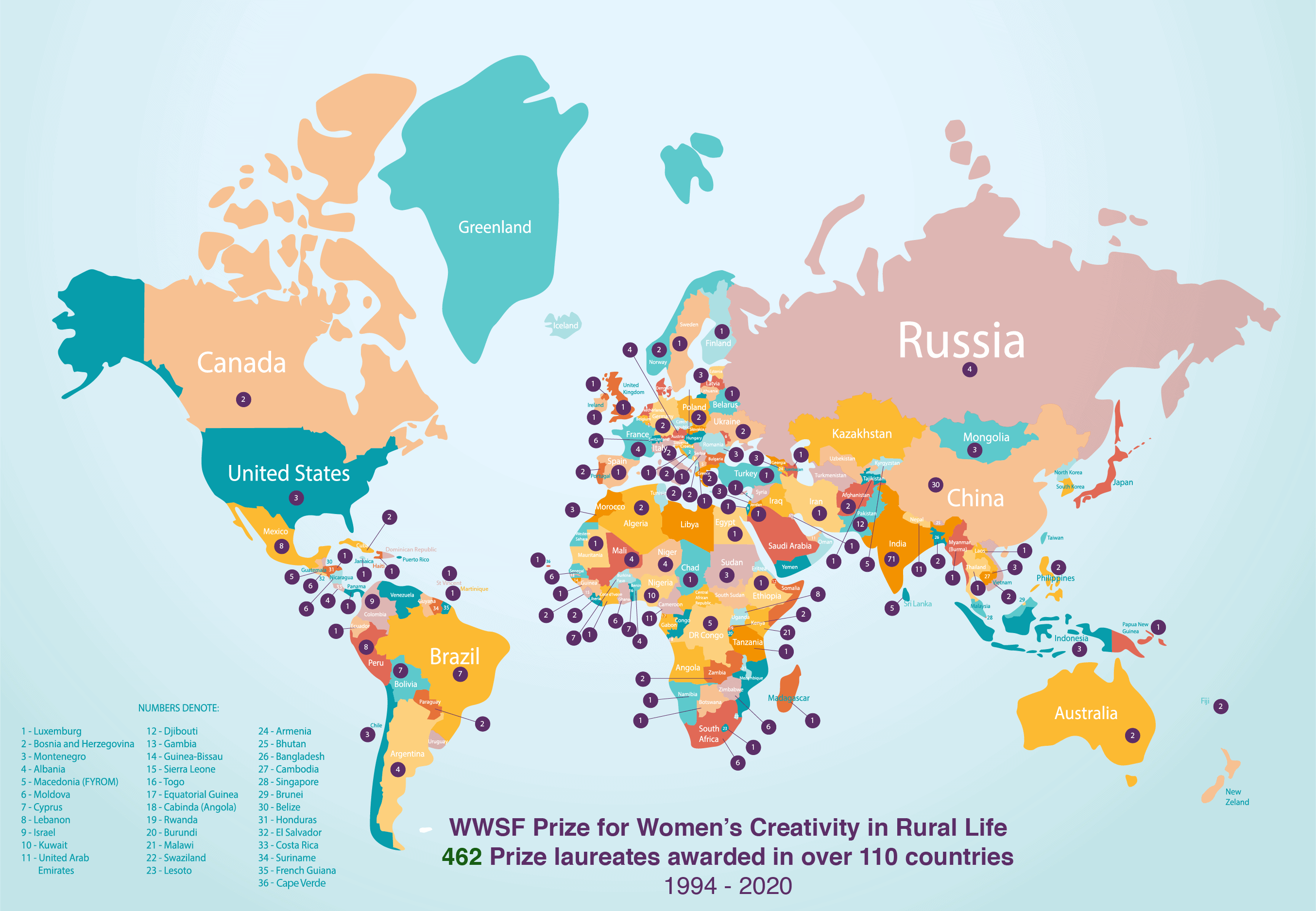
The WWSF introduces 60 Heroes out of 462 Laureates awarded with the WWSF Prize for Women’s Creativity in Rural Life (1994-2020)
UN Women this year is celebrating women’s leadership in all its forms and calling for women and feminists across the world to claim their space in leadership and decision-making. Presently, only 7.4 per cent of Fortune 500 companies are run by women. Despite progress and many broken records, women continue to be excluded in certain sports. Systemic barriers, gender bias, discrimination and gender stereotypes continue to hold women back from rising in STEM careers. Women and girls have been leading climate action and environmental movements, but men occupy 67 per cent of climate-related decision-making roles. 119 countries have never had a woman leader. Just 25 per cent of national parliamentary seats are held by women.
Around the world, the space for civil discourse and movements is shrinking. The media plays a critical role in amplifying women’s voices and stories and drawing attention to key issues. But, with women holding only 27 per cent of top management jobs in media organizations, More than one-third of women’s employment is in agriculture, increasing women’s access to land and providing better support for women farmers is, therefore, essential. The majority of negotiators, mediators, and signatories in peace processes are still men.
Amnesty International stated that across the Middle East and North Africa (MENA), despite some limited reforms, women continue to face entrenched discrimination and daily violence amid the abject failure of governments to stamp out arbitrary arrests, abductions, assassinations, so-called “honour” killings and other forms of gender-based violence, said Amnesty International, marking International Women’s Day. ..Inadequate government action to protect women from gender-based violence and address impunity has long perpetuated this form of abuse. As a first step, authorities must publicly condemn all forms of gender-based violence and dismantle discriminatory structures that facilitate such abuse – such as male guardianship,” said Heba Morayef. “They must also ensure that the rights of survivors are protected, that survivors can safely access justice and that perpetrators are held to account. Survivors must be able to access adequate shelter, psycho-social support as well as legal and other services.”
All over the world, a female-driven political awakening is taking place. But this is met with prosecution by the State and persecution by self-vigilante groups. Their experiences are marred with patriarchal subordination, sexualised violence, threat and harassment. They face severe retribution and systematic abuse, even at the hands of the State. It is important to have an enabling environment for these soft targets who face heightened risks as compared to their male counterparts. International obligation requires the State to stop criminalising women defenders, write SHRUTIKA PANDEY & MRINALINI MISHRA in The Leaflet of 8 March 2021.
MRT of 8 March 2021 states that International Women’s Day is not celebrated, a struggle is commemorated – that has not ended- in favor of justice, peace and freedom of each one of them. In a strict sense, feminism seeks make gender issues visible. Under that idea, there should be no censorship or exclusion. Nevertheless, What about trans women? While it is true that some people do not agree that they are part of the feminist movement, the reality is that they also suffer from violence, harassment and discrimination. Therefore, they are in the same fight. With that said, we present to you 8 recognized trans women in history
The Media Line of 7 March writes that “Women face uphill climb to equality in the MENA region” Activists and human rights groups paint a daunting portrait of the equality landscape between the genders in the MENA region, as they prepare to mark International Women’s Day, March 8. The coronavirus epidemic, certainly, did not help the plight of women this past year. Still, going forward, the largest issues facing women in the Middle East were entrenched long before the pandemic hit.
In the Gulf Cooperative Council (GCC) countries, women’s rights defenders have it tough. While prominent Saudi women’s activist Loujain al-Hathloul was freed last month after almost three years in prison [see https://www.trueheroesfilms.org/thedigest/laureates/1a6d84c0-b494-11ea-b00d-9db077762c6c], Samar Badawi [https://www.trueheroesfilms.org/thedigest/laureates/eaed8641-4056-4130-a5ff-fb7bf289cece], Nassima al-Sadah, Nouf Abdelaziz and Maya’a al-Zahrani remain in jail after their 2018 arrests on charges of advocating for women’s rights. “Those who are behind bars are the champions for the change that took place,” Khalid Ibrahim, executive director of the Gulf Centre for Human Rights, told The Media Line, referring to women driving.
In UCANews of 8 March 2021 Mary Aileen D. Bacalso, Manila writes that “Millions of women the world over suffer from discrimination, abuse, poverty, gender-based violence and human rights violations, of which enforced disappearance is one of the most cruel forms. Enforced disappearance, which motivated the international community to establish the International Convention for the Protection of All Persons from Enforced Disappearance, especially affects women. On this significant occasion, I remember the faces and voices of women I personally encountered from 50 countries that I visited during my almost three decades of advocacy for the cause of the disappeared. Many of them carried pictures of their loved ones. Some gave me every bit of information with the hope against hope to find light amidst the dark night of the disappeared.”
Euromed uses the occasion for a series of podcast. For our first episode, the story you are about to hear is that of Mozn Hassan, a woman human rights defender and the founder and executive director of Nazra for Feminist Studies, a feminist organisation working in Egypt and the MENA region on gender equality and combatting violence against women. See: https://www.trueheroesfilms.org/thedigest/laureates/38B5C337-72F5-C4DE-BC95-95094B9E3939
On 2 March 2021, Mary Lawlor – the UN’s Special Rapporteur on Human Rights Defenders – wrote for Amnesty International “Five years after Berta Cáceres was murdered, states are still failing to protect human rights defenders". With the presentation of Mary Lawlor's report to the UN Human Rights Council coming up this week, the piece is worth reading in full:
She was one of hundreds of human rights defenders killed that year because of their peaceful work, and hundreds more defenders have been killed every year since. Those responsible are rarely brought to justice. Although some have been convicted of Berta Cáceres’ killing, others believed to have been involved have still not been brought to account. [see: https://humanrightsdefenders.blog/2020/06/10/nina-lakhanis-who-killed-berta-caceres-reviewed/]
It’s a familiar and continuing story, in Honduras and across the world, where those responsible for the murder of a human rights defender often enjoy impunity. This week I am presenting my latest report to the United National Human Rights Council in Geneva, and it is on the killings of human rights defenders and the threats that often precede them.
At least 281 human rights defenders were killed in 2019, with a similar number expected to be recorded for 2020. Unless radical, immediate action is taken we can expect hundreds more murders again this year.
Since 2015, at least 1,323 defenders have been killed. While Latin America is consistently the most affected region, and environmental human rights defenders like Berta Cáceres often the most targeted, it is a worldwide issue. At least 281 human rights defenders were killed in 2019, with a similar number expected to be recorded for 2020
Between 2015 to 2019, human rights defenders were killed in at least 64 countries, that’s a third of all U.N. member states. Those collecting the data agree that underreporting is a common problem. The number of defenders killed is likely significantly higher than the figures we have.
We know that on every continent, in cities and the countryside, in democracies and dictatorships, governments and other forces threatened and killed human rights defenders. Many, like Berta Cáceres, are killed in the context of large business projects.
Why do so many governments and others kill human rights defenders working peacefully for the rights of others? Partly because they can, safe in the knowledge that there is unlikely to be the political will to punish the perpetrators.
While some states, particularly those with high numbers of such killings, have established dedicated protection mechanisms to prevent and respond to risks and attacks against human rights defenders, defenders often complain that the mechanisms are under-resourced.
And in too many cases, businesses are also shirking their responsibilities to prevent attacks on defenders or are even responsible for the attacks.
These murders are not random acts of violence that come out of nowhere. Many of the killings are preceded by threats. As Amnesty International noted, Berta Cáceres’ murder “was a tragedy waiting to happen,” and she had “repeatedly denounced aggression and death threats against her. They had increased as she campaigned against the construction of a hydroelectric dam project called Agua Zarca and the impact it would have on the territory of the Lenca Indigenous people.”
And yet her government failed to protect her, as so many governments fail to protect their defenders. Since I took up this mandate in May last year I have spoken to hundreds of human rights defenders. Many have told me about their real fears of being murdered, and have shown me death threats made against them, often in public.
They tell me how some threats shouted in person, posted on social media, delivered in phone calls or text messages, or in written notes pushed under a door. Some are threatened by being included on published hit lists, receiving a message passed through an intermediary or having their houses graffitied. Others are sent pictures through the mail showing that they or their families have been under long-term surveillance, while others are told their family members will be killed. It’s not that complicated. It’s up to states to find the political will to prevent killings by responding better to threats against human rights defenders, and to hold murderers to account
I’ve been told by defenders about a coffin being delivered to the office of an NGO; a bullet being left on a dining room table in their home; edited pictures of them being posted on Twitter, showing them having been attacked with axes or knives; and an animal head being tied to the door of their organization’s office.
Those advocating for lesbian, gay, bisexual, transgender and intersex rights, and women and transgender human rights defenders, are often attacked with gendered threats, and targeted because of who they are as well as what they do. Women and LGBTI people demanding rights in a patriarchal, racist, or discriminatory contexts often suffer specific forms of attack, including sexual violence, smears and stigmatisation.
The murders of human rights defenders are not inevitable, many are signalled in advance, and yet governments fail, year after year, to provide enough resources to prevent them, and fail, year after year, to hold the murderers to account. In fact, states should not only end impunity but also publicly applaud the vital contribution that human rights make to societies.
This week I’ll again remind the U.N. that their members are failing in their moral and legal obligations to prevent the killings of human rights defenders. It’s no use for government officials to wring their hands and agree that the murder of Berta Cáceres and other defenders is a terrible problem and that someone should do something about it.
It’s not that complicated. It’s up to states to find the political will to prevent killings by responding better to threats against human rights defenders, and to hold murderers to account.
On Wednesday 24 February 2021 Megan Thornberry writes about a report by the University of York and others concluding that human rights defenders have been at increased risk during pandemic, and calls for UK government to provide better protection.
There is a dearth of serious and quantitative research into how human rights defenders experience diplomatic support and interest in their work. So, this report – published by Amnesty International UK and the Center for Applied Human Rights, in collaboration with the Law Society of England and Wales, Peace Brigades International UK, Bond and other NGOs – is most welcome.
Research by the University’s Centre for Applied Human Rights (CAHR) and Amnesty International UK shows that during the COVID-19 pandemic, 94 per cent of human rights defenders interviewed reported face threats, death threats, abuse, and harassment.
It is reported that only 6 per cent of these activists, including lawyers, journalists, women’s rights defenders, and LGBTQ+ activists, received support from the UK government.
Researchers interviewed 82 human rights defenders from seven countries about their experiences with UK government support:
40% had contacted the UK government embassy as part of their work in the last two years, where as 70% had contacted other embassies
75% could not recall a time in which their resident country’s UK embassy had spoken out in support of specific at-risk human rights defenders
31% had been in contacted by their UK embassy seeking to further its knowledge about the struggles for human rights
The report highlights the increased threats to LGBTQ+ rights during the pandemic, as poor job security has driven many to return to unsafe and unaccepting hometowns in order to live with family. Particularly in countries such as Russia and the Philippines, this has placed LGBTQ+ activists at a higher risk of abuse. LGBTQ+ activists have also reported an increase in discrimination towards LGBTQ+ groups due to their being blamed for the pandemic.
Dr Piergiuseppe Parisi, a research associate at the Human Rights Defender Hub at CAHR and direct contributor to the report, said: “Human rights defenders are active agents of positive change. The UK should make sure that they are recognised as such, that they have the means to carry on with their crucial work and that they have access to rapid response protection mechanisms when they are in danger.”
Kate Allen, Director of Amnesty International UK, said: “The UK government has pledged to stand up for human rights defenders around the world. We now need to see words turned into action. The UK’s voice has power. It’s time to use it and to be a world leader.”
On 24 February 2021 a new Amnesty International investigation has identified a campaign of spyware attacks targeting Vietnamese human rights defenders (HRDs) from February 2018 to November 2020. Amnesty International’s Security Lab attributes these attacks to an attack group known as Ocean Lotus. The group has been active since at least 2014, targeting the private sector and HRDs. The spyware attacks investigated and identified by the Security Lab are the latest evidence of a crackdown on freedom of expression in Viet Nam and against Vietnamese activists outside the country.
Viet Nam’s history of Online Repression: Human rights are increasingly under attack both offline and online in Viet Nam. Over the past 15 years, repression linked to online activity has intensified, leading to a wave of harassment, intimidation, physical assault, and prosecution. Amnesty International has documented multiple cases of the arrest and prosecution of HRDs in Viet Nam in retaliation for their online expression since 2006. That year, former prisoner of conscience Truong Quoc Huy was arrested at an internet café in Ho Chi Minh City. Many activists and bloggers have been convicted for “conducting propaganda against the state.” Human rights blogger Nguyen Ngoc Nhu Quynh (Mother Mushroom) was sentenced to 10 years in prison in June 2017 on such charges. Activists and bloggers also face frequent physical assaults by officials or government-connected thugs. [see: https://www.trueheroesfilms.org/thedigest/laureates/70F07728-1E21-4D33-F0BE-460D5A188B9D] Police place activists under house arrest or briefly detain them to prevent them from participating in public events. The government also uses travel bans to prevent activists and HRDs from going abroad and engaging with the international community. In December 2020, Amnesty International published “Let Us Breathe”, a report documenting the widespread criminalization, online harassment and physical attacks faced by activists and bloggers and the rising numbers of individuals detained for peacefully expressing themselves online. [see: https://humanrightsdefenders.blog/2020/12/01/facebook-and-youtube-are-allowing-themselves-to-become-tools-of-the-vietnamese-authorities-censorship-and-harassment/ ]
What is Ocean Lotus?
The cyber-security industry, comprised of individual and company-based researchers, routinely researches and publishes information about attack groups targeting companies and governments. The industry often gives informal names to groups they continuously track based on each group’s unique tactics and tools. Ocean Lotus (also commonly called APT32 or APT-C-00) is one of these groups. The first known Ocean Lotus attack happened in 2014. It targeted US-based NGO Electronic Frontier Foundation (EFF), the Associated Press international news organization and two Vietnamese activists. This group was named Ocean Lotus in a report from the Chinese company Qihoo 360 in May 2015. In 2017, the American cyber-security company FireEye published a report linking the 2014 EFF and other attacks to this same Ocean Lotus. Over the years, Ocean Lotus has developed a sophisticated spyware toolkit comprised of several variants of Mac OS spyware, Android spyware and Windows spyware. They also strategically compromise websites in order to identify visitors and conduct further targeting. More recently, Ocean Lotus was found creating fake media websites based on content automatically gathered online. A significant part of the group’s activities is the targeting of HRDs and civil society. In 2017, the cyber-security company Volexity revealed that over 100 websites were compromised, including many belonging to human rights organizations from Viet Nam, in an attack campaign that they attributed to Ocean Lotus. Numerous other spyware attacks linked to Ocean Lotus against human rights organizations have also been reported, such as the targeting of the Cambodian human rights organization, LICADHO, in 2018. The cyber-security company FireEye describes Ocean Lotus’ operations as “aligned with Vietnamese state interests” based on the list of targeted companies and civil society groups they identified. In December 2020, Facebook published a threat report linking Ocean Lotus’ activities with a Vietnamese company named CyberOne Group. Although Amnesty International was unable to independently verify any direct connection between Ocean Lotus and Cyber One or with the Vietnamese authorities, the attacks described in this investigation confirm a pattern of targeting Vietnamese individuals and organizations.
Attacks against HRDs.
The investigation conducted by Amnesty International’s Security Lab revealed that two HRDs and a non-profit human rights organization from Viet Nam have been targeted by a coordinated spyware campaign. This spyware allows to fully monitor a compromised system, including reading and writing files, or launching other malicious programs. Bui Thanh Hieu is a blogger and pro-democracy activist who goes by the name “Nguoi Buon Gio” (The Wind Trader). He writes about social and economic justice and human rights. He is also critical of the Vietnamese government’s policies and actions regarding its relations with China, including the dispute over sovereignty in the South China Sea. Due to his writing and activism, the licence for an Internet Café he owned in Ha Noi has been revoked and he has been repeatedly subjected to reprisals. He was arrested along with activists Pham Doan Trang [see https://www.trueheroesfilms.org/thedigest/laureates/fe8bf320-1d78-11e8-aacf-35c4dd34b7ba] and Nguyen Ngoc Nhu Quynh in 2009 and was kept in police custody for 10 days for“abusing democratic freedoms to infringe upon the interests of the State.” In January 2013, Bui Thanh Hieu reported on the trial of 14 dissidents in Viet Nam and was arrested and released a few days later. He has since left Viet Nam and has lived in exile in Germany since 2013. Vietnamese Overseas Initiative for Conscience Empowerment (VOICE) is a non-profit organization supporting Vietnamese refugees and promoting human rights in Viet Nam. It was established in 1997 in the Filipino capital of Manila as a legal aid office, before formally registering in the United States in 2007. The organization continues to operate out of Manila and has helped 3,000 Vietnamese refugees resettle in third countries. Since 2011, VOICE has operated an internship programme to equip Vietnamese people with knowledge, skills, and tools to become effective activists. The organization has faced reprisals from Vietnamese authorities several times. Staff at VOICE told Amnesty International that employees and interns have been harassed, banned from travelling, and have had their passports confiscated when they have returned to Viet Nam. Furthermore, state-owned media has run an unsubstantiated smear campaign against VOICE, claiming that the organization is a terrorist group. A blogger residing in Viet Nam has also been confirmed as an Ocean Lotus target by the Security Lab, but due to security concerns their name has been omitted. They are known to have spoken out publicly about the Dong Tam incident on 9 January 2020, when approximately 3,000 security officers from Ha Noi raided Dong Tam village and killed the 84-year-old village leader Le Dinh Kinh. Three police officers were also killed. The Dong Tam incident sparked a national outcry in Viet Nam. Activists and bloggers were at the forefront of the public debate online, prompting a nationwide crackdown on on-line expression by the government. VOICE and the two bloggers all received emails containing spyware between February 2018 and November 2020. These emails pretended to share an important document. They either contained spyware as an attachment or as a link. Once downloaded and launched on the victim’s computer, the spyware would then open a decoy document in line with what the email pretended to share to trick the victim in believing the file was benign. Screenshot of the email sent to VOICE in April 2020The spyware identified by the Security Lab were either for Mac OS or Windows systems. The Windows spyware was a variant of a malware family called Kerrdown and used exclusively by the Ocean Lotus group. Kerrdown is a downloader that installs additional spyware from a server on the victim’s system and opens a decoy document. In this case, it downloaded Cobalt Strike, a commercial spyware toolkit developed by the American company Strategy Cyber and routinely used to lawfully audit the security of organizations through simulated attacks. It allows an attacker full access to the compromised system including executing scripts, taking screenshots or logging keystrokes. Unlicensed versions of Cobalt Strikes have been increasingly used by attack groups, including Ocean Lotus, over the past three years.Example of Windows Spyware Infection Chain from one of the emails received The Mac OS Spyware was a variant of a malware family for Mac OS developed and used exclusively by Ocean Lotus, analysed by Trend Micro in April 2018 and November 2020. It allows the perpetrator to access system information, download, upload or execute files and execute commands.
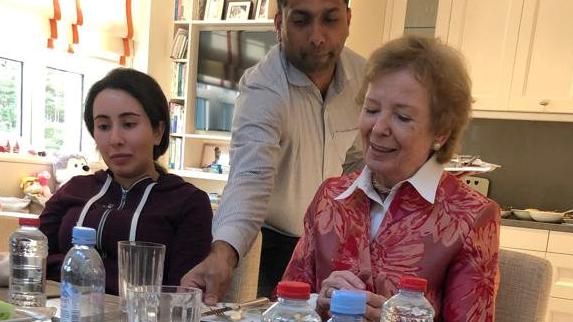
There’s a saying in show business that you can spend 20 years becoming an overnight star. In politics, the same is true in reverse, as the sad case of Mary Robinson and Princess Latifa of Dubai shows. Mary Robinson as former UN High Commissioner for Human Rights and a widely-honored human rights defender [with 9 awards to her name, see: https://www.trueheroesfilms.org/thedigest/laureates/4E44A265-DF1A-45E2-8C6A-3294577EA211] was a much admired personality. For that reason I was reluctant to highlight her role in the sad case back in December 2018, although many human rights NGOs (including AI and HRW) did criticise her.
The former UN human rights Commissioner has been criticised for describing the daughter of Dubai’s ruler as “troubled” after she was reportedly forcibly returned to the kingdom after fleeing months earlier. Mary Robinson met with Sheikha Latifa on 15 December and photos released showed the two women smiling together in what appears to be a home. Ms Robinson, the former president of Ireland, told BBC’s Radio 4 the princess was a “vulnerable” woman with a “serious medical situation” for which she was receiving psychiatric care.
Immediately the highly publicised and bizarre meeting in December was panned by rights groups for being stage-managed by the Emirati ruling family (Ms Robinson is a personal friend of Sheikha Haya, a wife of the Dubai ruler.) Defending her comments, Ms Robinson released a statement saying: “I am dismayed at some of the media comments on my visit and I would like to say I undertook the visit and made an assessment, not a judgement, based on personal witness, in good faith and to the best of my ability.”
Toby Cadman, a barrister instructed by Detained in Dubai to act on behalf of the princess, told Review: “I am extremely disappointed that she would lend herself to what has been interpreted as a whitewash. “We have requested an independent assessment of [Princess Latifa’s] state of mind and her physical well-being. It’s up to the United Nations to be satisfied that she is not being detained against her will.” Then in January 2019 Mrs Robinson stated that she contacted Michelle Bachelet, UN high commissioner for human rights. On 18/02/2019 Former Irish president Mary Robinson said she has no regrets over getting involved in the case of a Dubai princess who had tried to flee the UAE.
Exactly one year on from Latifa’s dramatic capture at sea, rights groups told The Independent they were deeply concerned about her welfare and still had no knowledge of what happened to her between her March 2018 capture and December when she reappeared in Dubai. Pleas to the UAE for an independent delegation to be granted access to the royal to assess her, have gone unanswered. “Human Rights Watch is still calling for her to be able to travel to a third country where we and other monitors can be assured she is able to speak freely and independently without fear of retaliation,” Hiba Zayadin of HRW told The Independent. “Ms Robinson is not equipped to make an evaluation of Latifa, who was in the presence of people who allegedly forcibly disappeared her,” she added.
Amnesty International put out a similar call. “There has been no reply from the UAE, which has never responded to anything regarding domestic human-rights abuses that Amnesty International has attempted to raise with them,” said Amnesty’s Devin Kenney.
Now, 16 February 2021, after new footage was shared by BBC Panorama, in which the 35-year-old daughter of the ruler of Dubai has confirmed that commandos drugged her as she tried to flee by boat and flew her back to detention and accused her father, Sheikh Mohammed bin Rashid Al Maktoum, of holding her “hostage”, Mrs Robinson has stated that she feels “horribly tricked” by the family of Princess Latifa Al Maktoum, and has joined in calls for immediate international action in order to establish Princess Latifa’s current condition and whereabouts
Robinson is rightly revered for her life’s work, and that work is not invalidated by her unacceptable interference in the case of Princess Latifa. But her reputation has been tarnished by this.