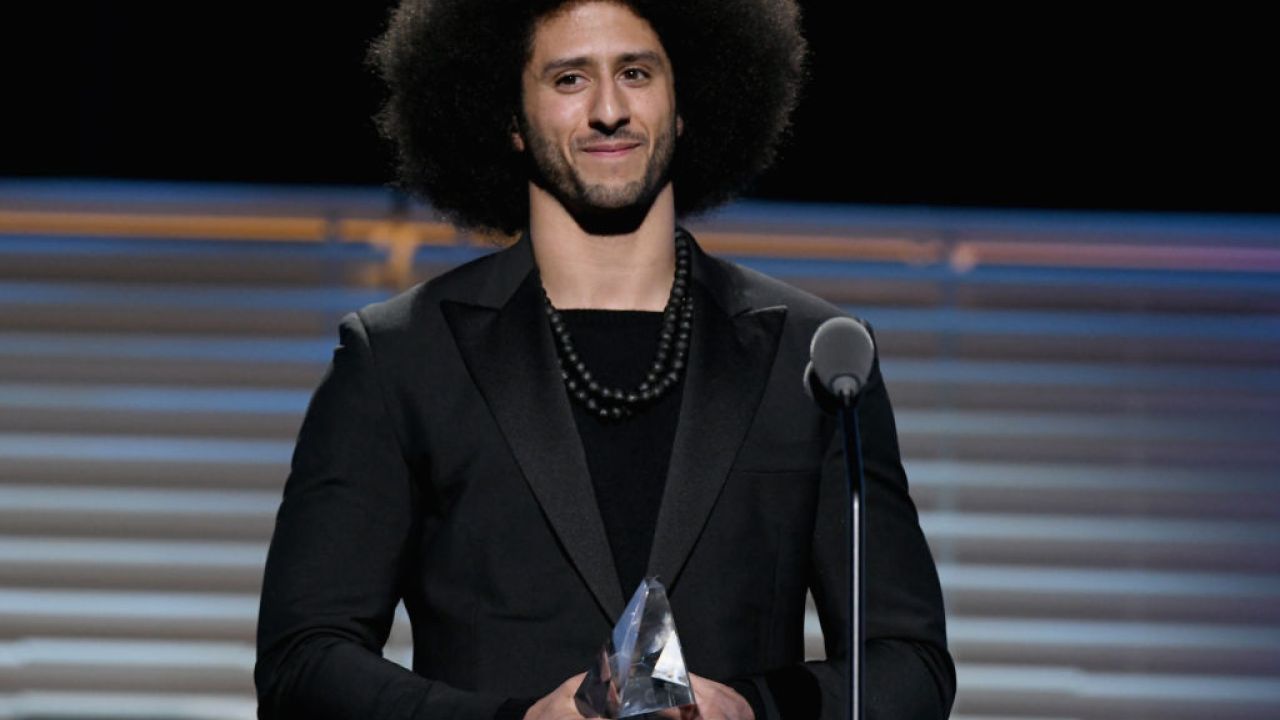
SPORTS ILLUSTRATED 2017 Sportsperson of the Year Show on December 5, 2017 at Barclays Center in New York City.
USA athlete and activist Colin Kaepernick has been honoured with Amnesty International’s Ambassador of Conscience Award for 2018. The award was officially presented at a ceremony in Amsterdam, Netherlands, on 21 April 2018, to coincide with the 50th anniversary of AI Netherlands.
“The Ambassador of Conscience award celebrates the spirit of activism and exceptional courage, as embodied by Colin Kaepernick. He is an athlete who is now widely recognised for his activism because of his refusal to ignore or accept racial discrimination,” said Salil Shetty, Secretary General of Amnesty International. [for more on this and other human rights awards see: http://trueheroesfilms.org/thedigest/awards/ambassador-of-conscience-award]
[During the 2016 pre-season of the American National Football League, Colin Kaepernick knelt during the US national anthem, as a respectful way of calling for the country to protect and uphold the rights of all its people. The bold move was a response to the disproportionate numbers of black people being killed by police. It sparked a movement that follows a long tradition of non-violent protests that have made history. While the polarised response to the “take-a-knee” protest has ignited a debate about the right to protest and free speech, Colin Kaepernick has remained focused on highlighting the injustices that moved him to act. His charity, the Colin Kaepernick Foundation, works to fight oppression around the world through education and social activism, including through free “Know Your Rights” camps which educate and empower young people.]
“I would like to thank Amnesty International for the Ambassador of Conscience Award. But in truth, this is an award that I share with all of the countless people throughout the world combating the human rights violations of police officers, and their uses of oppressive and excessive force. …said Colin Kaepernick. “While taking a knee is a physical display that challenges the merits of who is excluded from the notion of freedom, liberty, and justice for all, the protest is also rooted in a convergence of my moralistic beliefs, and my love for the people.“
See also: https://humanrightsdefenders.blog/2016/05/07/ais-ambassador-of-conscience-award-2016-shared-by-angelique-kidjo-and-african-youth-groups/
The targeted assassination of Marielle Franco, a 38-year-old human rights defender and Rio de Janeiro city councilor known for denouncing police abuses and extrajudicial executions, is a sickening development that must be fully investigated, said Amnesty International 0n 15 March. Marielle was shot dead in Rio de Janeiro’s Estacio neighborhood on Wednesday 14 March 2018. Her driver was also killed and a press officer was injured in the attack.
“This a chilling development and is yet another example of the dangers that human rights defenders face in Brazil. As a member of Rio de Janeiro’s State Human Rights Commission, Marielle worked tirelessly to defend the rights of black women and young people in the favelas and other marginalized communities,” said Jurema Werneck, Amnesty International’s Brazil director.
In 2016, Marielle was elected to the Rio de Janeiro city council. Two weeks ago, she was appointed rapporteur for a special commission that the city council created to monitor the ongoing federal intervention in Rio de Janeiro and the militarization of public security.
Gunmen riding in another vehicle carried out the attack, shooting indiscriminately before fleeing the scene without stealing anything, the Civil Police of Rio de Janeiro State said. The attack came a day after the 38-year-old city councilor had posted a message on social media criticizing the deployment of army soldiers to Rio’s sprawling “favelas”.
On 13 February 2018 fourteen international and regional rights organizations stated that the Egyptian government has trampled over even the minimum requirements for free and fair presidential elections (planned 26-28 March). The government of President Abdel Fattah al-Sisi has relentlessly stifled basic freedoms and arrested potential candidates and rounded up their supporters. “Egypt’s allies should speak out publicly now to denounce these farcical elections, rather than continue with largely unquestioning support for a government presiding over the country’s worst human rights crisis in decades,” the groups said.
The authorities have successively eliminated key challengers who announced their intention to run for president….The current atmosphere of retaliation against dissenting voices and the increasing crackdown against human rights defenders and independent rights organizations have made effective monitoring of the elections extremely difficult for domestic and foreign organizations. Media reports have said that the number of organizations that were granted permission to monitor the elections was 44 percent fewer than in the last presidential election in 2014 and that the number of requests, in general, has gone down. Several opposition parties called for boycotting the elections. A day later al-Sisi threatened to use force, including the army, against those who undermine “Egypt’s stability and security.” On February 6, the Prosecutor-General’s Office ordered an investigation against 13 of the leading opposition figures who called for a boycott, accusing them of calling for “overthrowing the ruling regime.” “Seven years after Egypt’s 2011 uprising, the government has made a mockery of the basic rights for which protesters fought,” the groups said. “Egypt’s government claims to be in a ‘democratic transition’ but move further away with every election.”
So, the two side events that are coming up are extremely valuable as the national space for dissent is nihil:
The Situation of Human Rights and Upcoming Elections in Egypt: Facilitating Radicalisation is an event organised by the Cairo Institute for Human Rights Studies (CIHRS) and co-sponsored by ISHR, that will take place on 9 March at 13:30 to 15:00 in Room XXIII. The event will address the deterioration of the human rights situation in Egypt and the dangers of the international community’s failure to respond.
Human rights violations in Egypt and in the Gulf States is an event organised by FIDH, CIVICUS, the Gulf Center for Human Rights. It will take place on 15 March 2018 at 15:00 till 16:00 in Room XXIII. The event will focus on the interlinked plight of human rights defenders in Egypt and the Gulf States as both are facing ongoing targeting by their own governments as well as explore measures for coordination and advocacy at the international level.
In the same context there is the press release of Friday 2 February 2018 in which a number of organisations, under the umbrella Committee for Justice (CFJ), condemned Tuesday’s execution of Egyptian Tayseer Odeh Suleiman after he was convicted in Ismalia’s military court in what they said was a flawed trial inconsistent with international legal and human rights standards. Suleiman, 25, was hanged after the Supreme Military Court of Appeals rejected the defence put foward by his lawyer without explaining the reasons behind the rejection….CFJ confirmed that there had been an unprecedented increase in the implementation of death sentences in Egypt, based on illegal proceedings, with 26 people executed between the end of December last year and the present. CFJ further asserted that the reason for the death penalties “under the guise of combating terrorism” were misleading and in violation of basic standards of a fair trial indicating significant flaws in Egypt’s judicial process.
On only a few days ago (2 March 2018), responding to reports from his family and colleagues that Ezzat Ghonim – a prominent Egyptian human rights lawyer and director of the NGO, Egyptian Coordination for Rights and Freedoms – failed to return home from work yesterday, Najia Bounaim, Amnesty International’s North Africa Campaigns Director, said: “Given the highly-charged political climate in Egypt and the clampdown on dissent in the lead-up to the presidential elections, we are deeply concerned that Ezzat Ghonim may have been forcibly disappeared. ”
Amnesty International published on 26 February 2018 an insightful interview with an Egyptian youth arrested in the august 2013 protests.
Weeks after his release Ibrahim Halawa spoke to AIu about his time in an Egyptian prison. Now walking the streets of Dublin his freedom has changed his life forever. Ibrahim Halawa was arrested aged just 17 along with hundreds of others during protests on 16 and 17 August 2013 around al-Fath Mosque in downtown Cairo. The protests descended into violence which the security forces responded to by using excessive lethal force that left at least 97 people killed, but according to Amnesty International’s research there is no evidence to indicate he was involved in any of the violence. The organization believes he was jailed for peacefully protesting. He was eventually acquitted on 18 September 2017, but 442 others were sentenced after a deeply unfair mass trial. Amnesty International is calling for all others who have been sentenced for peacefully exercising their rights to be immediately released.
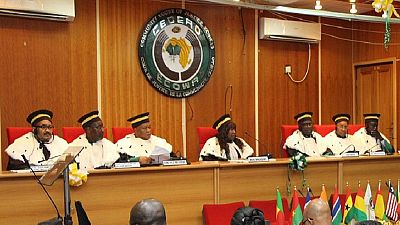
On 14 February 2018 the Economic Community of West African States (ECOWAS) Regional Court of Justicefound that Jammeh-era media laws violated the right to freedom of expression in The Gambia. The Federation of African Journalists and four Gambian journalists filed a case in the court in December 2015. They argued that their rights, including their rights to freedom of expression, had been violated by Gambia through the enforcement of laws criminalising libel, sedition and false news in the country. Two of the journalists were also subject to torture whilst in the custody of the then notorious National Intelligence Agency following their arrests under these laws.
Arguments were heard by the court in October 2016. The case was supported by the Media Legal Defence Initiative (MLDI). Amnesty International filed an amicus brief in the case along with other freedom of expression organisations. Although press freedom has improved under the new government of President Barrow, who was inaugurated in January 2017, these restrictive laws are still in place.
The ruling will set an important precedent as many countries within West Africa continue to use similar repressive laws to silence freedom of expression, and hinder the vital work of journalists, in violation of international and regional human rights law. The ball is now in the court of the Adama Barrow government to repeal the said laws in order to realign the law to respect media freedoms. Amnesty International’s West Africa researcher has hailed the ruling as a historic day for The Gambian media landscape. “Today is an historic day for Gambia’s journalists and human rights defenders who, for decades, have suffered torture, imprisonment or exile just for exercising their right to freedom of expression,”Sabrina Mahtani said.
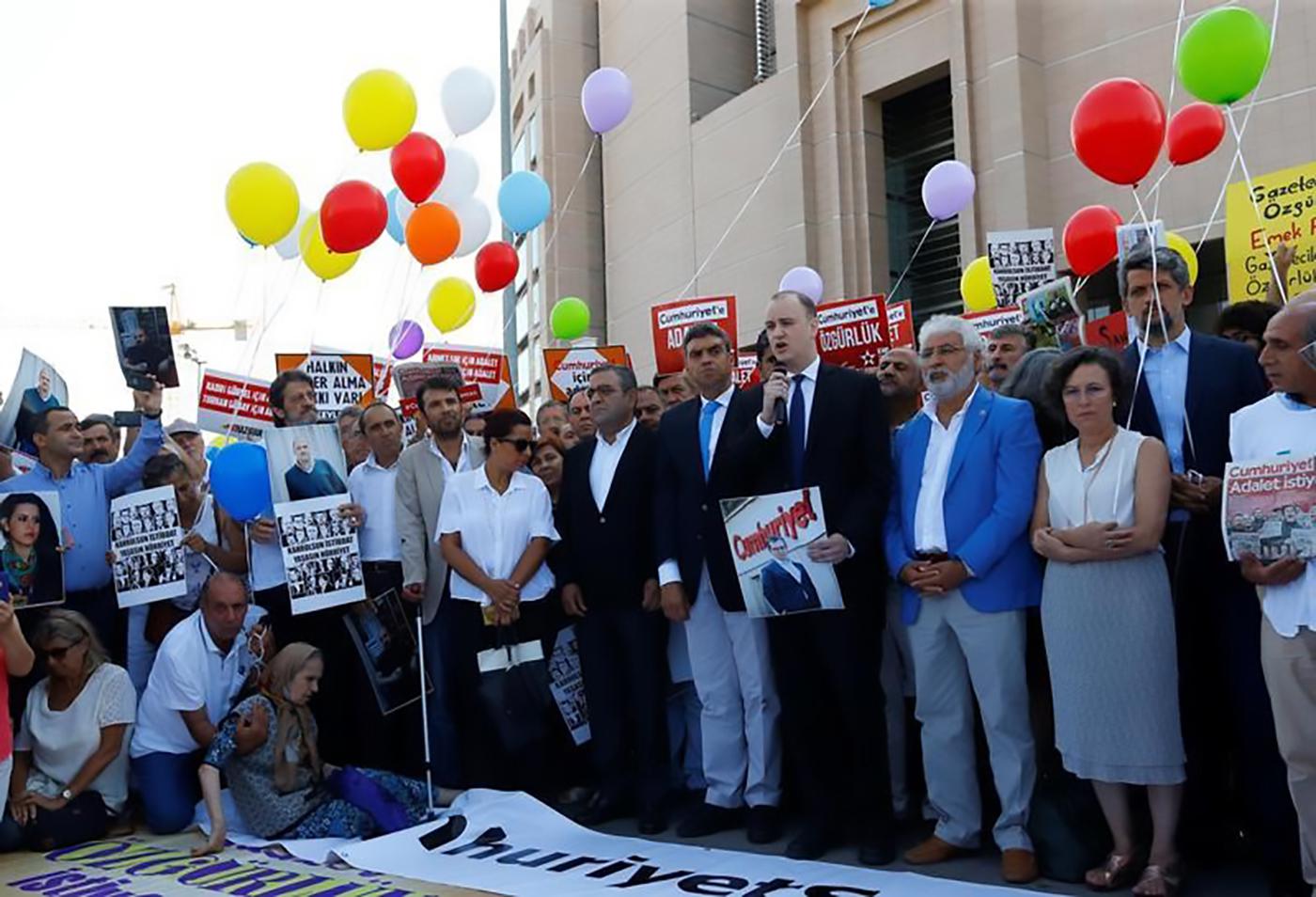
Following a decision by a court in Istanbul to conditionally release the Chair of Amnesty International Turkey, Taner Kılıç, after nearly eight months in detention, Gauri van Gulik, AI’s Europe Director said: “It is an enormous relief that Taner will soon be back with his wife and daughters, sleeping in his own bed for the first time in almost eight months. But we cannot forget that many other innocent people remain behind bars without a shred of evidence in Turkey.” “Today we take a brief moment to celebrate, but tomorrow we will continue our struggle to have all charges dropped against Taner, the Istanbul 10, and all other innocent victims wrongfully caught up in this vicious crackdown.”
NOTE: 1 February update in http://gkmen.com/2018/02/01/turkey-court-reverses-release-of-amnesty-head-taner-kilic/: “Andrew Gardner, a senior Amnesty researcher on Turkey, tweeted that Kılıç was transferred from prison custody to gendarmerie custody late Wednesday. While the Istanbul court rejected the appeal, it nonetheless sent the application to another court for a decision on Kilik’s detention. “This is devastating for Taner’s family and a disgrace to justice”,he added. The group said the next hearing in his trial has been set for June 21.
While Kılıç has now been released, the trial against him, director of Amnesty International Turkey İdil Eser, and the other nine human rights defenders on trumped-up terrorism related charges continues. [Kılıç was detained on June 6, 2017 and sent to jail three days later, where he has been ever since. Ten other activists “the Istanbul 10”, including Eser, were detained a month later. Eight of them were held for almost four months before being released on bail at their first hearing in October. The Istanbul 10 were accused of “membership of a terrorist organization,” a baseless allegation for which the prosecution has yet to provide any concrete evidence that would stand up to scrutiny. – https://humanrightsdefenders.blog/2017/11/22/celebrities-come-out-to-support-taner-kilic-amnesty-turkeys-chair-on-trial-today/ ]
Turkish police wrestle a lawyer to the ground outside of a courthouse in Turkey. (Photo: Social Media)
Ari Khalidi (Kurdistan24.net) reported on 30 January 2018 that an opposition lawmaker in Turkey revealed on Tuesday that authorities had arrested 572 lawyers during the one and a half year-long state of emergency in place since a failed military coup to topple the administration of President Recep Tayyip Erdogan. Republican People’s Party (CHP) lawmaker Senal Sarihan told a press conference at the Turkish Parliament that of the lawyers arrested, 488 faced maltreatment in police custody, as 79 of them were given prison sentences.
..Last week, the International Bar Association’s Human Rights Institute (IBAHRI) urged the Turkish government to stop persecuting lawyers.
“This situation demonstrates a flagrant disregard for the rule of law and is a deliberate attack on human rights defenders and legal professionals. We call on the Turkish government to bring an end to this deplorable situation and to adhere to international instruments,” IBAHRI’s Co-Chair Hans Corell said. According to IBAHRI, 1,488 lawyers were prosecuted, and 34 bar associations were shut down in Turkey.
Human Rights Watch in its World Report stated that Turkey “increased restrictions on the media, political opposition, and human rights defenders during 2017, on the back of a very narrow referendum“. Turkey also introduced a presidential system with insufficient democratic checks and balances against the president’s abuse of power. “Everywhere you look, checks and balances that protect human rights and rule of law in Turkey are being eroded” said Hugh Williamson, Europe and Central Asia director at Human Rights Watch. “The move to a presidential system, the ongoing state of emergency, and charges against opposition lawmakers have all weakened parliament, the courts are under ever tighter government control, and the crackdown on media and civil society deepens.”..
“We want to support all the courageous women and men who put their lives on the line in the struggle against torture, violence and despotism in Egypt,” said Markus Beeko, the Secretary General of Amnesty International in Germany, in a statement. For more information on this and other awards: http://trueheroesfilms.org/thedigest/awards/a-i-germanys-human-rights-award.
See also: https://humanrightsdefenders.blog/2017/11/10/helen-hunt-joins-list-of-celebrities-that-show-insensitivity-on-human-rights/
Ahead of the one-year anniversary (20 January) of the inauguration of US President Donald Trump, Margaret Huang, executive director of Amnesty International USA, said:
“While the policies of the Trump administration presented daunting challenges over the past year, we also saw the rise of a fierce and determined movement of people across the country and around the world standing up to defend human rights.
“Starting with the throngs of people braving the January cold to fill the streets on the very first day of his presidency and continuing throughout the year, we have taken heart in the galvanising spirit of resistance that has swept the world.
“We have marched alongside both seasoned activists standing up for women’s rights and we have welcomed those who have never actively protested before in denouncing Trump’s discriminatory Muslim ban.
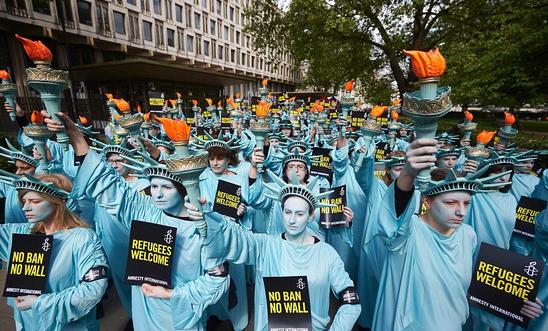
“We have placed welcome mats for refugees at the foot of Trump Tower, and filled London’s Grosvenor Square with 100 sombre Statues of Liberty standing in silent protest at the US Embassy.
“From Sydney to Madrid, human rights defenders have made it known that the politics of hate and fear have no place in the world we wish to build for ourselves and our children.
…
A year of human rights violations: Among other things in the past year, Amnesty has strongly criticised the Trump administration’s plan (reported earlier this week) to consider using nuclear weapons in response to a cyber-attack in the USA; the ending of “Temporary Protected Status” for over 250,000 people from El Salvador in the USA; the decision to recognise Jerusalem as the capital of Israel, its insistence on pushing ahead with a revised multi-country travel ban; an executive order affecting the Mexico-USA border which allows for the forcible return of people to life-threatening situations; the withdrawal from the Paris Agreement on climate change; the reinstatement of the “global gag rule”affecting funding for international women’s health programmes; its continued sale of military equipment to countries with poor human rights records; and the decision to continue the construction of the Dakota pipeline despite environmental and cultural concerns.
Then-incumbent Gambian President Yahya Jammeh arrives escorted by his bodyguards for an electoral rally on November 24, 2016. MARCO LONGARI/AFP/GETTY
Ousman Sonko, a former interior minister of Gambia suspected of human rights abuses who was arrested in January 2017, will have to remain in Swiss detention, the Swiss Federal Tribunal has ruled. Switzerland’s highest court has rejected an appeal by Sonko’s lawyers against a second prolongation of his detention. The Federal Tribunal said in a decision published in December that Sonko was still under urgent suspicion. As in a previous judgement on an appeal by Sonko, judges said they based their decision on independent reports by United Nations special observers on Gambia. These observers had not yet been questioned by the Office of the Attorney General (OAG) and the OAG also needed to go through files obtained from Gambia during the mutual assistance procedure, the latest judgement said. Trial International, an international justice organisation, accused Sonko of having personally taken part in what it described as torture between 2006 and 2016. Sonko served under ousted Gambian leader Yahya Jammeh. “As the head of detention centers, Sonko could not have ignored the large-scale torture that political opponents, journalists and human rights defenders suffered there,” said Benedict de Moerloose of TRIAL in a statement in 2017.
Barrow, the new President, had stated that he plans to install a truth and reconciliation commissionin the country in order to take account of alleged abuses under Jammeh, before deciding whether to attempt to prosecute the former president. In May 2017 in the wake of the launch of its global ‘brave’ campaign”, the Regional Director for West and Central Africa of AI, Alioune Tine, had called for justice for United Democratic Party (UDP) activist Ebrima Solo Sandeng, and for all victims of the Jammeh regime. “There must be justice for Ebrima Solo Sandeng and for all victims,” Alioune Tine told Freedom Newspaper. Alioune Tine said that, during his meeting with President Adama Barrow, he received assurances from the Gambian leader that there would be ‘zero tolerance’ for human rights abuses.
This blog has paid attention to many cases of harassment of human rights defenders in Chechnya, especially since two of the laureates of the MEA were linked to work there (the Joint Mobile Group (https://humanrightsdefenders.blog/2016/03/17/russia-defenders-attack-closing-office-un-joint-mobile-group-chechnya/) in 2013 and earlier Lyda Yusopova in 2004 http://www.martinennalsaward.org/hrd/lidia-yusupova/]. But things continue to be extremely difficult, as shown by case of Oyub Titiev, who heads the regional office of the Memorial, and was arrested last week. Open Democracy (on 12 January 2018) in partnership with OVD-Info, wrote about this and other politically-motivated arrests in Russia (see below in green). Front Line (12 January 2018), Amnesty International, the Council of Europe, US State Department, IFEX and others spoke out on the case.
On the morning of 9 January, Oyub Titiev (60) was detained by people wearing the uniform of traffic police officers. A friend of the human rights defender who witnessed the arrest from his car, said he had wanted to stop to speak with Titiev, but Titiev indicated he should drive past. Titiev’s lawyers were not allowed to see him for several hours. That evening Titiev was charged with possessing drugs (Article 228). He categorically denies the accusation. On 10 January police arrived at Titiev’s home looking for his son and brother, and when they did not find them they forced all the other family members out of the house, locked the doors and took the keys. The law enforcement officers wanted to use the fact they had the keys to influence Titiev’s relatives, since to gain entrance to the property the family members would need to go to the police station. On 11 January a court in closed session remanded Titiev in custody for two months.
Titiev took up the post of head of the Chechnya office of Memorial after the kidnapping in Grozny and subsequent murder of his predecessor Natalia Estemirova in July 2009. The Chechen public figure Ruslan Kutaev, who heads the Assembly of Peoples of the Caucasus, was also charged with illegal acquisition and possession of drugs. On 20 December 2017 he was released having served over three years in prison. There is evidence that Kutaev was tortured following his arrest. According to human rights defenders, the charges were trumped up.
The European Court of Human Rights is tired of hearing identical cases concerning torture in Russia, and has therefore asked Russia to pay compensation to Ildar Dadin on the basis of a simplified procedure. The European Court has proposed that Russia admit to violations of the prohibition on torture and inhuman treatment with regard to Ildar Dadin during the latter’s transfer to a prison colony and in the prison colony itself. The Court decided not to ask the Russian government for commentary.
In December 2015 activist Ildar Dadin was sentenced to three years in a general-regime prison colony for “repeated violation of the rules for holding public events” (Article 212.1 of the Russian Criminal Code). In 2014 Dadin had been arrested four times and fined for taking part in public protests. Later, his prison term was reduced to two-and-a-half years. On 22 February 2017 the Presidium of the Supreme Court quashed Dadin’s conviction.
Five members of the Moscow Public Monitoring Commission (PMC) have been banned from visiting Pre-Trial Detention Centre No. 1 (Matrosskaya Tishina) and the so-called Kremlin Central, which is on the territory of Matrosskaya Tishina. According to the authorities, this is because the five members of the PMC are witnesses in the criminal prosecution of another member of the PMC, Denis Nabiullin…