Archive for the 'human rights' Category

ICJ Report on freedom of information in South East Asia especially on-line

December 23, 2019
Malaysian cartoonist Zunar helps launch a report by the International Commission of Jurists at the Foreign Correspondents' Club of Thailand.  (Photo by Osama Motiwala/ICJ))
Malaysian cartoonist Zunar helps launch a report by the International Commission of Jurists at the Foreign Correspondents’ Club of Thailand.  (Photo by Osama Motiwala/ICJ))

On 16 December 2019 Dave Kendall wrote in the Bankok Post about the International Commission of Jurists(ICJ), having released a report called Dictating the internet: Curtailing free expression, opinion and information online in Southeast Asia. The report was presetned at the Foreign Correspondents’ Club of Thailand, where some of the human rights defenders featured in the case studies participated in a panel discussion. The Malaysian cartoonist Zunar, [https://humanrightsdefenders.blog/2019/07/18/fight-through-cartoons-zunar/] drew a cartoon live on stage; it showed a government figure placing handcuffs around the two ‘O’s in the word Google.

The ICJ has a slightly different take from other non-governmental organisations that seek to protect freedom of speech. For the ICJ, the law is both the problem and the solution: Southeast Asian governments use existing laws and draft new ones to stifle dissent, violating international statutes upholding freedom of expression that they themselves have signed onto. The report calls for governments in Southeast Asia to “repeal, amend or otherwise rectify existing legal and regulatory frameworks to bring them in line with their international obligations” — and argues that “legislation framed in human rights terms is also the best and most effective way to protect against the very real threats posed by the spread of hate speech, disinformation online, cyber-attacks and other cybercrimes.

From left: ICJ director of Asia and the Pacific Frederick Rawski, Myanmar surgeon Ma Thida, human rights defender Sutharee Wannasiri, Singaporean activist Jolovan Wham and Malaysian cartoonist Zunar (Photo by Dave Kendall)

“It’s not a pretty picture,Frederick Rawski, ICJ director of Asia and the Pacific told the forum. “Laws are used to harass and threaten human rights defenders, lawyers, journalists and others…New legal frameworks are being seen as an opportunity to consolidate and protect political power.” Corporations, too, have joined the party. “Businesses are using strategic lawsuits to avoid criticism, claiming they are protecting their businesses interests,Sutharee Wannasiri told the audience. [https://humanrightsdefenders.blog/2019/05/04/international-civil-society-week-3-human-rights-defenders-engaging-business/]. The human rights activist is out on bail.

Governments have often cited vague concepts of “national security” and “public order” to justify using disproportionate means to shut down opposing views, sometimes even when privately expressed. “I was sentenced to 23 years in prison in 1993,” said Dr Ma Thida, a Myanmar surgeon, writer, and human rights activist. “The first charge was ‘endangering national serenity’.” She said the use of speech-suppressing colonial-era laws such as the National Secrets Act has actually increased since Aung San Suu Kyi joined the Myanmar government.

Governments across Southeast Asia vary in the subtlety — or otherwise — they employ in using the law to stifle dissent. “The police were very nice to me,” recalled Jolovan Wham, a Singaporean civil and labour rights activist [https://humanrightsdefenders.blog/2019/02/24/human-rights-defender-jolovan-wham-in-singapore-sentenced-ngos-dismayed/]. “They asked me, ‘Is the room too cold? Would you like some biscuits?’ Singapore introduced its Protection from Online Falsehoods and Manipulation Act this year. “Singapore has a very good PR machine… they use democratic processes for authoritarian ends,” said Mr Wham. “They made a show of democratic consultation to justify this repressive law.

The ICJ report was welcomed by Sutawan Chanprasert, the founder of DigitalReach, a new organisation campaigning to protect digital rights in Southeast Asia. “The report shows that while technology gives more opportunities for people to express themselves on social media, the state is moving to control the online space too,” she told the Bangkok Post. “Under repressive ‘fake news’ laws, any content can be interpreted as ‘fake’, ‘false’ and ‘misleading’. And tech has provided a new kind of threat to freedom of expression– digital surveillance of political dissidents.

Thailand: Amnesty and UN Rapporteur agree on misuse of lese-majeste

December 23, 2019

Thailand: Amnesty International published a special 30-page report “They Cannot Keep Us Quiet” on Wednesday 11 December 2019. It is sub-titled “The criminalization of activists, human rights defenders and others in Thailand.” It was released hours after David Kaye, the UN Special Rapporteur on freedom of opinion and expression, after meetings on Tuesday launched a scathing attack on what he called misuse of laws prohibiting defamation of the monarchy. “Thai authorities are waging a campaign to criminalise and punish dissent by targeting civil society and political activists who peacefully exercise their rights to freedom of expression and assembly,” the Amnesty report said.

Mr Kaye said at a media briefing: “Lese-majeste provisions have no place in a democratic country. I urge the authorities of Thailand to take steps to revise the country’s Criminal Code and to repeal the law that establishes a justification for criminal prosecution.

And both singled out the refusal of the regime to back bail for dissident Jatupat Boonpatararaksa, better known as Pai Daodin.

https://wellstonjournal.com/un-envoy-amnesty-denounce-regime-ways.html

https://wellstonjournal.com/un-envoy-amnesty-denounce-regime-ways.html

Escazú Agreement to protect environmental human rights in Latin America stalling

December 23, 2019
Credit Wikipedia Commons

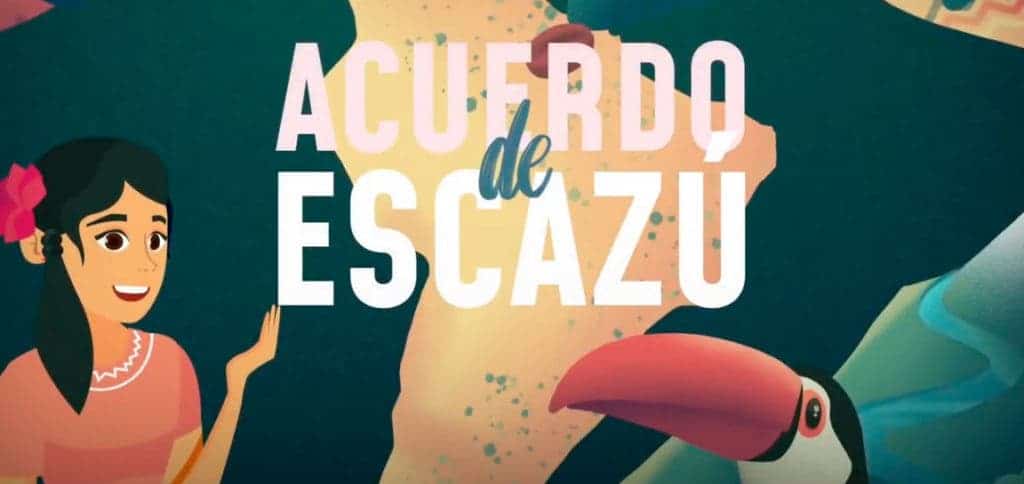
Despite being signed a year ago, the agreement hasn’t entered into force yet as it requires 11 of Latin America and the Caribbean’s 33 countries to ratify it. Only five have done that so far: Bolivia, Guyana, Saint Kitts, and Nevis, Saint Vincent and the Grenadines, and Uruguay. A group of 16 countries have signed it but not ratified it: Colombia, Antigua and Barbuda, Argentina, Brazil, Costa Rica, Ecuador, Granada, Guatemala, Haiti, Jamaica, Mexico, Nicaragua, Panama, Paraguay, Peru, Dominican Republic and Saint Lucia. Another group of 10 countries has not signed it: Bahamas, Barbados, Belize, Cuba, Dominica, El Salvador, Honduras, Suriname, Trinidad and Tobago, Venezuela and Chile.

The NGO Global Witness tracks every year the number of people killed because of standing up for their rights and defending the environment. In 2018, the figure reached 164 people, with more than half taking place in Latin America – the most violent region for environmental defenders in the world. [https://humanrightsdefenders.blog/2019/07/30/in-2018-three-murders-per-week-among-environmental-human-rights-defenders/]

A recent journalistic project called Land of Resistants, looked at the situation faced by environmental defenders in Latin America. They were subject to 1.356 attacks and incidences of violence between 2009 and 2019, according to the findings. Up to 50% of the attacks were targeted at people from ethnic minorities.

https://www.zmescience.com/science/escazu-agreement-16122019/

The unsatisfactory ‘end’ to the Khashoggi investigation?

December 23, 2019
Main media (here BBC) have reported it but as I have devoted several posts to the Khashoggi case [https://humanrightsdefenders.blog/tag/jamal-khashoggi/], I wanted to be complete:

A court in Saudi Arabia has sentenced five people to death and jailed three others over the murder of the journalist Jamal Khashoggi last year. The Saudi authorities said it was the result of a “rogue operation” and put 11 unnamed individuals on trial. A UN expert said the trial represented “the antithesis of justice”. “Bottom line: the hit-men are guilty, sentenced to death. The masterminds not only walk free. They have barely been touched by the investigation and the trial,” Special Rapporteur Agnes Callamard wrote on Twitter. (A report released by Ms Callamard concluded in June that Khashoggi’s death was an “extrajudicial execution” for which the Saudi state was responsible, and that there was credible evidence warranting further investigation that high-level officials, including Crown Prince Mohammed bin Salman, were individually liable.)

The shadow cast by the grisly murder of Jamal Khashoggi has hung over Saudi Arabia’s international reputation for more than a year now. The ruling princes, especially the all-powerful Crown Prince Mohammed bin Salman, will be hoping Monday’s verdicts draw a line under the whole affair. That may be wishful thinking. The two most senior suspects – dubbed “the masterminds” – have walked free after a trial shrouded in secrecy.

At a news conference in Riyadh on Monday, Mr Shaalan said the public prosecution’s investigations had shown that “there was no premeditation to kill at the beginning of the mission”…Ms Callamard dismissed as “utterly ridiculous” the assertion that the killing was not premeditated, noting that in one of the purported audio recordings from the consulate two Saudi officials were heard discussing how to cut up and transport Khashoggi’s body just minutes before he entered the consulate.

A statement by the Saudi public prosecution said a total of 31 individuals were investigated over the killing and that 21 of them were arrested. Eleven were eventually referred to trial at the Riyadh Criminal Court and the public prosecutor sought the death penalty for five of them. Human Rights Watch said the trial, which took place behind closed doors, did not meet international standards and that the Saudi authorities had “obstructed meaningful accountability”.

“Are You With Me?” – the life of Kevin Boyle

December 23, 2019

One Man’s War for Human Dignity: The Extraordinary Life of Kevin Boyleis the title of a piece by Charles Norchi (law professor) in Global Geneva of 6 December 2019. It is about the new book by Mike Chinoy about the life and work of Kevin Boyle, the Northern Irish human rights activist: “Are You With Me? Kevin Boyle and the Rise of the Human Rights Movement”. It chronicles the life of a man who spanned civil rights in Northern Ireland and the human rights movement from the halls of academia to international organizations and tribunals.

Boyle, a scholar-teacher-advocate-counselor who, like Eleanor Roosevelt, occupied multiple roles in the human rights movement, played a significant role in helping to bring an end to this turmoil which also affected the United Kingdom itself, Ireland, Europe and the United States. Yet he remained an unsung hero, until this book.

…Chinoy delivers the reader to a front row seat of the late 20th Century human rights canvass – the Northern Ireland civil rights movement, advocacy before the European Court of Human Rights, academia, civil society and the flowering human rights movement. Boyle was at the forefront of it all. From his perch at the Queen’s University Law Faculty in Belfast, he drafted proposals for resolving the Northern Irish conflict. He also shone a light upon the abuses perpetrated by the British army and Northern Ireland police in a landmark case to the European Commission on behalf of seven Northern Irish men who were interned without trial, beaten and tortured. He mobilized international law on behalf of victims of torture, unjust imprisonment, discrimination and defended freedom of expression, belief and association.

Boyle with former Irish president Mary Robinson during her stint as United Nations High Commissioner for Human Rights in Geneva (1997-2002).

Boyle also guided Amnesty International’s campaign against apartheid in South Africa, and spearheaded efforts to defend Salman Rushdie as Director of Article 19. Yet he never neglected human rights teaching, because students were the future. So he Directed the University of Essex Human Rights Law Centre and was founding Director of the Irish Centre for Human Rights at the National University of Ireland at Galway. When President Mary Robinson became United Nations High Commissioner for Human Rights, she wisely appointed Boyle her chief legal advisor – so he moved to Geneva.

This human rights law professor, advocate and activist died of lung cancer at age sixty-seven. At the time my University of Maine School of Law colleague Orlando Delogu who taught with Boyle at Galway observed, “He was single minded in his defence of oppressed people. The breadth of his interests was quite amazing, but always behind the scenes, the use of law – never violence.” Boyle helped lay the foundation for expanded human rights protections across the planet and inspired generations of scholars and activists.

How did Chinoy choose the title for this book? Boyle was first a university teacher. While lecturing he would pause and ask his students, “Are you with me?” It was a two-fold question. Did they understand the material? And would they be with him on the front line in the fight for human rights? “Are you with me?”

Are You With Me? will be launched at Essex University on 19 March 2020, with book events to follow in Dublin, Belfast, London, Galway and  Oxford. it can be pre-ordered through Lilliput Press: https://www.lilliputpress.ie/product/are-you-with-me

One Man’s War for Human Dignity: The Extraordinary Life of Kevin Boyle

“to the streets” – the new battlecry of the human rights movement?

December 22, 2019

The Economist of 14 November 2019 contains a timely article on “Economics, demography and social media only partly explain the protests roiling so many countries today“. Two pieces published more or less simultaneously this month go into this question in relation to the human rights movement. Is #TakeToTheStreets the ‘new’ tool for human rights defenders?

The first is by Cate Brown in Open Democracy of 11 December “The era of state mobilization is over: Welcome to the streets”, – ss civilian protesters take to the streets to demand their rights, human rights leaders consider a future of citizen-led activism.

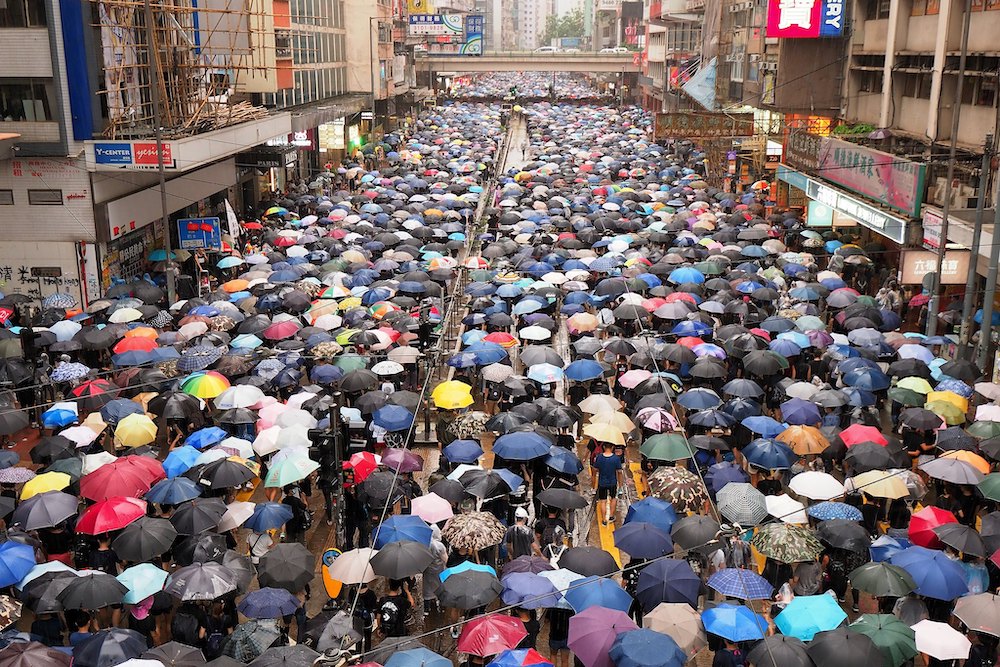
Protestors in Hong Kong gather against emergency anti-mask legislation, passed in response to months of demonstrations. Photo: Etan Liam/Flickr (CC BY-ND 2.0).

States are no longer trusted as representatives of popular interests or reliable guarantors of human rights, even in democracies. In response, civilian protesters have flooded the streets of major global capitals to demand immediate government action.

In Baku, demonstrators rallied for their right to assembly. In Beirut, citizens are calling for an end to government corruption. In Baghdad, protesters demand electoral reform, despite the deadly response of Iraqi security forces. In Santiago, dissent against a four percent increase in metro fares became a rallying cry for larger social reforms. And in Hong Kong, citizens have vowed to make ‘weekday chaos’ the new normal, adapting their tactics after six months of unanswered calls for political autonomy. Search the trending hashtag #TakeToTheStreets and you’ll find citizen-led anti-Trump and anti-Brexit movements in the United States and the UK. Search the #GiletsJaunes and you’ll find France’s infamous Yellow Vest movement celebrating their protest anniversary one year on.

…..quick concessions have failed to quiet broader calls for political reform. Instead, the single-issue protest movements have metastasized, gained momentum, and demonstrated staying power in the streets. Social media videos, like clips of Madi Karimeh, Lebanon’s ‘DJ of the Revolution’, or of the 170,000-person human chain linking protesters from Lebanon’s northern capital in Tripoli to its southern capital in Tyre, have helped build a sense of unity and vision among city-level protest movements…“Citizens are again claiming their rights in the streets, but there’s an important difference this year,” says Blavatnik School Professor of Practice of Public Integrity Chris Stone. “Citizen protesters are asking a new question: can we create a notion of rights enforcement that doesn’t depend on states?” It’s important for human rights organizations to consider this question. For years, the human rights movement has relied on parallel actions by frontline human rights defenders and global advocacy organizations like Human Rights Watch and Amnesty International. Frontline activists have played a central role in documenting incidents of abuse, convening civil society and amplifying messages across social networks. Groups like Human Rights Watch and Amnesty International then strengthened their campaigns with rigorous investigation and documentation, and provided an important bridge to pliable state leaders and UN representatives.

But with a cadre of autocratic leaders like Turkey’s President Recep Tayyip Erdogan, or populist leaders like US President Donald Trump, Russia’s President Vladimir Putin, and Brazil’s President Jair Bolsonaro leading some of the world’s most influential states, Human Rights Watch Executive Director Kenneth Roth suggests a tactical pivot towards nontraditional human rights allies and coalitions of smaller or midsize states.

“We used to look towards Geneva, New York, DC, and Brussels,” confirms a senior researcher at the Egyptian Initiative for Personal Rights (EIPR), “But the allies that we used to take for granted are no longer there.” Without reliable allies at the state level, the fundamental architecture of the human rights movement could be forced to change. “We need to invest in networks that are more grassroots-oriented,” continues the EIPR research lead, speaking on account of anonymity. “Local networks will help us diversify our allies and introduce us to arenas of mobilization that the Egyptian human rights movement knows nothing about.”

My generation of millennial protestors needs to recognize this opportunity: in the absence of reliable state allies, global rights organizations are ready to partner with us. Of course, groups like Amnesty International and Human Rights Watch have always worked with frontlines activists, but young civilian protesters may have a new opportunity to lead the way.

First, protesters need to invest in relationships that will strengthen their movements and amplify their demands. Next, protesters must look beyond the trending hashtags and the size of the crowds in the street: In a 2017 op-ed, Turkish scholar Zeynep Tufekci, author of Twitter and Tear Gas: The Power and Fragility of Networked Protest, warns that social media networks may make it much easier to pull off a large protest than it used to be, but “the significance of a protest depends on what happens afterwards.”

Protesters gathered in Beirut, Baghdad, Santiago, Port au Prince, Barcelona and Hong Kong must organize their crowds and identify next steps for collective action. With an agenda in hand, international rights organizations can extend their support. And together, we can push for more participatory, safe and inclusive states. For now, the hashtag #TakeToTheStreets is still trending. We’ll see how far people-power can go.

https://www.openglobalrights.org/era-of-state-mobilization-is-over-welcome-to-the-streets/

—–

The second piece is by in Foreign Policy in Focus of 10 December 2019: “As the Decade Closes, the Power of Protest Endures” –Despite the dashed hopes of the early 2010s, social movements are still winning important fights — and building a framework for human survival.

..as we mark the final Human Rights Day of this decade, we are ending the way we began — in the streets. In Hong Kong, Nicaragua, in Algeria, Sudan, Lebanon, Iran, and elsewhere, people have been on the march, facing bullets, beatings, and prison to demand an end to repressive and unaccountable government, to reject corrupt elites, and secure their rights. Are they naïve? Or do they know something important and powerful?

And what of the lawyers and communities challenging injustice in court, the investigators building meticulous records of human rights crimes, the journalists dragging into public view the buried facts, the advocates and activists pressuring and cajoling governments, companies, and other powerful actors to defend human dignity? They persist because they know the power of protest and resistance, and the efficacy of the human rights ideal, even if the tally of the past decade offers little encouragement.

From 2010 through 2012, protest movements swept across Iran and much of the Arab world. But in 2019, Tunisia stands alone among the countries of the Arab Spring in making the transition to democracy, and among its neighbors renewed repression and brutal wars have followed the uprisings. Hundreds of thousands have died, millions have been injured, and tens-of-millions have been displaced. The cost in lives, resources, and squandered potential is incalculable. Ten years ago, the smart phones and social platforms that helped to enable the protests were celebrated as vectors of positive change, opening avenues for speech and organizing beyond the control of authoritarian governments. They are now more often seen as fueling division, empowering surveillance, invading our privacy, and eviscerating the economic underpinnings of a free press.

Those who have sought refuge from obliterating violence and repression have met a rising tide of xenophobia, as politicians long confined to the margins of power ride a narrative of cultural, economic, and security threat, often focused on Muslims, refugees, LGBT people — anyone  seen as the “other” — to its center. They have sometimes been buoyed by hyper-partisan and often fraudulent media operations.

In the world’s biggest democracies — India, Brazil and the United States — the gravest threats to human rights and democracy come from elected presidents who openly praise dictators, demonize minorities, and undercut the rule of law, putting vulnerable populations at even greater risk. It would be easy to make a longer list of reversals: the promise of South Sudan, newly independent in 2011, now mired in war; Myanmar, where the pro-democracy icon Aung San Suu Kyi has emerged as an apologist for ethnic cleansing and crimes against humanity; Tanzania, where the media and civil society face ever tighter controls, arrests, and killings. And in Russia, a protest movement in 2011 held out hope for change, but instead Vladimir Putin increased his grip domestically, and enhanced his influence globally. Perhaps nowhere exemplifies the retreat more starkly than China, where once some Western analysts breezily promised that rising prosperity would bring progress on human rights and democracy. Instead, President Xi Jinping has put the fruits of development to work to build an algorithmically enhanced authoritarianism unrivaled in the scope of its ambition for control.

And yet. The protesters taking to the streets in Lebanon and elsewhere are not looking to a global scoresheet and calculating their chances. They are demonstrating that power without legitimacy can be checked in local struggles rooted in the demand for accountability, and ultimately for human rights. Ethiopia’s initial opening toward greater democratic space under President Abiy Ahmed tells us that some leaders appear to have learned this lesson, despite the crowing autocrats on the world stage.

And it isn’t only in street protest or in national struggle that we see the tools and values of human rights successfully at work. The millions of women and girls who bravely stepped forward to publicly shared their stories in response  to Tarana Burke’s #MeToo call built a global movement demanding an end to sexual violence. Persistent journalists turned accounts of Harvey Weinstein’s predation from Hollywood gossip into international news, and across the world, investigative reporting exposed the misogynistic abuses of other powerful figures.

They did so in the face of a U.S. president whose misogyny is proudly on display. Trade unions and women’s rights groups successfully fought for a new international treaty protecting against violence and harassment at work. Unevenly perhaps, but unstoppably, court cases, new regulations, a resetting of workplace norms, and sustained activism are creating new protections for women’s basic right to be free of harassment and violence. Spurred by litigation, culture change, and legislators responding to social movements, the rights of LGBT people are expanding around the world. A rearguard action by opponents in Russia and the United States decrying “gender ideology” and battling the spread of both women’s reproductive rights and LGBT rights is meeting both energized defense, and deep shifts in public opinion.

In a thousand smaller struggles, the embedding of human rights standards in domestic and international law is helping to bring the perpetrators of war crimes to justice, to secure land and environmental rights for communities threatened by development, and forcing companies to respect their human rights responsibilities. Local human rights defenders around the world don’t rely solely on the courage of their own conviction, or even the force of local law, rooted in their own experience, cultures and struggles, they are also part of a global ecosystem of shared norms, institutions, strategic collaboration, and communication that forms a resilient mesh that should be fostered and sustained. …

But a new global social movement is growing, in schools and on the streets. And existing norms around water, health, humanitarian disasters, and livelihoods offer a rich framework for building the accountability that is needed to spur action from wanton governments and companies. If we are back where we started the decade, we know the task, we have the tools — and like the protesters, we know the value of sticking to it.

General Assembly adopted draft resolution seeking protection of human rights in Russian-occupied Crimea,

December 22, 2019

https://www.bignewsnetwork.com/news/263442213/un-adopts-updated-resolution-to-safeguard-rights-in-crimea

Iran: nothing good to report in December 2019

December 20, 2019

The London-based human rights group Amnesty International says more than 300 people were killed in protests in Iran last month. In a report released on 16 December 2019 Amnesty says that according to reports it compiled, at least 304 people were killed and thousands injured between November 15 and 18 as authorities crushed protests with lethal force. The organization interviewed dozens of people inside Iran. It also analyzed video footage obtained by the group, which shows Iranian security forces opening fire on unarmed protesters who did not pose any imminent risk. The report said thousands of journalists and human rights defenders have also been arrested in an attempt to stop them from speaking out about Iran’s repression. Iran has yet to disclose details of the casualties.

On 18 December the European Union extended sanctions against Iran by another year over what the bloc says are serious human rights violations. The EU said in a statement it extended a travel ban and asset freeze against 82 people and also a ban on EU exports that might help in the repression of internal dissent. In 2011, the EU imposed the restrictions over the repression of peaceful demonstrators, journalists, human rights defenders and others. The sanctions also target those involved in torture, inhumane treatment and stonings or hangings. The extension prolongs the sanctions until April 13, 2018.

On 19 December 2019 Reporters Without Borders (RSF) said it is “appalled” by a Tehran court’s decision to uphold prison sentences for four journalists from the Gam (Step) online magazine. However, the appeals court in Tehran reduced the length of the jail terms from 18 to five years for each journalist — Amirhossein Mohammadifard, Sanaz Allahyari, Amir Amirgholi, and Assal Mohammadi — for a combined total of 20 years, the Paris-based media freedom watchdog said on December 18. The journalists were arrested a year ago on what Amnesty International called “spurious” national security charges related to their reporting on workers’ rights protests in Khuzestan Province over grievances concerning unpaid wages and poor conditions.

RSF said on December 18 that the same appeals court in Tehran also upheld a prison sentence for Marzieh Amiri, a journalist for the reformist Shargh newspaper, but reduced her sentence from 10 years in prison and 148 lashes to five years in prison. Amiri was arrested in May after covering a demonstration outside parliament in the capital.

On 20 December 2019 UN human rights experts called on the Iranian authorities to release all individuals arbitrarily detained and mistreated during recent protests, and expressed concerns over the hundreds of people who have been killed. “We are shocked at reports of the ill-treatment of those detained during the protests that took place in November 2019, and deeply disturbed that the reported use of excessive force by the Iranian security forces led to an untold number of casualties, including deaths,” the experts said.

——

https://www3.nhk.or.jp/nhkworld/en/news/20191216_26/

https://stockdailydish.com/eu-extends-sanctions-on-iran-over-human-rights-violations/

https://www.voanews.com/press-freedom/rsf-appalled-five-iranian-journalists-get-total-25-years-prison

UN Experts Alarmed at Alleged Mistreatment of Detained Protesters

More on Ozil and self censorship by western companies

December 20, 2019

deputy director of research at Chinese Human Rights Defenders) Arsenal player was right to speak up, and western companies should remember that staying silent is no guarantee of China’s favour. [see: https://humanrightsdefenders.blog/2019/12/16/china-arsenal-ozil-and-freedom-of-expression/]

Arsenal’s Mesut Ozil posted to his millions of social media fans about the persecution of Uighurs in China.
Arsenal’s Mesut Ozil posted to his millions of social media fans about the persecution of Uighurs in China. Photograph: Facundo Arrizabalaga/EPA

..Arsenal’s response has been a cynical attempt to placate government-manufactured outrage in the pursuit of profits over principles. Executives should remember that critical Chinese voices face detention and censorship. Following in the footsteps of many brands that adopted the Chinese Communist party (CCP) political stance, the club released a Chinese-language statement that “The content published is Özil’s personal opinion. As a football club, Arsenal has always adhered to the principle of not involving itself in politics.” The statement still does not appear on its English-language social media accounts or website.

As many NBA fans found out in October, when the Houston Rockets manager sparked a major crisis for briefly supporting the Hong Kong protestors, sports clubs are not prepared to stand up to the Chinese government for fear that it will shut down a significant source of revenue. Though global football institutions stayed silent when Uighur footballer Erfan Hezim was sent to an internment camp, they should not look away now that one of the sport’s most prominent players has forced the issue. China will host the 2021 Club World Cup and Xi Jinping has his eye on hosting the World Cup. Human rights abuses should not be swept under the rug.

No matter how much brands grovel to the Chinese government, they will always be vulnerable to nationalist sentiment inflamed by the Communist party that has tied its legitimacy on having led the country out of its “century of national humiliation”. Self-censorship is not a guarantee of protection for western brands and only exposes their hypocrisy to fans back home in democracies. Instead of falsely claiming they do not involve themselves in politics, Arsenal should use this opportunity to stand up for human rights.

https://www.theguardian.com/football/commentisfree/2019/dec/18/mesut-ozil-china-row-western-brands-be-warned-self-censorship-wont-protect-you

Interview with Olga Karach of International Center for civil initiative in Belarus.

December 20, 2019

On 21  October 2019 ISHR published this filmed interview with Olga Karach, Chief of International Center for civil initiative OUR HOUSE from Belarus.