Alan Macleod in Mint-press News of 7 May 2021 studies in quite some detail the way in which the recently released Human Rights Watch (HRW) report has made waves around the world and the organised backlash that followed.
For the first time, the New York-based non-governmental organization has categorized Israel as an apartheid state guilty of “crimes against humanity.” [see also`: https://humanrightsdefenders.blog/2021/01/18/israel-and-apartheid-israeli-human-rights-group-stirs-debate/]
The 213-page study goes into detail about a range of racist laws and policies carried out by successive administrations, concluding that there is an “overarching Israeli government policy to maintain the domination by Jewish Israelis over Palestinians and grave abuses committed against Palestinians living in the occupied territory, including East Jerusalem.” The report accuses the state of Israel of widespread “institutional discrimination” and of “denying millions of Palestinians their fundamental rights…solely because they are Palestinian and not Jewish.” It further notes that, across Israel and the Occupied Palestinian Territories, it has “sought to maximize the land available for Jewish communities and to concentrate most Palestinians in dense population centers.”
“Prominent voices have warned for years that apartheid lurks just around the corner if the trajectory of Israel’s rule over Palestinians does not change,” said the organization’s executive director, Kenneth Roth. “This detailed study shows that Israeli authorities have already turned that corner and today are committing the crimes against humanity of apartheid and persecution.
Perhaps most importantly, Human Rights Watch is now openly calling for global action to end the repression. The report asks the International Criminal Court to investigate and prosecute those involved in Palestinian persecution. While not explicitly endorsing the Boycott, Divestment and Sactions (BDS) movement, Human Rights Watch directly advocates that “[s]tates should impose individual sanctions, including travel bans and asset freezes, against officials and individuals responsible for the continued commission of these serious crimes,” and for businesses to “cease business activities that directly contribute to the crimes of apartheid and persecution.”
A big splash
The report was widely covered across the world and has been heralded by Palestine solidarity activists, with experts seeing it as a potential turning point in the struggle for Palestinian sovereignty. “It was inevitable that Human Rights Watch would have to declare Israel an Apartheid state and, from what I hear, Amnesty International is going to be next to say it,” Asa Winstanley of the Electronic Intifada told MintPress. “It puts Israel’s backers in a difficult spot because Human Rights Watch is really part of the establishment so they cannot just dismiss it and it makes it impossible to ignore… It is harder for them to say Human Rights Watch is anti-Semitic, but they’re trying it anyway,” he added.
Trying indeed. Michigan Congresswoman Lisa McClain tweeted that “Human Rights Watch has shown again how they have an anti-Israel agenda,” suggesting they instead focus their attention on China or Iran’s repressive governments. “Hostility and hypocrisy are HRW’s hallmarks when it comes to Israel,” wrote the American Jewish Committee. The Jerusalem Post’s editorial board was equally condemnatory, denouncing what they saw as the “cynical appropriation of the suffering of the victims of the actual apartheid regime.” Other Israeli journalists described the report as “a disgrace to the memory of the millions who suffered under that policy [apartheid] in South Africa.” The news even made enough waves to force a response from the White House. Press Secretary Jen Psaki replied that “[a]s to the question of whether Israel’s actions constitute apartheid, that is not the view of this administration.”
Organized spontaneity
Yet much of the online anger at the report was actually manufactured by an Israeli government-sponsored app, Act.IL, which organized supporters of the Jewish state to act in sync to create an artificial groundswell of opposition to it. The app, which reportedly has a budget of over $1 million per year, instructed users to leave combative comments on Facebook, Twitter, and popular news outlets, and to like and promote others who did the same.
Human Rights Watch’s Facebook post announcing the report’s release has received over 1,400 comments, hundreds of them written in a similar, scathingly negative tone. One that the app directly told users to signal boost, for instance, described Palestinians as a people “indoctrinated with hate for Israel and Jews for over 100 years,” and claimed they were paid salaries to murder Israelis. It also presented the 1967 war and occupation as a humanitarian effort to bring electricity and other infrastructure to Arabs.
Another “mission” Act.IL gave its users was to promote a Facebook comment attacking the report as “nothing more than hate speech” and calling its lead author a “rabid anti-Zionist and Israel hater.”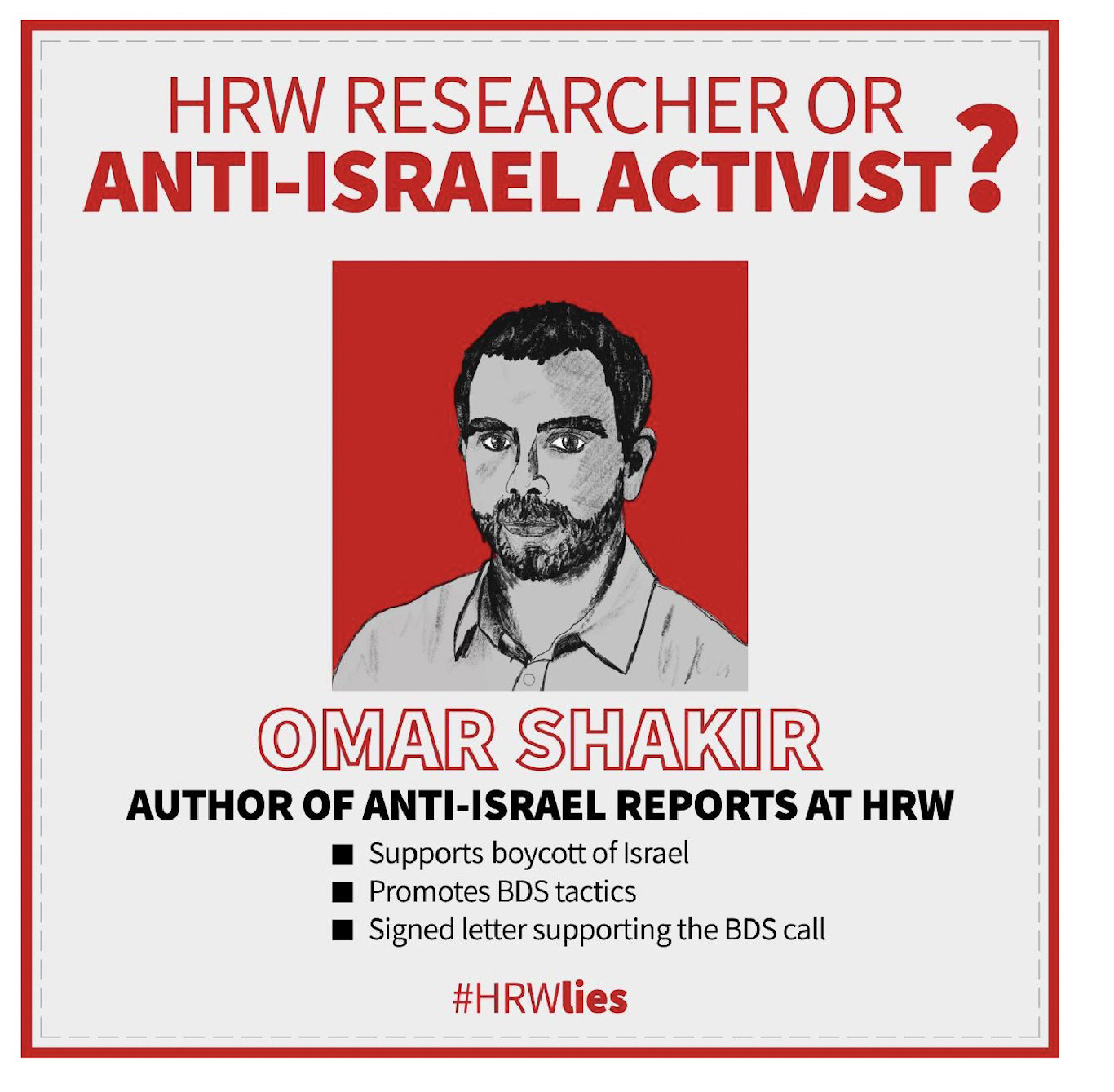
One of the many images provided to Act.IL users for their astroturfing campaign against HRW
Act.IL is one of the chief tools in Israel’s online public relations enterprise. The app debuted in 2017 and is part of what Israeli Minister of Strategic Affairs Gilad Erdan called an “Iron Dome of Truth.” “Our cell phones are the number one weapon against us,” he explained, noting that public opinion in the U.S. was beginning to turn against them. While most of the app’s nearly 20,000 users are volunteers, a core of them are paid operatives, with many students receiving scholarships as a reward for their work.
The app has been designed to feel like a game, with points assigned for completing “missions” such as sharing pro-Israel videos, reporting anti-Israel content, signing petitions, or attending online seminars. Users can track their progress on leaderboards, earn badges and prizes, and chat with other members of the community. While it might feel like Animal Crossing or World of Warcraft for some, its creators see this very much as a new front in the war against Palestine. Israeli Justice Minister Ayelet Shaked categorizes BDS as “another branch of terrorism in the modern age,” and has been an important voice in taking the fight to a new front.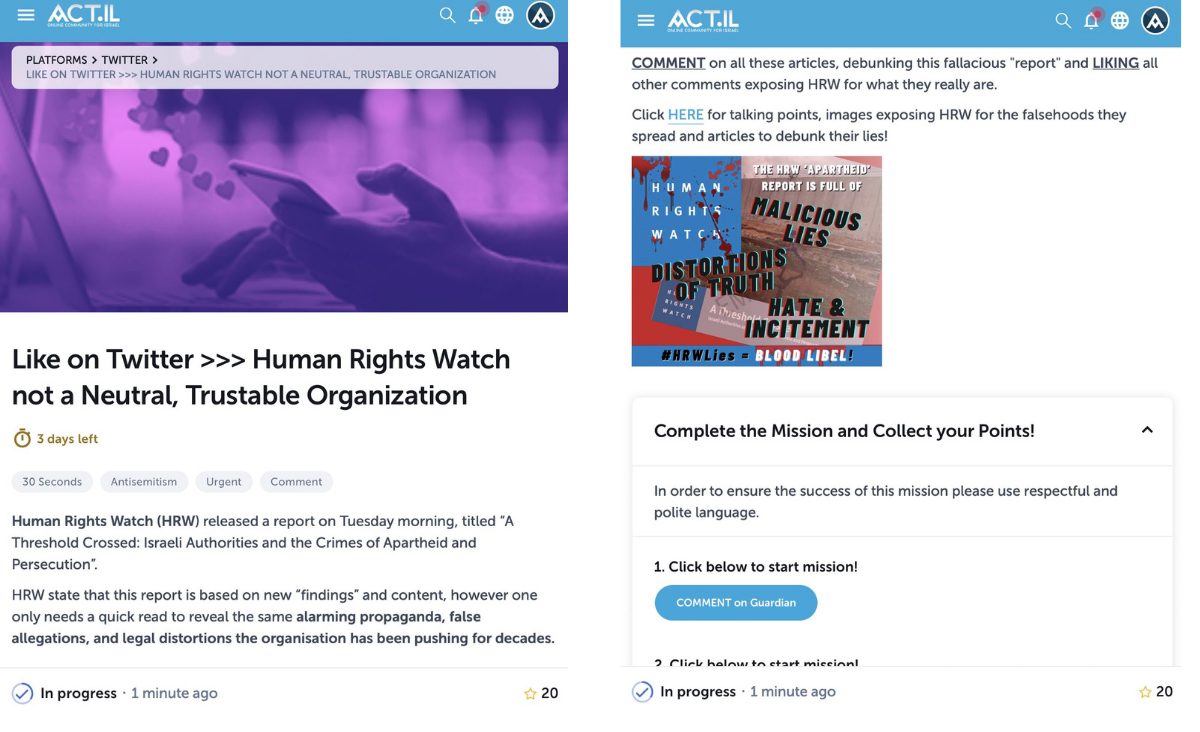
An Act.IL mission encouraging astroturfing of online discussions. Source |
@AntiBDSApp
There is also an online toolkit full of folders of responses to typical questions and issues that arise. Users can, for instance, go to the BDS folder to find stock replies to their arguments. Or they can go to a specific folder to find articles, images and videos they can use to demonize Hamas.
The missions are organized by outlet, so users can, for instance, target only Facebook, Telegram, or other platforms they are most familiar with. At the time of writing, there are 10 missions each to complete on Facebook and YouTube, 30 on Instagram, 25 on Twitter.
One current challenge is to upvote an answer to a question on Quora that asks about the validity and purpose of checkpoints in the West Bank. The answer claims they are purely about protection from terror attacks, and claims that Red Crescent ambulances are used to ferry bombs around the area. Other missions include pressuring an online store to remove a bag with a message stating “Make Israel Palestine Again.”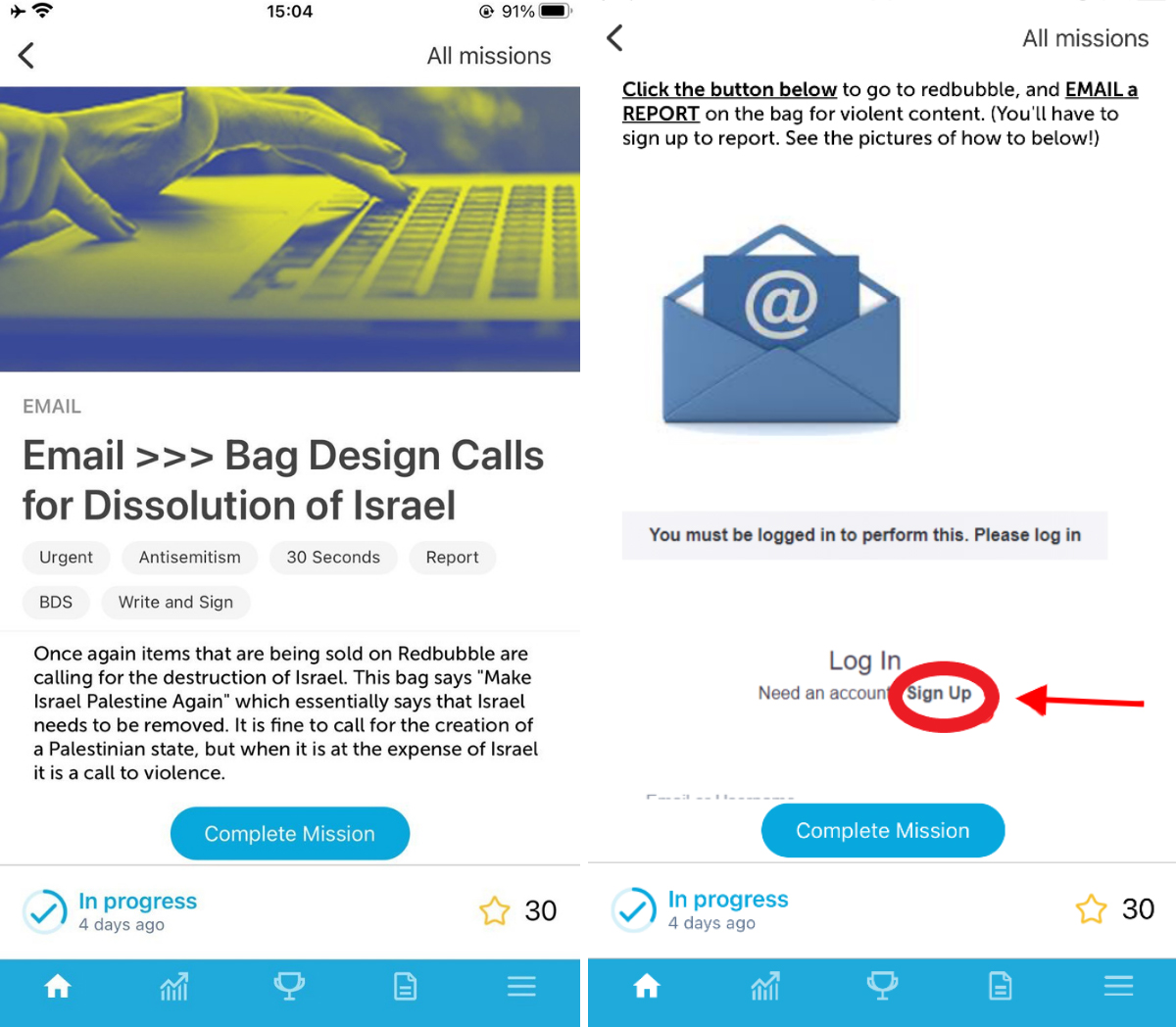
An Act.IL “mission” encouraging users to demand the removal of products with pro-Palestinian messaging
“It is quite astounding how openly they do it. But, of course, when you see a comment online, you wouldn’t necessarily think that it was coming from the Israeli government, but this is essentially what is happening,” Winstanley said. “Israel is not the only state to do this, but they do it fairly successfully.”
For all this, however, it is clear that Act.IL has a serious problem with user retention and lacks the volunteer numbers for it to be truly game changing.
Controlling the message
In a time of heightened awareness about foreign government interference online, it is particularly surprising that these operations can be openly carried out across virtually every major platform. Big tech companies like Twitter, YouTube and Facebook are constantly deleting tens of thousands of Russian, Chinese, Iranian and Cuban accounts belonging to what they claim are organized, state-sponsored disinformation campaigns.
In an effort to gauge the legality of its operations, MintPress reached out to Facebook, YouTube, Quora, and other big platforms used by Act.IL. We received no response from any of them. While this is particularly noteworthy — as these companies have teams of public relations representatives and are extremely forthright and timely with responses on other issues — it is perhaps not surprising. Facebook especially has long been working closely with the Israeli government in deciding which voices to censor. As far back as 2016, Ayelet Shaked boasted that Facebook removed 95% of the posts her office asked them to. Yet when Shaked herself called for a genocidal war against Palestine and its women, who give birth to “little snakes,” not only did the post remain online, it received thousands of likes and was widely circulated.
“The concern is that Facebook is adopting Israeli policy and terminology when it comes to defining what incitement is,” said Nadim Nashif, co-founder of 7amleh, the Arab Centre for the Advancement of Social Media. 7amleh was therefore dismayed when last year, Facebook appointed former Israeli Minister of Justice Emi Palmor to its Oversight Board, the council having the final say in the moderation of content on the platform used by 2.6 billion people worldwide. In her role as justice minister, Palmor was directly implicated in the persecution and subjugation of Palestinians.
Earlier this year, an Israeli Defense Forces soldier attempted to sue a Palestinian-American activist living in California over an allegedly slanderous Facebook post condemning her for participating in ethnic cleansing. Remarkably, the plaintiff attempted to convince a California judge to apply Israeli law to the incident, despite the fact that both she and the defendant are American citizens. https://cdn.iframe.ly/r7H7ueP?iframe=card-small&v=1&app=1
Inside the world of academia, professors critical of Israel have found themselves pushed out of the profession. In 2007, prominent critic of Israel Norman Finkelstein was denied tenure at DePaul University for political reasons. Seven years later, the University of Illinois “unhired” Steven Sailata for his comments denouncing Operation Protective Edge, the 2014 Israeli attack on Gaza. Emails showed that wealthy donors put significant pressure on the university to pull the plug on him. More recently, Cornel West was blocked from a tenured job at Harvard this year, despite having previously held tenure at Harvard, Princeton, and Yale. “Being the faculty advisor for the Palestinian student group was the one that probably went outside of the line for many Harvard staff,” West told Krystal Ball and Kyle Kulinski. “It’s a joke. It’s ridiculous. It’s ludicrous. It’s preposterous that it wouldn’t have something to do with politics.”
Top media figures have also paid the price for their support of BDS. CNN fired commentator Marc Lamont Hill after he made a speech at the United Nations calling for a free Palestine. Meanwhile, journalist Abby Martin was blocked from speaking at a conference at Georgia Southern University last year after she refused to sign a contract promising to renounce BDS. Georgia is one of dozens of U.S. states to have anti-BDS legislation, essentially forcing any would-be recipient of public contracts or funds, including government employees, to sign a pledge not to boycott Israel. Martin is currently suing the state of Georgia. MintCast Interviews Abby Martin About Her Anti-BDS Lawsuit & The Israel Lobby…
While Human Rights Watch’s report is new, the charge of apartheid is not. In 2017, a United Nations report “clearly and frankly concludes” that Israel is “a racist state that has established an apartheid system that persecutes the Palestinian people.” Earlier this year, Israeli human rights organization B’TSelem also used the word “apartheid,” claiming that Israel had established “a regime of Jewish supremacy from the Jordan River to the Mediterranean Sea.”…
Advocates for Palestine hailed Human Rights Watch’s study. Phyllis Bennis of the Institute for Policy Studies wrote:
There can be little doubt that much of HRW’s decision to issue this report now was based on the recognition that not only is it no longer political suicide to call Israeli apartheid what it is, but that we are now at a tipping point whereby failing to call out apartheid risks losing credibility for a human rights organization. It’s a huge victory for our movement.”
The battle, however, is far from won, and it is clear that the Israel lobby will continue to fight to hold back the tide until it is insurmountable.
Alan MacLeod is Senior Staff Writer for MintPress News. After completing his PhD in 2017 he published two books: Bad News From Venezuela: Twenty Years of Fake News and Misreporting and Propaganda in the Information Age: Still Manufacturing Consent, as well as a number of academic articles. He has also contributed to FAIR.org, The Guardian, Salon, The Grayzone, Jacobin Magazine, and Common Dreams.
https://www.hrw.org/news/2021/04/27/abusive-israeli-policies-constitute-crimes-apartheid-persecution