Archive for the 'human rights' Category

Another passionate plea by UN High Commissioner for better education and global leadership

February 6, 2015


High Commissioner Zeid Ra’ad Al Hussein delivers his speech at the United States Holocaust Memorial Museum. Credit: U.S. Holocaust Memorial Museum | Photo: Miriam Lomaskin

In an impressive speech on 5 February 2015 at the Holocaust Memorial Museum in Washington, D.C. – one week after the 70th anniversary of the liberation of Auschwitz – Mr. Zeid Ra’ad Al Hussein emphasized that education devoid of a strong universal human rights component can be next to worthless, especially in a crisis. “What good was it to humanity that…eight out of 15 people who planned the Holocaust at Wannsee in 1942 held PhDs?” he asked. “In the years after the Holocaust, specific treaties were negotiated to cement into law obligations to protect human rights. Countries the world over accepted them – and now alas, all too frequently, they ignore them in practice.” While it has been 70 years since the liberation of Auschwitz extermination camp, some of the processes used by the Nazis to carry out humanity’s largest organized destruction are being implemented again today by Islamic State of Iraq and the Levant (ISIL), explained Mr. Zeid.

This logic is abundant around the world today: I torture because a war justifies it. I spy on my citizens because terrorism, repulsive as it is, requires it. I don’t want new immigrants, or I discriminate against minorities, because our communal identity or my way of life is being threatened as never before. I kill others, because others will kill me – and so it goes, on and on.

Since the world cannot afford “sinking into a state of paralyzing shock…the task is to strengthen our ethics, clarity, openness of thought, and moral courage,” calling for new battle lines to combat extremism – based on the struggle for minds.

Children need to learn what bigotry and chauvinism are…they need to learn that blind obedience can be exploited by authority figures for wicked ends. They should learn that they are not an exception because of where they were born, how they look, what passport they carry, or the social class, caste or creed of their parents; they should learn that no one is intrinsically superior to her or his fellow human beings,” said Mr. Zeid.

The world needs “profound and inspiring” leaders who fully observe human rights and humanitarian law and all the treaties drafted to end discrimination, poverty, war, “with no excuses.”

It is obvious, Mr. Zeid continued, that forceful reprisals against atrocities – including “the savage burning of my compatriot the pilot Mu’ath al Kassassbeh” by ISIL – have had limited impact. Leaders must adopt a “battle-line based on ideas,” to speak out against Takfiri ideology (when one believer apostasies another believer and condemns them as impure). The movement to end that dangerous ideology must be waged by Muslim leaders and Muslim countries, he said.

Just bombing them or choking off their financing has clearly not worked…for these groups have only proliferated and grown in strength,” he said. “The space for dissent in many countries is collapsing under the weight of either poorly-thought out, or indeed, exploitative, counter-terrorism strategies.”

Few crises erupt without warning, he continued. Extremist ideas and violence manifest from years of tyranny, inequalities, fear and bad governance. They build up over years – even decades – of human rights grievances and the denial of basic economic and social rights. He insisted that atrocities can be prevented and extremism curbed through better, human rights-based global leadership and a fundamental rethink of education. “Surely we now know, from bitter experience, that human rights are the only meaningful rampart against barbarity.”

United Nations News Centre – In Washington, UN rights chief says atrocities can be prevented through better global leadership.

Homegrown African decision promotes press freedom and protects human rights defenders

February 5, 2015
A court has ruled that criminal defamation laws cannot include custodial sentences or sanctions that are disproportionate, such as excessive fines. (Gallo)

Simon Delaney, a media lawyer and advisor to the Decriminalisation of Expression Campaign, in The Guardian of 4 February reports on an important judgement by the African Court on Human and Peoples’ Rights on press freedom by ruling that criminal defamation laws cannot include custodial sentences or sanctions that are disproportionate, such as excessive fines.

[In 2012, Lohé Issa Konaté, the editor of a weekly newspaper in Burkina Faso, was found guilty of criminal defamation and sentenced to 12 months in prison after he published two articles accusing a public prosecutor of abusing his power. Konaté‘s paper was shut down for six months and he was ordered to pay an exorbitant fine, plus compensation and costs. Konaté argued that he was wrongfully punished for legitimate investigative journalism and his rights to freedom of expression were violated. A coalition of 18 media and human rights organisations added that criminal defamation laws undermine the democratic rights of the media and citizens to hold their governments to account. The court found that, although the Burkinabé law served the legitimate objective to protect the honour and reputation of public officials, the penalty of imprisonment was a disproportionate interference in the exercise of freedom of expression by Konaté and journalists in general. The court ordered Burkina Faso to change its criminal defamation laws and pay compensation to Konaté.]

The judgment is significant not so much because of the content of the decision (which is in line with international standards] but because it is homegrown ‘African’ decision.

The judgment, which is binding on African Union member states, gives impetus to the continent-wide campaign to decriminalise defamation. It also paves the way for the decriminalisation of ubiquitous laws prohibiting “the publication of matter with intent to bring the president into hatred, ridicule or contempt” and “the publication of false news with intent to cause fear and alarm to the public”.

Homegrown African decision promotes press freedom | Opinion | Analysis | Mail & Guardian.

Nominations for Sergio Vieira de Mello Award extended til 30 April

February 1, 2015

The Sergio Vieira de Mello Foundation is extending its call for nominations for the 2015 Award till 30 April 2015. This prize rewards an individual, a group or an organisation whose original and daring initiatives have brought people in conflict in war-torn societies towards reconciliation. For more information on the award see: http://www.brandsaviors.com/thedigest/award/sergio-vieira-de-mello-prize

Nominations should use the form on the website and submit it by email to info[at]sergiovdmfoundation.org, or by post : Sergio Vieira de Mello Foundation, 29 rue des Allobroges, 1227 Carouges, Geneva, Switzerland.

Sergio Vieira de Mello Foundation.

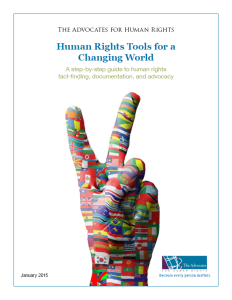
Human Rights Tools for a Changing World

January 30, 2015

Without necessarily endorsing the Manual “Human Rights Tools for a Changing World ” as the only or best guide, there is a lot of useful material in here:

Jennifer Prestholdt's avatarThe Human Rights Warrior

Change the World front cover

Originally published on The Advocates Post

The Advocates for Human Rights’ Executive Director Robin Phillips is in London today speaking about The Advocates’ human rights monitoring work at the International Bar Association’s colloquium on “Rule of Law Fact-Finding by NGOs: Monitoring Standards and Maximising Impact”.

This international convening to explore the standards and impact of non-governmental organization (NGO) fact-finding on human rights violations is also an appropriate setting to introduce The Advocates’ latest publication:

        Human Rights Tools for a Changing World:  A Step-by-Step Guide to Human Rights Fact-finding, Documentation and Advocacy 

Human rights advocacy takes many forms, and human rights activists can be found in every corner of the world.  Human Rights Tools for a Changing World was created with the express purpose of providing advocates of all backgrounds and experiences a full range of tools and resources to promote human rights in a changing…

View original post 604 more words

Call for Nominations Right Livelihood Award until 1 March

January 30, 2015

Right Livelihood logoNominations for the Right Livelihood Award 2015 can now be submitted. For more information on the Award see: http://www.brandsaviors.com/thedigest/award/right-livelihood-awards.

To nominate before 1 March go to:  http://www.rightlivelihood.org/guidelines_english.html

Conectas tries to balance Brazil’s human rights commitments at home and abroad

January 30, 2015

Under the title “Home and abroad: balancing Brazil’s human rights commitments”, Muriel Asseraf – in Open Democracy of 22 january 2015 – has written an interesting piece highlighting the role of the major NGO Conectas, whose strategy is based on “the conviction that human rights defenders and their organizations in the global south hold the key to an international order more diverse and committed to the respect of human rights”. A good read for the weekend! Read the rest of this entry »

Human Rights Defenders and Anti-Corruption campaigners should join hands

January 29, 2015
Jamil Nasir, a graduate of Columbia University, wrote on 10 December 2014 a short piece on the link between human rights and corruption: “The corruption link”. The author concludes that “Human rights defenders should not consider themselves just as activists; similarly anti-corruption champions should also not limit themselves like that. A bridge needs to be built between human rights and anti-corruption activists.” The article follows below in full:
The world celebrates ‘Anti-corruption Day’ and ‘Human Rights Day’ on December 9 and 10, respectively. Corruption and human rights are inextricably linked, but these linkages are not emphasised much in literature or discourse on corruption. The detrimental impact of corruption on economic growth and development is now well documented. It is a fact that corruption kills the incentive system, distorts technology choices, misallocates talent, promotes tax evasion and retards economic growth.And how does corruption impact human rights? First, it reduces the capacity of the state to protect, respect, and enforce its obligations with regard to the fundamental human rights enshrined in the social contract between the citizens and the state. For example, ‘access to justice’ and ‘security of life, property and honour’ are fundamental human rights. Can these rights be protected with a corruption-ridden judicial and police system? Our own current system is a pertinent example.Corruption in the judiciary and the police is not a secret in our country. When we talk of corruption in the judicial system, it does not mean prismatic decisions and judgements only. Granting adjournments to benefit one of the parties to a dispute is also corruption. When it comes to the police, corruption is not about flawed investigations but also non-submission of challans in the court on time. Consequently, the weaker party gets so disillusioned that it either does not pursue the case or enters into forced compromise.

Thus corruption affects fundamental rights as well as procedural rights like due process – the. right not to have undue delay in court proceedings and the right to a fair trial. Is it not corruption that has reduced the capacity of our state to enforce fundamental human rights? Have the court and police systems not become dysfunctional? Are these institutions not making the people poor rather than providing them quick justice?

This corruption lowers economic development and undermines poverty alleviation. The social contract obligates that the state should provide an environment where people can realise their full potential. Is such an environment possible without adequate resources with the state? Corruption reduces the level of revenues which consequently reduce the capacity of the state to fund basic social services. Again, Pakistan is a pertinent case. Due to corruption, tax evasion is rampant. Corruption also affects targeting of social programmes. If corrupt practices are pervasive, leakages in such programmes will usually be high. Anecdotal evidence suggests that the money allocated for various social spending and poverty alleviation programmes have not reached the intended targets. A substantial percentage of such funding was squandered away during the process of distribution. Further, targeting of the poor was riddled with nepotism and patronage.

Moreover, corruption enhances the operating costs of the government and reduces the resources available for social spending. The budget for the health and education sectors gets squeezed. It is an open secret now that the major chunk of the funds allocated for development of infrastructure like roads, schools and hospital buildings is eaten into by corruption in the form of commissions and kickbacks by the engineers, contractors and construction companies. And so corruption undermines development, deepens poverty and exacerbates other human rights violations.

Corruption can also violate human rights directly. If a corrupt judge takes a bribe to decide a case against an individual or a corrupt police officer takes a bribe not to properly investigate, that corruption directly violates human rights like the right to a fair trial. Corruption can manifest itself as the worst abuse of human dignity and rights.

One of the reports of Transparency International mentions a local public hospital in Zimbabwe whose nurses charged $5 every time the mother screamed while giving birth to a baby. This amount was charged as a penalty for raising alarm. Those women who were unable to pay the delivery fee were detained at the hospital until they had settled the debt. In this way, they were held hostage by the corruption prevalent in the hospital.

Corruption particularly targets the poor. For example, if a rickshaw driver or a street vendor pays a meagre amount of bribe (assume Rs100) to a policeman to avoid harassment, the impact on these poor chaps will be deep and severe since even Rs100 constitutes a major chunk of their daily income. It is not a big amount in absolute terms but it eats into their already tight budget. Compared with the daily income of the wage earners, the impact of this seemingly little amount can be well imagined on the household budget of the poor.

On the other hand, if a businessman pays – assume Rs100,000 – to a tax collector, he will get enormous personal benefit. But due to this collusion of the tax evader and the tax collector, millions of rupees will be dribbled through corruption. The taxes evaded due to this under the table deal, if properly collected, could be utilised for developing infrastructure, transfer payments or spent on poverty alleviation programmes.

This simple illustration shows that corruption adversely affects the poor. Second, it may also benefit the rich which is perhaps one explanation of the tolerance of the rich and the elite towards corruption in society. According to Professor Pranab Bardhan, corruption feeds on itself due to a variety of reasons. First, it is beneficial for the payer and the payee. Second, it is so entrenched that it becomes a self-fulfilling prophecy. Third, once corruption takes root in society, it is exceedingly difficult to eliminate.

It is time the discourse on corruption included the human rights perspective. A clear understanding between corruption and human rights can empower both human rights activists and those working against corruption. If linkages between corruption and rights become part of the narrative on corruption, attitudes will change. When people become more aware of the damage corruption causes to their fundamental rights, they are more likely to support campaigns against corruption. This new discourse can persuade key actors like judges, parliamentarians, lawyers, media and the public at large to take a strong stand against corruption. Connecting corruption to human rights violations means that acts of corruption can be challenged in a court of law as violation of fundamental human rights.

Weak human rights protection creates possibilities for corruption which also means that the promotion of human rights can be one of the tools against corruption. For example, promotion of the right to freedom of expression and information can go a long way in combating corruption in society. The right to information is critical in the fight against corruption.

Human rights defenders should not consider themselves just as activists; similarly anti-corruption champions should also not limit themselves like that. A bridge needs to be built between human rights and anti-corruption activists. This will be possible once the dots are connected and linkages between corruption and human rights are consciously explored for a joint struggle. Both human rights organisations and anti-corruption agencies should make a resolve to work together. The fight against corruption and the promotion of human rights are too important to be left to disjointed endeavours.”

The corruption link – Jamil Nasir.

Young human rights defenders honored by awards in Bangladesh

January 28, 2015

Recipients of the honorary awards given by Manusher Jonno Foundation, standing behind, with the guests sitting in front, in the capital's Bangla Academy yesterday, at the award giving ceremony marking Human Rights Day. Photo: Star

Recipients of the honorary awards given by Manusher Jonno Foundation, standing behind, with the guests sitting in front, in the capital’s Bangla Academy yesterday, at the award giving ceremony marking Human Rights Day. Photo: Star

A nice little item left-over from Human Rights Day 2014. How human rights awards play at the local level:

Ten human rights defenders from the grassroots level, two eminent social workers with international recognition, and a female football player were given honorary awards by Manusher Jonno Foundation (MJF) yesterday. The works of the activists focused on land rights, prevention of violence against women, child rights, and the rights of the indigenous people. The 10 grassroots activists were Jharna Ray, Madhobilata Chakma, and Nomita Chakma of Khagrachhari, Birendra Sangma of Mymensingh, Shafique Ullah of Noakhali, Kachhim Uddin of Tangail, Kananbala Gupta of Narail, Umme Kulsum Ranjana of Bogra, Kalpana Tirki of Rajshahi, and Rahela of Dinajpur.

Two social workers Jharna Dhara Chowdhury, chief of Noakhali’s Gandhi Ashram, and Angela Gomes, executive director of Bachte Shekha, were also honoured along with Bipasha Mali, a young footballer who was recently called to play on the national women’s football team.

Speaker Shirin Sharmin Chaudhury said, “They don’t work for recognition. Yet when we value their contributions, it makes us proud and we get inspiration to work.

MJF honours 10 grassroots human rights defenders | Two social workers, a young female footballer also receive the honorary awards.

Release of human rights defender Huang Kaiping in China marred by continued repression of others

January 28, 2015

The following, reported by Front Line on 28 January is a good illustration of what human rights defenders in China face: a bit of good news (re-appearance) mixed with continued repression:

On 28 January 2015 human rights defender Mr Huang Kaiping returned to his home in Beijing, following a period of over three months’ enforced disappearance.  Huang Kaiping is director of the Transition Institute, an independent think tank in Beijing that focuses on economic and political liberalisation. The Transition Institute was founded in 2007 to carry out research into tax reform, business regulation and the development of civil society in China. The Institute was forced to close by the Chinese authorities earlier this year, as they stepped up their campaign of harassment against a number of civil society organisations in China. Read the rest of this entry »

Human Rights Defenders in the Philippine embrace info-tech for human rights

January 27, 2015

Human rights defenders in the Philippines have been using information technology to advance their advocacy work.  Launched in 2011, the human rights website http://www.hronlineph.com started by Egay Cabalitan and Jerbert Briola is used by human rights defenders for updates on most recent social issues in the country. The website has produced a video featuring testimonies from various advocacy groups – medical, anti-mining, human rights defenders, and international support NGOs – on the usefulness of the website.

Recently HRonlinePH launched two videos about human rights and internet rights now shared on social media outlets.

https://www.youtube.com/watch?v=gu_E0C2bPDQ
https://www.youtube.com/watch?v=FPslUqomztU

Human rights defenders fully realize the potential of video to bring about change, And this video, a groundbreaking information tool for the HRonlinePH, is a supportive infrastructure how we can harness the power of technology and to help realize our shared interests in promoting and defending human rights, offline and online,” Human Rights Online Philippines said.

Featured in one of the videos are human rights defenders from Alyansa Tigil Mina (ATM), Asian Forum for Human Rights and Development (FORUM ASIA), Coalition Against Trafficking in Women, Asia-Pacific (CATW-AP), Medical Action Group (MAG), Partido ng Manggagawa (PM), Philippine Alliance of Human Rights Advocates (PAHRA) and Philippine Movement for Climate Justice (PMCJ).

Group takes a ride on info-tech for human rights advocacy | SciTech | GMA News Online.