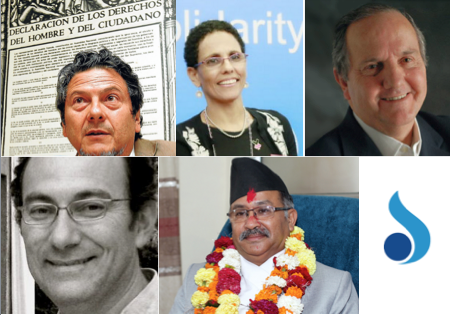
It is good to remember not only the front-line human rights defenders but also those who struggled on the side of the oppressed contributing their academic and diplomatic talents. One of those is certainly Rodolfo Stavenhagen (born 29 August 1932) who died on 5 November 2016. He was a Mexican sociologist,a professor-researcher at El Colegio de México and former Deputy Director General of UNESCO. From 2001 – 2008 he was the first United NationsSpecial Rapporteur on the situation of the human rights and fundamental freedoms of indigenous people through Resolution 2001/57. Read the rest of this entry »
The Asian Forum for Human Rights and Development (FORUM-ASIA), together with the Martin Ennals Award and the Right Livelihood Award, will host a panel discussion on the 25th Anniversary of its founding and 10th Anniversary of its presence in Geneva, entitled ‘50 Years of the International Bill of Human Rights and 10 Years of the UN Human Rights Council – What does this mean for Asia?’, on 16 November 2016 at 18:30 at the Ivan Pictet Auditorium, Maison de la Paix, in Geneva, Switzerland.
The University of Michigan’s 2016/17 Wallenberg Medal has been awarded to civil rights lawyer and social justice activist Bryan Stevenson. He is the executive director of the Equal Justice Initiative, an organization he founded in 1989 that focuses on social justice and human rights in the context of criminal justice reform in the United States. EJI litigates on behalf of condemned prisoners, juvenile offenders, people wrongly convicted or charged, poor people denied effective representation, and others whose trials are marked by racial bias or prosecutorial misconduct. Under Stevenson’s direction, EJI has handled hundreds of cases and spared the lives of 125 death row prisoners. Stevenson’s arguments have convinced the U.S. Supreme Court that juveniles in non-homicide cases may not be sentenced to life without parole. He is creating a memorial in Montgomery, Alabama, to commemorate the more than 4,000 persons who were lynched in 12 southern states between 1871 and 1950.
Stevenson is a professor of law at New York University, where he prepares students to consider the legal needs of those in resource-deprived regions. He has been a visiting professor of law at the U-M Law School. He wrote the prize-winning book “Just Mercy: A Story of Justice and Redemption” and has won numerous awards and honors, including Reebok Award (1989), the Gleitsman Award (2000). the MacArthur Foundation Fellowship Award Prize, the ACLU National Medal of Liberty, the Olaf Palme Prize for international human rights (2000), the Gruber Prize for International Justice (2009) and the Ford Foundation Visionaries Award.
Raoul Wallenberg was a 1935 graduate of U-M’s College of Architecture. As a Swedish diplomat Wallenberg saved the lives of tens of thousands of Hungarian Jews near the end of World War II.
NOTE: There are at least two other awards with Wallenberg in the title:
Raoul Wallenberg Prize (Council of Europe )
Raoul Wallenberg and Civic Courage Awards (USA), and there is
the Raoul Wallenberg Institute (Lund, Sweden)
The ceremony for Stevenson will take place on 7 March, 2017; after the medal presentation, Stevenson will give the 25th Wallenberg Lecture.
The 2016 Human Rights Tulip has been awarded to the Pakistani internet activist Nighat Dadstated the Dutch Ministry of Foreign Affairs today, 6 November 2016.
Human Rights Tulip Photo: Aad Meijer/Newsroom BZ
The Human Rights Tulip is an annual prize awarded by the Minister of Foreign Affairs to human rights defenders who take an innovative approach to promoting human rights. The prize consists of a bronze sculpture (see picture above) and €100,000, which is intended to enable recipients to further develop their work. [for last year’s award: https://thoolen.wordpress.com/2015/12/12/2015-human-rights-tulip-awarded-to-ira-mauritania/]
‘Human rights defenders are modern-day heroes,’ said minister Bert Koenders ‘Despite the many threats she has received, Nighat Dad continues to fight to improve adherence to human rights in Pakistan in a unique and innovative way. Ms Dad is a pioneer who is working to remove everyday obstacles to internet access, especially those that affect women.’
Ms Dad is a staunch defender of digital rights and the importance of protecting women and girls and marginalised groups on social media. Mr Koenders hopes that this prize will serve as a gesture of support for the freedom of internet users, especially women. In 2012 Ms Dad founded the Digital Rights Foundation, which supports female internet users in the form of digital security training courses, public awareness campaigns and the newly created Cyber Harassment Helpline. Ms Dad’s approach enables her to reach women throughout Pakistan, including those in more remote areas of the country. She was awarded the Atlantic Council Digital Freedom Award 2016 and was among six ‘next generation leaders’ named by TIME Magazine last year.
Foreign minister Bert Koenders will present her with the prize on Saturday 10 December, Human Rights Day, in The Hague.
As the Geneva-based International Service for Human Rights (ISHR) is one of the most important sources of information on HRDs and the UN, I hope that many of you will be able to give them feedback on their various communications and digital publications by filling our the on-line survey in the link below. It indeed takes not more than 5 minutes to complete.
Every December, Amnesty supporters across the globe will write millions of letters for people whose basic human rights are being attacked. It’s all part of Write for Rights, AI’s global letter-writing marathon. The video clip includes MEA laureate 2016 Ilham Tohti. It’s one of the world’s biggest human rights events and carries on a long tradition of people writing letters to right some of the world’s biggest wrongs.
Sam Zarifihas been appointed to serve as ICJ’s next Secretary General when the current Secretary-General retires next spring. Wilder Tayler will continue to work as SG until the end of March 2017 and Sam will begin in April 2017, although there will be some overlap to ensure a smooth transition in the Geneva based HQ.
Sam is a veteran of the human rights movement, with a most impressive array of experience and contacts, and has done phenomenal work as Director of the ICJ’s Asia and Pacific Regional Programme over the last four years. Prior to joining the ICJ Sam served as Amnesty International’s Director for Asia and the Pacific from 2008 to 2012. He was at Human Rights Watch from 2000, where he was Deputy Director of the Asia division. He was Senior Research Fellow at Erasmus University Rotterdam from 1997 to 2000, where he co-edited Liability of Multinational Corporations under International Law (Kluwer 2000) as well as several other publications on the subject. Sam was born and raised in Tehran, Iran and moved to the United States to complete his education. He received his Bachelor of Arts degree from Cornell University and his Juris Doctor from Cornell Law School in 1993. After practicing as a corporate litigator for several years, he obtained an LL.M in Public International Law from New York University School of Law in 1997.
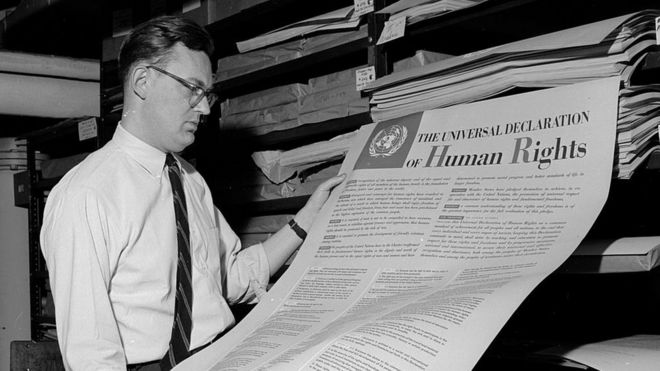
The Universal Declaration of Human Rights (UDHR) is now accessible in 501 languages and dialects, the Office of the High Commissioner for Human Rights announced on 2 November 2016.
“Our goal is to share the UDHR with the entire world, and it’s a great achievement for us to be able to make this important document available in more than 500 languages,” said OHCHR librarian Alfia Gilbert.
The collection constitutes the world’s most translated document according the The Guinness Records.
“The growing number of translations underscores the universality of the Universal Declaration of Human Rights and the power of its words to resonate strongly across cultures and languages,” said UN High Commissioner for Human Rights Zeid Ra’ad Al Hussein.
The Philippines seems to get most of its attention nowadays because of the ranting of its President rather than the human rights situation on the ground. That is why John Nery wrote a reply in the Philippine Daily Inquirer of 1 November 2016 under the title “Human rights defenders are beautiful“.
The intruiging title is linked to a recent episode in which President Duterte complimented the Filipino beauty queen, Kylie Verzosa, on her international recognition by saying “You see, Filipinas are beautiful”, and then added gratuitously “Pero kayong lahat diyan sa human rights commission, mga pangit (But all of you there at the Commission on Human Rights, you are all ugly)”. It would be a mistake to think that this was just another jest. Since the CHR, under then chair Leila de Lima, investigated him in 2009 for possible human rights violations in relation to the killings attributed to the so-called Davao Death Squad, he has harbored a sense of resentment against the constitutional agency which has dared question the rising casualty toll in his so-called war on drugs..
The writer then says: But we should all ask: What have human rights advocates done to deserve such hostility, such cavalier treatment, from the President? Human rights advocates, including those identified with the National Democratic Front, including those who have served and are serving in the CHR, were among those who tried to hold the Marcos regime accountable during the dictatorship itself, and are among those leading the fight to bring the Marcos family to justice. Mr. Duterte’s own mother, who was a leader of the anti-Marcos movement in Davao City, would have recognized them as kindred spirits……….A devout and disciplined Catholic, she would have understood the sacrifice these advocates made, in choosing the less lucrative, much more dangerous career of human rights work. I daresay she would have recognized in them the dignity, the beauty, of the saints: They are doing not only the right, but the beautiful, thing.
On 1 November 2016 the Reuter Thompson Foundation published an article on a woman human rights defender, Joan Carling, under the title “Malaria, murder and occupational hazards of indigenous activists in the Philippines“.
Joan Carling, a prominent indigenous rights defender from the Kankanaey tribe of the northern Philippines’ Cordillera region. Photo Reuters
A little over a decade ago, indigenous activist Joan Carling from the Philippines Cordillera region lost three colleagues in the space of a few years – all murdered in one of the world’s deadliest countries for land rights defenders. Then came her turn: a relative in the military told Carling’s father his daughter’s name was on the “order of battle”, the Philippines military’s list of people, including activists, who are deemed enemies of the state. “When you are on the order of battle, you are an open target for extrajudicial killings,” said 53-year-old Carling…She kept her head down, hired a bodyguard, then spent several months at a U.S. university having won a fellowship for frontline human rights defenders.
For decades, Carling has been at the forefront of the fight for land and the environment, which London watchdog Global Witness calls “a new battleground for human rights”, with communities worldwide locked in deadly struggles against governments, companies and criminal gangs exploiting land for products like timber, minerals and palm oil.
In 2015, more than three people a week were killed defending land, forests and rivers against industries, said Global Witness. Of the 185 murders it documented in 16 countries, the Philippines ranked among the most dangerous, with 33 deaths last year alone.
Carling, from the Kankanaey tribe of the northern region of Cordillera, grew up on a logging concession where her parents ran a shop. She got her first taste of protest in the mid-1980s while studying at the University of Philippines in Baguio. She spent two months in the Kalinga tribal areas protesting against four World Bank-funded dams along the Chico River, which activists said threatened to inundate 16 towns and villages and displace an estimated 85,000 people. The World Bank ended up withdrawing its funding for the Chico dams, which were never built, and the episode prompted the bank to develop its policy on indigenous peoples, she said.
In the early 1990s, Carling immersed herself in mountainous tribal villages in the Cordillera and worked with the Cordillera Peoples Alliance (CPA) fighting for land rights, until the day she fell sick and had to be hauled out on a stretcher. “…..After medical treatment, she went straight back to her duties, hanging her dextrose IV bag on the walls of a building in the town center, where she met indigenous people from remote areas who shared grievances about alleged land grabs.
After working with the CPA to help indigenous peoples at home, she moved on to a regional stage, and nearly eight years ago became head of the Asia Indigenous Peoples Pact (AIPP), based in Chiang Mai, Thailand. Through her work with AIPP, she has helped build a network among indigenous peoples from countries including Indonesia, Nepal, Taiwan and Japan – helping them to feel less isolated. She has turned her attention to the impacts of climate change and solutions such as hydropower, which often have a negative impact on indigenous communities.
Carling expressed concern about the “narrow conservation approach” of taking people out of the environment to protect the environment, instead of allowing indigenous peoples to protect the resources and watersheds on their ancestral land. “Indigenous people are actually the natural conservationists because it’s part of our being – to protect and conserve our natural environment because we need to pass it on to future generations,” Carling said. “That is the wisdom of the indigenous people – we only use what we need.”