This week (23 – 27 October 2017) there is an on-line Dialogue by New Tactics “Supporting Faith Leaders and Faith-Based Organizations as Human Rights Defenders” with as goal: Mobilizing Allies and Modeling Systems and Structures.
Archive for the 'human rights' Category
Faith Leaders as Human Rights Defenders
October 25, 2017Columbia University opens prize nominations for “court rulings” and “legal services” supporting freedom of expression
October 24, 2017Columbia University has opened 2018 prize nominations for judicial services and legal decisions supporting freedom of expression. What is a bit special about these awards is that they go to ‘court rulings” and “legal services” in the area of freedom of expression.
The initiative “seeks to advance understanding of the international and national norms and institutions that best protect the free flow of information and expression in an inter-connected global community with major common challenges to address.” It awards the Global Freedom of Expression Prizes, which began in 2014, every two years. “We believe that at a time when freedom of expression is threatened at a global level, there is a particular need to celebrate the victories in defense of this fundamental right”. Individuals and organizations, particularly jurists, academics and non-governmental organizations dedicated to freedom of expression, are invited to nominate court decisions or legal services from anywhere around the globe that “have had a recognizable impact on freedom of expression.” There will be separate prizes for “Court decision” and “Legal Service.” In the Legal Service Category, the awards will consider legal briefs, amicus briefs, academic or other publications.
Nominations will close Jan. 31, 2018 and winners will be announced March 13. Forms are available in both English and Spanish.
Members of the Awards Committee are: Lee C. Bollinger, President of Columbia University; Catalina Botero, former Special Rapporteur for Freedom of Expression of the Inter American Commission on Human Rights of the Organization of American States; Nicolas Bratza, former President of the European Court of Human Rights; Lydia Cacho, journalist, human rights defender and author; Agnes Callamard, Director of the Columbia Global Freedom of Expression initiative; Sarah Cleveland, Louis Henkin Professor of Human and Constitutional Rights and member of the UN Human Rights Committee; and Irene Khan, Director-General of the International Development Law Organization.
The winners of the 2016 prize for Excellence in Legal Services were Professor Yaman Akdeniz, Assistant Professor Kerem Altiparmak and Attorney at Law Serkan Cengiz for fighting a court order blocking access to YouTube in Turkey. That same year, the prize for a Significant Legal Ruling was awarded for Supreme Court of Norway, Rolfsen and Association of Norwegian Editors v. the Norwegian Prosecution Authority. The court backed broad protection against journalists being forced to expose their sources.
Ceremony for Alfredo Romero, recipient of the 2017 Robert F. Kennedy Human Rights Award, on 16 November
October 24, 2017
World Health Organization reconsidering Mugabe as “goodwill ambassador”
October 22, 2017he head of the World Health Organization, Tedros Adhanom Ghebreyesus, is rethinking his decision to name Zimbabwe’s president, Robert Mugabe, as a goodwill ambassador. The move provoked global outrage. WHO member states and activists alike noted that Zimbabwe’s health care system, like many of its public services, has collapsed under Mugabe’s regime. “I’m listening. I hear your concerns. Rethinking the approach in light of WHO values. I will issue a statement as soon as possible,” Tedros, a former Ethiopian health minister, tweeted on Saturday night.
The Canadian prime minister, Justin Trudeau, came closest when he said he thought Mugabe’s appointment “was a bad April Fool’s joke”. [see: https://humanrightsdefenders.blog/2015/10/23/mugabe-wins-chinese-peace-prize-this-time-for-real/]
Human Rights Watch (HRW) said it was an embarrassment to give the ambassador role to Mr Mugabe, because his “utter mismanagement of the economy has devastated health services”. The main opposition party in Zimbabwe, MDC, described the appointment as “laughable”…“Mugabe trashed our health delivery system. He and his family go outside of the country for treatment in Singapore after he allowed our public hospitals to collapse.”
The Human Rights Foundation (HRF) also condemned the decision by the World Health Organization (WHO): “The irony of the World Health Organization’s decision to praise Robert Mugabe is staggering. This a strongman infamous for seeking medical attention for himself abroad. His recent visits to Singapore for medical treatment have cost Zimbabwean taxpayers tens of millions of dollars. Mugabe can’t get adequate treatment in his own country because his kleptocratic regime has left Zimbabwe’s hospitals and health industry in a state of ruin,” said HRF president Thor Halvorssen. “Dr. Tedros should nullify Mugabe’s appointment immediately and also issue a strong public condemnation of his repressive rule”.
Sources:
https://www.theguardian.com/world/2017/oct/21/un-lambasted-after-naming-mugabe-goodwill-ambassador
HRF condemns World Health Organization for appointing Robert Mugabe as “goodwill ambassador”
Turkey angry after PACE Havel prize is awarded to jailed judge
October 18, 2017The Vaclav Havel Human Rights Prize, named after the dissident playwright who later became Czech president, is given by the Parliamentary Assembly of the Council of Europe (PACE). On Monday 16 October the prize awarded to the Turkish judge Murat Arslan, who was head of the Association for the Union of Judges and Prosecutors (YARSAV). Arslan was arrested in October 2016 on suspicion of links to Gulen who Ankara blames for the failed coup aimed at ousting President Recep Tayyip Erdogan.
The PACE described Arslan as a “staunch supporter of the independence of the judiciary.” But the Turkish foreign ministry said in a statement that it “is wrong and unacceptable to award the prize … to a person who is a member of Feto terrorist organisation“. “While the judicial process is underway, presenting a terrorism suspect as a human rights defender is a betrayal of the ideals of democracy and human rights,” it said. For more on the award see: http://trueheroesfilms.org/thedigest/awards/vaclav-havel-prize-for-human-rights-pace
In his absence, the prize was received by a representative of the European Magistrates for Democracy and Freedom group (Medel) which had nominated him. In a message from jail, Arslan told the ceremony that Turkey had “learnt nothing” from Europe’s 20th century history but “we will not let ourselves be closed up in a wall of fear”. [https://humanrightsdefenders.blog/2017/08/31/finalists-for-pace-vaclav-havel-human-rights-prize-announced/]
Turkey has been a member of the Council of Europe since 1950 but relations have frayed after the PACE in April voted to reopen political monitoring of the country. see also: https://humanrightsdefenders.blog/2017/07/11/council-of-europe-losing-patience-with-turkey-after-arrest-of-human-rights-defenders/
http://aa.com.tr/en/politics/turkish-mp-slams-europe-body-for-rewarding-feto-suspect/939149
Korean people win Friedrich Ebert human rights award for candlelight rallies
October 18, 2017Readers of this blog know my special interest in human rights awards. So you will understand my surprise to learn that the Friedrich Ebert Foundation has granted its 2017 Human Rights Award to all South Korean citizens (a total of 17 million!!) who took to the streets to protest against President Park Geun-hye for months and peacefully removed her from power.

Sven Schwersensky, resident representative at Friedrich Ebert Stiftung’s Korea office, talks about the Human Rights Prize during a press briefing Monday (Yonhap)
As Ock Hyun-ju reported in the Korea Herald of 16 October 2017: “The peaceful exercise of democratic participation and in particular the civic right of peaceful assembly are the essential components of democracy,” said Sven Schwersensky, resident representative in Korea. “In our view, the people’s candlelight demonstrations have given the whole world evidence of this important fact….At the time, authoritarianism was on the rise everywhere in the world, even in the western world,” he said, citing the UN special rapporteur Maina Kiai, who addressed the diminishing rights to public assembly and free speech under the former Park administration during his visit to Korea in 2016. “People of Korea showed resistance to authoritarianism.”
The organizing committee for candlelight demonstrations — an association of over 1,500 civic groups, labor unions and student organizations — took the prize on behalf of all Koreans. The committee received 20,000 euros ($23,590) in prize money. How the money will be spent has not been decided yet, it said. The award ceremony will take place in Berlin on 5 December. [see also: https://humanrightsdefenders.blog/2014/11/12/friedrich-ebert-award-goes-to-fartuun-adan-from-somalia/]
More about the FES Human Rights Prize: http://www.trueheroesfilms.org/thedigest/awards/friedrich-ebert-foundation-human-rights-award
Source: [Newsmaker] Koreans win global prize for candlelight rallies
Repressive governments and Ophelia compete to prevent HRDs to travel to Dublin
October 18, 2017Andrew Anderson, the executive director of Front Line Defenders, published a piece at the beginning of the Dublin Platform for Human Rights hosted by Front Line Defenders in Ireland

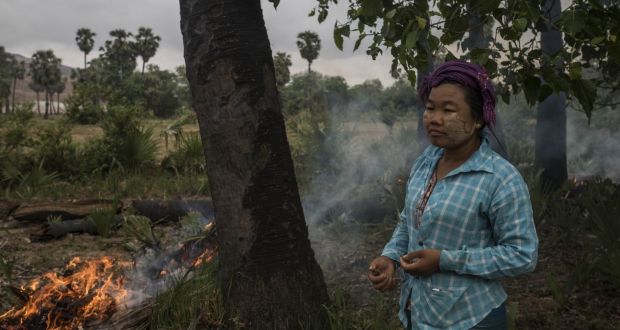
Thwe Thwe Win working on her land near the copper mine in Myanmar. 25 May 2016. Photo: Lauren DeCicca / Front Line Defenders
“Like thousands of people trying to get into Ireland on Monday, dozens of our international guests had flights canceled or postponed. Another 11, however, were prevented from attending long before Ophelia hit, banned from leaving home by their governments…..It is an opportunity for defenders typically preoccupied with defending their communities – and surviving the threats that ensure – to spend 72 hours not being physically surveilled by a totalitarian state, threatened at work by an extremist group, or receiving menacing phone calls demanding their stop their activism. It is an opportunity to relax, something activists tend to forget to do. It is also a chance for defenders to learn from their peers around the world. Feminists from Nigeria strategise with Colombians about how to peacefully defend indigenous land from paramilitaries. Emirati human rights defenders chat to Moroccans about the high-tech spying software both their governments recently purchased. Bahrainis lament with Bangladeshis the unrelenting influence of Saudi Arabia in each oppressive state’s policies. Rights activists from most of the former Soviet block tend to tease the Russian about their own governments’ adopting a “copy and paste” approach to many of Russia’s anti-NGO laws.“
This year there will be a noticeable gap in our Dublin Castle crowd. Last week, we learned that our Kuwaiti invitee was threatened by state officials not to travel. The Bahraini invited is currently in detention; last time she was there, they sexually assaulted her. The second young Bahraini woman we invited in her place – who boldly took to Twitter to speak out for the former – now has a travel ban. The Saudi activist learned he was on an intelligence surveillance list last week; he rang our Blackrock office to say he was too scared to leave home. The Gulf has been a blackhole of restrictions of freedom of movement for human rights defenders for some time now, but unfortunately that’s not the end of it. Our Syrian colleague has had his passport confiscated by state security in Turkey, and a Ukrainian lawyer has yet to be granted permission to travel.
An activist in Cameroon was arrested for his peaceful activism a few weeks ago – he won’t be joining us this week; he’s in prison. A Cuban human rights defender planned to leave home in Guantanamo City extra early, knowing he’d be stopped at the town’s many American-run military checkpoints – security in Guantanamo is tight. Ultimately, he was never granted the “exit permit” required to leave Cuba. In Colombia, David Rabelo Crespo was recently released from prison after 7 years for a crime he did not commit, but has still been forbidden from travel to Dublin.
Governments world-over know that it is not laws, conventions, or UN resolutions that bring human rights reform to a country – it’s people. They know that activists are only as powerful as their communities, both local and international, and are working harder than ever to ensure that networks of solidarity cannot flourish.
Radical social change – the kind that undermines dictatorships, dismembers racist populist tides, secures indigenous peoples’ rights to their land – has always been born out of collective struggle. It is clear that in preventing our human rights defender colleagues from Bahrain, Kuwait, Colombia, Saudi Arabia, Cameroon, Syria, and Bolivia from traveling, the respective authorities are not only vindictive, they are terrified of activists. Authoritarians think that if they lock human rights defenders away – behind bars or travel bans or physical attacks – that we will stop listening, that we will forget them. Authoritarians are wrong……….When governments work hard to silence activists, we must work harder to hear them.” [see also: https://humanrightsdefenders.blog/2015/11/30/closing-civil-society-space-a-euphemism-for-killing-human-rights-defenders/#more-7208]
Andrew Gilmour, UN Assistant Secretary-General for Human Rights,made statement on 17 October 2017 which is worth reading in its totality but I copy here only the part on reprisals:
At times – as some of you have experienced or witnessed – engagement with the UN on human rights can lead to reprisals and intimidation. This has been a long-standing concern to the Organization, and we are distressed at the increasing number of such acts. These range from travel bans, threats and harassment, smear campaigns, surveillance, restrictive legislation, physical attacks, arbitrary arrest and detention, torture and ill-treatment, including sexual violence, denial of access to medical attention, and even killings. Intimidation of human rights defenders is happening all the time. The purpose is to penalize individuals who have already spoken out, thereby also sending a signal to many others from speaking out in future.
Recognising the gravity of this issue, last October the Secretary-General announced that he had asked me to lead efforts to strengthen UN-wide action for prevention of, protection against, investigation into and accountability for reprisals. Many Governments are very supportive, and have offered resources for this endeavor. Our host country Ireland is very strong in this regard. We are trying to get as much information about what is going on, and for this we need your input, and will circulate our email address to help us get it.… I recount a few lines of what I said in my speech to the Human Rights Council three weeks ago as I presented the Secretary-General’s report on reprisals:
We believe the significance of this report goes far beyond the individual cases contained in it. I think we should see these individuals as the canary in the coal mine, bravely singing until they are silenced by this toxic backlash against people, rights and dignity – as a dark warning to us all. (…)
It is frankly nothing short of abhorrent that, year after year, we are compelled to present cases to you, the UN membership, of intimidation and reprisals carried out against people whose crime – in the eyes of their respective Governments – was to cooperate with the UN institutions and mechanisms whose mandate of course derives from you, the UN membership. (…)
I salute the extraordinary courage that it sometimes takes for the victims and their families to come forward and share their stories with us, and also the dedication of the civil society organizations who act on behalf of those affected.
Sources:
Its people and not laws that bring human rights reform to a country
http://www.ohchr.org/SP/NewsEvents/Pages/DisplayNews.aspx?NewsID=22251&LangID=E
Mbonimpa wins also the 2017 Civil Courage Prize
October 17, 2017On 18 October 2017, Burundi’s most prominent human rights defender, Pierre Claver Mbonimpa, will be awarded the Train Foundation’s 2017 Civil Courage Prize. The Civil Courage Prize recognizes individuals who demonstrate “steadfast resistance to evil at great personal risk.” Mbonimpa has won the prize for his work with the Association for the Protection of Human Rights and Detained Persons (APRODH), an organization that records the abuses committed by Burundi’s authoritarian regime, in its effort to crush dissent and advocates for justice for its victims. Mbonimpa, who currently lives in exile, has earned a reputation as the most vocal advocate pushing the regime to end its violent campaign against its political opponents. In August 2015, he survived an assassination attempt that left him severely wounded. During that same year, both his son and son-in-law were found dead shortly after being arrested during anti-government protests.
[see also: https://humanrightsdefenders.blog/2015/11/12/mea-laureate-mbonimpa-has-message-of-hope-at-his-sons-funeral/].
Mbonimpa won earlier the 2007 Martin Ennals Award for Human Rights Defenders, the 2015 African Human Rights Defenders Awards and in 2016 the Alison Des Forges Award for Extraordinary Activism (HRW). For more on all these the award see: http://www.trueheroesfilms.org/thedigest
Protection International releases its 2017 FOCUS REPORT on human rights defenders: global trends
October 16, 2017On 10 October 2017 Protection International (PI) presented the 2017 edition of its Focus Report, monitoring worldwide developments in the field of national protection mechanisms and public policies for the protection of human rights defenders (HRDs). Since the publication of its handbook Protection of human rights defenders: Best practices and lessons learnt (in 2011), the public debate regarding national public policies for HRD protection has evolved: initially only a handful of Latin American governments were addressing systematic attacks against HRDs through national protection mechanisms, and civil society organisations approached the issue with a lot of mistrust and scepticism. In recent years, it has become mainstream with the adoption of national laws and the emergence of draft bills in several countries of Latin America and Africa, while permeating the discussions on HRD protection in countries of Europe, Central and South-East Asia.
Many developments in this field of the HRD protection ecosystem also occurred since the publication of the last edition the Focus Report in 2014. [https://humanrightsdefenders.blog/2014/12/03/protection-international-focuses-on-national-protection-mechanisms/] This heightened interest nonetheless, the implementation gap remains a big issue and trust is far from assured, especially among groups of HRDs taking the brunt of state repression and violence and those HRDs in remote areas where the presence of state authorities is weak or contested by non-state actors. Research shows that political will and backing is key to overcome these problems.
With the 20th anniversary of the UN Declaration on HRDs fast approaching, Protection International believes it is now high time to shift the focus of the debate away from adopting laws to protect human rights defenders at risk towards a more comprehensive approach, which addresses the structural violence and repression against them.