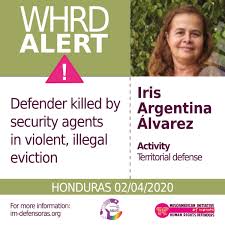
With all eyes on the pandemic it is easy to forget that “violence as usual” continues against human rights defenders. Here one case:
Human Rights Defender, Iris Argentina Álvarez, was killed on 2 April 2020, by private security agents from the company CRAE´S, employed by the La Grecia Sugar Mill. Her murder took place during a violent, illegal eviction in the Los Chanchos section of Marcovia, Choluteca in the South of Honduras. Community witnesses report that National Police officers were in the area when the aggressors opened fire against several families with many children. They affirm that the police did absolutely nothing to stop the violence that ended the life of the defender and left two other people wounded, including an underage child.
The Business and Human Rights Resource Centre attempted to contact La Grecia sugar mill but was not succesful and CRAE´S private security company did not respond.
Front Line Defenders just published ‘Dispatches 2019′ its annual magazine showcasing the work the organisation is doing to support human rights defenders. Together with Global Analysis 2019 (on which I reported already: https://humanrightsdefenders.blog/2020/01/14/front-line-defenders-global-analysis-2019-is-out-304-hrds-killed/),it offers a valuable reminder of the courage of human rights defenders in driving positive social change around the world and maintaining hope in the face of enormous adversity:
Over the last year, Front Line Defenders has continued to expand its support to human rights defenders most at risk. In 2019, FLD provided rapid and practical support to 2,307 human rights defenders and 366 organisations in 117 countries. Through the Protection Grants programme alone, FLD provided direct support through 626 grants totalling over euro 1.5 million to HRDs facing urgent threats, an increase of 17% compared to 2018.
As highlighted in its 2019-2022 Strategic Plan <https://www.frontlinedefenders.org/en/strategic-plan>, it is an organisational priority to support most-marginalised HRDs, including women human rights defenders, LGBTI rights defenders and defenders working on land, environment and indigenous peoples’ rights. Some examples of that commitment in 2019 include the provision of an unprecedented number of protection grants to environmental rights defenders (+51%), the presentation of the Front Line Defenders Annual Award to five LGBTI+ Rights Defenders, the beginning of a new learning and consultation process focused on defamation facing women human rights defenders at risk, and the publication (with Irish writing centre Fighting Words) of the anthology Yes, We Still Drink Coffee, Stories of Women Human Rights Defenders.
On 21 April, Reuters reported that Facebook has begun to significantly step up its censorship of “anti-state” posts in the country. This follows pressure from the authorities, including what the company suspects were deliberate restrictions placed on its local servers by state-owned telecommunications companies that caused Facebook to become unusable for periods of time. The next day Amnesty International demanded that Facebook reverses immediately its decision. “The revelation that Facebook is caving to Viet Nam’s far-reaching demands for censorship is a devastating turning point for freedom of expression in Viet Nam and beyond,” said William Nee, Business and Human Rights Advisor at Amnesty International. “The Vietnamese authorities’ ruthless suppression of freedom of expression is nothing new, but Facebook’s shift in policy makes them complicit.”
“Facebook must base its content regulation on international human rights standards for freedom of expression, not on the arbitrary whims of a rights-abusing government. Facebook has a responsibility to respect freedom of expression by refusing to cooperate with these indefensible takedown requests.” The Vietnamese authorities have a long track record of characterizing legitimate criticism as “anti-state” and prosecuting human rights defenders for “conducting propaganda against the state.” The authorities have been actively suppressing online speech amid the COVID-19 pandemic and escalating repressive tactics in recent weeks. “It is shocking that the Vietnamese authorities are further restricting its peoples’ access to information in the midst of a pandemic. The Vietnamese authorities are notorious for harassing peaceful critics and whistleblowers. This move will keep the world even more in the dark about what is really happening in Viet Nam,” said William Nee.
Facebook’s decision follows years of efforts by Vietnamese authorities to profoundly undermine freedom of expression online, during which they prosecuted an increasing number of peaceful government critics for their online activity and introduced a repressive cybersecurity law that requires technology companies to hand over potentially vast amounts of data, including personal information, and to censor users’ posts. “Facebook’s compliance with these demands sets a dangerous precedent. Governments around the world will see this as an open invitation to enlist Facebook in the service of state censorship. It does all tech firms a terrible disservice by making them vulnerable to the same type of pressure and harassment from repressive governments,” said William Nee…
In a report published last year, Amnesty International found that around 10% of Viet Nam’s prisoners of conscience – individuals jailed solely for peacefully exercising their human rights – were jailed in relation to their Facebook activity. In January 2020, the Vietnamese authorities launched an unprecedented crackdown on social media, including Facebook and YouTube, in an attempt to silence public discussion of a high-profile land dispute in the village of Dong Tam, which has attracted persistent allegations of corruption and led to deadly clashes between security forces and villagers. The crackdown has only intensified since the onset of COVID-19. Between January and mid-March, a total of 654 people were summoned to police stations across Viet Nam to attend “working sessions” with police related to their Facebook posts connected to the virus, among whom 146 were subjected to financial fines and the rest were forced to delete their posts. On 15 April, authorities introduced a sweeping new decree, 15/2020, which imposes new penalties on alleged social media content which falls foul of vague and arbitrary restrictions. The decree further empowers the government to force tech companies to comply with arbitrary censorship and surveillance measures.
From the Preface written John Peder Egenæs and Sandra Petersen of the Norwegian Human Rights Fund (NHRF):
…..2019 will stand out as an important year for the Norwegian Human Rights Fund (NHRF) in terms of growth and development. … We believe that the seeds of change planted by grantees every day will result in a robust and forceful defense for future generations. As this annual report demonstrates, our grantees and local human rights defenders are continuing to stand up and fight for a future of equality and dignity for all. For some, their work centers on ensuring that vulnerable workers have safe and dignified work environments, for others it’s providing psychosocial support for families of the disappeared and seeking justice for victims of torture and others are leading movements for gender equality. Establishing links, coordinating and collaborating on the local and national levels to create better working conditions for civil society and human rights defenders are crucial to strengthening the work and moving it forward. For this work, we support grantees who build networks and equip and empower defenders with the tools and skills needed for their work; who advocate for positive laws or the prevention of restrictive laws to protect or enable a thriving civil society; and others who provide relief, support and legal representation for human rights activists in cases of arbitrary arrests, detention or when they’re facing threats. Our grantees’ work is interlinked and reinforcing; success in one struggle impacts and can lead to success in another. Their work is driven by the needs on the ground and thus it comes in many forms, but the efforts to contribute to make positive and structural changes and the realization of human rights are shared by all. In 2019, the Norwegian government led an adoption of a new resolution on environmental human rights defenders – a critically important response during one of the most dangerous and even deadly points in recent history for human rights defenders, especially those who fight for natural resources, the rights of indigenous peoples and against environmentally detrimental megaprojects. …… Working together with our partners, we are able to see the reality of the dire situation for people on the front lines working for change, which leads us to seek to increase our support to and solidarity with their work. During 2019, the NHRF created strategic partnerships that increased the financial base for the years to come. We know this will be indispensable for local and front-line human rights defenders and for investing in the realization of human rights for the most vulnerable and marginalized. With these increased resources and with support from our partners, we will continue to invest and sow seeds that we believe will lead to long-term positive change…
On Tuesday 12 March 2020 Asharq al-Awsat reported – somewhat garbled – that Tahani Abbas, a Sudanese human rights activist, was awarded “the Martin Institute Prize in Switzerland.” The newspaper surely meant: the Martine Anstett Prize for Human Rights (see: http://www.trueheroesfilms.org/thedigest/awards/martine-anstett-human-rights-prize).
Ms. Abbas told Asharq Al-Awsat that she was proud to receive the prize and because it embodies the distant world’s perception of the Sudanese people’s struggle and shows that the world is watching out for human rights. She went on to say that “personally, the award credits me with a strong role with regards to defending human rights and makes me feel that our efforts and positions in the defense of human rights are appreciated and did not go in vain.” In her acceptance speech, Abbas stressed that all Sudanese women qualify to stand in her place and receive the prize, adding that “I am only a miniature and symbolic example that personifies that struggle of all the women of Sudan. I am an extension of Sudan’s feminist struggle, which is deeply ingrained in its history since before the era of the Kandakes or Nubian Queens, passing through Mendi, daughter of the Sultan Ajabna, and reaching the icon of the Sudanese revolution, Alaa Salah.”
Despite the admiration of observers and the organizers of the prize for the role of Sudanese women in the revolution, Abbas demonstrated her anger at what she calls “women’s weak political participation of after the revolution”. However, she says “Despite being denied political participation after the success of the revolution, our struggle will not stop.” Abbas has been an active human rights defender since 2009 and is a member of many Sudanese feminist and human rights groups. She is a member of the executive committee of the Regional Alliance of Women Human Rights Defenders of North Africa and the Middle East, a member of the executive committee of the No to the Oppression of Sudanese Women Initiative, the My Fair Home campaign which is concerned with domestic workers, the I am Sudanese, which is concerned with nationality and a member of the Sudanese Alliance to End Child Marriage.
In her assessment of the human rights situation in Sudan after the revolution, she says that it has improved a lot as per international standards. She said: ”The reports of international human rights organizations demonstrate this, and, locally, we feel that, as human rights defenders, we have achieved some victories.”
The 2020 World Press Freedom Index, annualy compiled by Reporters Without Borders (RSF), shows that the coming decade will be decisive for the future of journalism, with the Covid-19 pandemic highlighting and amplifying the many crises that threaten the right to freely reported, independent, diverse and reliable information.
This 2020 edition of the Index, which evaluates the situation for journalists each year in 180 countries and territories, suggests that the next ten years will be pivotal for press freedom because of converging crises affecting the future of journalism: a geopolitical crisis (due to the aggressiveness of authoritarian regimes); a technological crisis (due to a lack of democratic guarantees); a democratic crisis (due to polarisation and repressive policies); a crisis of trust (due to suspicion and even hatred of the media); and an economic crisis (impoverishing quality journalism).
These five areas of crisis – the effects of which the Index’s methodology allows us to evaluate – are now compounded by a global public health crisis.
“We are entering a decisive decade for journalism linked to crises that affect its future,” RSF secretary-general Christophe Deloire said. “The coronavirus pandemic illustrates the negative factors threatening the right to reliable information, and is itself an exacerbating factor. What will freedom of information, pluralism and reliability look like in 2030? The answer to that question is being determined today.”
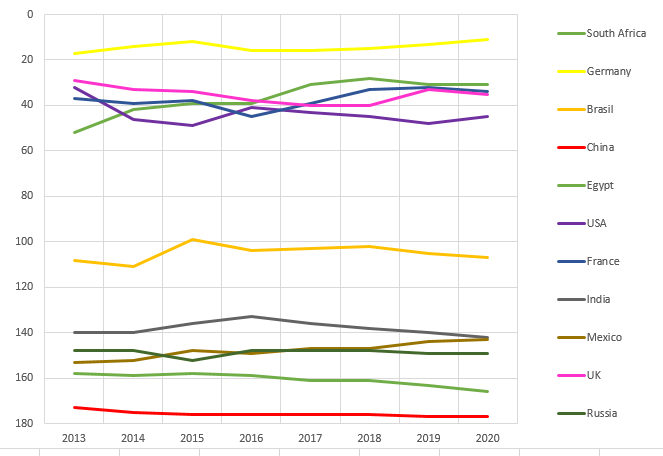
There is a clear correlation between suppression of media freedom in response to the coronavirus pandemic, and a country’s ranking in the Index. Both China (177th) and Iran (down 3 at 173rd) censored their major coronavirus outbreaks extensively. In Iraq (down 6 at 162nd), the authorities stripped Reuters of its licence for three months after it published a story questioning official coronavirus figures. Even in Europe, Prime Minister Viktor Orbán of Hungary (down 2 at 89th), had a “coronavirus” law passed with penalties of up to five years in prison for false information, a completely disproportionate and coercive measure.
“The public health crisis provides authoritarian governments with an opportunity to implement the notorious “shock doctrine” – to take advantage of the fact that politics are on hold, the public is stunned and protests are out of the question, in order to impose measures that would be impossible in normal times,” Deloire added. “For this decisive decade to not be a disastrous one, people of goodwill, whoever they are, must campaign for journalists to be able to fulfil their role as society’s trusted third parties, which means they must have the capacity to do so.”
Evolution of some countries ranked since 2013
The main findings of the 2020 Index: Norway tops the Index for the fourth year in a row in 2020, while Finland is again the runner-up. Denmark (up 2 at 3rd) is next as both Sweden (down 1 at 4th) and the Netherlands (down 1 at 5th) have fallen as a result of increases in cyber-harassment. The other end of the Index has seen little change. North Korea (down 1 at 180th) has taken the last position from Turkmenistan, while Eritrea (178th) continues to be Africa’s worst-ranked country.
Malaysia (101st) and the Maldives (79th) registered the biggest rises in the 2020 Index – 22nd and 19th, respectively – thanks to the beneficial effects of changes of government through the polls. The third biggest leap was by Sudan (159th), which rose 16 places after Omar al-Bashir’s removal. The list of biggest declines in the 2020 Index is topped by Haiti, where journalists have often been targeted during violent nationwide protests for the past two years. After falling 21 places, it is now ranked 83rd. The other two biggest falls were in Africa – by Comoros (down 19 at 75th) and Benin (down 17 at 113th), both of which have seen a surge in press freedom violations.
In the context of policy response by Human Rights NGOs to COVID-19 this joint statement should not be missing: On 9 April 2020 Reliefweb published the Joint NGO statement on civil and political rights at First Virtual Informal Dialogue with the UN High Commissioner for Human Rights on COVID-19
This joint statement on the protection of civil and political rights in the context of the COVID-19 crisis was delivered on behalf of 33 non-governmental organizations (NGOs) during the first virtual informal briefing with the UN High Commissioner for Human Rights on 9 April 2020. It was delivered in conjunction with a separate joint statement on economic, social and cultural rights (IOR 40/2124/2020).
Maria Arena and Pier Antonio Panzeri – a MEP and former MEP – write in an opinion piece in the EU Observer of 13 April 2020 that “Covid-19 is a gift for authoritarians and dictators“.
…..However, even in this emergency, it is necessary to maintain a very high level of attention to what is happening to democracy in this historical phase. The fight against the pandemic cannot be used as a pretext for a global attack on human rights and democracy, as is unfortunately happening in several parts of the world. We are not ‘diverting attention’. Quite the opposite. While we are doing everything we can to stop the contagion and start thinking about how to get out of the pandemic socially and economically, we also need to assess the risks for democracy and human rights at a global scale. It is essential to take care ‘now’ also of democracy and rights, because ‘later’ there is a real risk of regression, and without them our future can only be darker.
Second, many countries, on the pretext of Covid-19, are quietly taking advantage of the lack of world public opinion reaction to restrict the space and quality of democracy and eliminate opponents and human rights defenders.….
Finally, refugees in camps, detainees in every country in the world, homeless people, who have the right to be protected and safeguarded as far as possible against the epidemic, must not be forgotten in the emergency. In this context, Europe cannot waive its leading role in the protection of human rights.
We therefore welcome the joint proposal presented last Wednesday, 25 March, by the EU High Representative for Foreign Affairs and the European Commission to the European Council to adopt a decision on the “EU Plan on Human Rights and Democracy 2020-2024“. This includes, inter alia, strengthening the EU’s leadership in promoting and protecting human rights and democracy around the world, and identifying priorities for action, maximising the EU’s role on the world stage by expanding the “human rights toolbox”. [see: https://humanrightsdefenders.blog/2020/03/27/new-eu-action-plan-for-human-rights-and-democracy-2020-2024/]
An important move was the proposal that issues relating to the EU’s human rights policy in the world should no longer be subject to unanimity but to qualified majority voting, in order to avoid vetoes and denials by countries now in dangerous drift.
Ano Shumba writing for Music in Africa on 14 April 2020 refers to a call for applications: COVID-19 funding for artists and activists. The University of York’s Centre for Applied Human Rights (CAHR), through a grant from Open Society Foundations, is calling on artists and activists around the world to apply for COVID-19 funding of up to £3 000 ($3 750).
The CAHR recognises that collaborative endeavours between activists and artists have the potential to provide innovative responses to the current COVID-19 emergency, whether in a reactive, therapeutic or imaginative form. The centre seeks applications from artists and activists to address one or more of the following three objectives:
Document, monitor and analyse events in real time.
Reflect on well-being, both your own and that of your communities/organisations.
Go beyond a reactive response to imagine new, alternative futures. This future oriented work could assess how crises and disruption open up new possibilities for creativity and innovation, as well as for regressive and repressive measures, and/or build on positive responses to the virus itself (local and global forms of solidarity).
Expected outputs
Activists could write a diary, make a weekly podcast, write a blog, etc. Artists could work in their chosen media to respond to the activist’s contribution and/or to wider developments in their country/region. The CAHR is open to innovative suggestions on the nature of the collaboration between activists and artists.
Project proposals
Activists and artists should apply by presenting a single collaborative project proposal that does not exceed two pages in length and includes the following:
A brief profile/bio of the artist(s) and activist(s) involved.
A brief description of the project/programme of work, highlighting in particular how it responds to the COVID-19 emergency and its links to activism and civic/political space; which of the three objectives set out above it responds to; any safety, security and ethical concerns, and how these will be addressed; whether it builds on existing initiatives or is a new collaboration, and through which media/methodologies it will be carried out.
The main beneficiaries and audiences of the project/programme of work and why the methodology/medium is appropriate for the local context.
Details of additional sources of funding or contributions.
The envisioned output(s) of the project/programme of work, for both the activist(s) and artist(s).
The amount of funding you are applying for, and a brief justification for the specific amount requested in the form of a basic budget and justification of resources (subsistence/salary costs can be included). It is envisaged that most grants will be for between £1 000 and £2 000. Additional justification will be required for larger awards, up to £3 000, for example, that the application involves groups of activists and/or artists.
One appendix featuring examples of artistic work can be included in the application. The appendix can be additional to the two-page application.
While applications need to be in English, activist and artist outputs that are in part or completely in local languages are welcome.
Criteria for assessment
Clear description of the link between COVID-19, and responses to the virus, on the one hand, and threats to activism and civic/political space on the other, affecting either the artists/activists making the application and/or their country.
Evidence of a strong working relationship between the artist(s) and activist(s).
Feasibility and relevance of the project in challenging and difficult circumstances (including consideration of safety, security and ethics).
Evidence of innovation and creativity.
Deliverables
Artists and activists are expected to provide a timeline for outputs in their application, between now and 31 December 2020. Artists and activists are also expected to submit a short joint report (two pages) detailing the activities undertaken as well as all expenses incurred, by 31 January 2021.
There is no fixed deadline for proposals – applications will be considered on a rolling basis over the coming months. The CAHR will endeavour to get back to applicants within two weeks. Successful proposals will be selected by a panel that will include CAHR staff and associates from a variety of backgrounds.
Copyright
Copyright for the outputs remains the sole and exclusive property of the artist and the activist. Terms of reference/contracts will provide the CAHR with the limited right to reproduce, publicly display, distribute and otherwise use the expected outputs in relation to the CAHR’s work, and as an example of work commissioned through the Open Society Foundations’ grant. Copyright will be addressed in terms of reference/contracts developed with successful applicants.
Confidentiality and ethics
The CAHR will discuss anonymity, confidentiality and other ethical issues with artists and activists as they arise in relation to specific projects.
FRA accounces a discussion on the impact of COVID-19 measures on human rights defenders.
When:
17 April 2020
Where:
Online
Who:
EU Member States and Representatives from intergovernmental organisations and EU institutions responsible for cooperation with civil society and for supporting human rights defenders in Europe.
They will discuss the impact of COVID-19 measures for human rights defenders. FRA will look more closely into the effects of these measures on civil society organisations in the coming months.
The informal contact group on human rights defenders was set up a year ago. It allows ongoing, practical information exchange at the working level.
The aim is to enhance coordination and cooperation in supporting human rights defenders.
A very summary outline of the result of the 17 April meeting was published on 23 April:
In going forward, staff working on cooperation will continue to meet to exchange views on a range of issues on how best to support civil society and human rights defenders. These include: how Intergovernmental organisations can ensure continued participation by civil society during these times, including online; assessing the impact of COVID-19 measures on human rights defenders and civil society organisations; how donors could deal with the situation; digital security, safe communications, and the digital divide; and how do deliver capacity building and project support under the current circumstances.


 Download report (PDF | 117.05 KB)
 Hans Thoolen on Human Rights Defenders and their awards