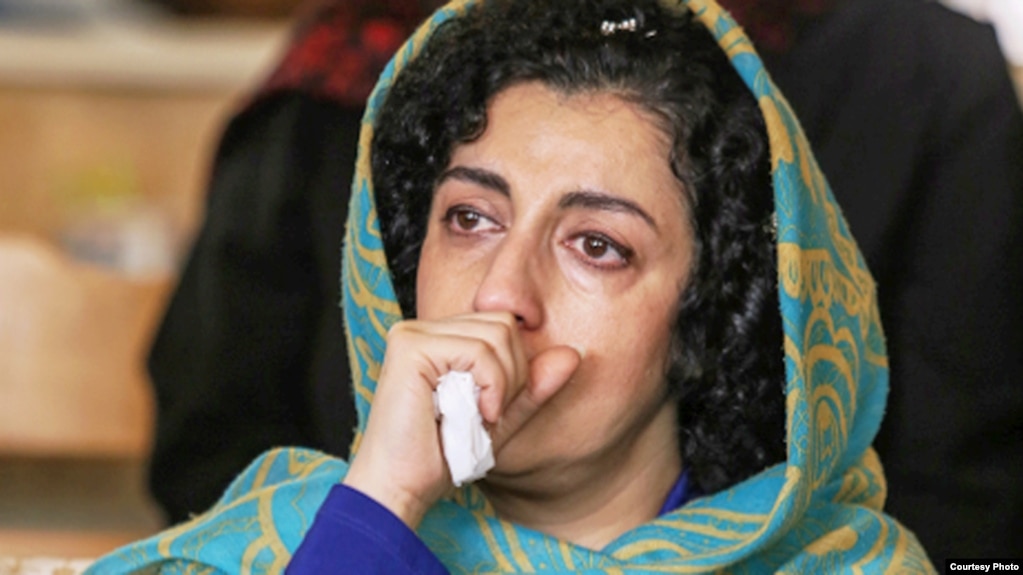
Narges Mohammadi has “serious health problems,” her brother says, but is not allowed out of prison to see a doctor.
Reporters Without Borders (RSF) has condemned the latest “absurd charge” brought against jailed Iranian journalist and human rights advocate Narges Mohammadi, who has been imprisoned since 2015. On 12 June 2020 RSF urged the UN special rapporteur on the human rights situation in Iran, Javaid Rehman, to “intervene quickly and do everything possible to obtain the release of Iran’s longest-held woman journalist.“
In a recent open letter to the Iranian judicial authorities, her brother revealed that she was now accused of “dancing in prison during the days of mourning” commemorating the seventh-century killing of Imam Hussein, a revered figure in Shi’ite Islam. Mehdi Mohammadi, now a refugee in Norway, also wrote that his sister had serious health problems but “was not allowed out of prison to see a doctor, who went to her cell.” “This persecution of Narges Mohammadi is evidence of judicial discrimination at the behest of the Intelligence Ministry and senior justice system officials,” said Reza Moini, the head of RSF’s Iran-Afghanistan desk.
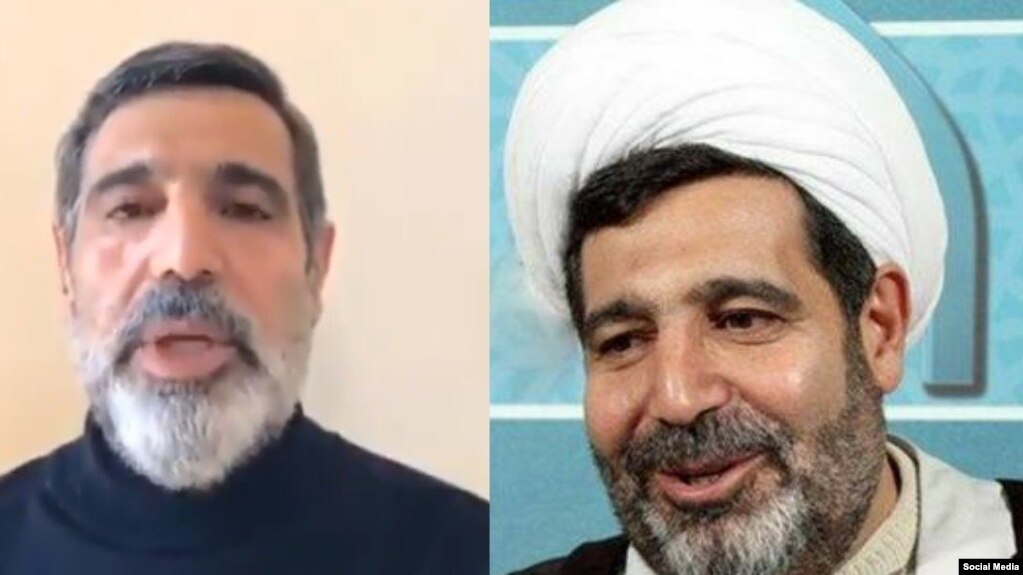
In the meantime there is also an interesting case of an Iranian judge and former prosecutor who was arrested in Romania by Interpol for rights violations (13 June 2020 Radio Farda)
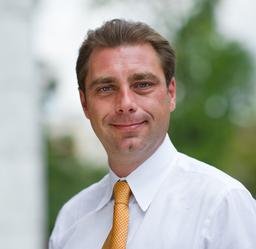
Gholamreza Mansouri, Iranian judge and former prosecutor.
Iran’s Judiciary Spokesman confirmed that Interpol has detained Gholamreza Mansouri in Romania. He is accused of human rights violations by rights defenders, but he is also one of the defendants in a recent sensational corruption case in Iran who fled to Europe. Judiciary spokesman Gholam-Hossein Esmaili said Mansouri’s extradition is not possible now due to coronavirus restrictions but he will be returned to Iran and put on trial for corruption. He also told a local news network that Iran requested the arrest through the Interpol.
In a tweet on June 11, the Secretary-General of Reporters without Borders urged German authorities not to let him escape justice. Reporters without Borders (RSF) has supported the call of Iranian activists and filed a complaint with Germany’s Federal Public Prosecutor against Mansouri for the arrest and torture of at least 20 journalists in 2013….Mansouri is a highly influential prosecutor and judge notoriously famous for prosecuting journalists and putting them behind bars. In one instance in 2013 he ordered the simultaneous arrest of 20 journalists in one day.
Mansouri’s name came up as one of the recipients of bribes in the first trial session of Akbar Tabari, a former Judiciary deputy. The former judge allegedly received 500,000 euro in bribes from Tabari.
In a video published on social media on June 9, Mansouri claimed that he was abroad for treatment of a serious medical condition and could not return due to the restrictions introduced after the breakout of coronavirus. He did not reveal where he was but said he would go to an Iranian embassy to arrange for his return to defend himself against the corruption charges.
Courtesy of Reliefweb of 15 Jun 2020, here the introduction to the EU’s annual report on human rights
1. INTRODUCTION
The 2019 EU annual report on human rights and democracy in the world marks the final phase of implementation of the EU Action Plan on Human Rights and Democracy (2015-2019) 1 . It presents the progress achieved to date, by means of a comprehensive set of actions taken by the European External Action Service (EEAS), the European Commission and EU delegations and offices around the world. In 2019, the EU demonstrated once again that it is a reliable, cooperative and principled global player, working for a better world where all human rights are fully protected and respected.
However, in many parts of the world, challenges remain. Human rights defenders (HRDs), journalists and media workers are under threat and attack because of their daily work, civic and democratic space continues to be restricted, women’s and girls’ human rights are being violated, and vulnerable groups are often left behind and exposed to further discrimination and inequality.
Against this background, the international community celebrated in 2019 the 10th anniversary of the Charter of Fundamental Rights, the 30th anniversary of the UN Convention on the Rights of the Child, the 70th anniversary of the Council of Europe and the 100th anniversary of the International Labour Organisation. These anniversaries gave great impetus to the EU’s continuous efforts to translate its legal and policy frameworks on human rights into reality. The EU worked with all partners to turn challenges into opportunities for all human beings, at any time, in any place.
The 21st EU-NGO Forum on Human Rights, held in Brussels on 3-4 December, put the human rights and environment nexus in the spotlight as an emerging challenge and gained unprecedented traction. On 9 December 2019, the Foreign Affairs Council agreed on the political appropriateness of establishing an EU global human rights sanctions regime to tackle serious human rights violations worldwide committed by state and non-state actors.
In 2019, the first ever EU guidelines focusing on economic, social and cultural rights were adopted: the EU Human Rights Guidelines on safe drinking water and sanitation. These guidelines opened new horizons in promoting the indivisibility of civil, political, economic, social and cultural rights. The Council also adopted Guidelines on non-discrimination in external action and revised Guidelines on EU policy towards third countries on torture and other cruel, inhuman or degrading treatment or punishment. Moreover, the Council conclusions on Democracy adopted in October provided a comprehensive framework to advance democratic governance.
This report focuses on thematic issues, using a number of country-specific examples, and aims to be a practical tool for all stakeholders. Reporting on human rights and democracy at country level can be found on the EEAS2 and EU delegations’ webpages.
Alice Morby in Dezeen Magazine of 26 January 2018 (this is not a typo – I came accross it only recently and thought it contained interesting thoughts as we often feel that there should be more design expertise available to human rights defenders)
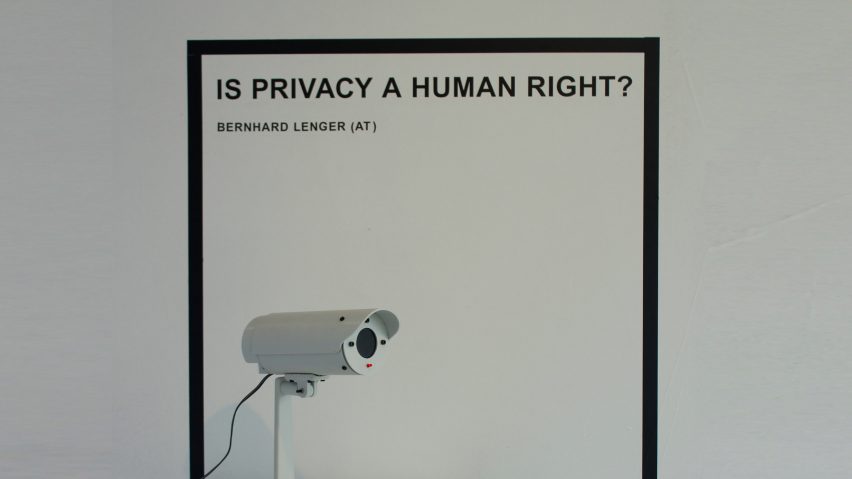
Lenger, pictured at Dezeen’s Good Design For A Bad World talk, believes designers can only make a difference if paired with other “changemakers”
“Think of it as a kind of consultant agency, an organisation that people, governments or NGOs can turn to and get support,” Lenger explained. “By combining the experts in two fields, design and human rights, unique and relevant projects will be the outcome – as the context of the projects is set by the culture and human rights issue of the human rights defender.“
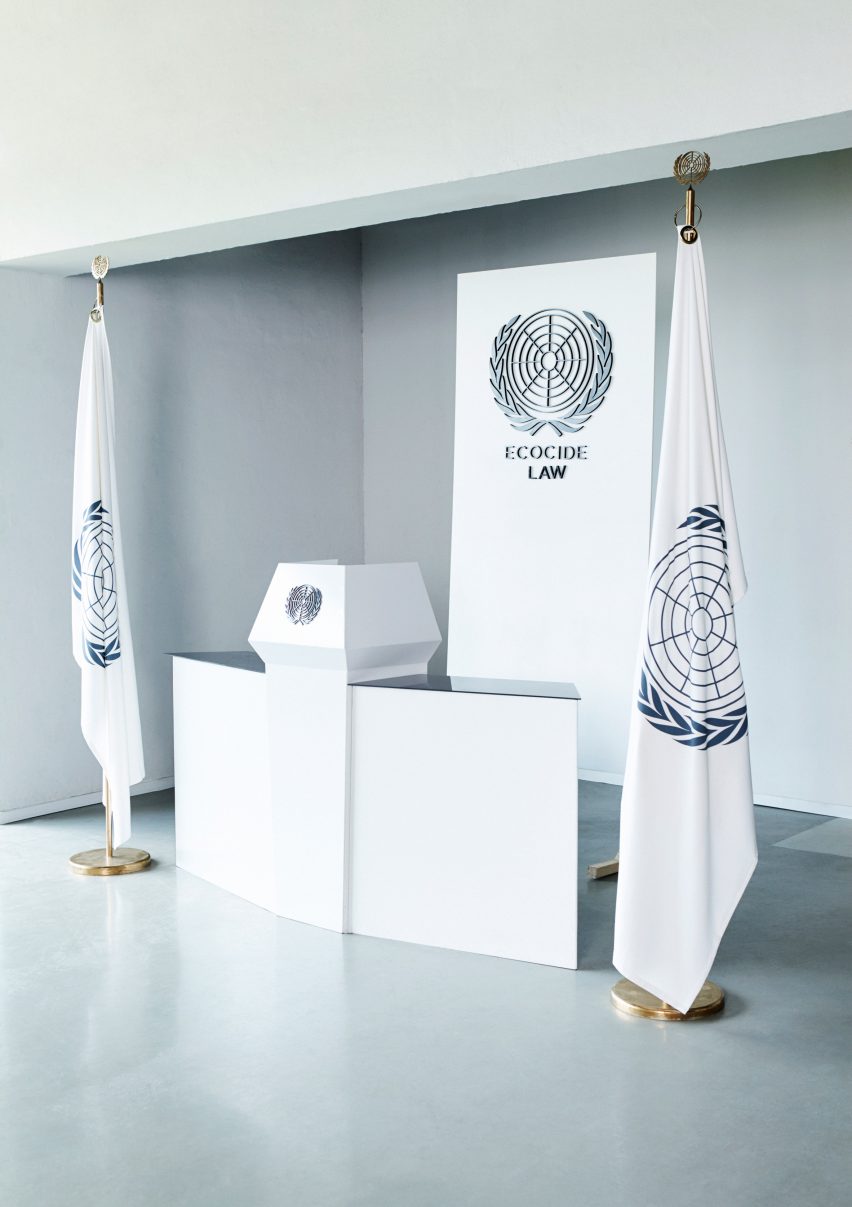
…Lenger was one of the speakers for Dezeen’s Good Design for A Bad World talks programme at Dutch Design Week 2017, where panellists – mainly designers – were invited to discuss how design could help tackle real-world issues. Speaking during a talk focused on pollution, Lenger presented another project he has been involved in, called This is Ecocide. Developed while he was studying at Design Academy Eindhoven, This is Ecocide saw Lenger partner with environmental lawyer Polly Higgins to develop a campaign to make ecocide – the destruction of the environment – illegal.
Lenger often takes a political stance with his work. His previous project, This is Ecocide, saw him try to criminalise the destruction of the environment
This project started with the discovery that ecocide was once recognised by the International Criminal Court as a crime, but was removed. With help from Higgins, he found that this was a result of lobbying from four countries: the USA, the UK, France and the Netherlands. “I was like, what should I do? I was 25 years old graduating from Design Academy, how could I work on a field of international law?” he told the audience.
Young designers are taking on more responsibility
According to Lenger, he isn’t unique in wanting to use to design to solve bigger problems. He said he had noticed a shift in the degree of responsibility felt by young designers. “Some people just want to make pretty things, some feel like there’s something missing if they just make pretty things,” he said.
Coronavirus “information heroes” – journalism that saves lives
On 15 June t2020 he NGO Reporters Without Borders (RSF) published a list of 30 coronavirus “information heroes” – 30 journalists, whistleblowers and media outlets whose courage, perseverance or capacity to innovate has helped to circulate reliable and vital information during the Covid-19 pandemic. See the list
Every crisis produces its heroes. Around the world there are journalists, whistleblowers and media outlets that have managed to overcome the barriers to information created since the start of the pandemic. Through their reporting or by means of initiatives that have needed courage, audacity and determination, they have provided access to trustworthy and quality information, helped to resist censorship, and combatted the runaway disinformation that threatens public health.
“Some people have taken such big risks to report the reality of the pandemic that they have died as a result, while others have disappeared or have been jailed,” RSF secretary-general Christophe Deloire said. “Prosecuted, attacked, insulted – many have paid a high price for defending the right to information and for combatting the rumours and disinformation that aggravate the consequences of this public health crisis. These new heroes remind us that journalism can save lives. They deserve our attention and admiration.”…
The list compiled by RSF, which is not intended to be exhaustive, includes both well-known media figures and people the public have not heard of. Although they come from all five main continents, nearly a third of these 30 heroes are from Asia, where the pandemic originated. Six are from Europe and Central Asia, and the others are from Africa, the Americas and the Middle East.
What most of these heroes have in common is the fact that they revealed information highlighting the pandemic’s gravity or their government’s mismanagement of the crisis. Some are veteran reporters like Ana Lalić in Serbia or combative investigators like Blaž Zgaga in Slovenia, Andjouza Abouheir in Comoros and Sergei Satsukin Belarus. However, others are ordinary citizens who, in response to the urgency and gravity of the public health crisis, decided to blow the whistle with the aim of saving as many lives a possible. It was an eye doctor, Li Wenliang, who first alerted the world to the existence of a fast-spreading disease in December 2019. And it was a lawyer, Chen Qiushi, who posted videos on his blog revealing the chaos in the hospitals in Wuhan, the site of the initial Covid-19 outbreak. Li died of the virus while Chen was forcibly quarantined and never reappeared.
You often pay dearly for the truth. In Venezuela, freelance journalist Darvinson Rojas spent 12 days in prison for a tweet questioning official pandemic figures. In India, newspaper reporter Vijay Vineet is facing a possible six-month jail sentence for reporting that lockdown restrictions forced hungry kids to eat cattle fodder. In Bangladesh, the well-known cartoonist Ahmed Kabir Kishore is facing a possible life sentence for posting cartoons on Facebook about politics during the Covid-19 crisis that alluded, inter alia, to corruption.
Others have avoided prison but can no longer work. After a lengthy and violent police interrogation over an article questioning the Kingdom of Eswatini’s handling of the Covid-19 crisis, Swati Newsweek website editor Eugene Dube had to flee to neighbouring South Africa. Chris Buckley, a Beijing-based reporter for the New York Times, was forced to leave China after spending 76 days in Wuhan at the height of the outbreak. For the first time in 24 years, his visa was not renewed.
Many of these heroes displayed courage in resisting pressure and censorship. They include Caixin, an independent English and Chinese-language media outlet in Beijing whose reporting has questioned the Chinese government’s narrative. For some, such as Afghan reporter Anisseh Shahid, it took courage to simply keep reporting in the field with the threat of infection compounding the threat of a Taliban attack. In the United States, several White House correspondents have distinguished themselves by their perseverance in adversity. Despite constant attacks by President Trump and his aides, they continue week after week to question his handling of the pandemic.
This exceptional crisis has also produced innovative initiatives that have helped to get the facts out and combat disinformation. In Africa, the Ivorian web radio WA FM and the Togolese news site TogoCheck were created to combat rumours and fake news and disseminate trustworthy information that the public can use to protect themselves and their health. In Brazil, alternative media outlets pooled resources to form a “Gabinete de crise” to inform the abandoned inhabitants of Rio de Janeiro’s favelas, while the Wayuri Network’s journalists have risen to the challenge of informing more than 750 indigenous communities in the Amazon. In Russia, 25 media outlets formed Syndicate-100 to make it easier for medical personnel, who have been hit hard by the epidemic, to report problems and alert the public.
Finally, RSF pays a special tribute to journalists in Guayaquil, Ecuador’s business capital and the site of Latin America’s biggest Covid-19 outbreak. The photos of bodies in Guayaquil’s streets have gone around the world. Despite being unprepared and lacking personal protective equipment, the city’s journalists have continued to work and to report in locations with a high infection rate. And this has taken a heavy toll. Thirteen of them have died of the virus.
ISHR’s report documents a disturbing pattern of intimidation and reprisals that must be addressed. Cases of intimidation and reprisals featured in the submission range from States maligning and stigmatising defenders to banning them from travel and detaining them. ‘Such reprisals violate human rights and fundamental freedoms that regional and international systems are obliged to promote and protect. Moreover, they also seriously impede bodies and mechanisms’ abilities to discharge their mandates effectively, threaten their integrity, and undermine the credibility of their work in the field of human rights’, said Adelaïde Etong Kame, ISHR Africa Programme Manager.
In Malawi and Cameroon, defenders engaging with the ACHPR are threatened, stigmatised, harassed and attacked. In Burundi, increased monitoring by regional and international human rights mechanisms has been met with increased risk, stigmatisation and harassment of defenders working with the mechanisms. In Mauritania, human rights defenders continue to be vilified by the government and accused of being terrorists. In Egypt, defenders engaging with the African human rights system have been maligned, intimidated, and detained.
The report also documents how recent hosts of ACHPR sessions, in particular Mauritania and Egypt, have hindered and restricted access to the sessions, through visa denials, intimidation, harassment, and undue restrictions at the sessions themselves. ..
ISHR’s submission also documents undue restrictions on accreditation, namely the case of the Coalition of African Lesbians (CAL), who have had their observer status to the ACHPR withdrawn, in violation of the rights of freedom of expression, association, and unhindered access to and communication with international bodies of CAL and its members, on discriminatory bases.
The primary duty to prevent and remedy reprisals lies with States—who must do more to prevent, investigate and ensure accountability for reprisals. ‘In that regard, the task for the Focal Point and the ACHPR is now to take up these cases and ensure they are addressed with the perpetrating governments. Otherwise, reprisals ‘work’ to dissuade engagement, and perpetrators will be emboldened’, said Etong Kame.
Participation, promotion and protection are the three watchwords that should guide the UN’s work on and with civil society, says a newly-released UN report. Offering examples of good practice within the UN system -which provide a baseline for a new UN strategy on civil society- and a range of recommendations, the report is timed to inform decision-making at the 44th session of the UN’s Human Rights Council.
On 31 May 2020 the ISHR discussed the new report of the UN on civil society: with countless recent examples of restrictive and repressive measures taken to silence or discredit civil society actors, the UN’s new report drawing together examples of some good practices across the UN, is timely. Re-stating the vital contribution of civil society actors, the report goes on to cite examples of good practices of UN entities engaging with and protecting civil society. The report recommendations – aimed at encouraging improvement across the UN system as well as by States – echo several which ISHR has consistently voiced .
ISHR’s Eleanor Openshaw said that good practice examples to inspire reform by the UN and States were valuable: ‘In days where we’ve seen journalists being arrested in Minneapolis and an increasing number of defenders murdered in Colombia – as just two such examples – we need States and UN bodies to revise and strengthen their practice to ensure the voice of civil society is heard and safeguarded.’…
‘The report contains examples where discussion between different stakeholders has been formalized and where their input is part of the process from policy inception to implementation,’ noted Openshaw.
One such example is the Inter-Agency Standing Committee (IASC), created by the UN General Assembly which styles itself as ‘a unique inter-agency forum for coordination, policy development and decision-making involving the key UN and non-UN humanitarian partners’. ‘This example of civil society having a seat at the table in recognition of the experience and expertise they bring to the issue makes more evident the lack of such opportunities in other spaces, particularly in human rights bodies,’ said Openshaw.
The report also highlights clear gaps. One of the key findings is the absence in 2/3 of UN mechanisms of means to contest restrictions on civil society participation or access to information. Whilst the report makes no explicit reference to Covid-19, having sought input prior to the onset of the pandemic, it does contain recommendations that speak to shifts in practice the pandemic has engendered.It notes how the impact of any modifications should be assessed to ensure civil society is not disadvantaged or disproportionately affected. This is one of several recommendations ISHR and other civil society have been making over time.
‘It’s great to see that the UN has reflected the recommendations of civil society groups such as ISHR, who have experience working with defenders and engaging with UN and regional organisations,’ noted Openshaw. ‘It’s but one example of civil society expertise adding value.’
The need for the UN to improve and make more consistent its work to promote, engage with and safeguard civil society has been a long-term call. The Secretary General made such a recommendation in his 2018 report on the Declaration on Human Rights Defenders, and again in his recent Call to Action for Human Rights. This new UN report was as a result of the request made by the Human Rights Council in 2018.
In a statement, Senator Francis Pangilinan said “The silencing of critics and the attacks on the media has been going on for three years now,” he said. “And unless we stand up, speak out, and vigorously oppose the tyranny in our midst, their conviction will not be the last” he added… Ressa and Santos are the first journalists to be found guilty of cyber libel.
In this context ABS-CBN was forced off the air after its television and radio broadcast operations nationwide were ordered shut a day after its 25-year-franchise expired.
Detained Senator Leila de Lima joined her colleagues in condemning Ressa and Santos’ conviction, saying it was “another demonstration” of the Duterte administration’s “weaponization of law against those who dare speak truth to power.” “Jailing me for over three years now is only one of the thousand sinister ways they are causing fear in the hearts of Filipinos who fight for what is just and right,” the senator said in a dispatch from Camp Crame. [see also: https://humanrightsdefenders.blog/2018/07/30/senator-de-lima-in-detention-in-philippines-receives-her-award/]
Meanwhile, former Senator Antonio Trillanes IV said the guilty verdict against the Rappler CEO was an “obvious attack” against press freedom and an “attack against our democracy itself.” “We are now but a few steps away from Martial Law,” Trillanes, who has been critical of the Duterte administration, said in a statement.
Meanwhile in June 2020 a film on Maria Ressa won a film award:
Families hold photographs of missing loved ones during a protest in Colombo, Sri Lanka’s largest city, in February 2020. (TNH)
Rights groups are warning of a crackdown on dissent and rising authoritarianism in Sri Lanka, raising fears for the future of long-stalled civil war reconciliation efforts. Since President Gotabaya Rajapaksa took office after November elections, local rights activists have reported a rise in surveillance by state security forces, threats, and other measures more common during the country’s 26-year civil war, which ended in 2009, as well as its aftermath. A long piece in the New Humanitarian of 10 june 2020 gives the details:
“Surveillance has always been there, but since the election what we have seen is that it’s more open and more rampant,” said Shreen Saroor, a women’s rights activist…
Human Rights Watch says Rajapaksa is re-establishing a “state of fear” in Sri Lanka, citing interviews with dozens of activists and journalists. Many local journalists say they are self-censoring as threatening phone calls and other pressures escalate, acutely aware of the country’s history of unsolved murders and abductions. At least two reporters have already fled the country, according to the Committee to Protect Journalists.
In February, Sri Lanka announced it was backing out of commitments made to the UN Human Rights Council in 2015 by a previous administration. These promised a range of measures to investigate abuses during the civil war. ..
[see also: from my blog post https://humanrightsdefenders.blog/2020/02/24/human-rights-defenders-issues-on-the-agenda-of-43rd-human-rights-council/ Sri Lanka: Civil society groups are concerned over the backsliding on the commitments made by Sri Lanka in Human Rights Council Resolution 30/1. The recently elected president, Gotabaya Rajapaksa, along with his brother Mahinda Rajapaksa, who has been appointed prime minister, have been implicated in war crimes and numerous human rights violations when they were defence secretary and president respectively from 2005 to 2015. The new Government has made clear its intention to walk away from the Council process on Sri Lanka, a process that is currently the only hope for victims of human rights violations that truth, justice, reparations, and guarantees of non-recurrence are possible. [see https://www.nwaonline.com/news/2020/feb/23/sri-lanka-details-un-case-pullout/] Meanwhile, the relatively open climate for human rights defenders and journalists of the past few years seems to be rapidly closing. More than a dozen human rights and media organisations have received intimidating visits by members of law enforcement and intelligence agencies, while death threats against journalists have resumed. ISHR calls on States to urge for continued cooperation of the Government of Sri Lanka with OHCHR and the Special Procedures. The Council should reiterate the reference in Resolution 40/1 to “the adoption of a time-bound implementation strategy” for implementation of all elements of Resolution 30/1. [see also: https://humanrightsdefenders.blog/2020/01/22/sri-lankan-government-accused-of-embarking-on-process-to-silence-critics/]
And, this month, Rajapaksa created two “task forces” with vague mandates, which rights groups fear could operate parallel to existing institutions. One, a body created to combat “anti-social activities”, is led by security and intelligence officials. Another task force mandated to protect cultural heritage appears to exclude non-Buddhists and non-Sinhalese. Rajapaksa’s first six months in office, the International Crisis Group said in a May report, have been “aggressively Sinhala nationalist, family-centred, and authoritarian”.
….“All these years of looking for justice would be then wasted,” said Yogeshwari, 45, whose husband disappeared 15 years ago.TNH Families of Sri Lanka’s missing thousands fear the government is aiming to curb investigations into unsolved civil war disappearances.
In announcing his country’s withdrawal from its UN Human Rights Council commitments in February, Sri Lanka’s foreign minister, Dinesh Gunawardena, said the previous pledges would infringe on “the sovereignty of [the] people of Sri Lanka”…
A government body tasked with investigating disappearances, the Office on Missing Persons (OMP), didn’t begin its work until 2018. It’s effectively the only government body actively working on reconciliation issues. Ruki Fernando, an advisor with Inform, a Colombo-based human rights documentation centre, expects the Rajapaksa government to take a similar line domestically by clipping the OMP’s powers. “It is not about shutting them down,” Fernando said. “It is more about making them administratively limp.”…
Saroor believes the Rajapaksa government will likely ramp up its stance against investigations and reconciliation efforts. “Sri Lanka transitional justice and truth-seeking will come to a standstill,” she said.
This piece was reported by a freelance journalist whose name is being withheld over concerns for their safety.
On 12 June 2020 the Oak Institute for Human Rights announced as the 2020 Oak Human Rights Fellow: Nasim Lomani, a human rights defender and migrants’ rights activist, who has been working in Greece and across the EU for over a decade.
As a then 16-year-old Afghanistani, Lomani left for Greece nearly two decades ago. Upon arrival, he was arrested and charged with illegal crossing of the Greek border, ultimately serving a two-year prison sentence. During the process of appealing to the court for having his rights as a refugee abused and violated, he learned about the bureaucratic difficulties that all migrants face while trying to enter Europe. He joined a number of solidarity groups, such as the Network for Social Support to Immigrants and Refugees and the Migrants’ Social Center in Athens, where he coordinated free language classes and the Athens Anti-racist Festival. He also engaged in solidarity work that involved lawyers, human rights defenders, as well as refugees and migrants.
In Greece, Lomani, founded City Plaza – Refugees Accommodation Solidarity Space in Athens – where he organized daily life for migrants, managed media communication, coordinated international volunteers, and served as the public representative to researchers, students, and academics. City Plaza, once one of the largest solidarity migrant accommodations in Athens, was an abandoned hotel in central Athens repurposed to offer migrants the right to live in dignity in the urban space with access to social, economic, and political rights. Lomani lived inside the now-closed City Plaza for the entirety of its existence. Over almost three and half years, it welcomed 3,000 people, lodging up to 400 at a time. The story of City Plaza is known as an example of self-organization, self-management, and everyday processes to help empower refugees. In essence, it was a political statement against Europe’s use of militarized borders, repression, and systematic violation of human rights and refugees’ rights.
Lomani was also involved in organizing the largest NoBorder refugee and migrant solidarity camp to date, leading to the closure of the Pagani Detention Center on Lesvos island in 2009.
Lomani is at increasing risk, as migration solidarity work and defending human rights in Greece, and Europe at large has been criminalized in recent years. Helping refugees and criticizing the human rights violations by authorities is now a major offense by both national and European law. In Greece, this has led to large-scale evictions of housing sites for refugees and asylum seekers and to increasing arrests and trials of activists on the ground.
Lomani has been active in the human rights field since he was a child, so the Oak Fellowship will come as a much-needed respite.
Established in 1997 by a grant from the Oak Foundation, the Oak Institute for Human Rights hosts a Fellow each year. The fellowship offers an opportunity to spend the fall semester in residence at Colby, where they teach, conduct research, and raise awareness about important global human rights issues.
On 11 June 2020 Visiting Fellow William Burke-White posted on the website of Brookings an informative piece “Order from Chaos” in which he reviews the danger of Trump’s new sanctions on the International Criminal Court and human rights defenders. It is worth reading and studying in full….:
In March, the Appeal’s Chamber of the International Criminal Court (ICC) authorized an investigation of potential war crimes alleged to have occurred more than a decade ago in Afghanistan, including those by the United States. While the U.S. military under President Obama did conduct investigations of its activities in Afghanistan, there remain concerns that those investigations did not go far enough up the chain of command and did not adequately include conduct by the U.S. intelligence community. In a post on this blog just after the decision, I argued that the Trump administration’s threats to prevent such a case may have actually pushed the court toward such an investigation.
Today, the Trump administration issued unprecedented sanctions against the ICC, as well as the international lawyers and human rights investigators involved in the case. This sanctions regime is fundamentally misguided. It will do little to stop the ICC’s investigation, erodes the U.S. longstanding commitment to human rights and the rule of law, and may undermine one of the most powerful tools in the U.S. foreign policy arsenal — economic sanctions.
What emergency? In a moment of real national emergencies — ranging from the COVID-19 pandemic, to police misconduct, to the highest unemployment rate in a generation — the fact that President Trump, in an executive order on June 11, “declare[d] a national emergency to deal with” the threat posed by the ICC investigation in Afghanistan seems almost farcical. An underfunded court with relatively little to show for two decades of work trying to end impunity would likely be surprised to learn that, in Trump’s view, it has the power to “impede the critical national security and foreign policy work of United States Government and allied officials, and thereby threaten the national security and foreign policy of the United States.” Admitting that a duly authorized investigation of U.S. conduct in Afghanistan constitutes such a threat is both a recognition of the power of international law and a suggestion that the U.S. has something to hide.
Of course, declaring a national emergency is a necessary precondition for the sanctions imposed on the ICC and its officials. While the U.S. has had a complicated history with the ICC — from President Bill Clinton’s signing of its founding treaty to President George Bush’s early efforts to undermine the court — the new sanctions go further than any past U.S. actions in their direct attack on the ICC and its staff. Bush’s “unsigning” of the Rome Statute was largely symbolic. So, too, was the American Service members Protection Act that threatened to invade the Netherlands to rescue any U.S. citizens that might be prosecuted in The Hague.
In contrast, today’s sanctions directly target individual international lawyers and investigators working for a legitimate international organization undertaking lawful actions under its statute. More specifically, today’s sanctions seize the property of to-be-designated ICC officials who undertake investigation or prosecution of U.S. personnel and any other foreign nationals who are deemed to have assisted such efforts. So too, the new sanctions prohibit the entry into the United States of such individuals and their immediate family members.
The sanctions language is sufficiently broad that it could, in theory, apply to a victim or witness who provided information incidental to the court’s investigation or an academic whose scholarship the court relied upon in framing a legal argument. This new sanctions regime draws strong parallels to those imposed by the U.S. in the past against terrorist groups, dictators, and human rights abusers. Those same sanctions are now turned on international lawyers and human rights defenders.
The sanctions imposed today on ICC officials are unlikely to achieve Trump’s objective of blocking the investigation of U.S. conduct in Afghanistan. If anything, the sanctions will redouble those efforts. Unlike most corrupt dictators or terrorist organizations, individuals who choose to work for the ICC or in international human rights more generally are motivated by conscience, not wealth. They rarely have significant assets in U.S. bank accounts or meaningful real property for the U.S. to seize. Similarly, the foreign victims of crimes in Afghanistan who might testify before the ICC are not likely to have assets subject to seizure.
Hence, the threat of such a seizure under this new sanctions regime will do little to deter investigation or cooperation. Even blocking ICC employees from entering the U.S. will have minimal impact. Effective investigation of crimes in Afghanistan more than a decade ago does not require on-the-ground presence in the U.S. today. In fact, given the moral compass of most human rights advocates and international criminal prosecutors, treating them like terrorists under this new sanctions regime will more likely be a call to action under the law than an effective threat.
This new sanctions regime is a direct affront to international human rights and, particularly, individuals who have dedicated their lives to enforcing international law and ending impunity. President Trump has a long history of attacking international institutions that he doesn’t like. His recent criticisms of the World Health Organization are case in point. This new attack on the ICC is, however, different because it targets not just another international institution, but also the individuals who work for that institution. As such, it is an effort to directly sanction human rights defenders and officials of international justice for doing their jobs. The new sanctions regime seeks to punish those individuals, working for an international organization created by a treaty the United States signed in 2000, and undertaking a legal investigation authorized by a panel of international judges. It flies in the face of every U.S. and international effort to protect human rights defenders and offers a powerful example for despots around the world to follow suit.
Other, better tools
Finally, the use of U.S. sanctions against ICC personnel is a dangerous step toward undermining one of the most powerful and important tools of U.S. foreign policy — international sanctions. In a world where the use of force is difficult and often ineffective, carefully crafted and strategically applied sanctions are a key tool of U.S. power. For sanctions to work, however, they must be used judicially and viewed as broadly legitimate. Overuse of sanctions creates incentives for actors to find work-arounds to avoid the pain. Sanctions that are seen as illegitimate fail to garner international cooperation for enforcement and compliance. Applying tough sanctions against the personnel of an international organization undermines their efficacy and legitimacy for times when they could actually advance U.S. national security.
So, what should Trump have done instead? Simply investigate and prosecute any crimes that the U.S. may or may not have committed in Afghanistan years ago. The Rome Statute of the ICC makes clear that the court is a backstop to national prosecutions and that it will not investigate or prosecute when national governments have held themselves and their soldiers accountable. If the U.S. did nothing wrong in Afghanistan, it could simply submit to the ICC evidence of a genuine investigation with respect to both military and intelligence agency activities that reached that conclusion. And if there are violations of the laws of war in Afghanistan that have yet to be adequately investigated and prosecuted, then the U.S. has a legal and moral duty to ensure that those perpetrators are held accountable. To do so would uphold the rule of law and provide a concrete step toward renewing America’s human rights leadership.



 Families hold photographs of missing loved ones during a protest in Colombo, Sri Lanka’s largest city, in February 2020. (TNH)
 TNH Families of Sri Lanka’s missing thousands fear the government is aiming to curb investigations into unsolved civil war disappearances.
 Hans Thoolen on Human Rights Defenders and their awards