Archive for the 'Human Rights Defenders' Category

In memoriam Diallo Abdul Gadiry from Guinea

October 29, 2020

On Wednesday 28 October 2020 Hassan Shire Sheikh, Executive Director of DefendDefenders, wrote the following obituary in memory of Diallo Abdul Gadiry

On behalf of AfricanDefenders (Pan African Human Rights Defenders Network) & DefendDendefenders (East and Horn of Africa Human Rights Defenders Project) I would like to pay a tribute to a friend we honour and respect. His great love of people was rooted in his faith.

As African human rights defenders fraternity, our hearts are filled with sorrow as we mourn Diallo’s death. Loosing someone we love is nothing easy, Diallo’s passing is even more painful to us. Knowing that we were part of his life, we can realize that we were blessed to have been able to share in his life.

Diallo was a founding member of the West African Human Rights Defenders Network, a Steering committee member of AfricanDefenders and the Forum for the Participation of NGOs to the ACHPR Sessions. We can’t weigh the energy he invested, the enthusiasm and dedication he put to promote and protect human rights in West Africa. Given the difficulties of travelling within the continent, Diallo would often times cross rivers or ocean move through the desert, and use many inter-regional connections to attend sessions of the African Commission on Human and People’s Rights to raise awareness or simply for solidarity with others.

We note numerous sacrifices and risks he made for the protection of the vulnerable. This courageous intellectual was an investigative journalist in West Africa who never shied away from controversial topics. Diallo leaves behind a legacy of enriched human rights defenders across West Africa and his loss will be felt deeply by many, especially those for whom he secured justice.

May the soul of our departed friend rest in eternal peace.

https://www.seneweb.com/news/Necrologie/guinee-deces-du-president-des-droit-de-l_n_332120.html

DefendDefenders seeks TECHNOLOGY PROGRAMME MANAGER for Kampala office

October 29, 2020

DefendDefenders (the East and Horn of Africa Human Rights Defenders Project) seeks to strengthen the work of human rights defenders (HRDs) in the East and Horn of Africa sub-region by reducing their vulnerability to the risk of persecution and by enhancing their capacity to effectively defend human rights. DefendDefenders focuses its work on Burundi, Djibouti, Eritrea, Ethiopia, Kenya, Rwanda, Somalia (and Somaliland), South Sudan, Sudan, Tanzania, and Uganda.

DefendDefenders is recruiting a Technology Programme Manager for its work in supporting HRDs. Under the overall supervision of the Director of Programmes and Administration, the Executive Director, and in direct partnership with other staff members, the Technology Programme Manager shall be responsible, but not limited to the following duties:

Key Responsibilities

  • Manage and give direction to the Technology Programme and projects;
  • Empower and mentor the team to take responsibility of their tasks and encourage a spirit of teamwork within the team;
  • Manage overall operational and financial responsibilities of the team against project plans and manage the team’s day-to-day activities;
  • Participate in management meetings and contribute grants, proposal design and implementation for the Technology Programme;
  • Ensure proper adoption and usage of internal IT tools and organisation systems by designing training programmes for staff and streamlining /recommending systems that can improve operational efficiency;
  • Communicate regularly with other managers, Director of Programmes & Administration and the Executive Director within the organisation. Ensure that the team works closely with other departments;
  • Plan budgets and work plans from inception to completion;
  • Work with partners, consultants, and service providers to ensure delivery of project goals;
  • Design and implement the IT policy, security protocols and best practice guides for the organisation and partner organisations; and
  • Represent DefendDefenders and the Technology Programme externally, develop partnerships, and attract funding and resources

Working conditions

  • Full-time position based in Kampala, Uganda;
  • The selected applicant must be able to relocate to Kampala immediately, or within a short timeframe; and
  • Health insurance (in Uganda) and travel insurance are provided.

Requirements

  • Previous experience in managing a team;
  • Strong communication and presentation skills;
  • Strong interpersonal skills and the ability to establish and maintain effective working relationships in a culturally diverse environment;
  • Willingness to travel;
  • Self-motivated, organised, and the ability to meet deadlines with minimal supervision;
  • Resourcefulness and problem-solving aptitude; and
  • Bachelor’s degree in Computer Science, Information Technology or related discipline, plus professional certifications.

Languages

Fluency in English is a must (spoken and written). Fluency in French is a strong asset, and in Arabic an asset.

Location

The position will be based in Kampala, Uganda, with frequent travels within and out of the country. Applicants should be eligible to work in Uganda without restriction.

Applicants should send a letter of motivation, CV, and contacts of three references to: jobs@defenddefenders.org by 15 November 2020. Do not send scanned copies of certificates. Interviews will be held in person (in Kampala, Uganda), or online late in November.

The subject line of the email should read “Application for Technology Programme Manager position.”

Questions about the position can be directed to jobs@defenddefenders.org

Torture in Nicaragua

October 25, 2020

On 25 October 2020 Mariana Castro published on Polygraph.info an overview article showing that despite official denials torture does occur in Nicaragua’s Prisons.

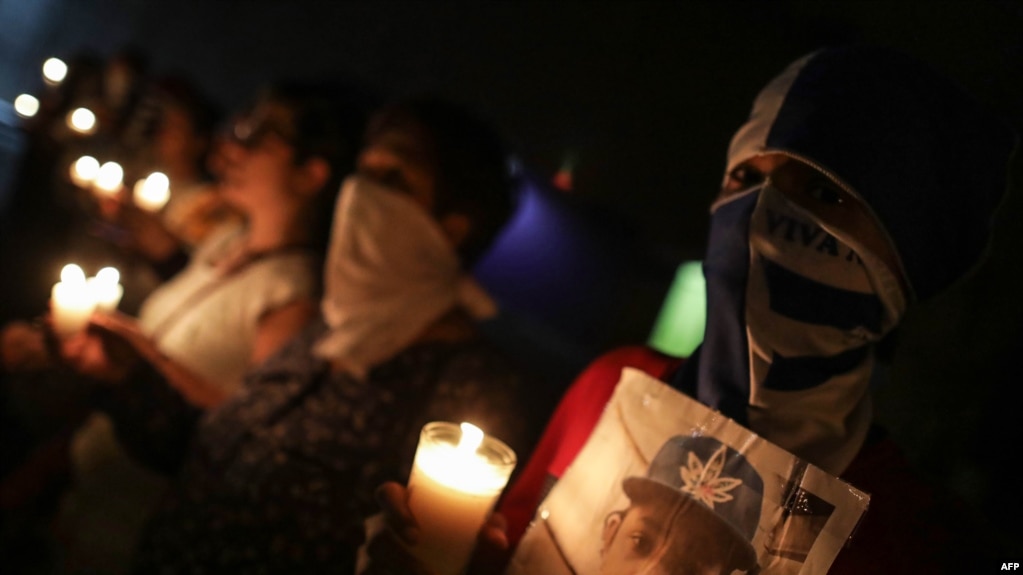
NICARAGUA – Anti-government demonstrators take part in a vigil to demand the release of political prisoners and justice for the victims of protests against President Daniel Ortega, outside the Metropolitan Cathedral of Managua on October 3, 2019.

“There are always prisoners who make up that they’re being tortured. …They invent things simply to create a negative image on Nicaragua before international organizations run by the yanquis…

On October 15, the General Secretariat of the Organization of American States (OAS) publicly denounced persistent human rights violations in Nicaragua and urged the government to release political prisoners, restore fundamental freedoms and respect the separation of powers and rule of law: “The government’s has refused to comply with the recommendations of the Inter-American Commission on Human Rights, the Interdisciplinary Group of Independent Experts (GIEI), and the office of the United Nations High Commissioner for Human Rights and to fulfill its duties under the Inter-American Democratic Charter.”

Four days later, Nicaragua’s president, Daniel Ortega, dismissed allegations that political prisoners made of being tortured, calling them “lies” and an attempt to taint the country’s image.

There are always prisoners who make up that they’re being tortured … they invent things simply to create a negative image on Nicaragua before international organizations run by the yanquis [referring to the United States], like the OAS,” Ortega said during a speech. (Source: El 19 Digital, October 19, 2020)

Based on multiple published reports, Ortega’s claim that torture accusations are invented is false.

Nicaragua under Ortega has faced extensive international scrutiny for violations of human rights. These include “targeting civil society, human rights defenders, including women human rights defenders, community and religious leaders, journalists and other media workers, students, victims and their family members, and individuals expressing critical views of the Government,” according to the United Nations Human Rights Council (HRC).

In April 2018, protests broke out in Nicaragua as fiscal reforms slashed social security. Protestors were met with a violent and lethal response from the government, fueling a civil uprising demanding Ortega’s resignation. More than 100,000 Nicaraguans have since fled the country.

Between the start of the protests and September 2019, 651 people died, nearly 5,000 were injured, 516 were kidnapped and 853 have gone missing, according to the Nicaraguan Association for Human Rights (ANPDH). Twenty-two police officers died, as stated by the U.N.

According to Human Rights Watch, many of those detained during the protests were subjected torture, including electric shocks, asphyxiation and rape. Detainees were also reportedly denied care in public hospitals.

The organization interviewed 12 former detainees, 11 of whom described suffering one of more forms of abuse, and seven who said they witnessed 39 detainees suffering abuses. It also interviewed three doctors and a psychologist who treated some detainees. They reported that many “showed signs of physical harm consistent with physical abuse and torture similar to that described by the 12 detainees.”

This week, Monitoreo Azul y Blanco (Blue and White Monitoring), a group that since 2018 registers and consolidates complaints of human rights violations in Nicaragua, published a video by Expediente Publico (an investigative journalism magazine in Honduras and Nicaragua) with testimonies from former political prisoners about their experiences of ill treatments and torture while incarcerated.

The testimonies mentioned the details of the event that resulted in the death of Eddy Montes, a Nicaraguan-American and U.S. Navy veteran who was shot dead in La Modelo prison in May 2019 after “a serious disturbance” inside of the prison, according to Nicaragua’s interior ministry.

The magazine also published an article on October 20 detailing testimonies of victims of abuse by the Nicaraguan police. They tell the story of J, an opposition protestor who between May 6 and May 13, 2019, was subjected to “constant questioning” and abuse by the police. Her complaint is one of dozens of cases.

Between April 2018 and June 2020, the Nicaraguan Human Rights Collective Never Again (Colectivo de Derechos Humanos Nicaragua Nunca+) registered complaints of five rapes, eight sexual abuses, seven threats of rape to detainees or their family members and three witnesses of rape to one or more fellow inmates, the article reported.

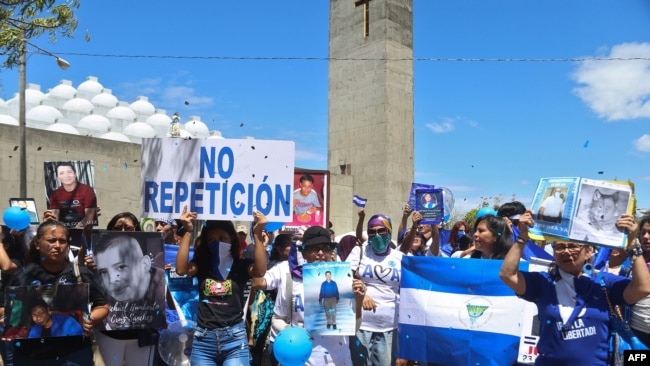
NICARAGUA – Members of the organization Mothers of April (AMA) hold portraits of their late loved ones outside the Cathedral in Managua on February 23, 2020.

On June 19, the Office of the United Nations High Commissioner for Human Rights issued a resolution to promote and protect human rights in Venezuela, and requesting the U.N.’s High Commissioner for Human Rights, Michelle Bachelet, to “enhance monitoring” and “continue to report on the situation of human rights in Nicaragua.”

Amid increased international pressure, Ortega’s government has released some political prisoners, including 91 people whose sentences were converted to house arrest in December 2019. But some 100 political prisoners (estimates vary slightly) remain in jails.

On September 30, more than 50 political prisoners went on a hunger strike as part of protests demanding their freedom. At least three of them sewed their mouths as part of protests and were then transferred to maximum security cells at the Jorge Navarro prison complex known as La Modelo. Amnesty International has described the complex as “one of the main destinations for those detained and punished for reporting human rights violations in the country.”

During his October 19 speech, Ortega said prison doors were open to those calling out the government, including relatives of prisoners, for them “to visit them when they say they’re being tortured, they are saying, they have sown their lips.”

But on the following day, representatives from the Permanent Commission on Human Rights (CPDH), one of Nicaragua’s oldest rights groups, went to visit the prison and were not allowed in, as La Prensa reported.

Allan Gomez, a member of the Union of Political Prisoners (UPPN), told Nicaragua Investiga that the denial of abuses is nothing new, “but human rights violations are fully visible.”

Earlier this month, the U.S. imposed its latest round of sanctions on top Nicaraguan officials, including the attorney general. According to The Associated Press, about two dozen people close to Ortega and his wife, Vice President Rosario Murillo, have been sanctioned – including Murillo and three of the couple’s children – since late 2017.

The European Union also recently renewed sanctions on Nicaragua – introduced in October 2019 – for another year, citing the “deteriorating political and social situation in Nicaragua.”

————

https://www.polygraph.info/a/factcheck-ortega-denies-torture-in-nicaragua-prisons-he-is-wrong/30909488.html

Saudi Arabia uses women to spruce up its image: 2 efforts

October 23, 2020

Effort 1: With women’s empowerment topping the agenda at next week’s B20 Summit, hosted by Saudi Arabia, Amnesty International is on 23 October 2020 reminding business leaders that many of the country’s bravest women’s rights activists are languishing in prison for daring to demand reforms.  “Since assuming the G20 Presidency Saudi Arabia has invested heavily in rebranding its image.But Saudi Arabia’s real changemakers are behind bars” says Lynn Maalouf, Amnesty International’s Deputy Regional Director for the Middle East and North Africa

Loujain al Hathloul, Nassima al-Sada, Samar Badawi, Maya’a al-Zahrani, and Nouf Abdulaziz spearheaded women’s rights campaigns, including calling for the right to drive and an end to the repressive male guardianship system. But while Saudi Arabia talks up recent reforms such as the relaxation of social restrictions and the loosening of the guardianship system to court approval from the rich and powerful around the B20, women’s rights activists remain in detention.

Saudi Arabia has publicized the fact that this year, 33 percent of B20 delegates are women – the highest ever contingency. The B20 website states that “Women in Business” will be Saudi Arabia’s “signature topic” as President. “B20 leaders must not be fooled by this shameless hypocrisy, and we call on them to show they care about human rights as much as business opportunities. Any business operating in or with Saudi Arabia has a responsibility to ensure they are not contributing to human rights violations through their activities.” 

The B20 is the official forum for business leaders to present policy recommendations to the G20, ahead of the main summit in November. This year high profile participants include representatives from HSBC, Mastercard, PwC, McKinsey, CISCO, ENI, Siemens, Accenture and BBVA.

Currently, 13 women’s rights defenders remain on trial facing prosecution for their human rights activism. Several face charges of contacting foreign media or international organizations, including Amnesty International. Some were also accused of “promoting women’s rights” and “calling for the end of the male guardianship system”. See also: https://humanrightsdefenders.blog/2019/03/13/saudi-arabia-persist-with-trial-for-women-human-rights-defenders/

Amnesty International has written to businesses participating in the B20 Summit raising serious concerns about the human rights risks of business operations in and with Saudi Arabia, and reminding them of their human rights responsibilities.

We urge B20 delegates also to think carefully about how their brands could be legitimizing human rights violations and endorsing Saudi Arabia’s charm offensive,” said Lynn Maalouf. “If B20 Saudi Arabia was as progressive as it claims, the activists who did so much to secure more rights for women would have a seat at the table.” 

Effort 2: Nineteen NGOs are calling on golf’s Ladies European Tour to reconsider the decision to hold a tournament hosted by Saudi Arabia. Pulling out of the tournament, they explain, would be ab act of solidarity with women’s rights campaigners detained in the Kingdom.

“While we acknowledge that such tournaments represent an important milestone in women’s golf, we are deeply concerned that Saudi Arabia is using this sports event as a public relations tool to sportwash its appalling human rights record, including discrimination against women and the crackdown on women’s rights defenders,” said the NGOs in a letter to the tour organisers.

The event is due to take place in Saudi Arabia from 12 to 19 November, with a cash prize of $1.5 million from the Saudi Public Investment Fund, which is chaired by Crown Prince Mohammad Bin Salman.

Saudi Arabia has faced sustained criticism that it uses major sporting tournaments to deflect from its human rights abuses. The arrest of prominent activist Loujain Al-Hathloul in 2018 and several others was highlighted as a serious concern.

Al-Hathloul’s sister, Lina, took to Twitter with the hashtag #StandWithSaudiHeroes to highlight the punishments that women activists are subjected to simply for demanding basic liberties that are taken for granted elsewhere. [see also; https://humanrightsdefenders.blog/2019/10/07/lina-al-hathloul-speaks-out-for-her-sister-loujain-imprisoned-in-saudi-arabia/]

In a letter penned to the top players on the Ladies European Tour, the 25-year-old described the event as a “grubby charade” as she argued that taking part was akin to giving “tacit endorsement to the Saudi regime and its imprisonment and torture of activists like my sister.”

Al-Hathloul’s imprisonment has been met with international outcry as concerns grow over her fate. Human rights organisations including Amnesty International have alleged that she and other women campaigners have been subjected to torture and sexual harassment, including threats of rape, while in Saudi detention.

The crackdown on female activists by the Saudi government reached its peak when the authorities arrested and detained Al-Hathloul, Eman Al-Nafjan and Aziza Al-Yousef on 15 May, 2018. Just weeks later, other leading women’s rights advocates and feminist figures were also arrested, including Samar Badawi and Nassima Al-Sadah.

“We remain concerned that they will not be able to exercise their right to a fair trial in accordance with the international human rights standards, to which Saudi Arabia is obliged to adhere,” wrote the NGOs. The only way to achieve true progress, they added, is to implement real reforms on women’s rights, and immediately release those arrested for defending these rights. “While we hope that Saudi Arabia can indeed develop its interaction with other countries around the world through hosting sports and other events in the Kingdom, we cannot ignore the country’s attempt to conceal its continued detention of women’s rights activists and discrimination against women by hosting a women’s sports tournament.”

Effort 2: The sister of jailed Saudi activist Loujain Al-Hathloul has called on European golf players to boycott the upcoming tournament in Saudi Arabic. In a letter sent to the Independent newspaper, Lina Al-Hathloul begged the top players on the Ladies European Tour to show support for her sister’s plight by not attending golfing events in Saudi Arabia scheduled for November.

In her letter, Lina wrote: “My sister is a women’s rights activist imprisoned and tortured by the Saudi regime. I understand the importance of sports to create links and bridges between different societies. “However, the current Saudi regime uses sports to whitewash its crimes, to have a window to the West, while maintaining and even worsening women’s conditions inside the country.

Don’t go to Saudi Arabia, don’t help that barbaric regime launder its reputation through your excellence. Stand in solidarity with women’s rights activists. Boycott the Ladies European Tour events in Saudi Arabia.

I am begging you, as a woman, as a person of conscience and as a role model – please boycott the Saudi women’s tour event.

—–

Support Loujain Hathloul by boycotting Saudi event, European golfers urged

https://www.amnesty.org/en/latest/news/2020/10/with-women-activists-jailed-saudi-b20-summit-is-a-sham/

2020 Allard Prize for International Integrity to Daphne Caruana Galizia and Danish whistleblower

October 22, 2020
Article Featured Image

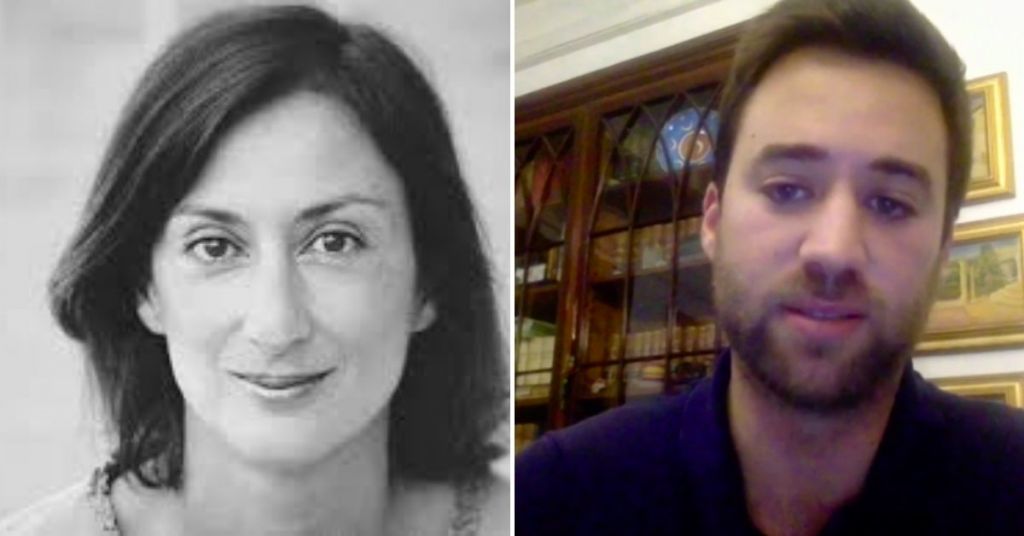
On 21 October 2020 assassinated Maltese journalist Daphne Caruana Galizia was posthumously awarded the 2020 Allard Prize for International Integrity, a prestigious global prize for people who demonstrate exceptional leadership and courage in protecting human rights. For more on this prize see: https://www.trueheroesfilms.org/thedigest/award/1f084460-a5ea-11e7-8132-af7bdbf76e65

Caruana Galizia was co-awarded the prize last night along with Howard Wilkinson, the man who blew the whistle on the Danske Bank money laundering scandal.

Both Caruana Galizia and Wilkinson were awarded $50,000 prizes and the assassinated journalist’s family has dedicated their prize money to the Daphne Caruana Galizia Foundation.Andrew Caruana Galizia virtually accepts the prize on his late mother's behalf

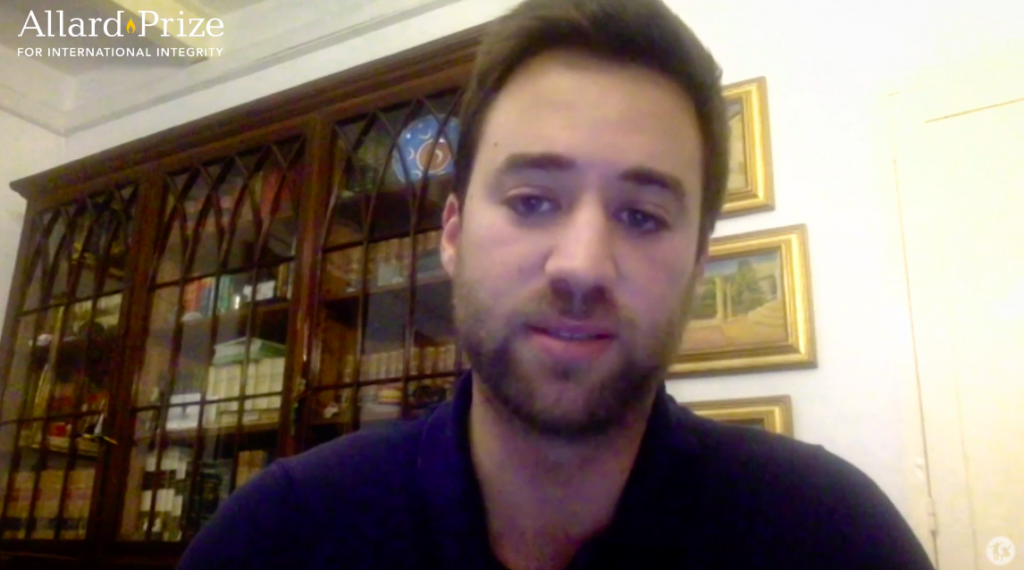
Andrew Caruana Galizia virtually accepts the prize on his late mother’s behalf

Virtually accepting the prize on his late mother’s behalf, Andrew Caruana Galizia said that such prizes shouldn’t be viewed as frivolous but crucial in ensuring the fight for justice lives on. “We know there’s a connection between remembering and justice. If we forget the people who were murdered, the human rights activists and journalists who lost their lives fighting for our right to know, to live in a democracy and enjoy other rights, then no one will remember to fight for justice.

See also: https://humanrightsdefenders.blog/2019/02/26/son-of-maltese-journalist-daphne-caruana-galizia-tells-un-impunity-continues/

Co-winner Howard Wilkinson blew the whistle on the largest money laundering scheme in history, worth at least $230 billion, while acting as the head of Danske Bank’s trading unit in the Baltics. On September 19, 2018, news broke of the money laundering scheme that moved rubles out of Russia, converted them to dollars at the Estonian branch of Danske Bank, and then moved the dollars to New York with the assistance of three correspondent banks (Bank of America, J.P Morgan, and Deutsche Bank). Danske Bank admitted all of its internal controls designed to prevent money laundering had failed. The bank revealed that the scheme had been reported to the bank’s highest levels by a whistleblower over four years before. The whistleblower’s identity was required to be secret. But it took only days for Wilkinson’s name to leak out.

The Allard Prize website states: “Despite the considerable risk to himself and his family, Wilkinson testified before the European Parliament and advocated for greater protections for whistleblowers and a new regulation model that encourages greater transparency. The scandal led to numerous investigations and criminal charges across Europe, Danske’s CEO’s resignation, and Danske’s Estonian branch’s closing.

When accepting the award, Wilkinson said, “Whistleblowers are the most loyal employees at all. The whole point of whistleblowers is to make things better.

Wilkinson was profiled by Whistleblower News Network as its “Whistleblower of the Week” weekly feature on October 19. 

https://lovinmalta.com/news/humbling-and-encouraging-daphne-caruana-galizia-wins-prestigious-global-integrity-award/

Kenyan documentary Softie shows defenders torn between family and the struggle

October 22, 2020

Katharine Houreld writes for Reuters on 21 October 2020 a very interesting piece about a documentary that puts the focus on the difficult dilemmas facing human rights defenders.

Njeri and Boniface Mwangi are activists – they protest together and are arrested together – but as the film progresses, the focus moves from whether their crusade will succeed to whether their family will implode.

Families of human rights defenders or activists … I want people to know we exist,” Njeri, a movie buff and avid motorcyclist, told Reuters at the film’s Kenya premiere this week. “Our children really struggle.”

Softie – an award-winner at the Sundance and Durban film festivals – shows the evolution of Boniface from an activist outraged by the 2007-8 election violence into a political candidate promising his new Ukweli party will change the system from within, a decade later.

His family grapple with his absence, a house permanently full of people, and death threats targeting their three young children. Njeri, fearing for their lives, eventually takes the kids to the Unites States in 2016.

In one tense on-camera exchange before his family leaves, Boniface pleads with his wife: “you need to have an ideal that you live for, that’s worth dying for.” “You think it will be better if you die?” Njeri replies sadly.

A later scene lays out the stakes. The couple’s eldest son Nate returns from his American school with something he has made for father’s day: a loving card for his mother. When filmmaker Sam Soko asks from behind the camera why there’s no message for his father, Nate shrugs.

Moments like that forced a reckoning, said Boniface, who appeared with his family at the premiere, all in matching purple outfits. Now he’s building his party, taking a rest from protests and spending time making meals for his family. He’s finally realised he can’t – and shouldn’t – try to change everything himself.

Change is not an event… it’s not a popcorn that pops in a microwave,” he told Reuters. “It’s a very slow painful marathon – and then the marathon doesn’t end.”

The film started out as a five-minute Youtube clip about organising a protest, said Soko, who is an activist himself. It sprawled into a seven year project, now streaming on PBS in the United States and Britain’s BBC.

It’s essentially still an activist manual,” he said. “But a different kind of manual … (about) what it means to love.”

https://www.reuters.com/article/us-kenya-film/kenyan-documentary-spotlights-activist-torn-between-family-and-the-struggle-idUSKBN2761FY

ALERT: IF true, unbelievable: Trump to declare Amnesty, HRW and other NGOs as antisemitic!

October 22, 2020

The normally reliable Jerusalem (By SARAH CHEMLA) reports on 22 Ocrtober 2020 that US President Donald Trump may declare major international Human Rights NGO’s Amnesty International, Human Rights Watch and Oxfam as antisemitic in a soon-to-be released State Department declaration, voicing that governments should not support them any longer. If the declaration happens, it is likely to cause an uproar among civil society groups and might incite litigation. Critics of the possible move also worry it could lead other governments to further crack down on such groups, according to Politico.

T’ruah, a rabbinic human rights organization that represents over 2,000 rabbis, responded to the allegation on Wednesday, saying that “any US government declaration that these groups are antisemitic for criticizing the Israeli government is ridiculous, and contributes to the silencing of Israel’s human rights defenders.” It continued, adding that “the Trump administration’s smear of these three human rights organizations is yet one more example of this administration’s disregard for democracy and human rights at home and abroad.” “In casting aspersion on longtime respected human rights organizations, the Trump administration joins an ignoble list of autocratic governments that have discredited, smeared and even banned their own internal human rights organizations,” T’ruah said.”Actions such as these damage US democracy by threatening the transparency necessary to protect human rights. Human rights and civil society groups play a prophetic role, even if their words may not be ones governments want to hear.”Israel is a state bound by international human rights law, like all other members of the United Nations, and like other countries can be criticized when it fails to live up to these commitments,” it said.”By falsely smearing human rights organizations as antisemitic, the Trump administration only makes it harder to counter actual acts of antisemitism when they happen, while simultaneously harming these organizations’ effectiveness in reporting on all countries’ human rights abuses – including those of the United States.” 

ACCORDING TO Politico, the declaration is expected to take the form of a report from the office of Elan Carr, the US special envoy to monitor and combat antisemitism. It would declare that it is US policy not to support such groups, including financially (NOTE: AI and HRW do not accept government funding as a matter of policy!) , and urge other governments to cease their support.The report would cite such groups’ alleged or perceived support for the Boycott, Divestment and Sanctions movement, which has targeted Israel over its construction of settlements on land Palestinians claim for a future state. The declaration is also expected to point to reports and press statements such groups have released about the impact of Israeli settlements, as well as their involvement or perceived support for a United Nations database of businesses that operate in disputed territories, Politico said. Contacted by Politico, the organizations named in the report denied any allegations that they are antisemitic. 
[In 2019, David Collier released a report into the work of Amnesty International after monitoring dozens of social media accounts maintained by the NGO and people who work for it, and concluded that the amount of hatred Israel receives is beyond any proportion, to a level that is, he said, antisemitic.“Targets are not chosen for their actions, but rather for their identity,” wrote Collier. “Persecuted Christians are blatantly ignored.”[see also: https://electronicintifada.net/blogs/asa-winstanley/how-racist-blogger-david-collier-infiltrated-labour-party]

However, some differ, see e.g.: https://www.jns.org/opinion/time-to-call-out-human-rights-groups-for-their-anti-semitism/

https://www.jpost.com/diaspora/antisemitism/trump-administration-to-declare-amnesty-human-rights-watch-oxfam-antisemitic-646535

https://www.hrw.org/news/2020/10/23/us-seeks-discredit-human-rights-groups

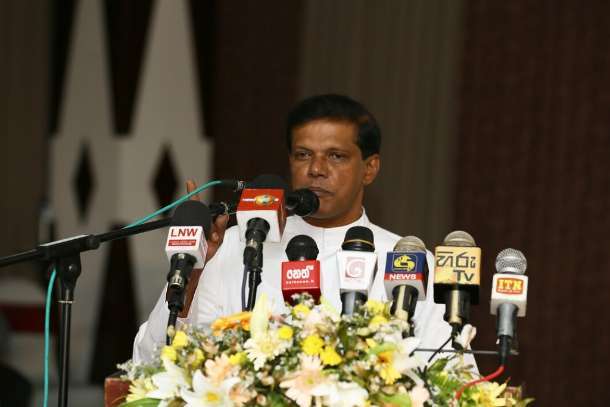
Sri Lankan priest Father Nandana Manatunga cares for relatives of disappeared

October 19, 2020

Quintus Colombage, for UCANEWS of 16 October 2020, reports on the role of Father Nandana Manatunga:

Sri Lankan priest gives succor to relatives of disappeared

Father Nandana Manatunga, a human rights defender and director of the Human Rights Office, was awarded the 2018 Gwangju Prize for Human Rights. (Photo: HRO)

Sri Lanka has the dubious distinction of having the second-highest number of disappearances in the world. Thousands went missing during the Janatha Vimukthi Peramuna (JVP) insurrection of 1987-89. About 60,000 people were killed or disappeared during the youth-led insurrection.  Thousands were killed and disappeared during the 26-year civil war that ended in 2009 when the country’s army defeated Tamil rebels. 

According to the UN, the war claimed the lives of at least 40,000 civilians in its final days alone, while other independent reports estimated the number of Tamil civilian deaths at more than 100,000. Both sides were accused of serious human rights violations.

Father Nandana Manatunga, 60, a well-known human rights defender and director of the Human Rights Office (HRO) in Kandy, has played an instrumental role in giving succor to the families of victims and providing a channel for them to tell their stories. His work has been internationally recognized and he was awarded the Gwangju Prize for Human Rights in 2018.

Among those who attend monthly meetings of relatives of victims of enforced disappearances at Father Nandana’s office is D.G. Yashohammy, 78, a Buddhist from Wattegama. Her 22-year-old son was abducted by a group of men in military uniforms during the JVP insurrection.

This is the same story for all of us. Father Nandana has created a platform for all of us to tell our stories.

Ashoka Weerasinghe, whose son was abducted in 1989, said families could speak about their disappeared loved ones and release their trauma during the regular meetings and workshops. “These fairs and other programs have brought us together. We thank Father Nandana for giving us the opportunity to alleviate our grief. He spends at least half of his life on the work. The priest is a very happy person who is pleased to see us happy,” she said.

Tamils from the north and east join the program once a year. On the first Friday of the month, women gather at the HRO in Kandy. The teams from Kandy, Jaffna and Mannar gather in their own places. A revolving fund has been set up for each of these groups, providing financial assistance for those in need or who require legal aid.

The HRO was started in 2008 to work with people of different faiths. The office provides protection, legal aid, security, health and trauma counseling to victims of rape, torture, abduction and other serious rights violations. Father Nandana, who was ordained in 1986, said all these programs are implemented to heal the serious wounds of their minds.

We want to keep all these stories alive, otherwise the next generation will want to know what happened to them,” Father Nandana told UCA News.

“We have empowered victims and their families from different parts of the country and have challenged religious leaders to stand by the victims and campaign for reform of the police and the judiciary.

As a priest, I protect, promote and safeguard the rights of the victims of all human rights violations. It is my mission following the teachings of Christ. All religious leaders have a moral obligation to advocate for human rights.” 

———

https://www.ucanews.com/news/sri-lankan-priest-gives-succor-to-relatives-of-disappeared/89909

UN rapporteur calls on Spain to release jailed Catalan activist Jordi Cuixart

October 17, 2020
Jordi Cuixart is the head of Omnium Cultural, a Catalonian cultural association

Jordi Cuixart is the head of Omnium Cultural, a Catalonian cultural association

THE UN’s special rapporteur on Human Rights Defenders, Mary Lawlor, has called for jailed Catalonian independence activist Jordi Cuixart to be freed.

Yesterday marked the third anniversary of the civic leader’s imprisonment for his role in the 2017 independence referendum. Writing in The National, Cuixart reveals the grim reality of life in a Spanish prison, saying that he’s forced to spend 23 hours a day in a room measuring just eight square metres. However, the father of two young children makes clear that he would make the same choices as before.”

He was handed a nine-year sentence after being convicted of sedition. Unlike the other eight imprisoned, Cuixart is not a politician, he is the head of Omnium Cultural, a Catalonian cultural association.

Taking to Twitter, Lawlor said it was time for Cuixart to be freed. “In 2019, the Working Group on Arbitrary Detention found his detention to violate both the [Universal Declaration of Human Rights] and [the International Covenant on Civil and Political Rights] and deemed it arbitrary. He should be released.”

https://www.thenational.scot/news/18801415.jordi-cuixart-un-rapporteur-calls-spain-release-jailed-catalan-activist/

Nicaragua: things getting worse and worse for human rights defenders: COVID-19 and foreign agents

October 17, 2020
The New Humanitarian of 2 September 2020 carried a special feature on Nicaragua. President Daniel Ortega is making life increasingly hard for aid and human rights groups in Nicaragua even as poverty, malnutrition, and emigration due to political strife are on the rise, and as he is criticised for a dismissive and reckless response to the coronavirus outbreak. Moreover, a new law for the regulation of “foreign agents” was passed on 15 October.

“In Nicaragua, simply existing as a person carries a risk,” Ana Quirós, director of the Center for Information and Advisory Services in Health, or CISAS, told The New Humanitarian. “You do not need a particular reason to become a victim of violence, of repression, kidnapping or assassination. It is a general risk.

Quirós was deported and stripped of citizenship in November 2018 after the government accused CISAS, which had been working on health education and HIV prevention in Nicaragua with the support of several international aid groups and actors – including Medico International, Medicus Mundi, and the EU – of “participating in destabilising activities”.

Quirós said individuals still working with aid and civic groups in the country are under great threat, and that several people who had been working with CISAS in Nicaragua since it was banned had been forced to flee the Central American country.

It has been during this pandemic that the absence of the NGOs has been most strongly felt, especially for us working in health,” the CISAS director said. “The government hasn’t made any efforts regarding communication, training, education in health, and with regard to the other basic human rights of the population,” Quirós said. “The population is very unprotected, and is hungry for information and real knowledge about the risks and measures that one needs to take to prevent illnesses.

Forty years after Ortega led a socialist revolution to uproot the dictatorship of Anastasio Somoza, Nicaragua continues to be burdened by a host of humanitarian concerns, albeit as it isolates itself from international aid institutions.

Under the government leadership of Ortega and his influential wife, Vice-President Rosario Murillo, the country remains one of the poorest in Latin America, while the violent repression of political opponents since April 2018 has generated a migration crisis proportionately comparable to that of Venezuela. After Ortega’s re-election in 2006, Nicaragua’s poverty rate fell, following a similar trend throughout Latin America, but an independent report published at the end of 2019 estimates that it has since soared, and that roughly a third of the population, or more than two million people, now live on less than $1.76 per day.

According to the World Food Programme, 17 percent of children under five suffer from chronic malnutrition, with the rate at nearly 30 percent – similar to humanitarian crisis settings such as Somalia – in Nicaragua’s northern provinces, which form part of Central America’s dry corridor. In 2019, WFP provided assistance to 45,000 people in Nicaragua affected by the seasonal climate change-linked emergency.

Due to severe restrictions on free assembly and expression, it is probable that protection and humanitarian needs are under-reported in Nicaragua,” ACLED wrote in an email to TNH. “It is clear from current political violence and demonstration trends in Nicaragua – particularly amid the pandemic – that the situation requires urgent attention from international humanitarian actors.

Demonstrations initially flared in April 2018 against a social security reform, which has since been scrapped. They later morphed into broader political unrest as the government responded with heavy-handed measures against student protesters, and as dissatisfaction grew at government corruption and the Ortegas’ increasingly autocratic rule.

The ensuing government crackdown led to the deaths of hundreds of people – the government set the number at 197, while human rights groups say it was at least 325 – and drove more than 103,000 people to seek asylum abroad. Most fled to neighbouring Costa Rica, where at least 400,000 Nicaraguans had already been living.

In July, Michelle Bachelet, the UN High Commissioner for Human Rights, condemned the ongoing repression in the country two years after the initial protests, listing a litany of government offences between March and June, including arbitrary arrests, house searches without warrants, and detentions, threats, and intimidation.

Line graph of demonstrations in Nicaragua, 2019-2020

Human rights violations continue to be documented against those who the government perceives as opponents, including human rights defenders, journalists, social leaders, and former political detainees,” Bachelet reported.

The crushing of the opposition included, in 2019, the revocation of the legal status of a number of civil society groups and local NGOs – the Nicaragua Centre for Human Rights (CENIDH) and CISAS among them.

Here, one cannot organise trade unions or teachers. One cannot organise any group that is not under the auspice of the regime,” Monica Baltodano, director of the Popol Na Foundation, another of the banned groups, told the independent news site Confidencial last December.

….Vice-President Murillo told Nicaraguans that the country was under divine protection, while officials ordered medical staff not to wear personal protective equipment (PPE) in order not to scare patients. In July, 25 doctors were fired for signing a letter critical of the government’s handling of the pandemic. It asked simply that health workers should not be persecuted and that they be allowed to use PPE.

After the United States and the EU imposed financial sanctions on Nicaraguan officials last year, 65 of the 148 officially recognised political prisoners were released from prison in December. Further sanctions have been imposed since, including on a second son of the presidential couple. But international political pressure has routinely been countered by the message that Nicaragua will manage on its own.

International aid groups and agencies have also experienced government pressure as it attempts to influence and define their roles. Ever since Ortega resumed the presidency in 2007, the organisations have had to operate with increasing care, former aid workers familiar with the country told TNH.

In 2015, the United Nations Development Programme was told by the government that it was no longer needed as an intermediary between donors and those executing development projects. Without providing further details, the authorities said the agency and its country chief were accused of “political meddling”, and of maintaining a “hidden agenda”.

UNDP told TNH at the end of July that its operations in Nicaragua were now “limited” and that it did not have a resident representative or a deputy representative. The UN agency did not respond to requests for further comment on the situation in the country.

In 2018, the government expelled a UN human rights team after the Office of the UN High Commissioner for Human Rights requested an immediate end to the persecution of political opponents and called for the disarming of masked civilians responsible for a string of killings and detentions. Soon after, two missions of the Inter-American Commission on Human Rights (IACHR) investigating violence during the anti-government protests were also thrown out.

As COVID-19 cases appear to mount, the Pan American Health Organization (PAHO) – the regional wing of the World Health Organization – has urged the government to take stronger measures to curb the spread of the virus.

PAHO continues to await authorisation to send a team of experts to evaluate the situation. Since the beginning of the outbreak, it has donated PPE to the health ministry, while repeatedly stating that the official COVID-19 data provided is incomplete.

In spite of donations from various international sources, doctors have argued that distribution of masks and other PPE items remains inadequate. As of 26 August, Citizen’s COVID-19 Observatory estimated that 107 health workers in Nicaragua had died from the coronavirus…

Meanwhile, the International Committee of the Red Cross, one of the few international aid groups with a presence in Nicaragua, has offered its support to help with the release of what human rights groups estimate – following the protest crackdown – to be more than 6,000 political prisoners.

In a written statement to TNH, the organisation said: “The ICRC returned permanently to Nicaragua in 2018. We have been visiting detention sites since 2019, and in November 2019 renewed our host country agreement. We can develop our humanitarian action with openness, in dialogue with the authorities and civil society, according to our humanitarian principles and working methods.”

Last Thursday 15 October Nicaragua’s National Assembly approved the law for the regulation of ‘foreign agents “. The law requires any Nicaraguan citizen working for “governments, companies, foundations or foreign organizations” to register with the Interior Ministry, report monthly their income and spending and provide prior notice of what the foreign funds will be spent on. The law establishes sanctions for those who do not register. Once registered as “foreign agents,” those Nicaraguans may not “finance or promote the financing of any type of organization, movement, political party, coalition or political alliance or association” that gets involved in Nicaragua’s internal politics.

https://www.thenewhumanitarian.org/news-feature/2020/09/02/Nicaragua-conflict-political-unrest-poverty-coronavirus

https://federalnewsnetwork.com/government-news/2020/10/nicaragua-passes-controversial-foreign-agent-law/