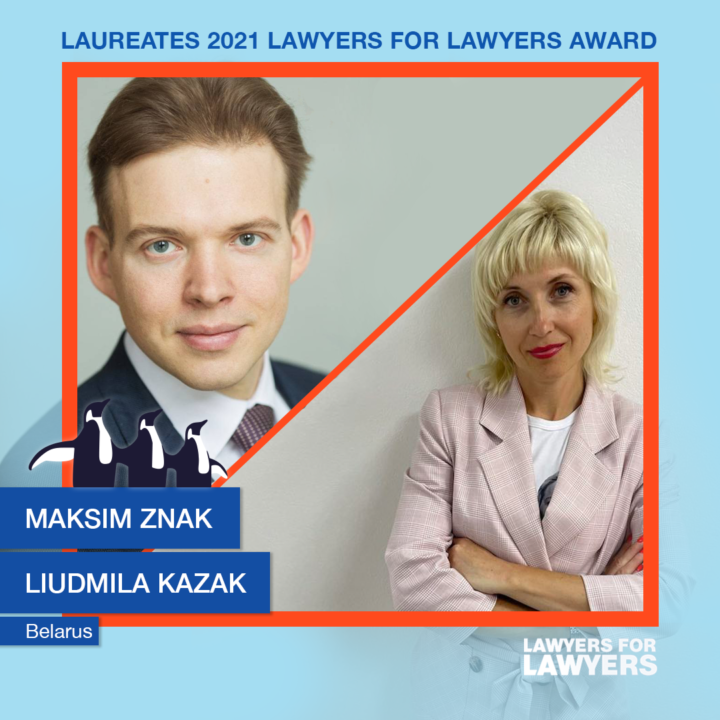
Belarusian lawyers Maksim Znak and Liudmila Kazak will receive the Lawyers for Lawyers Award 2021. The Award will be presented at a ceremony co-hosted by Lawyers for Lawyers and the Amsterdam Bar Association in the Rode Hoed in Amsterdam on 18 November 2021. For more on this award and its laureates, see: https://www.trueheroesfilms.org/thedigest/awards/B40861B3-0BE3-4CAF-A417-BC4F976E9CB0
“By awarding Maksim Znak and Liudmila Kazak the Lawyers for Lawyers Award, the jury wants to highlight the important work of both lawyers who bravely represented Belarusian human rights defenders and opposition leaders and are paying a high price for their work. With this Award, the jury also wants to raise awareness of other Belarusian lawyers who have been subjected to pressure, harassment and intimidation in connection to their professional activities especially in the aftermath of the 2020 presidential elections”.
Maksim Znak
Maksim Znak represented Viktor Babaryko, a potential candidate in the presidential elections who was not allowed to formally register. He also provided legal assistance to Svetlana Tikhanovskaya, a former candidate for the presidency who is now in exile, and Maria Kolesnikova, Coordination Council co-leader. On 9 September 2020, Mr. Znak was arrested for allegedly having committed the offence of “calls to actions seeking to undermine national security” in violation of Article 361(3) of the Criminal Code of Belarus. In February 2021, additional charges were added, including “conspiracy to seize state power” and “organising extremism”. On 6 September 2021, Mr. Znak was sentenced to 10 years in prison during a closed-door-trial. His sentencing is another indication of the challenging working environment in which Belarusian lawyers must operate.
Liudmila Kazak
Liudmila Kazak is a human rights lawyer who has defended political prisoners, human rights defenders, and journalists, including the opposition leader Maria Kolesnikova. On 24 September 2020, she was detained. The next day, the court held Kazak administratively liable for disobeying police officers based on testimony given by anonymous masked witnesses who appeared via Skype and claimed to be the arresting officers. She was sentenced to a fine under article 23.4 of the Belarusian Administrative Code and released on 26 September 2020. On 11 February 2021, she was notified of a pending disciplinary proceeding against her before the Qualification Commission for legal practice in the Republic of Belarus. On 19 February 2021, the Qualification Commission disbarred Ms. Kazak. Ms. Kazak appealed the decision, but, on 15 April 2021, a district court upheld Ms. Kazak’s disbarment. On 17 June 2021, an appellate court upheld the district court decision.
LUNCH BRIEFING 9/11 Twenty Years On Tuesday 28 September, 12:30-13:30 Auditorium A1A, Maison de la paix, Geneva, and online
Two full decades have elapsed since the 11 September 2001 terrorist attacks on New York City and Washington, D.C. In the aftermath of these events, the world has entered a period characterised by a number of dynamics, which have persisted and shaped significantly the configuration of the global order. What is the nature of these transformations, notably the militarisation of international relations, the securitisation of social affairs, the rise of cultural and religious tensions and the crisis of democracy? Has the post-COVID-19 moment in turn ushered the end of the post-11 September world? Ultimately, what historical meaning can we ascribe to legacy of ‘9/11’?
Mohammad-Mahmoud Ould Mohamedou is Professor of International History and Politics, and Chair of the Department of International History and Politics at the Graduate Institute. Previously the Associate Director of the Programme on Humanitarian Policy and Conflict Research at Harvard University, he is the author of a trilogy on the post-11 September era and recipient of the 2021 International Studies Association (ISA) Global South Distinguished Scholar Award.
The Lunch Briefing will be moderated by Julie Billaud, Associate Professor of Anthropology and Sociology.
On cue Imogen Foulkes wrote on 7 September 2021 a post for Swissinfo “When the world became a ‘human rights free zone’ September 11, 2001″.
No one will forget the shock of that day. It’s hard even now, two decades later, to describe how it felt to watch something so unimaginable, so horrific. When I returned to my newsroom that evening, a colleague said to me “well, Imogen, that’s it, our world has changed forever”. I was still so focused on the immediate event that I didn’t quite understand him, and it took me a while to realise how right he was.
Our world did change forever that day; from smaller inconveniences around how we travel, to fears over how safe we are, to prejudices and intolerance towards groups perceived as a threat, to sweeping changes in security laws.
In the latest episode of our Inside Geneva podcast, we look at those changes, and the consequences, in particular for human rights. Gerald Staberock, secretary general of the World Organisation Against Torture, tells me: “I want my government to fight terrorism. I want those who did 9/11 or whatever terrorist attacks to be brought to justice.” But he also regrets the fact that the 9/11 attacks, which he describes as “a denial of the very values of human rights”, led to – in his view – “another attack on human rights, through counterterrorism”.
Looking back now, with all the knowledge we have of extraordinary rendition, Guantanamo Bay, waterboarding and so on, it is quite hard to remember that in the first months and even years after 9/11, none of us, not even human rights defenders, were quite aware of how the “war on terror” was being fought.
Once that war was being conducted in earnest in Afghanistan, I remember getting a hint, off the record, from the International Committee of the Red Cross (ICRC), who told me that they were aware of detainees being transferred from Bagram airbase, but had no idea where they were being taken. It is the ICRC’s role, under the Geneva Conventions, to visit those detained during conflict, a role which was, for a while at least, impossible to fulfil.
Fionnuala ní Aoláin, currently UN special rapporteur on human rights and counterterrorism, also joins us on the podcast. Her position, she points out, was not created until five years after 9/11, and, she says “in that absence lies the story of a human rights free zone”, during which “the United States moved to engage in practices of torture, of rendition, or the establishment of a black hole where people were held arbitrarily”.
Governments have argued that extraordinary measures are necessary to counter extraordinary threats. Certainly no political leader wants a 9/11 type attack on his or her watch. And, many opinion polls show, the public are prepared to compromise some fundamental human rights standards in the name of defeating terrorism.
A 2016 study by the ICRC found that, among millennials in industrialised countries, many agreed that torture was justified if it led to information that could save lives. Strikingly, among young people living in conflict zones, or under repressive regimes, a large majority remained opposed to torture.
This shift in opinion is a concern for ní Aoláin, who points out that some governments have taken to justifying increasingly repressive laws in the name of the war on terror. “Right now, in…Saudi Arabia, Turkey, Egypt, we see governments saying that human rights defenders are terrorists, that eco warriors are terrorists, that women’s rights defenders are terrorists.”
Interestingly, ní Aoláin comes from Belfast. She grew up with terror attacks, and counterterrorism measures. She believes that “actually it is counterproductive to security to violate human rights”, a point of view Staberock agrees with. He remembers research done in Northern Ireland in which senior security officers admitted that preventive detention had been a disaster, not just from a human rights perspective, but from a security perspective because “it made the cause much broader, it made the problem much bigger…by victimising people, you weaken the cause”.
Both ní Aoláin and Staberock believe the term “terrorist” is too widely used, and that it can become a convenient slogan for governments to introduce all sorts of legislation which would otherwise not easily be justifiable.
Staberock argues that “the best answer to terrorism is to demask it as killings. Not allow it to hide behind ideology. Demask it in an ordinary criminal process, bring people to justice, punish them, stick to your rules”.
The first shots in the war on terror were fired, 20 years ago, in Afghanistan. Today, in that same country, we are watching a humanitarian and foreign policy disaster unfold. As western diplomats made a panicked dash for the airport, they left millions of Afghans to live, again, under the Taliban, the very “terrorist” group the US and its allies entered Afghanistan to defeat.
So have we learned anything from the last 20 years? Do listen to Inside Geneva to find out more, but I’ll leave you with these final thoughts from ní Aoláin.
“We appear not to have learnt any lessons,” she says. “What we appear to be doing is betraying civil society, leaving women, human rights defenders and girls…when we conveniently decide that we’ve had enough and it’s time for us to leave.”
But, as a human rights defender herself, she is not deterred: “If you fight for human rights you’re always pushing big rocks up mountains, and you watch them fall down, and you push the same rocks up the mountain again. I think those of who work on human rights in the context of counterterrorism are looking at an enormous big rock.”
The selection panel of the Václav Havel Human Rights Prize, which rewards outstanding civil society action in the defence of human rights in Europe and beyond, has announced the shortlist for the 2021 Prize. For more on this award and its laureates, see: https://www.trueheroesfilms.org/thedigest/awards/7A8B4A4A-0521-AA58-2BF0-DD1B71A25C8D
Meeting today in Prague, the panel – made up of independent figures from the world of human rights and chaired by Rik Daems, President of the Parliamentary Assembly of the Council of Europe (PACE) – decided to shortlist the following three nominees, in alphabetical order:
Maria Kalesnikava (Belarus) The nominee is one of the opposition leaders in Belarus and a member of the Coordination Council. She was the head of the campaign headquarters of former presidential nominee Viktar Barbaryka. She is one of the three female symbols of the Belarusian opposition and its people’s struggle for civil and political liberties and fundamental rights. The nominee was abducted in Minsk in September 2020 and has been detained since then. She was charged with undermining national security. She tore her passport at the border to prevent being removed from Belarus. The nominee is at serious risk for her safety and life. [see: https://www.trueheroesfilms.org/thedigest/laureates/beff3c8d-0e20-4e88-9efb-cdfcb4c26f40]
Reporters Sans Frontières The nominee is a leading INGO that safeguards the freedom of expression and information. Since 1985, RSF has provided emergency support to thousands of journalists at risk around the world and obtained the release of several detained journalists. RSF systematically takes steps to ensure investigation and legal proceedings against those responsible of the murder of journalists and supports democracy by rolling back disinformation. [see: https://http://www.trueheroesfilms.org/thedigest/laureates/B4EE0687-54AB-9CB3-AD6E-EA1A03C7D73B]
Germain Rukuki(Burundi) The nominee is a human rights defender who has been campaigning in the human rights field for years (in particular, against torture and the death penalty). Since 2015, human rights defenders and organisations in Burundi have been facing a shrinking space and have been targeted by the authorities. In this context, the nominee was sentenced in 2018 to 32 years in prison in what the international community considered to be a pretext to silence his voice and criminalise his human rights work. Subsequently, a Court of Appeal reduced his sentence to 1 year in 2021 and he was released. See: https://humanrightsdefenders.blog/2021/07/03/germain-rukuki-burundi-human-rights-defender-out-of-jail/
“I would like to thank all those who put forward nominations for the 2021 Prize,” said PACE President Rik Daems. “Fundamental rights and freedoms must be defended and preserved with strength and vigilance. They can never be taken for granted and it takes a lot of courage and determination to uphold them. The three selected candidates’ commitment to the values which were dear to Vaclav Havel and which Council of Europe stands for deserves our appreciation and recognition.”
The European Union has a chance to set an example for the entire world by protecting people who risk their lives standing up for human rights in the context of business activities, said Mary Lawlor, UN Special Rapporteur on the situation of human rights defenders, joined by the UN Working Group on the issue of human rights and transnational corporations and other business enterprises known as the Working Group on Business and Human Rights), Mr. Surya Deva (Chairperson), Ms. Elzbieta Karska (Vice-Chairperson), Mr. Githu Muigai, Mr. Dante Pesce, and Ms. Anita Ramasastry; and Mr. Fernand de Varennes, Special Rapporteur on minority issues.
The European Union legislative initiative on mandatory human rights and environmental due diligence “must include safeguards for human rights defenders,” they stated on 6 September 2021.
“The European Union, as the world’s largest single market, has a golden opportunity to advance the safety and security of human rights defenders who are working around the globe to build more just societies, often at great personal risk,” Lawlor said. “A robust, binding regime in the EU covering companies of all sizes would provide a powerful model for other parts of the world.”
Human rights defenders often risk their lives confronting violations along supply chains, Lawlor said. “Parent companies must carry out human rights and environmental due diligence throughout their supply chains to ensure human rights defenders are not subjected to reprisals from their subsidiaries, sub-contractors and suppliers,” she said. “The EU must ensure that where such retaliation happens, these companies can be held accountable.”
In the 10 years since the Human Rights Council adopted the UN Guiding Principles on Business and Human Rights, business compliance has remained extremely low. In the same period, increasing numbers of human rights defenders have been killed for their work. The UN Working Group on Business and Human Rights has recently developed guidance setting forth expectations that businesses address risks to defenders and that States address this as part of their own mandatory human rights due diligence regulations.
People who stand up for human rights related to environmental protection, community land rights, indigenous peoples’ rights, poverty, minorities and business accountability – often intertwining issues – are most at risk of being attacked or killed.
“Where human rights defenders come under attack in the context of business activities it is a clear sign of other underlying human rights issues.” Lawlor said. Potential risks for human rights defenders should be seen as a key component of companies’ due diligence duty to identify and assess human rights risks connected to their projects, and must be specifically included in the expected EU proposal.
“Business enterprises must also be obliged to consult with defenders under the EU initiative, and the door should be kept open for defenders to bring issues to companies’ attention at every stage within business projects,” Lawlor said. “
“Now is the time for the EU to give new life to its founding principles by delivering a strong law that could help reduce the number of lives lost in defence of human rights,” Lawlor said.
On 2 September 2021 Deutsche Welle reports on “UAE’s new human rights institute: Real change or ‘image washing’?” State media has trumpeted the creation of a new human rights body set to work in line with global principles. But the UAE’s critics say the move is audacious and a joke.
The United Arab Emirates announced earlier this week that it would set up an independent national human rights organization. The new institution will open an office in Abu Dhabi and, according to the UAE’s state media, “aims to promote and protect human rights and freedoms” in accordance with the local and international laws and guidelines.
The new organization — official name: UAE National Human Rights Institution — already has a hotline that anyone can call if they wish to report human rights abuses.
DW tried calling the number over two days this week. Even though local media said the hotline was active, several attempts failed. Either the calls were not answered or the connection was dropped. DW has reached out to the UAE Embassy in Berlin for further information on the new institution, but has yet to receive a response.
“This is just another tactic, part of the UAE’s decade-long whitewashing campaign to make themselves look like a tolerant, respectful and open country,” said Hiba Zayadin, a researcher with Human Rights Watch, who focuses on abuses in the Gulf states.
“But the situation on the ground is very different,” she told DW. “In fact, there is absolutely no room for dissent in the UAE. There have been no independent civil society groups there since 2012 and so many people have been jailed. There is a lot of fear of retaliation for speaking out and a high level of censorship, even amongst UAE-based international journalists and academics.”
Other human rights organizations and media watchdogs have come to similar conclusions.
Amnesty International maintains a long list of “prisoners of conscience” in the UAE, “including well-known human rights defender Ahmed Mansoor,” who is serving a 10-year prison sentence for posts on social media about human rights violations in the UAE.
In June, the UN’s special rapporteur on the situation of human rights defenders called on the UAE to release a number of people who had been imprisoned since 2013 for speaking out against the government.
“They should have never been detained in the first place for legitimately exercising the freedoms that all people are entitled to,” said Mary Lawlor.
Social media users in the Middle East were also critical about the announcement of the human rights organization. “The UAE and human rights don’t really go together,” one Twitter user wrote.
“This is the joke of the season,” UK-based researcher Fahad al-Ghofaili, quipped on the same website.
The UAE has said the new body will be set up in line with the so-called Paris Principles.
Those standards, officially adopted by the United Nations in 1993, essentially outline how a national human rights institution’s leadership should be selected, how it will be funded and staffed and how it can cooperate with both civil society organizations and the government, but also remain independent.
Alexis Thiry, a legal adviser at Geneva-based legal advocacy organization MENA Rights Group, told DW it was too early to know if the new UAE organization would be sticking to the Paris Principles, as promised. This was because the rights group had not yet been able to read a publicly available version of the law, UAE Federal Law number 12 of 2021, that enabled the creation of the institution, said Thiry.
“It is difficult to have an opinion about the forthcoming independence of the [institution] and its compliance with the Paris Principles,” he explained. “At this stage, it is also too early to comment on the performance of the institution since its members have yet to be appointed, to our knowledge.”
Despite its modern outward appearance, the UAE is regularly criticized about its human rights record
When a new institution like this is formed, it often applies for accreditation with the Global Alliance of National Human Rights Institutions to see if it is adhering to the Paris Principles. The MENA Rights Group often provides assessments to the Global Alliance, which has 118 member organizations from around the world.
From the information the legal advisory group did have, it seemed that the UAE’s new law would be similar to those in neighbouring countries, such as Saudi Arabia, Qatar and Bahrain. All of these countries already have national human rights institutions. But according to the Geneva-based lawyers, none of the national human rights institutions in Bahrain, Oman, Qatar or Saudi Arabia fully comply with the Paris Principles.
However, if the UAE’s attempts at creating this institution are really genuine, then organizations like Human Rights Watch and Amnesty would welcome that, activists said. In promotional materials, UAE media said the institution “would seek to cooperate and deal with the UN and concerned international bodies.”
“It will be interesting to see if the UAE are now willing to engage with external organizations,” Human Rights Watch researcher Zayadin noted.
Despite multiple attempts asking UAE authorities to respond to allegations of abuse inside the country, and to get access to prisoners there, Zayadin said her organization has never received any response from the government.
“A very first step towards a genuine commitment to improving human rights in the country would be to allow international, independent monitors access to the country,” said Zayadin. “An even more important step would be to release from prison all those who have been unjustly detained simply for exercising their right to free expression and association.”
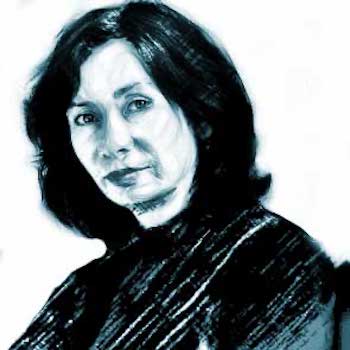
Natalia – Natasha to me and many others – was a colleague and very close friend. I last saw her 36 hours before the murder, while staying at her place in Grozny, as I always did when in Chechnya. We’d spent a week interviewing people whose homes police had torched because of their alleged involvement with militants, and whose relatives had been rounded up, disappeared, or killed by security officials.
We said goodbye just past midnight on July 14. When I woke up later that morning, Natasha had already left for an early meeting, so I went to the airport without getting to see her again. The next day, armed men pushed her into a car as she was running to catch a bus to the city center. They drove her into neighboring Ingushetia and shot her near the forest.
In 2011, having lost hope for an effective investigation by Russian authorities, Natasha’s family filed a complaint with the European Court, alleging a violation of her right to life because Russian authorities failed to protect human rights defenders in Chechnya, Chechnya’s leadership repeatedly threatened Natasha, and her abduction was apparently carried out by security officials.
Ten years later, the court ruled today that Russia had failed to investigate but also held that there wasn’t sufficient evidence to conclude that state agents had murdered Natasha.
The ECHR noted that Russian authorities promptly opened a probe into Estemirova’s killing and identified a suspect, but emphasized that Moscow’s failure to provide full materials of the case made the court “unable to conclude that the investigation had been carried out thoroughly.” It noted some contradictions in the expert evidence led it to doubt that the investigation had been effective.
The victim’s sister, Svetlana Estemirova, alleged in her appeal that state agents were behind the killing but the Strasbourg-based court ruled that the evidence didn’t support the claim.
The court required Russia to pay 20,000 euros ($23,600) to Estemirova’s sister and urged Russian authorities to track down and punish the perpetrators of her murder.
“I had very high hopes and it would be an understatement to say that I’m disappointed,” Natasha’s daughter Lana, who was 15 when she lost her mother, told me today.
The lack of sufficient evidence the court cited is a direct result of Russia’s brazen determination to protect the perpetrators of this outrageous murder. Natasha was killed for fearlessly exposing abuses by Chechen authorities. An effective investigation would leave no doubt about official involvement in her murder.
“A lot of people have asked me how I felt about the death in Senegal of the former dictator of Chad Hissene Habre, on whose prosecution I spent 17 years. https://www.nytimes.com/…/africa/hissene-habre-dead.html For me, especially in later years, the effort was much more about using the case to promote transformation and giving the victims a means to claim their dignity than about the person of Hissène Habré.At Habré’s trial, Kaltouma Deffalah, one of the survivors of sexual slavery, testified defiantly that she felt “strong, very courageous because I am before the man who was strong before in Chad, who …doesn’t even speak now, I am really happy to be here today, facing him, to express my pain, I am truly proud.” It was a sentiment expressed, in one way or another, by many of the survivors who testified.Since Habré was sentenced to life in prison in 2016, his victims have been campaigning to get reparations, as awarded by courts in Chad and Senegal. In fact, on the morning of his death, I was having a phone conference with the victims’ Chadian lawyer Jacqueline Moudeina [ see: https://www.trueheroesfilms.org/thedigest/laureates/179E3C5C-9175-1B42-99C9-1004DDBC850E]and other lawyers on how to kick-start the stalled procedures, particularly at the African Union ( background here – https://www.hrw.org/…/hissene-habres-victims-continue…) That said, it is a strange feeling that he’s dead. I used to imagine that Habré and I were sitting across a chessboard in a strategic battle, trying to anticipate the other’s moves. Back in 2004, I asked the French journalist Christian Millet, who maintained friendly contact with Habré, what he thought the former dictator’s strategy was against us. And Millet responded: “Il vous attend dans sa grotte.” He is waiting for you in his cave, a reference to his days as a rebel fighter in the rocky desert of northern Chad. Habré was playing this chess game with the black pieces, waiting for us to over-extend. That is how as president of Chad, with French and American help, he defeated Libya’s Moemmar Qaddafi whose troops had occupied part of his country.In Senegal, we were in Habré’s cave, where he had used the millions he looted from the Chadian treasury to build himself a network of protection that included politicians, religious figures and journalists . But in the end, the tenacity and perseverance of his victims, the evidence of his massive crimes ( thousands of killings, systematic torture, sexual slavery ) , and the courage of some Senegalese leaders such as then-justice minister Aminata Toure, overcame Habré’s home-field advantage, and he was powerless to prevent his conviction in an exemplary and transparent trial.In his one written declaration to the investigating judges, Habré said that I was “an enemy… who has never hidden his aggressive and outrageous hostility, a specialist in forgery and lies.” How do I feel now? I’m grateful that Habré lived long enough to face justice and the accusatory gaze of his victims.”
Enforced disappearance refers to the arrest, detention or abduction of persons by agents of the State, or those acting with State authorization or support, whose whereabouts are unknown.
Once largely the product of military dictatorships, it has become a global problem, according to the UN, with hundreds of thousands of people “disappeared” in more than 80 countries. Impunity remains widespread.
While strictly prohibited under international human rights law, the SG, Mr. Guterres said enforced disappearance continues to be used across the world as a method of repression, terror, and stifling dissent.
“Paradoxically, it is sometimes used under the pretext of countering crime or terrorism. Lawyers, witnesses, political opposition, and human rights defenders are particularly at risk,” he added.
Having been removed from the protection of the law, victims, who can include children, are deprived of all their rights and are at the mercy of their captors.
They are frequently tortured and know that it is unlikely anyone will come to their aid. Some are even killed.
“Enforced disappearance deprives families and communities of the right to know the truth about their loved ones, of accountability, justice and reparation,” the Secretary-General said.
“The COVID-19 pandemic has added to the agony and anguish of enforced disappearance, by limiting capacities to search for missing persons and investigate alleged enforced disappearance.”
It was established by the UN General Assembly, which adopted a resolution in December 2010 expressing deep concern about the rise in incidents in various regions, and increasing reports of harassment, ill-treatment and intimidation of witnesses of disappearances, or relatives of people who were disappeared.
“The Convention for the Protection of all Persons against Enforced Disappearances is indispensable in helping to tackle this cowardly practice. But it requires the will and commitment of those with the power to do so,” the Secretary-General said. “States must fulfil their obligations to prevent enforced disappearance, to search for the victims, and to investigate, prosecute and punish the perpetrators.”
Mr. Guterres reiterated his call for countries to ratify the Convention, and to work with the UN Committee that monitors its implementation, as well as the Working Group on Enforced Disappearances, which assists families in determining the fate of their loved ones.
On this day Amnesty International, Human Rights Watch and the International Commission of Jurists (ICJ) issued a statement that the government of Nepal should promptly enforce Supreme Court rulings and permit the regular courts to try cases of enforced disappearance and other grave international crimes. On the International Day of the Victims of Enforced Disappearances, August 30, 2021, thousands of Nepali families are no closer to knowing the truth of what happened to their missing loved ones than they were when the country’s armed conflict ended 15 years ago.
Nepal’s Supreme Court has repeatedly ordered the government to investigate gross violations of human rights and international humanitarian law during the conflict from 1996 to 2006, and to conduct a meaningful, effective transitional justice process to establish the truth and provide justice for thousands of cases of serious abuses.
“The Nepali government stands in blatant violation of express orders of the Supreme Court by failing to conduct a credible, timely transitional justice process,” said Mandira Sharma, senior legal adviser for South Asia at the ICJ.
Born in Kano state, northern Nigeria, in 1984 and a chemical engineer by training, Mubarak Bala is a prominent member of the Humanist movement. As President of the Humanist Association of Nigeria, he has played a vital role in the Humanist community in Nigeria.
Bala has been working to promote freedom of religion or belief in Nigeria and has been an outspoken religious critic in the conservative northern region, where open religious opposition is unusual. He has campaigned for the decriminalization of apostasy and blasphemy laws in states that implement Sharia in northern Nigeria. In addition he has engaged in human rights education and raised awareness on the importance of freedom of thought and conscience to peace, progress and stability in the region. He has organized meetings and conferences to enlighten the local populace especially those inclined to religious extremism and radical Islam due to indoctrination, lack of understanding or misinformation about freedom of religion or belief.
Bala has been held in detention since his arrest on 28 April 2020. Held for 15 months without any charge, Bala now faces charges of public disturbance in connection with Facebook posts deemed “blasphemous” he is alleged to have published in April 2020. In addition to being arbitrarily detained for 15 months, there have been several other violations of his rights to a fair trial, which include denying Bala access to his legal counsel until October 2020, failing to comply with a Federal High Court order to release Bala on bail, and consistent attempts to obstruct Bala’s legal team.
Andrew Copson, President of Humanists International, commented: “Mubarak Bala is an honorable humanist who has experienced great hardship and persecution in his realization of a life lived true to his values. Today he is a prisoner of conscience, whose thoughts are freer than he himself.”
“On behalf of my husband Mubarak Bala, I really want to thank humanists all over the world for this wonderful honour. This award has really shown that the world still cares for Mubarak, and that Mubarak has not been forgotten. This is to show that humanity is above all regardless of religion and belief. I thank Humanists International for your utmost support and care for Mubarak’s family. We don’t know how to thank you enough, all I can say is thanks a zillion! And I know this is indeed a phase which will come to pass soon. I also want to thank the Humanists Association of Nigeria who has struggled these past months for Mubarak’s release. You have all really shown so much love and care for Mubarak and we really appreciate it.“
The enforced disappearance of people is the latest tactic that authorities in Nicaragua have adopted to silence any criticism or dissenting voices, Amnesty International said in a new report released on 25 August 2021. Where are they? Enforced Disappearance as a Strategy of Repression in Nicaragua documents the cases of 10 people detained for their activism or for exercising their right to freedom of expression who have been subjected to enforced disappearance, despite being in the custody of the Nicaraguan authorities.
“Daniel Ortega’s government of is implementing a new strategy to try to silence those who speak out. By disappearing opponents, activists and journalists, Ortega is showing his fear of criticism and complaints,” said Erika Guevara-Rosas, Americas director at Amnesty International.
“The 10 cases we have documented demonstrate a new pattern of detentions followed by enforced disappearances and bear strong similarities to the cases of dozens of others who may be in the same situation. We demand that Daniel Ortega’s government immediately release all those detained for exercising their rights.”
Since the beginning of the human rights crisis in Nicaragua in April 2018, there has been no end to reports of harassment against people identified as opponents of the government, human rights defenders, journalists, victims of human rights violations and their families.
The new phase of the repressive strategy of President Ortega’s government, which is highlighted by the detention of a new group of people identified as opponents of the government, began on 28 May 2021. From then until 2 August, more than 30 people were deprived of their liberty, adding to the more than 100 people who were already in prison just for exercising their human rights.
After analysing the cases of 10 individuals, Amnesty International concluded that – in light of the Nicaraguan state’s international human rights obligations – their detention, followed by the concealment of their whereabouts, constitutes the crime of enforced disappearance. The cases documented were those of Daysi Tamara Dávila, Miguel Mendoza, José Pallais, Suyen Barahona, Víctor Hugo Tinoco, Félix Maradiaga, Ana Margarita Vijil, Violeta Granera, Jorge Hugo Torres and Dora María Téllez.
The 10 documented cases are not isolated cases and occur in a context where there are repeated reports of other situations that have important similarities. Therefore, the cases analysed likely represent just a small sample of a longer list of victims.
In all of the documented cases, as of 2 August (the closing date of the investigation), the authorities had not officially disclosed the exact location of the detainees – a requirement under international law. In most cases, the only information received about their possible location has been provided verbally by police officers at the gate of the Judicial Assistance Directorate Evaristo Vasquez Police Complex (Dirección de Auxilio Judicial Complejo Policial Evaristo Vásquez, DAJ), known as the “New Chipote” (Nuevo Chipote), after family members insisted. However, mere statements by police officers in charge of the entrance of a detention centre are not sufficient, official and credible proof of the whereabouts and conditions of the detainees.
Both the Public Prosecutor’s Office and the National Police have issued public statements acknowledging the detentions. However, in none of them do they mention the place of detention. Furthermore, the families have not been able to visit the detainees, their legal teams have not had access to interview them, and the judicial authorities have not responded to calls to authorise the entry of family members and lawyers.
The information available to Amnesty International shows that the families and legal representatives of the 10 detainees submitted more than 40 applications, petitions and appeals to different authorities, requesting access to their files, medical examinations for the detainees, interviews with their lawyers, family visits, and immediate release, among other requests. Unfortunately, these appeals have been ineffective and, in most cases, left unanswered by the authorities.
Enforced disappearance is a crime under international law and one of the most serious human rights violations because it implies the violation of multiple human rights. It is defined as a lawful or unlawful deprivation of a person’s liberty by state agents, or by other actors with the acquiescence or tolerance of the state, without subsequently acknowledging that the detention took place, or, if acknowledged, withholding information about the fate or whereabouts of the person deprived of liberty.
“This week will mark 90 days since the most recent detentions began, but the authorities continue to refuse to provide official information on the whereabouts and conditions of detention,” said Erika Guevara-Rosas. “The families deserve to know for sure if their loved ones are alive and where they are being held. The anguish they’re experiencing is yet another form of punishment under the repressive policies of Daniel Ortega’s government.”




 Hans Thoolen on Human Rights Defenders and their awards