Interesting example of how governments (here the EU) can work together to protect human rights defenders in a specific country (here Uganda). Since a few years there is an annual EU HRD Award to recognise and honour the achievements of an individual Human Rights Defender active in Uganda.
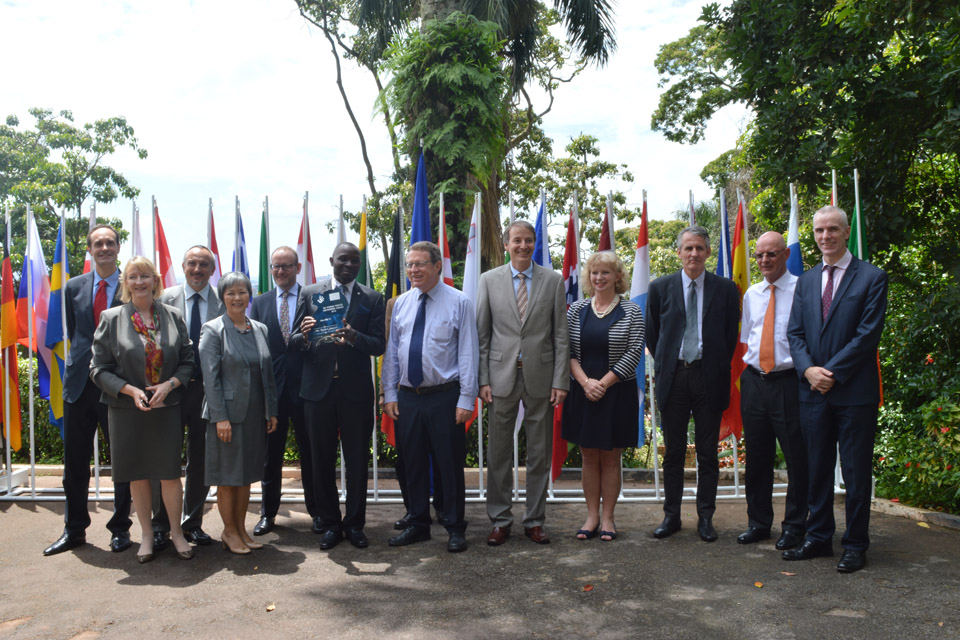
EU Heads of mission with the 2016 EU Human Rights Defender Award recipient, Robert Sempala in May 2016.
Now the British High Commission in Kampala, together with other European Union member states represented in Uganda, is inviting nominations for the 2017 EU Human Rights Defenders Award. The broad range of activities carried out by HRDs can include the following:
documenting human rights violations;
seeking remedies for victims of human rights violations through the provision of legal, psychological, medical or other support;
combating the culture of impunity which can hide systematic and repeated breaches of human rights and fundamental freedoms;
mainstreaming a human rights culture, and transmitting information about HRDs at the national, regional and international levels;
advocacy for the respect of human rights.
Nominations should be sent by e-mail to: Kampala.Reception@fco.gov.uk. Nominations should be a maximum of one page in length, and should use the following nomination form (MS Word Document, 51.5KB). The deadline for nominations is 14 April 2017. The winner will be announced on 25 May 2017 at a ceremony hosted by the Embassy of the Kingdom of the Netherlands in Uganda.
10 December is obviously International Human Rights Day, but there are several countries that have a different or additional Human Rights Day of their own. One of them is South Africa where 21 March is historically linked with 21 March 1960 and the events of Sharpeville (on that day 69 people died and 180 were wounded when police fired on a peaceful crowd that had gathered in protest against the Pass laws – https://www.parliament.gov.za/project-event-details/2)
Boipelo Mokgothu in Traveller24 used the occasion on 20 March 2017 to publish a compilation of the 10 most inspirational women from historical figures till today:
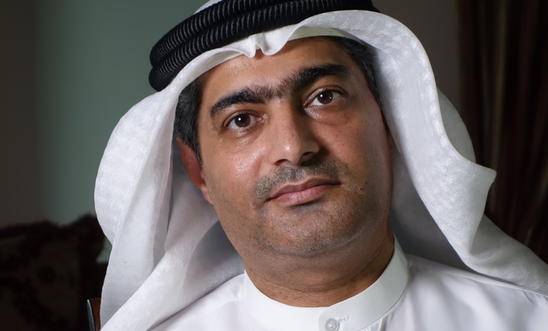
On 20 March, 2017, around midnight, Mr. Ahmed Mansoor was arrested at his home in Ajman, UAE, by a large team of the Emirates’ security forces. The Government has finally confirmed that it is holding him, but until today we don’t know where. The reasons for his arrest remain unknown but might be linked to a series of tweets he posted on Twitter in recent days, calling for the release of UAE human rights defender Osama Al-Najjaror to a letter that he signed, along with other activists in the region, calling for the release of all prisoners of conscience in the Middle East ahead of an Arab League Summit scheduled to be held in Jordan on 29 March 2017.
Following a massive crackdown on human rights defenders in the UAE in recent years, Ahmed Mansoor is today widely respected as the only independent voice still speaking out through his blog and Twitter account against human rights violations from inside the country. He was the Laureate of the Martin Ennals Award 2015. [https://humanrightsdefenders.blog/2015/10/07/the-link-to-the-full-mea-2015-ceremony-of-6-october/]. Mr. Mansoor has faced repeated intimidation, harassment, and death threats from the UAE authorities or their supporters, including arrest and imprisonment in 2011 following an unfair trial. Although pardoned and released later that year, the UAE authorities have arbitrarily imposed a travel ban on him. [https://humanrightsdefenders.blog/2015/09/15/fly-emirates-if-the-emirs-let-you/]
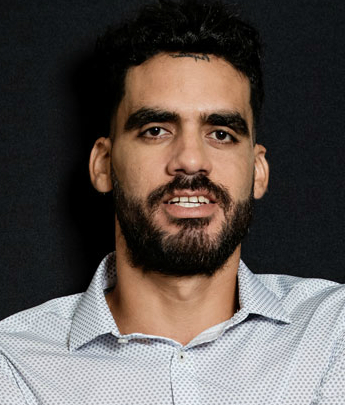
The Human Rights Foundation reported that Cuban graffiti artist Danilo ‘El Sexto’Maldonado was finally released from prison on 21 January 2017, after spending two months in detention. Cuban authorities arrested El Sexto for spray painting “Se fue” (in English, “He’s gone”) shortly after the death of the island’s former dictator, Fidel Castro. He was sent to one of Cuba’s most notorious maximum security prisons, El Combinado de Este, where he was subjected to daily psychological torture and frequent death threats. The Human Rights Foundation filed an individual complaint with the U.N. Working Group on Arbitrary Detention for its Havel Prize Laureate.[https://humanrightsdefenders.blog/2015/04/16/havel-prize-for-creative-dissent-awarded-to-girifna-sakdiyah-maruf-and-el-sexto/]
I have written earlier about the wisdom of having purely governmental human rights awards. Now Canada adds to the discussion:
In my article for Oxford University Press (“Human Rights Awards for the Protection of Human Rights Defenders” J Hum Rights Pract (2013) 5 p552) I wrote: “A word of caution with regard to ‘governmental’ awards is in order. While it is one thing for a government to ‘support’ (e.g. financially) an otherwise independent award with an autonomous jury, the notion that governments (such as the USA, the Netherlands, France, Poland, Sweden, Canada) should run their own awards, select the winner, have the Minister hand it out and promote the award through the diplomatic service, does not sit well with the desire to protect HRDs from the charge of being ‘foreign agents’, a frequent claim by repressive governments trying to depict HRDs as being supported and funded from abroad… A degree of distance would benefit governments and would also serve the laureates themselves who usually want to be seen as spearheading the non-governmental human rights movement. Intergovernmental organizations face similar problems in having awards, as was demonstrated by the controversy surrounding UNESCO’s decision in 2010 to launch an award paid for and named after the president/dictator of Equatorial Guinea, Obiang Nguema.”
A recent article (5 March 2017) by Dean Beeby of the Canadian Broadcasting Corporation (CBC) entitled “Diefenbaker award missing in action after Liberals take over” brings home another aspect, namely that such an award becomes a ‘political tit-for-tat’. An award created by Stephen Harper’s government, which honoured former Progressive Conservative prime minister John Diefenbaker, was inaugurated in early 2011 and given out for four years running before ‘disappearing’ in 2015 and 2016. Read the rest of this entry »
The banquet hall at the National Museum in Copenhagen played host to the presentation of the PL Foundation Freedom Award on 12 December 2016, an annual prize given in honour of a Danish resistance fighter that recognises the exercise of human rights in an extraordinary manner. The winner was Breaking the Silence, an Israeli organisation that collects and shares testimonies (some anonymous) from soldiers who have served in the West Bank and Gaza – over a thousand at the last count. “Breaking the Silence shows great personal courage to talk about their own experience in the West Bank” commented the PL Foundation, named after the Danish resistance fighter Poul Lauritzen. Previous winners include Turkish publisher Ragıp Zarakolu and Turkish playwright Ali Tuygan. One of Breaking the Silence’s co founders, Yehuda Shaul, 33, along with spokesperson Achiya Schatz, appeared in person to receive the award, which included a prize of 100,000 kroner, from Poul Søgaard, a leading judge at the Supreme Court.
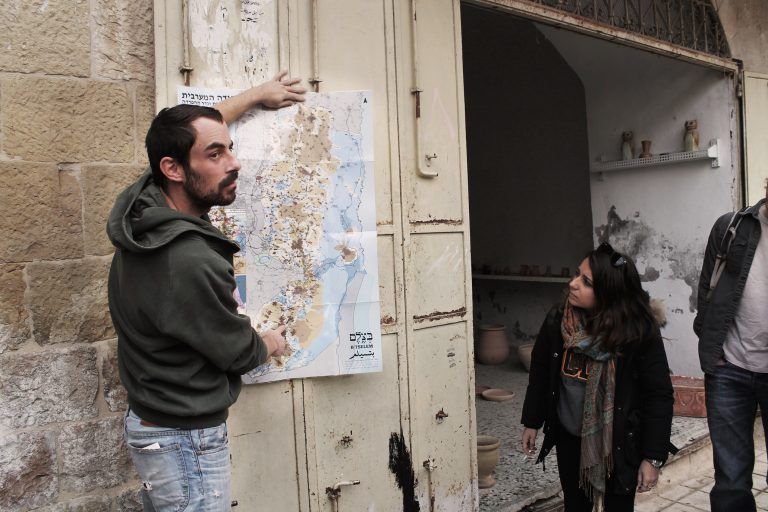
Founded in 2004, Breaking the Silence initially published the testimonies of the soldiers in an art gallery in Tel Aviv. Today, it publishes them in booklets and articles and shares them in lectures and guided tours of cities like Hebron in the West Bank.
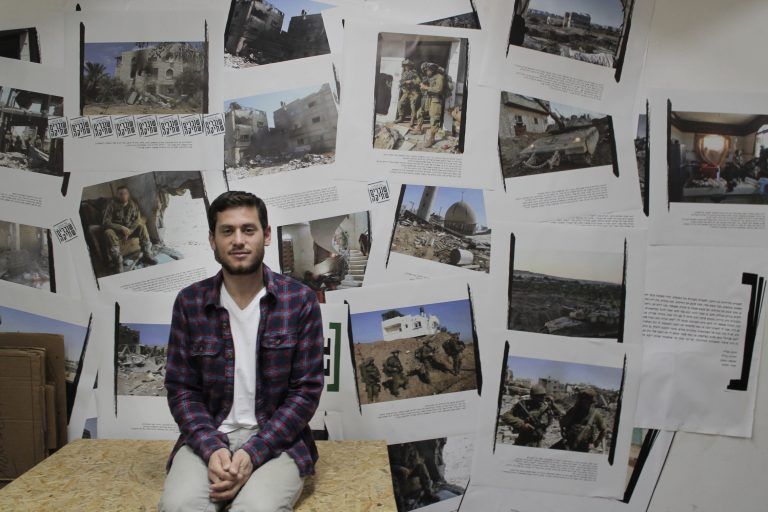
Achiya Schatz in front of the testimonies at the Breaking the Silence office in Tel Aviv. (all photos: Cornelia Mikaelsson)
Banned by the Israeli authorities from speaking to soldiers or schoolchildren, Breaking the Silence has been accused of spreading mistruths and of betraying the Israeli military. Threats are an occupational hazard. “To remain silent is no longer an option,” explains Achiya Schatz, 31, who did his national service in the Israeli army from 2005-08. Schatz recalls that many of his missions to search Palestinian residences were pointless – commanding officers would throw away the gathered intelligence without reading it. “After completing my service I got time to think. One question led to another and all of a sudden I asked myself: how can you ever occupy morally?”
Over half of Breaking the Silence’s funding comes from abroad (7 million kroner in 2014 alone) and one of its biggest supporters is Danish – Dan Church Aid, the humanitarian NGO. And this has led to extra suspicion in Israel. Earlier this year, the Israeli government passed a transparency bill forcing NGOs that receive more than half of their funding from foreign sources to declare them openly. Those who voted for the bill claimed that it served a democratic purpose. Critics, however, argued that it only was an attempt to target NGOs critical of Israel’s governmental policies. Israeli PM Benjamin Netanyahu wrote a statement on his Facebook page, claiming that the bill aims to “prevent an absurd situation, in which foreign states meddle in Israel’s internal affairs by funding NGOs, without the Israeli public being aware of it”. [see also: https://humanrightsdefenders.blog/2016/01/05/michael-sfardjan-israels-human-rights-activists-arent-traitors/]
Ido Even-Paz, one of the guides on the Breaking the Silence tour of Hebron
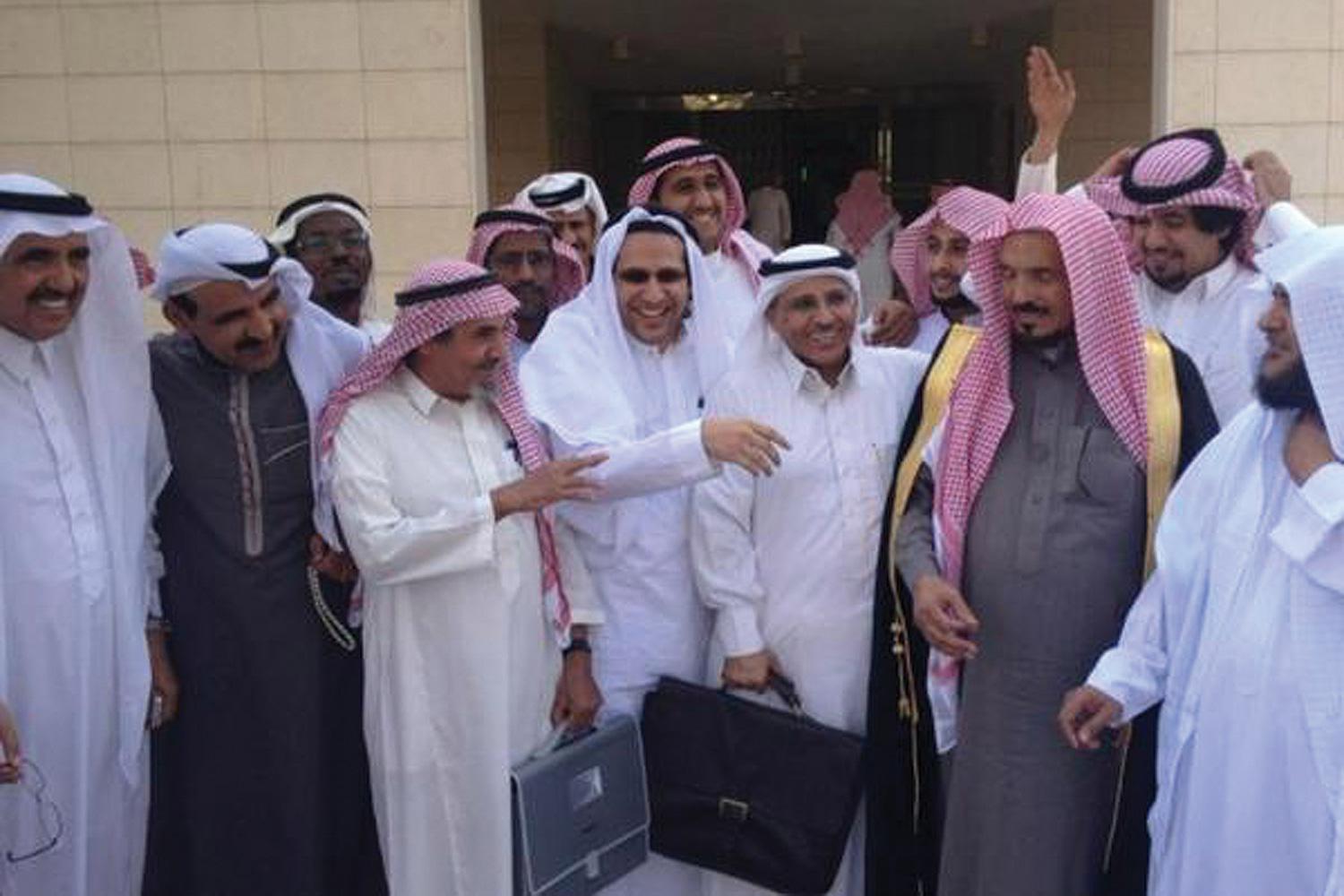
Waleed Abu al-Khair, prominent lawyer and human rights activist, speaks to Human Rights Watch over Skype from Jeddah, Saudi Arabia on September 19, 2013.
Saudi courts have convicted at least 20 prominent peaceful activists and dissidents since 2011. Many, like Abu al-Khair, have faced sentences as long as 10 or 15 years on broad, catch-all charges – such as “breaking allegiance with the ruler” or “participating in protests” – that do not constitute recognizable crimes. “Every day Waleed Abu al-Khair spends in prison compounds the injustice Saudi Arabia has imposed on him and his family,” said Sarah Leah Whitson, Middle East director at Human Rights Watch.
[Abu al-Khair has been one of Saudi Arabia’s leading human rights advocates for years. In July 2014, the Specialized Criminal Court (SCC), Saudi Arabia’s terrorism tribunal, convicted him on a number of broad and vaguely worded charges, including for comments to news outlets and on Twitter criticizing Saudi human rights violations. In addition to sentencing him to prison, the court banned him from traveling abroad for another 15 years. Abu al-Khair played no active part in his trial. He refused to recognize the legitimacy of the court or to defend himself. He also refused to sign a copy of the trial judgment or to appeal either his conviction or sentence. In January 2015, an appeals tribunal within the SCC overturned part of the earlier ruling following a prosecution appeal of the court’s suspension of five years of his term, and ruled instead that Abu al-Khair should serve all 15 years in prison.]
Anna Neistat, Senior Director of Research at Amnesty International, writes in the Huffington Postof 23 February 2017 about 4 Human Rights Defenders who deserve a “Lifetime Achievements” Oscar. Since it’s awards season, Amnesty International is paying tribute to four human rights heroes whose dramatic stories could – and should – be made into movies:
Itai Peace Dzamara
It’s been almost two years since Zimbabwean journalist and activist Itai Peace Dzamarawas dragged from a barbers’ chair by five armed men while he was getting a haircut. Dzamara, the leader of a pro-democracy movement called “Occupy Africa Unity Square”, had long been considered an enemy of the state by the Zimbabwean government. Just two days before his abduction he had delivered a speech at an opposition rally in Harare, calling for mass action against the deteriorating economic conditions in Zimbabwe. If this were a movie, justice would have been done long ago. Dzamara would have been returned to his wife and children, and the men who abducted him held accountable. But this isn’t Hollywood. This is Zimbabwe, where basic rights and freedoms have been trampled on throughout the long years of Robert Mugabe’s reign. As Itai Peace Dzamara and his family know, anyone who dares to speak out is a target for intimidation, harassment and arrest, and there’s no happy ending in sight. Despite a court ruling ordering state security agents to investigate Dzamara’s disappearance, there were gaps in the investigation and his whereabouts remains a mystery. [https://humanrightsdefenders.blog/2015/05/05/itai-dzamaras-disappearance-worrying-for-all-human-rights-defenders-in-zimbabwe/]
Berta Cáceres
GOLDMAN ENVIRONMENTAL FOUNDATION
Like the audience of a horror movie, the people around Berta could see that terrible danger was coming her way – but they were powerless to stop it. Honduras has the highest number of killings per capita of environmental and land activists in the world. The vast majority of these killings go unsolved and unpunished. One story that really stands out in this deadly context is that of Berta Cáceres. Berta was the leader and co-founder of an organisation that was campaigning against the construction of a hydroelectric project on the ancestral lands of indigenous communities in Honduras. In the early hours of 2 March 2016, she was murdered in her own home. Berta knew that she was putting her life in danger, but she was willing to take the risk to stand up for indigenous communities. Like the audience of a horror movie, the people around Berta could see that terrible danger was coming her way – but they were powerless to stop it. Despite the stark warning that her death served, environmental activists in Honduras say that stopping their work is not an option – no-one else will defend their communities and rights. They continue Berta’s work every day, reminding us that we should never take freedom for granted. It is essential that Berta’s assassination is solved, to show that there is a price to pay for attacking and killing environmental activists. Berta’s story ended in tragedy, but we will not stop fighting until we are sure that other activists will not meet the same fate. [https://humanrightsdefenders.blog/2016/03/07/exceptional-response-from-ngo-world-on-killing-of-berta-caceres/]
Sirikan Charoensiri
Sirikan Charoensiri, also known as “June”, is a young lawyer who has bravely stood up for human rights during a dark period of military rule in Thailand. In June 2015, she was on hand at a peaceful protest by pro-democracy student activists in Bangkok to monitor the situation and provide legal representation, if necessary. She now finds herself facing sedition charges and a potential trial in a military court alongside her clients. She also faces charges in two additional cases relating to her defence of the student activists and could be imprisoned for up to 15 years. As the Thai authorities have escalated their crackdown in the name of security, people who stand up for human rights in the country are increasingly falling foul of a government intent on silencing dissent. As June herself put it: “There is now an environment where risk is visible and imminent.” [https://humanrightsdefenders.blog/2016/12/01/international-day-of-women-human-rights-defenders-agents-of-change-under-pressure/]
Narges Mohammadi
Narges is a prisoner of conscience who should be lauded, not locked up, for her human rights work. In Iran, human rights defenders and other peaceful critics are subject to relentless harassment. Over the past year, those jailed after shockingly unfair trials before Revolutionary Courts including lawyers, bloggers, students, women’s rights activists, filmmakers and even musicians. Human rights defender Narges Mohammadi knows better than most how vengeful the Iranian authorities can be towards anyone who dissents. She is currently serving a total of 22 years in prison for speaking out against issues such as Iran’s prolific use of the death penalty and acid attacks on women. What makes her situation even worse is that she is critically ill and cannot receive proper medical care in prison. Just as cruelly, the authorities have at times denied her access to her young children, who had to leave Iran to live with their father in France after she was jailed. Narges is a prisoner of conscience who should be lauded, not locked up, for her human rights work. We will continue to fight until she is free.[https://humanrightsdefenders.blog/2014/06/12/retaliation-against-iranian-human-rights-defender-for-meeting-with-ashton/]
Itai, Berta, Sirikan and Narges are just a handful of the outstanding human rights defenders around the world who deserve recognition, but have instead been silenced by forces of cruelty, injustice and repression.
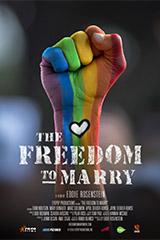
This documentary provides an insight into marriage equality movement in the USA. THE FREEDOM TO MARRYis an inspiring insiders’ look at the one the recent civil rights battles.
The historic Obergefell v. Hodges case represents the culmination of a decades-long struggle to guarantee the right of same-sex couples to marry. Among those leading the fight for justice is attorney and gay rights defender Evan Wolfson, who is considered by many the architect of LGBT marriage equality. Also profiled is human rights lawyer Mary Bonauto. In tracking the climactic countdown to the landmark Supreme Court decision, filmmaker Eddie Rosenstein manages to create a thrilling ambience.
THE FREEDOM TO MARRY was the Best Documentary and Best Editing winner at the Savannah Film Festival and recently picked up the Human Rights Prize at the Atlanta Jewish Film Festival 2017.
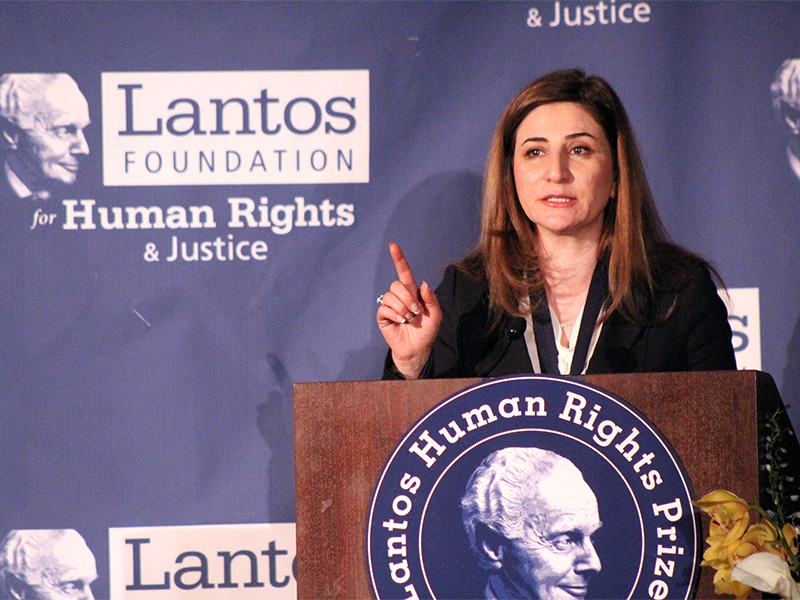
Iraqi lawmaker Vian Dakhil at the Lantos Human Rights Prize ceremony, 8 February 2017 – RNS photo
Last week I wrote about an award-winning human rights defender not being able to come and collect her award in the USA [https://humanrightsdefenders.blog/2017/02/01/yazidi-human-rights-laureate-may-be-banned-from-coming-to-washington-to-accept-award/]. Vian Dakhilmade it to Washington in the end. She had already received a visa to come to Washington to accept an award from the Tom Lantos Foundation when President Donald Trump’s executive order pausing immigration from seven Muslim-majority countries, including Iraq, was issued. After an arduous process involving the State Department and the Iraqi Embassy, she was granted an exemption to the travel ban so she could attend the award ceremony on 8 February. Her sister and translator was able to get a visa after a federal judge temporarily halted the implementation of the executive order. Read the rest of this entry »



 Hans Thoolen on Human Rights Defenders and their awards