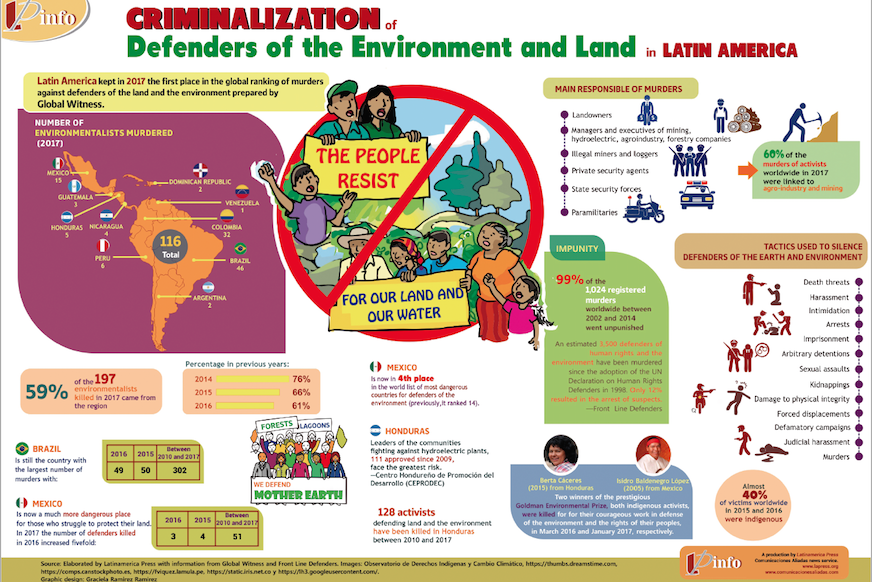
This blog has on several occasions drawn attention to reports that show that Latin America is among the deadliest places to be a human rights defender [e.g. https://humanrightsdefenders.blog/2016/01/06/latin-america-philippines-most-dangerous-places-for-human-rights-defenders/]. An infographic – published on 27 March 2018 by Latin America Press – summarises criminalization of land & environmental rights defenders in Latin America.
Author Archive
2018: Latin America still the graveyard for environmental human rights defenders
April 28, 2018Annual reports 2017 by Front Line Defenders
April 28, 2018On 23 April 2018 Dublin -based NGO “Front Line Defenders” published two significant reports:
- Dispatches 2017 – the annual publication about the significant challenges confronting human rights defenders (HRDs) and efforts to provide the protection and support they so critically need;
- The Annual Report on Human Rights Defenders at Risk 2017, which documents hundreds of physical, legal, and social attacks on HRDs around the world in 2017.What stands out is the courage and resilience of the individual HRDs who tirelessly continue their work to build more just and equal societies despite increasingly repressive environments. Almost every day a HRD is killed because of her or his peaceful work.
Moreover, in October 2017, Front Line Defenders held its biannual Dublin Platform for Human Rights Defenders at Risk, bringing together over 110 HRDs from 99 countries. To read the Platform Report, view video testimonies of fellow HRDs and see some photos from the event, click the link below to access the Platform page:
In 2018, Front Line Defenders will be reviewing its work and setting priorities for the next four years, so please feel encouraged to send them any feedback on how you think it could be more effective.
—–
Dispatches- https://www.frontlinedefenders.org/en/resource-publication/dispatches-2017
Annual Report- https://www.frontlinedefenders.org/en/resource-publication/annual-report-human-rights-defenders-risk-2017
Dublin Platform – https://www.frontlinedefenders.org/en/2017-dublin-platform
Bikes and digital power for human rights defenders in Africa
April 27, 2018Reporters Without Borders: 2018 World Press Freedom Index makes sobering reading
April 26, 2018Reporters Without Borders (better known under its French acronym RSF) published its WORLD PRESS FREEDOM INDEX 2018. The rankings you can find by clicking here READ MORE. The regional chapters below give a quick overview of the main trends, including the disturbing downward turn in the USA, the further sinking in ex-sovjet states and China’s nefarious example in Asia.
RSF INDEX 2018: JOURNALISM SORELY TESTED IN NORTH AFRICA
North Africa’s performance in the 2018 World Press Freedom Index reflects the different pressures to which journalists are exposed. Restrictive laws, reporting problems (especially at protests), and subjects that are off limits all prevent journalists from being free to provide independently reported and pluralist news and information.
RSF INDEX 2018: US FALLS AS CANADA RISES
Despite having strong constitutional protections to the contrary, the latest World Press Freedom Index findings on the US and Canada reveal two countries whose journalists and media workers face constant challenges to the very freedom to exercise their profession.
RSF INDEX 2018: MIXED PERFORMANCE IN LATIN AMERICA
The 2018 Index shows a slight overall improvement in respect for press freedom in Latin America but this should not divert attention from the continuing problems of violence, impunity, and authoritarian policies towards journalists in many Latin American countries.
RSF INDEX 2018: ASIA-PACIFIC DEMOCRACIES THREATENED BY CHINA’S MEDIA CONTROL MODEL
The Chinese model of state-controlled news and information is being copied in other Asian countries, especially Vietnam and Cambodia. North Asia’s democracies are struggling to establish themselves as alternative models. Violence against journalists is increasingly worrying in Afghanistan, India, Pakistan and the Philippines.
RSF INDEX 2018: THE DANGERS OF REPORTING IN AFRICA
SUB-SAHARAN AFRICA HAS MAINTAINED ITS THIRD PLACE IN THE RANKING BY GEOGRAPHICAL REGION, WITH A SLIGHTLY BETTER OVERALL INDICATOR THAN IN 2017. BUT THERE IS A WIDE RANGE OF SITUATIONS WITHIN THE REGION, AND JOURNALISTS ARE OFTEN THE VICTIMS OF INTIMIDATION, PHYSICAL VIOLENCE, AND ARREST.
RSF INDEX 2018: HISTORIC DECLINE IN PRESS FREEDOM IN EX-SOVIET STATES, TURKEY
THE FORMER SOVIET COUNTRIES AND TURKEY CONTINUE TO BE AT THE FOREFRONT OF THE WORLDWIDE DECLINE IN PRESS FREEDOM. ALMOST TWO-THIRDS OF THE REGION’S COUNTRIES ARE RANKED SOMEWHERE NEAR OR BELOW THE 150TH POSITION IN THE INDEX. THE REGION’S OVERALL INDICATOR HAS SUNK ALMOST AS LOW AS THAT OF MIDDLE EAST/NORTH AFRICA, THE REGION THAT IS LAST IN THE RANKING BY REGION.
RSF INDEX 2018: JOURNALISTS ARE MURDERED IN EUROPE AS WELL
The European model’s erosion, a trend visible in RSF’s most recent Indexes, has continued in the 2018 Index. The region has been shaken by two murders, as well as by threats to investigative reporters and unprecedented verbal attacks on the media. Even the countries at the top of the Index are affected by this alarming climate.
RSF INDEX 2018: MIDDLE EAST RIVEN BY CONFLICTS, POLITICAL CLASHES
The Middle East’s countries are yet again at the bottom of RSF’s World Press Freedom Index. Armed conflicts, terrorism charges against independent journalists and media, and growing online surveillance and censorship make reporting extremely dangerous for the region’s journalists.
https://rsf.org/en/rsf-index-2018-hatred-journalism-threatens-democracies
Goldman environmental prizes in 2018 go to women human rights defenders
April 23, 2018
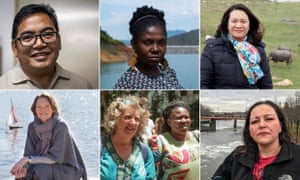
Goldman environment prize winners 2018: (clockwise from top left) Manny Calonzo, Francia Márquez, Nguy Thi Khanh, LeAnne Walters, Makoma Lekalakala and Liz McDaid, Claire Nouvian. Photograph: 2018 Goldman Environmental Prize
This year’s Goldman environmental prizes celebrate six remarkable success stories, five of them driven by women.
In Latin America, the winner is Francia Márquez, an Afro-Colombian community leader who led a 10-day, 350-mile march of 80 women from the Amazon to Bogotá that prompted the government to send troops to remove illegal miners who were polluting rivers with cyanide and mercury. [The dangers of environmental activism have been evident in the murder of two Goldman-prize recipients in the past two years: the 2015 winner Berta Cáceres and the 2005 winner Mexican activist Isidro Baldenegro López] “The first thing we need is to be more aware of the historical moment in which we find ourselves: the planet is being destroyed, it’s that simple, and if we do nothing to avoid it we will we will be part of that destruction,” Francia Márquez said. “Our time has come, we must act, we have a responsibility to future generations to leave a better world, in which taking care of life is more important than producing cumulative wealth.”
South African anti-nuclear activists Makoma Lekalakala and Liz McDaid, [see: anti-nuclear court ruling against former South African president Jacob Zuma]
Vietnamese clean-energy advocate Nguy Thi Khanh,
USA clean-water defender LeeAnne Walters, and
French marine-life champion Claire Nouvian.
Philippines anti-lead campaigner Manny Calonzo.
– see also: https://humanrightsdefenders.blog/2016/04/19/goldman-environmental-prizes-awarded-san-francisco-activists/
The three Child Rights Heroes for 2018 are announced
April 23, 2018Three Child Rights Heroes are honoured by the World’s Children’s Prize (WCP) 2018. Learn more about them by clicking their names below.
• Gabriel Mejía Montoya for his efforts over the course of more than 30 years to support Colombia’s street children, child soldiers and children in prison. Father Gabriel has suffered repeated attempts on his life because of his work.
• Rachel Lloyd for her 20-year fight against commercial sexual exploitation, CSEC, and domestic trafficking of girls and young women in the US. Rachel is a survivor of sexual and mental abuse during her childhood in England and exploitation in the sex industry in Europe.
• Valeriu Nicolae for his tireless struggle to protect the poorest and most vulnerable children in Romania’s Ferentari ghetto. Valeriu grew up in extreme poverty and was discriminated against because he was Roma.
The candidates were selected by a jury of children from 15 different countries. Rachel Lloyd has been elected Child Rights Hero by millions of young people. Gabriel Mejía Montoya from Colombia and Valeriu Nicolae from Romania get the World’s Children’s Honorary Awards.
Colin Kaepernick receives Amnesty International’s Ambassador of Conscience Award
April 22, 2018
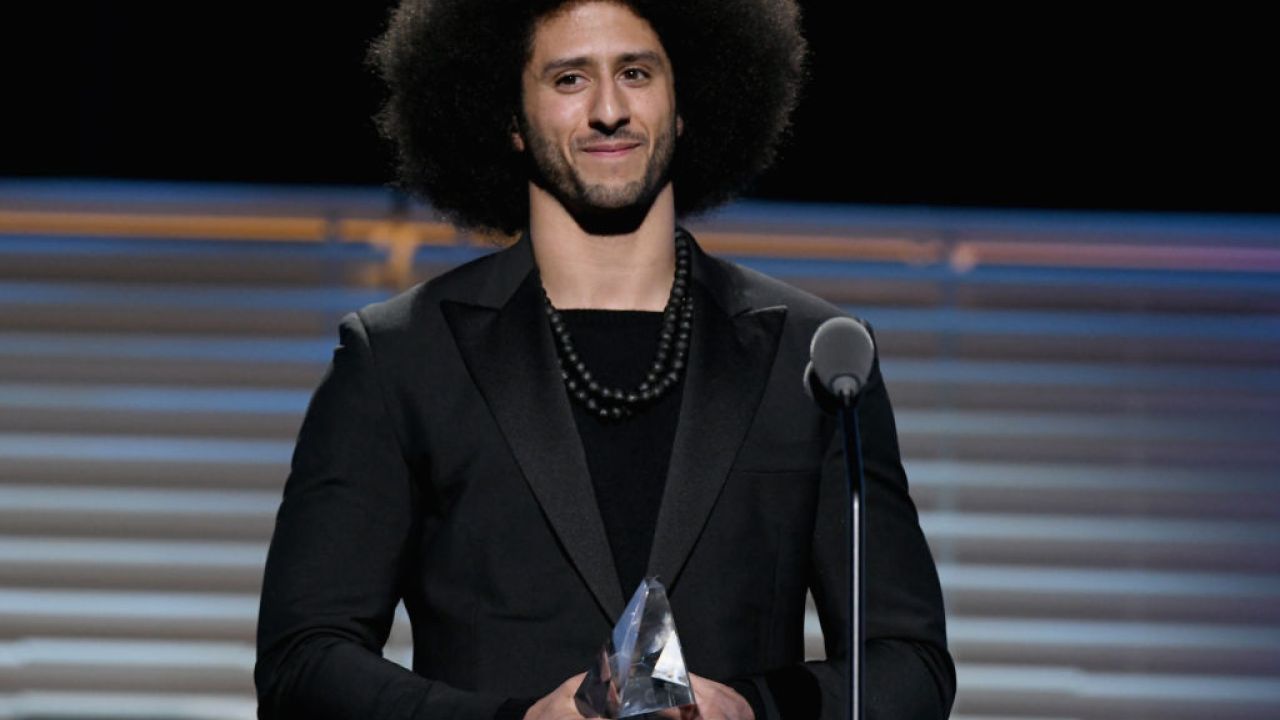
SPORTS ILLUSTRATED 2017 Sportsperson of the Year Show on December 5, 2017 at Barclays Center in New York City.
USA athlete and activist Colin Kaepernick has been honoured with Amnesty International’s Ambassador of Conscience Award for 2018. The award was officially presented at a ceremony in Amsterdam, Netherlands, on 21 April 2018, to coincide with the 50th anniversary of AI Netherlands.
“The Ambassador of Conscience award celebrates the spirit of activism and exceptional courage, as embodied by Colin Kaepernick. He is an athlete who is now widely recognised for his activism because of his refusal to ignore or accept racial discrimination,” said Salil Shetty, Secretary General of Amnesty International. [for more on this and other human rights awards see: http://trueheroesfilms.org/thedigest/awards/ambassador-of-conscience-award]
[During the 2016 pre-season of the American National Football League, Colin Kaepernick knelt during the US national anthem, as a respectful way of calling for the country to protect and uphold the rights of all its people. The bold move was a response to the disproportionate numbers of black people being killed by police. It sparked a movement that follows a long tradition of non-violent protests that have made history. While the polarised response to the “take-a-knee” protest has ignited a debate about the right to protest and free speech, Colin Kaepernick has remained focused on highlighting the injustices that moved him to act. His charity, the Colin Kaepernick Foundation, works to fight oppression around the world through education and social activism, including through free “Know Your Rights” camps which educate and empower young people.]
https://www.amnesty.org/en/latest/news/2018/04/colin-kaepernick-ambassador-of-conscience/
https://thinkprogress.org/colin-kaepernick-receives-humanitarian-prize-a1b3ca0460cc/
3 May World Press Freedom Day: awards for journalists
April 20, 2018As part of the global Celebration of World Press Freedom Day, the winner of the “UNESCO/Guillermo Cano World Press Freedom Prize” will be announced on 3 May 2018. for last year’s award: https://humanrightsdefenders.blog/2017/05/04/eritrean-born-journalist-dawit-isaak-awarded-2017-unescos-guillermo-cano-world-press-freedom-prize/
For more on this award and some 20 other international awards protecting freedom of speech and the media see: http://trueheroesfilms.org/thedigest/awards/unesco-guillermo-cano-world-press-freedom-prize.
The jury on Monday 23 April awarded the honor to Mahmoud Abu Zeid, known as Shawkan, who has been in jail since he was arrested in Cairo in August 2013 for covering a demonstration at Rabaa Al-Adawiya Square. Egypt’s Foreign Ministry strongly warned UNESCO against the move Sunday, saying that Shawkan faces terror-related charges. The U.N. Working Group on Arbitrary Detentions says Shawkan’s arrest is arbitrary and his continued detention infringes his human rights.