Author Archive

Women human rights defenders and journalists in Iraq receive training in Safety and Digital Security

April 29, 2019

To strengthen the resilience of Iraqi women journalists and women human rights defenders against online and offline gender-based attacks, Internews conducts workshops and other activities that focus on digital and physical security:

Iraq is one of the world’s most dangerous countries for journalists according to Reporters without Borders, ranking 160 out of 180 countries in the World Press Freedom Index. Women journalists and activists in Iraq have a particularly difficult time due to online threats and attacks that adversely affect their ability to express themselves freely and advocate effectively. Women have witnessed an escalation in online abuse over the past few years, not just in numbers, but also in methods and sophistication. The risk of harassment and gender-based attacks online is not limited to the digital space as research has shown that online abuse and stalking often escalate into real world physical violence if left unaddressed.

In an interview with The New Arab, Hala ‘Asif, a 24-year-old journalist working as a correspondent for the channel NRT in Baghdad, noted that, “Foreign journalists often investigate political affairs in Iraq, which sometimes is impossible for us to cover as it would be too dangerous and would prevent us from working safely in our country. I would like to go to other provinces in Iraq and carry out investigations about relevant issues, but as a young woman it would cost too much to take care of my safety.”

To address the issue of women’s safety in Iraq, Internews, with funding from the US State Department’s Bureau of Democracy, Human Rights and Labor (DRL), is using a multi-pronged approach – building local networks, coordinating advocacy, and conducting targeted journalism trainings on gender-sensitive issues. Internews’ program, Women Voices (Aswat Al-Maraa), aims to challenge societal attitudes that stigmatize survivors of sexual and gender-based violence (SGBV) by supporting journalists and women human rights defenders to shed light on sensitive issues through coordinated reporting and advocacy. The program works with female Iraqi journalists and media outlets to create a nationwide coalition of women journalists and human rights defenders to strengthen their resilience against gender-based attacks and build the capacity of journalists to report on sensitive human rights and SGBV.

Within the Women’s Voices project, Internews has conducted so far two training-of-trainers (TOT) workshops that focus on the digital and physical security of the project participants. Through a peer-to-peer program, TOT trainees have trained eighty women from Erbil, Najaf, and Halabja how to protect themselves from threats online and in their everyday lives.

….Another participant, from the Erbil workshop, said, “Females often have to face extreme scrutiny of their presence online, and are threatened with death in some instances for photos posted online without family consent or that are considered inappropriate; these kinds of workshops are incredibly important for every female in this country.”

To support the voices and participation of women in some of the world’s most challenging places, Internews’ MENA team ensures the implementation of digital as well as a physical security trainings in all of its projects across the region. ​

See also: https://humanrightsdefenders.blog/2017/05/09/defenddefenders-launched-new-security-manual-for-human-rights-defenders-in-africa/

https://reliefweb.int/report/iraq/uplifting-voices-women-supporting-their-physical-safety-and-digital-security

NGOs urge Putin not to sign Russia’s “Sovereign Internet Bill”

April 28, 2019
Participants in an opposition rally in central Moscow protest against tightening state control over the internet in Russia, 10 March 2019
Participants in an opposition rally in central Moscow protest against tightening state control over the internet in Russia, 10 March 2019  Igor Russak/SOPA Images/LightRocket via Getty Images

On 24 April 2019 nine major human rights, media and Internet freedom NGOs, called on Russian President Vladmir Putin, not to sign the so-called “Sovereign Internet Bill” as it will lead to further limitations of already restricted Internet and media freedoms in the country.

The bill (No. 608767-7) amends the laws “On Communications” and “On Information, Information Technologies and Information Protection” and states its aim as enabling the Russian Internet to operate independently from the World Wide Web in the event of an emergency or foreign threat. On 16 April 2019, the Russian State Duma approved the bill in the third reading amid widespread domestic criticism, protests and online campaigning around the country, and on 22 April, the Federation Council, the upper house of the Russian parliament, approved it. If signed by President Vladimir Putin, the bill would enter into force on 1 November 2019.

The bill creates a system that gives the authorities the capacity to block access to parts of the Internet in Russia, potentially ranging from cutting access to particular Internet Service Providers (ISPs) through to cutting all access to the Internet throughout Russia.

The bill gives control over Internet network routing to the state regulator for Telecommunications, Information Technologies and Mass Communications, Roskomnadzor. It provides that the ISPs should connect with other ISPs, or “peer,” at Internet exchange points (IXes) approved by the authorities, and that these IXes should not allow unapproved ISPs to peer. The bill would also create a centralised system of devices capable of blocking Internet traffic. The bill requires ISPs to install the devices, which the government would provide free of charge, in their networks.

Under this system, Roskomnadzor would monitor threats to Russia’s Internet access and transmit instructions to ISPs through the special devices about countering these threats. Cross-border Internet traffic would be kept under close state control. The draft does not specify what the range of instructions would be, but they could potentially include partially or fully blocking traffic both between Russia and the rest of the World Wide Web, and within Russia. Nor does the draft explain how the new equipment will work, or what specifically it will do. It is clear, however, that blocking would result from direct interaction between the government and the ISP and that it will be extrajudicial and nontransparent. The public would not know what has been blocked and why.

The bill states that the new measures will be activated in the event of a ‘security threat’. The draft does not define security threats, and instead gives the government full discretion to decide what would constitute a security threat and what range of measures would be activated using the new system to address a threat.

The bill also states that Russian ISPs remain obligated to filter and block content in accordance with existing Russian law.

Further, the bill creates a national domain name system (DNS) – a system that acts as the address-book for the Internet by allowing anyone to look up the address of the server(s) hosting the URL of a website they are looking for. The bill would require Internet providers to start using the national DNS from 1 January 2021. Forcing ISPs to use the national system will give Russian authorities the ability to manipulate the results provided to the ISP outside the ISP’s knowledge and control. Authorities will be able to answer any user’s request for a website address with either a fake address or no address at all. This not only allows them to conduct fine-grained censorship but will also let the national DNS to redirect users to government-controlled servers in response to any DNS requests instead of to a website’s authentic servers.

These proposals are very broad, overly vague, and vest in the government unlimited and opaque discretion to define threats. They carry serious risks to the security and safety of commercial and private users and undermine the rights to freedom of expression, access to information and media freedom.

The bill contravenes standards on freedom of expression and privacy protected by the International Covenant on Civil and Political Rights (ICCPR) and the European Convention on Human Rights (ECHR), to which Russia is a party. Both treaties allow states to limit freedoms to protect national security but impose clear criteria for such limitations to be valid. The UN Special Rapporteur on freedom of expression, commenting on the ICCPR, has reiterated that these limits should be “provided by law, which is clear and accessible to everyone,” and be predictable and transparent.

Human Rights Watch, ARTICLE 19 and other undersigned organisations are extremely concerned that the changes introduced in the bill threaten human rights and freedoms in Russia. Open, secure and reliable connectivity is essential for human rights online, including the rights to freedom of expression, information, assembly, privacy and media freedom. The bill could pose a threat to the Internet’s rights-enabling features if access to the World Wide Web is wholly or partially cut off, or if arbitrary blocking and filtering of content is carried out. It would facilitate state surveillance and curb anonymity online. It also risks severely isolating people in Russia from the rest of the world, limiting access to information and constraining attempts at collective action and public protest. The Bill’s negative impact on the freedom of expression will also affect the rights of journalists and media to work freely.

The adoption of the bill should be seen in the context of other Russian legislation that severely undermines protection of freedom of expression and privacy online and fails to meet international human rights standards. These include:

. The 2016 ‘Yarovaya Law,’ which requires all communications providers and Internet operators to store metadata about their users’ communications activities, to disclose decryption keys at the security services’ request, and to use only encryption methods approved by the Russian government. It was adopted to allegedly counter ‘extremism’ but in practice, it creates a backdoor for Russia’s security agents to access Internet users’ data, traffic, and communications.

. In 2017, Federal Law 327-FZ made amendments to the ‘Lugovoi Law’ (Federal Law FZ-398, 2013) that gave the General Prosecutor or his/her deputies a right to block access to any online resource of a foreign or international NGOs designated ‘undesirable’; and, to ‘information providing methods to access’ the resources enumerated in the ‘Lugovoi Law’, i.e. including hyper-links to old announcements on public rallies not approved by local authorities.

. The recent March 2019 bills mandate blocking and penalizing websites that publish what authorities deem to be “fake news” and “insult” to authorities, state symbols, and what the legislation vaguely describes as Russian “society.”

The President of the Russian Federation should reject the bill. The Russian Government should also review other Internet related legislation, abolish the above listed laws and bring its legal framework to full compliance with international freedom of expression standards.

ARTICLE 19

Civil Rights Defenders

Committee to Protect Journalists

Human Rights Watch

International Federation for Human Rights (FIDH)

International Media Support

International Partnership for Human Rights

Norwegian Helsinki Committee

PEN International

Reporters without Borders

https://www.ifex.org/russia/2019/04/24/sovereign-internet-bill/

https://www.hrw.org/news/2019/04/24/joint-statement-russias-sovereign-internet-bill

The FRAME exhibition: Filmmakers Making Women’s Lives Visible

April 27, 2019

Making women’s lives visible is a political act,” says The Asia Foundation’s Jane Sloane.There are many women human-rights defenders who are akin to modern day Joans of Arc. I wish more of their stories could be the inspiration for feature films.” Sloane was recently awarded an Atlantic Fellowship from the London School of Economics’ Inequalities Institute. She used the opportunity to launch an exhibition called FRAME: How Asia-Pacific Feminist Filmmakers and Artists Are Confronting Inequalities.

A collaboration with photographers and art directors Ariel and Sam Soto-Suver, and Maxine Williamson, artistic advisor and exhibition manager, FRAME showcases eight Asia-Pacific screen artists who are exploring and confronting inequality through their work both in front of and behind the camera: Anida Yoeu Ali, Jan Chapman, Mattie Do, Rubaiyat Hossain, Erica Glynn, Leena Yadav, Van Ha, and Anocha Suwichakornpong.

With FRAME now touring internationally, in this interview Sloane talks about her film series with InAsia

….I’ve also felt some frustration that so many women filmmakers in Asia and the Pacific aren’t being recognized for their work. I believe focusing on feminist filmmakers is a way to address the broader inequalities that women face as filmmakers.

Is this an important moment for women filmmakers in Asia?

Well, I think it’s a tipping point because of movements such as #MeToo, the Sustainable Development Goals, and 50/50 by 2020. With Asia now producing over half of the world’s films, it has real potential as the ground from which a lot of women filmmakers can spring. One of the biggest issues in Asia and the Pacific is violence against women, and film is a powerful way to engage people in that conversation. I lead the work to empower women at The Asia Foundation, and something really interesting from the Foundation’s latest survey in Bangladesh is that boys around the age of nine and 10 are at a key moment in formulating their lifelong attitudes towards girls and women. Film is one of the most accessible mediums for young people in many Asian countries, and it has huge potential to influence the attitudes and behavior of the next generation.

Jan Chapman. Photo: Ariel and Sam Soto-Suver

Tell me about the films that are featured in FRAME. Are they very different from one another?

They are. There’s Mattie Do—her filmmaking captures the phenomenal wealth disparities that exist in Laos. Van Ha’s documentaries in Vietnam have focused on the dislocation of people living in poverty because of the effects of urbanization and corporatization. Erica Glynn, an indigenous Australian filmmaker, is really focused on issues such as the entrenched illiteracy that’s a reality for many Aboriginal and Torres Strait Island peoples. Anida Ali’s work spectacularly challenges assumptions around gender, race, class, and religious identity, including Islamophobia, which is particularly important given the recent terrorist attack in New Zealand. Anocha Suwichakornpong has used film to make visible the roles that women have played as leaders and change-makers in history. And Jan Chapman, producer of The Piano, has played an instrumental role in lifting up strong female figures in filmmaking. I think that is the power of film, that it can challenge the audience at so many different levels.

With civil society under pressure in many places in Asia right now, how have these women been able to navigate the political landscape to maintain some freedom of expression in their films?

I think that the space for women to organize is closing down at the moment. It makes it harder for women to speak—in public spaces and in film. Often, it’s been a combination of tactics—diplomacy, organizing, networking. These filmmakers are so committed to their filmmaking that they have become very skilled at finding money, finding talent, and negotiating where they can film and under what conditions. When I was in the Philippines recently, a group of feminist filmmakers specifically asked whether I could capture the story of their work in Mindanao tracking the role of women organizing and speaking out to end conflict and save lives. So, I feel like FRAME has really struck a chord, and that it’s something whose time has come.

Jane Soane is director of The Asia Foundation’s Women’s Empowerment Program. She can be reached at jane.sloane@asiafoundation.org. The views and opinions expressed here are those of the interviewee, not those of The Asia Foundation.

https://asiafoundation.org/2019/04/24/frame-filmmakers-making-womens-lives-visible/

Lysa John of CIVICUS argues for new coalitions and open movements to defend human rights

April 26, 2019

This article is part of a series in the context of International Civil Society Week (ICSW), sponsored by CIVICUS, and which took place in Belgrade, on 8 – 12 April 2019. Written bythe secretary-general of CIVICUS: “Grassroots Organising Points the way in Fight Against Rising Repression

.. Greta Thunberg is marvelling at how, in just a few short months, her solitary protests outside Sweden’s parliament, have inspired and united hundreds of thousands of young people and others across the globe into a powerful, growing grassroots movement for climate change action. Thunberg’s school climate strike has inspired more than 1,500 climate strike events in more than 100 countries across the globe, from Argentina to New Zealand.

Lysa John – Credit: CIVICUS

…..The old approaches of working with governments, who are failing to serve their people’s interests, for incremental change, are not working anymore…

In this environment, citizen action is increasingly being organized into grassroots, social movements – mass-based, non-hierarchical groupings driven by people power, that are starting to prove successful in the fight for human rights and social justice.

The global #MeToo gender rights movement and the March for Our Lives American gun reform movement led by high school students – both still growing campaigns – provide encouraging lessons for the Climate School Strike movement on the power of this dynamic approach to activism.

So, how does civil society engage social movements in a way to harness the power of dynamic, new ways to tackling the world’s most pressing challenges?..

In order to build stronger, more resilient and effective civil society we need to re-connect with citizens. Across the world, we are seeing the emergence of diverse civic movements aimed at calling out injustices or achieving improvements in governance in local and national contexts.

Many of these are spontaneous, self-organised expressions of change – led by ordinary people who feel strongly about universal values of justice, integrity and solidarity. For formal civil society organisations (CSOs), there could not be a better time to lean into and strengthen approaches to community leadership for ‘glo-cal’ change. We have the passion and intellect to connect the action on the streets with the spaces where decisions must be taken; and to channel the local energies for change into strategies for long-term, globally-connected transformation.

At the International Civil Society Week (ICSW), a primary goal is for delegates to work together to understand and connect with people’s movements on the streets around the world, to build bridges that strengthen alliances and create solidarity and to identify steps to build and sustain collective impact. On every continent, forces seek to undo the advances made in our societies and communities. But around the world, brave citizens continue to risk their lives to stand up against repression and persecution.

The ICSW is all the more significant this year as civil society leaders, activists and innovators are gathering in a country in which a growing social movement has been demonstrating some of these very goals. For weeks now, there have been ongoing mass protests in the capital, Belgrade, calling for democratic reforms under the banner of a campaign known as “#OneinFiveMillion. The campaign is a live example of how civil society plays an instrumental role in fighting to protect and expand civic freedoms and democratic values in the Balkans and globally. The toppling of Macedonia’s government in 2017 by unprecedented civic action is another example of that fight back. Serbian civil society played a crucial role in the country’s transition to democracy. But not all parts of the country’s society are equally protected, with gay-rights activists and women human rights defenders, in particular, targets of attacks and threats. By hosting ICSW 2019 in Serbia, we will shine a spotlight on the region’s communities, help address their challenges and find ways to support them.

We will also examine the opportunities we have to forge new alliances and increase our collective impact by coming together to fight for common issues. Across the past year, we have civil society get better at transferring strategies and lessons for change across countries.

India’s legal win for the lesbian, gay, bisexual, transgender and queer community has, for instance, boosted efforts to repeal discriminatory laws in other countries, including Costa Rica and Portugal. In Argentina, Kenya and Ireland, we saw ordinary people take action to defend and advance abortion rights. Last, but not in the least, we will spend time reviewing the changes we need within civil society and the way we operate. We need greater accountability for our own actions and the way we engage those we are meant to serve and represent.

…..

Building a new generation of champions for social justice – in the way that Greta Thunberg has inspired millions of children and youth to take action for the climate – is the future we need to design together; our time in Belgrade offers us the opportunity to commit to doing this better and more actively together.

http://www.ipsnews.net/2019/04/grassroots-organising-points-way-fight-rising-repression/

“Somos Defensores” in Colombia publishes annual report 2018: worst ever

April 26, 2019

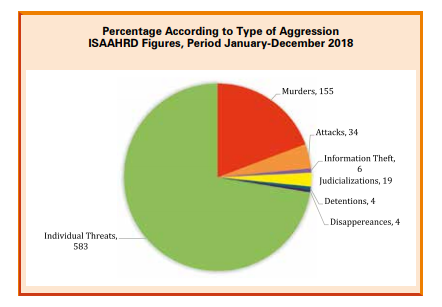
On 23 April 2019 the annual report by “Somos Defensores” in Colombia reveals increase in attacks against human rights defenders in 2018

Attacks against HRDs Colombia

Unfortunately, 2018 was the worst year for human rights defenders, as shown by the data. They recorded the highest aggression figures that have been presented since the beginning of the Information System in 2009. [see also: https://humanrightsdefenders.blog/2018/04/28/2018-latin-america-still-the-graveyard-for-environmental-human-rights-defenders/]

That is, not counting the amount of cases that for different reasons are not included, since we start from accepting the existence of underreporting, which means that the level of violence is much higher than we can imagine…Despite the evident crisis of human rights and the urgent need for intervention to protect the lives of everyone, and in particular, human rights defenders, the current Government of Iván Duque has opted to take opposing positions to its duty to offer guarantees and has left aside the difficult situation that defenders are going through; dedicating his efforts, instead, to putting other issues at the center, such as the orange economy…

See also: https://humanrightsdefenders.blog/2019/02/20/human-rights-defenders-in-latin-america-under-constant-attack/

Read the full post here

TrialWatch officially launched by Clooneys

April 25, 2019

As announced earlier this year [https://humanrightsdefenders.blog/2019/03/15/star-power-for-good-george-and-amal-clooney-at-least-try-to-tackle-controversial-issues/] on 25 April 2019 the Clooney Foundation for Justice (CFJ), together with partners Microsoft Corporation, Columbia Law School, the American Bar Association, and the Office of the United Nations High Commissioner for Human Rights (OHCHR), launched their TrialWatch® initiative at an inaugural TrialWatch Conference and launch event.

Clooney Foundation For Justice Logo

Courts around the world are increasingly being used to silence dissidents and target the vulnerable. But so far there has been no systematic response to this,” said Amal Clooney, Co-President, Clooney Foundation for Justice. “The Clooney Foundation for Justice’s TrialWatch program is a global initiative to monitor trials, expose abuses, and advocate for victims, so that injustice can be addressed, one case at a time.”

TrialWatch is an initiative focused on monitoring and responding to trials around the world that pose a high risk of human rights violations. TrialWatch aims to be the first comprehensive global program scrutinizing criminal trials around the world. CFJ will recruit and train trial monitors, including non-lawyers, who can observe and report on criminal trials around the world, and use a specialised app to record the proceedings. The Clooney Foundation for Justice will then work to expose injustice and rally support to secure justice for defendants whose rights have been violated. For each trial monitored, CFJ will work with an eminent legal expert to produce a Fairness Report assessing and grading the fairness of the trial against human rights standards, and, where necessary and possible, will be followed up with legal advocacy to assist a defendant in pursuing remedies in regional or international human rights courts. Ultimately, the data that is gathered will populate a global justice index that measures states’ performance in this area.

TrialWatch will focus on trials involving journalists, LGBTQ persons, women and girls, religious minorities, and human rights defenders. In recent months, TrialWatch monitors have observed proceedings in Africa, Asia, Europe, the Middle East, and Latin America. The cases have involved journalists being prosecuted under a wide variety of laws, including cyber laws, administrative laws, and terrorism laws, in six countries. TrialWatch has covered a trial of individuals being prosecuted under anti-LGBTQ laws in sub-Saharan Africa and proceedings involving a journalist detained under India’s National Security Act for criticizing the government on social media. TrialWatch monitors are also monitoring the trial of a lawyer in Eurasia, who is being prosecuted in connection with his work on behalf of human rights defenders and the trial of a journalist in Nigeria, who is being prosecuted for writing about internal government documents and refusing to reveal his source. Fairness reports are being produced to assess each of these trials, and many more trials will be monitored on an ongoing basis around the world.

CFJ has partnered with the Office of the United Nations High Commissioner for Human Rights (OHCHR) to develop an online training course for monitors. This course was developed by CFJ and approved by OHCHR.

——

https://finance.yahoo.com/news/clooney-foundation-justice-convenes-human-rights-leaders-mark-103100664.html?

On 26 April Numan Afifi must report to the police in Malaysia – smells like reprisal

April 24, 2019

On 16 April 2019, human rights defender Numan Afifi was asked by the Royal Malaysia Police (PDRM) to present himself on 26 April at the federal police headquarters in Bukit Aman in relation to an investigation into a speech that he had delivered at the United Nations in Geneva last month.

According to the information received from  Front Line Defenders, Numan Afifi is a human rights defender who has advocated for LGBT+ rights in Malaysia. He has actively contributed to issues ranging from democracy to HIV advocacy through his involvement in the Pelangi Campaign, the Coalition of Malaysian NGOs in the UPR Process (COMANGO) and Challenger.

On 16 April 2019, the human rights defender was contacted by an inspector from the Classified Crimes Investigation Unit, which investigates cases that fall under the Sedition Act. Numan Afifi has been asked to present himself at the federal police headquarters in Bukit Aman on 26 April 2019 to provide a statement regarding a speech presented at the United Nations Human Rights Council in Geneva during the Consideration of the Universal Periodic Review (UPR) Outcome of Malaysia on 14 March 2019. The human rights defender has not been told whether the police investigation concerns his speech alone or if other civil society organisations present at the conference are involved as well. To date, no official charges have been lodged against him.

In Geneva, Numan Afifi read out a statement on the situation of LGBT+ rights in Malaysia. The statement, which was a response to Malaysia’s UPR submission, had been prepared by a coalition of 12 Malaysian organisations working on gender identity and sexual orientation. It commended the government on its acceptance of one of the recommendations regarding sexual orientation and gender identity, and raised concerns about the rejection of the other 10. The statement also called for the government and civil society to have a dialogue on sexual orientation and gender identity.

[On 17 April 2019, a smear campaign has been launched against him by pro-government groups on social media, alleging that the statement he had presented at the UN conference contained inaccurate information. The human rights defender is being pressured to retract his claims regarding the existence of state-sponsored violence against LGBT+ people in Malaysia. In June 2017, Numan Afifi was barraged with online criticism, harassment and death threats after organising a “gay breaking fast” event during the month of Ramadan to show solidarity to the LGBT+ community.]

For some of many posts on reprisals: https://humanrightsdefenders.blog/tag/reprisals/

https://www.frontlinedefenders.org/en/case/numan-afifi-summoned-questioning-police-over-speech-delivered-un

Report “Indigenous World 2019” launched on 24 April in NY

April 24, 2019

On 24 April 2019, at the United Nations Permanent Forum on Indigenous Issues in New York, IWGIA released The Indigenous World 2019, an extensive yearbook presenting a comprehensive, global overview of the developments indigenous peoples experience. The book documents an increasing trend towards the harassment and criminalization of indigenous peoples and communities. It also highlights the rising tensions between states and indigenous peoples, shrinking civil society space, loss of land rights and lack of access to justice for indigenous peoples to enjoy their rights.

“Indigenous peoples make up 5% of the world’s population, yet they represent 15% of the world’s poorest, and in 2017, half of the approximately 400 environmental and human rights defenders killed. The numbers for 2018 are as-yet-unknown, but this troubling trend hasn’t seemed to stop,” Julie Koch, IWGIA Executive Director, says. “We need to do more to protect, learn from and support indigenous peoples and their traditional, sustainable practices as key actors in ensuring a safer and more equitable world.”

In 2018, there has been an increase in the documentation and reporting of illegal surveillance, arbitrary arrests, travel bans preventing free movement, threats, dispossession and killings of indigenous peoples. We have witnessed instruments meant to protect indigenous peoples being turned against them, through the use of legislation and the justice system, to penalize and criminalize indigenous peoples’ assertion of their rights. [see e.g. https://humanrightsdefenders.blog/2017/08/08/9-august-international-day-of-the-worlds-indigenous-peoples-un-experts-see-increasing-murder/]

The intensification and exploitation of natural resources is leading to a global crisis for indigenous peoples’ rights,” Koch says. Many indigenous peoples live in the Earth’s last remaining biodiversity hotspots and are often called the “guardians of the forest”. Several studies have shown that tree cover loss is significantly reduced on indigenous land compared to non-indigenous controlled land.

See also: https://humanrightsdefenders.blog/2017/07/15/documenting-the-killings-of-environmental-defenders-guardian-and-global-witness/

Tensions are rising between states and indigenous peoples

Anne Gallagher new director-general of Commonwealth Foundation

April 24, 2019
Anne Gallagher
Anne Gallagher

The Commonwealth Foundation, which supports civil society organisations throughout the Commonwealth, has appointed Anne Gallagher as its next director general. Gallagher, president of the International Catholic Migration Commission, will relocate from Australia to take up the London-based role for an initial four-year term from June. She will succeed Vijay Krishnarayan, who is stepping down after completing the maximum of two terms.

Before joining the ICMG, Gallagher, a lawyer by training, worked at the United Nations in roles including special adviser to the UN High Commissioner for Human Rights. She has also held positions including co-chair of the International Bar Association’s Presidential Task Force Against Human Trafficking and been a member of the Asia Dialogue on Forced Migration.

Gallagher said in a statement “As the civil society voice of the Commonwealth, the foundation has played a vital role in advancing core Commonwealth values of democracy, freedom, human rights and the rule of law…That role will continue to be critical as we move into a future where truly inclusive multilateral cooperation is becoming ever more urgent.

https://www.thirdsector.co.uk/anne-gallagher-appointed-director-general-commonwealth-foundation/management/article/1582715

Novelty: on-line training in human rights for Jamaican judiciary

April 23, 2019
Judges participating in break out groups at the Workshop on International Human Rights Online Training Course for the Jamaican Judiciary for the Presentation of the Online Training Platform last Thursday (11 April)

Caribbean News reports on 22 April 2019 that judges in Jamaica now have an interactive online platform offering resources and self-paced learning opportunities on international human rights law. The online platform is sponsored by United Nations Jamaica and the office of the United Nations High Commissioner for Human Rights in collaboration with the Judicial Education Institute and the Court Management Services. The platform was launched 11 April in Kingston by Chief Justice Bryan Sykes and senior human rights adviser George Abualzulof representing the United Nations resident coördinator to Jamaica.

The Chief Justice noted that “the online training platform on international human rights provides the opportunity to be aware of current and new ways of thinking about human rights and how it applies in different circumstances. It also gives us the opportunity to be aware of what is happening in other parts of the world on this very important issue.

The UN’s senior human rights adviser described the online platform as “marking a milestone in the development of professional training capacity in the administration of justice,”..

The online training platform offers modular training with an emphasis on international human rights; human rights of persons deprived of liberty; rights to a fair trial; and international human rights law. Judges learn at their own pace in a collegial environment where peers can learn while holding discussions on human rights law and standards.