Author Archive

FIDH makes fresh start with Congress in Taiwan and new Board and President

October 28, 2019

Botswana human rights defender Alice Mogwe, newly elected president of the FIDH, says: “The universality of human rights is under attack – we must fight back!

The member organisations of the International Federation for Human Rights (FIDH) elected their new president during its 40th Congress in Taiwan. Alice Mogwe, will lead the Federation for the next three years, ushering in its 100th anniversary in 2022. In December 2018 Alice Mogwe was the first civil society leader to address the United Nations General Assembly on behalf of over 250 human rights defenders from around the world. [https://humanrightsdefenders.blog/2018/12/17/tuesday-18-december-first-time-a-human-rights-defender-addresses-un-general-assembly/] As founder and director of DITSHWANELO – the Botswana Centre for Human Rights – she has spearheaded efforts to advance human rights in Botswana and its Southern African neighbours.
Our fellow human rights defenders the world over are criminalised, disappeared, threatened, and even killed. The space given to us to express ourselves is shrinking. It is thus more important than ever to emphasize that our values are universal and that we must fight back!” declared Alice Mogwe. Ms. Mogwe’s academic background in law, public policy, African studies, and mediation has served her well in advocating for the rights of indigenous peoples, women, LGBTI+ communities, children, migrants and refugees. She also fought for the abolition of the death penalty in Botswana and Africa, and for demanding accountability from the extractive industry in her native country. “We must amplify local voices at regional and international levels. Member organisations are the lifeblood of FIDH; our strength lies in our diversity.

During her three-year mandate, Ms. Mogwe’s priorities will include:
• Strengthening the work of FIDH to raise attention and protect human rights defenders, who face an unprecedented wave of attacks all over the world. Responding to the closure of civic space through programmes providing rapid and practical support for human rights defenders;
• Protecting human rights defenders from digital surveillance and tracking, fostering safe and effective use of technology by human rights defenders, indigenous communities, ethnic, religious, linguistic minorities, and others;
• Strengthening horizontal cooperation between the Federation’s members, both intra- and inter-regionally, to fully utilise their collective power and capabilities. During the Congress, 16 new organisations were approved to join FIDH, increasing its membership to 192. The newly elected International Board is composed of 22 activists from 21 countries.

Composition of the new FIDH International Board:
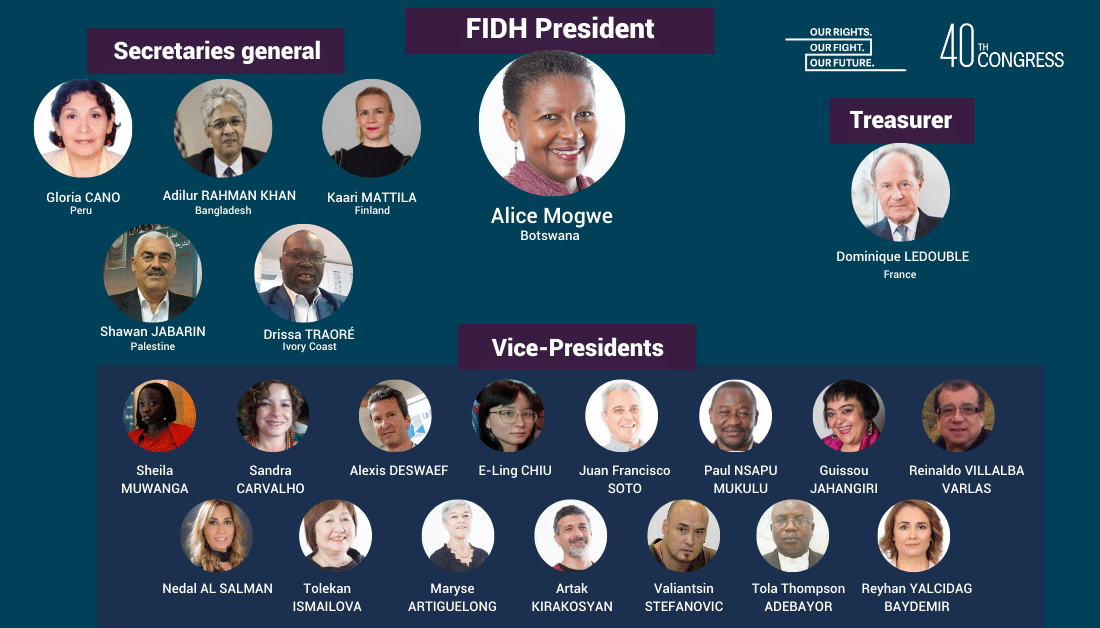
President
Alice MOGWE

Treasurer
Dominique LEDOUBLE

Secretaries General:
Kaari MATTILA
Gloria CANO
Shawan JABARIN
Adilur RAHMAN KHAN
Drissa TRAORE

Vice Presidents
Sheila MUWANGA
Sandra CARVALHO
Alexis DESWAEF
Reinaldo VILLALBA VARGAS
E-Ling CHIU
Juan Francisco SOTO
Tola Thompson ADEBAYOR
Paul NSAPU MUKULU
Guissou JAHANGIRI
Reyhan YALCINDAG BAYDEMIR
Nedal AL SALMAN
Tolekan ISMAILOVA
Maryse ARTIGUELONG
Artak KIRAKOSYAN
Valiantsin STEFANOVIC
https://www.fidh.org/en/region/asia/taiwan/botswana-activist-alice-mogwe-elected-new-fidh-president-the

Universal human rights apply to Ilham Tohti? China and EU: disagree

October 26, 2019
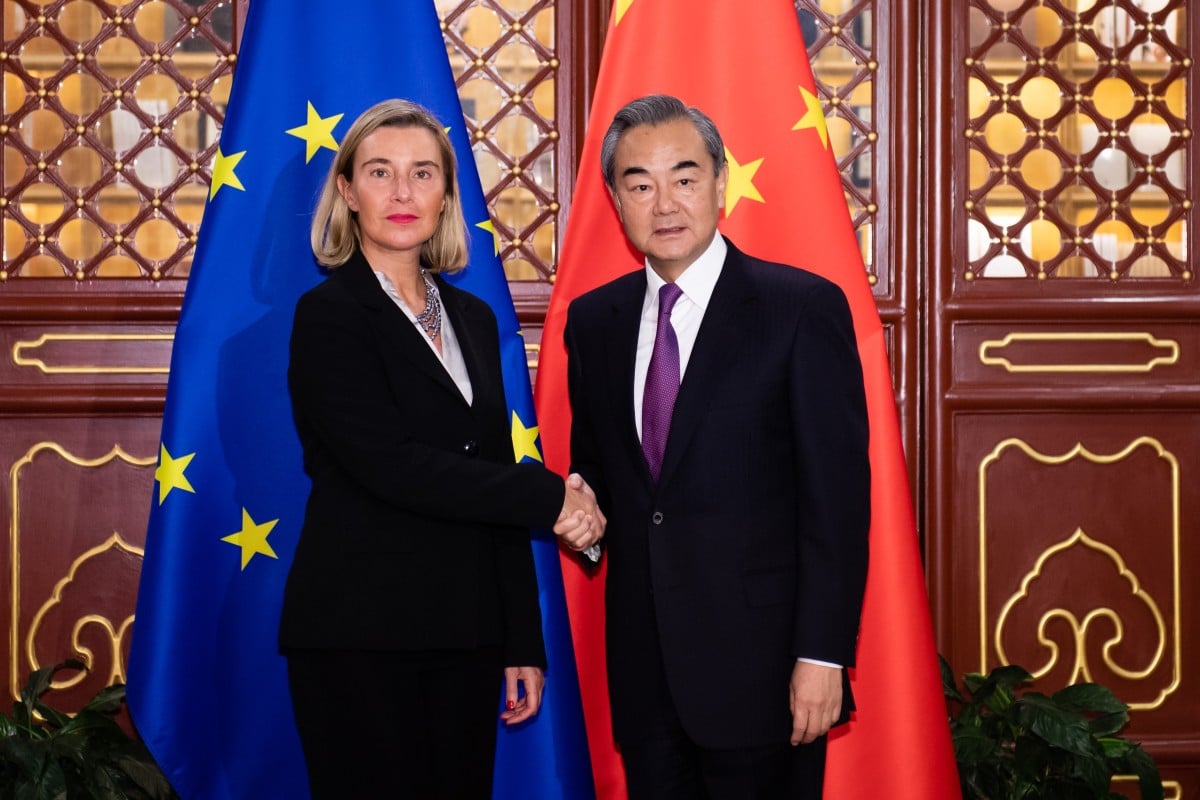
Chinese Foreign Minister Wang Yi met his EU counterpart Federica Mogherini in Beijing on Tuesday. Photo: Xinhua

Keegan Elmer  in the South China Morning Post of 25/26 October 2019 reports that Chinese officials have told their European counterparts that human rights should be measured by the people’s well-being and rejected the EU’s support for the “universal” values enshrined in the United Nations Charter. The statements issued by both sides after a meeting between the EU’s foreign affairs chief and Chinese foreign minister Wang Yi underlined their disagreements on human rights by recording their discussions on the topic in markedly different ways. While the Europeans focused on Mogherini’s support for “universality”, the Chinese statement emphasised her call for mutual respect and comments that there were “different approaches” to the issue.

According China, Mogherini had acknowledged that there are “different approaches to safeguarding and promoting human rights” and accepted that there were “problems with the human rights situation in European countries”. It continued that she had agreed to continue cooperation and exchanges with China “on the basis of mutual respect”, adding: “The EU does not intend to act as the ‘teacher’ of other countries on human rights issues.”

But the EU’s account of the meeting did not refer to Wang’s comments and said Mogherini had “underlined to the Chinese leadership that the EU will continue to stand up for the universality, interdependence and indivisibility of human rights based on the UN Charter and standards”.

China extraordinary sensitivity to ‘interference’ of any level into what it considers its domestic affairs is well-known. I touched upon this hot’ topic’ in my own 2011 article “The international human rights movement: not perfect, but a lot better than many governments think” in the book ‘NGOs in China and Europe’ (exceptionally also published in Chinese!): Yuwen Li (ed), Ashgate, 2011, pp 287-304 (ISBN: 978-1-4094-1959-4).

On the same day that the pair met in Beijing, the European Parliament awarded its 2019 Sakharov Human Rights Prize to human rights defender Ilham Tohti, who is serving a life sentence. The statement announcing the award called for his immediate release and said “for over two decades, he has worked tirelessly to foster dialogue and understanding between Uygurs and other Chinese people”. [see: https://humanrightsdefenders.blog/2019/10/24/lham-tohti-now-also-awarded-the-2019-sakharov-prize/]. Predictably, during a press conference on Friday, Chinese foreign ministry spokesman Hua Chunying said the parliament had “given a prize to a criminal”. “I don’t know how much meaning, value or influence [the prize] has,” said Hua. “I only know Tohti is a criminal that has been sentenced by a Chinese court.

Neither the Chinese nor the EU have said whether Tohti’s case or the situation in Xinjiang – where Beijing is accused of detaining a million mainly Uygur Muslims in re-education camps – had been discussed.

Celebrity endorsements and the Dubai Expo: on the one hand and the other

October 26, 2019
Why will.i.am and Mariah Carey should say 'no' to Dubai Expo 

Serial sinner, Mariah Carey [see e.g.: https://humanrightsdefenders.blog/2019/07/10/nicki-minaj-did-the-right-thing-and-cancelled-her-performance-in-saudi-arabia/] performed this week at the one-year countdown to Dubai Expo 2020.  Lyndon Peters argues that celebrities, businesses and governments still have time to take a stand against UAE’s human rights record, and pull their support from Dubai Expo 2020.

Sheikh Khalifa bin Zayed Al Nahyan proclaimed 2019 as the ‘Year of Tolerance’, but for many it has been the Year of Intolerance. So far this year, the situation for human rights defenders and political prisoners in the UAE has deteriorated. Over 135 human rights organisations issued a joint call last week for the release of human rights defender Ahmed Mansoor in solitary confinement at Al-Sadr prison, Abu Dhabi [https://humanrightsdefenders.blog/2019/10/01/ahmed-mansoor-goes-on-second-hunger-strike-after-severe-prison-beating/ ].

Nevertheless it seems “The World’s Greatest Show” will go on and with the help of Mariah Carey, will.i.am and Lionel Messi; Dubai Expo 2020 is not short of celebrity endorsements!

That the issue of celebrity endorsements is not an easy is clear [see also: https://humanrightsdefenders.blog/2019/07/11/star-power-and-human-rights-food-for-thought-by-kate-allen/] is clear considering that:
The rapper will.i.am provides the voiceover on an Expo 2020 promotional video in which he reels off a series of great accomplishments in the history of human civilisation. On the other hand, in 2007 ‘will.i.am’, as part of the Black Eyed Peas, recorded a song for a charity album called Instant Karma: The Amnesty International Campaign to Save Darfur. Darfuris suffered massacres at the hands of Janjaweed militias. Rebranded as the RSF, former Janjaweed militias, are now a key ally of the UAE within Sudan itself, and have fought as mercenaries for the UAE and Saudi Arabia in Yemen and Libya.

– Meanwhile Lionel Messi is “Proud to be an Expo 2020 Dubai ambassador” and he features in a promotional video for the event. Still, in 2016 he donated $72,000 to the NGO Medicins Sans Frontieres (MSF). MSF have provided medical services in various parts of Yemen during the ongoing conflict, and their hospitals have been hit by the airstrikes of the Saudi coalition of which the UAE is a member.That Lionel Messi and will.i.am would promote an event on behalf of the UAE government is unfathomable, especially considering their previous support for Medecins Sans Frontieres and Amnesty International respectively, states Peters.

….

With one year until Dubai Expo 2020, there is still time for trade delegations to reconsider their attendance and for businesses to consider their human rights policies. There is also time for the UAE to stop violating the rights of their own citizens, enforce protections for migrant workers and cease the harmful interventions in Yemen, Libya and Sudan.

https://www.alaraby.co.uk/english/comment/2019/10/24/will-i-am-mariah-carey-should-say-no-to-dubai-expo

1 million $ Berggruen Prize for Justice Ginsberg for her human rights stance

October 25, 2019

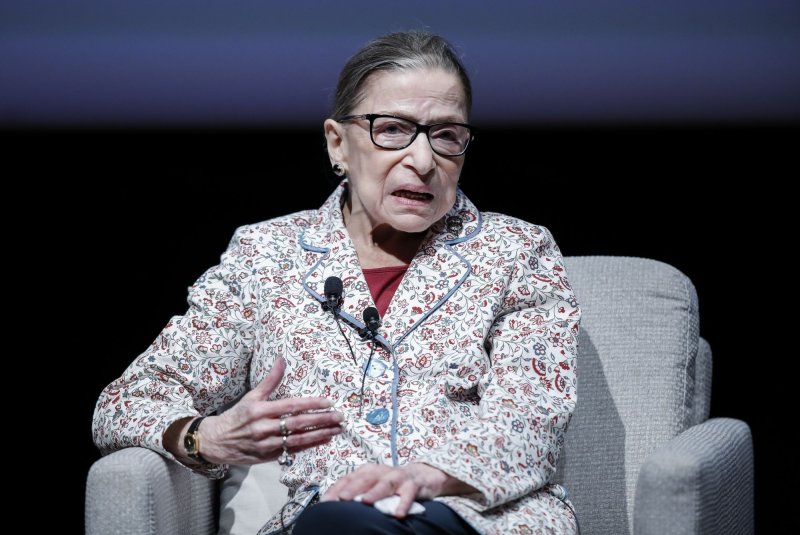
Ruth Bader Ginsburg; Photo by Kamil Krzaczynski/UPI | License Photo
On 23 October 2019 UPI reported that Supreme Court Associate Justice Ruth Bader Ginsburg received a $1 million prize for her support of human rights and gender equality. The Berggruen Institute, a non-partisan think tank, presented the fourth annual award to Ginsburg, 86. The institute was founded in 2010 by billionaire philanthropist Nicolas Berggruen.
I am delighted the Jury has chosen to honor such a prolific leader in the field of jurisprudence,Berggruen said. “Throughout her career, Ginsburg has used the law to advance ethical and philosophical principles of equality and human rights as basic tenets of the USA..Her contributions have shaped our way of life and way of thinking and have demonstrated to the world the importance of the rule of law in disabling discrimination.”

The Berggruen Prize for Philosophy & Culture is given each year to someone who has contributed to self-understanding and advancement in the world. Ginsburg chose to donate her winnings to a charity or non-profit organization she has not revealed.

https://www.upi.com/Top_News/US/2019/10/23/Justice-Ginsburg-awarded-1M-prize-for-support-of-human-rights/7351571852581/

lham Tohti now also awarded the EU’s 2019 Sakharov Prize 

October 24, 2019

Ilham Tohti, renowned Uyghur economist fighting for rights of China’s Uyghur minority, awarded 2019 Sakharov Prize      

Ilham Tohti, renowned Uyghur economist fighting for rights of China’s Uyghur minority, awarded 2019 Sakharov Prize © AP Images/Andy WONG  

It was just accounced that Uyghur human rights defender Ilham Tohti has been awarded this year’s European Parliament Sakharov Prize for Freedom of Thought. European Parliament President David Sassoli announced the laureate in the Strasbourg chamber at noon on Thursday, following an earlier decision by the Conference of Presidents: “I am very pleased to announce that the European Parliament has chosen Ilham Tohti as the winner of the 2019 Sakharov Prize for Freedom of Thought. Tohti has dedicated his life to advocating for the rights of the Uyghur minority in China. Despite being a voice of moderation and reconciliation, he was sentenced to life in prison following a show trial in 2014. By awarding this prize, we strongly urge the Chinese government to release Tohti and we call for the respect of minority rights in China”. The Sakharov award ceremony will be held in the European Parliament’s hemicycle in Strasbourg on 18 December. For more on the Sakharov Prize for Freedom of Thought and similar awards, see: http://www.trueheroesfilms.org/thedigest/awards/sakharov-prize-for-freedom-of-thought.

This is the 6th major human rights award that Ilham Tohti has picked up:

2014   Freedom to Write Award (PEN)

2016   Martin Ennals Award for Human Rights Defenders

2017   Prize for Freedom (Liberal Int’l)

2017   Weimar Human Rights Award

2019   Vaclav Havel Prize for Human Rights (PACE)

2019   Sakharov Prize for Freedom of Thought

It will be interesting to see how the Chinese government is going to react as it tends to be very sensitive on awards for its human rights defenders, think of the Nobel Peace Prize for Liu Xiaobo on 2010 or the reaction of the Chiane government against the former UN High Commissioner for Human Rights giving the MEA in 2016 [https://www.reuters.com/article/us-china-rights-un-idUSKCN12C0X2]. Another example is: https://humanrightsdefenders.blog/2017/11/11/cyber-attacks-on-city-of-weimar-for-awarding-ilham-tohti/

Indonesian human rights defender Veronica Koman receives Sir Ronald Wilson Human Rights Award

October 24, 2019

The Australian Council for International Development (ACFID) has awarded the Sir Ronald Wilson Human Rights Award to Indonesian lawyer and human rights defender Veronica Koman for her courageous work in exposing human rights violations in the Indonesian Provinces of Papua and West Papua. [https://humanrightsdefenders.blog/2019/09/17/un-experts-urge-indonesia-to-protect-human-rights-defender-veronica-koman/]

Amid the recent internet blackout and mass demonstrations in West Papua Ms Koman disseminated information about the escalating situation on social media and functioned as a key source of information to the outside world. It honours the courage she has shown to continue to stand up for the human rights of West Papuans, and their right to self-determination, despite intensifying harassment and intimidation. Ms Koman has received death threats and accusations of being a traitor and has had charges brought against her for spreading false information and provoking unrest, with penalties of up to 6 years in prison. There are reports that Indonesian authorities have requested Interpol to put Ms Koman on a ‘red notice’ to locate her and enable her extradition. ACFID presented the award to Ms Koman at its annual conference on Wednesday 23 October 2019, in Sydney.Ms Koman said: “I dedicate this award to the victims of the crackdown which began in late August in West Papua, especially the dozens who have died at the hands of security forces, and the 22 political prisoners charged with treason. I hope this year’s award will raise awareness in Australia about human rights abuses suffered by West Papuans and the decades-long denial of their fundamental right to self-determination.

ACFID CEO, Marc Purcell, said: “We call on the Government of Australia to provide Ms Koman the protection to which she is entitled as a human rights defender. In line with recommendations from the UN Office of the High Commission of Human Rights, the Australian Government should also encourage Indonesia to drop all charges against Ms Koman and to protect the freedom of expression of all people reporting on the protests in West Papua.

For the Sir Ronald Wilson Human Rights Award see: http://www.trueheroesfilms.org/thedigest/awards/sir-ronald-wilson-human-rights-award

https://acfid.asn.au/media-releases/veronica-koman-receives-sir-ronald-wilson-human-rights-award?utm_source=miragenews&utm_medium=miragenews&utm_campaign=news

Winners of the 2020 Andrei Sakharov Prize (of the APS) announced:

October 23, 2019

The American Physical Society (APS) on 22 october 2019 announced the Society’s Spring 2020 prize and award recipients. This includes the 2020 Andrei Sakharov Prize [see: http://www.trueheroesfilms.org/thedigest/awards/andrei-sakharov-prize-aps] which goes to:

Ayşe Erzan, Istanbul Technical University
For her lifelong commitment to human rights, especially for her steadfast defense of the rights of citizens to criticize those in power, even at great personal cost.

Xiaoxing Xi, Temple University
For his articulate and steadfast advocacy in support of the US scientific community and open scientific exchange, and especially his efforts to clarify the nature of international scientific collaboration in cases involving allegations of scientific espionage.

https://www.aps.org/publications/apsnews/updates/spring-prizes20.cfm

Follow up on HRD summit during RightsCon Tunis 2019

October 23, 2019

On 12 June 2019, ProtectDefenders.eu participated at the RightsCon Tunis 2019 panel on the Human Rights Defenders World Summit 2018. A delegation of human rights defenders presented their experience of taking action to defend human rights and the consequences they had to face because of these actions. They have also mentioned the significance of the Summit 2018 had for them and what states, businesses and donors must do to ensure their fundamental role is protected and recognised in the digital sphere and beyond.  In relation to this, they have called on the Tech community to join them in the struggle for human rights. See also: https://humanrightsdefenders.blog/2018/12/18/premiere-powerful-video-summarizes-human-rights-defenders-world-summit-2018/

At the end of the HRD World Summit 2018 in Paris, all defenders agreed on a landmark Action Plan, which was presented to the UN General Assembly in December 2018. As participants to the Paris Summit continue to spread this message around the world, this panel was an opportunity to remind the world of the essential work they do and the need to create a safe and enabling environment for all those who actively defend human rights.

The Action Plan calls on Governments, corporations, international financial institutions, donors and others to take practical steps to ensure human rights defenders are recognised and protected, including by adopting national governmental action plans and legislation, and protecting defenders as a key priority in foreign policy, particularly women human rights defenders, LGBT+, indigenous rights defenders and other marginalized defenders who face the most risk and exclusion.

https://www.protectdefenders.eu/en/newsletter/october-2019_44#the-human-rights-defenders-world-summit-at-rightscon-tunis-2019-298

Congo’s Hip-Hop artist Moses Kabaseke Defender of the Month for DefendDefenders

October 23, 2019
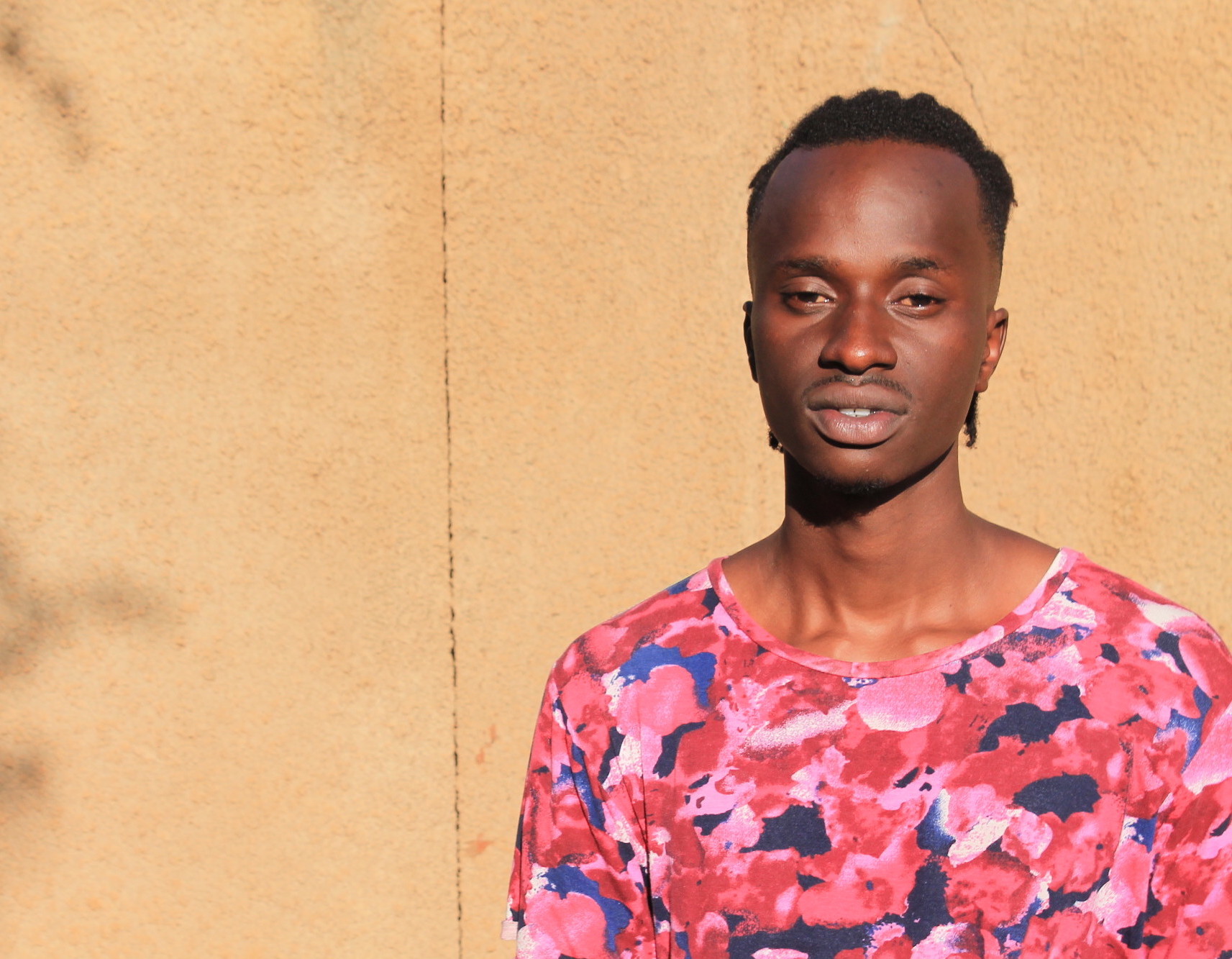
Human Rights Defender of the Month (September 2019): Moses Kabaseke 

Moses Kabaseke, a talented hip-hop artist and activist from the Democratic Republic of the Congo (DRC), was forced to flee to Uganda in 2013 only 16 years old. Kabaseke, known by his stage name Belidor, has produced music since he was a child. “I use music as a weapon – music has power. I use music to promote human rights.

Moses Kabaseke refers to DRC as the rich country with the poor people. “Back home a life means nothing. In Congo, life is something that can be taken from human beings easily – there’s no justice,” he states. “It’s difficult for people that have not experienced atrocities to understand how that feels like. With my music, I try to capture the trauma and injustices experienced by so many.” When he was only seven years old, his father was killed. “Every night when my mother was crying, I felt so bad. Since that age, I decided to fight for what was right.” In 2012, history repeated itself when his stepfather was killed before his eyes. At that point his mother had to make the difficult decision to leave home. In a quest to find safety, she brought her four children to Uganda.

“We don’t want to be here, but we are forced to be here,” he stresses, pointing out that life in exile is difficult. Being away from home, without external support and regular income, they face many challenges. “We need to look for ways to pay our bills. However, my siblings and I all have the blood of our father, so the thing we know how to do is music; so, we perform.”

In Uganda, Kabaseke continued his human rights promotion by composing music. After five years of hard work, often performing in Kampala’s bars, restaurants, and churches to finance his music, he recently finished his first autobiographical album. The album, ‘Les Mille Cris’ (Thousands of Cries), which contains ten songs written and produced by himself, conveys messages about human rights violations and injustices in DRC, and life as a refugee, among others. “Les Mille Cris is about breaking down the truth, sensitising Africans and victims of violations, and giving a voice to the voiceless.”

Through his music, he encourages people to tell their story, and moreover, urges the world to listen. Speaking the truth can come at a high cost. “As the number of my followers increase, my personal insecurity increase. Personal safety is essential as an artist talking about human rights,” he says. When asked what inspires him to continue despite the many challenges he is faced with, he states that “I promote human rights because I have been a victim of the system […] we are the main actors in the process of change. We have to stand for our rights.” Moses Kabaseke has partaken in several trainings organised by DefendDefenders, and performed at DefendDefenders’ events.

Check out Moses Kabaseke’s music:

https://defenddefenders.org/defender/human-rights-defender-of-the-month-september-2019-moses-kabaseke/

Carnegie paper: international community must redouble efforts to defend human rights defenders

October 22, 2019
The Carnegie Endowment for International Peace pubished on 22 October 2019 a working paper by Saskia Brechenmacher and Thomas Carothers entitled “Democracy,Defending Civic Space: Is the International Community Stuck?”. It concludes that as space for civil society continues to close, the international community must redouble its efforts to defend the right of human rights defenders to hold governments around the world accountable. The Executive Summary:

Civic Space Continues to Close

Since the mid-2000s, civic space has come under attack in many countries around the world. To counter this trend, transnational actors that support civil society have responded in many ways—from exerting diplomatic pressure and building international norms to providing emergency funds for activists. Despite these efforts, governments continue to impose legal and extralegal restrictions amid a worsening larger political environment for civil society. Closing civic space now appears to be just one part of a much broader pattern of democratic recession and authoritarian resurgence. The international response seems stuck: some useful efforts have been undertaken, but they appear too limited, loosely focused, and reactive.

Areas of Progress in the International Response

  • Research and knowledge dissemination: Timely information about civil society restrictions and overall trends is now widely available. Funders, policymakers, and relevant multilateral organizations are generally more aware of the problem; some actors have carried out internal strategic reviews and trainings to strengthen their programmatic and policy responses.
  • Support for local resistance and adaptation: Major funders have established or expanded emergency funds for persecuted rights activists and organizations. Some have also initiated programs to help civic actors adapt to regulatory, political, and legal pressures, while some have examined ways to offer more flexible funding. Several new transnational coalitions and initiatives have been set up to share lessons and lead joint campaigns.
  • Diplomatic pressure and international policy changes: Western governments have sometimes applied pressure on countries that are closing civic space, and they have supported advocacy in international bodies such as the United Nations. Civil society advocates have successfully pushed for reforms to harmful counterterrorism regulations, and some have begun engaging private sector actors on the importance of protecting civic space.

Factors Limiting the International Response

  • Lack of conceptual and strategic clarity: Ongoing confusion over the root causes of closing civic space impedes efforts to develop a more unified strategy. Diverse actors disagree on whether tackling the challenge will require addressing the global political backlash against progressive causes or the overall global democratic recession, or whether a more focused approach would be more effective.
  • Countervailing interests: Most Western governments still do not strongly prioritize closing civic space in their foreign policy agendas. They often refrain from escalating diplomatic pressure on repressive governments for fear of damaging their geopolitical, security, or economic interests. The loss of U.S. leadership on the issue has been particularly damaging.
  • Closing space at home: Civic space is now under threat in many established democracies, and the international repercussions are profound. Western governments that lash out against domestic critics are less likely to speak out against civil society restrictions abroad, and they have less credibility when they do so. Their actions also set a negative example for leaders in other parts of the world.
  • Inadequate scale: The resources committed to fighting the problem have been insufficient. Funders have also generally failed to embed their responses into a broader strategic framework. Explanations include a weak appetite for political risk among funders, the cross-cutting nature of the problem, and a lack of clarity on what a large-scale response might look like.
  • Working in silos: Weak coordination and information sharing between different parts of the assistance community persist. Obstacles include the diverging policy and organizational interests within and between governments, as well as divisions in the wider funder community, including between human rights organizations and development and humanitarian actors.
  • Struggles to change aid practices: Implementing far-reaching changes in aid practices has proven difficult, due to bureaucratic inertia, risk aversion, and narrower methods of monitoring and evaluation.
  • Chasing a moving target: The problem of closing space continues to evolve quickly, which makes it difficult for the international community to anticipate new openings and threats. For example, international actors have been slow to react to the spread of new technological tools for restricting civic space online and offline.

Policy Recommendations

  • Develop a strategic framework that links closing civic space to other key foreign policy challenges, articulates a positive vision of civic space globally, and offers tailored tactical guidance. Such a strategy should differentiate short-, medium-, and long-term priorities and distinguish between different types of political contexts.
  • Improve foreign policy alignment by issuing specific guidance on defending civic space to embassies, systematically integrating the issue into diplomatic training and senior leadership briefings, designating a senior official to spearhead interagency coordination on civic space–related issues, and amplifying the voices of civil society actors, particularly in restrictive contexts.
  • Avoid setting negative precedents by ensuring that domestic legislation does not threaten civic space. Nongovernmental actors should build cross-border alliances to share knowledge and resources, engage lawmakers in established democracies who stigmatize civil society, and champion transparency and accountability in internal practices and external partnerships.
  • Bolster coordination among concerned transnational actors by evaluating existing mechanisms, investing in new platforms or tools for information sharing and institutional learning, expanding country-level networks, and forging new partnerships between governmental and private funders.
  • Adjust funding practices to ensure a balance between support for long-term institution- building and catalytic funding, and track how much funding goes directly to local organizations as core versus project support. Funders should continue to expand flexible funding strategies for hostile environments, work with intermediaries that can reach a wider range of partners, and reduce grantees’ administrative burdens.
  • Anticipate new opportunities and threats by, for example, monitoring and recognizing examples of positive reform, developing targeted roadmaps that identify opportunities and flashpoints in collaboration with embassies or local partners, and investing in technological know-how.

For the full text of this working paper, see: https://carnegieendowment.org/files/WP_Brechenmacker_Carothers_Civil_Space_FINAL.pdf

See also: https://humanrightsdefenders.blog/2019/05/05/civil-society-and-human-rights-ngos-are-fighting-back-but-against-odds/ and https://humanrightsdefenders.blog/2019/02/21/amnesty-launches-report-on-laws-designed-to-silence-human-rights-defenders/

https://carnegieendowment.org/2019/10/22/defending-civic-space-is-international-community-stuck-pub-80110