Author Archive

Daughter’s murder motivated Norma Ledezma to hunt for Mexico’s disappeared

December 5, 2019

The former factory worker, who left school at 11 but has completed a law degree since becoming a campaigner and founded her organization Justice for our Daughters in 2002. She succeeded in getting the government to name a justice center for women was named after Paloma, who was 16 when she went missing. She has also helped locate some victims alive, including several who were being trafficked. Most, however, are never found.

…Collectives of mothers who have lost children have scoured the Mexican countryside armed with shovels following tips of where mass graves might hold their loved ones. About one in four of those listed as missing are women, though the government said earlier this year it was reviewing the data. Ledezma said the government had no strategy to fix the issue. The government did not immediately respond to a request for comment. Earlier this year it said it would allow the United Nations to review reports on cases of disappearances.When her body was found, authorities did not run DNA tests on her, instead relying on clothing samples and the color of her nail polish. Ledezma could not bring herself to go into the room where her body lay. It was on the day of Paloma’s funeral that Ledezma decided to help those who seek justice for similar cases and she has pressed on despite threats from organized criminals. “I haven’t left the country because I have a debt to my daughter… I’ll be here until the last day”, she said.

What kind of lawyers will attend the ‘Global Lawyers Forum’ in Guangzhou on Human Rights Day?

December 5, 2019
Lawyer Wang Yu is taken to a studio for TV denunciation of the ABA award. Pictorial rendition is based on Wang Yu’s account. Source: Safeguard Defenders.

The government has invited, according to its official website,more than 600 important international guests from governments, judicial departments, financial circles, international lawyers’ associations, other bar associations and well-known law firms, etc.”………to uphold the rule of law spirit of building a community of shared future for humanity, create an international platform for lawyers from all countries for exchange and cooperation, further consolidate the consensus of the international legal profession, etc…

We know that since July 2015, Chinese human rights lawyers have been suppressed on a large scale [ see https://humanrightsdefenders.blog/2015/07/29/the-remarkable-crackdown-on-lawyers-in-china-in-july-2015/ and https://humanrightsdefenders.blog/2019/06/26/lawyers-key-to-the-rule-of-law-even-china-agrees-but-only-lip-service/]. To this day, many lawyers, including Wang Quanzhang [see https://humanrightsdefenders.blog/2018/12/05/li-wenzu-wife-of-wang-quanzhang-wins-2018-edelstam-award/], Zhou Shifeng, Yu Wensheng, Chen Wuquan, Chen Jiahong, Qin Yongpei, and others are in prison. Lawyer Gao Zhisheng disappeared on August 13, 2017, and his whereabouts still are unknown. Lawyer Jiang Tianyong, who was released from prison earlier this year, has since been under illegal house arrest [see also: https://humanrightsdefenders.blog/2017/11/21/jiang-tianyong-chinese-defender-of-defenders-sentenced-to-2-years-jail/].

China Change asked a number of Chinese human rights lawyers to express their views on this “Global Lawyers Forum”. Here a selection:

“…..If the purpose of the conference, as the government claims, is to “consolidate the international consensus of the lawyers’ profession,” what then is the consensus of the legal profession? It is the UN’s “Basic Principles on the Role of Lawyers.” Domestic law should be amended on the basis of these principles.  (Liu Shuqing, Jinan, deprived of his lawyer’s license in 2016)

This rhetoric can be deceptive domestically and internationally, giving those who don’t know the true nature of the CCP and the reality on the ground the wrong impression that China has rule of law, so much so that it is a world leader in the area.” (Jiang Tianyong, Beijing, 709 detainee, and still under house arrest since his release at the end of February 2019.)

Lawyer Jiang Tianyong

“I think it is a ridiculous thing for China to host such an event. As everyone knows, the Chinese government has always opposed constitutional democracy and the rule of law. It disregards human rights and blatantly infringes upon every right of the people. Such a conference is only a cover-up for the CCP.”   (A lawyer who wishes to remain anonymous)

“The All China Lawyers’ Association (ACLA) is the same as the Chinese government; it is a part of the government. ACLA contributes little to defending human rights in China, and more often than not it is an accomplice in suppressing human rights. Such a country holding such a conference and urging lawyers from all over the world ‘to jointly promote the rule of law around the world’ –– how could anyone believe this? How could anyone attend and support such a meeting? Are the participants burying their heads in the sand or just being ignorant?” (Liang Xiaojun, Beijing)

“Nearly without exception, any Chinese lawyer who has participated in any international exchange meeting, including meetings with Hong Kong and Taiwanese lawyers, has been interrogated and threatened by China’s national security agents or domestic security police after they returned home to the mainland. In such a ‘police state,’ how can there be normal international exchanges?” (Chen Jiangang, Hubert H. Humphrey Fellow 2019, who fled China in the summer after being threatened with “disappearance” by a director of Beijing’s Judicial Bureau)

“The choice to hold the ‘Global Lawyers Forum’ in Guangzhou is ironic in light of the purpose of the gathering. The retrogression of the legal system in China over the past decade, and the persecution of lawyers who dare to speak out, has reached a shocking point. And the crackdown and persecution of lawyers in Guangzhou is the most severe in the country. Therefore, the selection of Guangzhou for the ‘Global Lawyers Forum’ is an affront to the spirit of rule of law.” (Liu Zhengqing, Guangzhou, license revoked in 2019)

“I really am not inclined to criticize any lawyers or officials who will attend the conference. I just want them to be clear-headed when they are in China. What they will see is definitely not all of China, or even the most important part. If they aren’t hoodwinked and if they observe the Chinese legal profession with clear eyes, a greater number of ordinary Chinese lawyers may have heartfelt admiration for them.” (Wen Donghai, Changsha)

“I hope attendees from foreign bar associations won’t just listen to the officials’ big empty words and propaganda but pay more attention to the actual human rights situation in China. I hope they learn more about religious groups, ethnic minorities, dissidents and human rights activists. These groups have suffered cruel persecution in China; I hope the foreign attendees will speak on their behalf at the conference and raise questions.” (An anonymous Beijing lawyer)

“I hope the participants can hear the voices of lawyers not sanctioned by the CCP government, and especially look into the real reasons for the revocation of so many lawyers’ licenses.” (Liu Zhengqing, Guangzhou)

…….


China Has Invited 600 International Lawyers and Judicial Officials to its ‘Global Lawyers Forum,’ But These Chinese Lawyers Won’t Be Welcome

CAFOD starts “messages to the brave” campaign

December 3, 2019

Send a message to the brave this Christmas, says CAFOD

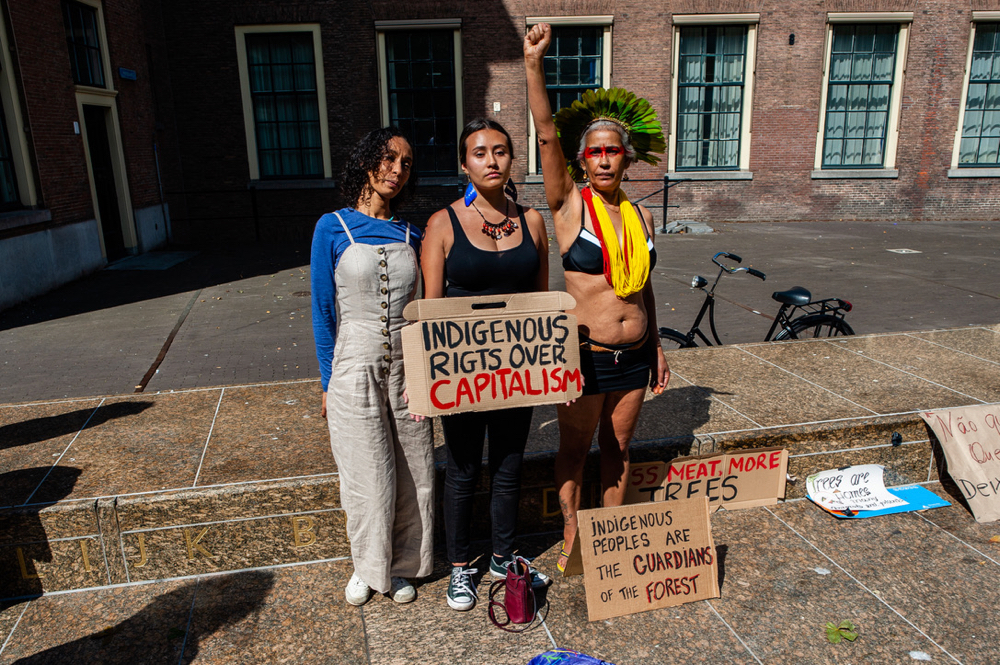
Three Brazilian women protest in the Netherlands against Brazil’s rainforest destruction Photo: Ana Fernandez / SOPA Images/Sipa USA

Samantha Aidoo – Campaigns Engagement Manager at CAFOD – explains the Messages to the Brave campaign:

Indigenous governor Cristina Bautista from Northern Cauca, Colombia, was passionate about defending the rights of the Nasa people and protecting their land and territory. But her courage and determination came at great personal cost. On 29 October, the 42-year-old and four unarmed indigenous guards who were with her were killed in a brutal attack near their Tacueyó reserve. Five other people were injured. The organisation which Cristina and her colleagues were part of, ACIN – the coordinating council for 22 indigenous reserves in the area which is supported by CAFOD – is no stranger to tragedy.

Just a few weeks earlier, Glabedy Gómez who worked alongside ACIN, her daughter, Karina, and four other people were ambushed and killed on their way back from a political event. Karina, 32, strongly believed that debate and political participation were important paths for building peace in Colombia and had been campaigning to stand in a local election. It is people like Cristina and her colleagues – known as human rights defenders – who are responding most acutely to what Pope Francis referred to in his 2015 encyclical Laudato Si’ as “the cry of the earth and the cry of the poor”.

Across the world, indigenous communities are trying to stop big businesses from fencing off their land, tearing down forests and polluting rivers in the pursuit of mining, logging or large-scale agribusiness. But community members who dare to speak out and organise others to do the same may be harassed, threatened or even killed. To anyone here who has been following the climate strikes, or perhaps even taken part in one, it may seem unfathomable that people speaking out for the environment, peace and human rights could pay with their lives, but that is exactly what is happening. [see e.g. https://humanrightsdefenders.blog/2019/01/09/global-witness-report-2018-on-environmental-defenders-bad-but-2017-was-worse/]

..

Their courage is helping to keep greenhouse gases in check and preserve key values like peace and human rights, but these communities are often left defending “our common home” on their own. In many countries, corruption, a lack of political will, or simply the fact that they live in a remote place means that communities who speak out often have no legal protection and no recourse for justice. That’s why this Advent, CAFOD is inviting people across England and Wales to send Christmas cards to those facing threats and attacks around the world in Brazil, Colombia, Uganda or the Occupied Palestinian Territory.

The Messages to the Brave campaign highlights the tireless work of men and women like Jose Batista Afonso from Brazil. Born in the countryside to rural worker parents, Jose grew up deeply connected to the land. He hadn’t planned to be a lawyer, but this changed after he saw rural leaders around him being routinely assassinated. Despite receiving death threats, for more than 20 years Batista has worked for the Pastoral Land Commission, defending the rights of landless communities in the Brazilian Amazon with support from CAFOD.

.. a simple card will show them that they aren’t alone in their fight to protect “our common home”, they have a community of people in the UK who are praying and standing with them. Perhaps members of the Fuerza Mujeres Wayuu women’s movement in Colombia, who have received more than six threats already this year, put it best when they say that together, we can “weave little by little for the future, a world more just than the one we had to live in”.

https://www.thetablet.co.uk/blogs/1/1331/send-a-message-to-the-brave-this-christmas-says-cafod

Dunja Mijatović calls on Bulgaria to counter hate speech and domestic violence

December 3, 2019

A Roma family who fled the village of Voyvodinovo, Bulgaria, during the anti-Roma protest in January 2019. ©Angelina Genova

A Roma family who fled the village of Voyvodinovo, Bulgaria, during the anti-Roma protest in January 2019. ©Angelina Genova

“The government should step up its efforts to fight the hate speech prevailing today in Bulgaria in particular against Roma, LGBTI people and other minority groups” said the Council of Europe Commissioner for Human Rights, Dunja Mijatović, on 2 December 2019 after a 5-day visit to the country.

Hate speech and hostility against Roma persist, with little if any response from the authorities to counter this long-standing phenomenon. “The lack of reaction to some very serious instances of hate speech by some high-level politicians, which systematically go unsanctioned, is worrying.” The Commissioner deplored the situation of Roma who had to leave their homes earlier this year following anti-Roma rallies in several villages, including in Voyvodinovo where around 200 individuals left in fear. “Such disastrous events illustrate the highly detrimental impact that hate speech can have on the lives of people and communities. I call on the authorities to urgently address the situation of the persons affected,” she added.

“There is a need for a political and cultural shift as regards the treatment and image of minority groups in Bulgaria. Recognising racist motivation as an aggravating circumstance for all offences and implementing the judgments of the European Court of Human Rights, including those on forced evictions and the registration of associations of persons identifying as a minority are among the immediate steps which the government should take.” In addition, the Commissioner is concerned about the demonstrations organised by extremist groups and calls on the authorities to strongly and publicly condemn such manifestations.

…….The Commissioner visited the only crisis shelter for women victims of domestic violence currently operating in Sofia. “As a matter of urgency, the authorities should increase the number of shelters and other social services available to victims of domestic violence.” The Commissioner is also concerned by the climate of increased hostility against human rights defenders, in particular women’s and LGBTI rights activists.

Moreover, Commissioner Mijatović is alarmed by the continuous deterioration of media freedom in Bulgaria. Non-transparent media ownership, threats and harassment of journalists, and the use of defamation suits are chronic problems. In addition, political influence over media outlets severely undermines the credibility of the press. “This must stop. Citizens need a free, investigative and independent press in order to be able to participate more actively in the democratic fabric of society. Journalists should be free to play their crucial role without interference.”

https://www.coe.int/en/web/commissioner/-/bulgaria-should-counter-harmful-narratives-endangering-human-rights-and-step-up-efforts-to-fight-hate-speech-and-domestic-violence

Finland’s 2019 International Gender Equality Prize to the NGO Equality Now

December 3, 2019
Pikkutyttö Equality Now aims to protect and promote the rights of women and girls around the world, and is particularly active in Kenya. Image: Dai Kurokawa / EPA

Finland‘s International Gender Equality Prize has been awarded to the global non-profit organisation Equality Now as a recognition of its work in tackling gender inequality and changing discriminatory laws around the world. For more information on the award, see: http://www.trueheroesfilms.org/thedigest/awards/international-gender-equality-prize.

Yasmeen Hassan, Global Executive Director of Equality Now, collected the award on behalf of the organisation at a ceremony in Tampere on Monday 2 December: “Of course we are excited. Women’s organisations are small all over the world and often lack the resources. That is why getting such recognition is fantastic,” Hassan said.

Equality Now was established in New York in 1992 with the aim of protecting and promoting the rights of women and girls around the world. Currently, the organisation is particularly active in Kenya, where it is trying to reduce child marriages, sexual abuse of women and female genital mutilation. According to Hassan, much work remains to be done. According to the organisation’s website, Equality Now is a non-governmental organisation that aims “to increase awareness of the violations to women’s rights that happen every day around the world”.

During the open nomination period, over 300 proposals from more than 60 countries were submitted for consideration for the award, and the final decision was based on the recommendation of an independent international jury.

The jury included Pekka Haavisto, Finland’s current Minister for Foreign Affairs, Eva Biaudet, President of the National Council of Women of Finland, Katja Iversen, President and CEO of Women Deliver, Anneli Jäätteenmäki, a former Member of the European Parliament, and Dean Peacock, Senior Advisor for Global Advocacy at Promundo.

Save the date: 14 January 2020 Webinar on protection of human rights defenders in development

December 1, 2019

The Human Rights Funders Network announces a WEBINAR: “Uncalculated Risks: How funders can address threats to human rights defenders in development” to be held on 14 January 2020.

Sheryl Mendez of Freedom House, Katie Skartvedt and Greg Regaignon of Wellspring Philanthropic Fund, and Mark Fodor and Gretchen Gordon of the Coalition for Rights in Development, discuss how funders can use the report, Uncalculated Risks: Threats and attacks against human rights defenders and the role of development financiers, as a tool in their work.See: https://humanrightsdefenders.blog/2019/07/30/uncalculated-risks-attacks-on-human-rights-defenders-in-name-of-development/.More information (including a time and registration link) will be available soon!

Behrouz Boochani gives interview in New Zealand – finally out of Manus island

December 1, 2019

Boochani in 2018 outside an abandoned naval base on Manus Island where he was kept for three years. Photo/Getty Images

On 28 November, 2019 Sally Blundel inteviewed Iranian asylum seeker Behrouz Boochani. The award winning refugee [see: https://humanrightsdefenders.blog/2019/02/04/manus-island-detainee-behrouz-boochani-wins-major-literary-prize-putting-more-pressure-on-detention-policy/] was invited to New Zealand. Where he will be after his month-long visa expires, he cannot say, but he will still write, he says, this time a novel. “Because literature has the power to give us freedom. Because through literature we can challenge the power structure.”

In a quiet suburban Christchurch garden, Kurdish-Iranian journalist, writer, poet and film-maker Behrouz Boochani, cigarette in hand, paces out three large steps. “We lived in a very small room, from here to here, four of us. On Manus you didn’t have privacy or space. Finding the time and quiet to write was the hardest thing.”

But find time he did, to write poems and articles, film a documentary on a smartphone and tap out an entire book, furtively sent paragraph by paragraph via What’sApp text messages, chronicling the squalid conditions, medical neglect, mental anguish, suicide, even murder, experienced by asylum seekers held on Manus Island under Australia’s “stop the boats” policy.

It is six years since Boochani was pulled from a sinking boat just days out of Indonesia and taken to Australia’s “offshore processing centre” on Manus Island, Papua New Guinea. It is just over a week since he left Port Moresby to fly to Auckland, taking a route that avoided Australia, to speak at Christchurch’s WORD book festival as a free man. “I got my freedom through literature,” he says.

Boochani knows the power of words. As a journalist in Iran in 2013, he reported on the arrest and detention of his colleagues on Kurdish-language magazine Werya in Ilam, north-west Iran. His fellow journalists were eventually released – they attributed their survival to Boochani’s article – but by then he was in danger. He fled, travelling through South-east Asia to Indonesia where, in July that year, he was among a group of 75 men, women and children who boarded an unseaworthy boat heading for Australia. The vessel’s bilge pump failed in rough seas. When rescued by the Royal Australian Navy, Boochani requested asylum under the 1951 Convention Relating to the Status of Refugees, to which Australia is a party. Instead, he and his fellow asylum seekers were incarcerated on Christmas Island before being transferred to the Manus Island detention centre as part of Australia’s “Pacific Solution II”.

………To write his book, he adopted a new routine, sleeping from 6pm until 11pm when everyone was too busy to note his absence. From 11pm, he would write under the blankets until 8am, then sleep until noon. In 2016, after the PNG Supreme Court declared the indefinite detention of asylum seekers to be unlawful, phones were no longer prohibited. Each night, he would sit outside, smoking, writing, absorbing as much of the natural environment as he could from his side of the prison fence. “For the prisoner who is alone, nature is so important,” he says. “Always, it is a place you can escape to – even the sky, they cannot take the sky away. But it is very harsh to look up at the many birds flying and knowing you cannot follow them.”

….

“If someone asked me to write this book again, of course I am able to write it, but I could not write it this way. When I describe starving, I was starving. When I describe the characters, those people were around me in prison. It is the same with the feelings. In that camp people rely on each other; there’s a culture of brotherhood because there is no space, but there’s also a kind of hatred because you are so tired of having so many other people around you. I have lost those feelings now, but in prison they were true feelings.”

Boochani in Christchurch. Photo/Getty Images

Through articles sent to the Guardian, the Sydney Morning Herald, the Refugees Action Collective and the United Nations, and the support of a global network of writers, translators, academics and activists, including Australia’s Janet Galbraith, founder of online project Writing Through Fences, Boochani refused to let the thousands of asylum seekers sent to Manus Island and Nauru fade from public gaze. In 2017, the UN High Commissioner for Human Rights described Australia’s offshore processing centres as “unsustainable, inhumane and contrary to human rights” (New Zealand’s offers under National first, then Labour, to settle at least 150 detainees were rejected by successive Australian prime ministers).

……

Plea for release

But within the camp the book also drew attention to Boochani himself. This year, the Media, Entertainment and Arts Alliance, the union for Australia’s creative professionals, sent an open letter to the Government of Scott Morrison urging Boochani’s release. Signed by prominent journalists and writers, including Tom Keneally Helen Garner, Christos Tsiolkas, Kate Grenville and Nobel laureate JM Coetzee, it said, “We are deeply concerned for Behrouz Boochani’s welfare and safety. The success of his book and his status as a journalist have made him a target of the Manus authorities; a danger that has only increased with his rising profile.”

In June, WORD Christchurch programme director Rachael King invited Boochani to speak at a special festival event. Especially after the city’s March 15 mosque shootings, she explained, “it felt important to share the stories of refugees”.

With help from author Lloyd Jones, whose recent book The Cage is itself a dark parable about the human capacity for inhumanity, she was able to email her invitation directly to Boochani. Boochani was receptive to the idea. By then he was one of more than 300 people moved from Manus Island to Port Moresby. He was hoping to be part of Australia’s “refugee swap” deal with the US (he was later accepted for this programme), but he wanted to wait until the Manus Island camp was finally closed.

“It would have been immoral for me to leave those people in Manus, to create a platform and have this privilege and this recognition, because it is about all our resistance – it was not only for me.”

In October, Australia’s Home Affairs Minister, Peter Dutton, told Parliament “we’ve completely closed” the Manus Island facility. By then, only three asylum seekers were left on the island. The remaining detainees still in Papua New Guinea were in Port Moresby, including a reported 46 held in Bomana Prison.

New Amnesty report: Governments failing women human rights defenders

December 1, 2019
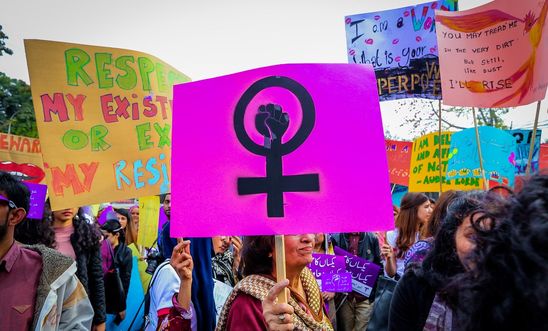
Women in Lahore, Pakistan, march to mark International Women's Day 2019
Women in Lahore, Pakistan, march to mark International Women’s Day 2019 © Ema Anis for Amnesty International

Governments around the world are failing to protect women human rights defenders from increasing attacks, Amnesty International said on 29 November 2019, International Women Human Rights Defenders Day. In a new report –Challenging power, fighting discrimination” – based on interviews with 23 activists across 21 countries, Amnesty highlights how women human rights defenders continue to be assaulted, threatened, intimidated, criminalised and even killed for their campaigning.

Kumi Naidoo, Amnesty International’s Secretary General, said: “Women human rights defenders are attacked because of who they are and what they do. The risks are even greater for those facing intersecting forms of discrimination: if you are a woman and from a racial minority, indigenous, poor, lesbian, bisexual, trans, or a sex worker, you have to fight so much harder to have your voice heard by those in power…All over the world, women human rights defenders are speaking out against injustice, abuse and discrimination, often because they have experienced it first-hand…..They are central to human progress: they fight for human rights and against patriarchy and racism, while pushing for ground-breaking reforms on so many fronts. Governments must live up to their commitment to ensure these activists can operate freely and safely.

In recent years, campaigners working on the rights of women, LGBTI people and other marginalised groups have come under growing pressure from politicians, religious leaders and violent groups. Women campaigning on these issues tend to be the first to be targeted in increasingly frequent backlashes against a more inclusive, fairer world.

Sexual violence

The report highlights several cases in which violence, including sexual violence as a form of torture, was used against women human rights defenders to silence them. In Bahrain, Ebtisam El-Saegh, an activist with the human rights organisation SALAM for Democracy and Human Rights, was sexually assaulted, badly beaten, kicked in the stomach and kept standing for most of the seven hours she was being interrogated while in detention in 2017. El-Saegh told Amnesty: “I was threatened that they would harm my family and that they would bring my husband and torture and electrocute him. The men told me ‘no one can protect you’.”

In Egypt, Malak al-Kashef, a 19-year-old transgender woman human rights defender was arrested in March this year following her involvement in peaceful protests in Cairo. She faced trumped-up charges of ‘aiding a terrorist organisation’ and ‘misusing social media to commit a crime punishable by law.’ While in detention, she was subjected to a forced anal examination and other forms of sexual assault. Even though she was undergoing gender affirming treatment, Malak was placed in an all-male detention facility which put her at increased risk of sexual violence. She was eventually released in July this year.

Smear campaigns

Women activists are often subjected to smear campaigns which vilify their “deviant behaviour” and are designed to fuel hostility against them. After rescuing migrants from the central Mediterranean Sea in June 2019, Carola Rackete, the Italian captain of the rescue boat Sea-Watch 3, was repeatedly insulted by the Italian Minister of Interior who called her a pirate and a criminal. His slurs were followed by vicious verbal attacks by others who incited sexual violence against her while also targeting her gender and appearance.

In Mauritania, Mekfoula Brahim, a woman human rights defender who has campaigned for an end to female genital mutilation, was branded an apostate in 2016 Facebook posts after defending a blogger sentenced to death for criticising those who use religion to discriminate against minorities. The slur exposed her to the risk of being prosecuted and sentenced to death.

Click to access ACT3011392019ENGLISH.PDF

https://www.amnesty.org.uk/press-releases/governments-failing-protect-women-activists-increasing-attacks-new-report

http://www.voxy.co.nz/politics/5/353494

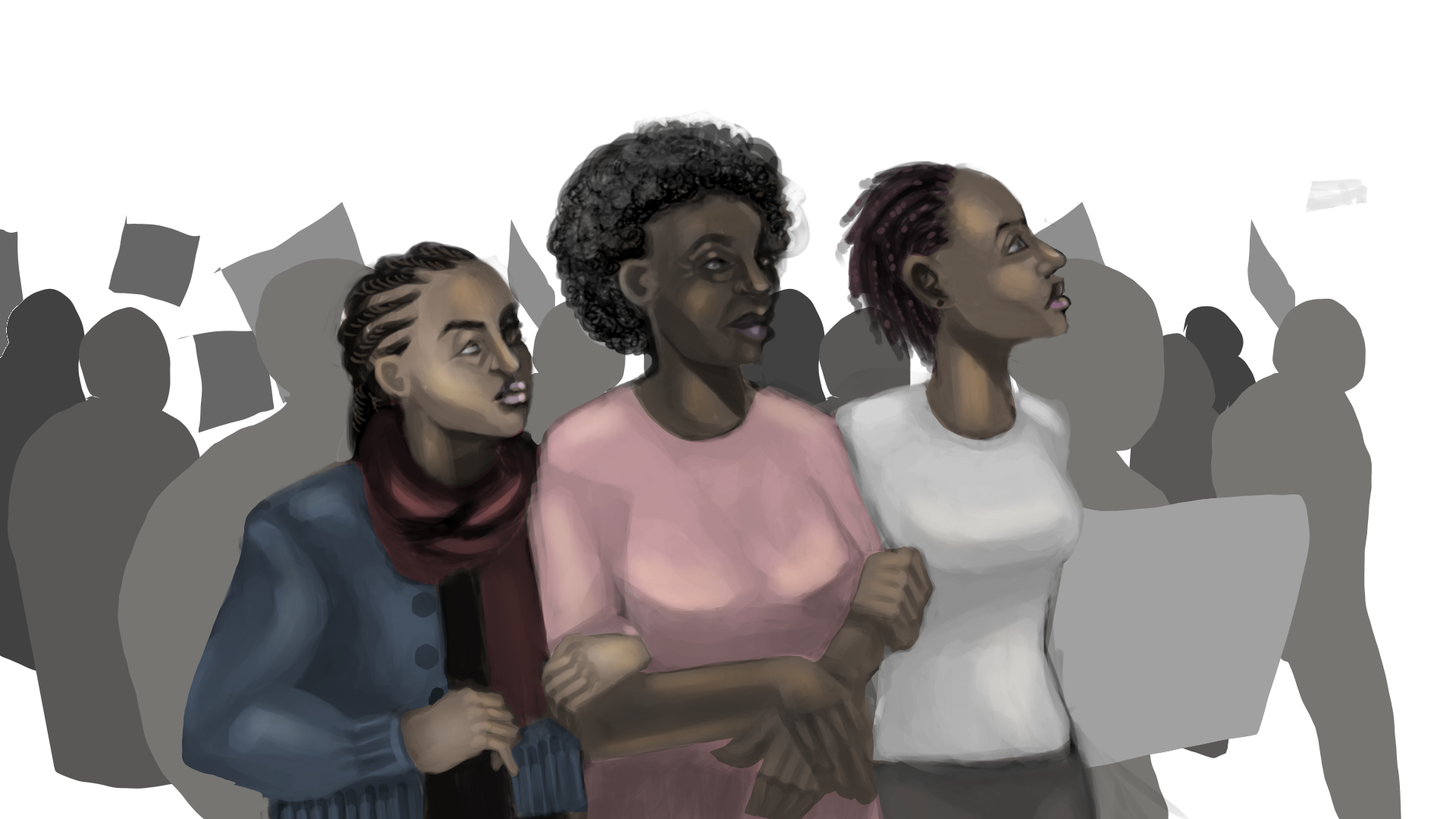
THE THREE WOMEN: audio from AfricanDefenders

December 1, 2019

AfricanDefenders & DefendDefenders launched on 29 November 2019 their audio campaign about African women human rights defenders and courage, simply called THE THREE WOMEN”. The story by Gentrix Barasa and beautiful Illustrations by Primordial M. Here is the first episode (https://twitter.com/hashtag/IAmTheThreeWomen) in the context of the 16 Days Campaign Against Gender Based Violence:

THE STORY OF MARTHA. A woman could be heard screaming from a distance in the town square. The distinct sound of a whip hitting her body could be heard reverberating throughout the town. A small crowd of onlookers were gathering around quietly, curious to see what was going on and to find out why this woman was being beaten. Nuru was rushing home so she could prepare lunch when she spotted the crowd of onlookers. Despite being aware that she would get in trouble with her father if she was late, she was drawn towards the woman.
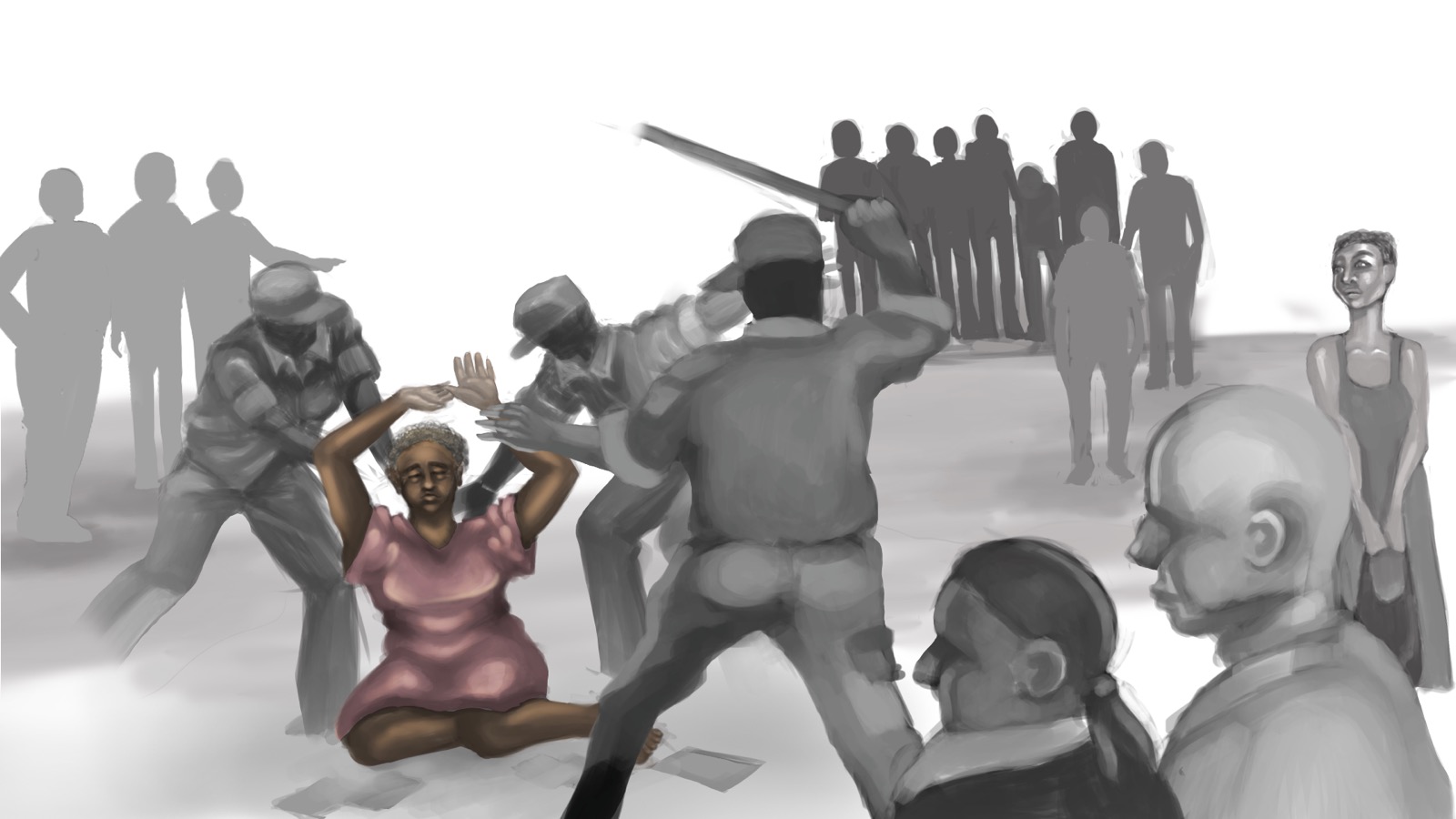
“What is going on?” she asked the man standing beside her.

“Oh, Martha started with her nonsense again. They should beat that devil out of her.”

The men in the town, especially the elders, did not appreciate when women challenged societal norms. In their mind, Martha was turning their wives and daughters against them with all this talk of women’s rights and liberation. They had complained to the mayor of the town, Mr. Tapiwa, when they caught wind of the women’s march that Martha was organising.

“This one is from Tapiwa,” one of the policemen said before hitting Martha.

“I heard she is secretly a man,” Nuru heard a woman whisper, “why else would she behave like this? This is not how women are supposed to behave.”

“I heard she is just trying to break our marriages, so we are miserable and alone like her,” another whispered.

“She is a witch. She does not even have children and she is trying to tell us how to bring up our daughters.”

“I heard she is a prostitute. She is just trying to corrupt us,” the whispers continued.

“I feel bad for her, but she should know that activism is not the work of a woman,” a man chimed in.

The police eventually stopped harassing and beating Martha, before taking off. The crowd slowly dispersed, without offering her any help. Eventually, Nuru was the only one left.

She looked around nervously as if trying to make sure no one was looking. As much as she felt sorry for her, she was scared to go against the people of the town. She did not want to be an outcast like Martha. When she was sure no one was looking, she reached out for Martha’s hand helping her to her feet.

“Why did they do this to you?” Nuru asked, while watching the older woman wince in pain as she started walking.

“I was fighting for your rights.”

“What do you mean my rights?”

Martha gestured at a nearby bench for them to sit on.
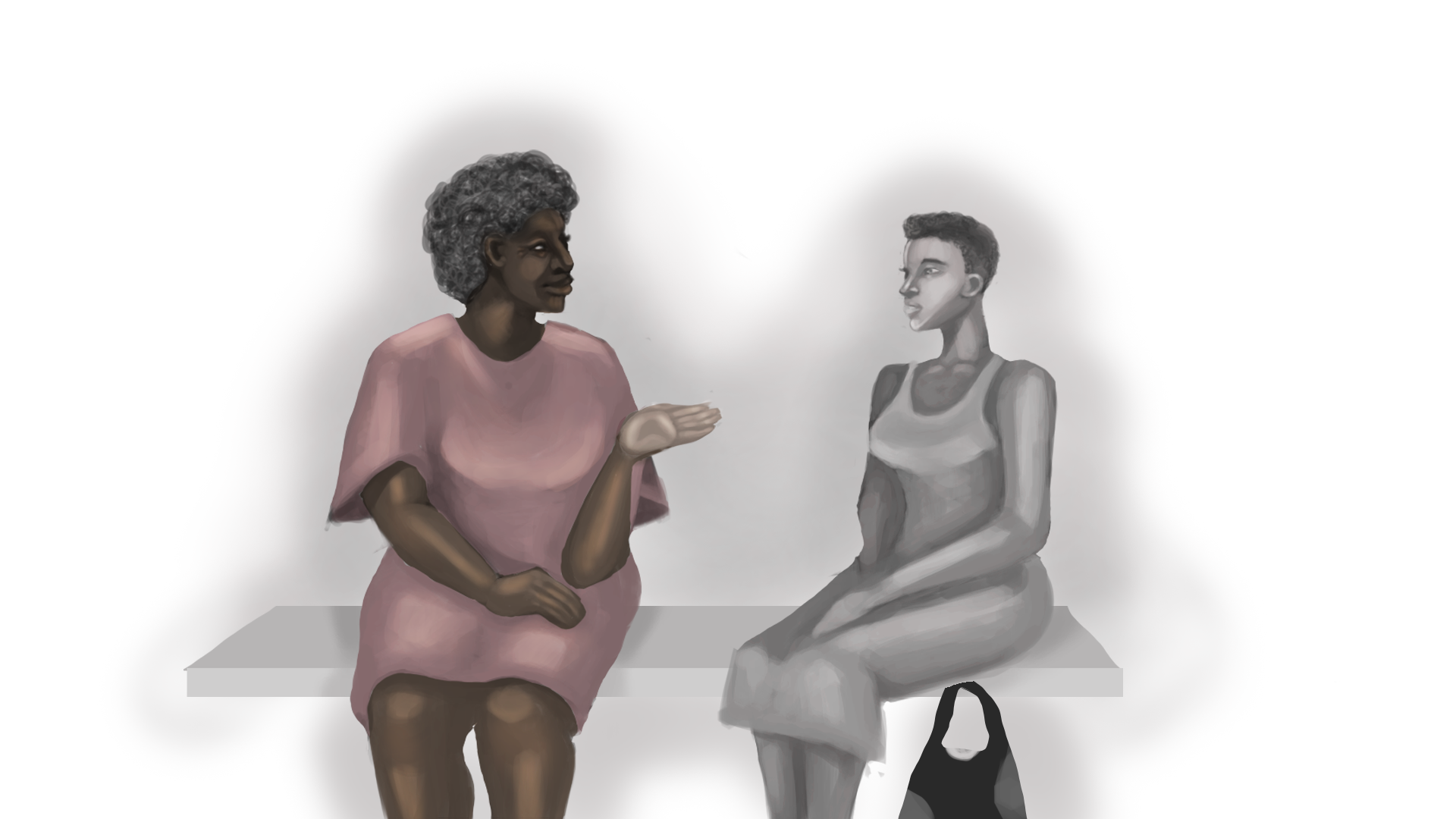
“Don’t you want to live in a world where you have choices?” Martha asked.

“I do have choices. I make choices every day,” Nuru said defensively.

Martha looked at Nuru, slightly raising an eyebrow. “Did you know you could own property, get an education, be equal to your father and brothers?” Martha continued.

Nuru stared into the distance with a look of longing. She had always wanted more for herself, but she had come to accept her life. Also, she was too scared to go against her father. “My father would never allow it, “she finally said.

Martha reached into her bag and retrieved a card. “This organisation can help you to learn more about your rights and can find you a good school. It is not his place to allow it. It is your right.”

Nuru hesitantly took the card and quickly pocketed it, afraid someone would see.

“I heard you are organising a march tomorrow.”

Martha nodded and handed her a flier with all the information about the march. “You don’t have to come to this if you don’t want to, but at least think about what I told you.”

Nuru nodded while gathering her things. She was still not quite sure if she would dare to go against her father, after all, who would take care of the house? “You are really nice,” Nuru said. She felt like Martha needed to hear some kind words. Then, Nuru took off.

Despite a restless night and the pain from the beating, Martha got up early the next morning to get ready for the march. The beating was the worst she had gotten since she started being outspoken about women’s rights. She had received calls and text messages all morning from people backing out of her march. It had worked – the beating had served as a warning to anyone planning to participate. Martha felt ashamed to admit it to herself, but they were really close to breaking her. She had tried so hard to not let them win, but that beating might have been the straw that broke the camel’s back.

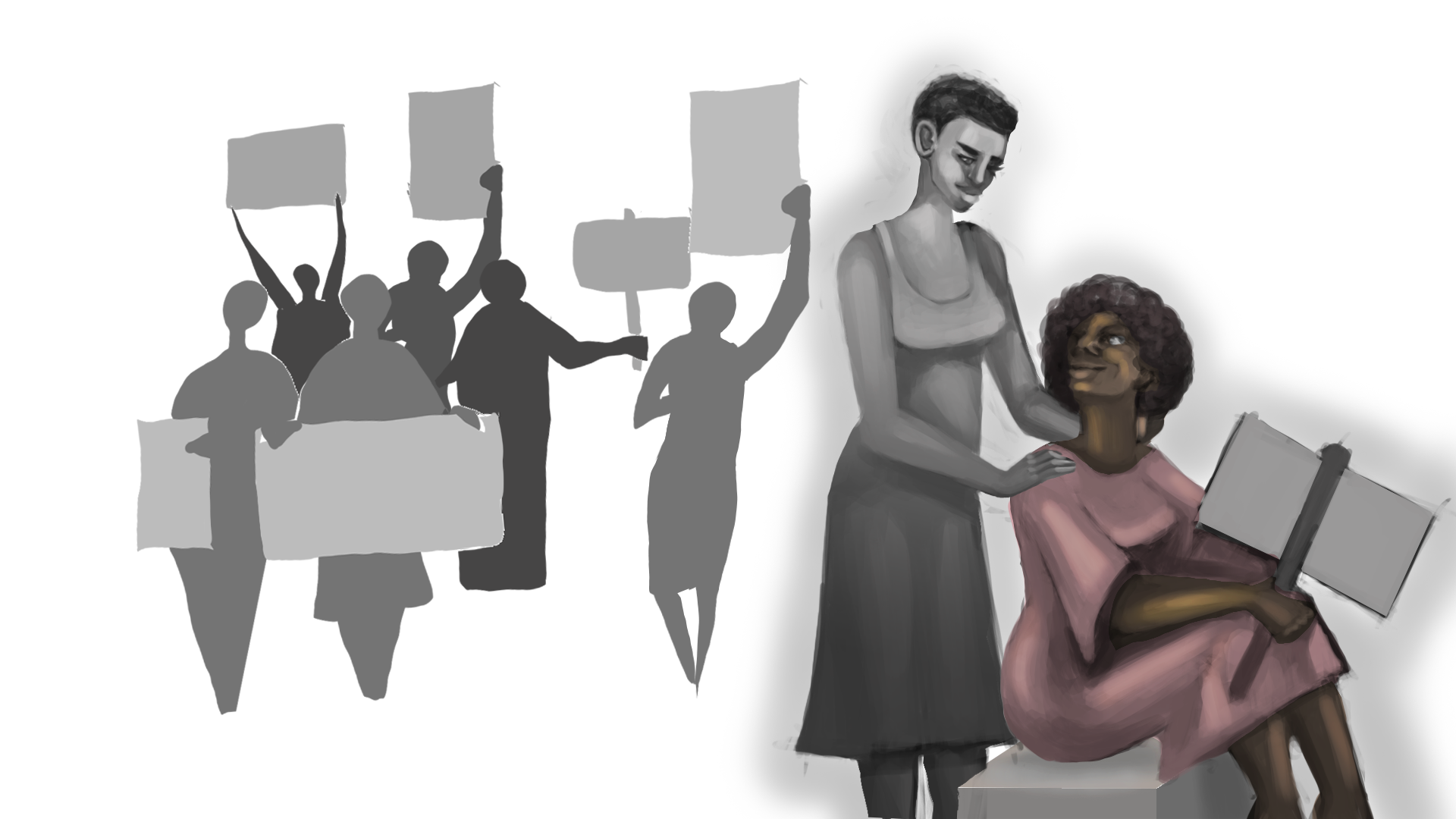
She held out hope that at least one other person would show up, but she had been standing there for an hour. At that point, it was apparent that the march was a complete failure. In that moment, it was hard to remember why she was fighting so hard for this. As she sat down on the side of the road, with the sign Don’t tell me how to dress – tell them not to rape, next to her, a single teardrop ran down her face. With a sigh she reached out for the sign, resigning to go home. Instead of feeling the wooden base of the sign, she felt a hand touching hers. She looked up in panic, expecting to see the policemen from the previous day. Instead, it was Nuru.

“What are you doing here?” Martha asked in a confused tone, quickly drying her tears.

“We want to fight for our rights.”

“We?” asked Martha, even more confused. She then saw a group of women behind Nuru.

“We came to stand with you and all the women and girls in town,” Nuru said.

Martha smiled. She stood up grabbing the rest of the signs and handing them out to the group. They started chanting the slogans on the signs, marching towards Mr. Tapiwa’s office.


THE THREE WOMEN

Four jailed Iranian human rights lawyers win European Bar award

November 29, 2019
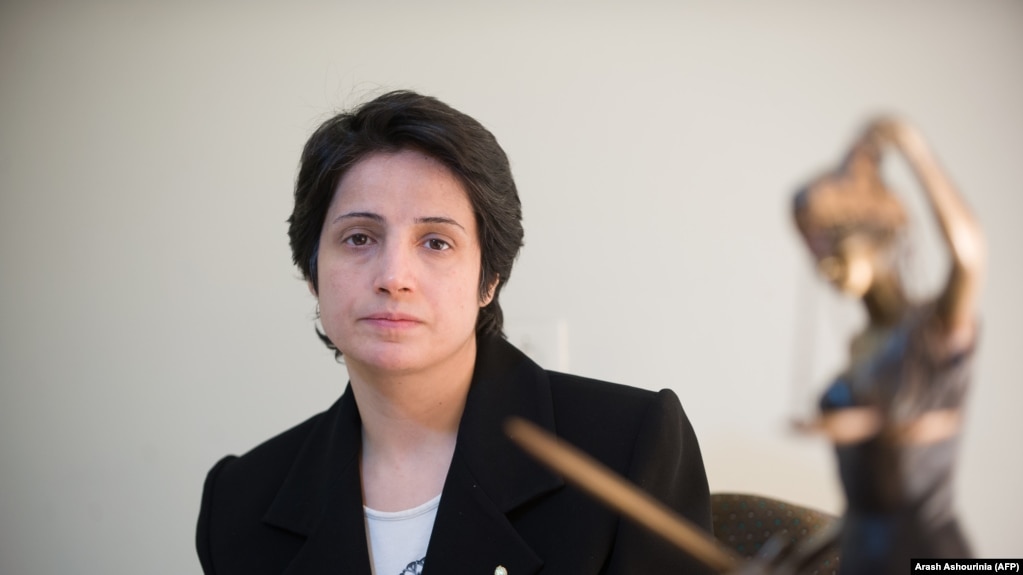
IRAN -- Iranian lawyer Nasrin Sotoudeh is seen in Tehran on November 1, 2008.

Iranian lawyer Nasrin Sotoudeh is seen in Tehran on 1 November 2008.

The Council of Bars and Law Societies of Europe (CCBE) has bestowed its annual Human Rights Award to four lawyers from Iran: Nasrin Sotoudeh, Addolfattah Soltani, Mohammad Najafi and Amir Salar Davodi. Shirin Ebadi will receive the award on behalf of the jailed lawyers from CCBE President José De Freitas.

The CCBE is a professional organization that represents Law Societies from 45 different countries and over one million lawyers. Previous recipients of the award include Avocats Sans Frontières (ASF) and Azerbaijani human rights lawyer Intigam Aliyev. For more on this and other awards for lawyers see: http://www.trueheroesfilms.org/thedigest/awards/ccbe-human-rights-award

Nasrin Sotoudeh is a human rights defender who has been in prison since summer of 2018 for her peaceful activities defending women’s rights to choose their dress style. Although there is no written law in Iran for compulsory hijab, the police and courts spend considerable resources to force women to use the veil. [see also: https://humanrightsdefenders.blog/2019/06/13/1-million-people-demand-that-iranian-government-release-nasrin-sotoudeh/]

Abdolfattah Soltani who co-founded the Defenders Of Human Rights Center along with his colleagues, Nobel Peace Prize laureate Shirin Ebadi and others served as the attorney defending the family of Iranian-Canadian photo journalist Zahra Kazemi. [see also: https://humanrightsdefenders.blog/2018/11/22/iranian-human-rights-defender-abdolfattah-soltani-released-from-jail/

Mohammad Najafi performed various human rights related work and defended protestors who were arrested during a mass uprising in early 2018.

Amirsalar Davoudi was sentenced to 30 years in prison, 111 lashses and substantial monetary fine for his work. One of the charges included “collaborating with the enemy sate” which was brought against Davoudi for doing an interview with the Voice of America’s Persian section.

A statement from the CCBE urges Iran “to take all the necessary measures to release these four human rights lawyers and to guarantee that all lawyers in the Islamic Republic of Iran are able to perform their professional duties without fear of reprisal, hindrance, intimidation or harassment.

https://en.radiofarda.com/a/jailed-iranian-lawyers-win-human-rights-award/30297336.html