Author Archive

Egyptian writer Ahdaf Soueif shines spotlight on human rights at UAE’s inaugural Hay festival

February 29, 2020
Egyptian novelist Ahdaf Soueif brought up the cases of Egyptian and Emirati political prisoners during her talk at the Hay festival in Abu Dhabi on 26 February (Facebook/@AhdafSoueif)

A letter signed by the festival’s president Stephen Fry, and more than 40 public figures and organisations castigated Emirati authorities for continuing to incarcerate citizens for expressing their views. See: https://humanrightsdefenders.blog/2020/02/26/hay-festival-in-emirates-promotes-freedom-of-expression-but-not-for-its-citizens/.

https://www.middleeasteye.net/news/ahdaf-soueif-declares-solidarity-political-prisoners-uae-cultural-festival

Call for nominations for Samir Kassir Award for Freedom of the Press goes ahead in MENA region

February 28, 2020
The European Union launched a call for nominations for the “Samir Kassir Award for Freedom of the Press” at the Delegation of the European Union to Lebanon. During the press conference, Ambassador Ralph Tarraf reaffirmed the European Union’s commitment to pursue Samir Kassir’s struggle for free speech and an independent free press. [for more on this and many other awards relating to freedom of the press, see: http://www.trueheroesfilms.org/thedigest/awards/samir-kassir-award-for-freedom-of-the-press]
The contest is open to candidates from North Africa, the Middle East, and the Gulf until 1 April, 2020, and three awards will be granted for: the best opinion article, investigative article, and audiovisual news report. The contributions must be centered on subjects relating to rule of law, human rights, good governance, fight against corruption, freedom of expression, democratic development and citizen participation. The jury will be composed of seven voting members from Arab and European media and one observer representing the European Union. The names of the jury members will be communicated during the prize-awarding ceremony, which will take place on 2 June 2020 in Beirut, marking the 15th memorial of Samir Kassir’s assassination.

https://en.annahar.com/article/1131572-european-union-launches-the-15th-editionon-of-the-samir-kassir-award-for-freedom

Right livelihood awards nominations close by 4 March

February 28, 2020

Just a reminder that the deadline for nominations for the 2020 Right Livelihood Awards is 4 March.  For more information see: https://humanrightsdefenders.blog/2020/01/16/call-for-nominations-for-the-2020-right-livelihood-awards/

Women human rights defenders in focus at 43rd Human Rights Council

February 27, 2020

UN High Commissioner for Human Rights, Bachelet, taking part in a panel discussion, held at the UN Human Rights Council on Tuesday 25 February 2020, said that the Beijing Declaration should be celebrated but noted that the Plan of Action agreed at the event is still unfinished. According to Ms. Bachelet, the risks of setbacks to women’s rights are real, and growing. ….”Women’s rights are threatened and attacked” on many fronts, she warned, adding that there over this period there has been “a backlash and the resurgence of gender inequality narratives based on age-old discrimination”. Ms. Bachelet also welcomed the speech delivered to the Human Rights Council by UN Secretary-General António Guterres on Monday. As part of his Call to Action for human rights [see https://humanrightsdefenders.blog/2020/02/25/43rd-session-hrc-un-secretary-general-launches-call-to-action-on-human-rights/], He called on every country to “support policies and legislation that promote gender equality, to repeal discriminatory laws, to end violence against women and girls and to strive for equal representation and participation of women in all areas”.

Against this backdrop the NGO side eventWomen human rights defenders radically transforming a world in crisis” is most timely.

Wednesday 4 March 2020, 11:00 – 12:00, Room XXVII Palais des Nations, Geneva. This event is co-hosted by ISHR, Amnesty International, Global Fund for Women, Urgent Action Fund, Mesoamerican Initiative of women human rights defenders, and Just Associates (JASS).

Panellists:

  • Michel Forst, UN Special Rapporteur on the situation of Human Rights Defenders
  • Nazik Awad, Sudan
  • Aurelia Martin Arzu Rochez, Honduras
  • Luz Mary Rosero Garces, Colombia
  • Fatima Bentaleb, France
  • Hasmida Karim, Indonesia

Moderator:

  • Zephanie Repollo, Just Associates (JASS)

US absence from UN human rights council encourages China and Russia?

February 26, 2020
Secretary of State Pompeo and Nikki Haley, the US envoy to the UN at the time, announcing the US withdrawal from the Human Rights Council, June 19, 2018.
For the last decade, Western democracies and human-rights defenders have been locked in a tense struggle with authoritarian great powers at the United Nations. Since 2009, Russia and China have waged a highly successful campaign to dismantle the international human-rights system, particularly through the Human Rights Council. The two countries have made strides especially after the Trump administration withdrew the United States from the Council in 2018….

The campaign has been led by China, which has attacked the international human-rights system since its re-election to the Human Rights Council in 2013 for consecutive three-year terms that ended in 2019. Russia has preferred to work behind the scenes, particularly since its bid for election to the Council failed in 2016….

Both countries have also operated as part of what is called a like-minded group, a powerful international coalition that includes Algeria, Belarus, Cuba, Egypt, Pakistan, Philippines, Sri Lanka, Sudan, Venezuela and Vietnam. The group has challenged the UN’s human-rights mechanisms by emphasizing cooperation and dialogue over country-specific measures that name and shame abusing states, denigrating the relevance of civil and political rights while prioritizing economic and social rights and stressing the importance of sovereignty and nonintervention. Since 2013, Russia and China have played a key role in coordinating the group’s effort to undermine international human-rights protections.

In March 2018, for example, China presented a resolution to the Human Rights Council titled “Promoting Mutually Beneficial Cooperation in the Field of Human Rights,” which aimed to discard country-specific mechanisms that name and shame countries for their rights abuses.  [see also: https://humanrightsdefenders.blog/2018/03/07/china-and-the-un-human-rights-council-really-win-win/]. No less significant was the like-minded group’s support for China during its last Universal Periodic Review session in November 2018. The review took place amid escalating human-rights violations inside China, including the death in custody of Liu Xiaobo, a prominent activist and Nobel Prize laureate, and the mass internment of more than a million ethnic Uighur Muslims in so-called political re-education camps in the remote province of Xinjiang.

…..

An important factor contributing to the success of China and Russia in undermining the international human-rights system has been the withdrawal of the US from the Human Rights Council in June 2018. By leaving the Council, the US has created a leadership void that Russia, China and their allies have exploited to consolidate their grip on power. Just weeks after the US withdrew, Russia and China successfully lobbied to slash funding for key human-rights posts in UN peacekeeping missions that protect civilians from violence in some of the most vulnerable countries in the world, including Haiti, the Democratic Republic of the Congo and South Sudan. Worse, the like-minded group bolstered its influence over the global human-rights system when Venezuela, one of the world’s most flagrant violators of international human-rights norms, was elected to a three-year term to the Human Rights Council in October 2019. Having left the Council, the US was unable to sway the vote.

With the lack of US leadership, the European Union has struggled to push back against Russia and China’s growing influence at the UN. In July 2019, the European Union issued a joint statement with several other Western democracies, including Australia, Japan, New Zealand and Switzerland, condemning China’s mass detention of Muslims in Xinjiang. In reply, more than a dozen members of the Organization of Islamic Cooperation, a powerful group of countries that includes Egypt, Saudi Arabia, Algeria and Qatar, signed a declaration praising China’s policies in the region. [see also: https://humanrightsdefenders.blog/2019/07/20/china-coalition-anti-human-rights-un/]

Most worrisome, countries that once looked to the US for leadership in advancing human rights may now be looking to Russia, China and their allies for guidance in an international arena increasingly dominated by autocrats and aspiring despots.

https://www.passblue.com/2020/02/24/how-the-us-enabled-aggressions-by-china-and-russia-at-the-un/


As if to show thagt there is truth in the assertions above, the Russian Foreign Minister Sergey Lavrov on 25 February 2020 decried what he terms the “double standards” employed at the U.N. Human Rights Council in favor of Western democratic values, at the expense of what he calls the legitimate sovereign rights of nations that do not fall within the Western orbit. Lavrov did not hide his disdain Tuesday at the so-called country-specific resolutions adopted by the Council, saying the resolutions had become an increasingly popular pretext to interfere in the internal affairs of sovereign states.

https://www.voanews.com/europe/russia-accuses-un-human-rights-council-pro-western-bias


Hay Festival in Emirates promotes freedom of expression but not for its citizens

February 26, 2020
As the Hay Festival Abu Dhabi opens on February 25–28, 2020 in the United Arab Emirates, we the undersigned call on the Emirati authorities to demonstrate their respect for the right to freedom of expression by freeing all human rights defenders imprisoned for expressing themselves peacefully online, including academics, writers, a poet, and lawyers. In the context of the Hay Festival, the UAE’s Ministry of Tolerance is promoting a platform for freedom of expression, while keeping behind bars Emirati citizens and residents who shared their own views and opinions. We support the efforts of festival participants to speak up in favor of all those whose voices have been silenced in the UAE. We further support calls for the UAE authorities to comply with international standards for prisoners, including by allowing prisoners of conscience to receive books and reading materials.The country’s most prominent human rights defender, Ahmed Mansoor, is currently serving a 10-year prison sentence after being convicted on the spurious charge of “insulting the status and prestige of the UAE and its symbols including its leaders” in reprisal for his peaceful human rights activism, including posts on social media. [see also: https://humanrightsdefenders.blog/tag/ahmed-mansoor/]……

Other prisoners have been tortured in prison in the UAE. A Polish fitness expert, Artur Ligęska, was held in the same isolation ward as Mansoor, in conditions he described as “medieval.” After his charges were dismissed and he was freed in May 2019, Ligęska wrote a book in which he recounted the prison conditions in Al-Sadr’s isolation wing, where prisoners were held without running water for many months in very unhygienic conditions, and some were subjected to torture, abuse, and sexual assault. He was instrumental in getting the news about Mansoor’s hunger strike out to the world from prison in March 2019, at great personal risk.

Other human rights defenders have faced similar mistreatment in prison, where they are often held in isolation, resorting to hunger strikes to try to bring attention to their unjust imprisonment and ill-treatment in detention, such as human rights lawyers Dr. Mohammed Al-Roken and Dr. Mohammed Al-Mansoori...

,,,

The Hay Festival Abu Dhabi is supported by the UAE’s Ministry of Tolerance in a country that does not tolerate dissenting voices. Regrettably, the UAE government devotes more effort to concealing its human rights abuses than to addressing them and invests heavily in the funding and sponsorship of institutions, events, and initiatives that are aimed at projecting a favorable image to the outside world.

With the world’s eyes on the Hay Festival Abu Dhabi, we urge the Emirati government to consider using this opportunity to unconditionally release our jailed friends and colleagues, and in the interim, to at least allow prisoners of conscience to receive books and reading materials, to have regular visits with family, to be allowed outside of their isolation cells to visit the canteen or go outside in the sun. In particular, we ask that Ahmed Mansoor be given a bed and a mattress so that he no longer has to sleep on the floor, and that prison officials cease punishing him for public appeals that are made on his behalf. We ask the authorities to improve their prison conditions as a sign of goodwill and respect for people who wish to organize and participate in events in the UAE, such as the Hay Festival Abu Dhabi or the upcoming Expo 2020 Dubai, in the future. By doing so, the UAE would demonstrate that the Hay Festival is an opportunity to back up its promise of tolerance with actions that include the courageous contributors to freedom of expression who live in the country. [see also: https://humanrightsdefenders.blog/2019/10/26/celebrity-endorsements-and-the-dubai-expo-on-the-one-hand-and-the-other/]

for names see: https://pen.org/open-letter-ngos-and-individuals-to-uae-authorities/

43rd session HRC: UN Secretary General launches Call to Action on human rights

February 25, 2020
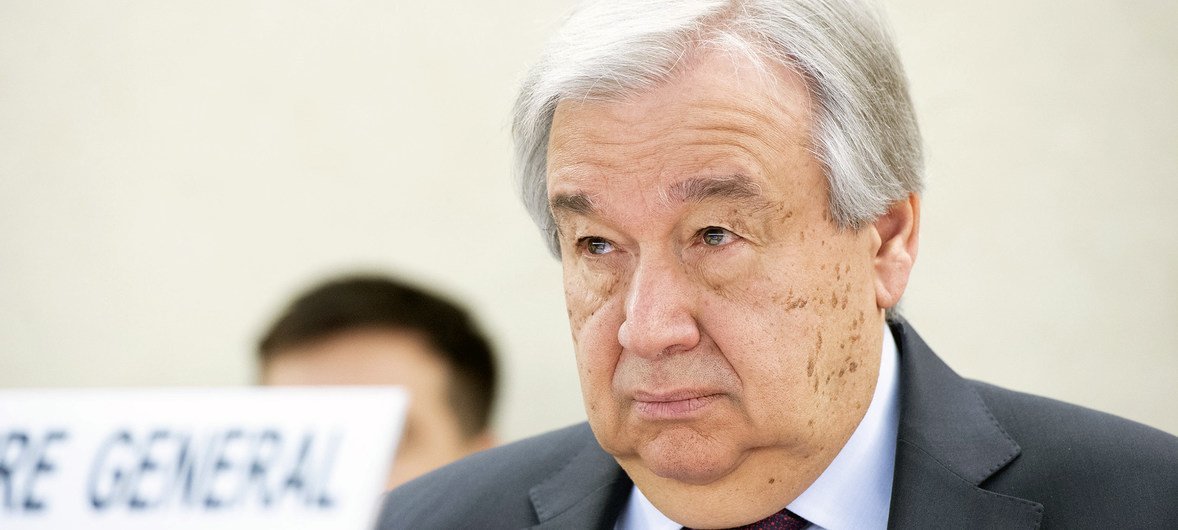
UN Secretary-General António Guterres attends the High Level Segment of the 43rd Regular Session of the Human Rights Council in Geneva. UN Photo/Violaine Martin
On 24 February 2020, with human rights under attack, António Guterres unveiled a blueprint for positive change. People’s basic human rights – their birth-right – are “under assault”, he said as he launched a Call to Action aimed at boosting equality and reducing suffering everywhere. “Human rights are our ultimate tool to help societies grow in freedom,” he told Member States on the opening day of the UN Human Rights Council’s 43rd session in Geneva. [see also: https://humanrightsdefenders.blog/2020/02/24/human-rights-defenders-issues-on-the-agenda-of-43rd-human-rights-council/]

In his speech he detailed a seven-point blueprint for positive change and issued an appeal for solidarity. “People across the world want to know we are on their side,” he said. “Whether robbed of their dignity by war, repression of poverty, or simply dreaming of a better future, they rely on their irreducible rights – and they look to us to help uphold them.” Echoing the call for change, High Commissioner for Human Rights Michelle Bachelet said that although threats to human rights, development and peace were on the rise, so were the practical, actionable solutions to these issues.

In his pledge to utilize the full weight of his office and the UN family to fulfil the Call to Action, Mr. Guterres highlighted the enduring value of the Universal Declaration of Human Rights.

Highlighting the document’s proclamation that human rights are ‘humanity’s highest aspiration’, Mr. Guterres insisted that all States had a responsibility to protect and promote people’s “dignity and worth”. National sovereignty “cannot be a pretext for violating human rights”, Mr. Guterres insisted, while also maintaining that greater equality “strengthens States and societies, thereby reinforcing sovereignty”.

Positive change is possible, the UN chief insisted, recalling his own experience living under dictatorship in Portugal, which finally gave way to a democratic movement when he was 24 years old. Other “human rights struggles and successes inspired us”, the UN chief said, noting how these had secured the end of apartheid in South Africa and colonial rule. One billion people have also been lifted out of poverty in a generation, he continued, and there have also been major advances in improving access to drinking water, along with big declines in child mortality. ..

Chief among these challenges are several protracted, unresolved conflicts that have left families trapped in war-torn enclaves, “starved and bombed in clear violation of international law”, he said.  Human trafficking also affects “every region of the world”, the UN chief noted, leaving women and girls “enslaved, exploited and abused”, unable to realise their potential.  Journalists and civil society are also under threat, with activists jailed, religious groups and minorities – including indigenous peoples, migrants, refugees and the LGBTI community – persecuted under “overly broad definitions of national security”.

Global hunger is also increasing, Mr. Guterres said, before highlighting a series of 21st century issues linked to huge problems that affect all countries: the climate crisis, population growth, urbanization and the dark underbelly of technological progress. “People are being left behind. Fears are growing. Divisions are widening,” he said. “Some leaders are exploiting anxieties to broaden those gaps to breaking point.”

Introducing his Call to Action blueprint, Mr. Guterres explained that its aim was to “transform the ambitions of the Universal Declaration into real-world change on the ground”.

Heading the seven-point protocol is a call to put human rights at the core of sustainable development – a reference to the 17 Sustainable Development Goals (SDGs), agreed to by the international community in 2015 under the Agenda 2030 banner. “The vast majority of the goals and targets correspond to legally binding human rights commitments made by every Member State,” Mr. Guterres said. “When we help lift people out of abject poverty – when we ensure education for all, notably girls – when we guarantee universal healthcare…we are enabling people to claim their rights and upholding the core pledge of the 2030 Agenda to leave nobody behind.”

Among the other priorities, the UN Secretary-General highlighted that much more needs to be done to prevent violence against women. “Violence against women is the world’s most pervasive human rights abuse,” he said, in a call to “every country” to support policies that promote gender equality, repeal discriminatory laws…ensure sexual and reproductive health and rights, and strive for women’s equal representation.

Turning to 21st century challenges, Mr. Guterres reiterated that the climate crisis was “the biggest threat to our survival”. It has already threatened human rights around the world and would continue to do so in future, he noted, before underscoring people’s right to a safe, clean, healthy and sustainable planet that the Call to Action is designed to achieve. Young people will be empowered to participate in this process, the UN chief insisted, so that they do “not simply speak, but to participate and shape decisions that will affect their future”.

Finally, on the challenges posed to human rights by new technology, Mr. Guterres explained that progress in this field “are too often used to violate rights and privacy through surveillance, repression and online harassment and hate”. Facial recognition and robotics should never be used to deepen inequality, he insisted, while also reiterating his call for online-ready human rights norms such as the Internet Governance Forum.

Following this announcement Netsanet Belay, Amnesty International’s Research and Advocacy Director, said: “…We hope this will translate to a genuine, effective and coordinated UN response to address ongoing human rights crises around the world – from the ethnic cleansing of the Rohingya in Myanmar, to the systematic targeting of human rights defenders in Saudi Arabia and the mass internment of almost one million Uighurs in China – and to hold states to account. “We welcome any initiative that seeks to put human rights front and centre at the UN across its operations. To ensure the success of this initiative, the Secretary-General must lead by example in his willingness to speak up when abuses are taking place, and must ensure adequate funding for the protection of human rights within the UN. Mr. Guterres has described his new initiative as a call for action. Now we need to see the action.

https://news.un.org/en/story/2020/02/1057961

https://www.amnesty.org/en/latest/news/2020/02/un-action-plan-on-human-rights-bold-leadership/

In memoriam Thich Quang Do, dissident monk in Vietnam

February 25, 2020
AFP reported on 23 February 2020 that Thich Quang Do, a dissident Buddhist monk who has effectively been under house arrest since 2003 has died at the age of 93. Head of the banned Unified Buddhist Church of Vietnam, the vocal patriarch was born in 1928 in Thai Binh province and spent most of his life advocating for religious freedom and human rights in communist-run Vietnam. His staunch activism landed him under what was effectively house arrest in 2003 in Ho Chi Minh City, where he was under constant surveillance. Do died on Saturday night 22 February at Tu Hieu pagoda, UBCV announced on Sunday morning. According to his will signed on April 2019, Do requested a “simple funeral, not more than three days.” “After the cremation, my ashes will be scattered at sea,” said the statement quoting his will.

Do has long been a thorn on the side for communist-run Vietnam, and he has been nominated multiple times for the Nobel Peace Prize for his vocal advocacy for democracy. In 2001, he wrote an “Appeal for Democracy” and also called on northern and southern dissidents to drop their cultural differences and unite in 2005. He received Norway’s Rafto human rights award the following year for “his personal courage and perseverance through three decades of peaceful opposition against the communist regime in Vietnam.” He also won a Hellmann/Hammett grant in 2001 and the Homo Homini award in 2002.

The UBVC has been banned since the early 1980s, when it refused to join the state-sanctioned Vietnam Buddhist Church.

https://www.japantimes.co.jp/news/2020/02/23/asia-pacific/vietnamese-dissident-monk-nobel-dies/#.XlUxREPgpTY

Gui Minhai: 10 years jail sentence in China

February 25, 2020
Members of the pro-democracy Civic party carry portraits of Gui Minhai and Lee Bo during a protest in Hong Kong.
Members of the pro-democracy Civic party carry portraits of Gui Minhai and Lee Bo during a protest in Hong Kong. Photograph: Bobby Yip/Reuters

A court in Ningbo said on Tuesday that Gui had been found guilty and would be stripped of political rights for five years in addition to his prison term. The brief statement said Gui had pleaded guilty and would not be appealing against his case. The Swedish foreign minister, Ann Linde, told Radio Sweden: “We have always been clear that we demand that Gui Minhai be released so he is able to reunite with his daughter, his family and that demand remains…We demand immediate access to our Swedish citizen in order to give him all consular support that he is entitled to.

Gui appears to have been tried and convicted in secret, denying him any chance of a fair trial,” said Patrick Poon, a China researcher at Amnesty International, calling the verdict “deplorable” and based on unsubstantiated charges.

For previous posts on this shocking story:

https://humanrightsdefenders.blog/2019/12/10/sweden-charges-ex-ambassador-to-china-over-pressure-on-daughter-of-gui-minhai/

https://humanrightsdefenders.blog/2019/11/19/sweden-defies-chinese-threats-after-award-to-book-publisher-gui-minhai/

https://humanrightsdefenders.blog/2016/01/21/confessions-abound-on-chinese-television-first-gui-minhai-and-now-peter-dahlin/

—————

https://www.theguardian.com/world/2020/feb/25/gui-minhai-detained-hong-kong-bookseller-jailed-for-10-years-in-china

Human Rights Defenders issues on the agenda of 43rd Human Rights Council

February 24, 2020

On 17 February 2020 the International Service for Human Rights (ISHR) published – as usual – its excellent “HRC43 | Key issues on agenda of March 2020 session”. Here some excerpts that relate directly to human rights defenders in the 43rd session of the UN Human Rights Council, which runs from 24 February to 20 March 2020.  If you want to stay up-to-date: with all issues follow @ISHRglobal and #HRC43 on Twitter.

Here are some highlights of the session’s thematic discussions

Protection of human rights defenders including women human rights defenders. The Council will consider a resolution, presented by Norway, to renew the mandate of the Special Rapporteur on the situation of human rights defenders. The mandate gathers and responds to information on the situation of defenders around the world, engages constructively with governments and non-State actors and provides recommendations to promote the effective implementation of the Declaration on human rights defenders. In 2019, the Council and the General Assembly unanimously affirmed the vital work defenders play. The Council recognised the critical role of environmental human rights defenders in protecting vital ecosystems, addressing climate change, attaining the sustainable development goals (SDGs). The General Assembly passed by consensus a resolution focusing on implementation of the Declaration and some key elements of protection policy; the resolution also attracted a record number of co-sponsors. The Special Rapporteur on the situation of human rights defenders will present his report on human rights defenders operating in conflict and post-conflict situations on 4 March, and country visits to Colombia and Mongolia.

Reports of cases of intimidation and reprisal against those cooperating or seeking to cooperate with the UN not only continue, but grow. Intimidation and reprisals violate the rights of the individuals concerned, they constitute violations of international human rights law and undermine the UN human rights system. [for some of my ealrier posts on reprisals, see: https://humanrightsdefenders.blog/tag/reprisals/]. During the 42nd session, the Council adopted a resolution which listed key trends such as the patterns of reprisals, increasing self-censorship, the use of national security arguments and counter-terrorism strategies by States as justification for blocking access to the UN. The resolution also acknowledged the specific risks to individuals in vulnerable situations or belonging to marginalised groups, and called on the UN to implement gender-responsive policies to end reprisals. The Council called on States to combat impunity and to report back to it on how they are preventing reprisals, both online and offline. [see also: https://humanrightsdefenders.blog/2019/11/08/michel-forst-in-last-address-to-general-assembly-pleads-to-fight-reprisals/]. Item 5 of the Human Rights Council’s agenda provides a key opportunity for States to raise concerns about reprisals, and for governments involved in existing cases to provide an update to the Council on any investigation or action taken toward accountability to be carried out.

At this 43rd session, the Council will discuss a range of economic, social and cultural rights in depth through dedicated debates with mandate holders alongside the annual report of the Secretary-General on the realisation of economic, social and cultural rights globally. These include interactive dialogues with the following:

  • The Special Rapporteur on the right to adequate housing on her annual report and country visits reports to Nigeria and France.
  • The Special Rapporteur in the field of cultural rights on her annual report on cultural rights defenders and country visit report to the Maldives and Poland.
  • The Special Rapporteur on human rights and the environment on his annual report and country visits to Fiji and Norway.

The Council will discuss a range of civil and political rights through dedicated debates with the mandate holders, including interactive dialogues with:

  • The Special Rapporteur on torture on his annual report and visit to Comoros.
  • The Special Rapporteur on freedom of religion or belief on his annual report and visits to the Netherlands and Sri Lanka.
  • The Special Rapporteur on the promotion and protection of human rights while countering terrorism on her annual report and visit to Kazakhstan.
  • The Special Rapporteur on the right to privacy on his annual report.

Country-specific developments

China Confronted with mounting evidence of serious human rights violations in China, specifically the mass internment, ‘re-education’, surveillance and harassment of Turkic Muslims in the western province of  Xinjiang, the view of many parts of the UN is incontrovertible. Beginning with a major UN review in August 2018, the UN High Commissioner has pressed for access, while the Special Procedures have expressed serious concerns about protection of freedom of religious belief, the impacts of counter-terrorism and counter-extremism measures, and the imposition of the death penalty in at least one case, that of university president Tashpolat Tiyip. In light of these concerns and the continued deterioration of the situation for human rights lawyers and defenders; the attacks on cultural rights and other freedoms in Tibet; and criminalisation of peaceful assembly and excessive use of police force in Hong Kong, it is high time for the Council to act. Member States should take concrete steps to call for independent, expert monitoring and reporting on the situation in Xinjiang, including access to the region, and urge accountability for actions by public authorities. [see also: https://humanrightsdefenders.blog/2019/07/12/joint-letter-by-22-states-to-human-rights-council-re-chinas-uighurs/ and https://humanrightsdefenders.blog/2019/07/20/china-coalition-anti-human-rights-un/]

Saudi Arabia The Council’s action on Saudi Arabia has contributed to the provisional release of at least seven women’s rights activists from detention. However, they are still facing trial and many remain in detention. Recent revelations of phone hacking, surveillance and possible blackmail and extortion of the owner of the Washington Post demonstrate the measures that the State is prepared to take to silence any form of criticism or dissent. The joint statement delivered by Australia in September sets out benchmarks for the Saudi government to take to demonstrate its willingness to improve the human rights situation. These benchmarks have not been met. States should ensure that Council scrutiny is maintained and in particular establish a monitoring and reporting mechanism over the situation. [for other posts on Saudi Arabia, see: https://humanrightsdefenders.blog/tag/saudi-arabia/]

Egypt The lack of action by the international community has emboldened the Egyptian government to continue to violate fundamental rights of its citizens. Special Procedures have rung the alarm bell regarding the pattern of reprisals against individuals and groups who sought to or engaged with the UN. In the last quarter of 2019 alone, more than 3,000 people were arbitrarily arrested and prosecuted under counter-terrorism laws in a nationwide crackdown against all forms of peaceful expression. The Committee against Torture has found that torture in Egypt is widespread and systematic and the situation meets all of the objective criteria for situations requiring the Council’s attention. States should initiate Council action on the situation before it further deteriorates. [see also: https://humanrightsdefenders.blog/tag/egypt/ ]

India The High Commissioner expressed concern over India’s Citizenship (Amendment) Act 2019 (CAA) for being ‘fundamentally discriminatory’ as it fails to extend protections to Muslim asylum seekers. Nationwide demonstrations and protests have been met with police brutality and arbitrary detentions. Vigilante groups allegedly affiliated with right-wing Hindu nationalist groups close to the government have physically attacked student protestors. Human rights defenders involved in organising peaceful assemblies have been detained and faced online harassment. ISHR calls on States to raise these concerns in their national statements including during the high level segment. [See also: https://humanrightsdefenders.blog/2019/06/27/ngos-come-out-in-support-of-indias-lawyers-collective/]

Burundi. At the last Council session, the Council renewed the mandate of the Commission of Inquiry on Burundi, which will present its oral briefing on 10 March at 10:00. ISHR remains highly concerned about the human rights situation in Burundi and its refusal to cooperate with the Council’s mechanisms. For more information on the situation of human rights defenders in Burundi, check ISHR Briefing Paper for the UPR here. See also: https://humanrightsdefenders.blog/2019/03/29/ngo-statement-condemns-new-irregularities-in-the-case-of-germain-rukuki-burundi/

Sri Lanka. Civil society groups are concerned over the backsliding on the commitments made by Sri Lanka in Human Rights Council Resolution 30/1. The recently elected president, Gotabaya Rajapaksa, along with his brother Mahinda Rajapaksa, who has been appointed prime minister, have been implicated in war crimes and numerous human rights violations when they were defence secretary and president respectively from 2005 to 2015. The new Government has made clear its intention to walk away from the Council process on Sri Lanka, a process that is currently the only hope for victims of human rights violations that truth, justice, reparations, and guarantees of non-recurrence are possible. [see https://www.nwaonline.com/news/2020/feb/23/sri-lanka-details-un-case-pullout/] Meanwhile, the relatively open climate for human rights defenders and journalists of the past few years seems to be rapidly closing. More than a dozen human rights and media organisations have received intimidating visits by members of law enforcement and intelligence agencies, while death threats against journalists have resumed. ISHR calls on States to urge for continued cooperation of the Government of Sri Lanka with OHCHR and the Special Procedures. The Council should reiterate the reference in Resolution 40/1 to “the adoption of a time-bound implementation strategy” for implementation of all elements of Resolution 30/1. [see also: https://humanrightsdefenders.blog/2020/01/22/sri-lankan-government-accused-of-embarking-on-process-to-silence-critics/]

Other country situations:

    • Interactive dialogue with the High Commissioner on the Occupied Palestinian Territories
    • Interactive dialogue with the Special Rapporteur on Eritrea
    • Interactive dialogue with the Special Rapporteur on Myanmar
    • Interactive dialogue with the Special Rapporteur on the Democratic People’s Republic of Korea
    • Interactive dialogue with the High Commissioner on Libya
    • High-level interactive dialogue on the Central African Republic
    • Interactive dialogue with the Commission on human rights on South Sudan
    • Interactive dialogue with the Special Rapporteur on Iran
    • Interactive dialogue with the Commission of Inquiry on Syria
    • Enhanced interactive dialogue on the High Commissioner’s report on the Democratic Republic of Congo
    • Interactive dialogue with the Independent Expert on Mali 
    • Interactive dialogue on the High Commissioner’s oral report on Ukraine
    • High Commissioner briefings on the following countries: Guatemala, Honduras, Colombia, Nicaragua, Yemen, Venezuela, Myanmar, Cyprus, Sri Lanka, Iran, Eritrea, Afghanistan

During this session, the Council will adopt the UPR working group reports on Italy, El Salvador, the Gambia, Bolivia, Fiji, San Marino, Kazakhstan, Angola, Iran, Madagascar, Iraq, Slovenia, Egypt and Bosnia and Herzegovina. This session of the Council will provide an opportunity for Angola, Egypt and Fiji  to to accept recommendations made in relation to human rights defenders, as proposed in ISHR’s briefing papers.

Council programme, appointments and resolutions

The President of the Human Rights Council will propose candidates for the following mandates:

  1. Two members of the Expert Mechanism on the Rights of Indigenous Peoples (one from Asia and one from the Arctic);
  2. Independent Expert on the situation of human rights in Somalia;
  3. Special Rapporteur on adequate housing as a component of the right to an adequate standard of living, and on the right to non-discrimination in this context;
  4. Special Rapporteur on contemporary forms of slavery, including its causes and its consequences;
  5. Special Rapporteur on the rights of indigenous peoples;
  6. Special Rapporteur on the sale and sexual exploitation of children, including child prostitution, child pornography and other child sexual abuse material;
  7. Special Rapporteur on the situation of human rights defenders;
  8. Special Rapporteur on the situation of human rights in Myanmar.

Some resolutions werealready announced (States leading the resolution in brackets):

  1. Prevention of genocide (Armenia)
  2. Special Rapporteur on Torture, mandate renewal (Denmark)
  3. Freedom of religion or belief (EU)
  4. Situation of human rights in Myanmar (EU)
  5. Situation of human rights in the Democratic People’s Republic of Korea, mandate renewal (EU)
  6. Mandate renewal of the Special Rapporteur on the human rights of migrants (Mexico)
  7. Protecting the rights of human rights defenders, mandate renewal (Norway)
  8. Technical assistance and capacity-building to improve human rights in Libya (African Group)
  9. Combating intolerance, negative stereotyping and stigmatization of and discrimination, incitement to violence and violence against persons based on religion or belief (Pakistan on behalf of the OIC)
  10. The human rights situation in the Syrian Arab Republic (France, Germany, Italy, Jordan, Kuwait, Morocco, Netherlands, Qatar, Turkey, United Kingdom of Great Britain and Northern Ireland)
  11. Situation of human rights in South Sudan, mandate renewal (Albania, Norway, United Kingdom of Great Britain and Northern Ireland)
  12. Situation of human rights in the Islamic Republic of Iran, mandate renewal (North Macedonia, Republic of Moldova, Sweden, United Kingdom of Great Britain and Northern Ireland)
  13. Freedom of Expression, mandate renewal (Netherlands, Canada)

Officers of the Human Rights Council

Newly appointed members of the Bureau for the 14th cycle comprises of the following Ambassadors:

  • Ms. Elisabeth Tichy-Fisslberger (Austria), President of the Human Rights Council
  • Mr. Yackoley Kokou Johnson (Togo), Vice-President and Rapporteur
  • Mr. Nasir Ahmad Andisha (Afghanistan), Vice-President
  • Ms. Socorro Flores Liera (Mexico), Vice-President
  • Mr. Juraj Podhorský (Slovakia), Vice-President

Panel discussions

During each Council session, panel discussions are held to provide member States and NGOs with opportunities to hear from subject-matter experts and raise questions. All panel discussions will be broadcast live and archived on http://webtv.un.org. Four panel discussions are scheduled for this upcoming session:

  1. Annual high-level panel discussion on human rights mainstreaming titled “Thirty years of implementation of the Convention on the Rights of the Child: challenges and opportunities” will take place on 24 February at 16:00
  2. High-level panel discussion commemorating the twenty-fifth anniversary of the Beijing Declaration and Platform for Action with a particular focus on their implementation will take place on 25 February at 09:00
  3. Annual interactive debate on the rights of persons with disabilities, titled “Article 8 of the Convention on the Rights of Persons with Disabilities, on awareness-raising”, will take place on 6 March at 16:00
  4. Debate on the midterm review of the International Decade for People of African Descent will take place on 13 March at 16:00.

NOTE: The UN’s liquidity crisis is having a serious impact on this session and the next one (44th in June) and ISHR – jointly with 26 other NGOs – have expressed their concerns to the UNSG that in light of the special emergency measures and ongoing budget constraints, further measures may be imposed to restrict civil society participation at the Council. Despite the adoption of a number of measures by the Council over the years to address the budgetary constraints faced by the United Nations Office at Geneva (UNOG), the Director General of UNOG informed the Council’s President that the Council may not be able to carry out all its mandated activities in 2020. This is due to the special emergency measures instituted by the UNSG to respond to the UN’s liquidity crisis which prohibit all lunch-time meetings, thus making it impossible for UNOG to provide conference services to all the Council’s required meetings. The President of the Council requested the UNSG to issue an exemption of these measures to ensure that the Council can hold all its meetings. The UNSG issued an exemption for meetings during the High-level Segment and voting on resolutions, but not for other meetings in the March session. [see also: https://humanrightsdefenders.blog/2019/05/20/lack-of-funds-forces-lack-of-oversight-by-un/]

For more information contact: Salma El Hosseiny at s.hosseinyATishr.ch 

For a survey of the 42nd session, see: https://humanrightsdefenders.blog/2019/10/02/result-of-the-42nd-session-of-the-un-human-rights-council/

See also CIVICUS advisory on this Council session: https://www.civicus.org/index.php/media-resources/news/united-nations/geneva/4282-advocacy-priorities-at-43rd-session-of-un-human-rights-council

https://www.ishr.ch/news/hrc43-key-issues-agenda-march-2020-session