On 3 April 2020Michael Caster wrote “If you care about human rights in China, April 5 – this Sunday – should be circled on your calendar. On that day, human rights lawyer Wang Quanzhang, my old friend and colleague, after an outrageous series of abuses by the Chinese state, is set to walk free. Wang, a defender of villagers’ rights and religious minorities, has been disappeared into Residential Surveillance at a Designated Location (RSDL), hidden under a false name in pre-trial detention for years, and subjected to a secret trial where he was refused legal representation.“
An activist holds a sign calling for Wang Quanzhang’s release in Hong Kong. Photo: HKFP/Catherine Lai.
…..China law scholar Jerome Cohen coined the term “non-release release” in 2016, then discussing the fake release of human rights lawyer Wang Yu. Like Wang Quanzhang, she had been held in secret for months under RSDL, where she was also tortured….Since Wang was disappeared, his wife Li has also become a fierce defender, despite mounting intimidation from the police. On March 24, Li received a hand-written letter from Wang in prison saying that after release he will likely have to return to his hometown in Jinan. Those of us who know China can read between the lines. Wang risks being forcibly sent away, where he will be kept, apart from his police escorts, away from all others including his family. See also: https://humanrightsdefenders.blog/2018/12/05/li-wenzu-wife-of-wang-quanzhang-wins-2018-edelstam-award/
Responding to the release of Chinese human rights lawyer Wang Quanzhang after four and a half years in prison for “subverting state power”, Amnesty International’s China Researcher Doriane Lau said on 5 April 2020: “There are reasons to fear that Wang Quanzhang’s release from prison offers merely the illusion of freedom. The Chinese government has a history of monitoring and controlling human rights defenders even after they’re released from jail…..Wang Quanzhang was targeted by the government for his work defending human rights and helping to expose corruption. It is an outrage that he was ever jailed in the first place, but now he has served his sentence the authorities must immediately lift all restrictions on him and allow him to return to his family home.”
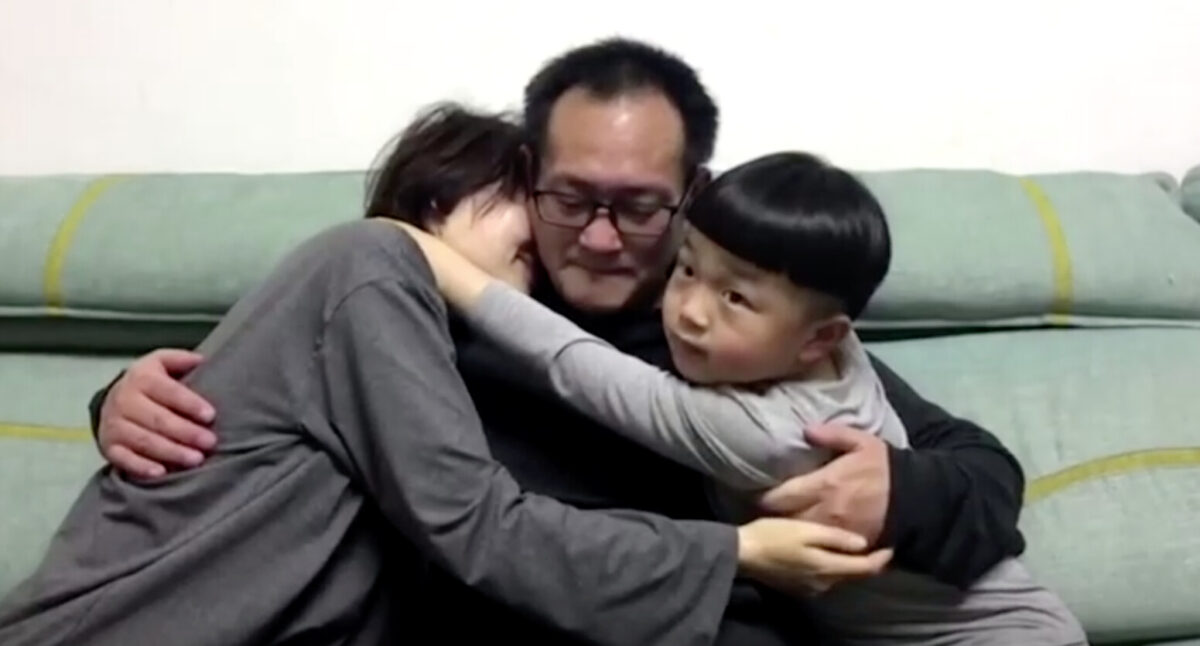
And then on 27 April 2020: ‘Feels Like a Dream’: Teary Reunion for Freed Chinese Human Rights Lawyer and Family
Wang Quanzhang embraces his wife and son at their home in Beijing, on April 27, 2020. (Screenshot via Reuters)
In the midst of the COVID-19 crisis, many human rights organisations have been formulating a policy response. While I cannot be complete or undertake comparisons, I will try and give some examples in the course of the coming weeks. Here the one by Sam Gregory of
…..The immediate implications of coronavirus – quarantine, enhanced emergency powers, restrictions on sharing information – make it harder for individuals all around the world to document and share the realities of government repression and private actors’ violations. In states of emergency, authoritarian governments in particular can operate with further impunity, cracking down on free speech and turning to increasingly repressive measures. The threat of coronavirus and its justifying power provides cover for rights-violating laws and measures that history tells us may long outlive the actual pandemic. And the attention on coronavirus distracts focus from rights issues that are both compounded by the impact of the virus and cannot claim the spotlight now.
We are appalled by the conduct of Kenya security agents as shown in this citizen video. All perpetrators of this act must be held to account. Police and other law enforcement agents must safeguard human rights even as they enforce govt’s regulation during this time. #CurfewKenyapic.twitter.com/MUfxGGKl8A
In this crisis moment, it is critical that we enhance the abilities and defend the rights of people who document and share critical realities from the ground. Across the three core thematic issues we currently work on, the need is critical. For issues such as video as evidence from conflict zones, these wars continue on and reach their apex even as coronavirus takes all the attention away. We need only look to the current situation in Idlib, Yemen or in other states of conflict in the Middle East.
For other issues, like state violence against minorities, many people already live in a state of emergency.
Coronavirus response in Complexo do Alemão favela, Rio de Janeiro (credit: Raull Santiago)
Favela residents in Brazil have lived with vastly elevated levels of police killings of civilians for years, and now face a parallel health emergency. Meanwhile immigrant communities in the US have lived in fear of ICE for years and must now weigh their physical health against their physical safety and family integrity. Many communities – in Kashmir and in Rakhine State, Burma – live without access to the internet on an ongoing basis and must still try and share what is happening. And for those who fight for their land rights and environmental justice, coronavirus is both a threat to vulnerable indigenous and poor communities lacking health care, sanitation and state support as well as a powerful distraction from their battle against structural injustice.
A critical part of WITNESS’ strategy is our work to ensure technology companies actions and government regulation of technology are accountable to the most vulnerable members of our global society – marginalized populations globally, particularly those outside the US and Europe, as well as human rights defenders and civic journalists. As responses to coronavirus kick-in there are critical implications in how both civic technology and commercial technology are now being deployed and will be deployed.
Already, coronavirus has acted as an accelerant – like fuel on the fire – to existing trends in technology. Some of these have potentially profound negative impacts for human rights values, human rights documentation and human rights defenders; others may hold a silver lining.
My colleague Dia Kayyali has already written about the sudden shift to much broader algorithmic content moderation that took place last week as Facebook, Twitter, Google and YouTube sent home their human moderators. Over the past years, we’ve seen the implications of both a move to algorithmic moderation and a lack of will and resourcing: from hate speech staying on platforms in vulnerable societies, to the removal critical war crimes evidence at scale from YouTube, to a lack of accountability for decisions made under the guise of countering terrorist and violent extremist content. But in civil society we did not anticipate that such a shift to more broad algorithmic control would happen so rapidly in such a short period of time. We must closely monitor and push for this change not to adversely affect societies and critical struggles worldwide in a moment when they are already threatened by isolation and increased government repression. As Dia suggests, now is the moment for these companies to finally make their algorithms and content moderation processes more transparent to critical civil society experts, as well as reset on how they support and treat the human beings who do the dirty work of moderation.
WITNESS’s work on misinformation and disinformation spans a decade of supporting the production of truthful, trustworthy content in war zones, crises and long-standing struggles for rights. Most recently we have focused on the emerging threats from deepfakes and other forms of synthetic media that enable increasingly realistic fakery of what looks like a real person saying or doing something they never did.
We’ve led the first global expert meetings in Brazil, Southern Africa and Southeast Asia on what a rights-respecting, global responses should look like in terms of understanding threats and solutions. Feedback from these sessions has stressed the need for attention to a continuum of audiovisual misinformation including ‘shallowfakes’, the simpler forms of miscontextualized and lightly edited videos that dominate attempts to confuse and deceive. Right now, social media platforms are unleashing a series of responses to misinformation around Coronavirus – from highlighting authoritative health information from country-level and international sources, to curating resources, offering help centers, and taking down a wider range of content that misinforms, deceives or price gouges including even leading politicians, such as President Bolsonaro in Brazil. The question we must ask is what we want to see internet companies continue to do after the crisis: what should they do for a wider range of misinformation and disinformation outside of health – and what do we not want them to do? We’ll be sharing more about this in the coming weeks.
And where can we find a technological silver lining? One area may be the potential to discover and explore new ways to act in solidarity and agency with each other online. A long-standing area of work at WITNESS is how to use ‘co-presence’ and livestreaming to bridge social distances and help people witness snd support one another when physical proximity is not possible.
Our Mobil-Eyes Us project supported favela-based activists to use live video to better engage their audiences to be with them, and provide meaningful support. In parts of the world that benefit from broadband internet access, and the absence of arbitrary shutdowns, and the ability to physically isolate, we are seeing an explosion of experimentation in how to operate better in a world that is both physically distanced, yet still socially proximate. We should learn from this and drive experimentation and action in ensuring that even as our freedom of assembly in physical space is curtailed for legitimate (and illegitimate) reasons, our ability to assemble online in meaningful action is not curtailed but enhanced.
In moments of crisis good and bad actors alike will try and push the agenda that they want. In this moment of acceleration and crisis, WITNESS is committed to ensuring an agenda firmly grounded, and led by a human rights vision and the wants and needs of vulnerable communities and human rights defenders worldwide.
In the midst of the COVID-19 crisis, many human rights organisations have been formulating a policy response. While I cannot be complete or undertake comparisons, I will try and give some examples in the course of the coming weeks. Here the one by Kerry Kennedyof
…Nearly 52 years later, it is just as imperative that we take to heart his message to “remember those who live with us,” that our societal response to the coronavirus pandemic be tethered to the same strong sense of equity and social justice of which my father spoke.
In the midst of this global pandemic, that means:
Remembering the most vulnerable—those without a stable or permanent home, those with disabilities, and those without a safety net who have no ability to work from the shelter of their homes or take time off, by ensuring that everyone has access to adequate, affordable healthcare. Those of us who can afford to stock our pantries with reserves must not hoard, instead ensuring that local food depositories and soup kitchens are sufficiently funded and supplied.
Remembering the prisoners—who are unable to practice social distancing to prevent the spread of illness. At Robert F. Kennedy Human Rights, we echo the increasing calls to release people being detained pretrial and in immigration detention, starting with the most vulnerable, to ease spread of the virus in crowded, unjust lockups. Jail and immigration detention should never equate to death sentences, and we hope that the current public health crisis will help us see with new eyes how these systems of mass human caging are and have always been so incredibly cruel, dangerous, violent, and unnecessary.
Remembering the truth tellers—as national governments increasingly declare states of emergency to bolster their responses to the pandemic and save lives, we must keep a watchful eye, given the rise of authoritarianism, to ensure that civic space is protected. Governments around the world have made a practice of using such states of emergency to curtail the legitimate activity of human rights defenders. These actions, such as China’s mandate that citizens carry cell phones so they can be constantly tracked, followed by Israel’s announcement that its citizens must do the same, must comply with international law mandating timeliness and sunset clauses, proportionality and nondiscrimination.
Remembering the first responders—our public health officials, the workers stocking the shelves of our grocery stores, and all others who are ensuring that our basic needs are met are putting their lives on the line. The government must do its utmost to make sure that these human rights defenders are armed with necessary resources and protections, including economic security, to stem the outbreak and stay safe.
International human rights law offers us a blueprint for action, reminding us that all citizens of the world have inalienable rights—no matter their race, gender, background, income level, or sexual orientation.
In the midst of the COVID-19 crisis, many human rights organisations have been formulating a policy response. While I cannot be complete or undertake comparisons, I will try and give some examples in the course of the coming weeks. If there are special ones you would like to draw my attention to, please do not hesitate. Here is one from Phil Lynch, the Director of the International Service for Human Rights:
Staying true to our values is never more important than during times of hardship or crisis. At ISHR, there are five values driving our response to the COVID-19 global pandemic: solidarity, dynamism, alertness, wellbeing and hope.
Solidarity
…Solidarity is an essential value at this time. At ISHR this means showing solidarity with colleagues – with a number of staff volunteering to help and alleviate the workload of others who may have reduced capacity – as well as solidarity with human rights defenders, with our programme staff reaching out to national and regional-level partners to discuss their wellbeing, situation, priorities and needs. Please do reach out to us if there are any ways we can provide support to you at this vital time. In addition to showing solidarity, we’ve also greatly appreciated receiving solidarity. I’ve personally benefited from the wisdom, insights and advice of other NGO directors in terms of their response to this crisis, and discovered the musical talents of neighbours as we’ve gathered on our balconies every evening to clap and sing our gratitude to the doctors, health care professionals and sanitation workers on the frontlines of this crisis.
Dynamism
This crisis has highlighted the importance of dynamism, adaptability and planning for uncertainty, as well as the limitations of log frames, tightly earmarked funds, and donor restrictions on building organisational reserves.
At ISHR we are determined to use this crisis as an opportunity to innovate and to test and expand new ways of working. Last year, thanks to the support of several donors – including the United Kingdom, Canada, Switzerland and the Netherlands – we launched the ISHR Academy – an interactive, online platform to build the capacity and skills of human rights defenders to leverage the UN human rights system to contribute to national level change. With a significantly increased demand for online training and strategic advocacy support, we’re currently working on new modules for the Academy, as well as translation into Spanish. With further financial support we’d love to develop even more modules and in additional languages. This would increase access to resources, strategic advice and tailored advocacy support for human rights defenders from all regions. The suspension, postponement and cancellation of a significant number of meetings and sessions of international and regional human rights mechanisms has starkly exposed the need for such bodies to develop means by which human rights defenders can more effectively engage and participate remotely. This is relevant not only now in response to the COVID-19 crisis, but in the longer term in response to the climate crisis and the imperative of reducing travel-related emissions. Effective means of virtual participation are also critical for defenders who lack the resources to travel to Geneva or New York, as well as those for whom travel may be restricted or banned by repressive governments. ISHR programme staff are actively engaged on these issues – leading and participating in strategic discussions and the formulation of practical recommendations as to how to use this crisis as an opportunity to make human rights mechanisms more accessible, effective and protective for defenders worldwide.
Alertness
ISHR is not the only body looking at ways to use this crisis as an opportunity. Unfortunately, some governments will use this emergency as a subterfuge to more permanently increase surveillance, as well as restrict fundamental rights to freedom of expression, association, assembly, protest and movement. Alertness is therefore a critical value at this time. We must be vigilant to ensure that any laws or regulations enacted in response to COVID-19 are for the legitimate purpose of protecting public health, and that any restrictions they impose are reasonable, proportionate and strictly time bound….With persons in detention at particular risk, ISHR staff are also using the opportunity to push for the release of arbitrarily detained human rights defenders, including several with underlying health conditions in States including China, the United Arab Emirates and Bahrain.
Wellbeing
..All ISHR staff have worked remotely since at least 13 March, with exceptions only for staff that need to attend the Geneva office for short periods for essential functions. Staff are working from various locations and states of confinement in Switzerland, France, New York, London, Brussels, Abidjan and Jakarta. We have agreed a complete restriction on work-related travel, with both this restriction and the work from home arrangements remaining in place for the indefinite future.
….Financial security is imperative at this time and I am so impressed and thankful for the initiative of major donors such as the Sigrid Rausing Trust and the Open Society Foundations to proactively reaffirm their funding commitment, to indicate that they will be highly flexible in the use of funds and reporting requirements, and to invite us to reach out if we need further support. Best practice at this time of unprecedented uncertainty is to enable the conversion of project or earmarked funds to core or unrestricted funds. I am working with the Board to evaluate and prepare for a range of scenarios, ensuring the long term sustainability of ISHR. Your contributions as private donors will be vital in this regard – every donation helps!
Hope
The final value motivating ISHR at this time is that of hope, which we draw from many places.
We take hope from the doctors, health care professionals and sanitation workers who bravely and tirelessly provide vital care and support.
….
I wish you, your families, your loved ones and your colleagues are and remain healthy, safe and well.
Intentionally shutting down or restricting access to the internet violates multiple rights and can be deadly during a health crisis such as the COVID-19 pandemic, Human Rights Watch said on 31 March 2020. Governments that are currently imposing an internet shutdown, such as Bangladesh, Ethiopia (it just announced restoring service), India, and Myanmar, should lift them immediately to save lives. During a health crisis, access to timely and accurate information is crucial. People use the internet for updates on health measures, movement restrictions, and relevant news to protect themselves and others.
“Internet shutdowns block people from getting essential information and services,” said Deborah Brown, senior digital rights researcher and advocate. “During this global health crisis, shutdowns directly harm people’s health and lives, and undermine efforts to bring the pandemic under control.” For people around the world staying at home, either willingly or because of government restrictions, the internet is critical to communicate with doctors, family, and friends. For many children and others seeking an education, it is needed to continue learning as schools shutter around the world.
[Internet shutdowns have become increasingly common in recent years, usually during tense periods, such as elections, anti-government protests, or armed conflicts. Thirty-three countries enforced 213 internet shutdowns in 2019, according to Access Now. Government justifications ranged from a need to combat fake news to public safety and national security.[
There is a list – updated monthly – by the One Free Press Coalition of nearly 40 news organizations, which identifies the 10 most urgent cases threatening press freedom around the world. Understanding the COVID-19 requires unbiased journalists, whose work requires protection. Not only does the act of informing the public carry risk to one’s own health but, in many countries, risk of retaliation. In China, freelance video journalist Chen Quishi disappeared on February 6 after informing family of plans to report on a temporary hospital in Wuhan, where the virus originated. Beijing has since expelled journalists from outlets including The Wall Street Journal, The New York Times and The Washington Post and demanded personnel information from Voice of America and TIME. Mohammad Mosaed, a reporter in Iran who criticized the government’s response to the pandemic, has been barred from practicing journalism and suspended from social media. Family members of imprisoned Egyptian journalist Alaa Abdelfattah were detained for protesting on behalf of prisoners who are vulnerable to the spread of the virus. An Azerbaijani journalist freed in mid-March described detention conditions allowing one shower per week, without soap, he told CPJ
Journalist, who warned about pandemic, banned from work and social media.
Freelance economic reporter Mohammad Mosaed awaits a court date, after intelligence agents of the Islamic Revolutionary Guard Corps (IRGC) arrested and interrogated him in February regarding social media accounts critical of government. The criticism included lack of preparedness to tackle the coronavirus outbreak. Until trial, authorities bar him from practicing journalism and suspended his social media accounts. Last year he endured 16 days in Evin prison for his tweets and was released on bail.
Editor facing potential detention, arrested again March 28.
Rappler editor Maria Ressa is scheduled for trial April 24, expecting a verdict on a cyber-libel charge brought by local businessman Wilfredo Keng regarding a May 2012 story. The relevant law took effect four months after the story in question was published. Depending how judges interpret the 2012 Cybercrime Prevention Act, Ressa could face six years in prison.
Family of jailed journalist protests prisons’ inaction to prevent COVID-19 threat.
While blogger Alaa Abdelfattah is held in Cairo’s Tora Prison, three of his family members face charges of unlawful protest, illegal assembly and obstructing traffic in their call to protect prisoners from the spread of coronavirus. They were released on bail exceeding $300 apiece. After reporting about politics and human rights violations, Abdelfattah has endured threats and been told he will never go free if he speaks of guards’ abuse.
Journalist covering coronavirus disappeared more than six weeks ago.
Freelance video journalist Chen Quishi has not been seen since February 6, when he informed family of plans to report on a temporary hospital. In late January, he had traveled from Beijing to the city of Wuhan in Hubei province and began filming and reporting on the coronavirus health crisis, according to his posts on YouTube. Friends running his Twitter account believe he is likely held in residential surveillance.
Journalist fears for her life, amid government-orchestrated threats.
After 19 years of persecution and legal censorship, award-winning journalist Claudia Julieta Duque told IWMF that she learned on February 29 about an ongoing criminal threat against her life. According to Duque, agents of the state institution in charge of protecting human rights defenders and at-risk journalists, called the National Protection Unit (UNP), were reportedly ordered to carry out intelligence activities to infiltrate Duque’s security scheme and threaten her welfare.
Imprisoned publisher undertook hunger strike while awaiting appeal.
No date has been set, following postponement of a March 12 appeal in the case of Martin Inoua Doulguet, publisher of Salam Info. He was found guilty on criminal charges of defamation and conspiracy in September, and sentenced to three years in prison. The privately owned quarterly newspaper reports on crime and politics in Chad, and Doulguet’s penalty includes a $1,675 fine and paying part of $33,514 in plaintiff damages.
Journalist serving life sentence prepares for final appeal.
On April 6, a Kyrgyz court is scheduled to hear the final appeal in the case of award-winning journalist Azimjon Askarov. The ethnic Uzbek, who reported on human rights, has spent more than nine years imprisoned on trumped-up charges that included incitement to ethnic hatred and complicity in the murder of a police officer. The decade-long case has drawn persistent international condemnation, and Kyrgyzstan’s only imprisoned journalist’s health deteriorates.
Cuban journalist Roberto Jesús Quiñones has spent more than six months behind bars, experiencing worsening treatment. Staff listen to all of his phone calls, have served him food containing worms, and upon learning of his secretly publishing from prison, suspended family visits and put him in solitary confinement. A municipal court in Guantánamo sentenced him to serve one year as a result of “resistance” and “disobedience” when police beat and detained him for covering a trial as a CubaNet contributor last April and his refusal to pay a fine imposed on him following this incident.
Reporter experiences repeated retaliation for his work.
On two different occasions last year, Benin courts delivered prison sentences to Ignace Sossou, a reporter for privately owned site Web TV. First was a one-month imprisonment and fine of $850 for publishing “false information” about local business dealings. Then an 18-month sentence and fine of $337 for defamation and disinformation in his reporting public statements made by Public Prosecutor Mario Mètonou.
Turkish and U.S. leaders continue pressuring for murdered journalist’s justice.
On March 25 Turkish officials indicted 20 Saudi nationals in the ongoing pursuit for answers surrounding Jamal Khashoggi’s brazen killing in Istanbul in 2018 and the Saudi crown prince’s role. That follows a March 3 news conference with U.S. Senator Ron Wyden, Representative Tom Malinowsk, and The Washington Post columnist’s fiancé, Hatice Cengiz, announcing that they are invoking procedures within the Senate Intelligence Committee to provide a congressional release of information from intelligence agencies.
On 27 March 2020 HRW Europe said that people in immigration detention in European countries pending deportation should be given alternatives to detention amid the COVID-19 pandemic. “While entire societies learn to live under lockdown, we shouldn’t forget about people locked up because they have the wrong papers,” said Judith Sunderland, associate Europe and Central Asia director at Human Rights Watch. “Authorities across Europe should take measures to protect the health and rights of detainees and staff in immigration detention centers, including by releasing people and finding alternatives to detention.” ….As travel bans increasingly prevent forced returns and courts limit their activities, the reason that thousands of people across the EU and other European states may be held in detention – imminent deportation – is no longer justified. The EU Returns Directive allows detention pending deportation for up to 18 months, but stipulates that if “a reasonable prospect of removal no longer exists…detention ceases to be justified and the person concerned shall be released immediately.”
Amnesty International issues a call for action re Greece: While the world is facing the crisis of COVID-19 pandemic, the risks for refugees in the Greek islands are multiplying by the hour. Thousands of older people, people with chronic diseases, children, pregnant women, new mothers and people with disabilities are trapped there in dangerously overcrowded conditions. Now, they also face the threat of the COVID 19 pandemic, the consequences of which would be catastrophic for those confined in camps. In addition to protecting the rest of the population, the Greek Government must take immediate measures to protect refugees from the pandemic and move them to safety.
…In a statement of principles on the treatment of prisoners and detainees amid the COVID-19 crisis, the European Committee for the Prevention of Torture, a body of the CoE, asked authorities to use alternatives to detention “and refrain, to the maximum extent possible, from detaining migrants.” On March 25, its sister body, the UN Subcommittee on the Prevention of Torture urged all states to reduce populations in detention centers and refugee camps “to the lowest possible level.” The same day, UN High Commissioner for Human Rights Michelle Bachelet said governments should “work quickly to reduce the number of people in detention” to mitigate the risk of COVID-19 “rampaging through such…extremely vulnerable populations.” On March 26, Council of Europe Commissioner for Human Rights Dunja Mijatović echoed the call to release detainees from immigration detention to the extent possible.
Moroever, we should not forget that more than three quarters of refugees live in developing countries in the Americas, Africa, the Middle East and Asia. As the Reuters and Al-Jazeeraa stories (link below) makes clear, a COVID-19 outbreak would put extraordinary strain on fragile local health-care services and likely result in avoidable suffering and death. Preventing or delaying outbreaks, particularly among the most vulnerable, is the most important action we can take right now.
From the myriad of messages on the spread and impact of the Covid-19 virus, here a few excerpts:
On 27 March 2020, Rosa Kornfeld-Matte, UN Independent Expert on the enjoyment of all human rights by older persons said that society has a duty to exercise solidarity and better protect older persons who are bearing the lion’s share of the COVID-19 pandemic. “Reports of abandoned older persons in care homes or of dead corpses found in nursing homes are alarming. This is unacceptable,” said “We all have the obligation to exercise solidarity and protect older persons from such harm.” Older persons .. are further threatened by COVID-19 due to their care support needs or by living in high-risk environments such as institutions, the expert said. [https://reliefweb.int/report/world/unacceptable-un-expert-urges-better-protection-older-persons-facing-highest-risk-covid]
—–
Adrien-Claude Zoller, President of the small NGO ‘Geneva for Human Rights – Global Training’ issued a statement of solidiarity ith the marginalised who will suffer most:….As a human rights organisation, Geneva for Human Rights is deeply worried about the situation of the most vulnerable, of the unemployed and homeless, of those in extreme poverty, of people with disabilities, of women already assuming so many tasks, of the elderly, of those arbitrarily detained in overcrowded prisons, of minorities, migrants, internally displaced, refugees, and indigenous peoples. It is a matter of human dignity. Human rights are at stake. Many Governments first denied, then de-dramatized the spread of the virus, before taking measures to contain it and limit the damage for their economy. Too often in these measures, the social impact of both the health and the economic crises is neglected. We all fully support efforts to eradicate the virus. At the same time, we should not forget the commitment of the international community to eradicate extreme poverty (‘Sustainable Development Goal’, Nr.1). We have to protect the most vulnerable. ….Countrywide lockdowns imply a limitation of human rights. Indeed, complying with these emergency rules, including home confinement, is a moral imperative, a matter of solidarity to slow down the spread of the virus in our communities, and to support those on the frontline, in particular health- and social workers. However, we should recall that measures derogating from human rights obligations in ‘public emergency which threatens the life of the nation’ have to be limited ‘to the extent strictly required by the exigencies of the situation’. They have to be proportionate, limited in time, and in no way discriminatory (International Covenant on Civil and Political Rights, Article 4, United Nations, 16 December 1966). In many countries, such derogations led to special powers attributed to the Executive branch. Still, the principles of proportionality and non-discrimination have to apply. Parliamentary control and the Rule of Law remain a must, as well as transparency and access to all the information. We are dismayed that in several ‘denying’ countries (e.g. China at the beginning of the pandemic, Brazil, Egypt, Turkey) journalists, physicians, health workers and human rights defenders, are targeted for having exposed the gravity of the situation and the fate of marginalized people…………
The G20 seems to be aware as shown by a portion of their recent statement: “Enhancing Global CooperationWe will work swiftly and decisively with the front-line international organizations, notably the WHO, IMF, WBG, and multilateral and regional development banks to deploy a robust, coherent, coordinated, and rapid financial package and to address any gaps in their toolkit. We stand ready to strengthen the global financial safety nets. We call upon all these organizations to further step up coordination of their actions, including with the private sector, to support emerging and developing countries facing the health, economic, and social shocksof COVID-19.We are gravely concerned withthe serious risks posed to all countries, particularly developing and least developed countries, and notably in Africaand small island states, where health systems and economies may be less able to cope with thechallenge, as well as the particular risk faced by refugees and displaced persons. We consider that consolidating Africa’s health defense is a key for the resilience of global health. We will strengthen capacity building and technical assistance, especially to at-risk communities. We stand ready to mobilize development and humanitarian financing” [https://g20.org/en/media/Documents/G20_Extraordinary%20G20%20Leaders%e2%80%99%20Summit_Statement_EN%20(3).pdf]
Since the adoption of the EU strategic framework on human rights and democracy in 2012, the EU has adopted two EU Action Plans (2012-2014 and 2015-2019). The new proposal follows up on this, setting out the priorities for the period of 2020-2024.
This Action Plan identifies priorities around five mutually reinforcing lines of action:
Protecting and empowering individuals;
Building resilient, inclusive and democratic societies;
Promoting a global system for human rights and democracy;
New technologies: harnessing opportunities and addressing challenges;
Delivering by working together.
What is new in this Action Plan?
The new Action Plan builds on the previous action plans and continues to focus on some long-standing priorities, such as supporting human rights defenders and the fight against death penalty. More importance is given to empower people and defeat discrimination on all grounds. It also addresses more prominently the accountability gap, the erosion of rule of law and access to justice. This Action Plan takes account of today’s world new challenges and therefore focuses in particular on:
environmental challenges and climate change;
leveraging the benefits of digital technologies and minimising the risks of misuse in line with EU’s commitment to lead the transition to a new digital world;
stepping up economic, social and cultural rights;
more emphasis on democracy, including on the misuse of online technologies and shrinking civic and political space;
a stronger focus on human rights defenders;
strategic communication and public diplomacy.
How will the Action Plan be implemented?
The objectives under the Action Plan will be implemented at country, regional and multilateral level, taking account of local circumstances and specificities. The EU will leverage the broad range of policies, tools and political and financial instruments at its disposal to implement it, such as:
political, human rights and sectoral policy dialogues;
EU trade policies, including the EU’s generalised scheme of preferences;
thematic and geographical instruments under the 2021-2027 multiannual financial framework;
actions in multilateral and regional human rights fora;
communication activities and awareness‑raising campaigns;
dialogue with civil society, human rights organisations and the business sector.
The EU Action Plan provides guidance to over 140 EU Delegations and Offices as well as Member States embassies for targeted initiatives and actions at country level all over the world.
How will the Commission and the High Representative follow up on and monitor the implementation of this Action Plan?
Actions apply to all regions in the world taking into consideration local needs and specificities. The EU’s 142 Delegations and Offices will take a lead in reflecting the priority actions in initiatives at the country level including through the adoption of tailored-made strategies at a local level. The EU will also engage with different stakeholders on the overall implementation, and organise an annual meeting with civil society. The public EU annual report on Human rights and democracy in the worldis another effective tool to monitor the progress made in a transparent manner. A mid-term review of the implementation is foreseen.
What has the EU achieved on human rights and democracy worldwide so far?
Since 2015, more than 30 000 human rights defenders were protected by the EU via the dedicated mechanism ProtectDefenders.eu. In 2019 alone, the EU raised Human Rights Defenders cases in dialogues and consultations with over 40 countries.
The EU advocated for abolition of death penalty.
Between January 2015 and October 2019, the EU supported over 3 350 actions relevant to children’s rights in 148 third countries and territories. For example, under the global programme on Female Genital Mutilation (€11 million), 16 countries adopted action plans and 12 established national budget lines to put an end to Female Genital Mutilation.
In 2014-2019, the EU supported democracy in more than 70 partner countries with €400 million aiming at, for instance, contributing to the organisation of elections and supporting oversight bodies, independent media, parliaments and political parties to play their essential role in democratic societies. 98 EU Election Observation Missionswere deployed worldwide.
The General System of Preference contributed to the implementation of human rights and labour Conventions, including through monitoring missions in 11 countries in the last year. For example, this contributed to a reduction of child labour to 1% in Sri Lanka through pioneering ‘Child Labour Free Zones’.
Joint Proposal
…Article 22 of the Treaty on the European Union offers the European Council the possibility to adopt a unanimous Decision setting out the EU’s strategic interests and objectives in specific areas of the Common Foreign and Security Policy (CFSP). Once the European Council sets the strategic objectives, the Council would then be able to adopt by qualified majority (QMV) decisions implementing the European Council’s strategic decisions.
Why is this proposed now? In 2018, the Commission has proposed to move from unanimity to QMV in certain areas of the CFSP. The Von Der Leyen Commission recognises that to be a global leader, the Union needs to take decisions in a faster and more effective way and overcome unanimity constraints that hamper our foreign policy, as set out in the High Representative/Vice-President’s mission letter. The Joint Proposal adopted by the College today offers such a possibility, by proposing to take decision related to the implementation of the Action Plan by QMV.
The Bandera County Courrier of 7 March 2020 referred to the following four women human rights defenders from four non-European countries who should serve as examples for the many who are tirelessly fighting for their rights.
Mexico: Norma Librada Ledezma
Norma Librada Ledezmas 15 – year-old daughter Paloma disappeared on2 March 2002 in Chihuahua, Mexico. 27 For days, the mother searched desperately for her daughter . The police did not give her any support. At the 29. March 2002 Paloma’s body was found. Ledezma is convinced that if the police had investigated earlier and more thoroughly, their daughter could have been saved. That day, the Mexican founded the organization “Justicia para nuestras hijas”, which means: justice for our daughters. This provides legal advice and support in cases of feminicide (murder of women). The same applies to human trafficking and kidnapping. Ledezma wants justice for the victims and the families affected. The Mexican has already supported more than 200 investigations into cases of feminicide and kidnapping. The death of her daughter Paloma is not an isolated case in Mexico. According to UN Women, around ten women are killed in Mexico every day. Ledezma has been able to improve the investigation of feminicides in the country with her work. The Mexican woman has also set up a public prosecutor’s office in Chihuahua that specializes in crimes against women as victims. For her commitment, Ledezma has been nominated for the Martin Ennals Human Rights Award, an award for people and organizations who are committed to protecting human rights. [see also: https://humanrightsdefenders.blog/2019/12/05/daughters-murder-motivated-norma-ledezma-to-hunt-for-mexicos-disappeared/]
Norma Librada Ledezma Photo: Martin Ennals Foundation
India: Malti Tudu
Malti Tudu has a mission: she wants to end child marriage in her homeland, the state of Bihar, India. In the tribe the number of child marriages is particularly high. 74 percent of women get married under 18 year For the young activist, one thing is certain: children should not be forced to marry. According to Unicef, child marriage violates the rights of girls and boys, with girls being affected five times more often. The married girls have to drop out of school. Teenage mothers also die more often than mature women from complications during pregnancy or childbirth. Tudu has been fighting child marriage in Bihar for more than two years. The activist has partnered with other women. Together they educate the residents in the surrounding villages and try to prevent as many child marriages as possible. The women also get a lot of headwind in their actions. But Tudu remains persistent – with success. She has already saved several girls from getting married. In the meantime, she has become a role model for many young women in India. In recent years, more and more women have come together to fight child marriage in India. And there is progress: In the past ten years, the proportion of child marriages in India has gone from 50 percent to 27 percent.
Kenya: Christine Ghati Alfons
Christine Ghati Alfons, a young Kenyan, is fighting for the circumcision of girls to stop. That is not easy. Many in their homeland are still convinced that circumcised women have better chances of marriage and are better integrated into the community. Officially, genital mutilation has been official in Kenya since 2011 forbidden. Nevertheless, according to the United Nations, one in five women is still between 15 and 49 years in Kenya – the mutilation happens in private clinics or at home.
Christine Ghati Alfons. Photo: private
Had her father not stood up for her then, Alfons would have been circumcised. His involvement broke a taboo in the community – and had consequences. He was killed because he wanted to protect his eight-year-old daughter. Alfons didn’t know anything about her father’s courage for a long time. Because all of her friends were circumcised, she wanted that too. The vehemence with which her mother forbade her surprised her. When they talked about the risk of contracting HIV during circumcision at school, Alfons decided against it. Only then did she learn from the mother why her father died. “I want to make my father proud,” says Alfons today. She is committed to girls who have no one to stand up for them. The 27 year-old founded the organization “Safe Engage Foundation ”with which she goes to the communities to talk to children, parents and teachers, to convince them of the cruelty. When genital mutilation occurs, the clitoris and labia become partially or completely away. In particularly severe cases, the entire external genitalia is cut off and sewn back up except for a hole the size of a matchstick. The circumcised women torture themselves throughout their lives with physical and psychological pain. Not only in Africa, but also in Asia and the Middle East.
Saudi Arabia: Manal al Sharif
Manal al Sharif becomes famous in Saudi Arabia in 2011 with a shaky cell phone video that she films in an apparently banal activity: she is behind the wheel of a car. At the time, the autocratic monarchy was the last country in the world where women were prohibited from driving a car.
Manal al Sharif. Photo: Andreas Gebert / dpa
The eight-minute recording shows Sharif, an IT consultant, driving through the streets of the Saudi city of Khobar. She speaks to her friend and co-activist Wajeha al Huwaider, says things like: “We want change in our country” and: “A woman deserves the same rights as every man.” And she is optimistic. “Things will change – God willing.” A lot has happened since the video went viral. Initially, the Sharif admission jailed for eleven days. The repressive regime accuses her of “inciting public opinion against the state”. When she is released, she leaves the country because of death threats. But Sharif’s video fired the Saudi “Women2Drive” movement. And even after her emigration, the activist remains part of the movement, campaigning for women’s rights in Saudi Arabia. 2018 the Saudi Crown Prince Mohammed bin Salman – de facto the most powerful man in the country – allows women to drive. Nevertheless, he continues to take decisive action against critics of the Kingdom. According to Amnesty, some women’s rights activists, such as Loujain al Hathloul, have been detained for several years, relatives report torture. Sharif now lives in Sydney, has written a book about her experiences and is committed to Women in their country of origin…Manal al Sharif is now considered one of the most important women rights activists in Saudi Arabia.









 Hans Thoolen on Human Rights Defenders and their awards