Author Archive

Belarus an ‘absolute catastrophe” says human rights defender Ales Bialiatski

March 9, 2021

Pip Cook in Geneva Solutions of 9 March 2021 published a rich, detailed interview with Belarus human rights defender Ales Bialiatski [see: https://www.trueheroesfilms.org/thedigest/laureates/6CF69C2A-4101-6782-F0AB-53A307E9F7B2]

Ales Bialiatski laying flowers at a memorial to Aliaksandr Taraikouski, a protester who was killed during a demonstration on August 10, 2020. Credit: HRC Viasna

On February 16, Ales Bialiatski’s home and the offices of his human rights organisation Viasna in Minsk were raided by police. He was targeted along with more than 40 other human rights defenders, journalists and their relative in towns across the country, with reports of officials using excessive force while seizing phones, computers and credit cards.

Bialiatski, one of Belarus’ most prominent human rights defenders, says the authorities were looking for any evidence of organisations or journalists “financing” peaceful protests against the country’s president Alexander Lukashenko. The raids are the latest development in the government’s brutal crackdown on mass protests which have been ongoing in the country since Lukashenko claimed victory in a rigged election last August. [see also: https://humanrightsdefenders.blog/tag/ales-bialiatski/]

The authorities have recently opened a criminal case against Viasna and Bialiatski himself. A former political prisoner who spent nearly three years jailed in Minsk, he says that, by the time this article is published, he may once again be behind bars.

Millions of people want change, and the answer of the government is repression,” says Bialiatski, speaking to Geneva Solutions from the Right Livelihood Foundation offices in Geneva. He and Viasna received the prestigious award in 2020.

Seven months on from the election, more than 33,000 people have been detained, and there are widespread reports of police brutality, arbitrary arrests, kidnapping, and torture of detainees.

The human rights situation in Belarus is, in Bialiatski’s words, “an absolute catastrophe”. “The situation is quite horrible because it’s not only human rights defenders that suffer,” he explains. “It’s all levels of society. Anybody who can think.”

Over half a year since the first protests broke out in the capital Minsk, he says the authorities are still tightening their grip on personal freedoms and carrying out grave human rights violations, targeting activists, journalists and anyone who opposes the regime. But the people of Belarus are not giving up.

What’s going on in Belarus? The government’s crackdown in Belarus follows mass protests in the country last summer after a fraudulent election in which Lukashenko, known as “Europe’s last dictator”, claimed to have won 80 per cent of the vote. The poll is widely accepted to have been rigged to extend his 25-year rule, prompting the largest demonstrations in the country’s history.

Elections in Belarus have never been considered free and fair by many international observers. Bialiatski has been working to advocate for democratic freedoms in the country since his early twenties, when the country was still under Soviet rule.

He founded Viasna in 1996, five years after Belarus gained independence from the Soviet Union and two years after Lukashenko came to power. The organisation’s initial aim was to help thousands of protesters arrested during mass pro-democracy rallies after Lukashenko brought in sweeping constitutional reforms that consolidated his authoritarian rule.

“[My colleagues and I] thought that this work would finish in a few years because the problem would disappear,” says Bialiatski. “But it’s been 25 years and there’s still work to do. It’s never ended. Unfortunately, the human rights situation never got better.”

Accusations of rigged elections, brutal suppression of civil rights and corruption have been hallmarks of Lukashenko’s half a century in power. However, Bialiatski says last year’s poll acted as a catalyst. It was then that Belarusian society finally “woke up” and demanded change.

Breaking the silence. In the run-up to elections in Belarus in 2020, a number of opposition figures became extremely popular, including former members of Lukashenko’s government and Sergei Tikhanovskya, a well-known blogger who travelled the country interviewing former loyal supporters of the ruler about why they had turned against him.

Although Lukashenko jailed or exiled many of his opponents, he did not see Sviatlana Tsikhanovskaya – who ran in the place of her husband when he was imprisoned – as a significant threat. However, Tsikhanovskaya became hugely popular, gaining the support of fellow opposition figures and attracting large crowds of supporters to her rallies.

Events in 2020 drastically impacted the Lukashenko’s loyal following and damaged his reputation. The country’s already dire economic situation was exacerbated by the Covid-19 crisis, which the ruler has fervently denied, refusing to bring in restrictions and joking that the virus could be fought with vodka and work in the country’s potato fields. “Lukashenko was laughing into the world’s face and denying the existence of the virus, while people all around were dying,” says Bialiatski.

Tsikhanovskaya was widely expected to win the vote in a landslide. Although independent polling is illegal in Belarus, making it difficult to measure her lead in the run up to the election, some independent exit polls conducted outside polling stations in foreign embassies on election day showed her to have received 79.69 per cent of the vote while Lukashenko received just 6.25 per cent.

When the government announced it had won 80 per cent of the vote, claiming that Tsikhanovskaya had received less than 10 per cent, Belarusians realised the election had been rigged. “It was an open lie in the face of the people,” says Bialiatski. “Of course there were rallies – nobody believed the result.”

“The very first mass protests on the street were a result of despair and disappointment and disagreement with this injustice that had happened in the country,” he adds.

Thousands of people took to the streets across the country to peacefully protest the result, but they were met with a brutal crackdown from authorities. In Minsk, which saw the worst of the violence, police and the army deployed water cannons, stun grenades and rounds of rubber bullets against protesters. Police vans were reportedly driven into crowds and hundreds were injured, with journalists and independent observers apparently targeted.

As reports circulated of extreme violence against protesters, including systematic torture of detainees by police and security forces, thousands more Belarusians rallied. Over 200,000 people took part in the largest protest in the country’s history, and there were hopes that the pressure may finally topple Lukashenko.

However, the result was an even more brutal crackdown, in which thousands were injured and arrested. “Unfortunately, the peaceful protests didn’t lead to a change of government as was hoped and expected,” says Bialiatski. “Instead, daily repressions started against different people at different layers of society, at different organisations and activists.”

Crackdown on human rights and freedom of speech. According to Viasna, over 2,300 criminal cases have been opened against human rights defenders and activists since the protests erupted in August 2020. In February alone, during the latest spate of arrests, a further 511 people were detained, 102 people received sentences and 49 people imprisoned.

There is currently a criminal case open against Viasna and Bialiatski himself for inciting “public disorder” through allegedly financing ongoing protests by paying the huge fines imposed on protesters. He says the latest raids in which police seized phones, laptops and credit cards were an attempt to collect evidence. “This is considered as financial proof against the regime,” he explains. “They are not allowing us to exercise our human rights protection work, which is our right.

“We are working all the time on the edge of the knife because [we] don’t know when this criminal case will take force and [we] will be sentenced for it,” he says.

It’s not just activists who are being targeted. According to Viasna, there are currently 258 political prisoners in the country, including journalists and bloggers. On 17 February, two journalists, Katsiaryna Andreyeva and Darya Chultsova, both of the Polish-funded Belsat TV channel, were convicted of violating public order and sentenced to two years in prison for covering the protests.

“They are looking for ‘criminals’ among those who help political prisoners and write about the struggle of Belarusians for freedom,” wrote Tsikhanovskaya on Twitter in response to the latest raids. Tsikhanovskaya was forced to flee to Lithuania following last year’s elections.

“But in search of criminals, they should look into the offices of the riot police, the GUBOPiK (interior ministry directorate) and all those responsible for the repression.”

A number of Bialiatski’s colleagues are incarcerated in the country’s jails, imprisoned for as little as sending food parcels to jailed protesters. A former political prisoner himself who spent nearly three years behind bars from 2011-2014, Bialitksi knows all too well how terrible the conditions in Belarus’ prisons can be. With widespread reports of detainees being tortured and subjected to brutal treatment, he says he’s deeply concerned for their welfare.

“How people are treated in Belarusian jails is not a humane way to treat people,” he says. “I really hope that my colleagues and my friends can survive it and I really hope that one day they will be released.”

Pressure from the international community. Last summer’s crackdown prompted western countries to impose sanctions on Minsk, but Lukashenko has refused to resign, bolstered by diplomatic and financial support from long-standing ally Russia. Tikhanovskaya, who remains in Lithuania after the country rejected the Belarusian authority’s request for her extradition, is leading a campaign to encourage external pressure on Belarus in the hope that tougher measures against the regime may succeed in toppling Lukashenko.

Her efforts could be paying off. In December, the EU imposed a third round of economic sanctions against key individuals and companies in Belarus, while in February the Biden administration expanded the list of senior officials in the country who are no longer welcome in the United States.

Tikhanovskaya has also created a Coordination Council, effectively a government in waiting, which is headed by Bialiatski. The council is drafting a new constitution and keeps in contact with key figures in Belarus to ensure that the exiled opposition does not become detached from those who are keeping up the pressure on Lukashenko from within.

The situation in Belarus is also being closely watched by the United Nations. Human Rights chief Michelle Bachelet recently presented her report on the aftermath of August’s elections to the 46th session of the Human Rights Council at the end of February. Bachelet warned of a “human rights crisis” in the country and called for an immediate end to the policy of systematic intimidation used by the Belarusian authorities against peaceful protesters and for the release of political prisoners.

Viasna has supported a number of other rights organisations including Amnesty International and Human Rights Watch in calling on the Human Rights Council to establish a new mechanism on Belarus. Bialiatski explains that the situation in the country must be kept high up on the international agenda if there is any hope of bringing down Lukashenko’s regime.

“It is very important to continue to exercise international pressure on Belarus, pointing out that human rights have to be preserved in the country,” he says. “This help of international society is required today – not tomorrow, today. Because tomorrow it might be too late.”

Hope for the future. Bialiatski says it is impossible to predict what the coming weeks, and even days, will bring to the people of Belarus. He says the latest crackdown has had a “very, very intimating result. People are scared. ”

“One thing is for sure,” he continues. “The administrative and criminal charges, and punishments and sentences against the activists and human rights defenders will get harsher. This I can guarantee. The current power is continuing to tighten the screws.

“I ask myself often how long the people can continue to bear this pressure, and if they will continue to bear it much longer.”

There are hopes that the spring could bring another wave of protests in Belarus. Speaking during a trip to Finland last week, exiled opposition leader Tikhanovskaya said she expected mass protest against Lukashenko to start up again soon after a lull in public demonstrations due to the authorities brutal suppression.

Bialiatski shares some of her cautious optimism. “The crisis has not gone, we are not beyond it,” he says. “The disagreement, disapproval and unhappiness of the people is so strong that I think there will be another breakout soon.”

He says that it is only a matter of time before Lukashenko loses his grip on Belarus – be it a result of peaceful protests, international pressure or the deteriorating economic situation in the country, although most likely a combination of all three. “This is the first time we have clearly seen that the current regime is in the minority and this gives us a significant certainty that the regime, the current power, cannot stay much longer,” he says.

After spending most of his life tirelessly working to uphold human rights in the face of relentless persecution at the hands of the Belarusian authorities, Bialiatski has managed to retain faith that his country will one day become a free democracy. What gives him hope that this could finally be the turning point in Belarus’s history? The country’s young people, he says, who have led the movement against Lukashenko.

“These young people in Belarus who strive for a change have totally different values ​​to Lukashenko and his entourage,” he says. “And it’s difficult to change the minds of young people. They are born with it. They will keep on fighting. ”


https://genevasolutions.news/peace-humanitarian/belarus-human-rights-defender-says-crackdown-on-freedom-an-absolute-catastrophe

Celebrating International Women’s Day in 2021

March 8, 2021

This day leads to a plethora of statements and actions. Here a small selection focusing on women human rights defenders:

Credit: UN Women/Yihui Yuan.

Joan Kuriansky – a volunteer with The Advocates For Human Rightswrites: “Celebrating International Women’s Day in 2021 compels us to pause and examine the lessons of the past year- the COVID pandemic, economic distress and the surging mandate of Black Lives Matter. Each phenomenon has made so more visible the challenges that historically face women across the globe. Importantly, these forces have also made it clear how connected we are to each other whether in neighborhoods within miles of our home or across a continent and the extraordinary role that women play in making lives better and more just in every corner of the world. The UN and UNDP estimate that the pandemic will push 47 million more women and girls below the poverty line. Our upcoming workshop at the NGO CSW65 Virtual Forum will highlight the economic and other inequalities women face as a result of the pandemic. Register here: https://bit.ly/3dmVgSk Event link: https://bit.ly/2NhPoiL

Women have been in the forefront of promoting peaceful solutions to conflict -conflict that has often included the rape and violation of women, the death of those in combat and the destruction of communities. Women have been in the forefront of promoting peaceful solutions to conflict -conflict that has often included the rape and violation of women, the death of those in combat and the destruction of communities. The Soldiers Mother’s Committee in Russia and Chechnya [[https://www.trueheroesfilms.org/thedigest/laureates/3371DC1A-42AE-44BF-E349-26987BF98314], or the Women of Liberia Mass Action for Peace founded by Leymah Gbowe or the 3 co-founders of Black Lives Matter have inspired all of us. And as we documented in our work with the Liberian Truth and Reconciliation Commission, women have a key role to play in the post-conflict and peacebuilding process.], or the Women of Liberia Mass Action for Peace founded by Leymah Gbowe or the 3 co-founders of Black Lives Matter [https://www.trueheroesfilms.org/thedigest/laureates/4f840e00-be5d-11e7-b953-f7f66015c2f3]have inspired all of us. And as we documented in our work with the Liberian Truth and Reconciliation Commission, women have a key role to play in the post-conflict and peacebuilding process.

Women's World Summit Foundation (WWSF)

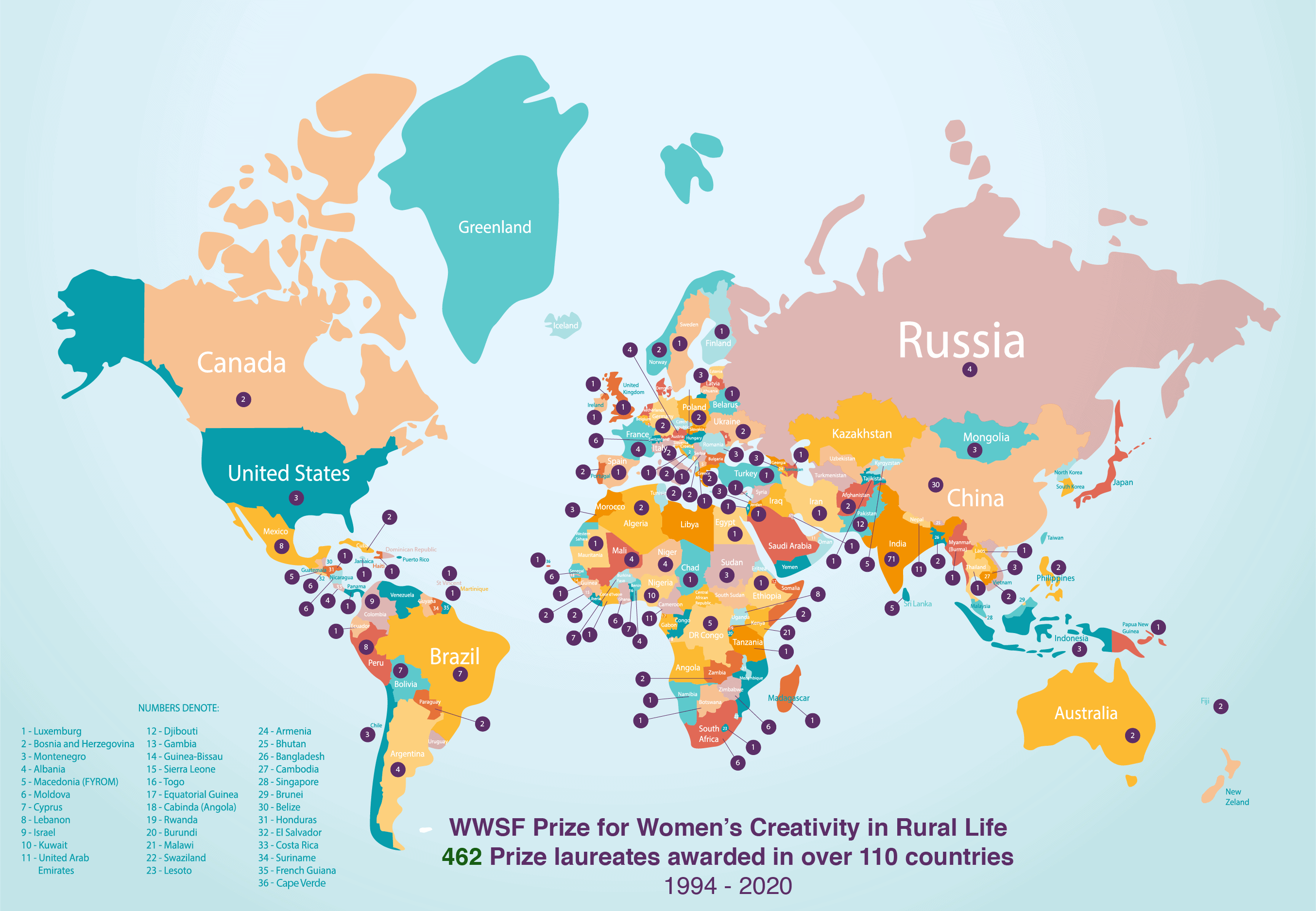
The WWSF introduces 60 Heroes out of 462 Laureates awarded with the WWSF Prize for Women’s Creativity in Rural Life (1994-2020)

UN Women this year is celebrating women’s leadership in all its forms and calling for women and feminists across the world to claim their space in leadership and decision-making. Presently, only 7.4 per cent of Fortune 500 companies are run by women. Despite progress and many broken records, women continue to be excluded in certain sports. Systemic barriers, gender bias, discrimination and gender stereotypes continue to hold women back from rising in STEM careers. Women and girls have been leading climate action and environmental movements, but men occupy 67 per cent of climate-related decision-making roles. 119 countries have never had a woman leader. Just 25 per cent of national parliamentary seats are held by women.

Around the world, the space for civil discourse and movements is shrinking. The media plays a critical role in amplifying women’s voices and stories and drawing attention to key issues. But, with women holding only 27 per cent of top management jobs in media organizations, More than one-third of women’s employment is in agriculture, increasing women’s access to land and providing better support for women farmers is, therefore, essential. The majority of negotiators, mediators, and signatories in peace processes are still men.

In news media, only 24 per cent of the persons heard, read about or seen in newspaper, television and radio news are women. In global news coverage of COVID-19, only one in five expert sources counsulted were women.

Amnesty International stated that across the Middle East and North Africa (MENA), despite some limited reforms, women continue to face entrenched discrimination and daily violence amid the abject failure of governments to stamp out arbitrary arrests, abductions, assassinations, so-called “honour” killings and other forms of gender-based violence, said Amnesty International, marking International Women’s Day. ..Inadequate government action to protect women from gender-based violence and address impunity has long perpetuated this form of abuse.  As a first step, authorities must publicly condemn all forms of gender-based violence and dismantle discriminatory structures that facilitate such abuse – such as male guardianship,” said Heba Morayef.   “They must also ensure that the rights of survivors are protected, that survivors can safely access justice and that perpetrators are held to account. Survivors must be able to access adequate shelter, psycho-social support as well as legal and other services.”

All over the world, a female-driven political awakening is taking place. But this is met with prosecution by the State and persecution by self-vigilante groups. Their experiences are marred with patriarchal subordination, sexualised violence, threat and harassment. They face severe retribution and systematic abuse, even at the hands of the State. It is important to have an enabling environment for these soft targets who face heightened risks as compared to their male counterparts. International obligation requires the State to stop criminalising women defenders, write SHRUTIKA PANDEY & MRINALINI MISHRA in The Leaflet of 8 March 2021.

MRT of 8 March 2021 states that International Women’s Day is not celebrated, a struggle is commemorated – that has not ended- in favor of justice, peace and freedom of each one of them. In a strict sense, feminism seeks make gender issues visible. Under that idea, there should be no censorship or exclusion. Nevertheless, What about trans women? While it is true that some people do not agree that they are part of the feminist movement, the reality is that they also suffer from violence, harassment and discrimination. Therefore, they are in the same fight. With that said, we present to you 8 recognized trans women in history

The Media Line of 7 March writes that “Women face uphill climb to equality in the MENA region” Activists and human rights groups paint a daunting portrait of the equality landscape between the genders in the MENA region, as they prepare to mark International Women’s Day, March 8. The coronavirus epidemic, certainly, did not help the plight of women this past year. Still, going forward, the largest issues facing women in the Middle East were entrenched long before the pandemic hit.

In the Gulf Cooperative Council (GCC) countries, women’s rights defenders have it tough. While prominent Saudi women’s activist Loujain al-Hathloul was freed last month after almost three years in prison [see https://www.trueheroesfilms.org/thedigest/laureates/1a6d84c0-b494-11ea-b00d-9db077762c6c], Samar Badawi [https://www.trueheroesfilms.org/thedigest/laureates/eaed8641-4056-4130-a5ff-fb7bf289cece], Nassima al-Sadah, Nouf Abdelaziz and Maya’a al-Zahrani remain in jail after their 2018 arrests on charges of advocating for women’s rights. “Those who are behind bars are the champions for the change that took place,” Khalid Ibrahim, executive director of the Gulf Centre for Human Rights, told The Media Line, referring to women driving.

In UCANews of 8 March 2021 Mary Aileen D. Bacalso, Manila writes that “Millions of women the world over suffer from discrimination, abuse, poverty, gender-based violence and human rights violations, of which enforced disappearance is one of the most cruel forms. Enforced disappearance, which motivated the international community to establish the International Convention for the Protection of All Persons from Enforced Disappearance, especially affects women.  On this significant occasion, I remember the faces and voices of women I personally encountered from 50 countries that I visited during my almost three decades of advocacy for the cause of the disappeared. Many of them carried pictures of their loved ones. Some gave me every bit of information with the hope against hope to find light amidst the dark night of the disappeared.”

Euromed uses the occasion for a series of podcast. For our first episode, the story you are about to hear is that of Mozn Hassan, a woman human rights defender and the founder and executive director of Nazra for Feminist Studies, a feminist organisation working in Egypt and the MENA region on gender equality and combatting violence against women. See: https://www.trueheroesfilms.org/thedigest/laureates/38B5C337-72F5-C4DE-BC95-95094B9E3939

[https://open.spotify.com/episode/0BLcZcwdDrab9guLW6fHVo]

https://www.woman.ch/campaign-17-days/meet-60-heroes-out-of-462-laureates-awarded-with-the-wwsf-prize-for-womens-creativity-in-rural-life-1994-2020/

https://un-women.medium.com/claiming-womens-space-in-leadership-6acc13946e2

https://www.amnesty.org/en/latest/news/2021/03/mena-gender-based-violence-continues-to-devastate-lives-of-women-across-region/

https://www.ucanews.com/news/women-turn-grief-into-courage/91671#

‘Beijing Spring’ The Story of Chi Xiaoning and His Smuggled Camera

March 6, 2021

Revealed for the first time: Reminiscent of what is happening in Hong Kong today, this is a story about underground film-making, radical art, and censorship. In 1979, Chi Xiaoning created his “Film of Star Group Activities of 1979.” It is the only known video documenting the radical activities of the Stars Group, avant-garde artists from China who championed individuality and freedom of expression. The only copy of the footage is in the M+ Collections in Hong Kong. American film-maker Andy Cohen, a regular Global Insights Magazine contributor, portrays this story in his 2020 film ‘Beijing Spring’, which is being premiered internationally at the Geneva Human Rights Film Festival (FIFDH) in March, 2021. [see https://fifdh.org/en/2021/film/120-beijing-spring]

In Global Geneva of 11 February 2021 Andy Cohen writes about the challenges behind Chi Xiaoning’s daring film-making during a period that was subject to severe censorship in favour of official propaganda art.

Stars Protest March Demanding Artistic Freedom— Beijing, National Day (1979) (Photo: ©Wang Rui)

Before the 1980s, documentary films in China were mostly propaganda made to serve the ideological purposes of the Communist Party. Views critical of the party were prohibited. Only one official voice could be heard: that of the government. Film-makers obeyed Mao Zedong’s dictum that artists’ works should reflect the lives of the masses — the workers, peasants, and soldiers—for whom they were made. These films, scripted and staged using ‘model people’ instead of ordinary subjects, were crafted in a dogmatic, formulaic style that put a positive spin on government policies.

By 1979, however, the political tide in the People’s Republic had turned and the scent of reform began to fill the air, heralding what would become known as the Beijing Spring. Mao Zedong had died a few years earlier, and the nation had begun to reawaken after thirty years of oppression that had claimed more than fifty million lives. Deng Xiaoping, the new ‘paramount leader’, experimented with not only economic reforms but also loosening restrictions on freedom of speech. He even tolerated the open postings of government criticisms in one easily monitored locale in central Beijing — a long brick wall running along Xidan Street just west of Tiananmen Square that came to be known as Democracy Wall.

Originally intended for workers and peasants to post the grievances they’d suffered during the Cultural Revolution, the wall was quickly overtaken by artists and activists, who seized the opportunity to post their radical works in such a prominent place. These artworks and writings not only exposed the suffering the country had been through but also focused on the present plights of ordinary people, emphasising that every individual is unique, equal, and imbued with the right to openly express thoughts and emotions without being crushed or silenced.

A young Beijing film-maker named Chi Xiaoning used this moment to shoot an unofficial documentary about the Democracy Wall movement in a style different from its predecessors. Chi chose to focus his film on the daring activities of one specific group that had arisen from the underground magazine Today: a band of artists who called themselves the Stars Group (Xingxing). Explaining the imagery behind the choice of the name, the group’s co-founder Ma Desheng said: ‘When I was growing up there was only one star in the sky: the red sun, Mao Zedong. Many stars mean many people. Every individual is a star.’

In order to realise his vision, Chi needed to overcome one major obstacle: finding a camera and film stock, both of which were unavailable to the average person. Luckily for Chi, his faithful friend Ren Shulin was among the precious few who not only knew how to operate a camera but actually had access to one.

In May 1979, Ren was assigned to work at the Institute of Coal and Carbon Science. His job was to film official documentaries about safety in coal mines. ‘To smuggle one or two boxes of film out of my service was easy. To get more? That took some time. And to get the movie camera out — that racked my brains,” Ren later stated. In the end, Ren succeeded and the two began filming on 27 September, 1979, the first day that the Stars Group hung an unofficial exhibition on the perimeter fence outside of Beijing’s China Art Gallery (now known as the National Art Museum of China). Simultaneously, an official propaganda art show was being held inside the space.

Adding to this paradox was the name of the film Ren had smuggled out: Every Generation Is Red (Dai Dai Hong). Ren’s knowledge and courage enabled him to play the crucial role of camera assistant, steadily unloading and reloading the reels under the cover of trees at the eastern wall of the gallery. By keeping the film stock safe from the crowds, avoiding the scrutiny of undercover police, and feeding him reels, Ren enabled Chi to continuously film the Stars exhibition on the fence.

The camera Ren smuggled out was a hand-wound Gansu’s Light model (Gan Guang). This made Chi’s already difficult task all the more so, as he aimed to capture real events unfolding in real time. A fully wound camera could shoot for only thirty seconds, and an entire box of film produced only three minutes of footage. This time constraint, coupled with having to avoid the police, tested Chi’s improvisational style.

Filmmaker Chi Xiaoning on Top of Democracy Wall (1979)  (Photo: ©Wang Rui) 

Chi climbed the back of the fence to capture the impressions of onlookers as they stared at the artworks with shock and awe. Chi’s method, like the Stars artists’, focused on ordinary people such as factory workers, teachers with students, and the elderly. He recorded their genuine emotions and free expressions typically hidden beneath the outer masks that had become the default after years of toeing the party line.

The fact the Stars artists also employed original, modernist styles and content, utilising free forms and abstraction, added a meta-artistic layer to the undertaking. Chi shot an avant-garde film about avant-garde artists during a time when the act of filming was also considered an act of protest. This was art for art’s sake, produced about and with the aim of freedom of expression. Chi’s lens revealed faces viewing never-before-seen artworks that challenged the aesthetic conventions of the party, and that depicted the naked female body in twisted modern forms. The first day was a success for both the Stars artists and the greater artistic principle.

Early the next morning, Chi and Ren were back at the fence, locked, loaded, and ready to film, when the police suddenly arrived to take down the Stars Group exhibit. As the police closed in, Chi wound his way through the crowds, in and out of the chaos ‘like a wartime journalist in a battlefield’, as Ren later described it. After tearing the art off the fence, the police surrounded Chi and Ren. They had no chance to escape. The police confiscated the camera from Chi. From Ren, they took the camera bag containing the used and unused film stock.

“I was very nervous,” Ren recounted. “If the camera was confiscated, I’d be fired from my job at the institute. But Xiaoning was calm, arguing with the other side.” After being kept in a windowless room inside the museum for hours, the film and the camera were abruptly and inexplicably returned to Chi and Ren. For some reason, the authorities’ mood was sympathetic to the artists that day.

Stars Artists Group Portrait (1980)  (Photo: ©Helmut Opletal)

The Stars Group artists, on the other hand, were angry that their show had been terminated and their artworks confiscated. Together with other political activists, they planned a protest rally and march. Everyone knew this could mean jail time for the ringleaders.

The Stars rally was an enormous provocation to the Communist leaders — it was reported on and documented by foreign media at the time — and it was planned for 1 October: National Day and the thirtieth anniversary of the founding of the People’s Republic. The big parade had been cancelled in light of Mao’s death in 1976; now, in its stead, the Stars and their supporters took it upon themselves to march from Democracy Wall to the Municipal Building. Chi planned to film it but told Ren not to assist him. If caught, there was no sense in both of them going to jail, as he would need Ren to develop the reels and edit the film.

Chi stood atop Democracy Wall, filming as the rally began. When the group headed for the Municipal Building, Chi and his camera weaved in and out. He went inside factories and shot from windows to capture workers’ perspectives; he zoomed in on passengers’ reactions as they peered from the windows of passing buses; he filmed the crowds of protestors marching along rainy streets, zooming in on their puddle-pounding feet.

While the crowds marched on, Ren waited anxiously all day for news of his friend. This was an era before cell phones and pagers. It was inevitable that, with a 16mm camera in hand, filming in highly visible locations, Chi once again attracted the omnipresent authorities’ attention. When asked how Chi had saved his film, Stars Group artist and friend Wang Keping recounted that Chi had told him he’d exposed the part that had not yet been filmed, tricking the police into thinking it was useless. Beyond showcasing his enormous talent, what makes Chi’s footage even more spectacular and immediate is the constant risk of arrest he faced while filming.

In stark contrast to his main action footage of the protest march, Chi also shot B-roll focusing on scenes by the lake in the park of the Old Summer Palace. In its deceptively quiet manner, however, the B-roll is just as avant-garde. From the weather conditions it is evident that he filmed on two different occasions. On the first day, the water was calm, as were the demeanours of the subjects—rowing on the lake, playing guitars or mah-jong, strolling along tree-lined trails, and picnicking. This idleness was diametrically opposed to the ‘heroic’ actions of the ‘model people’ in official documentaries. The calmness of the lake mirrors the first quiet day of the exhibit.

Artist Ma Desheng Speech at Democracy Wall (1979) (Photo: ©Wang Rui)

On the second day of B-roll, the wind was flapping the red flags on the bridge and bending the branches of trees, reflecting the chaos of the protest march. Chi’s use of contrasting weather filmed at the park echoes the inner emotions of his subjects as well as the political events surrounding them. The B-roll shows close-ups of everyday objects with an anthropomorphic introspection: the empty rowboats lined up like cadres, crates of empty soda bottles (Coca-Cola had just entered China in December 1978), goldfish swimming in a vendor’s water-filled plastic bag—all shots considered unsuitable for documentaries at the time.

When asked why the style of this footage can now be considered groundbreaking, Ren replied, “Documentary films in China were almost all propaganda, not the expression of the author himself. We were conscious of this, so our film, from idea to structure to visual language, was different from documentaries of that time.”

Despite its significance, almost no one knew about this unfinished film until recently. In total, it comprises forty-seven minutes of raw footage, out of sequence, that was hidden from the authorities for the past thirty-five years. Fearing for the safety of his friends and his family, Chi hid the salvaged footage in a confidant’s home, swearing him to secrecy.

After Chi’s untimely death in 2007, no one knew the whereabouts of the footage, not even Ren, as it had been kept underground, passed from friend to friend. The footage was eventually recovered and the only copy now resides in the M+ Collections.

Film of Star Group Activities of 1979 by Chi Xiaoning and Ren Shulin reflects on and documents the social, cultural, and political changes that took place during the Beijing Spring. This treasure trove will be mined for years to come by film-makers, historians, and art historians alike. This pivotal moment in China’s history, which gave birth to its democracy movement, could not have been possible without the powerful combination of art and activism that coalesced at Democracy Wall. And because of the courageous feats of one documentarian and his assistant cameraman, history will forever have the visual accounts of those exciting times.


Andy Cohen is an American documentary film-maker, journalist and author based in Geneva. Much of his work is investigative and human rights-based. Cohen’s films have been shown at the FIFDH Geneva, Venice Film Festival, Telluride, Tribeca, Traverse City, Toronto International Film Festival, Berlin Film Festival, and the Sundance Film Festival, among others, and broadcast on PBS, BBC, UK Ch4, ARTE, Netflix, and Amazon.For more information about AC Films, please go to his website.

A version of this article was first published by M+ HK.

Andy Cohen

Beijing Spring’ is scheduled for its International Premier at the Human Rights Film Festival in Geneva (FIFDH), which takes placed 5-14 March, 2021. See: https://humanrightsdefenders.blog/2021/03/06/2021-edition-of-geneva-film-festival-kicks-off-in-virtual-format/

2021 edition of Geneva film festival kicks off in virtual format

March 6, 2021
The FIFDH kicks off in virtual format for its 19th edition
  • Wolfgang Spindler  reported on 0 March 2021 that the 19th edition of the International Film Festival and Forum on Human Rights in Geneva has gone virtual. Usually every year some 40 000 visitors attend to watch and discuss films that focus on human rights violations. Around 300 filmmakers, human rights defenders and politicians from 25 countries across the globe used to be invited. But, this year, the festival has been forced to change and adapt to the COVID-19 pandemic. Participants are now encouraged to click on ‘likes‘ instead of applauding, as physical presence is not possible.

Isabelle Gattiker is the FIFDH Festival Director. She said that the festival had to reinvent itself. They are proposing videos on demand, that she describes as not being able to replace real cinema theatres. But they have tried “to work on public participation despite the digital format”. Online audiences can comment and ask questions during the showings every evening from 8 pm (CET) from anywhere on the planet.

For the first time ever there will also be a public award, where the viewers can give a mark to the films they’ve watched. At the end of the festival, the film with the highest rating from the official selection will be awarded this prize.

Soltan Achilova This 19th edition is dedicated to Turkmenistan Photojournalist, Soltan Achilova. The 71-year-old was amongst this year’s finalists for the “Martin Ennals Award“, an annual prize known as “the Nobel prize for human rights defenders. See: https://humanrightsdefenders.blog/2021/02/23/soltan-achilova-has-issued-a-rare-rebuke-of-the-turkmen-president-on-youtube/

https://www.euronews.com/2021/03/05/the-fifdh-kicks-off-in-virtual-format-for-its-19th-edition

https://fifdh.org/en/program-2021

Profile of Nicoline Nwenushi wazeh Tumasang from Cameroon

March 6, 2021

On 29 January 2021 the ISHR published this interview with Nicoline Nwenushi wazeh Tumasang, an inspiring human rights defender from Cameroon who shares her story of hope, resilience and fight for gender equality.

I am Nicoline Nwenushi wazeh Tumasang, a gender and development specialist, jurist, human rights defender and civil society activist. I am also the CEO and founder of Pathways for Women’s Empowerment and Development and its Integrated agricultural Training Center (PaWED/IATC), whose missions are to ensure a gender just society in which men and women enjoy equity, contribute and benefit as equal partners in the development of the country and the world. I am also one of the chairs of Cameroon Women’s Peace Movement (CAWOPEM).

My priority areas of intervention include but are not limited to research on women’s equal and meaningful participation; empowerment for women and girl’s for economic rights and freedom; campaign and advocacy towards the realisation of the right to education for crisis-affected and displaced children and youth; advocacy and campaign to end the Anglophone crisis in Cameroon and limit atrocities especially sexual and gender-based violence (SGBV) on women and girls; capacity and movement building; advocacy and lobbying; networking and fundraising.

The year is 2050 : what does the world look like – in particular for women, ethnic minorities, LGBTI people, etc. ?

It is a world where gender and social justice prevails and all stakeholders work in synergy to ensure equity, safety, and contribute their full potential and benefit as common humanity….Through designing advocacy and campaign strategies, empowering, creating awareness and holding service providers accountable. Contributing to building the resilience of the vulnerable masses and creating safe spaces for women, girls and other socially vulnerable groups.

Was there a defining moment in your life that motivated you to defend human rights?

Before joining the civil society world as a human rights defender, I palpated vulnerability in accessing justice. These vulnerabilities, especially that of widows, triggered my passion to defend human rights. However, the outbreak of the Anglophone crisis in 2016 was a decisive period for me.

Do you face any threats and attacks because of your work?

Although I have personally not faced any physical attacks and threats, our work has been greatly impeded by intimidation from government, shrinking civic space measures, insecurity due to the ongoing armed conflicts and government’s denial to call for ceasefire, as well as threats and intimidation from the non-State armed groups.

What could be done for you to be able to work and live safely?

A specific legislation on the protection of human rights defenders particularly women human rights defenders, scrupulous punishment of offenders and compensation for damage will provide us with a safe and conducive working environment. Also, funding of our projects will give our work better visibility and respect.

How does the Covid-19 pandemic affect your work?

From an economic perspective, COVID-19 and the lockdown measures have devastating effects on the women’s economic empowerment projects that we were running hitherto. Our inability to sell three thousand (3000) broiler chickens in our Integrated Agricultural Training Center (IATC) has caused us damages worth some $8000 and a risk for the Microfinance institution to forfeit our assets used as collateral to obtain the loan. This equally means that the women who were beneficiaries of this project and had gained a certain degree of financial independence and security from gender-based violence have lost their livelihood activities and will have to strive to start all over again. Furthermore, telecommuting has left most of our beneficiaries behind due to the lack of android gadgets, sustainable connectivity and power supply.

Photo credit (in order of appearance): PaWED; Center regional delegation of MINPROF for PAWED; Yaoundé’s Women’s March against Kumba killings

http://ishr.ch/news/human-rights-defenders-story-nicoline-nwenushi-wazeh-tumasang-cameroon?fbclid=IwAR2Ri-UkKELjcenwPqC3FKLeh4mVHS2WzWVDMKqX9boNpiVhwUENN2VDpZE

Free Visual content for human rights campaigns: a marvellous initiative

March 4, 2021
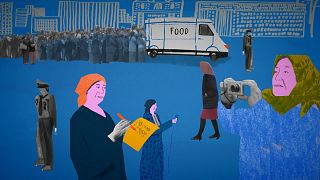
Illustration: Cachetejack for Fine Acts

The future of human rights must be hopeful.When we only show the abuses, people start to believe that we live in a world of crisis with no alternative. We believe that the image of human rights needs to be reimagined so we can bring more people on board.

Reimagining Human Rights is a project by Fine Acts, in partnership with hope-based comms. We are building the largest collection of free, evergreen, hopeful visual content around human rights, for activists and nonprofits around the world to use in their campaigns.

We commissioned a selection of amazing artists from around the world. We also opened a call for existing works to creatives everywhere. We received close to 1000 illustrations (THANK YOU) from the global creative community, and selected to feature over 100 (and counting). See all the powerful and uplifting illustrations below and enjoy new works every week until January 2021. Below a few examples of the many beautiful illustrations.

All featured works are published under a Creative Commons-Attribution-NonCommercial-ShareAlike 4.0 International license on TheGreats.co – Fine Acts’ new platform for free socially engaged visuals, and made available for free non-commercial use and adaptation to activists and orgs worldwide, given the appropriate credit.

To see how to use the artworks, please read this brief info.


hope-based comms.png
GOODTYPE.png
Into Action TaskForce.png

Safwat Saleem for Fine Acts    DOWNLOAD
Safwat Saleem for Fine Acts
DOWNLOAD
Safwat Saleem for Fine Acts    DOWNLOAD
Safwat Saleem for Fine Acts
DOWNLOAD
Safwat Saleem for Fine Acts    DOWNLOAD
Safwat Saleem for Fine Acts
DOWNLOAD

https://fineacts.co/reimagining-human-rights

Profile in Persecution: Hasan Radhi AlBaqali

March 3, 2021

Americans for Democracy and Human Rights in Bahrain (ADHRB) posted on 18 the following profile on Hasan Radhi AlBaqali who was a 28-year-old security personnel at a private company when he was arrested by Omani authorities on 22 February 2016 at Muscat Airport Oman based on Bahrain’s allegations, via INTERPOL, that he was a fugitive from justice. During his detention, he was subjected to torture and to several human rights violations. Recently, his health condition has been deteriorating, and he has not been provided with adequate medical care. He is currently held in Jau Prison.

At the end of 2012, Hasan left Bahrain into exile. While being in exile between 2012 and 2016, he was convicted in absentia with: 1) Disturbing the peace, 2) rioting, 3) placement of objects resembling explosive devices, 4) arson, 5) possession and fabrication of combustible or explosive materials, 6) possession of arms, 7) travelling to Iran to receive military training, and 8) membership in a terrorist cell. Consequently, he was sentenced in absentia to nearly 100 years in prison. It is believed that Hasan’s conviction was due to his peaceful participation in the 2011 pro-democracy protests in Bahrain.

On 22 February 2016, airport security officers at Muscat Airport Oman arrested Hasan based on Bahrain’s allegations, via INTERPOL, that he was a fugitive from justice. Then, he was turned over to Bahraini security forces, who put him aboard one of their private planes, drugged him via several injections which knocked him unconscious, and flew him back to Bahrain. His personal belongings including phone, money, passport, and national ID card were taken from him en route and have not since been returned to him or his family. After arriving in Bahrain, Hasan was transferred to the Criminal Investigations Directorate (CID) building in Adliya.

From the date of arrest till the next day, 23 February, Hasan was subject to enforced disappearance until 10 p.m. of 23 February when he was able to call his family, telling them that he was in the CID building. The family received this call after multiple attempts to reach him through the Omani Embassy and through several human rights organizations.

Hasan was interrogated for 15 days between the CID and Building 15 of Jau Prison, where he was tortured by National Security Agency (NSA) officers and CID officers in order to give a false confession. He was beaten on his head, neck, and stomach, subjected to electric shocks to his testicles, placed naked in a cold room and submerged in cold water, deprived from sleep, and threatened with his life and wife. As a result, he confessed to the charges attributed to him. During this period, Hasan’s lawyer was unable to attend the interrogations, and Hasan was unable to meet his parents. Instead, he was able to only call them four times during this entire period, where the duration of each call was less than one minute.

Hasan was prevented from attending his trial, and he was brought to court once but was forced to remain in the police vehicle outside under the pretext that there were not enough police officers present to guard him inside the courtroom. Consequently, he was convicted in November 2016 of attempting to kill a policeman, although he was outside Bahrain when this incident happened. Therefore, he was sentenced to an additional 7 years in prison. Hasan appealed his sentence, and on 2 February 2017, the Appeals Court reduced his sentence from seven years to five years. On 15 May 2018, in an unfair mass trial that involved 138 individuals, the Bahraini Fourth High Criminal Court convicted Hasan of: 1) training to the use of firearms and explosive devices for terrorist purposes, (2) possession of firearms without a license and using them for purposes contrary to safety and public order for terrorist aims, and (3) the charge of joining a terrorist group, Zulfiqar Brigades, whose purpose violates the provisions of the constitution. Consequently, he was sentenced to another 7 years in prison, in addition to the revocation of his nationality.

In November 2016, following the issuance of the seven-year sentence against him, Hasan was subjected to a second and more severe round of torture. He was beaten on his head, stomach, and waist, and he was repeatedly electroshocked on his testicles. This torture led to a severe deterioration in Hasan’s health. He suffered from loss of focus due to frequent head injuries, severe injury to his testicles as he began to urinate blood, and chronic abdominal pain.

At that point, the Office of the Public Prosecutor (PPO) ordered that he be examined at Salmaniya hospital. The decision may have been motivated by the fact that Hasan’s sister filed complaints with both the Office of the Ombudsman and the Special Investigations Unit. An examination at the hospital on 19 November 2016 found that he had suffered “testicular trauma,” with edematic swelling of the left testicle and epididymis to more than one third larger than the normal size. He was removed from the hospital and returned to prison before he could complete a proper course of treatment, and the family has not been given full access to his hospital records. The PPO insists that the medical records should stay under their custody and that if the family wants any medical information they should seek it through the prosecutor’s office. Throughout this second round of interrogations, Hasan was also denied access to an attorney, was not allowed to receive visits from his family, and his phone calls to family were limited to a single minute.

Recently, Hasan’s health has been deteriorating since the injuries sustained from torture were not treated properly. He was seeing blood in his urine and feces as well as feeling severe pain in his stomach, kidneys, and bladder. In light of this, in the beginning of January, he was taken to an appointment in the Military Hospital and did the PCR test ahead of a surgery for varicose in his testicles which was scheduled for the third week of January 2021. However, instead of being returned to Building 14 and placed in isolation, he was taken to solitary confinement in the isolation building, Building 15 of Jau Prison. He was not informed of the steps to be followed ahead of the surgery, leaving him with no knowledge about his situation. Additionally, he was not given any medication to ease the pain he was feeling. Finally, within the closed cell, he could not know day from night and as such could not pray. These conditions took a psychological toll on Hasan since the pain, coupled with the isolation and lack of knowledge about his fate, brought him to the point of hysteria. Furthermore, he had been prohibited from contacting his family since his transfer, therefore making him forcibly disappeared. He was only able to call them on 16 January after going on a hunger strike in order to pressure authorities to grant him the right to call. In that call, he explained to them what occurred over the last two weeks and requested that they contact governmental bodies in order to alleviate his suffering. Although the family did contact the Ombudsman Office, because they are not routinely informed about his medical situation, they could not provide all the relevant information.

Hasan’s arrest, confiscation of his belongings, torture, unfair mass trial, denial of medical treatment, and enforced disappearance violate both the Bahraini Constitution as well as international obligations to which Bahrain is party, namely, the Convention against Torture and Other Cruel, Inhuman or Degrading Treatment or Punishment (CAT), the International Convention on Civil and Political Rights (ICCPR), and the International Covenant on Economic, Social and Cultural Rights (ICESCR). Since Hasan was arrested for political reasons and given that his conviction depended on forced false confessions, we can conclude that he is arbitrarily detained by Bahraini authorities.

Accordingly, Americans for Democracy & Human Rights in Bahrain (ADHRB) calls on Bahraini authorities to uphold their human rights obligations by investigating all allegations of torture, enforced disappearance, and denial of proper medical treatment to ensure accountability. ADHRB also demands that Hasan be provided with the required medical treatment for all the injuries and health problems resulting from torture within safe and healthy conditions. ADHRB reiterates its demand for Bahraini authorities to release Hasan immediately, along with all political prisoners that were tried based on confessions taken under torture.

Colombia accounts for half the number of all environmental defenders murdered in 2020

March 3, 2021

On 2 March 2021 Mongabay writes about the terrible situation that of the 331 murders of environmental defenders registered worldwide in 2020, Colombia had the most murders at 177.

Impunity still reigns when it comes to the murders of human rights defenders around the world, according to the Front Line Defenders organization, in its global analysis of 2020. The analysis examined 331 homicides of leaders who fight for the defense of the land, the environment, Indigenous peoples, women and the LGBTIQ community. Of these, 177 cases occurred in Colombia.

During the COVID-19 pandemic, defenders have been exposed not only to the day-to-day risks they face from their work and the virus, but also to pressure from governments to control information. Not all of these HRDs are recognized, but the Digest counts some 50 laureates from Colombia [see https://www.trueheroesfilms.org/thedigest]

Many of those killed, the report states, supported communities in their fight against COVID-19 , worked on food security issues, access to medical care and were critical of governments. For Front Line Defenders , the health crisis increased risks, especially for women defenders, leaders of the LGBTIQ community and vulnerable populations such as refugees, migrants and sex workers.

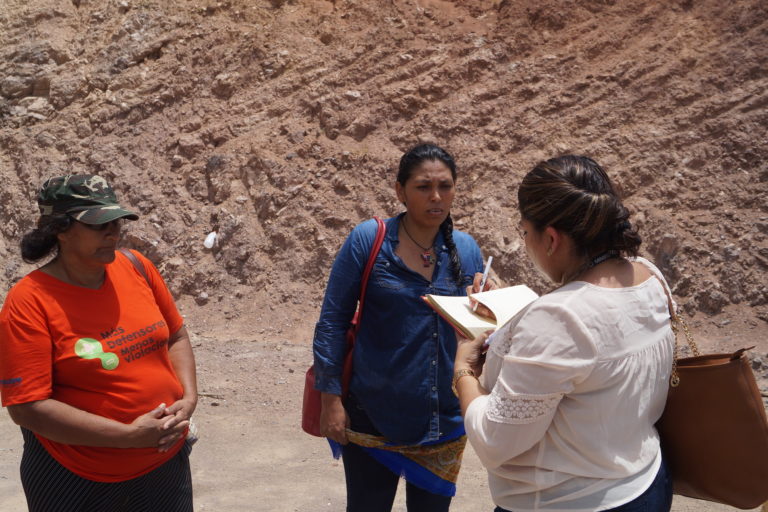
Fidel Heras Cruz traded the tranquility of a simple, quiet life for the front line of the fight against economic powers that threaten the environment. Photo: Courtesy COPUDEVER.

For Shirley Muñoz, who coordinates information systems for the Somos Defensores de Colombia, the pandemic made the state abandonment more evident. Colombia accounts for 53% of all rights defenders cases globally in 2020.

“In many territories, the control of the pandemic was exercised by illegal armed groups through fear and threats, and defenders had to be locked up in their homes, which made them more at risk,” Muñoz said in an interview with Mongabay Latam. A large number of the murders that we verified were committed in or near the defenders’ homes.”

Front Line Defenders believes that cases may continue to increase as verifications of allegations are made, and that upcoming figures from Somos Defensores de Colombia will bring the final number of deaths in 2020 higher.

According to Front Line Defenders, 69% of the murders that occurred last year occurred against leaders who worked in defense of the land, the environment and the rights of Indigenous peoples.

Report authors point out that the Intergovernmental Platform for Biodiversity and Ecosystem Services (IPBES) has emphasized that the loss of biodiversity could put world food security at risk and Indigenous communities play a fundamental role in the conservation of ecosystems. Since 2017, Front Line Defenders has registered 327 murders of defenders of the rights of Indigenous peoples in the world.

They tried to kidnap Irma Lemus (center) on her journey into exile. Photo: Radio Progreso.

In Colombia, violence has been particularly directed against those who participate in the implementation of the Peace Agreement with the guerrillas of the Revolutionary Armed Forces of Colombia (Farc), those who are part of the initiatives to replace drug crops, and those who oppose natural resources extraction projects.

In addition to homicides, Front Line Defenders also recorded the most common types of human rights violations, which in the case of Latin America are physical attacks (27%), detentions and arrests (19%), harassment (13%), legal actions against leaders (13%), and smear campaigns (7%) .

The report notes that many defenders who were detained were also exposed to an increased risk of contracting COVID-19. Even though many countries allowed the release of prisoners due to the pandemic, according to the report, defenders were not among those released despite serving sentences for “non-violent crimes.”

In the case of Colombia, it is likely that the number of attacks on defenders reported in 2020 has dropped, but this does not mean – warns Muñoz – that the violence has. The reason is that during the pandemic it is presumed that there is a large under-registration since many organizations in charge of registering this type of human rights violations were not able to monitor the territories. So, Muñoz concludes, “there were attacks, but not all of them were recorded.”

Javier Francisco Parra was shot dead in the municipality of La Macarena, Meta, Colombia. Photo: Cormacarena.

Front Line Defenders stresses that direct human rights violations were compounded by restrictive legislation that was introduced in response to the pandemic. “Several other laws were passed designed to limit the ability of human rights defenders and civil society to function well and safely. […] Other governments, including Peru, Honduras, Mexico and Panama, allowed development, deforestation and mining projects to continue despite economic closures, ”the report indicates.

Human rights defenders not only have to protect themselves from physical attacks and murder, but also from digital attacks.

In 2020, a team of Front Line Defenders protection coordinators received 304 requests for support for the following reasons: 26% received threats via social media such as Facebook, Twitter and Instagram; 16% were hacked or had their social media accounts compromised; 11% reported telephone surveillance; another 11% reported physical monitoring and 9% said that devices with important information were confiscated or stolen from them.

More than a quarter of those most affected by this type of attack are human rights defenders (17%); rights of the land, the environment and Indigenous peoples (16%). Front Line Defenders claims it received dozens of reports of online gatherings – especially from LGBTIQ groups, feminists and black advocates – that were infiltrated by attackers taking advantage of security breaches

https://www.washingtonpost.com/opinions/2021/03/02/colombia-biden-violence-cauca-duque-peace-farc/

Mary Lawlor addresses Lawlessness in case of Berta Caceres and other HRDs

March 3, 2021

On 2 March 2021, Mary Lawlor – the UN’s Special Rapporteur on Human Rights Defenders – wrote for Amnesty International “Five years after Berta Cáceres was murdered, states are still failing to protect human rights defenders". With the presentation of Mary Lawlor's report to the UN Human Rights Council coming up this week, the piece is worth reading in full:

It’s five years today since environmental human rights defender Berta Cáceres was murdered in her home in Honduras. [see: https://www.trueheroesfilms.org/thedigest/laureates/2AD0CEE4-80CB-3234-04B4-F2ED7ACBE6C5]

She was one of hundreds of human rights defenders killed that year because of their peaceful work, and hundreds more defenders have been killed every year since. Those responsible are rarely brought to justice. Although some have been convicted of Berta Cáceres’ killing, others believed to have been involved have still not been brought to account. [see: https://humanrightsdefenders.blog/2020/06/10/nina-lakhanis-who-killed-berta-caceres-reviewed/]

It’s a familiar and continuing story, in Honduras and across the world, where those responsible for the murder of a human rights defender often enjoy impunity. This week I am presenting my latest report to the United National Human Rights Council in Geneva, and it is on the killings of human rights defenders and the threats that often precede them.

At least 281 human rights defenders were killed in 2019, with a similar number expected to be recorded for 2020. Unless radical, immediate action is taken we can expect hundreds more murders again this year.

Since 2015, at least 1,323 defenders have been killed. While Latin America is consistently the most affected region, and environmental human rights defenders like Berta Cáceres often the most targeted, it is a worldwide issue. At least 281 human rights defenders were killed in 2019, with a similar number expected to be recorded for 2020

Between 2015 to 2019, human rights defenders were killed in at least 64 countries, that’s a third of all U.N. member states. Those collecting the data agree that underreporting is a common problem. The number of defenders killed is likely significantly higher than the figures we have.

We know that on every continent, in cities and the countryside, in democracies and dictatorships, governments and other forces threatened and killed human rights defenders. Many, like Berta Cáceres, are killed in the context of large business projects.

Why do so many governments and others kill human rights defenders working peacefully for the rights of others? Partly because they can, safe in the knowledge that there is unlikely to be the political will to punish the perpetrators.

While some states, particularly those with high numbers of such killings, have established dedicated protection mechanisms to prevent and respond to risks and attacks against human rights defenders, defenders often complain that the mechanisms are under-resourced.

And in too many cases, businesses are also shirking their responsibilities to prevent attacks on defenders or are even responsible for the attacks.

These murders are not random acts of violence that come out of nowhere. Many of the killings are preceded by threats. As Amnesty International noted, Berta Cáceres’ murder “was a tragedy waiting to happen,” and she had “repeatedly denounced aggression and death threats against her. They had increased as she campaigned against the construction of a hydroelectric dam project called Agua Zarca and the impact it would have on the territory of the Lenca Indigenous people.”

And yet her government failed to protect her, as so many governments fail to protect their defenders. Since I took up this mandate in May last year I have spoken to hundreds of human rights defenders. Many have told me about their real fears of being murdered, and have shown me death threats made against them, often in public.

They tell me how some threats shouted in person, posted on social media, delivered in phone calls or text messages, or in written notes pushed under a door. Some are threatened by being included on published hit lists, receiving a message passed through an intermediary or having their houses graffitied. Others are sent pictures through the mail showing that they or their families have been under long-term surveillance, while others are told their family members will be killed. It’s not that complicated. It’s up to states to find the political will to prevent killings by responding better to threats against human rights defenders, and to hold murderers to account

I’ve been told by defenders about a coffin being delivered to the office of an NGO; a bullet being left on a dining room table in their home; edited pictures of them being posted on Twitter, showing them having been attacked with axes or knives; and an animal head being tied to the door of their organization’s office.

Those advocating for lesbian, gay, bisexual, transgender and intersex rights, and women and transgender human rights defenders, are often attacked with gendered threats, and targeted because of who they are as well as what they do. Women and LGBTI people demanding rights in a patriarchal, racist, or discriminatory contexts often suffer specific forms of attack, including sexual violence, smears and stigmatisation.

The murders of human rights defenders are not inevitable, many are signalled in advance, and yet governments fail, year after year, to provide enough resources to prevent them, and fail, year after year, to hold the murderers to account. In fact, states should not only end impunity but also publicly applaud the vital contribution that human rights make to societies.

This week I’ll again remind the U.N. that their members are failing in their moral and legal obligations to prevent the killings of human rights defenders. It’s no use for government officials to wring their hands and agree that the murder of Berta Cáceres and other defenders is a terrible problem and that someone should do something about it.

It’s not that complicated. It’s up to states to find the political will to prevent killings by responding better to threats against human rights defenders, and to hold murderers to account.

https://www.amnesty.org/en/latest/news/2021/03/asesinato-berta-caceres-estados-siguen-sin-proteger-defensores/

Call for nominations for the 2021 Lawyers for Lawyers Award

March 2, 2021

The Lawyers for Lawyers Award aims to honour lawyers who have made significant contributions to the protection of the rule of law and human rights in challenging environments. Through the bi-annual Award, Lawyers for Lawyers generates public recognition for the work and outstanding achievements of lawyers at risk. See for the award and its laureates: https://www.trueheroesfilms.org/thedigest/awards/B40861B3-0BE3-4CAF-A417-BC4F976E9CB0

Nominations must be submitted using the nomination form here. Please send the complete nomination form, including the required attached documents to info@lawyersforlawyers.nl or lawyersforlawyers@protonmail.com.

The closing date for submission of nominations is16 April 2021.

See also: https://humanrightsdefenders.blog/2014/04/24/lawyers-for-lawyers-raises-the-alarm-filipino-lawyers-at-risk/