Prominent Pakistani human rights defender and lawyer Asma Jahangirhas died at the age of 66. She reportedly suffered a cardiac arrest and was taken to hospital, where she later died.
She was one of the most recognized and honored human rights defenders with over 17 human rights awards, including the Martin Ennals Award in 1995, whose film on her work shows a much younger Asma, fearless in spite of threats on her life:
I met her for the first time in 1993 at the 2nd World Conference on Human Rights in Vienna, where she deeply impressed me by standing up and openly criticizing her fellow NGO representatives for having tried to prevent former President Jimmy Carte from speaking at the NGO forum. This principled stand was a hallmark of her life as Pakistani human rights lawyer and as UN Special Rapporteur. In many instances she was able to give sound advice on cases of other human rights defenders in difficulty. For earlier posts on Asma see: https://humanrightsdefenders.blog/tag/asma-jahangir/
Asma Jahangir’s career in short:
Trained as a lawyer and worked in Pakistan’s Supreme Court from age 30
A critic of the military establishment
Jailed in 1983 for pro-democracy activities
Put under house arrest in 2007 for opposing military leader’s removal of Supreme Court chief justice
Co-founder of the Human Rights Commission of Pakistan and of the first free legal aid centre in Pakistan (together with her sister Hina Jilani)
Co-founder of the Women’s Action Forum, set up to oppose law that reduced a woman’s testimony in court to half that of a man’s
The first female leader of Pakistan’s Supreme Court bar association
Winner of 17 human rights awards and the French Legion of Honour
Served twice as UN special rapporteur: on freedom of religion and on later on Human Rights in Iran
Nobel Peace Prize winner Malala Yousafzai called Ms Jahangir a “saviour of democracy and human rights”.
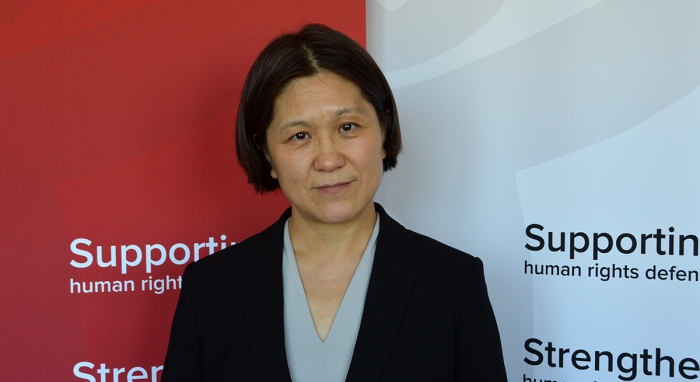
On 9 November 2017 ISHR met Yaxue Cao, the founder and editor of ChinaChange.org, an English-language website devoted to news and commentary related to civil society, rule of law, and human rights activities in China. She works to help the rest of the world understand what people are thinking and doing to effect change in China. Reports and translations on China Change have been cited widely in leading global news outlets and in U.S. Congressional reports. Yaxue Cao grew up in northern China during the Cultural Revolution and studied literature in the US. She lives in Washington, DC.
Ayşenur Parıldak, a 27-year-old reporter from Turkey’s now-closed Zaman newspaper who has been behind bars for 13 months, was named the recipient of the first Shahnoush Award by the Oslo-based Vigdis Freedom Foundation (VFF). [for more on this and other awards: http://trueheroesfilms.org/thedigest/awards/shahnoush-award]
“I was subjected to violence and sexual abuse. I was interrogated day and night for eight days. They [police officers] were questioning me while they were under the influence of alcohol […] I am afraid of being forgotten here,” Parıldak said in a letter to the Cumhuriyet newspaper in October 2016.
“The Shahnoush Award will be given every year to a female prisoner of conscience whose courage has not been internationally acknowledged. By doing so, Vigdis brings attention to the suffering of women who languish behind bars for speaking out and whose human rights have been violated. They are not forgotten; they are not alone. Hope is sometimes the difference between life and death. May the [Shahnoush] Award give hope to those who need it most.” said Marina Nemat, a board member of VFF.
Parıldak, also a law student at Ankara University’s faculty of law, was detained while taking exams on Aug. 11, 2016. She was released by the court on May 2, 2017 but was later rearrested by the same court before being freed since a prosecutor objected to the initial ruling. During her trial, she told judges that she had thought of committing suicide several times while in prison. Behind bars since last year, Parıldak faces 15 years in jail under Turkey’s broad anti-terror laws based on her tweets and alleged use of the ByLock mobile app. Turkish authorities believe ByLock indicates links to the Gülen movement, which the government accuses of masterminding the abortive coup last year. The movement denies all involvement.
Human Rights Watch Associate Director, International Justice Program, Elise Keppler, wrote an obituary for Oby Theodora Nwankwo, a Nigerian activist who tirelessly advocated for the International Criminal Court (ICC) and women’s rights. She died on 9 December 2017 at the age of 61:
I got to know Oby through our common work to push back against unprincipled attacks by some African leaders on the ICC. The attacks surged after the ICC issued arrest warrants in 2009 and 2010 for Sudanese President Omar al-Bashir for alleged genocide, war crimes, and crimes against humanity in Darfur.
Over the years, Oby was a member of the Committee on the Elimination of Discrimination against Women, and she led the Nigerian Coalition for the International Criminal Court and the Civil Resource Development and Documentation Center. Oby also helped guide the work of the global Coalition for the International Criminal Court through its steering committee.
I looked to Oby for guidance, sound advice, and the passion needed to keep at it even when the landscape was challenging. Her efforts have made a difference. In the past year, some of the worst attacks on the ICC emanating from Africa have ebbed, and more than a dozen countries stepped forward to reaffirm their commitment to the ICC.
Nigeria – and Africa – lost a tremendous activist. Oby’s energy for the cause will remain in my heart as the work continues.
The 2017 Human Rights Tulip has been awarded to Mexican human rights defender Graciela Pérez Rodriguez. Foreign minister Halbe Zijlstra will present her with the prize on Friday 8 December in The Hague, two days ahead of Human Rights Day. The Human Rights Tulip is an annual prize awarded by the Dutch government to human rights defenders who take an innovative approach to promoting human rights. The prize consists of a bronze sculpture and €100,000, which is intended to enable recipients to further develop their work. See: http://trueheroesfilms.org/thedigest/awards/tulip-award
Graciela Pérez Rodriguez defends the rights of family members of disappeared persons in Mexico. Through her work she attempts to break through the taboos surrounding this issue. The human rights defender is herself searching for her disappeared daughter, brother and three nephews. Graciela Pérez Rodriguez, a non-professional who has immersed herself in forensic science, is a founding member of the Forensic Citizen Science project. This national collective of disappeared persons’ family members in various Mexican states helped establish the Mexican National Citizen Registry of Disappeared Persons and a DNA database run by and for citizens, which facilitates the identification of victims’ remains at a late stage.
‘Despite the difficult circumstances in which she works, Graciela remains committed to searching for disappeared persons in Mexico,’ Mr Zijlstra said. ‘Human rights defenders like Graciela are indispensable in the fight for a better world. It takes pressure from the inside to achieve real change.’ Disappearances are a serious problem in Mexico. Between January and August this year over 2,400 people were reported missing. In mid-October the Mexican Congress passed a new law to combat disappearances, which provides for longer prison sentences and a committee tasked with finding disappeared persons. The Dutch government sees this law as an important step forward in dealing with this problem.
Liberal International (LI) – the global federation of liberal parties – is giving its Prize for Freedom to Senator Leila de Lima, whom the organization described as a “political prisoner” and a critic of authoritarian President Rodrigo Duterte. In its news release of Tuesday, 30 October 2017, the LI said “Politicians from around the world voted to award Liberal International’s highest human rights honor – the Prize for Freedom – to imprisoned Philippines political prisoner, Senator Leila de Lima,” it said. “Senator De Lima, a vocal and ardent critic [of] the Philippines authoritarian president Rodrigo Duterte’s so-called ‘war of drugs’, has been held in pre-trial detention on politically motivated charges since February 2017” .
De Lima is presently detained at the Philippine National Police’s (PNP), Quezon City over allegations that she was involved in the illegal drug trade inside that national penitentiary during her stint as Justice secretary. De Lima has repeatedly denied the charges against her, saying she is a victim of political persecution.
On 30 October 2017 the International Service for Human Rights (ISHR) published this testimony by Doaa Hassan, the criminal justice programme director at the Egyptian Commission for Rights and Justice. Doaa is particularly focusing on enforced disappearances which several members of the organisation have been victims of.
No country for questions. (Vietnam News Agency via AP)
With a blue fish painted on her cheek, a smiling Nguyen Ngoc Nhu Quynh stares out from her Facebook page, where she writes in Vietnamese under the name Mẹ Nấm, or Mother [of] Mushroom. Nguyen, a single mom and tour guide, began blogging over a decade ago adopting her daughter’s nickname as part of her writing name; in recent years she’s sometimes added on “Bear,” a nickname for her younger child.
Last week, Vietnam convicted and sentenced her to prison for a decade on charges of “conducting propaganda against the state.” The main evidence against her? A body of writing, some 400 Facebook posts about fish deaths, China’s intervention in the South China Sea, and police brutality in Vietnam. Her Facebook posts were described by the police as “a pessimistic, one-sided view that caused public confusion and affected the people’s faith [in the State].”
Nguyen has described her writing differently, saying it was motivated by wanting to leave a better country for her children. She’s part of a wave of environmental activism that is growing in the one-party state where civil liberties and the press are severely restricted; in recent years Vietnam has seen public rallies over harm to marine life and to protect trees. Over years, from posting about parenting, she graduated to impassioned writing about the environment and human rights:
The 2016 fish die-off. Nguyen has often posted about the deaths of some 70 metric tons of fish in April 2016 that locals blamed on waste water from a new steel plant in the Ha Tinh province owned by Formosa Ha Tinh Steel, a subsidiary of Taiwan-based Formosa Plastics Group, a major investor in Vietnam. State-media first blamed the firm for the marine crisis, which hurt both fishing and tourism, but then back-tracked. The firm also initially said it was not to blame, sparking anger and protests. While heading to an environmental rally last May, Nguyen was assaulted in a hotel lobby, according to the Office of the United Nations High Commissioner for Human Rights (OHCHR). Later that month, Nguyen made it to another rally and managed to hold up a sign asking “Why did the fish die?” Vietnam eventually officially blamed Formosa, which has promised to pay $500 million for clean-up and compensation. Security authorities cited signs they found in Nguyen’s home, including one that says “Fish need water,” as part of their evidence against her, according to the OHCHR.
South China Sea In November 2015, Nguyen called on people to rally against the visit of Chinese president Xi Jinping, citing detentions of fishermen as well as China’s treatment of its ethnic minorities. Vietnam and China have ongoing territorial disputes in the South China Sea. In an earlier post she criticized Vietnam’s stance with China over the South China Sea.
Deaths in detention Nguyen and others compiled reports from state-owned media and put together a file called “Stop police killing civilians” about 31 people who died in police custody. The document was later criticized by the police: “[It] bears a hostile viewpoint against the people’s police force.” ….
Offline protests Apart from blogging, she also waged her battles in offline protests. She actively participated and advocated for activities to promote a freer political atmosphere and cleaner environment. …
..She was detained and allegedly assaulted by police several times before her current incarceration. One time she faced a $66 fine over her Facebook posts. When Civil Rights Defenders, a Swedish advocacy group, awarded her the title of Defender of 2015, she was not able to receive the prize in person as she was in detention. At the same time as she was becoming an increasingly active blogger, Nguyen continued to support her family, including her two children, 60-year-old mom and 90-year-old grandmother, by working as an independent tour guide.
Things came to a head last year. Nguyen was arrested in October 2016 after she accompanied the mom of an imprisoned online activist to help her see her son. Her daughter, now 11, saw her being hand-cuffed and taken away by numerous police officers. Nguyen’s son was just two at the time of her arrest. In March, the US awarded her its “Women of Courage” award. Numerous rights groups have called for her release, including Human Rights Watch, Civil Rights Defenders and Pen America.
“Her activism has been motivated in part by her strong views that her children should inherit a country where human rights, environmental protection, and rule of law are meaningful and part of everyday reality, and not just rhetoric spouted by the ruling Communist Party,” wrote Phil Robertson, of Human Rights Watch….
Since December 2012, on average two human rights defenders have been killed every month in Mexico. During his recent visit to Mexico (25 January 2017), United Nations Special Rapporteur on the situation of human rights defenders, Michel Forst, highlighted the particular dangers faced by indigenous rights defenders and those campaigning to protect the environment from the impact of mega development projects. “The situation of human rights defenders in Mexico is conditioned by the criminalisation of their activities through the deliberate misuse of criminal law and the manipulation of the state’s punitive power by both state and non-state actors, to hinder and even prevent the legitimate activities of defenders to promote and protect human rights,” said Forst. “The failure to investigate and sanction aggressors has signaled a dangerous message that there are no consequences for committing such crimes. This creates an environment conducive to the repetition of violations”. Two major contributory factors are the impunity enjoyed by organised criminal gangs and the failure by state authorities to provide protection to HRDs or to bring the perpetrators of attacks to justice. Nothing demonstrates the problem better than the work and life of Miriam Rodriguez Martinez, who was gunned down on 10 May 2017.
SOMINI SENGUPTAin the The Saturday Profileof 16 June 2017 wrote a long profile of Saudi human rights defender Manal al-Sharif. How she went from puritanical teenager to becoming the face of the women’s struggle in Saudi Arabia.
Manal al-Sharif, an activist for women’s rights in Saudi Arabia, in Central Park during a tour for her new memoir.Credit Nathan Bajar for The New York Times
Manal al-Sharif was 14 when she burned her brother’s Back Street Boys cassettes, then her mother’s fashion magazines. She gave up drawing human figures and reading her prized Agatha Christie novels — forbidden, she had learned, under the puritanical strain of Islam sweeping through her native Saudi Arabia at the time. All kinds of things were forbidden for women and girls, she had also learned: no plucking your bushy eyebrows, no parting your hair fashionably to the side, no revealing your face in public. The one thing she could not destroy was a plastic bag of family photographs that her mother had stashed in her bedroom. She found them, years later, after her mother had died. There was a photo of herself, in a red dress for Eid; another of her mother, in a calf-length skirt she had stitched herself; another of her dad, barechested, for the hajj. “I’m so happy she hid them from me,” Ms. al-Sharif said the other day, scrolling through the images she had uploaded on her phone. “I thought we didn’t have any.”
Ms. al-Sharif, 38, has undergone a radical change of heart since those Salafi firebrand days. She is now best known for challenging the laws and mores that keep women down in Saudi Arabia, including what she considers the kingdom’s infantilizing restrictions on the right of women to drive. Her first book, “Daring to Drive: A Saudi Woman’s Awakening,” published this week by Simon & Schuster, is a memoir of her political coming of age. It is equally a portrait of tumult and tyranny in Saudi Arabia over the last four decades — and the kingdom’s vexing relationship with the United States……..
..
…………..She lives in Australia now, with her husband, a Brazilian, and their 3-year-old son. She has applied for the Saudi government to recognize her second marriage and has yet to receive it. Exile is frustrating. “When you’re there you don’t just talk. You take action,” she said. “I feel little bit helpless now, being outside.”
And then there’s her firstborn son. He lives in Saudi Arabia, with his father. Ms. al-Sharif visits as often as she can. He asks her all kinds of questions about all kinds of things, like whether to talk to a girl.
“I say: ‘Abdalla, you’re a very intelligent boy. I’ll give you two answers. An answer that I believe in. And an answer that’ll keep you away from trouble,’” she said.
He is now 12, and she hopes he will one day read the book and understand her choices. “It tells my whole story.”

 “I was subjected to violence and sexual abuse. I was interrogated day and night for eight days. They [police officers] were questioning me while they were under the influence of alcohol […] I am afraid of being forgotten here,” Parıldak said in a letter to the Cumhuriyet newspaper in October 2016.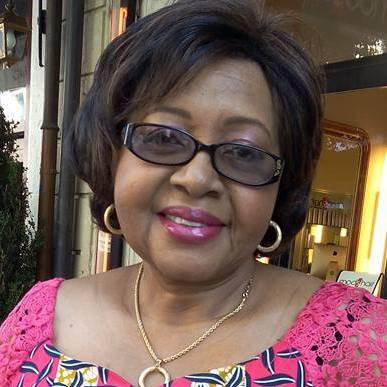


 Hans Thoolen on Human Rights Defenders and their awards