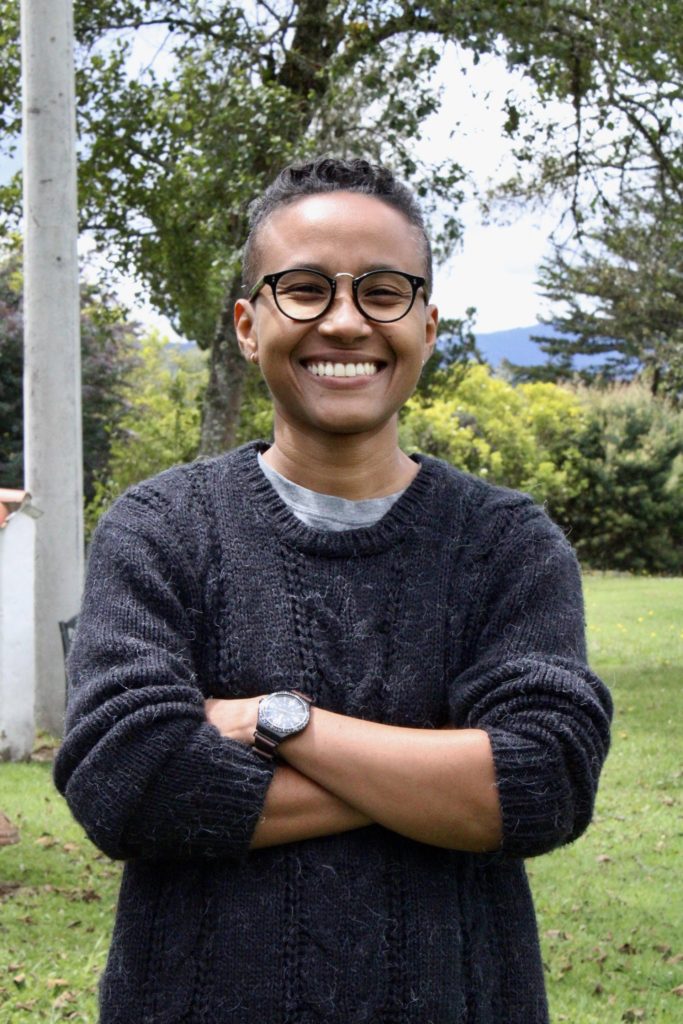
Óscar Calles is a journalist and human rights defender from Venezuela. Since 2019, he has been working for PROVEA, one of the country’s most prominent rights groups.
In an interview with ISHR, he recalled his experience of witnessing and broadcasting mass protests in his country in 2017, and how harshly these were repressed. This, he said, led him to take direct action in the defence of human rights and civil liberties.
Human rights organisations, activists and defenders only exist to ensure that all persons can live with dignity,’ says Oscar Calles. ‘Do not turn your backs on the hundreds of victims who are still awaiting justice to this day,’ he further urges States at the UN Human Rights Council, calling on to renew a key accountability mechanism for Venezuela.
In June 2024, Óscar was also one of 16 defenders who participated in ISHR’s Human Rights Defender Advocacy Programme (HRDAP)
Iranian hip-hop artist Toomaj Salehi, Uyghur poet and activist Tahir Hamut Izgil, and Venezuelan pianist and recording artist Gabriela Montero.
On 22 May 2024) The Human Rights Foundation announced the recipients of the 2024 Václav Havel International Prize for Creative Dissent: Iranian hip-hop artist Toomaj Salehi, Uyghur poet and activist Tahir Hamut Izgil, and Venezuelan pianist and recording artist Gabriela Montero.
“Their work stands as a testament to extraordinary bravery and ingenuity,” HRF Founder Thor Halvorssen said. This year’s laureates will be recognized during a ceremony on Tuesday, June 4, at the 2024 Oslo Freedom Forum (OFF) in Oslo, Norway. Montero will be performing the European and Scandinavian premiere of “Canaima: A Quintet for Piano and Strings” at the Oslo Konserthus. The Havel Prize ceremony will also be broadcast live at oslofreedomforum.com.
Toomaj Salehi is an Iranian hip-hop artist known for lyrics protesting the Iranian regime and calling for human rights. In September 2022, at the height of the nationwide “Women, Life, Freedom” protests, Salehi released several songs supporting women’s rights. One song, “Divination,” with the lyrics, “Someone’s crime was that her hair was flowing in the wind. Someone’s crime is that he or she was brave and…outspoken,” grew in popularity and was sung throughout the protests. Salehi was first arrested in October 2022 and was released on bail in November 2023 after the Iranian Supreme Court overturned his charges of “corruption on Earth,” “propaganda against the system,” “collaboration with a hostile government,” “inciting people to murder and riot,” and “insulting the leadership.” On November 27, 2023, he posted a YouTube video describing the torture and forced confession he experienced during his detention. Three days later, armed plain-clothes agents abducted Salehi. He was subsequently charged in two trials. On April 24, the Isfahan Revolutionary Court sentenced him to death.
Tahir Hamut Izgil is a prominent Uyghur poet, filmmaker, and activist. He is known for his avant-garde poetry, written in Uyghur and influenced by Uyghur life. Originally from Kashgar, Izgil led the 1989 student movement at the Central Nationalities Institute in Beijing. In the late 1990s, he was arrested on charges related to the possession of sensitive literature, leading to a three-year sentence in forced labor camps. He is among the few Uyghur intellectuals who successfully escaped the region in 2017.Izgil’s new memoir, “Waiting to Be Arrested at Night: A Uyghur Poet’s Memoir of China’s Genocide,” documents his journey living in and escaping the Uyghur Region, sharing a rare testimony of the Uyghur genocide with the broader world. His book has been listed as one of the “50 notable works of nonfiction” by The Washington Post and as one of the “10 0 Must-Read Books of 2023” by Time Magazine
Gabriela Montero is a Grammy Award-winning Venezuelan pianist and recording artist. Celebrated for her exceptional musicality and ability to improvise, Montero has garnered critical acclaim and a devoted following on the world stage. Montero’s recent highlights include her first orchestral composition, “Ex Patria,” a tone poem that grew from the human rights struggle in Montero’s native Venezuela. The piece powerfully illustrates and protests Venezuela’s descent into lawlessness, corruption, and violence, winning her first Latin Grammy® for Best Classical Album.Montero is a committed human rights advocate, using her gifts of composition and improvisation as tools of creative dissent. In 2015, she was named an Honorary Consul by Amnesty International. Montero was awarded the 2012 Rockefeller Award for her contribution to the arts and was a featured performer at Barack Obama’s 2008 Presidential Inauguration. [see also: https://humanrightsdefenders.blog/2018/10/15/venezuelan-pianist-gabriela-montero-wins-the-2018-beethoven-prize/]
On 15 February 2024 AP carried the story that Venezuela’s government has ordered the local UN office on human rights to suspend operations, giving its staff 72 hours to leave, after accusing the office of promoting opposition to the South American country. The UN office was established in Caracas in September 2019.
The foreign affairs minister, Yván Gil, announced the decision at a news conference in Caracas on Thursday. Gil’s announcement came on the heels of the detention of the human rights attorney Rocío San Miguel, which set off a wave of criticism inside and outside Venezuela.
The South American country’s government said it had made a decision “to suspend the activities of the technical advisory office of the UN high commissioner for human rights and carry out a holistic revision of the technical cooperation terms”.
The government said the UN human rights office must rectify its “colonialist, abusive and violating attitude”, accusing it of playing an “inappropriate role” in the country and supporting impunity for people involved in attempts at assassination, coups, conspiracies and other plots.
The Venezuelan government regularly accuses members of the political opposition of plotting takeovers or the assassination of President Nicolas Maduro, all accusations vehemently denied by opposing parties and their members.
“We regret this announcement and are evaluating the next steps. We continue to engage with the authorities and other stakeholders,” said UN human rights office spokesperson Ravina Shamdasani. “Our guiding principle has been and remains the promotion and protection of the human rights of the people of Venezuela.”
Venezuelan state television on Wednesday harshly criticized comments by the UN’s special rapporteur on the right to food, Michael Fakhri, who just concluded a visit to Venezuela. Fakhri had said in a statement the government food program does not tackle the root causes of hunger and is susceptible to political influences.
San Miguel was taken into custody on Friday at the airport near Caracas while she and her daughter awaited a flight to Miami. Authorities did not acknowledge her detention until Sunday, and as of Wednesday her attorney had not been allowed to meet with her.
San Miguel’s daughter, ex-husband, two brothers and former partner were also detained following her arrest. Of them, only her former partner remains in custody.
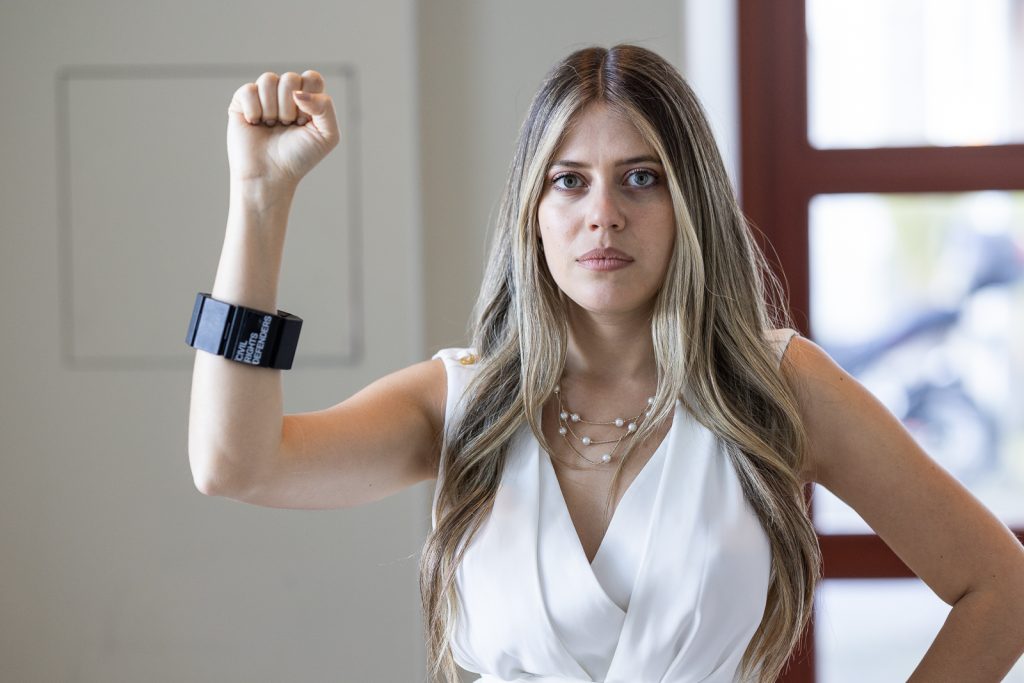
10 years ago, Civil Rights Defenders launched the Natalia Project, the world’s first assault alarm and community-based security system for human rights defenders. In the event of an attack, participants in the project can send out a distress signal so they can be located quickly and get help.
Natalia Project participant Génesis Dávila is the director and founder of Defiende Venezuela, a human rights organisation fighting for accountability and justice for victims of political persecution, people in arbitrary detention, and others who have been subjected to government-sanctioned attacks in Venezuela. In Venezuela being a human rights defender puts Génesis at risk of the very same political persecution she is trying to document.
“I face different threats on a daily basis. In general, they come from the Venezuelan regime. They harass human rights defenders because we try to protect people who are in danger and victims of human rights violations. This is something that puts us at great risk.” “It is really exhausting because then you don’t have space for other things. It’s the feeling of being chased all the time. It puts you under stress. You feel that you are never safe, wherever you are.”
In the case of an attack, the alarm is activated, and a distress signal goes off. Civil Rights Defenders and a network of human rights defenders can start investigating the situation within minutes.
“For me, my Natalia has been a game changer. It helped me feel safe. Just having this tiny device with me, knowing that there was someone on the other side of the world just waiting for my call, being ready to act if something happens gave me such a confidence. That changed everything.”
The Natalia Project device is built to be durable and easy to use and take wherever is needed.
“Everywhere I go, I bring my Natalia. If I’m about to fly somewhere, I check my passport, cellphone and my Natalia. It makes me feel safe. It’s my lucky charm.”
“Anyone who wants to support human rights can do it. You don’t have to be a lawyer, or someone waving a flag. You just need to advocate for human rights, and that will be enough.”
The CIVICUS Monitor, which tracks freedom of association, peaceful assembly and expression in 198 countries and territories, announced in a new report – “People Power Under Attack 2023” – that almost one third of humanity now lives in countries with ‘closed’ civic space.
This is the highest percentage –30.6% of the world’s population– living in the most restrictive possible environment since CIVICUS Monitor’s first report in 2018. Meanwhile, just 2.1% of people live in ‘open’ countries, where civic space is both free and protected, the lowest percentage yet and almost half the rate of six years ago.
“We are witnessing an unprecedented global crackdown on civic space,” said CIVICUS Monitor lead researcher Marianna Belalba Barreto. “The world is nearing a tipping point where repression, already widespread, becomes dominant. Governments and world leaders must work urgently to reverse this downward path before it is too late.”
The CIVICUS Monitor rates each country’s civic space conditions based on data collected throughout the year from country-focused civil society activists, regionally-based research teams, international human rights indices and the Monitor’s own in-house experts. The data from these four separate sources are then combined to assign each country a rating as either ‘open,’ ‘narrowed,’ ‘obstructed,’ ‘repressed’ or ‘closed.’
Seven countries saw their ratings drop this year. These include Venezuela and Bangladesh, each now rated ‘closed’ due to intensifications of existing crackdowns on activists, journalists and civil society.
Democratic countries slipped too. Europe’s largest democracy, Germany, fell from ‘open’ to ‘narrowed’ amid protest bans and targeting of environmental activists. Bosnia & Herzegovina also declined to ‘obstructed,’ the twelfth European country downgraded since 2018.
One of 2023’s most dramatic slides occurred in Senegal, once considered among West Africa’s most stable democracies. Senegal entered the ‘repressed’ category amid sustained government persecution of protesters, journalists and opposition ahead of February elections.
“The range of countries where authorities restricted citizen participation in 2023 shows clampdowns are not isolated incidents but are part of a global pattern,” said Belalba. “A global backslide requires a global response. If citizens are not able to freely gather, organise and speak out, the world will not be able to solve inequality, confront the climate crisis and bring an end to war and conflict.”
CIVICUS Monitor data shows that worldwide, authorities target people’s freedom of expression above all else. Half of all documented violations in 2023 targeted free speech, with incidents ranging from a bombing outside a journalist’s house in Indonesia, the arrest of the head of a radio station in Tunisia and police pepper-spraying a reporter covering a protest in the United States.
Our research also reveals that intimidation is the number one tactic to restrict citizen freedoms. Human rights defenders, activists and media experienced intimidation in at least 107 countries. Media in particular bear the brunt, with 64% of incidents targeting journalists.
Despite these alarming trends, People Power Under Attack 2023 highlights areas of progress too. Timor-Leste’s civic space moved up to the second best rating ‘narrowed’ from ‘obstructed,’ reflecting the country’s commitment to fundamental freedoms. Four other countries saw ratings improve, though they remain in ‘repressed’ or ‘obstructed’ zones.
The report also details bright spots where countries made steps toward opening societies. Among these, Fiji repealed a restrictive media law. The Kenyan courts recognised the right of LGBTQI+ people to associate. Even Tajikistan, rated ‘closed,’ created a national human rights strategy with civil society input. Still, these and other improvements remain halting and often disconnected compared to widespread repression.
“These small steps show that even amid unprecedented restrictions, civil society is pushing back,” said Belalba. “These courageous acts of resistance by active citizens and civil society organisations give us hope that the downward trend is not permanent and can be reversed.”
The winners of this year’s edition of the Lorenzo Natali Media Prize, awarded by the European Commission, were announced on 11 October at a ceremony hosted at the Solvay Library in Brussels.
The winners of the International Prize are:
Three Venezuelan journalists Carmen Victoria Inojosa, Claudia Smolansky and a third whose name cannot be disclosed for security reasons, were awarded the International Prize for their compelling article ‘Así funcionan las casas clandestinas de la Dgcim en Caracas‘ published in Armando.info. Their work exposed the harrowing reality of systematic persecution in Venezuela, targeting political opponents and their families with alarming impunity.
On 25 July, 2023 – International Afro-Latina, Afro-Caribbean and Diaspora Women’s Day, – Amnesty International highlighted nine defenders and collectives who have devoted their lives to ending inequality and violence, advocating a dignified life for all people because their work deserves the recognition, visibility, protection and resources necessary for it to continue to spread.
Rede Vozes Negras pelo Clima, Brazil
Rede Vozes Negras pelo Clima is an initiative of 11 Black Brazilian women who are working in their respective territories to protect human rights, confront climate racism and promote anti-racist socio-environmental justice. They belong to traditional, riverine quilombola communities. They are also activists and leaders of communities that live on the margins of large urban centres, communities that are being directly affected by the consequences of the climate crisis and development projects that fail to take into account the rights of local populations.
They are thus fighting for anti-racist adaptation policies and an energy transition that will guarantee the promotion of human rights and nature. Mitigation initiatives need to incorporate the ancestral knowledge and wisdom of traditional peoples and communities and ensure the participation of those people affected by extreme weather events when decisions are being made as to the investments that need to be made to repair losses and damage.
Dayana Blanco Acendra, Colombia
Dayana Blanco is a renowned Colombian lawyer who heads ILEX Acción Jurídica, an Afro-Colombian and Afro-LGBTQI+ organization committed to racial justice in Colombia, Latin America and the Caribbean. According to Blanco, “Racial justice in Colombia requires all of society to commit to combatting the historical inequality that has affected the Afro-descendant population. This means actions to address social and economic inequality.”
With an outstanding academic background and experience in different sectors, Dayana has promoted innovative research on racist police violence, statistical invisibility in the systematization of violence against Afro-descendant leaders and economic and social rights. In addition, together with her team and in coordination with other civil society organizations, she has obtained notable rulings in defence of Afro-Colombian midwifery, overcoming the statistical invisibility of the Afro-descendant population, among others, and demonstrating her dedication to the struggle for equality and justice.
Under her leadership, ILEX has – through legal mobilization, research and strategic communications – become a reference for promoting the rights of the Afro-descendant population. Dayana and her team highlight the importance of addressing social and economic inequality as a fundamental element of racial justice in Colombia, calling on the whole of society to unite in the struggle and build a more equitable future for all.
Donaida Pérez Paseiro, Cuba
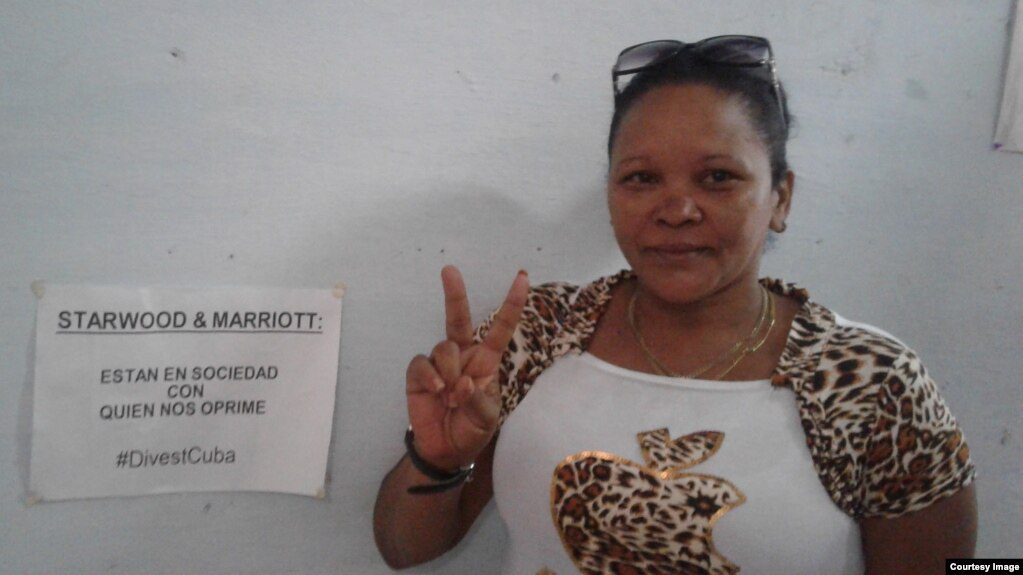
Donaida Pérez Paseiro is a Black activist, religious leader and president of the Asociación Yorubas Libres de Cuba. Yoruba is a religion of the African diaspora that is practised in many countries, including Cuba. Donaida was arrested on 16 July 2021 and sentenced in February 2022 to eight years’ imprisonment by the Santa Clara Municipal People’s Court for “public disorder”, “contempt” and “attacking” an official. According to the information available to Amnesty International, Donaida should never have been charged with these crimes.
The charges of “contempt” and “public disorder” are frequently used in Cuba to limit the right to freedom of expression and peaceful assembly. Both she and her husband, Loreto Hernández García, were tried along with 14 other protesters in what appears to have been an unfair trial.
Donaida is the wife of Yoruba leader and activist Loreto Hernandez Garcia who was unjustly sentenced to seven years in prison for demanding respect for human rights in Cuba during the 11 July 2021 demonstrations.
Donaida is an example of courage and perseverance in the resistance against repression in Cuba. Her commitment has manifested itself in numerous peaceful marches and protests. According to her family, she was a freelance journalist and founded the Laurel Express press agency, where she gave visibility to the injustices and challenges faced by her community in the city of Placetas. Her activism spans multiple spheres, having been a member of the Orlando Zapata Tamayo resistance front and the central opposition coalition. Donaida’s legacy transcends borders and leaves a profound inspiration for those who seek a Cuba without repression.
Guerline M. Jozef, Haiti
Guerline M. Jozef is the founder and executive director of the Haitian Bridge Alliance, the only Black and Haitian women-led organization serving migrants on both sides of the U.S.-Mexico border. Named one of the most influential people in 2021 on racial issues by Politico, she is also co-founder of the Black Immigrants Bail Fund and the Cameroon Advocacy Network.
The Haitian Bridge Alliance (HBA), also known as “the Bridge,” is a grassroots community-based organization that advocates for just and humane immigration policies and provides migrants and immigrants with humanitarian, legal and social services, with a special focus on Black migrants, the Haitian community, women and girls, LGBTQIA+ people, and survivors of torture and other human rights abuses. HBA also seeks to highlight issues specific to Black migrants and encourages solidarity and collective action to bring about policy changes. Through her work, Guerline reminds us that together, Anpil men, chay pa lou! Many hands lighten the load!
Miriam Miranda, Honduras
An Afro-indigenous Garífuna leader from Honduras, Miriam Miranda stands out as a courageous defender of human and environmental rights. As coordinator of the Organización Fraternal Negra Hondureña (OFRANEH), she has carried out invaluable work to protect and defend the rights of the Garífuna people in Honduras. Her tireless work, lucidity and commitment have earned her the recognition of prestigious awards, such as that of the Friedrich Ebert Foundation, as well as the Carlos Escaleras and Oscar Romero awards.
Miriam’s struggle is deeply rooted in the Garífuna territory of Honduras and is manifested through the history of OFRANEH, an organization through which these people are building their dignity and their future. The land and the sea, as an indispensable part of their identity, determine an essential struggle to preserve the natural assets of their territory.
Miriam is a highly respected thinker and leader within the social movement. She has an enormous capacity to devour books and mobilize energies from all sides to defend her people. She is one of those people who make life possible, whose words always point forward and who finds strength in the deep roots of her origin, where her future of freedom was born. As the daughter of Barauda (representing Garífuna female strength, Barauda is an historical character who pushed the Garífuna hero Sathuye to continue the struggle for the liberation of his people), Miriam has turned her critical eye to the source of it all: the predatory civilization of consumerism.
Her tireless work and courage inspire others to keep fighting. Her contribution and leadership have already left an indelible mark on the history of Honduras and global struggles for territory. [see also: https://humanrightsdefenders.blog/tag/miriam-miranda/]
Shackelia Jackson, Jamaica
The extrajudicial killing of her brother, Nakiea Jackson, in 2014 pushed Shackelia Jackson into a life of activism. Since then she has been healing, evolving, learning and gathering the tools with which to reconcile her conflicting realities. A political science scholar and communicator, Shackelia is the mother of an empathetic child, who longs with innocence to experience the world. Despite challenges and setbacks, Shackelia remains dedicated to the wider struggle, supporting causes that prevent the institutionalization and normalization of practices that violate human rights and erode the sanctity of life.
Through her grassroots organizing efforts in Jamaica, she has raised funds to support back-to-school initiatives and education programmes, recognizing the importance of empowering the younger generation. Shackelia’s work has gone far beyond her local community. She has become a global force, lending her voice and expertise to international platforms. As keynote speaker at an Amnesty International event in London, she captivated the audience with her powerful words, urging them to stand up and take action. In 2017, Shackelia also participated in roundtable discussions at Amnesty International events in Brazil and the United States, amplifying the voices of the oppressed and demanding accountability.
It was on this journey that Shackelia realized that change starts with each individual. She has encouraged others to join her in writing for rights, and to use their words as weapons against injustice. “Let us write until we are heard, let us write until justice is done,” she said.
Ivana C. Fred Millán, Puerto Rico
Ivana Fred is a prominent Black and transgender activist, writer and leader from Puerto Rico. She has dedicated her life to fighting for human rights and equality for transgender people in her country. Her passion for justice has made her an influential figure and a powerful voice in Puerto Rican society.
Since her first steps into activism in 1999, Ivana has formed part of pioneering projects aimed at trans people and has used her voice and pen to amplify the stories and needs of trans people.
As she says: “Life put me in a place where I could develop as a leader, the ‘Ponte el Sombrero’ project gave me the tools to empower and educate socially disadvantaged and discriminated populations. That was how I came to understand that to exist is to resist”.
Ivana has also made her mark in the media, writing for the Metro newspaper and participating in acclaimed documentaries and films such as “Mala Mala” and “Las Muchachas”. Her presence and perspective have helped generate greater visibility and understanding of transgender experiences in Puerto Rico.
Ivana Fred is currently one of the directors of the organization Trans Goofy Games, where she continues to lead and support initiatives that promote transgender inclusion and empowerment. With unwavering commitment, Ivana has remained a visible leader and loyal activist. From her early days of activism to the present day, her voice has been resolute in seeking dignity and respect for all transgender people.
With her courage and determination, Ivana has shown that to exist is to resist and has paved the way for a more inclusive and respectful future in Puerto Rico and beyond. Her legacy as a visible leader and her tireless activism inspire us all to continue fighting for a world where everyone can live with equality and dignity.
Elena Lorac, Dominican Republic
Elena Lorac is a prominent activist and advocate for human rights in the Dominican Republic, especially on the part of Dominicans of Haitian descent. As national coordinator of the Movimiento Reconoci.do, she has led the fight for the right to nationality and full integration of this community into Dominican society.
With more than 12 years’ experience, Elena has worked to strengthen community leadership and empower black women in the country’s bateyes [sugar mill settlements]. She also provides support to Haitian migrants and Venezuelan migrants and refugees, and is known for her community-based approach.
Elena is also a nationally and internationally renowned speaker, speaking on issues such as nationality, discrimination and racism, and raising awareness of policies that affect Dominicans of Haitian descent in the Dominican Republic. Her tireless work has been instrumental in promoting human rights and achieving the real inclusion of this community in Dominican society.
Aracelis Sánchez, Venezuela
Aracelis Sánchez, a human rights defender and the founder of Organización de Familiares de Víctimas de Violación de Derechos Humanos (Orfavideh), is promoting solidarity and demanding justice together with more than 200 mothers of victims of extrajudicial executions in Venezuela.
Aracelis, who lost her son Darwilson Sequera, has been fighting for more than 10 years to get cases of human rights violations committed by Venezuelan state security forces investigated. Orfavideh provides human rights training workshops for mothers, equipping them with tools with which to demand guarantees and use the mechanisms of justice in Venezuela.
Aracelis stresses that when victims are empowered and able to put pressure on prosecutors, their cases are investigated. She believes that support and empowerment are essential to transform grief into positive action and thus achieve justice for victims and their families.
Today the three Martin Ennals Award Laureates 2023 were announced !
The 2023 Laureates — Delphine Djiraibé (Chad), Feliciano Reyna (Venezuela), and Khurram Parvez (Jammu and Kashmir) — have each dedicated over 30 years of their lives to building movements which brought justice for victims, accountability from leaders, or medicines to the marginalized. They have made human rights real for thousands of people in their communities, despite the ongoing, sometimes life-threatening, challenges they endure. For more on this award and its laureates, see: https://www.trueheroesfilms.org/thedigest/awards/043F9D13-640A-412C-90E8-99952CA56DCE
———————
Delphine Kemneloum Djiraibé was one of the first female lawyers in Chad and a pioneer of the human rights movement in one of the poorest countries in the world, fraught with corruption and human rights abuses. Convinced that her role is to “challenge the power”, Delphine has advocated on behalf of victims and the democratic process for over 30 years. She was a key figure in bringing the former dictator Hissène Habré to justice. Djiraibé heads the non-governmental organisation Public Interest Law Center (PILC), which trains volunteers and accompanies citizens seeking justice for violations of their rights. In recent years she has been particularly active in combating gender-based violence and is in the process of establishing the first women’s counselling center in Chad, which will include an emergency shelter for women affected by domestic violence. See also: https://www.trueheroesfilms.org/thedigest/laureates/5B701F71-12FD-B713-9F99-5E09B9AFD6DA
After the death of his partner Rafael from AIDS in 1995, Feliciano Reyna, then an architect, founded Acción Solidaria to provide much needed medication and treatment to Venezuelans living with HIV & AIDS. Feliciano and Acción Solidaria began advocating for access to health for the marginalised LGBTQI population in a country where healthcare was on the decline and corruption on the rise. They created the first national AIDS Help Line in Venezuela and ran a national awareness campaign on HIV & AIDS, which aired on TV and in movie theaters, and received radio and magazine coverage. Feliciano Reyna went on to found CODEVIDA, a coalition of Venezuelan organisations promoting the rights of Venezuelan citizens to health and life. As he put it: “We walked directly into the complex humanitarian emergency in Venezuela”. Despite ongoing threats, since 2006, he has worked closely with UN mechanisms to defend human rights in his country. In 2019 his advocacy was instrumental in establishing the Independent International Fact-Finding Mission on Venezuela.
At the age of 13, when Khurram Parvez witnessed the shooting of his grandfather during a protest demonstration against the molestation of women outside his house in Kashmir, he chose to “not incite violence and become part of some revenge” , but rather to become a “nonviolent activist“. He founded the Jammu and Kashmir Coalition of Civil Society (JKCCS) and is the Chair of the Asian Federation Against Involuntary Disappearances. For 15 years he has travelled to the most remote parts of the region to sit with victims of abuse, collect documentation and report on their stories. Under his leadership, the JKCCS has been highly effective in translating the protections guaranteed in international human rights law into local realities. Despite continued attacks on his right to freedom of expression by the Indian government, being jailed in 2016 and losing a leg to landmines, Khurram relentlessly spoke the truth and was an inspiration to civil society and the local population. In November 2021, he was arrested under the Unlawful Activities Prevention Act (UAPA) on politically motivated charges. He remains detained without trial in India. See also: https://www.trueheroesfilms.org/thedigest/laureates/81468931-79AA-24FF-58F7-10351638AFE3
You can watch them take questions from the press at the Club Suisse de la Presse, livestreamed on February 14th, 2023 from 12h CET.
Hailing from Somalia, Ukraine, Venezuela and Uganda, the 2022 Laureates have each created new models for human and societal interactions that challenge the status quo. With crises stemming from authoritarian governance, international aggression, profit-seeking economic systems and political inertia to take action against a planetary climate breakdown, these change-makers have imagined a better world and work tirelessly to make it a reality.
“The 2022 Right Livelihood Laureates are grassroots actors dedicated to strengthening their communities. In the face of failing governance and a breakdown of order – including wars, terrorism, extractivism, massive displacement and economic crises – they have established new, human-centric systems. Their successes demonstrate how we can build societies on the principles of justice rather than exploitation,” said Ole von Uexkull, Executive Director at Right Livelihood.
Human rights defenders promote dignity, fairness, peace and justice in their homes, workplaces, communities and countries. They challenge governments that fail to respect and protect their people, corporations that degrade and destroy the environment, and institutions that perpetuate privilege and patriarchy. For many, the United Nations (UN) is the last arena in which they can confront abuses.
Human rights defenders must be able to share crucial information and perspectives with the UN safely and unhindered. Yet some States try to escape international scrutiny by raising obstacles – such as intimidation and reprisals – aimed at creating fear and systematically hindering defenders’ access to and cooperation with human rights mechanisms. See my post of today: https://humanrightsdefenders.blog/2022/09/20/human-rights-defenders-at-the-51st-session-of-the-un-human-rights-council/
This needs to change! Join the campaign of the International Service for Human Rights today so human rights defenders have a seat at the UN table.
What can you do? ISHR and partners have worked to support individual defenders and organisations that have endured multiple forms of reprisals and intimidation. Take action for them now and help #EndReprisals!
Here are two quick, impactful actions you can take:
Write to State representatives at the UN and urge them to take up cases from Belarus, Burundi, China, Egypt, and Venezuela Click to tweet a message in solidarity with the individuals or groups described in a specific case: