IOC President Thomas Bach said Saturday 2 December 2018 at meetings in Tokyo that “human rights standards” will be included in Olympic host-city contracts, beginning with the 2024 Games in Paris. “Promoting humanistic values in sport has been a core feature of the IOC since its beginning” and “Our mission, to put sport at the service of humanity, goes hand in hand with human rights, which is part of our DNA” But his answers re the Bejing Winter Olympics in 2022 fell short of this lofty language: Bach was asked if the committee would look at human rights in China, where hundreds of thousands of Muslims in western China are being held in interment camps. He said the IOC would not question China because it “has not the mandate nor the authority to solve the human rights problems” that are clearly “political issues. Bach suggested the committee would focus on issues like the rights of transgender athletes. “We should concentrate on what we can really achieve and what we can really do” .
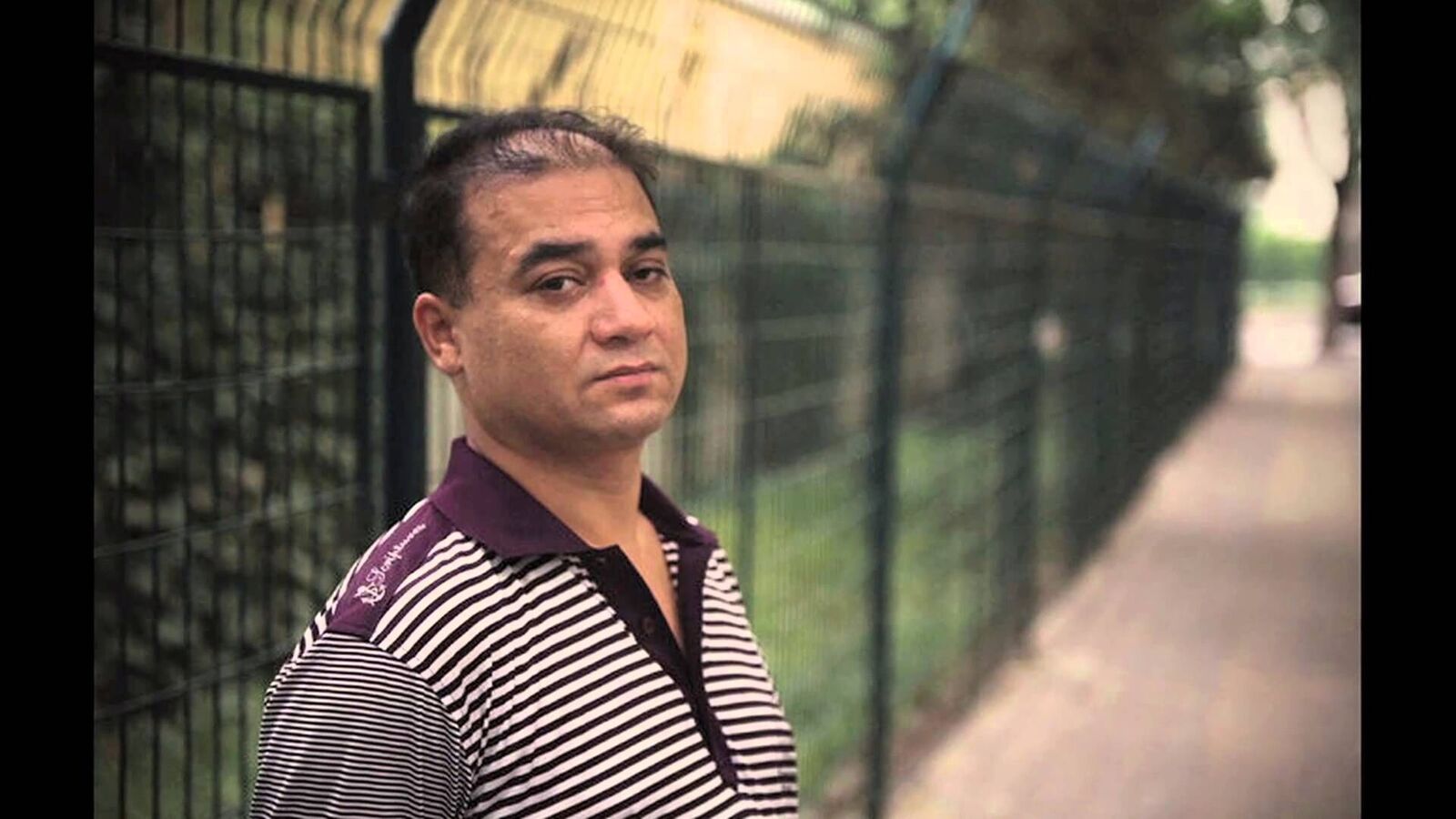
Rightly Front Line Defenders reminds us that today, 15 January 2018, Ilham Tohti completed his fourth year in Chinese detention. The human rights defender, economics professor and advocate for the rights of China’s Uyghur minority was arrested following a raid on his home on 15 January 2014. In the course of his incarceration, Ilham Tohti has been subjected to recurring violations of international human rights standards with regard to detention conditions such as limitations of family visits, intercepted communication, solitary confinement, deprivation of food and intimidation. Ilham Tohti’s family and colleagues have also been subjected to judicial harassment.
Ilham Tohti <https://www.frontlinedefenders.org/fr/profile/ilham-tohti> formerly lectured as a professor at the Central University for Nationalities in Beijing. He has researched, taught, and written numerous articles on topics related to human rights violations in China’s northwestern Xinjiang Province, the homeland of China’s sharply repressed Uyghur minority. In 2006, the human rights defender founded Uyghur Online, a Chinese-language website for the dissemination of Uyghur-centric news. Across these platforms, Ilham Tohti regularly criticised the exclusion of China’s Uyghur population from Chinese development, and encouraged greater awareness of Uyghur status and treatment in Chinese society. For these actions, Ilham Tohti was declared a “separatist” by the Chinese state and ultimately given a life sentence in prison.
Following his arrest on 15 January 2014, Ilham Tohti was tried at the Urumqi City Intermediate People’s Court on 23 September 2014. He was found guilty of “separatism” and sentenced to life in prison. Seven of the human rights defender’s students were arrested in the same year, and his niece was arrested in early 2016 for possessing photos of and articles written by the defender on her phone. On 10 October 2016, Ilham Tohti was granted the Martin Ennals Human Rights Award. {see earlier posts on Ilham https://humanrightsdefenders.blog/tag/ilham-tohti/]
Uyghur scientist and human rights activist Ilham Tohti – laureate of the 2016 Martin Ennals Award – was awarded the Weimar Human Rights Prize by the Weimar city council for his commitments to the rights of Uyghurs in the Xinjang autonomous region of China. On 30 June 2017, the City Council made the decision following to the recommendation of the Advisory Committee on the Award of the Weimar Human Rights Award, which had voted for a proposal from the Ilham Tohti Initiative and the Society for Threatened Peoples of Germany. The justification of the City Council states: “As a renowned professor of economic and social issues at the Central Nationalities University of Beijing, Ilham Tohti has been tirelessly trying to point out to a broad public the serious economic and social dilemmas of the Uyghurs in Xinjiang. He has always advocated a peaceful coexistence between the ethnic groups of the Uyghurs and Han Chinese, as well as other minorities, and has only observed compliance with the existing autonomy law by the Chinese government. In September 2014, the ethnic bridge builder and inconvenient advisor, who always claimed that Xinjiang Autonomous Province remained an integral part of the People’s Republic of China, was sentenced to life imprisonment by the Urumchi Middle People’s Court for separatism. The City Council hopes that the award will spread Tohti’s message of peace and dialogue and the efforts for his release. ”
The award ceremony will take place on 10 December 2017 on the occasion of the International Day of Human Rights.
Just now, on 15 December 2016, the European Parliament adopted an urgent and substantive resolution on breaches of human rights, democracy, and rule of law in China. The resolution condemns in particular exactions committed in East Turkestan and Tibet against the Uyghur and Tibetan populations respectively and addresses the cases of the imprisonment of economics professor Ilham Tohti (MEA Laureate 2016) and the dismantling of Larung Gar, the largest Buddhist institute in the world. The EU demands Tohti’s immediate and unconditional release, recalling his scholarly work on Uyghur-Han relations. [https://humanrightsdefenders.blog/2016/10/11/hot-news-ilham-tohti-chinas-mandela-wins-2016-martin-ennals-awad/]
On 20 September Sophie Richardson, China Director of Human Rights Watch, wrote a timely piece “China Wants You to Forget Ilam Totti“:
“It’s been two years since Ilham Tohti, [sometimes spelling Ilam Totti] a well-regarded ethnic Uyghur economist and peaceful critic of the Chinese government, was sentenced to life in prison by the Xinjiang People’s High Court for alleged “separatism” after a grossly unfair trial. Tohti and his family had already endured years of harassment and periods of house arrest by state agents, but in September 2014 Beijing evidently felt it necessary to take him off the grid permanently.”
Since then, human rights defenders and the rule of law in China have been under sustained attack from President Xi Jinping’s government. But the dynamics in Xinjiang – a region synonymous with gross discrimination against the predominantly Muslim Uyghur population, restrictions on religion and speech, economic development plans that favor Han Chinese over Uyghurs, and now a highly politicized counterterrorism campaign to stem violence – provide fertile ground for further serious human rights violations.
The signs are ominous: restrictions on observing Ramadan are now an annual reality, and some Uyghurs are now being required to give DNA samples and other biodata in order to obtain passports. China’s state media reports on counterterrorism operations when it’s politically convenient to do so, but we don’t know how many local residents die in these raids, how those detained in connection with the operations are treated, or even whether the state is responding to a credible threat. Hundreds – perhaps thousands – of Uyghurs have fled the country, some of whom have been forcibly returned under Chinese government pressure.
The European Parliament awards the Sakharov Prizefor Freedom of Thought every year to honor individuals and organisations defending human rights and fundamental freedoms. Nominations for the Sakharov Prize are made by political groups or by at least 40 MEPs. The 4 nominees for this year’s Sakharov Prize are:
Can Dündar, the former editor-in-chief of Turkish daily Cumhuriyet, was arrested last November after his newspaper reported on Turkey’s intelligence service smuggling arms to rebels in Syria. He was later sentenced to five years and 10 months in prison for “revealing state secrets”, survived an assassination attempt and now lives in exile. He was nominated by Greens/EFA, EFDD and GUE/NGL.
Mustafa Dzhemilev, former chair of Mejlis of the Crimean Tatars People (Tatar parliament), a former Soviet dissident and a Ukrainian MP, has been standing up for human and minority rights for more than half a century. He was six months old when he and his family were deported to central Asia along with all other Crimean Tatars and was only able to come back 45 years later. Now, after Russia annexed Crimea, the human rights activist is again barred from entering the peninsula. He was nominated by EPP and ECR.
Nadia Murad Basee and Lamiya Aji Bashar are advocates for the Yazidi community and for women surviving sexual enslavement by Islamic State. They are both from Kocho, one of the villages near Sinjar, Iraq, which was taken over by Islamic State in the summer of 2014, and are among the thousands of Yazidi girls and women abducted by Islamic State militants and forced into sex slavery. Murad is also a promoter for recognition of the Yazidi genocide. They were nominated by S&D. Murad Basee was also nominated separately by ALDE.
The vote for the shortlist of three finalists will be held during a joint meeting of the foreign affairs and development committee. The Conference of Presidents, made up of the Parliament President and the political group leaders, will announce the winner(s) of the 2016 Sakharov Prize on 27 October.
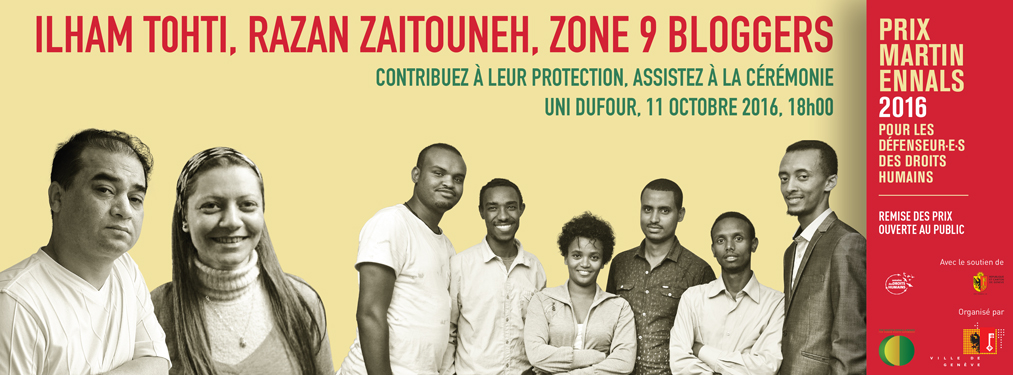
The 2016 Martin Ennals AwardCeremony, organized annually by the City of Geneva and the Martin Ennals Foundation, will this year take place on 11October, 6.00 pm, at Uni Dufour, Geneva, as thethe opening of the Human Rights Week hosted by the University of Geneva from October 11 to 14 and with the support of the Canton of Geneva.
The laureate will be selected from among three 2016 finalists:
Mr. Ilham Tohti (China) was sentenced to life imprisonment after working for two decades to foster dialogue and understanding between Uyghurs and Han Chinese.
Mrs. Razan Zaitouneh (Syria) was kidnapped after dedicating her life to defending political prisoners and documenting crimes against humanity in Syria.
Zone 9 Bloggers (Ethiopia) have been prosecuted for documenting human rights abuses in their country.
The finalists and laureate are selected by the Jury of the Martin Ennals Award, made up of ten of the world’s leading human rights organizations: Amnesty International, Human Rights Watch, Human Rights First, International Federation for Human Rights (FIDH), World Organisation Against Torture (OMCT), Frontline Defenders, the International Commission of Jurists, EWDE-Germany, the International Service for Human Rights, and HURIDOCS. The detailed programme of the ceremony will follow at the beginning of September.
Martin Ennals Award for Human Rights Defenders
For the conversation in the social media, use the hashtag: #Ennals2016.
Just now the Martin Ennals Foundation announced that the three Final Nominees of the 2016 Martin Ennals Award for Human Rights Defenders are: Read the rest of this entry »
Samah Hadid – a human rights activist from Australia – writes on 6 March that the following women human rights defenders are worth knowing more about. I have abridged her text a bit:
Human rights activist Samah Hadid. Photo: Supplied
This year’s International Women’s Day [IWD] is dedicated to women who ‘Make it Happen’, and plenty of women come to mind who embody this theme. As attacks on women human rights activists and defenders continue to rise, I think this IWD is a perfect time to celebrate the women who are champions for the freedom of others.
Salwa Bugaighis- lawyer and political activist from Lybia
Salwa was shot dead in 2014 and her assassination left me and many worldwide devastated. Salwa was a courageous lawyer who from a young age pushed for democracy in Libya. She was actively involved in Libya’s revolution and has been described as the “Libyan human rights activist who took on Gaddafi”. Salwa was also actively involved in Libya’s post-revolution transition, calling for the inclusion of women in this process. At every chance, she pushed for national reconciliation in the troubled country. We can all take inspiration from Salwa’s courageous activism. Her commitment to peace and freedom is a legacy we should all aspire to.[see also: https://thoolen.wordpress.com/2014/06/29/human-rights-lawyer-salwa-bugaighis-killed-in-libya/]
Mu Sochua- politician and women’s rights advocate from Cambodia
Mu Sochua grew up during the reign of the brutal Khmer Rouge in Cambodia. She was forced into exile and returned to rebuild her country. As the Minister of Women’s Affairs, Mu advocated to end human trafficking and the exploitation of female workers, and drafted crucial laws on ending violence against women. Standing strongly behind her principles, Mu stepped down as minister and decided to become an opposition figure in light of government corruption and repression. As a result, Mu has faced, and continues to be threatened with, imprisonment for criticising the government and Prime Minister.
Gillian Triggs- president of the Australian Human Rights Commission and legal expert
The head of Australia’s Human Rights Commission has recently faced an onslaught of politically driven attacks and abuse from leading politicians, including the Australian Prime Minister, for her human rights advocacy. Triggs, a highly accomplished lawyer and academic, has been unfairly targeted for promoting and protecting human rights, particularly on the issue of asylum seeker children locked up in immigration detention. Yet in the face of political pressure and relentless attacks by the government, she remains determined to fulfil her mission of protecting human rights in Australia.
Rebiya Kadeer- Uyghur activist and leader
Rebiya is many things: businesswoman, mother of eleven children, political leader and, let’s face it, one of China’s fiercest freedom fighters. As a member of the persecuted ethnic Uyghur minority in China’s Xinjiang region, Rebiya has spent her life campaigning for the rights of Uyghurs. Her activism has come at a price; Chinese authorities sentenced her to eight years in prison for her work and she was later forced to live in exile. Despite this, Rebiya – who is known as the ‘Mother of the Uyghur nation’ – has not been silenced by Chinese authorities and continues her activism at the age of 60! [see also: https://thoolen.wordpress.com/2013/09/19/challenges-for-human-rights-education-at-side-event-council-on-25-september/]
Yara Sallam- feminist activist and human rights lawyer from Egypt
At the age of 28, Yara is a leading human rights activist in Egypt. Her commitment to defending human rights, especially women’s rights in Egypt, is inspiring for a fellow young Arab woman like myself . As a feminist, she has championed greater space for women to exercise their civil and political rights and to be free from sexual violence. Yara was recently sentenced to two years in prison for attending a protest in Egypt, where it is now illegal for citizens to effectively exercise their right to protest. Even from prison, Yara continues to champion the causes of vulnerable women who have been detained and imprisoned.[for more on her: https://thoolen.wordpress.com/tag/yara-sallam/]
Nimko Ali- anti-FGM campaigner in the UK
Nimko is survivor of female genital mutilation and a fierce campaigner who leads the anti-FGM campaign in the UK. She has propelled the issue onto the front pages of newspapers and into the halls of parliament, advocating for stronger legislation and policy changes. She is a co-founder and director of Daughters of Eve, a not-for-profit raising awareness about FGM and providing support to survivors of FGM. Nimko has faced verbal and physical attacks for speaking out and yet her advocacy remains steadfast. Nimko considers herself a survivor, not a victim. Her fighting spirit is one we can all learn from. I certainly have.





 Hans Thoolen on Human Rights Defenders and their awards