Posts Tagged ‘United Nations’

The state of the States: understanding fragile states

February 22, 2013

On 22 February 2013 Dan Smith published a post on his blog on the ‘state of States’. While not directly touching on human rights defenders, it gives in few words an excellent overview of the formation and deformation of States which provide much of the power and abuse that human rights defenders struggle against. I summarize some of the  main issues here, but urge you to read the full text:

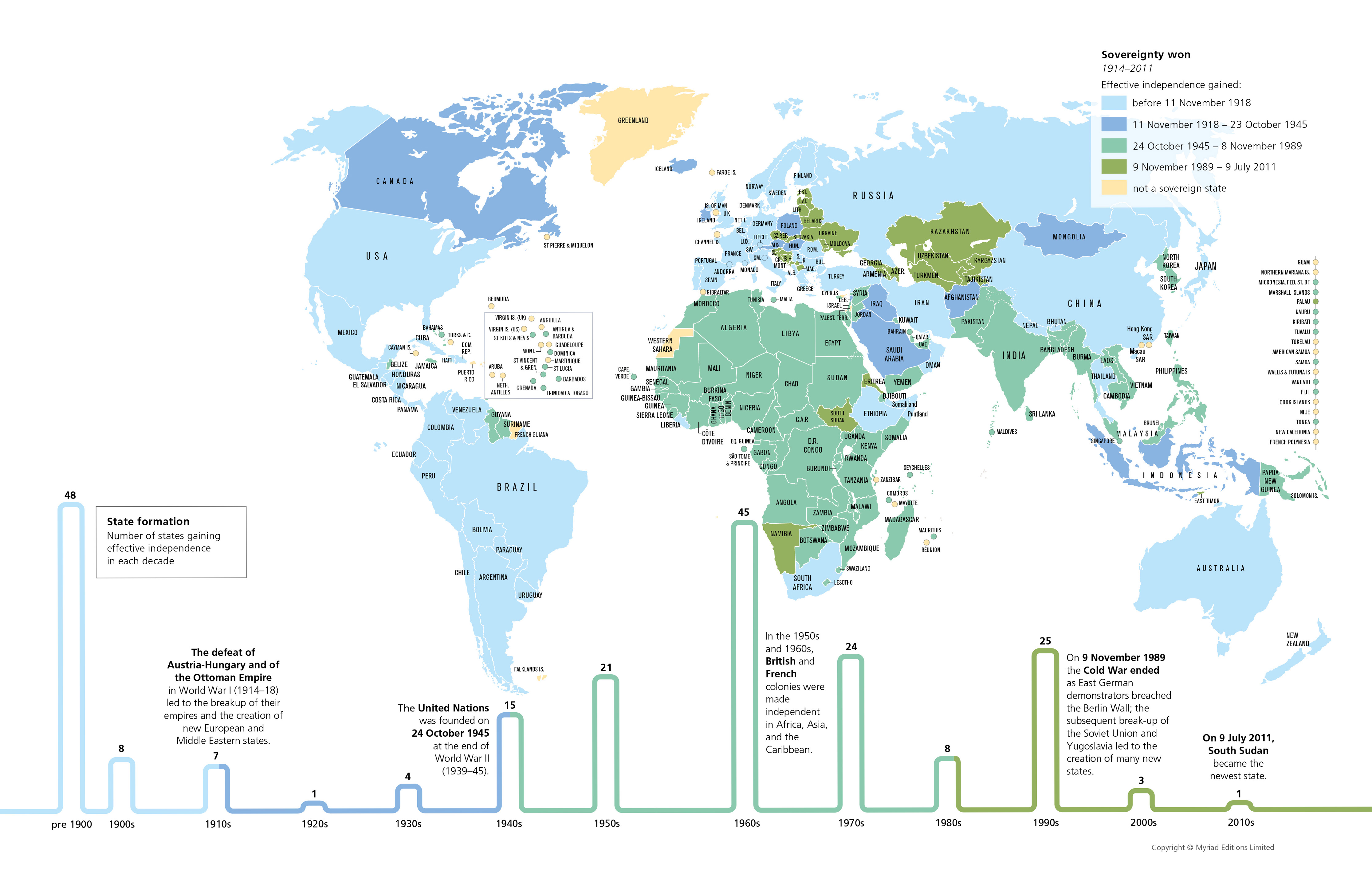
First he points out that most states are relatively new. By 1900 there were just 48 states in our modern sense of the term. In the years either side of World War I, with the break-up of the Ottoman and Habsburg Empires, there was considerable state-making. Even so, the UN was founded by just 51 states. Today, 193 states make up the UN, the newest being South Sudan in July 2011.

From 48 to 193 (recognised states, that is) - from The State of the World atlas

From 48 to 193 (recognised states, that is) – from The State of the World atlas Read the rest of this entry »

Russian “homosexual propaganda” law risks to target human rights defenders

February 7, 2013

A draft law to criminalise “homosexual propaganda”, currently being considered by the Russian parliament, flagrantly violates international human rights laws and standards, says the International Service for Human Rights (ISHR). The ISHR is particularly concerned that the law will be used to target, intimidate or harass human rights defenders and those who speak out on the rights of lesbian, gay, bisexual, transgender and intersex people. “States have an obligation not only to respect and protect human rights, but also to respect and protect those who stand up and speak out for human rights. Russia’s draft law is manifestly incompatible with this obligation,” said Ms Collister of the ISHR.ISHR-logo-colour-high

ISHR’s statement comes as three United Nations Independent human rights experts have also called on Russian parliament to scrap the draft Bill. In a joint statement issued by the Special Rapporteur on freedom of opinion and expression, the Special Rapporteur on human rights defenders and the Special Rapporteur on the right to health, the experts state, “The draft legislation could further contribute to the already difficult environment in which these defenders operate, stigmatizing their work and making them the target of acts of intimidation and violence, as has recently happened in Moscow.”

For further comment, contact Heather Collister, International Service for Human Rights, on + 41 79 920 3805 or h.collister@ishr.ch.


Urgent Appeals in theory and practice by the Asian Human Rights Commission; with examples from India and Pakistan

February 2, 2013

Under the title “Urgent Appeals, theory and practice“, the NGO ‘Asian Human Rights Commission‘ reflects on the need and increasing practicality (especially thanks to IT) of conducting urgent appeals. The AHRC Urgent Appeals system was created to give a voice to those affected by human rights violations and it now concludes that “Patterns start to emerge as violations are documented across the continent, allowing us to take a more authoritative, systemic response, and to pinpoint the systems within each country that are breaking down. This way we are able to discover and explain why and how violations take place, and how they can most effectively be addressed. On this path, larger audiences have opened up to us and become involved: international NGOs and think tanks, national human rights commissions and United Nations bodies.  The program and its coordinators have become a well-used tool for the international media and for human rights education programs. All this helps pave the way for radical reforms to improve, protect and to promote human rights in the region”.

for the full text of the reflection go to: http://www.humanrights.asia/news/urgent-appeals

To illustrate the point the AHRC comes at the same time with a call for action against what it calls a “witch hunt” by the Indian authorities against human rights defender Madhuri Krishnaswami of the Jagrat Dalit Adivasi Sangthan. In the most recent attack, the District Magistrate has written a letter to the Divisional Commissioner that found its way to Chief Secretary accusing the organisation to have links with Maoists and have demanded an inquiry into the issue. The attack is not a stray one but comes high on heels of an externment notice served on her by the same district administration in May, 2012 and subsequent attack on a JADS rally by the local goon with the administration looking away. Interestingly, the charge has been refuted by the police with the Inspector General of Police, categorically denying the presence of any Maoists activities in the reason.[The administration, evidently, is working on the behest of deeply entrenched vested interests whose corruption Madhuri and the organisation have continuously been exposing. The current attack, too, is an attempt to divert attention from the massive scam in the implementation of the Mahatma Gandhi National Rural Employment Guarantee Act in the area tipped to be worth more than 150 crore INR.]

A more elaborate case narrative can be found on: http://www.humanrights.asia/news/urgent-appeals/AHRC-UAC-009-2013/?searchterm=None

At the same time the AHCR expresses great concern over the abduction of 4 human rights defenders in Pakistan by (probably) members of an outlawed religious organization. The unknown armed persons abducted six workers of a NGO including, two lady workers. However, after some time they threw the two women out of the vehicle. It is feared that the abducted workers would be assassinated as has happened in the past. Many health workers and human rights defenders have been killed after their abduction by such ‘religious groups’. The NGO, ‘HAND’, works under the UN programme. The abducted persons and female workers who were working in the Noor Mohammad Village Goth, Mauripur, Karachi, where they have been distributing medicines and rations to the residents for some time. The male abductees were Engineer Amjad Ali Siyal, Mohammad Ashfaq, dispenser, Khurram Ahmad Abbas, dispenser and driver Humayun Ahmad, driver. The released women, Miss. Shakila and Miss. Rashida told police that the kidnappers had taken the four abducted workers in a car towards Balochistan. The police claim that they were abducted by one of the banned Muslim extremist groups who are opposed to the polio vaccination programme and this incident due to the campaign against NGO volunteers. It is believed that the abductors are convinced that they are working for the interests of America or the West.

And by the way, human rights work in the UN costs money

February 1, 2013

High Commissioner for Human Rights, Ms. Navane...

The UN High Commissioner for Human Rights, Navi Pillay. on Thursday 31 January launched an appeal for US$130.4 million in 2013, telling donors that the UN Human Rights Office could respond to more of the many requests for assistance she receives if additional resources were made available. Despite reducing its expenditure by more than 7.5 percent in 2012, the UN Human Rights Office experienced a funding shortfall for the third year in a row. As a result, 46 posts have been cut or frozen, a decision which will affect our ability to respond to ongoing challenges, such as discrimination, climate change, HIV-related issues, protection of human rights defenders and support for various key human rights bodies”, Mrs Pillay said.

Clearly, preventing crises costs vastly less than responding to them once they have occurred,” the High Commissioner said. “It is a disturbing paradox that raising funds to respond to crisis situations is so much easier than raising funds to prevent crises from happening in the first place. Imagine all the suffering, destruction and loss of life that could have been avoided if we were able to prevent or mitigate only some of the crises the world is witnessing today……… This prevention role – which is generally less visible than our responsive role – is of crucial importance and deserves strong donor support and attention.

Twenty years ago, when the Office of the High Commissioner was created, the international community made the decision to invest more in human rights, but this sector remains severely underfunded, especially compared to the high degree of public recognition the UN gets for its human rights work.

The Annual Appeal can be downloaded from the OHCHR website at: http://www.ohchr.org/EN/PublicationsResources/Pages/AnnualReportAppeal.aspx

Call for Nominations 2013 for the Nansen Refugee Award now open

January 24, 2013

Do you know of anybody who has gone beyond the call of duty and shown outstanding dedication and service to the refugee cause? Or maybe a group of people or an organization? Any person can nominate candidates (individuals, groups of people or organizations) but self-nominations and nominations of current or former UNHCR staff are not encouraged.

Each laureate for the Nansen Refugee Award is selected in line with the following:

  • The deed for which the person/entity is nominated should either take place outside the framework of normal professional duties and/or go beyond the call of duty;
  • It should demonstrate courage;
  • It should raise awareness for refugees; and
  • It should, in a significant way, benefit the beneficiaries the Awardee serves and possibly also the country/area where the Awardee operates.

The independent Nansen Refugee Award Committee, chaired by the United Nations High Commissioner for Refugees, selects the annual laureate by a unanimous or majority decision.

Ms. Ingrid PrestetunMs. Ingrid Prestetun, Coordinator, Nansen Refugee Award Programme, UNHCR Geneva.

Download the nomination form here (EnglishFrench) and send it to: Nansen@unhcr.org

UN Watch: simply anti UN and anti Pillay – NGOs should Watch Out

January 23, 2013

Today’s post, praising the Office of the High commissioner for Human Rights, lead a reader to draw my attention to the continuing attacks by UN Watch. In a recent post (9 January this year) I had already urged Human Rights Watch to take more and more publicly distance from this other NGO, but reading the website of UN Watch I realize that in fact all human rights organizations should take distance instead of being lured into signing up for an ad-hoc critical statement that suits them at that moment.

As an example I refer to the statement by UN Watch in May 2012 criticizing the extension of Mrs Pillay’s mandate. In an effort to make it sound as if a whole range of NGOs share UN Watch’s horror of this excellent High Commissioner it makes the assertion that “UN Watch is among more than 38 human rights groups that have “questioned Pillay’s record in taking on the most powerful blocs and repressive regimes“. In fact the questioning was done by a group of mostly unknown groups and – worse – the criticism only related to the High Commissioner’s (admittedly disappointing) decision not to attend the reception in Oslo for Nobel laureate Liu Xiaobo back in 2010. I have severe doubts that all of the NGOs agreed with the sweeping statement regarding Pillay’s record!

To get an idea of who the groups in question are I have reproduced the far from impressive the list below. If any feel that they do not want to be associated with this rabid and manipulating anti-UN NGO they should stand up and be counted! The prevalence of pro-Israel and anti-Cuba groups is remarkable in itself.

Hillel C. Neuer
Executive Director
United Nations Watch
Switzerland

Art Kaufman
Director
World Movement for Democracy
United States

Tashi Albertini
President
Associazone TicinoTibet
Switzerland

Abdurashid Abdulle Abikar
Chairman
Center for Youth and Democracy
Somalia

Nguyên Lê Nhân Quyên
Vietnamese League for Human Rights in Switzerland

Ted Brooks
Executive Director
Committee for Peace and Development Advocacy
Liberia

Benjamin Abtan
SOS Racisme

Bernard Schalscha
Secrétaire général
Collectif Urgence Darfour

Ulrich Delius
Asia Desk
Society for Threatened Peoples
Germany

Shomik Chaudhuri
Vice President
Institute of International Social Development
India

Carlos E. Tinoco
Consorcio Desarrollo y Justicia, A.C.
Venezuela

Peter Hesse
Director, Fondation Peter Hesse (www.solidarity.org)
Germany

Logan Maurer
Regional manager
International Christian Concern (www.persecution.org)
United States

Dr. Theodor Rathgeber
Forum Human Rights
Germany

Rene Wadlow
Representative to the UN, Geneva
Association of World Citizens
Switzerland

Natalia Taubina
Director
Public Verdict Foundation
Russia

Sylvia G. Iriondo
President
Mothers and Women against Repression (MAR por Cuba)

Nataliya Gourjii
Executive Director
Charitable Foundation ROKADA
Ukraine

Elena Bevilacqua
Director of Headquarters
International Union of Notaries (U.I.N.L.)

John Suarez
International Secretary
Directorio Democratico Cubano

Omar Lopez
Human Rights Director
The Cuban American National Foundation
United States

Klaus Netter
Main Representative, UN Office in Geneva
Coordinating Board of Jewish Organizations
Switzerland

Volodymyr Yavorskyy
Executive Director
Ukrainian Helsinki Human Rights Union

Jean Stoner
NGO Representative
Sisters of Notre Dame de Namur
United States

Zohra Yusuf
Council Member
Human Rights Commission of Pakistan

Heng-Hao (Leo) Chang
Secretary General
International Federation of Medical Students’ Associations

Sharon Gustafson
President
International Council of Jewish Women

Dr. Yael Danieli
Senior Representative to the United Nations
International Society for Traumatic Stress Studies

Thomas Leys
President
International Federation of Liberal Youth

Do Hoang Diem
Chairman
Viet Tan
Vietnam

Alim A. Seytoff
Vice-President
Uyghur American Association

Bhawani Shanker Kusum
Secretary and Executive Director
Gram Bharati Samiti
India

Francois Garaï
Representative
World Union of Progressive Judaism

Mamadi Kaba
President
RADDHO
Guinee

Dieudonné Zognong
Fondation Humanus
Cameroon

Dickson Ntwiga
Executive Director
Solidarity House International

Amina Bouayach
President
Moroccan Organization for Human Rights (OMDH)

Amaya Valcarcel
International Advocacy Coordinator
Jesuit Refugee Service
Italy

The website of UN Watch – quite smart, well-organised and with plenty of videos – is there for all to see:  http://blog.unwatch.org/index.php/category/navi-pillay/
Incoming President of UN Human Rights Council pledges support for human rights defenders

December 14, 2012

The incoming President of the Human Rights Council – Polish Ambassador  Remigiusz Henczel – pledged to continue the efforts of his predecessors in ensuring full participation of civil society and human rights defenders in the work of the UN’s main human rights body. He added that to make human rights a reality, the work of human rights defenders must be fully supported by the work of the Council. These positive remarks were made during the Council’s 7th organisational session (10 December) for the next cycle, which will start on 1 January 2013. The organisational session was the first meeting with the Council members newly elected by the General Assembly on 11 November 2012.

In her closing remarks as the outgoing President, Ambassador Dupuy Lasserre of Uruguay highlighted some of the successes and challenges of her 18-month term. She underscored the need for the Council to drive important ‘unpoliticised messages’ while involving a wide range of actors to promote and protect human rights. The President also highlighted the importance of strengthening the stance taken by the Council on reprisals to prevent intimidation against human rights defenders.

For those who are interested to know more about the Council or want to follow its proceedings more closely I recommend the International Service for Human Rights (http://www.ishr.ch/council) who also publishes the Human Rights Monitor, a non-governmental but unbiased take on the sometimes bewildering number of UN human rights bodies and procedures. The draft programme of work of the Council’s 22nd session in March 2013 is available on the OHCHR extranet and here.

ISHR-logo-colour-high


The newly elected members of the HRC are (by region):

  • Africa: Cote d’Ivoire, Ethiopia, Gabon, Kenya, Sierra Leone
  • Asia: Japan, Kazakhstan, Republic of Korea, Pakistan, United Arab Emirates
  • Eastern Europe: Estonia, Montenegro
  • Latin America and Caribbean: Argentina, Brazil, Venezuela
  • Western Europe and Others: USA, Germany, Ireland

The members leaving at the end of 2012 are (by region):

  • Africa: Cameroun, Djibouti, Mauritius, Nigeria, Senegal
  • Asia: Bangladesh, China, Jordan, Kyrgyzstan, Saudi Arabia
  • Eastern Europe: Hungary, Russian Federation
  • Latin America and Caribbean: Cuba, Mexico, Uruguay
  • Western Europe and Others: Belgium, Norway, USA

Also interesting to note that Belarus did not observe the diplomatic tradition of making complimentary statements but expressed concern about the election of a Polish diplomat as the next President of the Council and the ‘overrepresentation’ of EU members in important mandates. This discontent was clearly influenced by Poland’s leading role in the creation of the mandate of the Special Rapporteur on Belarus earlier this year.

Third and final clip in animated series on human rights system

December 11, 2012

This is third and last chapter in the series of animated videos to which I referred earlier. This is the chapter dealing with collective rights and the issue of enforcement. Unfortunately I see a major error with regard to the latter as the clip does not make clear that the Treaty Bodies complaint procedures are only open to those who reside in countries that have (1) ratified the treaty in question (b) recognised the right of individual complaint. For everybody there are the co-called ‘charter-based’ procedures (mechanisms) which are even less legally binding. These together constitute the global level of complaint procedures, against which one can then place the regional systems.

For the rest a solid and neutral explanation of the history and cohesion of the international system.

Applications for grants from the UN Trust Fund Violence against Women can now be submitted

November 29, 2012

With in mind that today is Women Human Rights Defenders Day, one more post related to women:

The United Nations Trust Fund in Support of Actions to Eliminate Violence against Women is accepting applications from government authorities, civil society organizations and networks — including non-governmental, women’s and community-based organizations and coalitions, and operational research institutions.

The 2012 UN Trust Fund Call invites proposals in the following areas of action:
i.              Closing the Gap on the Implementation of National and Local Laws, Policies and Action Plans that Address Violence against Women
ii.             Addressing Violence against Adolescent and Young Girls

Applicants are invited to submit grant proposals for a minimum of US$100,000 up to a maximum of US$1 million for a period of two to three years. The application deadline is 21 January 2013.

The complete Call for Proposals detailing criteria, eligibility requirements and application guidelines is available at: http://grants.unwomen.org/ <http://grants.unwomen.org/>  or via the UN Women homepage.

Short films contest by UN DPI, High Commissioner in Armenia but where are the others?

November 23, 2012

Young Armenians aged from 17 to 25 can take part in a short (three minute long) film contest on human rights in the digital age by sending their submissions to the United Nations Department of Public Information (UN-DPI) in Armenia by 5 December. The contest is being organised by the UN-DPI, the Office of the High Commissioner for Human Rights, the UN Population Fund, the OSCE Office in Yerevan, the Council of Europe in Armenia and the EU Delegation to Armenia, with the support of the Human Rights Defenders Office.

The aim of the competition is to promote the Universal Declaration of Human Rights and to raise awareness among young people about human rights in the digital age, opportunities that the internet and social media offer to defenders of human rights, to give youth the opportunity to tackle this topic from a creative point of view and to promote successes for human rights defenders.  All entries will be posted on the UN Armenia YouTube Channel and the general public will be invited to vote to select the best film. The best films will be screened on Human Rights Day in Yerevan in December 2012. The award ceremony in Armenia will be broadcast live, connecting youth from different countries, who will be able to talk to each other via the internet, promoting international dialogue, building tolerance and sharing their experiences in promotion of human rights.
The Armenian announcement states interestingly that “The same event will simultaneously take place in other UN member states.” but I have not seen  or found any other such announcements !?