share information on human rights defenders, with special focus on human rights awards and laureates

An Egyptian lawyer, Samir Sabry, has requested the Attorney General to bring human right defender Asmaa Mahfouz to court. The reason? Winning the Sakharov Prize in 2011! If Egypt Today had reported it a day earlier (on 1 April), I would have credited it as a good April 1st spoof, but unfortunately it is not. In his complaint, Sabry called for the Attorney General to transfer Mahfouz to a Criminal Court trial and ban her from travelling outside the country. He stated that the prize, worth €50,000 was given to her suddenly, and he did not know why. He asked whether it is funding, a reward, or for certain service, and what the reason is for this award. The complaint from Sabry also claimed that this is a Jewish award [SIC} and questions the award’s links to Zionism. According to Sabry, the answer is that Mahfouz received the prize money, and accepted the award, in return for betraying Egypt.
Asmaa Mahfouz was one of the founding members of the April 6 Youth Movement, which sparked nation-wide demonstrations in April 2008 and was indeed awarded the Sakharov prize in 2011 (sharing it with four other Arab figures).
The prize in question is the Sakharov Prize for Freedom of Thought [http://trueheroesfilms.org/thedigest/awards/sakharov-prize-for-freedom-of-thought], which is of course is not granted by Israeli but by the European Parliament!
However, the issue of foreign funding is a major one in the Egyptian context as demonstrated by the case of two Egyptian woman human rights defenders in the ‘NGO foreign-funding case” (as ISHR reminds us on 29 March 2018): harassed and targeted Egyptian woman defenders Azza Soliman and Mozn Hassan [https://humanrightsdefenders.blog/2017/02/02/right-livelihood-has-to-go-to-egypt-to-hand-mozn-hassan-her-2016-award/] face life imprisonment if their cases are brought to trial simply for conducting legitimate human rights work.
The Right Livelihood Foundation stated on Friday 24 November that its 2017 prize winner from Azerbaijan, Khadija Ismayilova, would not be able to attend the 1 December award ceremony in Stockholm because of a travel ban linked to a suspended sentence she is serving. Khadija Ismayilova says that she is under the travel ban “because I criticize the government when it steals the people’s money.” Lawyers Colin Gonsalves from India and Yetnebersh Nigussie of Ethiopia share the cash award of 3 million kronor ($374,000) with Ismayilova. [https://humanrightsdefenders.blog/2017/10/04/2017-right-livelihood-laureates-announcement-in-video/]
Ismayilova, Azerbaijan’s top investigative journalist, was convicted of tax evasion in 2015 in what was largely viewed as a payback for her work. She was released from prison six months later after a higher court commuted her 7 ½-year sentence and converted it into a suspended one. She is not legally allowed to travel outside the country while she is still serving the sentence. Ismayilova petitioned the court several times after her release to be allowed to travel outside the country but all of her requests have been denied.
Andrew Anderson, the executive director of Front Line Defenders, published a piece at the beginning of the Dublin Platform for Human Rights hosted by Front Line Defenders in Ireland
“Like thousands of people trying to get into Ireland on Monday, dozens of our international guests had flights canceled or postponed. Another 11, however, were prevented from attending long before Ophelia hit, banned from leaving home by their governments…..It is an opportunity for defenders typically preoccupied with defending their communities – and surviving the threats that ensure – to spend 72 hours not being physically surveilled by a totalitarian state, threatened at work by an extremist group, or receiving menacing phone calls demanding their stop their activism. It is an opportunity to relax, something activists tend to forget to do. It is also a chance for defenders to learn from their peers around the world. Feminists from Nigeria strategise with Colombians about how to peacefully defend indigenous land from paramilitaries. Emirati human rights defenders chat to Moroccans about the high-tech spying software both their governments recently purchased. Bahrainis lament with Bangladeshis the unrelenting influence of Saudi Arabia in each oppressive state’s policies. Rights activists from most of the former Soviet block tend to tease the Russian about their own governments’ adopting a “copy and paste” approach to many of Russia’s anti-NGO laws.“
This year there will be a noticeable gap in our Dublin Castle crowd. Last week, we learned that our Kuwaiti invitee was threatened by state officials not to travel. The Bahraini invited is currently in detention; last time she was there, they sexually assaulted her. The second young Bahraini woman we invited in her place – who boldly took to Twitter to speak out for the former – now has a travel ban. The Saudi activist learned he was on an intelligence surveillance list last week; he rang our Blackrock office to say he was too scared to leave home. The Gulf has been a blackhole of restrictions of freedom of movement for human rights defenders for some time now, but unfortunately that’s not the end of it. Our Syrian colleague has had his passport confiscated by state security in Turkey, and a Ukrainian lawyer has yet to be granted permission to travel.
An activist in Cameroon was arrested for his peaceful activism a few weeks ago – he won’t be joining us this week; he’s in prison. A Cuban human rights defender planned to leave home in Guantanamo City extra early, knowing he’d be stopped at the town’s many American-run military checkpoints – security in Guantanamo is tight. Ultimately, he was never granted the “exit permit” required to leave Cuba. In Colombia, David Rabelo Crespo was recently released from prison after 7 years for a crime he did not commit, but has still been forbidden from travel to Dublin.
Governments world-over know that it is not laws, conventions, or UN resolutions that bring human rights reform to a country – it’s people. They know that activists are only as powerful as their communities, both local and international, and are working harder than ever to ensure that networks of solidarity cannot flourish.
Radical social change – the kind that undermines dictatorships, dismembers racist populist tides, secures indigenous peoples’ rights to their land – has always been born out of collective struggle. It is clear that in preventing our human rights defender colleagues from Bahrain, Kuwait, Colombia, Saudi Arabia, Cameroon, Syria, and Bolivia from traveling, the respective authorities are not only vindictive, they are terrified of activists. Authoritarians think that if they lock human rights defenders away – behind bars or travel bans or physical attacks – that we will stop listening, that we will forget them. Authoritarians are wrong……….When governments work hard to silence activists, we must work harder to hear them.” [see also: https://humanrightsdefenders.blog/2015/11/30/closing-civil-society-space-a-euphemism-for-killing-human-rights-defenders/#more-7208]
Andrew Gilmour, UN Assistant Secretary-General for Human Rights,made statement on 17 October 2017 which is worth reading in its totality but I copy here only the part on reprisals:
At times – as some of you have experienced or witnessed – engagement with the UN on human rights can lead to reprisals and intimidation. This has been a long-standing concern to the Organization, and we are distressed at the increasing number of such acts. These range from travel bans, threats and harassment, smear campaigns, surveillance, restrictive legislation, physical attacks, arbitrary arrest and detention, torture and ill-treatment, including sexual violence, denial of access to medical attention, and even killings. Intimidation of human rights defenders is happening all the time. The purpose is to penalize individuals who have already spoken out, thereby also sending a signal to many others from speaking out in future.
Recognising the gravity of this issue, last October the Secretary-General announced that he had asked me to lead efforts to strengthen UN-wide action for prevention of, protection against, investigation into and accountability for reprisals. Many Governments are very supportive, and have offered resources for this endeavor. Our host country Ireland is very strong in this regard. We are trying to get as much information about what is going on, and for this we need your input, and will circulate our email address to help us get it.… I recount a few lines of what I said in my speech to the Human Rights Council three weeks ago as I presented the Secretary-General’s report on reprisals:
We believe the significance of this report goes far beyond the individual cases contained in it. I think we should see these individuals as the canary in the coal mine, bravely singing until they are silenced by this toxic backlash against people, rights and dignity – as a dark warning to us all. (…)
It is frankly nothing short of abhorrent that, year after year, we are compelled to present cases to you, the UN membership, of intimidation and reprisals carried out against people whose crime – in the eyes of their respective Governments – was to cooperate with the UN institutions and mechanisms whose mandate of course derives from you, the UN membership. (…)
I salute the extraordinary courage that it sometimes takes for the victims and their families to come forward and share their stories with us, and also the dedication of the civil society organizations who act on behalf of those affected.
Sources:
Its people and not laws that bring human rights reform to a country
http://www.ohchr.org/SP/NewsEvents/Pages/DisplayNews.aspx?NewsID=22251&LangID=E
NGOs and human rights defenders have until the end of May to submit cases of reprisals to the UN Secretary-General’s report, covering the period June 2016 to May 2017. The Call for submissions to the Secretary General’s annual report on cooperation with the United Nations, its mechanisms and representatives in the field of human rights – more frequently referred to as the ‘reprisals report’ – will be made public soon. Please send your submission to reprisals@ohchr.org. For some of my earlier posts on reprisals see: https://humanrightsdefenders.blog/tag/reprisals/
The report consists of a compilation of cases of intimidation and reprisals due to cooperation with the United Nations organisations and its specialised agencies in the field of human rights, including cases in relation to the Human Rights Council, its Universal Periodic Review and Special Procedures; Human Rights Treaty Bodies; the Office of the High Commissioner for Human Rights, its field presences and Human Rights Advisers; United Nations Country Teams; human rights components of peacekeeping missions and other parts of the Secretariat or specialized agencies working in the field of human rights.
When submitting cases please ensure consent has been obtained from the alleged victim or his/her family and this is clearly indicated in your email; meaning 1) the victim or his/her family has been informed and has understood the possible security risks, and 2) the victim or his/her family has agreed to have his/her case included in the reprisals report; Mention is made of whether or not the alleged act of reprisal has been referred to in any official UN publication (UN report, press release, public statement, video of UN conference etc.) and, if so, the reference to this publication, including document symbol number where relevant, is provided. The report also contains a section on follow-up. Hence information in follow-up to cases included in the 2014 (A/HRC/27/38), 2015 (A/HRC/30/29) and 2016 (A/HRC/33/19) reports is also welcome. This information could for instance concern continued acts of reprisal or indicate measures that have been taken by the relevant State to investigate or prevent future reprisals from occurring. Please note that also for follow-up information the three requirements mentioned above must be adhered to.
Bahrain shows again how important this exercise is: According to Front Line Defenders there is a clear pattern of preventing HRDs to attend to the human rights sessions: From 24 to 25 April 2017, twenty-two human rights defenders in Bahrain were interrogated by the Bahraini authorities. All defenders received police summonses on 21 April 2017 to appear before the office of the General Prosecutor. Most of the human rights defenders who were summoned for interrogation received confirmation that the Public Prosecutor has issued travel bans against them. The interrogations, which lasted on average 3 to 7 minutes, were in relation to allegations that the human rights defenders had attended an illegal gathering in Diraz village sometime between 2016 and 2017. Ebtisam Al-Saegh and Hussain Radhi were among the twenty-two human rights defenders who were summoned, interrogated and later received confirmation that they were subject to a travel ban. In a separate case on 20 April 2017, Sharaf Al-Mousawi was prevented from traveling to attend a meeting on development in Lebanon. The interrogations precede the upcoming Universal Periodic Review (UPR) session which will take place in Geneva, Switzerland, on 1 May 2017.
Ebtisam Al-Saegh is a Bahraini human rights defender who works for the organisation Salam for Human Rights and Democracy. Hussain Radhi is a human rights defender who works for the Bahrain Center for Human Rights (BCHR) and Sharaf Al-Mousawi is President of the Bahrain Transparency Society, a non-governmental organisation promoting transparency and the elimination of corruption in Bahrain. The organisation is also a partner organisation of Transparency International.
On 25 April 2017, the Public Prosecution interrogated Hussain Radhi after he received a summons on 21 April 2017 by the Bahraini security forces. He was interrogated for three or four minutes and accused of participating in an illegal gathering; allegations which he denies. While returning from a trip on 20 April 2017, Hussain Radhi was informed upon his arrival at the airport in Bahrain that on 14 April 2017, a travel ban had been issued against him by the Public Prosecution.
Twenty-one other human rights defenders faced the same situation between 21 and 25 April 2017. On 24 April, Ebtisam Al-Saegh was also interrogated for three minutes after waiting for a couple of hours at the office of the Public Prosecutor. A Police force made up of six vehicles came to her home on 21 April and delivered a summons for interrogation at the Public Prosecutor’s office. The human rights defender then inquired with the Bahraini Immigration and Visas Office about her ability to travel and was informed that she faced a travel ban by order of the Public Prosecutor. Among the other human rights defenders who were interrogated, and informed that they are banned from travel, are Abdulnabi Al-Ekri , Mohammad Al-Tajer , Enas Oun , Rula Al-Safar , Jalila Al-Salman , Zainab Al-Khamis , and Ahmed Al-Saffar . All 22 human rights defenders were accused of participating in illegal gatherings between October 2016 and January 2017 in the village of Diraz. All denied the charges and several noted that it would be impossible for them to even enter Diraz as it is blocked by checkpoints manned by security forces. The human rights defenders seem to believe that the summonses and interrogations were used to justify the travel bans ahead of the upcoming UPR session in Geneva, Switzerland, in an attempt to deter their legitimate and peaceful work to protect and promote human rights in Bahrain and participate in international human rights mechanisms as is their right.
In November 2016 <https://www.frontlinedefenders.org/en/case/ebtisam-al-saegh-summoned-interrogation> , several human rights defenders, including Ebtisam Al-Saegh and Hussain Al-Radhi, were interrogated and prevented from traveling ahead of that month’s Human Rights Council session.
See also: http://www.omct.org/human-rights-defenders/urgent-interventions/bahrain/2017/04/d24314/ which contains a Joint appeal (of 25 April 2017) signed by 60 organisations around the world to release human rights defenders Nabeel Rajab and Abdulhadi Al-Khawaja who both require adequate medical care.
Source: Call for contributions to Secretary-General’s reprisals report | ISHR
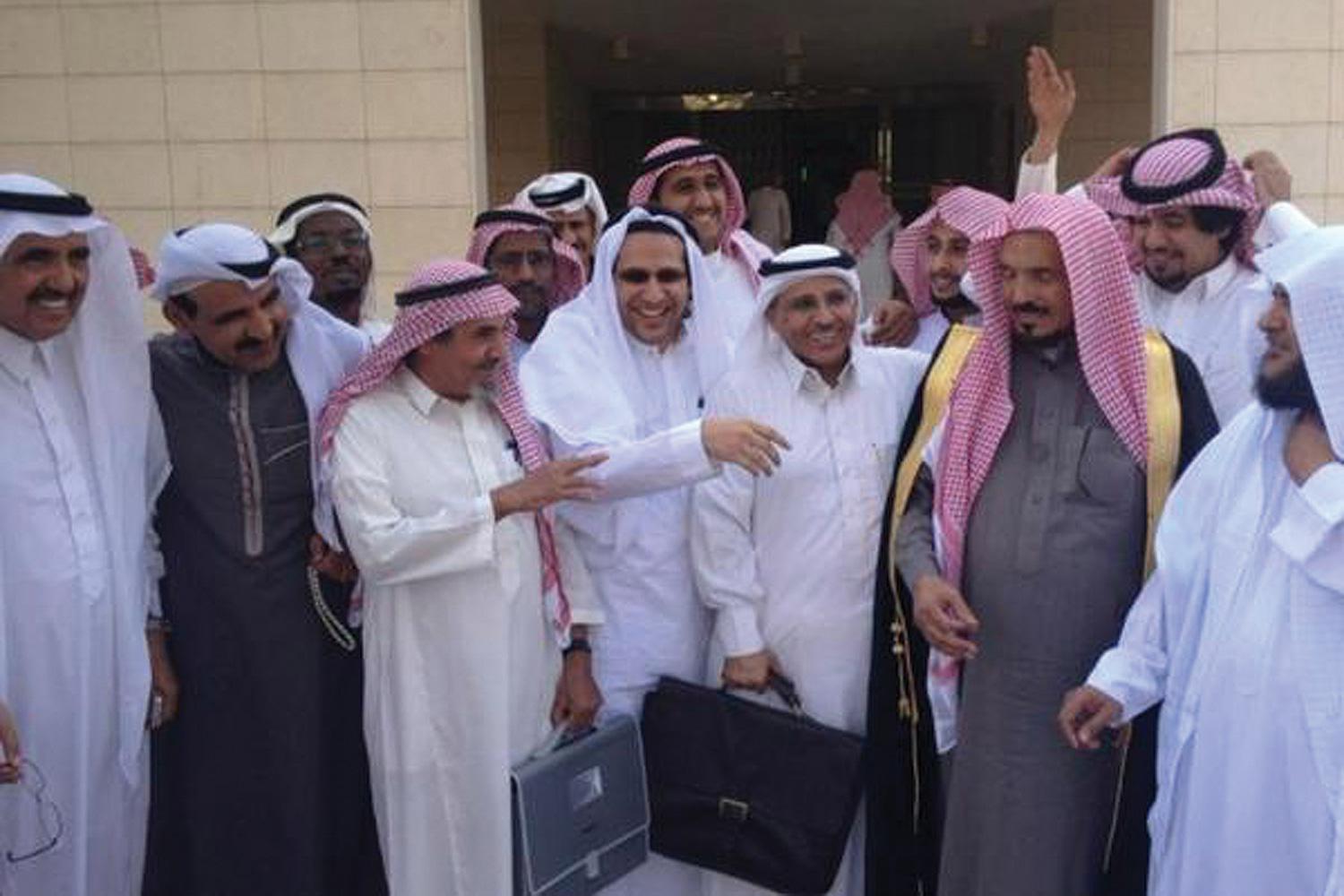
Saudi courts have convicted at least 20 prominent peaceful activists and dissidents since 2011. Many, like Abu al-Khair, have faced sentences as long as 10 or 15 years on broad, catch-all charges – such as “breaking allegiance with the ruler” or “participating in protests” – that do not constitute recognizable crimes. “Every day Waleed Abu al-Khair spends in prison compounds the injustice Saudi Arabia has imposed on him and his family,” said Sarah Leah Whitson, Middle East director at Human Rights Watch.
[Abu al-Khair has been one of Saudi Arabia’s leading human rights advocates for years. In July 2014, the Specialized Criminal Court (SCC), Saudi Arabia’s terrorism tribunal, convicted him on a number of broad and vaguely worded charges, including for comments to news outlets and on Twitter criticizing Saudi human rights violations. In addition to sentencing him to prison, the court banned him from traveling abroad for another 15 years. Abu al-Khair played no active part in his trial. He refused to recognize the legitimacy of the court or to defend himself. He also refused to sign a copy of the trial judgment or to appeal either his conviction or sentence. In January 2015, an appeals tribunal within the SCC overturned part of the earlier ruling following a prosecution appeal of the court’s suspension of five years of his term, and ruled instead that Abu al-Khair should serve all 15 years in prison.]
Saudi authorities regularly pursue charges against human rights activists based on their peaceful exercise of freedom of expression, in violation of international human rights obligations. Other Saudi activists and dissidents currently serving long prison terms based solely on their peaceful activism include Mohammed al-Qahtani, Abdullah al-Hamid, Fadhil al-Manasif, Sulaiman al-Rashoodi, Abdulkareem al-Khodr, Fowzan al-Harbi, Raif Badawi, Saleh al-Ashwan, Abdulrahman al-Hamid, Zuhair Kutbi, Alaa Brinji, and Nadhir al-Majed. Saudi authorities arrested activists Issa al-Nukheifi and Essam Koshak in December 2016 and January 2017 respectively, and they may face trial. Others, including Abdulaziz al-Shubaily and Issa al-Hamid, are free while appealing long sentences the SCC handed down in 2016. Mohammed al-Oteibi and Abdullah Attawi are currently on trial for forming a human rights organization in 2013.
Source: Saudi Arabia: Imprisoned Activist Earns Human Rights Award | Human Rights Watch
This blog tries to stick as much as possible to the core issue of human rights defenders and leaves general activism (even when inspired by human rights concerns) to other blogs. Now I want to make an exception for a personal Call for Action issued on 12 February 2017 by my good friend and well-known human rights defender, Reed Brody [https://humanrightsdefenders.blog/tag/reed-brody/], who has earned his nickname The Dictator Hunter:
He passionately feels that we should all do more to stop Trump (and his admirers in Europe). Here the full text:
A letter from America to my friends abroad
Many of you are watching events in the United States and asking what is going on – and what you can do.
Yes, this is the most dangerous moment for the US and for the world in my lifetime. A US president with total disregard for the foundations of a constitutional democracy – checks and balances, the independence of the judiciary, freedom of the press, the protection of minorities, reasoned debate – has near-complete control over the official levers of power: the executive branch (including the CIA, FBI, NSA), both houses of Congress, and perhaps soon the judiciary.
On the other hand, I have never witnessed in my country the kind of mobilization we are seeing today. The nationwide Women’s Marches were the largest demonstrations in US history, but it was only the beginning. Each day brings new acts of resistance. When the “Muslim ban” was announced (a crude and cruel measure only designed to stoke fear and portray the president as the people’s protector), people spontaneously flooded the airports around the country, New York taxi drivers went on strike. When Uber tried to profit from the strike, 200,000 customers deleted their Uber accounts. Bodegas in New York closed to protest the ban. All around the country, citizens are packing elected officials’ town hall meetings, flooding Congress with petitions, postcards, and phone calls. The premier legal organization challenging Trump’s actions, the American Civil Liberties Union, raised $24 million in the days following the Ban. This week, 1,200 people crowded into my neighborhood synagogue to organize the next stages of the resistance in Brooklyn, and the same thing is happening all over the country. Everything is political. Sports. Oscars. Consumer choices. Companies are being forced to take stands, and many of them, particularly in high-tech and globalized industries, are opposing the president.
It’s important to remember that WE are the majority. We are also the large majority in the places that matter most to the economy – New York, California, Washington DC, in almost all the nation’s cities.
This epic battle for the soul of my country is just beginning. The outcome is uncertain. The next terrorist attack, and the one after, will surely test us even more.
Ultimately it will be Americans who decide the fate of the US but there are many ways you can help.
-Protest, protest protest! People marched around the world marched with us on January 21, but it can’t stop there. The more organized protests at US embassies and symbols of US power the better.
– Don’t give Trump the respect he doesn’t deserve. This week, the speaker of the House of Commons said that he would oppose having Trump address Parliament. Over 1.8 million Brits have signed a petition against any Trump visit. When Trump visits the UK, or anywhere, let him know how the people of the world feel.
-Demand that your leaders stand up to Trump. Angela Merkel reminded Trump of the US’s obligations under the Refugee Convention. François Hollande has been outspoken. (Unlike Spain’s Rajoy who offered to be an “intermediary” for Trump in Europe and Latin America).
-Like Canada’s Justin Trudeau, leaders should publicly welcome all people from all countries and specifically assure nationals of the 7 “banned” countries that they will be allowed in.
-Ask your country to rebuke Trump’s measures which violate international law such as the Muslim ban in international fora such as the UN Human Rights Council and the UN General Assembly. The ACLU and other groups are already challenging these actions before the Interamerican Commission on Human Rights.
-Remind non-US companies that they also have obligations, as US law professors did when they wrote to European air carriers https://www-cdn.law.stanford.edu/…/Stanford-Law-Professors-… to ensure the rights of travelers.
-Academics, experts, companies and even countries can join litigation in the US with “amicus curaie,” or “friends of the court” briefs. The legal attack on the Muslim ban has been joined https://lawfareblog.com/litigation-documents-resources-rela… by hundreds of technology companies, professors, cities and states, but it would be important for foreign voices to be heard on this and (probably) forthcoming cases.
-Boycott Trump products. Like a third-word kleptocratic dictator (and I know a thing or two) Trump is openly mixing the public and the private. Hit him where it hurts – his brand, his ego and his pocketbook. Phone numbers of his hotels are here https://twitter.com/billmckibb…/…/829412430157602816/photo/1 A list with retailers that do business with the Trump family and whose boycott is sought by #GrabYourWallet ( as in Grab her Pussy) here
https://grabyourwallet.org/Boycott%20These%20Companies.html
-Join the over 5 million people who have signed Avaaz’s Global Open Letter to Donald Trump. https://secure.avaaz.org/cam…/…/president_trump_letter_loc/…
-Watch the daily TV show Democracy Now on the internet – it’s where progressives in the US get their news and connect to all the struggles here and abroad. https://www.democracynow.org/
Even if you live abroad, you can join and give your support to the groups that are defending our liberties like the Center for Constitutional Rights, Planned Parenthood, Democracy Now, the ACLU. The Nation’s Katha Politt lists some groups here https://www.thenation.com/…/you-might-not-be-in-the-mood-t…/ Here is a longer list http://www.advocate.com/…/24-trump-fighting-charities-need-… –
-If the travel ban, or some version of it, is reinstated, we will need volunteers and volunteer lawyers at airports around the world to help stranded travelers and to communicate with volunteers at US airports .
Trump (“Only America first”) doesn’t care about what the rest of the world thinks, but the US political and economic establishment on whose acquiescence he depends does care. Make clear that a racist islamophobic US government will not enjoy the same status and goodwill.
Most important, don’t let what happened in the US happen in your country!! Trump “won” the US election (just as Brexit prevailed) by building the fear of foreigners and because too many people (white working class) did not see the political system as working for them. The Democratic Party essentially imposed a candidate who many saw as the embodiment of an out-of-touch elite. The same thing now threatens to happen in France, the Netherlands and elsewhere. Please don’t let it. We need you to make a better world together.
In Solidarity
Reed Brody
reedbrody@gmail.com
twitter @reedbrody
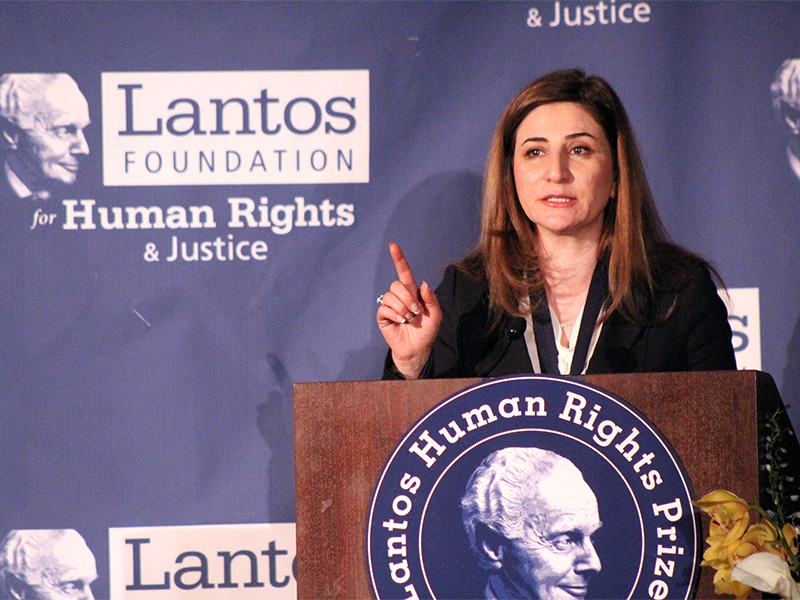
Last week I wrote about an award-winning human rights defender not being able to come and collect her award in the USA [https://humanrightsdefenders.blog/2017/02/01/yazidi-human-rights-laureate-may-be-banned-from-coming-to-washington-to-accept-award/]. Vian Dakhil made it to Washington in the end. She had already received a visa to come to Washington to accept an award from the Tom Lantos Foundation when President Donald Trump’s executive order pausing immigration from seven Muslim-majority countries, including Iraq, was issued. After an arduous process involving the State Department and the Iraqi Embassy, she was granted an exemption to the travel ban so she could attend the award ceremony on 8 February. Her sister and translator was able to get a visa after a federal judge temporarily halted the implementation of the executive order. Read the rest of this entry »

Egyptian human rights defender Mozn Hassan, who shared the 2016 Right Livelihood Award with her organisation Nazra for Feminist Studies, will receive her award in Cairo on 25-26 March 2017. Hassan was unable to attend the award ceremony in Stockholm on 25 November 2016 due to a travel ban imposed on her by the Egyptian authorities. Since then, the judiciary has initiated a move to freeze Hassan’s and Nazra’s assets, which five UN experts have condemned.

Monika Griefahn, the Foundation’s Board Chair, said: “In a show of solidarity with Hassan and other Egyptian civil society activists who have been prevented from travelling freely abroad, the Foundation will send a high-level delegation to Cairo to present her with the Right Livelihood Award instead.” The delegation will include European Parliamentarians, fellow Laureates and the Foundation’s Board members.
This is also a reminder of the nominations deadline for the 2017 Right Livelihood Award which is 1 March 2017! The Right Livelihood Award accepts proposals from everyone through an open nomination process.