Posts Tagged ‘transnational represion’

China on dissent: over 1,500 convicted in six years, report finds

March 11, 2025

Alan Lu for RFA on 5 March 2025 refers to a a new report which shows the extent of Beijing’s arbitrary detentions, with severe sentences for prisoners of conscience.

Chinese authorities have arbitrarily detained thousands of people for peacefully defending or exercising their rights over the past six years and convicted 1,545 prisoners of conscience, a rights group said on Wednesday.

Chinese Human Rights Defenders, or CHRD, a non-government organization of domestic and overseas Chinese rights activists, said the scope and scale of wrongful detention by Chinese authorities may constitute crimes against humanity.

“They were sentenced and imprisoned on charges that stem from laws that are not in conformity with the Chinese government’s domestic and international human rights obligations,” the group said in a report.

“Their cases proceeded through the full criminal justice system, with police, prosecutors, and courts arbitrarily depriving them of their liberty in violation of their human rights.”

Prisoners of conscience have faced severe penalties, with an average sentence of six years, increasing to seven for national security charges.

Three people, identified as Tashpolat Tiyip, Sattar Sawut and Yang Hengjun, were sentenced to death, while two, Rahile Dawut and Abdurazaq Sayim, received life sentences, the group said, adding that 48 were jailed for at least a decade.

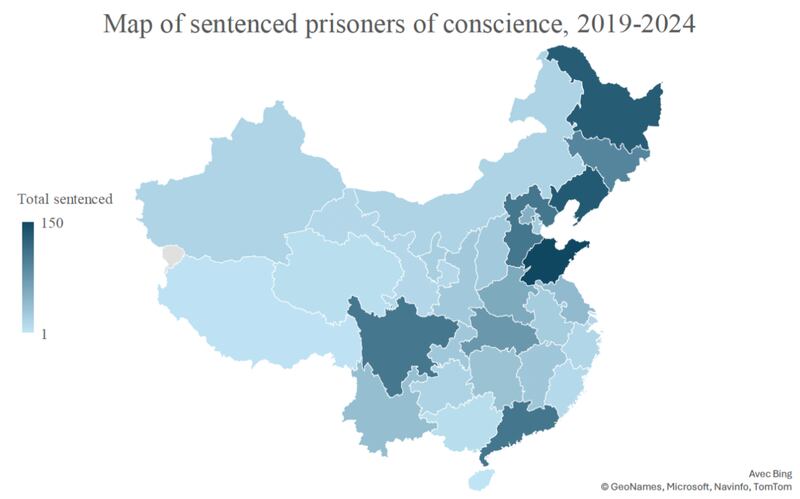
Map of sentenced prisoners of conscience in mainland China, excluding Hong Kong and Macao.
Map of sentenced prisoners of conscience in mainland China, excluding Hong Kong and Macao. (CHRD)

Among the convicted, women activists and marginalized groups, including ethnic Tibetans and Uyghurs, were disproportionately represented among those wrongfully detained, the group said.

Out of all the prisoners of conscience aged 60 or older, two-thirds were women, it added.

“Human rights experts and international experts have raised that people over the age of 60 should generally not be held in custody due to the effects on their physical and mental health,” Angeli Datt, research consultant with CHRD, told journalists in a press briefing Wednesday.

“That two-thirds of them are women was really shocking to me,” she said.

“Worse still, the impunity Chinese government officials enjoy at home emboldens them to commit abuses abroad,” the group said.

China dismissed a Swiss report last month alleging that it pressures Tibetans and Uyghurs in Switzerland to spy on their communities.

‘Endangering national security’

The CHRD said that under Chinese leader Xi Jinping, the scope and scale of the use of arbitrary detention to silence critics and punish human rights personnel had grown.

The organization documented a total of 58 individuals known to have been convicted of “endangering national security.”

“The overall average prison sentence for a national security crime is 6.72 years, though this figure excludes those sentenced to death with a two-year reprieve or life imprisonment,” it said.

In Hong Kong, more people were convicted of “subversion” and “inciting subversion” — terms that the U.N. describes as “broad and imprecise, making them prone to misapplication and misuse.”

In one 2024 case, authorities convicted 45 people for participating in a primary election, an act fully protected under both domestic and international law. Subversion charges accounted for 37% of all prisoners of conscience sentenced in Hong Kong during this period.

https://www.rfa.org/english/china/2025/03/06/chia-dissent-crack-down-humgn-rights/

https://thediplomat.com/2025/03/chinas-system-of-mass-arbitrary-detention/


The Arab Interior Ministers’ Council must end its role in transnational repression

February 20, 2025

MENA Rights Group leads a coalition of 15 civil society organisations in urging the Arab Interior Ministers’ Council to cease its facilitation of arbitrary extraditions of peaceful dissidents and human rights defenders across Arab League countries and to align its legal framework and systems with international human rights law

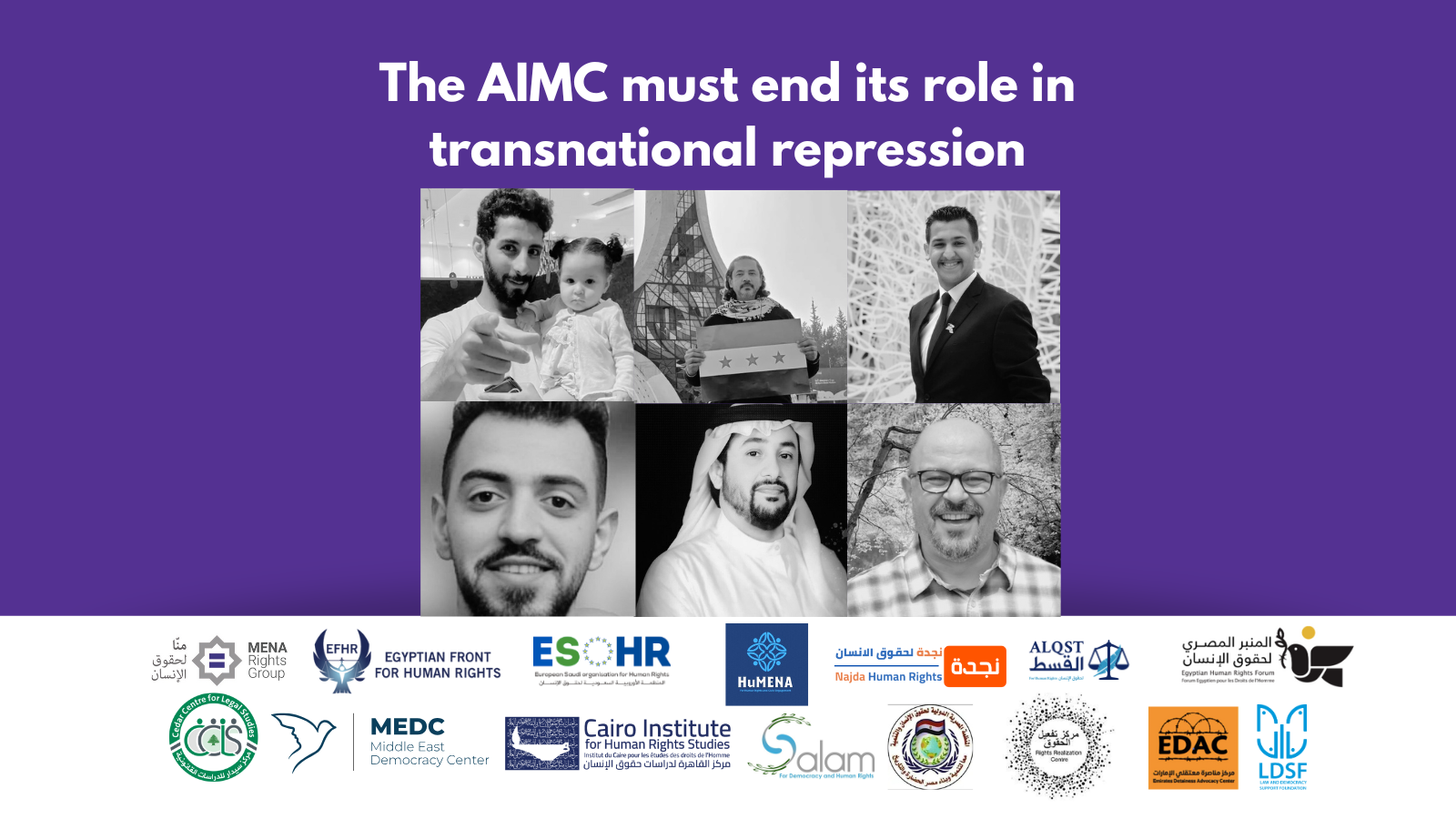
From left to right: Ahmed Kamel, Abdelrahman al-Qaradawi, Salman al-Khaldy, Hassan al-Rabea, Khalaf al-Romaithi, Sherif Osman

February 17, 2025The undersigned organisations call on the Arab Interior Ministers’ Council (AIMC) to cease its facilitation of arbitrary extraditions of peaceful dissidents and human rights defenders across Arab League countries and to align its legal framework and systems with international human rights law.

On Sunday, February 16, 2025, the AIMC held its 42nd annual conference in its headquarters in Tunis. Often misleadingly referred to as “Arab INTERPOL”, the AIMC is an Arab League body tasked with enhancing cooperation among Arab states in the fields of internal security and crime prevention. Through its Department of Criminal Prosecution and Data, the AIMC circulates state-requested warrants to liaison divisions in Member States and facilitates wanted individuals’ extradition.

Although extraditions for “crimes of a political nature” are explicitly prohibited by the AIMC’s legal framework, specifically article 41 of the Riyadh Arab Agreement for Judicial Cooperation, they still occur in practice. Lacking an oversight body to prevent the abuse of its systems, the AIMC has become the perfect tool for Arab League states to request politically motivated extraditions.

Between 2022 and 2025, MENA Rights Group has documented the unlawful extraditions of four individuals: Khalaf al-Romaithi, Hassan al-Rabea, Salman al-Khaldy, and Abdulrahman al-Qaradawi. Currently, one individual is facing an imminent risk of extradition: Ahmed Kamel.

Ahmed Kamel is an Egyptian national currently detained in Saudi Arabia, where he had been living for a decade. In reprisal for peacefully protesting during the Arab Spring in Cairo in 2011 and 2014, Kamel faces imminent extradition to Egypt, where he may be subjected to human rights abuses including torture.

Despite their prohibition, Arab states continue to request and fulfil politically motivated extraditions, weaponising domestic laws which conflate peaceful criticism and human rights activism with terrorism or threats to state security.

Furthermore, the AIMC’s legal framework makes no reference to international human rights standards. More specifically, it fails to mention the principle of non-refoulement, enshrined in article 3 of the UN Convention against Torture, which provides that individuals must not be extradited to a country where they would face torture. 

UN Special Procedures mandate holders have raised concerns over the AIMC’s operations in a communication addressed to the Arab League, notably raising the impossibility for individuals to access their criminal file and challenge their arrest warrant. However, the UN experts have been provided with no response, and the Council has yet to undertake any reform.

As the AIMC continues to facilitate grave human rights violations across the Arab region, substantial change is required to ensure peaceful dissidents and human rights defenders are not at risk of transnational repression.

The undersigned organisations therefore urge the AIMC to immediately halt its facilitation of politically motivated extraditions, and undertake urgent reforms, in consultation with civil society, to align its legal framework and systems with international human rights law.

Signatories:

  1. MENA Rights Group
  2. Egyptian Front for Human Rights
  3. Egyptian Organization for Human Rights
  4. ESOHR
  5. Cedar Centre for Legal Studies 
  6. Law and Democracy Support Foundation – LDSF 
  7. Middle East Democracy Center (MEDC)
  8. ALQST for Human Rights
  9. Egyptian Human Rights Forum ( EHRF)
  10. Rights Realization Centre / مركز تفعيل الحقوق
  11. Salam for Democracy and Human Rights
  12. Najda for Human Rights
  13. Emirates Detainees Advocacy Center (EDAC) 
  14. HuMENA for Human Rights and Civic Engagement
  15. Cairo Institute for Human Rights Studies (CIHRS)

https://menarights.org/en/articles/aimc-must-end-its-role-transnational-repression-say-ngos

Canada’s Hogue report – missed opportunity to tackle transnational repression

February 19, 2025

Emile Dirks, Noura Aljizawi, Siena Anstis and Ron Deibert wrote in the The Globe and Mail of 10 February 2025 about the problem of transnational repression.

The final report of the public inquiry into foreign interference (the Hogue Commission) offers a measure of reassurance to Canadians; there is no evidence that Canadian MPs worked with foreign states to undermine the 2019 or 2021 federal elections. Justice Marie-Josée Hogue’s findings, however, are cold comfort to people at risk. While the commission’s work has ended, distant autocrats continue to target Canadians and Canadian residents with transnational repression, the most coercive form of foreign interference.

Commissioner Justice Marie-Josee Hogue Patrick Doyle/Reuters

Through digital harassment, assault and even assassination, authoritarians reach across borders to silence their foes abroad. Victims include activists, human-rights defenders, exiled critics and asylum seekers tied by citizenship or ancestry to repressive states like China, Russia, India or Saudi Arabia. For authoritarians, these people are not citizens, but disloyal subjects to silence.

The danger that transnational repression poses is not new. A 2020 report by the Canadian Coalition on Human Rights in China demanded the Canadian government address threats against pro-democracy activists, while a 2022 report by the Citizen Lab highlighted the lack of support to victims of digital transnational repression. Prior to the 2024 election, the Biden-Harris administration adopted a whole-of-government approach to ensure government agencies like the State Department, Department of Homeland Security, Department of Justice, and the FBI worked together to provide recommendations to victims on how to better protect themselves.

Researchers and civil society have long worried that Canadian authorities are overlooking transnational repression as a unique challenge that requires tailored responses. Considering the seriousness of the threat and the stark absence of action by the government, many researchers anticipated the commission’s final report would explore transnational repression as a distinct form of foreign interference. Yet, while Justice Hogue wrote that “it would be challenging to overstate the seriousness of transnational repression,” she ultimately reasoned the issue lay outside her mandate.

This was a mistake. The final report was a missed opportunity to fully explore the corrosive impact of transnational repression on Canadian democracy. A recent report by the Citizen Lab highlights the profound toll transnational repression takes on vulnerable people, especially women, in Canada and beyond. Intimidation, surveillance and physical attacks prevent victims from participating fully in civic life and create a climate of persistent fear.

Transnational repression harms victims in more subtle ways, too. Our research shows that the mere threat of an online or offline attack is enough to frighten many diaspora members into silence. Victims become wary of participating in social media or even using digital devices. They report being afraid to engage with members of their communities, leaving them increasingly isolated. It has an insidious, chilling effect on targeted communities.

Unfortunately, the future looks bleak. Democratic backsliding in the United States threatens to deprive Canada of an ally in the fight and reverse whatever measures U.S. agencies might have taken on the issue. Our research shows that suspicion of law enforcement discourages victims from contacting authorities. Proposed moves by the Trump administration – including halting asylum hearings, ending resettlement programs, and sending “criminal” migrants to Guantanamo Bay – will further erode victims’ confidence in the U.S.’s willingness to protect them.

Big Tech is also worsening the problem. Across social-media platforms, state-backed harassment of vulnerable diaspora members is rife. Elon Musk’s X tolerates and even promotes hate-mongering accounts, while Mark Zuckerberg’s announcement that Meta will stop using “politically biased” fact-checkers signals a worrying disinterest in robust content moderation. We should expect a tsunami of digital transnational repression targeting vulnerable Canadians now that tech CEOs are loosening the restraints.

Canada cannot rely on outside leadership or corporate actors to tackle this problem. What is needed is a commission on transnational repression. On Jan. 24, the British parliament’s Joint Committee on Human Rights launched such an inquiry. Once our House of Commons sits again we can follow our British counterparts and resume the Subcommittee on International Human Rights’s work on transnational repression. The new Parliament should launch a multiparty inquiry into the crisis, with a mandate to examine repression outside of federal elections. Crucially, it must earn the trust of victims, something the Hogue Commission lacked. The Uyghur Rights Advocacy Project and the Canadian Friends of Hong Kong both pulled out of the inquiry, citing the participation of three legislators with alleged links to the Chinese government.

This is not a partisan issue. Whoever wins the next federal election will have a duty to contend with the continuing threat transnational repression poses to Canada. With global authoritarianism on the rise, the problem is only likely to worsen in the years to come.

see also: https://humanrightsdefenders.blog/2024/03/19/transnational-repression-human-rights-watch-and-other-reports/

https://www.theglobeandmail.com/opinion/article-the-final-hogue-report-was-a-missed-opportunity-to-tackle/

UN special rapporteurs note human rights violations against Gülen movement in Turkey – Erdogan disagrees vehemently

December 7, 2024

The Turkish government has refused to respond to allegations of systematic repression against individuals allegedly affiliated with the Gülen movement made by United Nations special rapporteurs, according to official documents published on Friday by the Office of the United Nations High Commissioner for Human Rights.

In a joint letter dated October 7, 2024, seven UN special rapporteurs asked the Turkish government about alleged measures of “systematic repression against persons ostensibly affiliated with the Gülen Movement through the misuse of counter-terrorism legislation, and the concomitant impact on civil society, human rights defenders, political dissidents, and journalists.”

The allegations center on Turkey’s treatment of people allegedly associated with the faith-based Gülen movement, inspired by the late Muslim cleric Fethullah Gülen.

In its response via a diplomatic note dated October 30, the Turkish government refrained from answering the allegations brought up by the special rapporteurs and instead listed their accusations against the Gülen movement and requested the “Special Procedures of the Human Rights Council not to allow FETÖ and its members to abuse these mechanisms, and to dismiss their allegations.”

FETÖ is a derogatory acronym used to refer to the Gülen movement as a terrorist organization.

Turkish President Recep Tayyip Erdoğan has been pursuing followers of the Gülen movement since corruption investigations revealed in 2013 implicated then-Prime Minister Erdoğan and some members of his family and his inner circle.

Dismissing the investigations as a Gülenist coup and conspiracy against his government, Erdoğan designated the movement a terrorist organization and began to target its members. He intensified the crackdown on the movement following an abortive putsch in 2016 that he accused Gülen of masterminding. The movement has strongly denied involvement in the coup attempt or any terrorist activity.

The rapporteurs outlined practices they say violate international human rights laws, including arbitrary arrests, torture, transnational renditions and surveillance abuses.

The UN Rapporteurs said these individuals face intensified crackdowns involving mass detentions, forced disappearances and unjust prosecutions under vague anti-terrorism laws. Between June 2023 and June 2024, more than 8,800 people were detained and 1,500 were charged with terrorism offenses, they said.

Among the rapporteurs’ chief concerns was the treatment of children detained as part of these operations. In May 2024, 16 children were arrested in İstanbul and allegedly subjected to psychological pressure, physical torture and denial of legal counsel. The UN rapporteurs described these actions as clear violations of international protections for children under the Convention on the Rights of the Child.

The rapporteurs also criticized Turkey’s use of public “grey lists,” wanted lists where individuals — ranging from journalists to human rights defenders — are labeled as terrorists, often without evidence or due process. These lists, which include photos and personal details, are made public alongside monetary rewards for information leading to their capture. This practice, according to the rapporteurs, endangers lives, undermines freedoms and creates a “hitman economy.”

Another key concern involved transnational renditions. The rapporteurs alleged that Turkey has systematically abducted and forcibly returned suspected Gülen affiliates from other countries under vague bilateral security agreements. Victims were reportedly detained in secret, subjected to torture and coerced into confessions used in prosecutions.

The misuse of surveillance powers also drew heavy criticism. Turkey’s intelligence agency was accused of fabricating evidence from the ByLock messaging app to convict thousands of people on tenuous charges of affiliation with the Gülen movement. The UN noted that such actions lack due process and violate privacy rights under international law.

The rapporteurs called on Turkey to address these alleged violations, halt ongoing abuses and ensure compliance with international human rights standards. They expressed particular concern about the government’s expansive interpretation of anti-terrorism laws, which they argue target legitimate political activity, dissent and human rights advocacy.

The letter was authored by seven UN special rapporteurs and a UN expert, including Mary Lawlor, special rapporteur on the situation of human rights defenders; Alice Jill Edwards, special rapporteur on torture and other cruel, inhuman or degrading treatment or punishment; and Fionnuala Ní Aoláin, special rapporteur on the promotion and protection of human rights while countering terrorism. Other contributors included Gabriella Citroni, chair-rapporteur of the Working Group on Enforced or Involuntary Disappearances and Irene Khan, special rapporteur on freedom of opinion and expression.

Q&A: Transnational Repression

June 14, 2024

On 12 June 2024, Human Rights Watch published a useful, short “questions-and-answers” document which outlines key questions on the global trend of transnational repression. 

Illustration of a map being used to bind someone's mouth
© 2024 Brian Stauffer for Human Rights Watch
  1. What is transnational repression?
  2. What tactics are used?
  3. Is transnational repression a new phenomenon?  
  4. Where is transnational repression happening? 
  5. Do only “repressive” states commit transnational repression?
  6. Are steps being taken to recognize and address transnational repression? 
  7. What should be done? 

What is transnational repression?

The term “transnational repression” is increasingly used to refer to state actors reaching beyond their borders to suppress or stifle dissent by targeting human rights defenders, journalists, government critics and opposition activists, academics and others, in violation of their human rights. Particularly vulnerable are nationals or former nationals, members of diaspora communities and those living in exile. Many are asylum seekers or refugees in their place of exile, while others may be at risk of extradition or forced return. Back home, a person’s family members and friends may also be targeted, by way of retribution and with the aim of silencing a relative in exile or forcing their return.

Transnational repression can have far-reaching consequences, including a chilling effect on the rights to freedom of expression and association. While there is no formal legal definition, the framing of transnational repression, which encompasses a wide range of rights abuses, allows us to better understand it and propose victim-centered responses.

What tactics are used?

Documented tactics of transnational repression include killings, abductions, enforced disappearances, unlawful removals, online harassment, the use of digital surveillance including spyware, targeting of relatives, and the abuse of consular services.  Interpol’s Red Notice system has also been used as a tool of transnational repression, to facilitate unlawful extraditions. Interpol has made advances in improving its vetting systems, yet governments continue to abuse the Red Notice system by publishing unlawful notices seeking citizens who have fled abroad on spurious charges. This leaves targets vulnerable to arrest and return to their country of origin to be mistreated, even after they have fled to seek safety abroad.

Is transnational repression a new phenomenon?

No, the practice of governments violating human rights beyond their borders is not new. Civil society organizations have been documenting such abuses for decades. What is new, however, is the growing recognition of transnational repression as more than a collection of grave incidents, but also as an increasing phenomenon of global concern, requiring global responses. What is also new is the increasing access to and use of sophisticated technology to harass, threaten, surveil and track people no matter where they are. This makes the reach of transnational repression even more pervasive. 

Where is transnational repression happening? 

Transnational repression is a global phenomenon. Cases have been documented in countries and regions around the world. The use of technology such as spyware increases the reach of transnational repression, essentially turning an infected device, such as a mobile phone, into a portable surveillance tool, allowing targeted individuals to be spied on and tracked around the world. 

Do only “repressive” states commit transnational repression?

While many authoritarian states resort to repressive tactics beyond their own borders, any government that seeks to silence dissent by targeting critics abroad is committing transnational repression. Democratic governments have also contributed to cases of transnational repression, for example through the provision of spyware, collaborating with repressive governments to deny visas or facilitate returns, or relying upon flawed Interpol Red Notices that expose targeted individuals to risk.

Are steps being taken to recognize and address transnational repression? 

Increasingly, human rights organizations, UN experts and states are documenting and taking steps to address transnational repression.

For example, Freedom House has published several reports on transnational repression and maintains an online resource documenting incidents globally. Human Rights Watch has published reports, including one outlining cases of transnational repression globally and another focusing on Southeast Asia. Amnesty International has published a report on transnational repression in Europe. Many other nongovernmental organizations are increasingly producing research and reports on the issue. In her report on journalists in exile, the UN Special Rapporteur on freedom of expression dedicated a chapter to transnational repression. The UN High Commissioner for Human Rights used the term in a June 2024 statement.

Certain governments are increasingly aware of the harms posed by transnational repression. Some are passing legislation to address the problem, while others are signing joint statements or raising transnational repression in international forums. However, government responses are often piecemeal, and a more cohesive and coordinated approach is needed. 

What should be done? 

Governments should speak out and condemn all cases of transnational repression, including by their friends and allies. They should take tangible steps to address transnational repression, including by adopting rights-respecting legal frameworks and policies to address it. Governments should put victims at the forefront of their response to these forms of repression. They should be particularly mindful of the risks and fears experienced by refugee and asylum communities. They should investigate and appropriately prosecute those responsible. Interpol should continue to improve vetting process by subjecting governments with a poor human rights record to more scrutiny when they submit Red Notices. Interpol should be transparent on which governments are continually abusing the Red Notice system, and limit their access to the database.  

At the international level, more can be done to integrate transnational repression within existing human rights reporting, and to mandate dedicated reporting on cases of transnational repression, trends, and steps needed to address it.

see also: https://humanrightsdefenders.blog/2024/03/19/transnational-repression-human-rights-watch-and-other-reports/

https://www.hrw.org/news/2024/06/12/qa-transnational-repression

Transnational repression: Human Rights Watch and other reports

March 19, 2024
Illustration of a map being used to bind someone's mouth

On 22 February 2024, Human Rights Watch came with a study on governments reaching outside their borders to silence or deter dissent by committing human rights abuses against their own nationals or former nationals. Governments have targeted human rights defenders, journalists, civil society activists, and political opponents, among others, deemed to be a security threat. Many are asylum seekers or recognized refugees in their place of exile. These governmental actions beyond borders leave individuals unable to find genuine safety for themselves and their families. This is transnational repression.

See earlier posts:

Transnational repression looks different depending on the context. Recent cases include a Rwandan refugee who was killed in Uganda following threats from the Rwandan government; a Cambodian refugee in Thailand only to be extradited to Cambodia and summarily detained; and a Belarusian activist who was abducted while aboard a commercial airline flight. Transnational repression may mean that a person’s family members who remain at home become targets of collective punishment, such as the Tajik activist whose family in Tajikistan, including his 10-year-old daughter, was detained, interrogated, and threatened.

Transnational repression is not new, but it is a phenomenon that has often been downplayed or ignored and warrants a call to action from a global, rights-centered perspective. Human Rights Watch’s general reporting includes over 100 cases of transnational repression. This report includes more than 75 of these cases from the past 15 years, committed by over two dozen governments across four regions. While the term “transnational repression” has at times become shorthand for naming authoritarian governments as perpetrators of rights violations, democratic administrations have assisted in cases of transnational repression.

Methods of transnational repression include killings, unlawful removals (expulsions, extraditions, and deportations), abductions and enforced disappearances, targeting of relatives, abuse of consular services, and so-called digital transnational repression, which includes the use of technology to surveil or harass people. These tactics often facilitate further human rights violations, such as torture and ill-treatment.

This report also highlights cases of governments misusing the International Criminal Police Organization (Interpol)—an intergovernmental organization with 195 member countries—to target critics abroad.

Victims of transnational repression have included government critics, actual or perceived dissidents, human rights defenders, civil society activists, journalists, and opposition party members and others. Governments have targeted individuals because of their identity, such as ethnicity, religion, or gender. Back home, families and friends of targeted people may also become victims, as governments detain, harass, or harm them as retribution or collective punishment. Transnational repression can have far-reaching consequences, including a chilling effect on the rights to freedom of expression, association, and assembly among those who have been targeted or fear they could be next.

This report is not an exhaustive examination of cases of transnational repression. Instead, it outlines cases that Human Rights Watch has documented in the course of researching global human rights issues that point to key methods and trends of transnational repression.

Human Rights Watch hopes that by drawing attention to cases of transnational repression, international organizations and concerned governments will pursue actions to provide greater safety and security for those at risk. Governments responsible for transnational repression should be on notice that their efforts to silence critics, threaten human rights defenders, and target people based on their identity are no less problematic abroad than they are at home. This report provides governments seeking to tackle transnational repression with concrete recommendations, while raising caution against laws and policies that could restrict other human rights.

Human Rights Watch calls on governments committing transnational repression to respect international human rights standards both within and beyond their territory. Governments combatting transnational repression should recognize such abuses as a threat to human rights generally and act to protect those at risk within their jurisdiction or control.

See also: 22 March 2024: https://ishr.ch/latest-updates/addressing-transnational-repression-a-global-mandate-for-justice-and-human-rights/

https://www.hrw.org/report/2024/02/22/we-will-find-you/global-look-how-governments-repress-nationals-abroad

https://www.commondreams.org/news/human-rights-watch-dissidents