Posts Tagged ‘ProtectDefenders.eu’

New ProtectDefenders.eu study reveals urgent need for increased funding and support for human rights defenders

June 14, 2024

In the study The Landscape of Public International Funding for Human Rights Defenders, released on 12 June 2024, ProtectDefenders.eu sheds light on the critical challenges faced by human rights defenders (HRDs) worldwide, specifically focusing on their financing by public actors.

The research, which combines an analysis of financial data over a period of four years with interviews, investigations, and input from defenders, underscores the pressing need for greater financial support and resources to safeguard the invaluable work of human rights defenders in promoting and protecting human rights globally.

The ProtectDefenders.eu study reveals and documents a concerning trend: while the need for support for HRDs has never been greater, funding levels have stagnated, with only marginal increases observed over the examined period. Despite rhetoric emphasising the importance of prioritising human rights prioritisation, the actual allocation of resources has failed to keep pace with the deteriorating global situation, representing a mere 0.11% of total Official Development Assistance (ODA) annually.

Key findings from the study include:

  • Disparity in funding: While some donors have demonstrated a strong commitment to supporting HRDs, others have allocated minimal resources, with wide variations observed among donor contributions. This disparity is also evident among different groups of defenders and thematic areas, as well as in funding dynamics by region, with a concerning decrease in attention to the MENA region
  • Challenges in accessing funds: HRDs continue to face obstacles in accessing international funds, including restrictive funding requirements and bureaucratic hurdles
  • Need for core funding: There is a critical need for core, flexible, and sustainable funding to enable HRDs to effectively carry out their vital work
  • Lack in localisation efforts: The study emphasises the importance of localising HRD protection programs and ensuring that funding reaches grassroots organisations and movements.

This research underscores the urgent need for action to better support human rights defenders and is a call to action for donors, policymakers, and stakeholders to stand in solidarity with human rights defenders,” said Gerald Staberock, Chair of the Board of ProtectDefenders.eu and Secretary-General of the World Organisation against Torture. “HRDs play a vital role in advancing human rights and democracy worldwide, yet they continue to face increasing risks and challenges. It is imperative that donors and stakeholders heed the recommendations outlined in this study to ensure that HRDs receive the support they need to carry out their crucial work.”

In response to these findings, the study presents a series of detailed recommendations aimed at addressing the funding gap and improving support for HRDs. These recommendations include increasing overall funding levels, reducing restrictions on grants, enhancing political and diplomatic support, and investing in donors’ own capacities to better understand the needs and contexts of HRDs.

ProtectDefenders.eu issues a clear call to all donors and public actors to urgently address this situation. Specifically, the demands include:

  1. Increase in public funding: Advocating for an increase in public funding for HRDs from 0.11% to 0.5% for the period 2025-2028.
  2. Building trust through core grants: Urging for more core grants with reduced restrictions, audits, lower result expectations, and extended support horizons.
  3. Directing more grants locally: Advocating for a higher proportion of grants to be allocated to local NGOs to ensure funding reaches grassroots organizations and movements.
  4. Establishment of HRD principles for regranting: Calling upon the community of donors and financiers of HRD work to establish HRD Principles for Regranting, outlining guidelines for more effective and equitable distribution of funds.

The full report, along with its recommendations, can be accessed here.

https://protectdefenders.eu/projects/research-institutional-funding-human-rights-defenders/
https://www.omct.org/en/resources/news-releases/new-protectdefenders-eu-study-reveals-urgent-need-for-increased-funding-and-support-for-human-rights-defenders

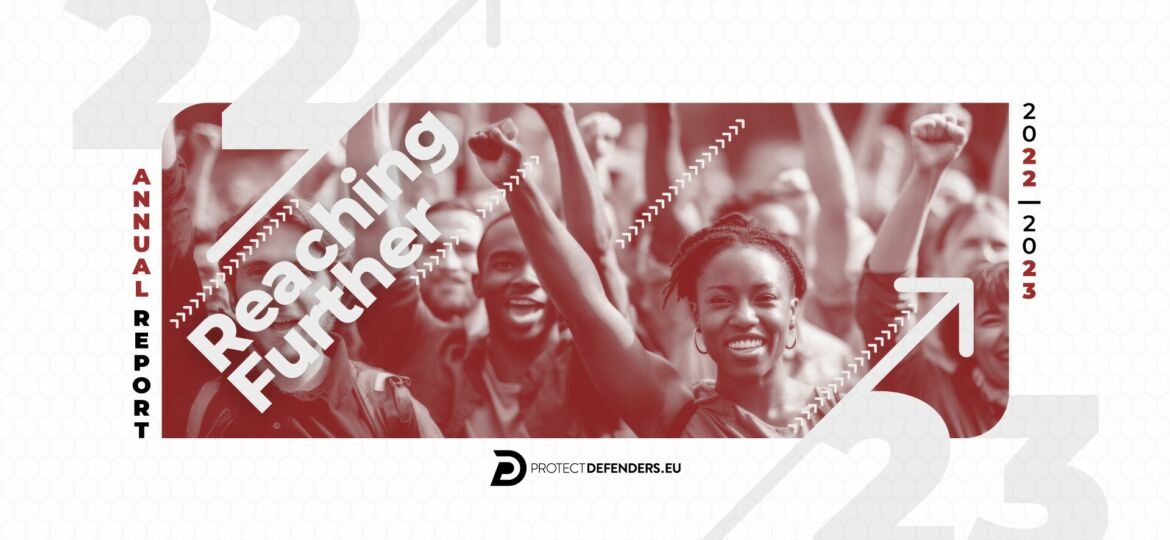
ProtectDefenders.eu publishes annual report “REACHING FURTHER”

April 30, 2024

04224-(1920x1080px)-Annual-Report-PD-v01-Reaching-Further

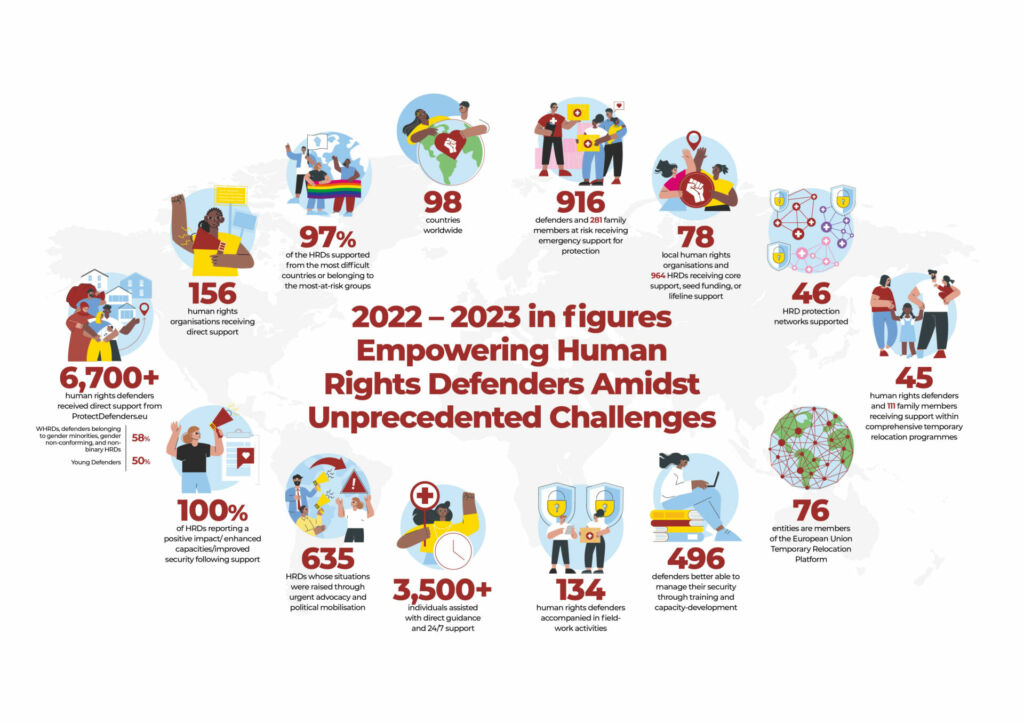
On 25 April 2024, ProtectDefenders.eu, the European Union (EU) Human Rights Defenders Mechanism, presented its comprehensive annual report entitled “REACHING FURTHER,” covering the period November 2022 – October 2023. This report illustrates the support provided and efforts made by ProtectDefenders.eu to support human rights defenders (HRDs) around the world, and especially to reach those who are the most at risk.

In November 2022, ProtectDefenders.eu entered the third phase of its implementation, marking a milestone in its commitment to safeguarding human rights defenders worldwide. Throughout the first year of this new phase, the renewed and consolidated EU HRD Mechanism has provided direct protection, support, and empowerment to over 6,700 at-risk HRDs, with a particular focus on those facing the highest risks. Notably, 50% of beneficiaries were young defenders, and 58% identified as women human rights defenders (WHRDs), trans-male, trans-female, genderqueer, or gender non-conforming individuals.

Despite facing extraordinary challenges amidst protracted crises globally, ProtectDefenders.eu has demonstrated remarkable effectiveness, efficiency, and adaptability in addressing the pressing needs of HRDs. The mechanism has extended support not only to individual defenders but also to their families, communities, and organizations. This comprehensive support, including financial aid, technical assistance, and guidance, has been delivered through collaboration among consortium partners, showcasing flexibility, creativity, and responsiveness in the face of evolving challenges.

ProtectDefenders.eu has actively responded to increased requests for protection support amid protracted crises in various regions, including Belarus, Myanmar, Afghanistan, Nicaragua, Sudan, Tanzania, and beyond. Emergency protection measures have been consistently provided, alongside investments in the capacity and resilience of human rights organisations and communities. The international temporary relocation system supported by ProtectDefenders.eu, including through the Shelter Initiatives program, further exemplifies the mechanism’s commitment to HRD safety.

Through reactive and preventative advocacy efforts, ProtectDefenders.eu has achieved multiple successes globally, pioneering a collective advocacy approach on shared concerns such as international funding for HRDs and EU visas. The enhanced coordination among consortium partners has facilitated continuous improvements and innovation, addressing challenges faced by HRDs and organizations at risk more effectively.

Moreover, significant progress has been made in enhancing outreach efforts to new groups, including young defenders and those with disabilities. Increased collaboration with local actors, context-specific support, and prioritized coordination have extended the impact of ProtectDefenders.eu widely, with 93% of supported organizations not affiliated with consortium partners.

Looking ahead, ProtectDefenders.eu will remain particularly committed to fulfilling its protection mandate by addressing comprehensively the unique vulnerabilities and barriers faced by HRDs with disabilities. The EU HRD mechanism will actively engage in finding innovative solutions to ensure their protection, inclusion, and access to resources.

Read the full ProtectDefenders.eu Report: REACHING FURTHER on our website.

More on the EU Visa Framework for at-risk Human Rights Defenders

December 21, 2023

An initiative of ProtectDefenders.eu, the EU Human Rights Defenders Mechanism implemented by international civil society

Human rights defenders have the right to carry out their legitimate work safely and to access support and protection when they are at risk, especially those who operate in the most difficult contexts. Their right to defend rights has been systematically enshrined by the European Union in its political guidelines, and statements, as well as in its financial programming and external actions. In fact, the European Union is a leading actor in the promotion and protection of human rights in the world and it is regarded by the human rights defenders’ community as an invaluable source of empowerment and legitimacy. [see the call of 2022:https://humanrightsdefenders.blog/2022/09/24/call-for-an-eu-visa-framework-for-at-risk-human-rights-defenders/]

Human rights defenders often carry out their work at great personal risk, and increasingly face killings, attacks, threats, and acts of intimidation because of their peaceful activities, in addition to being subjected to repression, restrictive legislation, and judicial harassment. For these at-risk human rights defenders, the possibility of accessing a visa to a European territory emerges as an essential security and protection tool, which empowers them to carry out their activities in their countries in a more secure and protected way. Visas and multiple-entry visas are widely regarded by the international human rights defenders community as a vital element of a comprehensive security strategy, one that enables defenders to consider the possibility to move in and out of their country in a way that allows them to manage the level of risk that they face as a result of their work, and to continue to work in their communities without forcing them to resort to permanent asylum paths when facing aggravated threats. However, despite political commitments and existing guidelines, the EU and its member states’ stated support for human rights defenders is not consistent with the current EU visa policies and practices, as human rights defenders at risk around the world lack consistent procedures to effectively and predictably access visas for the EU territory.

The community in support of human rights defenders, including the Consortium of organisations implementing the European Union Human Rights Defenders mechanism ProtectDefenders.eu, have systematically noted and documented with great concern the numerous, diverse, and blatant obstacles for defenders to access EU visas. ProtectDefenders.eu – which has supported 45,000+ human rights defenders and civil society organisations to continue their work in the most difficult situations since 2015 – encounters these obstacles also in relation to its daily operations delivering EU-funded programmes of practical support for human rights defenders. Every day, human rights defenders face an array of impediments that hinder their access to this essential security and protection tool, preventing them from accessing safe haven when necessary, as well as from engaging in existing opportunities for rest and respite and temporary relocation programmes, or carrying out essential international advocacy, mobilisation, or networking activities in the EU territory.

This lack of reliable, predictable, and coherent access for human rights defenders to EU visas unnecessarily aggravates the risk, isolation, and vulnerability they face as a result of their work – which is exacerbated for those defenders belonging to particularly threatened groups – such as women human rights defenders, LGBTI rights defenders, or indigenous rights defenders; for those facing spurious criminalisation processes aimed at impeding their mobility, or for those without secure access to basic travel documents. Major crises affecting human rights defenders and massive backlash against civil society notoriously reveal the gap in the effective implementation of the EU political commitments and guidelines related to visas, as recently illustrated by the demand for support from those human rights defenders and civil society members in Afghanistan in need of urgent evacuation. A more predictable, coordinated, and consistent policy on visas for human rights defenders – allowing for flexible and reactive protocols in critical situations, would reportedly have avoided, or at least mitigated the deficiencies of the EU response, or lack thereof.

With the exception of the positive examples of current good practices and initiatives implemented by some Member States, European institutions, or political actors in the EU, the EU as a whole has yet to make a serious effort to mainstream access to at-risk human rights defenders in their visa policies. The current legislative instruments and established practices fail to comply with the consistency required for the Union’s actions enshrined in the EU Treaties and attest to a lack of harmonisation, effort-sharing, and coordination among both the Member States and the European institutions.

ProtectDefenders.eu and the international civil society organisations participating in this initiative are convinced that with political will and clear guidelines, the EU can and should return to its political mandate in favour of human rights and human rights defenders, and lead on the implementation of concrete initiatives, good practises, and policy changes to ensure that at-risk human rights defenders can access European Union visas with guarantees, security, and predictability.

ProtectDefenders.eu and the international civil society organisations participating in this initiative are calling on all European Union actors to urgently implement all appropriate measures at all levels to develop and promote an enabling framework for human rights defenders to access visas for the EU, one that guarantees predictability, consistency, and protection for those who are most at-risk HRDs.

More specifically, ProtectDefenders.eu and the international civil society organisations participating in this initiative call on the EU stakeholders to:

  • propose a specific facilitated procedure for human rights defenders within the EU Visa Code, setting common criteria and defining the elements of a facilitated procedure;
  • include instructions in the EU Visa Handbook on granting facilitations to HRDs and their family members;
  • work towards amending the legal instruments on visas, particularly the Visa Code,
  • create an EU Directive to protect Human Rights Defenders (HRDs), outlining ways to support and protect them in accessing and staying in the EU, as well as meeting their support needs to continue their work. The Directive would provide a legal tool to grant HRDs at risk access and stay in the EU for a specified time.; and
  • introduce amendments to the Temporary Protection Directive that allow temporary protection status in the EU to be granted to defenders at risk.

see also: https://bnnbreaking.com/breaking-news/human/fra-report-proposes-changes-to-eu-visa-code-handbook-for-human-rights-defenders/

The 2022 “Human Rights Defenders Movement at a Crossroad” video report published

October 11, 2022

In September 2022, more than thirty human rights defenders from all over the world took the floor in a moment of a global backlash against the grass-roots movement for human rights and democracy. See: https://humanrightsdefenders.blog/2022/04/20/2021-protectdefenders-eu-annual-report/

The conference “The Human Rights Defenders’ Movement at a Crossroad“ featured the testimonies and experiences of a great diversity of grassroots activists coming from all backgrounds, including Yvette Mushigo (Synergie des Femmes pour la Paix et la Réconciliation des Peuples des Grands Lacs d’Afrique, DRC); Ukei Muratalieva (Nazik Kyz, Kyrgyzstan); Rocío Walkiria Santos Reyes (CEHPRODEC, Honduras); Yasmine Shurbaji (Families for Freedom, Syria); and Monika Maritjie Kailey (Komunitas Masyarakat Adat Marafenfen, Aru Islands, Indonesia).

With the participation of the United Nations Rapporteur on the situation of Human Rights Defenders, Mary Lawlor; the French Ambassador at Large for Human Rights, Delphine Borione; the Inter-American Commission on Human Rights Rapporteur on the Rights of Human Rights Defenders and Justice Operators, Commissioner Joel Hernández García; the Human Development, Migration, Governance, and Peace Unit Acting Director at the European Commission, Chiara Adamo.

“We call on the EU and the Member States to ensure the effective, timely, relevant and comprehensive implementation of the EU Guidelines on Human Rights Defenders”.

Read the keynote by Cristina Palabay (KARAPATAN Alliance, The Philippines)

Look around this room and you will see so many different nationalities full of patient, committed, resilient people working to defend human rights. That is hope” – UNSR on HRDs, Mary Lawlor.

You can see all the photos of the conference “The Human Rights Defenders Movement at a Crossroad” in the gallery here.

https://mailchi.mp/protectdefenders/bulletin-pdeu-conference-2022?e=ccacd47b1a

Call for an EU Visa framework for At-Risk Human Rights Defenders

September 24, 2022

ProtectDefenders.eu and the great many undersigned NGOs are convinced that with political will and clear guidelines, the EU can and should return to its political mandate in favour of human rights and human rights defenders, and lead on the implementation of concrete initiatives, good practises, and policy changes to ensure that at-risk human rights defenders can access European Union visas with guarantees, security, and predictability.

More specifically, they call on the EU stakeholders to:
i) propose a specific facilitated procedure for human rights defenders within the EU Visa Code, setting common criteria and defining the elements of a facilitated procedure;
ii) include instructions in the EU Visa Handbook on granting facilitations to HRDs and their family members,
iii) work towards amending the legal instruments on visas, particularly the Visa Code, and
iv) introduce amendments to the Temporary Protection Directive that allow temporary protection status in the EU to be granted to defenders at risk.


Furthermore, they call on the EU Member States to implement consistent policies and guidelines to recognise the right of human rights defenders to access visas; as well as to promote the exhaustive use of their current prerogatives to urgently guarantee access to visas for those facing severe threats and risks.


ProtectDefenders.eu is the European
Union Human Rights Defenders
mechanism, led by a Consortium of 12
NGOs active in the field of Human Rights:
• Asian Forum for Human Rights and
Development (FORUM-ASIA)
• DefendDefenders – East and Horn of Africa
Human Rights Defenders Project
• Euro-Mediterranean Foundation Of
Support To Human Rights Defenders
(EMHRF)
• ESCR-Net
• Front Line Defenders
• ILGA World
• Peace Brigades International
• Protection International
• Reporters Without Borders
• The International Federation for Human
Rights (FIDH)
• The World Organisation Against Torture
(OMCT)
• Urgent Action Fund for Women’s Human
Rights (UAF)
This initiative is supported by:
• AfricanDefenders
• Amnesty International
• Araminta
• Artist Protection Fund
• Artists at Risk (AR)
• Asociación Zehar-Errefuxiatuekin
• Brot für die Welt
• Cairo Institute for Human Rights Studies
• Center for Applied Human Rights (CAHR),
University of York
• Civil Rights Defenders
• Comissió Catalana d’Ajuda al Refugiat
(CCAR)
• Defenders in Dordrecht (DiD)
• Docip (Indigenous Peoples’ Center for
Documentation, Research and Information)
• European Center for Press and Media
Freedom (ECPMF)
• Fédération internationale des ACAT /
International Federation of ACAT (FIACAT)
• Freedom House
• Free Press Unlimited (FPU)
• Gulf Centre for Human Rights (GCHR)
• Hamburg Foundation for politically
persecuted persons
• Heinrich-Boell-Stiftung (hbs)
• Human Rights House Foundation (HRHF)
• Human Rights House Tbilisi
• Humanists International
• Iniciativa Mesoamericana de Mujeres
Defensoras de Derechos Humanos
• International Arts Rights Advisors (IARA)
• International Dalit Solidarity Network (IDSN)
• International Partnership for Human
Rights (IPHR)
• International Service for Human Rights
(ISHR)
• Justice & Peace
• Mundubat
• Open Society Foundations (OSF)
• PEN America’s Artists at Risk Connection (ARC)
• Pen International
• Réseau de Défenseurs des Droits Humains
de l’Afrique Centrale (REDHAC)
• Scholars at Risk
• Southern Africa Human Rights Defenders
Network
• Tbilisi Shelter City
• Un Ponte Per
• Unit for the Protection of Human Rights
Defenders of Guatemala

2021 ProtectDefenders.eu Annual Report

April 20, 2022

“The Human Rights Movement at a Crossroad”

On 14 April 2022, ProtectDefenders.eu published its 2021 annual report:

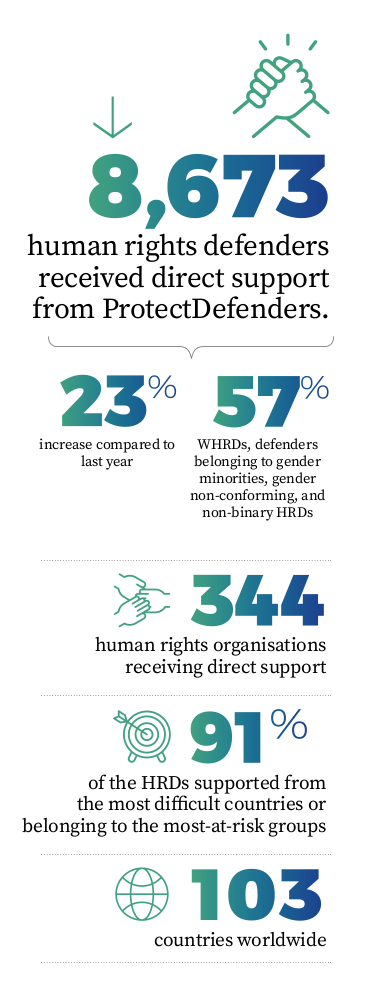
Throughout 2021, the EU human rights defenders mechanism, ProtectDefenders.eu, has delivered life-saving support and multi-faceted assistance to nearly 8,700 of the most at-risk human rights defenders and grassroots human rights organisations around the world – 23% more than in 2020. The EU HRD mechanism’s strategic, flexible, and efficient support has mitigated the ravages suffered by the human rights defence community last year, amid the pervasive impacts of the COVID-19 pandemic and the most critical global and geopolitical environment for human rights defence work reported since the creation of ProtectDefenders.eu in 2015.

Despite this extremely adverse situation, ProtectDefenders.eu has continued to mobilise protective support to individuals at risk, and to provide comprehensive assistance to organisations and movements confronting security threats. The support of ProtectDefenders.eu has helped human rights defenders and grassroots human rights groups to strengthen their resilience and protection globally, particularly in the most difficult contexts, making a significant contribution to their ability to continue their work.

Last year, the activities of the EU HRD mechanism have been impacted by an unprecedented increase in requests for urgent materially protective support from defenders and communities: ProtectDefenders.eu has had to respond to, among other severe crises, the dismantling and repression of civil society in Belarus, the consequences of the coup d’état in Myanmar on civil society and HRDs, and the collapse of Afghanistan as the Taliban took over its government. Thus, significant efforts were made to reach these most difficult countries and the most at-risk groups of defenders, who have absorbed an unprecedented level of the support delivered by the EU HRD mechanism. See also; https://humanrightsdefenders.blog/2019/05/28/the-eu-human-rights-defenders-mechanism-a-short-overview/

In a quickly evolving context, creative and flexible solutions and adaptations have been implemented, and this year the consolidation of the ProtectDefenders.eu consortium has given rise to new spaces to explore the privileged positioning of the EU HRD mechanism in the international community in support of defenders. This is illustrated by the launch of the first HRD resettlement stream by the government of Canada in partnership with ProtectDefenders.eu, the articulation of a comprehensive response in Afghanistan through new programmes in partnership with the EU, and the steps taken towards a more comprehensive and collective approach to advocacy on issues of common interest.

ProtectDefenders.eu has continued to provide a comprehensive, holistic and effective emergency protection for HRDs at the greatest risk, including 24/7 support, and to invest in the resilience and capacity of human rights organisations to continue their work in adverse environments – notably through lifeline and core-funding grant-making to local actors, including communities defending rights. ProtectDefenders.eu has also ensured that international temporary relocation capacities remain operational and accessible for HRDs and members of their families, and has taken a significant step in strengthening regional relocation structures through the Shelter Initiatives program. Furthermore, and despite the prevailing limitations created by the pandemic, capacity-building activities have continued to provide access to knowledge about reinforced protection strategies for the community of defenders. Similarly, ProtectDefenders.eu has strengthened its support to individual HRDs and NGOs through its reactive and protective advocacy work to HRDs at risk through urgent interventions, reports, and related proactive steps, mobilising the international community in an effort that has led to multiple success stories throughout the world.


This coordinated implementation, coupled with a holistic and complementary approach between partners, actions, strategies, and programmes, continues to step up the practical support available to HRDs at risk and local human rights NGOs in a timely and comprehensive manner; the vast majority of HRDs accessing ProtectDefenders.eu’s support have reported enhanced security and protection, and highly positive outcomes. Although the extreme situation in 2021 has pushed the mandate and resources of the EU HRD mechanism to the limit, ProtectDefenders.eu has managed to maintain and generate a consistently noticeable and positive impact on the HRD community at highest risk.

The 2021 ProtectDefenders.eu Annual Report is introduced by Victoria Fyodorova, a woman human rights defender from Belarus, Jamila Afghani, a WHRD from Afghanistan, Josep Borrell, Representative of the Union for Foreign Affairs and Security Policy/Vice-President of the European Commission, Jutta Urpilainen, Commissioner for International Partnerships, and Maria Arena, Chair of the European Parliament’s subcommittee on Human Rights.

Click to read and download the 2021 ProtectDefenders.eu Annual Report

EU by far biggest funder of human rights defenders

February 28, 2022

The European Union (EU) provided roughly €10 billion to support non-government organisations (NGOs) in its partner countries over the past seven years (2014-2021) EU High Representative and Vice-President Josep Borrell said in a statement in celebration of World NGO day, 26 February.

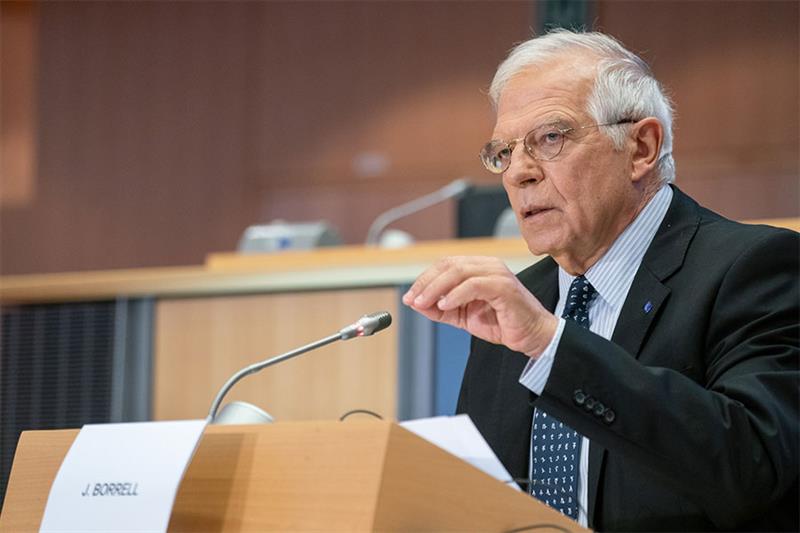
Josep Borrell

File Photo: EU s High Representative and Vice-President Josep Borrell. Photo courtesy of European parliament website.

With these allocations, the EU represents the world’s largest provider of support to local NGOs in partner countries, Borrell noted. He also stated that it has been a leading donor for the protection and support of human rights defenders, with 53,000 defenders and their families taken care of through the website ProtectDefenders.eu since 2015. See also: https://humanrightsdefenders.blog/2021/12/17/eu-launches-a-e1-5-billion-6-year-plan-to-promote-human-rights-and-its-defenders/

On World NGO Day, we honour all civil society actors who, every day, are at the forefront of the fight for human rights, the respect of democratic values and the rule of law. The EU commends their role in supporting and giving a voice to the most vulnerable as well as their essential contribution to building peaceful, just, and inclusive societies.

Today, with the unprovoked and unjustified military aggression against Ukraine by the Russian Federation, international peace and the rule of law are under attack. The EU stands firmly by the Ukrainian and Russian people along with their civil society and youths, whose future and voices are threatened by President Putin’s disregard of democracy, human rights, and international rules,” Borrell stated.

Borrell added that countries that curtail NGOs’ activity through legal and administrative measures hamper universal human rights and fundamental freedoms. See e.g.: https://humanrightsdefenders.blog/tag/foreign-agents/

Poetry Challenge for Human Rights Defenders

November 16, 2021

Protection International, ProtectDefenders.eu and the Centre for Applied Human Rights of the University of York have been promoting a Human Rights Defenders Poetry Challenge:

This poetry challenge is for all activists and artists irrespective of previous experience with this form of art. As the global pandemic continues, we’d like to encourage those that work in support of human rights to take a moment to reflect on the past year, take a break from the current context in which we are situated and ponder about where we should be go from here.

We are accepting poetry of all styles (haiku, slam poems, free verse, limericks, etc.) and multimedia submissions are also welcome. Poems can be submitted in English, Spanish, French, Portuguese, Swahili and Thai, and the top poems in each language will be published in a digital booklet. The top three poems overall will win a cash prize, the authors be granted free access to our e-learning course on preventative protection and security and they will also be invited to a virtual poetry reading with key stakeholders and celebrity guests. The Poetry Challenge is completely free to participate, with no submission or entry fees.

More detailed information about the poetry challenge can be found on Protection International’s website or within our sharable explainer document (available in all Poetry Challenge languages).

We have also prepared a social media kit including draft posts and graphics in multiple languages.

Contact Meredith Veit (meredith.veit@protectioninternational.org) or Tommaso Ripani (tommaso.ripani@protectioninternational.org) if you have any questions!

Deadline for submissions: 30 November 2021

For the first results see: https://www.protectioninternational.org/en/news/human-rights-defenders-poetry-challenge-finalists

EU human rights committee condemns India’s arrest of human rights defenders

June 1, 2020
Maria Arena is the chairperson of the Subcommittee of Human Rights of the European Parliament member of Socialist and Democrats parliamentary group. Photo: Reporter

20 May 2020 the chairperson of the Subcommittee of Human Rights of the European Parliament sent a letter to Indian Home Minister Amit Shah, condemning the arrest of human rights defenders under the Unlawful Activities (Prevention) Act.

In her letter, Maria Arena said the European body has been closely following the arrests of human rights defenders Anand Teltumbde and Gautam Navlakha by the National Investigative Agency in India.

Academic and Dalit author Teltumbde and human rights defender Navlakha had surrendered to the police last month after exhausting their possible legal remedies.

Nine other defenders have been in jail since 2018 in the Bhima Koregaon case, where the charges relate to caste violence around an Ambedkarite event and an alleged Maoist plot to foment armed revolution and possibly assassinate Prime Minister Narendra Modi.

In 2018, the United Nations’ Office of the High Commissioner for Human Rights had issued a statement against terror charges being invoked against the activists.

It is particularly alarming to note that human rights defenders cannot conduct advocacy activities, notably in favor of India’s poorest and most marginalised communities, without becoming subject to intimidation and harassment,” Arena said in her letter.

Equally worrying is the fact that terrorism charges, including under the Unlawful Activities Prevention Act (UAPA) have been used to silence them,” she noted pointing out that by United Nations Special Procedures, this clearly represents a violation of international human rights standards.

The letter further stated that to date, the European Parliament had noted that various forms of legitimate peaceful protests against laws, policies and governmental actions, including the Citizenship Amendment Act, had been portrayed as terrorist activities under this legislation, resulting in a number of arrests. [see also: https://humanrightsdefenders.blog/2018/10/07/india-attacks-on-human-rights-defenders-abound-under-unlawful-activities-prevention-act/]

This is notably the case for human rights activists such as Safoora Zargar, Gulfisha Fatima, Khalid Saifi, Meeran Haider, Shifa-Ur-Rehman, Dr Kafeel Khan, Asif Iqbal and Sharjeel Imam, who were recently arrested by the police,” the letter noted.

Against this background, there are also increased fears that the legislation might confer discretionary powers upon state agencies. India, she said, should do much more to ensure a safe and conducive environment for civil society working in the country and consider enacting a law on the protection and promotion of human rights defenders.

In a similar vein, ProtectDefenders on May 26 2020 reports “Increasing attacks against human rights defenders in India and Guatemala”. …..

Over the past month, ProtectDefenders.eu has received a considerable and growing number of reports regarding attacks, threats, and alerts affecting human rights defenders in India. This information alerts to the numerous acts of police and judicial harassment in the repression of legitimate activities in favor of human rights. Among other incidents, police harassment and arbitrary detention of human rights defenders were reported in Manipur State, in relation to statements made to criticise the management of the current COVID-19 pandemic by local authorities.

Safoora Zargar, a 27-years old student and woman human rights defender unjustly detained since 10 April, is one of the OMCT’s campaign #FacesOfHope

For the OMCT campaign see: https://humanrightsdefenders.blog/2020/05/25/faces-of-hope-campaign-human-rights-defenders-imprisoned-worldwide/

Moreover, the Paris-based International Federation for Human Rights has written to Prime Minister Narendra Modi and home minister Amit Shah terming the detentions of several Indian human rights activists ‘arbitrary’. It says the activists have been arrested for “their participation in peaceful protests against the Citizenship Amendment Act 2019 (CAA)” in the last few months.

The letter highlights the cases of Devangana Kalita and Natasha Narwal, student activists who have been associated with the anti-CAA protests in Delhi and were arrested recently by the Delhi police.

https://www.geo.tv/latest/290529-eu-human-rights-subcommittee-condemns-indias-arrest-of-human-rights-activists

https://www.telegraphindia.com/india/europe-flags-rights-concern/cid/1777254

https://thewire.in/rights/ifhr-anti-caa-activists-arrests-release

Follow up on HRD summit during RightsCon Tunis 2019

October 23, 2019

On 12 June 2019, ProtectDefenders.eu participated at the RightsCon Tunis 2019 panel on the Human Rights Defenders World Summit 2018. A delegation of human rights defenders presented their experience of taking action to defend human rights and the consequences they had to face because of these actions. They have also mentioned the significance of the Summit 2018 had for them and what states, businesses and donors must do to ensure their fundamental role is protected and recognised in the digital sphere and beyond.  In relation to this, they have called on the Tech community to join them in the struggle for human rights. See also: https://humanrightsdefenders.blog/2018/12/18/premiere-powerful-video-summarizes-human-rights-defenders-world-summit-2018/

At the end of the HRD World Summit 2018 in Paris, all defenders agreed on a landmark Action Plan, which was presented to the UN General Assembly in December 2018. As participants to the Paris Summit continue to spread this message around the world, this panel was an opportunity to remind the world of the essential work they do and the need to create a safe and enabling environment for all those who actively defend human rights.

The Action Plan calls on Governments, corporations, international financial institutions, donors and others to take practical steps to ensure human rights defenders are recognised and protected, including by adopting national governmental action plans and legislation, and protecting defenders as a key priority in foreign policy, particularly women human rights defenders, LGBT+, indigenous rights defenders and other marginalized defenders who face the most risk and exclusion.

https://www.protectdefenders.eu/en/newsletter/october-2019_44#the-human-rights-defenders-world-summit-at-rightscon-tunis-2019-298