Posts Tagged ‘Police’

Report of a UN consultation on law enforcement’s role in peaceful protests

February 21, 2024

On 16 February, 2024 Sandra Epal Ratjen & Nicolas Agostini in Global Rights reported on a UN consultation on law enforcement’s role in peaceful protests which brought together practitioners and human rights defenders.

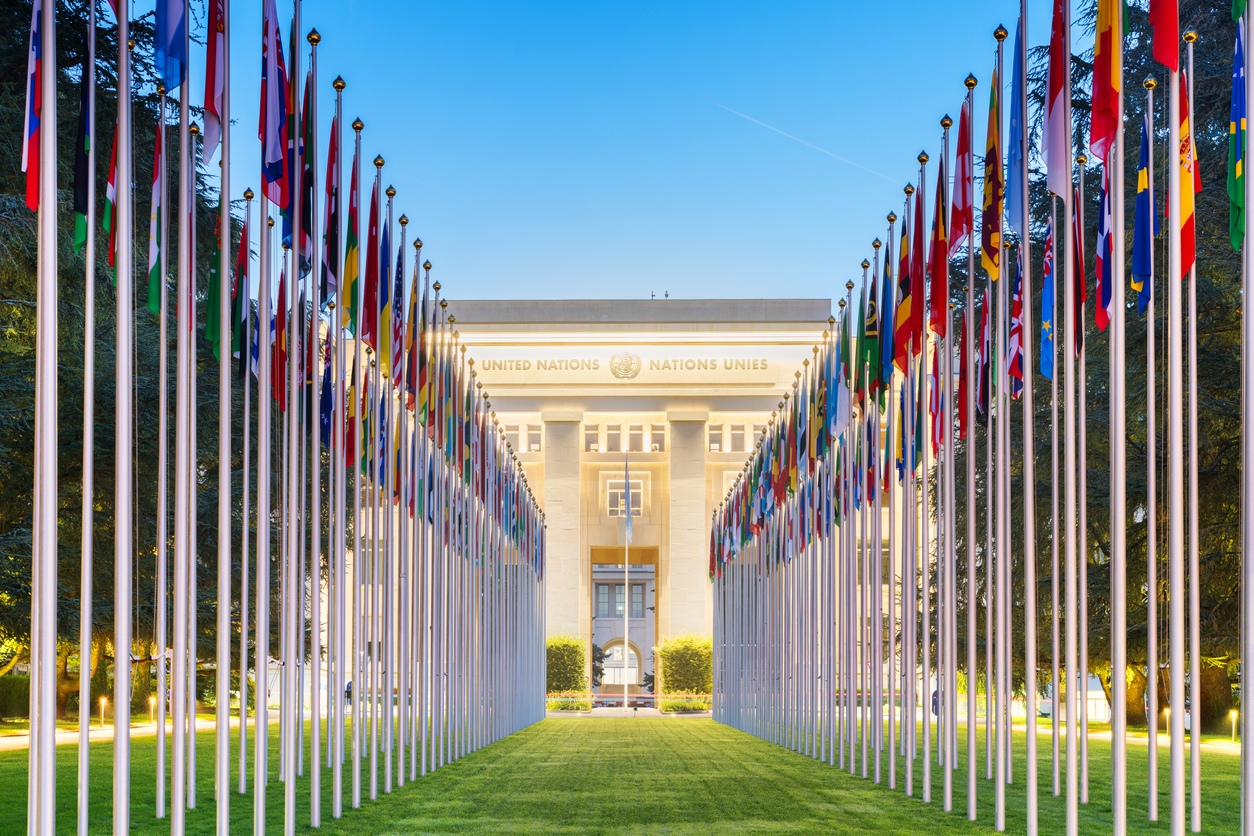
Over two days in Geneva, the UN special rapporteur on freedoms of peaceful assembly and association, Clément Voule, the UN Human Rights Office (OHCHR), and the UN Office on Drugs and Crime (UNODC) convened a consultation on the facilitation of peaceful protests by law enforcement. The event followed several regional workshops, organized in accordance with Human Rights Council resolution 50/21, which requested that the special rapporteur develop “technical and practical tools . . . to assist law enforcement officials in promoting and protecting human rights in the context of peaceful protests.” There was nothing unusual in this format—or in the event’s title. But despite its attractive feel (at least for human rights geeks), it ran the risk of turning into yet another academic discussion replete with theorizing but offering little in the way of practical solutions. 

It turned out to be one of the most refreshing, engaging, and action-oriented human rights dialogues we’ve attended.

It’s about the makeup

What made the event rather unusual was its makeup. In addition to civil society members (public assembly, law enforcement, torture, and rule of law specialists attended), the consultation brought together practitioners from all over the world. By “practitioners,” we mean not just police watchdogs (oversight bodies and disciplinary authorities) but police officers and commanders, all on active duty. 

While some activists would draw back with a wince, those human rights defenders and organizations who were present engaged with an open mind, as did law enforcement personnel. Participants weren’t going to talk amongst themselves or only preach to the converted. They were going to try to bring about an actionable outcome. After all, their aim was to devise how law enforcement can facilitate peaceful assemblies and protect rights in such contexts.

Peer pressure was minimal. On all sides, there was nothing to “prove”: no need to adopt an intransigent position, no need to show you’re smart, no need to cajole anyone—there were only incentives to share expertise and experience. 

Sure, there were precedents. Recent workshops brought together practitioners and outlined best practices. For instance, the “Istanbul Process” meeting on promoting religious tolerance held in Singapore was practitioner-centric. Since then, however, the Istanbul Process has collapsed as the Organization of Islamic Cooperation (OIC) revived the “defamation of religions” agenda.

Without naïveté but considering the “real-world” nature of the outputs of this process, we’re confident that the work done under the auspices of Clément Voule, OHCHR, and UNODC will, to some extent, enhance human rights compliance in police practice and benefit both peaceful protesters and law enforcement officials. Notably, the outcome documents are less technical than most human rights documents. 

It’s also about the substance

The consultation was also innovative because of its hands-on approach. In addition to the main working document, a “Model Protocol” for the law enforcement facilitation of peaceful protests, the project led by Clément Voule and his team, OHCHR, and UNODC will produce a “Handbook” and a “Checklist” for law enforcement professionals. The latter two will be practical documents guiding police practice. 

The magnitude and diversity of experiences in the room meant that discussions were light-years away from sterile sloganeering or divisive debates—the kind we see on social media. On civil society’s side, no one advocated “defunding the police.” On the police side, no one advocated for qualified immunity. All participants created a fertile ground for dialogue on how to ensure human rights-compliant, competent, and respected law enforcement that is able to facilitate, not hinder, public assemblies. 

Civil society participants recognized the need for well-funded, well-trained police. We kept in mind (and were reminded of) the realities of the job—what the average law enforcement officer faces daily. The challenges include understaffing, lack of adequate training, and, quite simply, fear (facing a crowd, even peaceful, will never feel like sitting on your sofa sipping a Whiskey Sour). Law enforcement participants, for their part, recognized the need for accountable police behavior and to confront discrimination and abuses of power. They kept in mind (and were reminded) that to be respectful is a sine qua non to be respected.

Also reviewed were “prior to protest,” “during protest,” and “after protest” issues, plus the situation of specific groups and accountability for violations. One section addressed police well-being, which is essential to human rights compliance, as strained police officers are much more likely to engage in misconduct. We didn’t shy away from addressing sensitive issues—police brutality, accountability, or budgeting. 

It wasn’t an echo chamber, but participants agreed on key points. Among others: the role of police vs. the role of prosecution; the need for effective communication between protesters and police, de-escalation, and adequate training for police officers; or the fact that a clear distinction must always be made between peaceful and non-peaceful elements of an assembly. 

It was a far cry from the way these conversations unfold online, and once again, one can see the toxicity of social media. Instead of fostering healthy discussions (differences aren’t that wide between most people), social media algorithms artificially promote simplistic views, entrench positions, and elevate the most divisive topics. This process distracts those seeking solutions from problem-solving. No one benefits from this situation—certainly not rights-holders. 

Don’t forget political will 

Assuredly, the outcomes of this consultation will go unheeded in many countries, where protests are rare or police have total impunity. Elsewhere, not much will happen without political will. 

But the beauty of this consultation is that political will to facilitate assemblies won’t need to come from the highest level. Once publicly available, the outcome documents—particularly the Handbook and Checklist, with their guidelines on communication, de-escalation, and risk assessment regarding protests—will be available for law enforcement agencies and officers at all levels to use. The ideal scenario, of course, will be governments publicly committing to using the outcome documents.

The final documents will stem from a dialogue that brought together people with hands-on experience who tried to build bridges and maximize their chances of having an impact on the ground. This model should inform future human rights dialogues.

The Protocol, Handbook, and Checklist will be presented at the next session of the UN Human Rights Council, February 26–April 5, 2024. Clément Voule will make his last appearance as special rapporteur. For his successor—and for all people of goodwill who want to see peaceful protests proceed without hindrance, as well as rights-compliant law enforcement, joint work will be needed to popularize, operationalize, and implement the documents. 

https://www.openglobalrights.org/sandra-Epal-Ratjen/Human-rights-dialogue-we-need

Microsoft exercising human rights concerns to turn down facial-recognition sales

April 30, 2019
FILE PHOTO: The Microsoft sign is shown on top of the Microsoft Theatre in Los Angeles, California, U.S. October 19,2018. REUTERS/Mike Blak
REUTERS/Mike Blak

Joseph Menn reported on 16 April 2018 in kfgo.com about Microsoft rejecting a California law enforcement agency’s request to install facial recognition technology in officers’ cars and body cameras due to human rights concerns. Microsoft concluded it would lead to innocent women and minorities being disproportionately held for questioning because the artificial intelligence has been trained on mostly white and male pictures. AI has more cases of mistaken identity with women and minorities, multiple research projects have found.

Anytime they pulled anyone over, they wanted to run a face scan” against a database of suspects, company President Brad Smith said without naming the agency. After thinking through the uneven impact, “we said this technology is not your answer.” Speaking at a Stanford University conference on “human-centered artificial intelligence,” Smith said Microsoft had also declined a deal to install facial recognition on cameras blanketing the capital city of an unnamed country that the nonprofit Freedom House had deemed not free. Smith said it would have suppressed freedom of assembly there.

On the other hand, Microsoft did agree to provide the technology to an American prison, after the company concluded that the environment would be limited and that it would improve safety inside the unnamed institution. Smith explained the decisions as part of a commitment to human rights that he said was increasingly critical as rapid technological advances empower governments to conduct blanket surveillance, deploy autonomous weapons and take other steps that might prove impossible to reverse….

Smith has called for greater regulation of facial recognition and other uses of artificial intelligence, and he warned Tuesday that without that, companies amassing the most data might win the race to develop the best AI in a “race to the bottom.”

He shared the stage with the United Nations High Commissioner for Human Rights, Michelle Bachelet, who urged tech companies to refrain from building new tools without weighing their impact. “Please embody the human rights approach when you are developing technology,” said Bachelet, a former president of Chile.

[see also my older: https://humanrightsdefenders.blog/2015/11/19/contrasting-views-of-human-rights-in-business-world-bank-and-it-companies/]

https://kfgo.com/news/articles/2019/apr/16/microsoft-turned-down-facial-recognition-sales-on-human-rights-concerns/

Student dissertation award in the Netherlands goes to Canadian study on Police failures to combat sexual assault

February 14, 2018

This blog has a keen eye for all human rights awards, so I report with pride rather than embarrassment that the 7th Thoolen NJCM Dissertation Prize 2017 goes to Sylvie McCallum Rougerie. Sylvie wrote her dissertation on ‘Police Failures to Combat Sexual Assault: Lessons from International and Regional Human Rights Law for Improving Accountability under the Canadian Charter of Rights and Freedoms’.

No less than four student dissertations made the final cut this time. They were assessed on the following criteria: originality of the chosen human-rights based theme, development thereof; academic level; degree of innovative insight; and accessibility.  Tied for second place are Jordi Bierens and Danielle Snaathorst. Jordi wrote his dissertation on the growing influence of fundamental rights on European copyright rules. Danielle wrote about ‘The Curious Case of the Legitimate Aim. Understanding the “Legitimate Aim” Test of the European Court of Human Rights in Cases Concerning Freedom of Religion’. The third place goes to Jake Tingen. He wrote his dissertation on the tension between the freedom of information and the Dutch Public Access to Government Information Act.

The prize for winning the Thoolen NJCM Dissertation Prize is the publication of the winning dissertation by NJCM’s publishing house, Stichting NJCM-Boekerij. The award ceremony will take place during NJCM’s seminar on 12 April 2018 in The Hague (from 7.00 to 8.30 pm).

See also: https://humanrightsdefenders.blog/2016/03/03/dissertation-on-social-rights-and-austerity-wins-thoolen-njcm-award-2016/

https://njcm.nl/actueel/and-the-thoolen-njcm-dissertation-prize-2017-goes-to/

Enough break-ins is enough say Ugandan human rights defenders

February 12, 2018
I wrote earlier about the suspiciously high rate of break-ins in the human rights community in Kampala [https://humanrightsdefenders.blog/2016/06/14/uganda-ngo-offices-regularly-ransacked-coincidence/]. The Ugandan Observer of 12 February writes: “Angry human rights workers camp at Old Kampala police

Police has called for calm and patience from furious staff of human rights awareness and promotion forum-Uganda (HRAPF), who’d staged a protest at Old Kampala police station following a second break-in into their offices last week. Nearly two years after the first break-in on May 22, 2016 – leading to the brutal murder of the security guard on duty Emmanuel Arituha; last week on February 9, HRAPF offices in Kampala were again broken into by unknown assailants.

Some of HRAPF staff and partners in a meeting with police station DPC

Armed with placards, HRAPF staff camped at Old Kampala police station to demand for the immediate conclusion of the investigations into the now rampant breaking into NGO offices. Following a meeting with senior police officials at the station, police acknowledged the need for quicker investigations and promised to provide armed guards to the NGO until the investigations are concluded. For the first break-in investigations, police officials reportedly said the file had been called to the CIID headquarters but will be recalled to the station to conclude investigations. 

A matrix organised by the by National Coalition of Human Rights Defenders Uganda (NCHRDU), shows that at least 24 premises of Non-governmental organisations and civil societies have been broken into since 2012.

…..

Organisations such as the Uganda Land Alliance, the Foundation for Human Rights Initiative, the Legal Aid Service Providers Network, Akina Mama Wa Afrika and the Anti-Corruption Coalition have suffered break-ins in similar fashion and, despite timely reports to the police on all occasions, investigations have been unsatisfactory and the follow up insufficient.

This is the latest in a series of attacks against civil society organisations which, regardless of the motivations of the assailants, points to the increasing lack of protection provided to human rights defenders in Uganda, said Jjuuko.

http://observer.ug/news/headlines/56884-angry-human-rights-workers-camp-at-old-kampala-police.html

https://76crimes.com/2018/02/09/unchecked-criminals-hit-ugandan-civic-groups/

Killing of human rights lawyer Rehman in Pakistan leads to low level response

May 17, 2014

The recent killing of the lawyer Rashid Rehman (or Rahman) in a case of blasphemy in Pakistan has created a lot of media attention. This report from the local newspaper The News International of 17 May throws an interesting light on the follow up within the police and alleges that two lower level policemen have been made the scapegoats:

“Police bosses have held their subordinates responsible for their incompetence and negligence in the murder of human rights activist Rashid Rahman. The Multan CPO has transferred Chyllyak SHO Ghulam Abbas and Shah Shamas SHO Akbar Kamboh for their negligence in providing security to Rashid Rahman. On the other hand, a senior police official has contradicted receiving any sort of application from Rashid Rahman for security protection. The official said the government could not provide security to each citizen on demand. The government only provides security to the accused and complainant in all cases, including in blasphemy cases, instead of providing security to counsels. Rashid Rehman was gunned down in his chamber on May 7 evening just a month after he had been threatened by the prosecution during a court hearing. No progress could be made on his murder after eight days of the high profile assassination, which had been condemned across the world. The UN and the US have urged the government to ensure the arrest of killers. Sources in the CPO office disclosed that the route of providing security shelter passed through the SSP Operations. “When someone seeks security, he submits his request to the CPO office who forwards it to the SSP Operation for looking into the matter whether the applicant is deserved for security or not,” they added. They said the HRCP Task Force had informed the Multan CPO office on receiving life threats. The CPO office directed Cantonment SP Mehmoodul Hassan to ensure security to Rashid Rehman. The SP asked Shah Shamas SHO Akram Kamboh to ensure security in jail while Chyllyak SHO Ghulam Abbas was directed to ensure security in his chamber at District Courts. They said that both the SHOs had been suspended in this regard. On the other hand, the Punjab IGP office had directed the Multan CPO to ensure security for Rashid Rahman at any cost on the report submitted by Punjab Special Branch on April 21. However, the CPO office did not comply with the IGP office order and assigned a task to SSP Operation to provide security to rights activist. The sources said that the senior officers had suspended two SHOs to save their skin. CPO Sultan Ahmed Chaudhry was repeatedly contacted on Friday, but his gunman Abdur Razaaq promised every time to ring back, but to no avail. Multan SSP Operations Shaukat Abbas, however, denied that the application was sent to the police by the slain for security. “The government does not provide security to everyone in blasphemy cases. The government only provides security to the complainant and the accused,” he said. The government cannot provide security to the defence counsel even in blasphemy cases, he added. Meanwhile, human rights activists criticised the police for adopting dual standards. The police did not provide security to Rashid Rahman despite his application, but security was provided to a Muhammad Latif Ansar Sial alias Prof Lajpal. He is not an academician but always shows himself as professor. Lajpal had contested in all general elections or local bodies held in the past. He participated in the 2013 elections from NA-151 and PP-198, securing only 59 and 9 votes as an independent candidate. He contested the 2008 elections from NA-151 and secured 183 votes. Rights activists observed police were not taking one of the valuable assassinations seriously and using delaying tactics. The United Nations declared it a cold-blooded murder and strongly condemned it on May 9, right after the second assassination. They urged the government to ensure prompt investigation into the matter so that lawyers, human rights defenders and journalists could work without any fear. The spokesperson for UN High Commissioner for Human Rights Rupert Colville in Geneva said the murder of Rashid Rahman had “brought into stark focus the climate of intimidation and threats that permeates the work of human rights defenders and journalists in the country.“ The UN had urged the government last month to investigate the threats and ensure security for Rehman. “We condemn the killing of Rehman and urge the government to ensure a prompt investigation and bring the perpetrators to justice,” the UN spokesman said.

via MULTAN City News – thenews.com.pk.

Egyptian Center for Social and Economic Rights raided by police, just now

December 19, 2013

Mona Seif, Egyptian human rights defender and Final Nominee of the MEA 2013 reported today 19 December, at 12h00 that “less than an hour ago the Police raided the NGO Egyptian Center for Social and Economic Rights, founded by former presidential candidate Khaled Ali, and arrested Mostafa Eissa (an employee in their media unit) and 2 volunteers, as well as confiscated all computers of the media unit. We haven’t been able to know where were they taken to.”

Cambodia: Joint NGO Statement on the use of force against protesters

September 25, 2013
On 24 September 2013, five NGOs issued a joint statement on Cambodia exactly when there is the interactive dialogue with the UN Rapporteur on that country: Read the rest of this entry »

Asian Parliamentarians and Human Rights Defenders meet again on the issue of Torture – 11-13 November

August 27, 2013

The Asian Human Rights Commission (AHRC) in collaboration with DIGNITY, has made the practice of custodial torture and ill-treatment a core area of engagement. With a view to counteract the widespread practice of torture, the AHRC and DIGNITY have formed an Asian Alliance against Torture and Ill-treatment (AAATI) in 2012. The first conference of Asian Parliamentarians and Human Rights Defenders was held in Hong Kong in 2012 [ see report Torture – Asian and Global Perspectives Vol. 1, No. 3 ].

The focus for the second meeting [scheduled for 11-13 November 2013] will be to identify the reluctance of governments to achieve a substantial change in the nature of policing in their countries to bring these institutions at par with the policing systems of advanced democracies.

The link below refers to the announcement which in fact is a CONCEPT PAPER:

ASIA: Second Regional Conference of Asian Parliamentarians & Human Rights Defenders on Elimination of Custodial Torture and Ill-treatment in Asia November 2013, Hong Kong — Asian Human Rights Commission

For details please contact: Bijo Francis, Executive Director, Email: ahrc at ahrc.asia


Transgender activist harassed by Greek police

June 14, 2013

The Observatory for the Protection of Human Rights Defenders (a joint programme of two reputed international NGOs: the FIDH andOMCT) has been informed by the Greek Helsinki Monitor (GHM) about the police harassment of Ms. Electra Koutra,  GHM legal counsel, in the framework of police profiling operation against transgender persons in Thessaloniki.logo FIDH_seul
OMCT-LOGO
Read the rest of this entry »

Bangladesh: detention of ill-treated human rights defender Mahmudur Rahman extended and charges confirmed

June 14, 2013

On 12 June 2013, the pre-trial detention of human rights defender Mahmudur Rahman in Bangladesh was extended for three days by Metropolitan Magistrate Mohammad Harunur Rashid, who confirmed the charges of inciting violence. The human rights defender was arrested on 11 April 2013, and was subjected to severe torture whilst in custody. Frontline NEWlogo-2 full version - cropped

Read the rest of this entry »