Posts Tagged ‘NGOs’

Enforced disappearances in China

August 31, 2022

On 30 August, 2022, the International Day of the Disappeared, the international community must recognize and respond to the widespread use of enforced disappearances in the People’s Republic of China, say an impressive group of NGOs (see list a the end):  

Just over five years ago, on 13 August 2017, human rights lawyer Gao Zhisheng vanished for the third time. Gao, praised as the ‘Conscience of China’, had long fought for the rights of those who dared to speak out, who belonged to religious minorities, who were evicted from their homes when their land was seized, or who protested against exploitation. For that, he was in and out of prison and separated from his family for nearly a decade. For more than five years, his wife and children have had no idea of his whereabouts, nor even if he is alive. [see: https://www.trueheroesfilms.org/thedigest/laureates/33C77656-F58B-454E-B4C7-E1775C954F14]

Gao Zhisheng’s case is severe, and yet represents only the tip of the iceberg: many other activists and lawyers face a similar fate, such as Tang Jitian, disappeared in 2021, tortured, and detained in a secret location. UN experts, including the Working Group on enforced disappearance, have sounded the alarm from as early as 2011 about the use of enforced disappearances against those taking part in China’s human rights movement. It is used to silence those promoting rights and freedoms, to enable acts of torture and ill-treatment without any oversight, and to send a chilling message to any person who may dare to criticize the government. 

The UN Secretary-General Antonio Guterres echoed this when he reminded the international community that enforced disappearance is a ‘method of repression, terror, and stifling dissent’. Relatives – themselves also victims of this crime– are deprived of their right to justice, and to know the truth, constituting a form of cruel and inhumane treatment for the immediate family. 

But no matter how powerful a country is, no matter what security challenges (real or perceived) they may face, the experts rightfully emphasize: ‘There can never be an excuse to disappear people.’ Enforced disappearances are strictly prohibited under international law under any circumstances, and may constitute a crime against humanity when committed as part of a widespread or systematic attack against any civilian population. 

The Chinese government continues to ignore calls for it to ratify the International Convention for the Protection of All Persons from Enforced Disappearance. It has disregarded requests for over nine years by the UN’s Working Group on Enforced and Involuntary Disappearances to visit the country, including its most recent on 7 January 2022. In the meantime, the number of cases of individuals disappeared presented before the Working Group soared, reaching 214 by 2021, out of which 98 remain outstanding. 

It is urgent that the UN, governments, and civil society worldwide press China to end, unequivocally, all forms of enforced disappearance. 

UN experts and civil society actors have documented many practices used by the Chinese authorities amounting to enforced disappearance. Some are written into Chinese law, or Chinese Communist Party guidance; others happen outside the scope of China’s own laws.  Some target individuals for their actions or speech; others are wielded with the intent to terrorize a particular ethnic or religious community. 

Residential Surveillance at a Designated Locations (RSDL)

‘Residential Surveillance at a Designated Location’  is allowed for in China’s Criminal Procedure Law, and authorizes holding someone in custody – prior to arrest – for up to six months in an undisclosed location. This ‘location’ is unofficial, selected at the discretion of the police, and the individual is isolated in solitary confinement without access to family, counsel or options to appeal the measure. This is especially true for those activists and dissidents accused of ‘national security crimes’. Incomplete government data admits to use of RSDL in some 23,700 instances, but civil society estimates that for the period 2013 to 2021, the real figure is closer to 85,000, with increased use over time. The practice continues despite having been condemned by UN experts as ‘a form of enforced disappearance’ that ‘may per se amount to cruel, inhuman or degrading treatment or punishment, or even torture.’ The experts’ assessment is clear: RSDL must be repealed. [see also: https://humanrightsdefenders.blog/2022/02/05/chinas-residential-surveillance-at-a-designated-location-needs-to-disappear/]

Liuzhi system 

The liuzhi (留置) extralegal detention system mimics the practice of RSDL, but is used to specifically punish any public servant or Chinese Communist Party (CCP) member who allegedly ‘violates duties’ or commits ‘economic crimes,’ potentially reaching nearly 300 million victims.  As with RSDL, liuzhi detentions can last up to six months, holding victims incommunicado and in solitary confinement at undisclosed locations. Yet, detentions are outside the scope of China’s laws, including the Criminal Procedure Law, as liuzhi is not part of the criminal justice system. Instead, it is run by China’s powerful extra-judicial anti-graft watchdog, the National Supervision Commission (NSC), a quasi-state body answerable only to the CCP. Legal safeguards, including the right to legal counsel, do not apply to individuals investigated under liuzhi, until and unless their case is sent for criminal prosecution. Incomplete official data acknowledges 11,000 individuals held under liuzhicivil society estimates actual figures to surpass 57,000 disappeared victims. UN experts addressed a general allegation on this issue to China in September 2019.

Psychiatric incarceration (ankang)

Since the 1980s, China’s Ministry of Public Security has locked up individuals targeted for their political and religious beliefs in psychiatric hospitals for the criminally insane, known as ankang (安康) (‘peace and health’). Despite legal reforms, police continue to send human rights defenders for compulsory treatment without medical justification in both ankang facilities, and psychiatric hospitals for the general public. Civil society data indicates this is a regular, large-scale practice, where victims are denied contact with the outside world and often subjected to torture and ill-treatment, while families are not informed about their relatives’ forced hospitalization.

Enforced disappearance in Tibet

The Chinese authorities continue to disappear Tibetans, including religious leaders, critics and influential thinkers, subjecting them to torture and ill-treatment, and employing the threat of disappearance to instill widespread fear across Tibet.  In February 2022, six UN experts raised concern over the physical well-being of Tibetan musician Lhundrup Drakpa, writer Lobsang Lhundrub, and school teacher Rinchen Kyi, arrested and disappeared ‘in connection with their cultural activities in favour of the Tibetan minority language and culture.’ In July 2021, four UN experts expressed similar concern over the enforced disappearance of Rinchen Tsultrim and Go Sherab Gyatso, pointing to a ‘worrying pattern of arbitrary and incommunicado detentions (…) against the Tibetan religious minority, some of them amounting to enforced disappearances.’ 

The 11th Panchen Lama, Gedhun Choekyi Nyima, one of the most important Tibetan Buddhist leaders, was disappeared in 1995 at the age of six. The Chinese government continues to ignore calls for his release, UN experts’ concerns, or the UN child rights committee’s request for access to establish his whereabouts and health.

Enforced disappearance in the Uyghur region 

Beginning in 2017 in the Xinjiang Uyghur Autonomous Region (XUAR, or Uyghur Region), Uyghurs and Turkic Muslims have been detained incommunicado by Chinese government officials in internment camps, forced labor facilities, official prisons where they serve lengthy sentences, and other facilities where they are at risk of being subject to forced labor. Reports to the UN Working Group on enforced disappearances escalated dramatically, indicating a widespread and systematic practice. While the Chinese government refers to these camps as ‘vocational education and training centers’, administrative detention in the camps has no basis in Chinese, or international law. 

Journalists and NGOs have reported countless testimonies of people whose family members are or were missing and believed to be detained in the XUAR, and yet who have no way to establish their family members’ whereabouts.  They almost never receive official confirmation regarding their family member’s status from the Chinese authorities; efforts to gather information from Chinese consulates or embassies abroad have been largely unsuccessful. Very few detainees are allowed contact with the outside world. Even nominally ‘free’ Uyghurs living in XUAR have been effectively forbidden to speak with their family or friends abroad. Uyghurs in the country and overseas are wholly deprived of their right to truth. 

We, the undersigned organizations, urge the international community as a whole to ensure sustained attention and take meaningful action to put an end to all forms of enforced disappearance in China. The authorities must release all those disappeared, ensure their relatives’ right to truth, justice, reparation, and guarantees of non-recurrence. 

We stand in solidarity with all those missing, and with their loved ones, left longing for them to return alive. 

Signatories

            Amnesty International

            China Against the Death Penalty

            China Aid Association

            Chinese Human Rights Defenders

            Freedom House

            Front Line Defenders

            Global Centre for the Responsibility to Protect

            Grupo de Apoio ao Tibete Portugal

            Hong Kong Democracy Council

            Hongkongers in Britain

            Hong Kong Watch

            International Bar Association’s Human Rights Institute (IBAHRI) 

International Campaign for Tibet

            International Commission of Jurists

            International Service for Human Rights (ISHR)

            International Society for Human Rights

            International Tibet Network

            Lawyers for Lawyers

            Lawyers’ Rights Watch Canada

Northern California Hong Kong Club

            Objectif Tibet, Sciez, France

            PEN America

Safeguard Defenders

The Rights Practice

The 29 Principles

Tibet Initiative Deutschland

Tibet Justice Center

Tibet Support Group Ireland

Students for a Free Tibet

Swiss Tibetan Friendship Association

Uyghur Human Rights Project

World Organisation Against Torture (OMCT)

World Uyghur Congress

Enforced Disappearances in Bangladesh have to stop

August 30, 2022

On 29 August 2022, on the occasion of the International Day of Victims of Enforced Disappearances, AFAD, FIDH, Maayer Daak and Odhikar urge the government of Bangladesh to:
1) Halt all enforced disappearances and immediately return all disappeared persons to their
families.
2) Set up an independent mechanism to investigate all cases of enforced disappearances.
3) Refrain from all forms of reprisals against human rights defenders, family members of the
disappeared, and civil society activists, and ensure the safety and security of victims and
their families.
4) Hold all perpetrators accountable.
5) Ratify the International Convention for the Protection of All Persons from Enforced
Disappearance.
6) Adopt and implement domestic legislation criminalizing enforced disappearance in line
with international law.

See also: https://humanrightsdefenders.blog/2022/03/17/un-experts-urge-bangladesh-to-end-reprisals-against-human-rights-defenders/

The Asian Federation Against Involuntary Disappearances (AFAD) is a federation of human rights
organizations working directly on the issue of involuntary disappearances in Asia. AFAD was founded
on 4 June 1998 in Manila, Philippines and was the recipient of the 2016 Asia Democracy and Human
Rights Award. See: https://www.trueheroesfilms.org/thedigest/laureates/5E526725-F43B-83FB-3B7E-2B3C56D01F60
The International Federation for Human Rights (FIDH) is the world’s oldest non-governmental
human rights organization. Founded in 1922, FIDH federates 192 member organizations from 117
countries. Its core mandate is to promote respect for all the rights set out in the UDHR. http://www.fidh.org
Maayer Daak is a platform of the families of victims of enforced disappearances in Bangladesh with
the common goal of seeking the whereabouts of their loved ones and advocating for justice.
Odhikar is a human rights organisation in Bangladesh, established on October 10, 1994 by a group of
human rights defenders, to monitor human rights violations and create wider awareness. It holds
special consultative status with the ECOSOC of the United Nations.

http://odhikar.org/wp-content/uploads/2022/08/Joint-Statement-IDD-AFAD-FIDH-Maayer-Daak-Odhikar.pdf

UN and NGOs denounce ODHIKAR’s deregistration in Bangladesh

June 16, 2022

The Office of the United Nations High Commissioner for Human Rights and 11 international and regional rights organisations have demanded that the government must immediately cancel its decision to deregister rights organisation Odhikar and allow the rights organisation to function without fear of reprisal.

Ravina Shamdasani, spokesperson for the UN High Commissioner for Human Rights, said in a press briefing in Geneva statement on Friday, ‘We are concerned by the Government of Bangladesh’s decision not to approve the renewal of registration for Odhikar, a prominent and respected human rights organisation in the country’.

She said, ‘We urge the government to immediately reconsider this decision, and to ensure that Odhikar has the ability to seek full judicial review of any such determination. We are further concerned that this decision will have a chilling effect on the ability of civil society organisations to report serious human rights violations to UN human rights mechanisms.’

Odhikar has documented and reported on rights violations for many years to the Office of the UN High Commissioner for Human Rights, UN Special Procedures mandate holders and human rights treaty bodies, she mentioned in the briefing available on the website of the UN body.

Intimidation and reprisals against Odhikar have been documented since 2013, and appear to have intensified, with accusations of ‘anti-state’ and ‘anti-government’ activities, she added.

‘There has been increased surveillance of its activities in recent months. The UN Secretary-General has also raised concerns about reprisals against Odhikar over the past decade for cooperating with the UN,’ she said.

On June 5, 2022, the bureau sent a letter to Odhikar, denying its application for renewal of registration. Odhikar’s application for renewal of its registration with the NGO Affairs Bureau under the Prime Minister’s Office has been pending since 2014, she said, adding that Odhikar’s bank account was also frozen in 2014. ‘We call for Odhikar to be permitted access to its banked funds pending reconsideration of the renewal application,’ said the UN official.

Eleven international and regional human rights organisations, meanwhile, in a joint statement called on the government to immediately reverse the decision to deregister Odhikar.

Human rights defenders should be allowed to conduct their work without fear of reprisals, intimidation, and harassment from the authorities,’ read the statement issued by Human Rights Watch, Amnesty International, Anti-Death Penalty Asia Network, Asian Federation Against Involuntary Disappearances, Capital Punishment Justice Project, Elios Justice at Monash University, Human Rights First, International Coalition Against Enforced Disappearance, International Federation for Human Rights, within the framework of the Observatory for the Protection of Human Rights Defenders, Robert F Kennedy Human Rights and World Organisation Against Torture. {See also: https://humanrightsdefenders.blog/2022/03/17/un-experts-urge-bangladesh-to-end-reprisals-against-human-rights-defenders/]

The rights organisation in the statement said this latest development appeared to be part of a pattern of reprisals by the government against human rights organisations groups and defenders following the US sanctions against the Rapid Action Battalion on December 10, 2021. [See https://humanrightsdefenders.blog/2022/03/21/bangladesh-sanctions-seem-to-work/]

On 14 June 2022 Forum Asia in a strong statement said: FORUM-ASIA expresses its solidarity with Odhikar and calls on the Bangladeshi authorities to immediately recall the decision of rejecting Odhikar’s renewal application thereby ensuring it to carry on their human rights work. FORUM-ASIA reiterates its earlier call to repeal the Foreign Donation (Voluntary Activities) Regulation Act, 2016 as it imposes restrictions on civil society organisations’ ability to access resources.

The same day, the Asian Human Rights Commission (AHRC) and CIVICUS: World Alliance for Citizen Participation said they “are extremely alarmed by the decision of the government to arbitrarily revoke the registration of Odhikar, a leading human rights organisation in Bangladesh. This move is another blow to civil society and human rights defenders who have been facing systematic repression by the Sheikh Hasina regime.

http://www.humanrights.asia/opinions/AHRC-ETC-004-2022/

https://www.newagebd.net/article/172898/un-11-intl-orgs-slam-odhikar-deregistration

Disappointment with UN High Commissioner’s visit to Xinjiang boils over

June 9, 2022

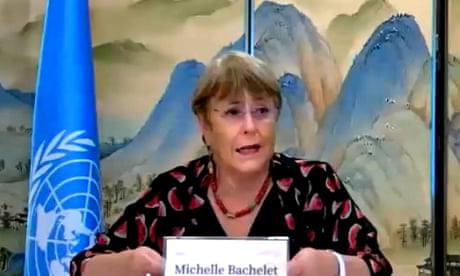
Many have been the reactions to the UN High Commissioner’s visit to China, some even expressing doubt BEFORE the visit took place [see: https://www.aljazeera.com/news/2022/5/24/what-will-the-un-human-rights-commissioner-see-in-xinjiang and https://www.hrw.org/news/2022/05/20/un-rights-chiefs-credibility-stake-china-visit]. The open referred to in the Guardian of 9 June 2022 was signed by academics in wake of Michelle Bachelet’s China visit and demands release of UN report on human rights abuses.

Agnes Callamard, the secretary general of Amnesty International, said on 28 June that Bachelet should condemn human rights violations in Xinjiang, and call on China to release people arbitrarily detained and end systematic attacks on ethnic minorities in the region. “The high commissioner’s visit has been characterized by photo opportunities with senior government officials and manipulation of her statements by Chinese state media, leaving an impression that she has walked straight into a highly predictable propaganda exercise for the Chinese government,“.

Dozens of scholars have accused the UN human rights chief of having ignored or contradicted academic findings on abuses in Xinjiang with her statements on the region. In an open letter published this week, 39 academics from across Europe, the US and Australia called on Michelle Bachelet to release a long-awaited UN report on human rights abuses in China.

The letter, published online, included some academics with whom Bachelet had consulted prior to her visit to Xinjiang. The letter’s signatories expressed gratitude for this, but said they were “deeply disturbed” by her official statement, delivered at a press conference in Guangzhou at the end of her six-day tour. They said her statement “ignored and even contradicted the academic findings that our colleagues, including two signatories to this letter, provided”.

UN High Commissioner for Human Rights visits China.

It is rare that an academic field arrives at the level of consensus that specialists in the study of Xinjiang have reached,” the letter said. “While we disagree on some questions of why Beijing is enacting its atrocities in Xinjiang, we are unanimous in our understanding of what it is that the Chinese state is doing on the ground.”.

Rights organisations and several governments have labelled the campaign a genocide or crime against humanity. Beijing denies all allegations of mistreatment and says its policies are to counter terrorism and religious extremism.

At the end of her visit Bachelet said she had urged the Chinese government to review its counter-terrorism policies in Xinjiang and appealed for information about missing Uyghurs. She was quickly criticised by some rights groups for giving few details or condemnation of China while readily giving long unrelated statements about US issues in response to questions from Chinese state media.

The academics’ letter is among growing criticism of Bachelet for not speaking out more forcefully against Chinese abuses after her visit, as well as a continued failure to release the UN report, which is believed to have been completed in late 2021. On Wednesday dozens of rights groups, predominately national and local chapters of organisations associated with Uyghur and Tibetan campaigns, demanded her resignation. See: http://www.phayul.com/2022/06/09/47195/

The 230 organisations accused Bachelet of having “whitewashed the Chinese government’s human rights atrocities” and having “legitimised Beijing’s attempt to cover up its crimes by using the Chinese government’s false ‘counter-terrorism’ framing”.

“The failed visit by the high commissioner has not only worsened the human rights crisis of those living under the Chinese government’s rule, but also severely compromised the integrity of the Office of the High Commissioner for Human Rights in promoting and protecting human rights globally,” the statement said.

They also decried that she had repeatedly referred to the detention camps in Xinjiang by the Chinese government’s preferred term: “vocational education and training centres”.

All this led to speculation that Mrs Bachelet’s decision not to seek a second term was related to the critcism [see: https://www.theguardian.com/world/2022/jun/13/un-human-rights-chief-michelle-bachelet-no-second-term-china]

https://www.theguardian.com/world/2022/jun/09/fury-at-un-human-rights-chief-over-whitewash-of-uyghur-repression

https://www.ohchr.org/en/statements/2022/05/statement-un-high-commissioner-human-rights-michelle-bachelet-after-official

https://www.npr.org/2022/05/29/1101969720/un-human-rights-chief-asks-china-to-rethink-uyghur-policies?t=1654771491735

Many NGOs join to demand release of human rights defenders in Algeria

May 23, 2022

38 NGOs, including HRW and AI, ask Algeria to end the repression of human rights and the “immediate” release of detainees. They have launched a campaign calling on Algeria to end the repression of Human Rights and demand the immediate release of people detained in the country for exercising their freedom of expression. “The campaign calls on all relevant individuals, organizations and parties to contribute to collectively demanding an end to the criminalization of the exercise of fundamental freedoms in Algeria using the label At least 300 people have been arrested since the beginning of 2022, and until April 17, in the country for exercising their right to free expression, peaceful assembly or association, according to human rights defender Zaki Hannache. “The arrests and sentences of peaceful activists, independent trade unionists, journalists and human rights defenders have not decreased, even after the protest movement was closed,” they said in a statement. The organizations have given the example of the hunger strike of the Algerian activist, Hadi Lassouli, to protest against his arbitrary imprisonment, as well as the case of Hakim Debazi, who died in custody on April 24 after being placed in preventive detention on April 22. February for social media posts. “Those suspected of criminal responsibility for serious human rights violations must be brought to justice in trials with due guarantees, and the authorities must provide victims with access to justice and effective reparations,” they have requested. This awareness campaign will be carried out until the anniversary of the death of Kamel Eddine Fejar, a human rights defender who died in custody on May 28, 2019 after a 50-day hunger strike. The United Nations High Commissioner for Human Rights, Michelle Bachelet, was “concerned” last March at the increase in fundamental restrictions in the country, including an increase in arrests and detentions of human rights defenders, as well as members of civil society and political opponents. “I call on the government to change course and take all necessary measures to guarantee the rights of its people to freedom of expression, association and peaceful assembly,” she said in a statement from the UN High Commissioner for Human Rights.

https://www.indonewyork.com/breaking/38-ngos-including-hrw-and-ai-ask-algeria-to-end-the-repression-of-human-h30616.html

Call for applications: funding from USAID for human rights

May 16, 2022

The United States Agency for International Development (USAID), Bureau for Development, Democracy, and Innovation, Democracy, Human Rights, and Governance (DDI/DRG) Center is inviting applications for the Justice, Rights, and Security (JRS) Annual Program Statement (APS). Deadline: 11 May 2023

The purpose of the JRS APS is to empower USAID and its Missions to seek solutions to JRS-related challenges, to engage new and underutilized partners, to solve problems not adequately addressed by other USAID investments, and to offer USAID Missions and USAID/Washington Offices a mechanism through which such work can be innovatively accomplished with dedicated support and expertise from USAID Washington DRG Center’s JRS team.

Objectives
  • Promote Justice, including the following objectives:
    • To ensure the independent, efficient, and open administration of justice.
    • To enhance the quality and accessibility of justice.
    • To guarantee impartial application of the law and due process.
    • To improve justice seeker experiences and outcomes.
    • To strengthen effective checks and balances and accountable institutions as foundations of democratic governance.
  • Protect Rights, including the following objectives:
    • To improve enabling environments for the protection and advancement of human rights.
    • To facilitate, develop, and implement effective remedies to address human rights violations and abuses to ensure non-recurrence.
    • To promote equal and equitable enjoyment of human rights by all.
    • To empower people to know, use, and shape the law in their daily lives to protect and advance human rights.
    • To facilitate the work of all types of human rights defenders and activists.
  • Promote Security, including the following objectives:
    • To constrain the arbitrary exercise of power and tempering the use of force by civilian law enforcement.
    • To strengthen the accountability, professionalism, capacity, and integrity of police and other civilian law enforcement actors.
    • To safeguard all members of society from crime and violence, including gender-based violence, so they may live safely and recognize their full potential.
Both U.S. and Non-U.S. Non-Profit Organizations NGOs) are eligible to apply for this APS

Historic vote: Russia also out of ECOSOC NGO Committee

May 13, 2022

On Wednesday, 13 April, members of the United Nations Economic and Social Council (ECOSOC) elected 19 members to the UN Committee on NGOs, a body frequently criticised for restricting civil society participation at the UN. See my earlier posts on this topic: https://humanrightsdefenders.blog/tag/ngo-committee/

Members of the United Nations Economic and Social Council (ECOSOC) voted to elect 19 members for the next 4 year term (2022-2025) of the ECOSOC Committee on NGOs. The 19 members of the Committee, elected from five regional groups, are the gatekeepers for civil society at the UN as they decide which NGOs receive UN accreditation participation rights.

In the election, the Eastern European States was the only regional group which presented a competitive slate, as three candidates, Armenia, Georgia and Russia, contested for the two available seats. Armenia, Georgia and Russia received 47, 44 and 15 votes respectively. As a result, Russia,  a member of the Committee since its establishment in 1947, has been voted out. This result comes one week after a historic resolution of the UN General Assembly to suspend Russia’s Human Rights Council membership. https://humanrightsdefenders.blog/2022/04/08/suspension-of-membership-un-human-rights-council-finally-operationalised/

Despite Russia’s departure, the incoming NGO Committee still includes members with deeply problematic records on safeguarding human rights and civil society participation. According to the CIVICUS Monitor, 60% of the incoming members are currently characterised as being ‘closed’ or ‘repressed’ civic spaces. This includes all members for the Asia-Pacific region. Civic space is ‘obstructed’ or ‘narrowed’ within the remaining 40%.

Members of the NGO Committee are the primary decision makers on which NGOs can access UN bodies and processes,” said Maithili Pai, Programme Officer and ISHR focal point for civil society access and participation. “States must fulfil their fundamental mandate under ECOSOC Resolution 1996/31 by acknowledging the breadth of NGO expertise and their capacity to support the work of the UN, and ensuring just, balanced, effective and genuine involvement of NGOs around the world.” she added.

ISHR is aware of 352 currently deferred organisations seeking UN accreditation, at least 40 which have faced over four years of deferrals, and one that has been deferred for 14 years. In response, ISHR sought to campaign for states to engage in competitive and meaningful elections that could produce positive outcomes for civil society. We urge incoming members of the Committee to open the doors of the UN to civil society groups from around the world.

https://ishr.ch/latest-updates/ecosoc-committee-on-ngos-elections-russia-voted-out-for-first-time-in-75-years/

After almost 30 years Kenneth Roth will leave Human Rights Watch

April 27, 2022
Human Rights Watch Executive Director Kenneth Roth speaks during an interview
Human Rights Watch Executive Director Kenneth Roth speaks during an interview with Reuters in Geneva, Switzerland, April 9, 2018. © 2018 Reuters/Pierre Albouy

Human Rights Watch Executive Director Kenneth Roth has announced that he plans to step down at the end of August 2022, Human Rights Watch said on 26 April. Roth has led the organization since 1993, transforming it from a small group of regional “watch committees” to a major international human rights organization with global influence.

I had the great privilege to spend nearly 30 years building an organization that has become a leading force in defending the rights of people around the world,” Roth said. “I leave Human Rights Watch with confidence that a highly talented and dedicated staff will carry on that defence with great energy, creativity, and effectiveness.

Under Roth’s leadership, Human Rights Watch grew from a staff of about 60 with a $7 million budget, to 552 covering more than 100 countries and a nearly $100 million budget.

Roth began his human rights career as a volunteer, working on nights and weekends while serving as an attorney and a federal prosecutor. He joined Human Rights Watch in 1987 as deputy director. At the time, the organization consisted of Helsinki Watch, formed in 1978 to support dissident movements in Eastern Europe; Americas Watch, founded in 1981; and Asia Watch, formed in 1985. Shortly after Roth joined, the organization created Middle East Watch and Africa Watch. Early in his tenure, Roth moved the organization toward a single identity as Human Rights Watch…

Roth recognized the need for real time documentation of atrocities to generate immediate pressure to end them. That led to the creation of a group of specially trained researchers who could provide a surge capacity to the organization’s regular country researchers.

Roth also embraced new possibilities to bring perpetrators to justice. As Human Rights Watch researchers meticulously documented abuses, the organization pressed the United Nations Security Council, then in a more cooperative moment, to create international war crimes tribunals for the former Yugoslavia and Rwanda. Human Rights Watch research was used to build some of the cases, and staff testified at both UN tribunals. Human Rights Watch also played a prominent role in establishing the International Criminal Court, fending off pressure from the US government seeking to ensure immunity for its own forces.

Ken’s fearless passion for justice, his courage and compassion towards the victims of human rights violations and atrocity crimes was not just professional responsibility but a personal conviction to him,” said Fatou Bensouda, former chief prosecutor of the International Criminal Court. “He has indeed been a great inspiration to me and my colleagues.”

Today, amid the horrific abuse taking place in Ukraine, an infrastructure is in place to hold perpetrators accountable.

Roth also created special teams to address the needs of certain marginalized people, including women, children, lesbian, gay, bisexual and transgender (LGBT) people, refugees, people with disabilities, and older people. He also oversaw the development of specialized programs on poverty and inequality, climate change, technology, and corporate social responsibility. In addition, he initiated a program to address human rights in the United States.

Roth changed the way that Human Rights Watch directed its advocacy. The organization began focusing mainly on US foreign policy. Roth globalized the organization’s advocacy, establishing offices in Brussels, London, Paris, Berlin, Stockholm, Tokyo, Sao Paolo, Johannesburg, and Sydney. He also spearheaded the organization’s work with the United Nations, with dedicated advocates in New York and Geneva.

After the 9/11 attacks, Human Rights Watch documented and exposed the use of “black sites” where US officials interrogated and tortured terrorism suspects. Under Roth, Human Rights Watch pressed the US government to investigate and prosecute those responsible for issuing the orders. Eventually the US Senate issued the Torture Report confirming Human Rights Watch’s findings and denouncing the Central Intelligence Agency’s use of torture.

Ken Roth turned Human Rights Watch into a juggernaut for justice,” said Anthony Romero, executive director of the American Civil Liberties Union. “He has inspired a generation of human rights defenders to fight for a better world. During the so-called ‘war on terror,’ Ken went to Guantanamo and brought to bear his acumen and stature in exposing the farce of the military commission process. No organization and no leader have had a greater impact in human rights on a global scale.

Human Rights Watch’s communication strategy evolved dramatically under Roth. The organization began by writing reports. Over time, it also began producing shorter and quicker reports and built a strong multimedia capacity, so that videos, photos, and graphics now routinely accompany the organization’s publications and sometimes are the publication itself. The organization also embraced social media. The organization has amassed nearly 14 million followers on the major social media platforms. Roth himself has more than half a million Twitter followers.

In his nearly 30 years at the helm of Human Rights Watch, Roth traveled the world, pressing government officials of all stripes to pay greater respect to human rights. He met with more than two dozen heads of state and government along with countless ministers and made investigative or advocacy trips to more than 50 countries. Whenever he could, he also met with communities affected by human rights violations. During his early years with the organization, he conducted fact-finding investigations himself, including in Haiti, Cuba, Israel-Palestine, Kuwait after the Iraqi invasion, and Serbia after the US bombing. In recent years, he has been especially concerned with addressing atrocities during the Syrian war as well as Chinese government repression in Xinjiang.

Roth inevitably earned many enemies. Despite being Jewish (and having a father who fled Nazi Germany as a 12-year-old boy), he has been attacked for the organization’s criticism of Israeli government abuses. The Rwandan government was particularly vitriolic in its criticism of Roth after Human Rights Watch, which had issued a definitive account of the genocide, also reported on atrocities and repression under President Paul Kagame.

The Chinese government imposed “sanctions” on him and expelled him from Hong Kong when he traveled there to release the annual World Report in January 2020, which spotlighted Beijing’s threat to the global human rights system. Roth responded to these and many other criticisms by noting that the organization employs the same fact-finding methodology and applies the same human rights principles in every country where it works.

Roth has written extensively on a range of human rights issues. In addition to writing the introduction to the World Report since 1990, he has published more than 300 articles including in the New York Times, The Washington Post, The Guardian, The New York Review of Books, Foreign Policy, and Foreign Affairs. I quoted him often in this blog: see e.g. : https://humanrightsdefenders.blog/tag/kenneth-roth/

Roth plans to write a book drawing on his personal experiences about the most effective strategies for defending human rights. “I am leaving Human Rights Watch but I am not leaving the human rights cause,” Roth said.

Human Rights Watch will conduct an open search for Roth’s successor. Tirana Hassan, chief programs officer, will serve as interim executive director.

https://www.hrw.org/news/2022/04/26/kenneth-roth-step-down-human-rights-watch

https://www.usnews.com/news/politics/articles/2022-04-26/head-of-human-rights-watch-to-resign-after-nearly-3-decades

Israeli Court backs Oded Goldreich who wants to donate Israel Prize money to human rights NGOs

April 15, 2022
Israel Prize winner in mathematics and computer science Professor Oded Goldreich will be donating his prize money to five left-wing human rights organisations [@WeizmannScience/Twitter]

Times of Isrel (TOI ) on 14 April 2022 reports on Professor Oded Goldreich, a recent recipient of the Israel Prize in mathematics, wants to donate his NIS 75,000 ($23,350) in prize money to five human rights organizations, including Breaking the Silence and B’Tselem.

Goldreich, a professor of computer science at Israel’s Weizmann Institute, received the Israel Prize at the offices of the Education Ministry Monday, despite opposition from some government ministers and following a nearly year-long political saga over his alleged support for anti-Israel boycotts.

The five groups that will receive the prize money are Breaking the Silence, Standing Together, Kav LaOved, B’Tselem, and Adalah.

Breaking the Silence collects and publicizes mostly anonymous testimony of alleged IDF mistreatment of Palestinians. The organization has riled Israelis, and drawn ire from officials, who have challenged the authenticity of its anonymous claims and decried its work in international forums.

Standing Together supports and donates supplies to soldiers; Kav LaOved is a legal aid group for disadvantaged workers; B’Tselem documents alleged human rights violations in the West Bank; and Adalah is a legal center for Palestinians.

Last month, the High Court of Justice ruled that Education Minister Yifat Shasha-Biton must hand over the prize to Goldreich, following a petition against her refusal to give him the award filed by the members of the prize committee. The committee had initially awarded the honor to Goldreich last year.

The court ruling was a majority decision, with Justices Yael Willner and Yitzhak Amit siding with the appeal and Justice Noam Sohlberg opposing it.

Shasha-Biton had claimed that an academic boycott of Israel, which she said Goldreich supports, impacts freedom of speech. Amit ruled that “the harm to academic freedom of speech by withholding the prize from professor Goldreich is much worse.”

Denying the honor to a recognized academic over comments he made is “an invitation to monitor, track, and persecute academics in Israel,” Amit said. Shasha-Biton said at the time that she regretted the justices’ decision, but would respect it. She noted that since the court had previously said the education minister should decide the matter, it should have respected her decision.

“A person who calls for a boycott of an Israeli academic institution is not worthy of a state prize, no matter what his achievements or political views are,” she said.

Likud MK and former intelligence minister Eli Cohen tweeted that “Goldreich is the symptom. The root of the problem is the High Court of Justice.”

https://www.timesofisrael.com/controversial-israel-prize-winner-to-donate-grant-money-to-human-rights-ngos/

https://www.ynetnews.com/article/skrb3h4eq

https://www.middleeastmonitor.com/20220414-israel-prize-winner-to-donate-award-money-to-groups-fighting-to-end-the-occupation/

Norway’s NGOs furious about Telenor’s data ending up in the hands of Myanmar’s junta

March 31, 2022
Former Minister of Trade and Industry Monica Mæland visiting Myanmar in 2014. Photo: Trond Viken, Ministry of Trade and Industry

On 25 March, Telenor announced that the telecom giant had transferred the operational activities of Telenor Myanmar to M1 Group. [see: https://humanrightsdefenders.blog/2021/10/26/norways-telenor-in-myanmar-should-do-more-than-pull-out-it-should-not-hand-sensitive-data-to-the-regime/] In a release following the announcement, the Norwegian Forum for Development and Environment (ForUM) condemns the sale, and Kathrine Sund-Henriksen, ForUM’s general manager calls it a dark day for Telenor and for Norway as a human rights nation.

ForUM is a network of 50 Norwegian organizations within the development, environment, peace, and human rights with a vision of a democratic and peaceful world based on fair distribution, solidarity, human rights, and sustainability. ForUM writes that together with transferring the operational activities of Telenor Myanmar to M1 Group, Telenor also sells sensitive personal data of 18 million former Telenor customers, and there is an imminent danger that this information will soon be in the hands of the country’s brutal military dictatorship. ForUM is furious at the news that the sale has been completed.

Ever since the sale was announced last summer, we have worked to prevent it because there is a big risk that the military junta will have access to sensitive personal information and use it to persecute, torture, and kill regime critics. Incredibly, Telenor is going through with a sale that has been criticized by human rights experts, civil society, Myanmar’s government in exile, and even their own employees in the country,” says Kathrine Sund-Henriksen.

Telenor has admitted that since October last year they have known that the junta uses the M1 Group as an intermediary and that the data will soon end up in the hands of Shwe Byain Phy Group, a local conglomerate with close ties to the junta. Kathrine Sund-Henriksen believes it is only a matter of time before the sale has tragic consequences for human rights activists in the country.

When metadata is transferred, the junta will be able to know who a user has called, how long the call has lasted, and where the call was made. All of this can be used to expose activist groups operating in secret for the junta. According to the UN, the junta has killed more than 1,600 people and more than 12,000 have been arrested since last year’s coup. Those numbers will continue to increase, and Telenor has given the junta all the information they need to expose human rights defenders,” Kathrine Sund-Henriksen says.

https://www.forumfor.no/nyheter/2022/forum-for-utvikling-og-miljo-fordommer-salget-av-telenor-myanmar