Posts Tagged ‘Michel Forst’

The NGO Forum and the 65th session of the African Commission on Human and Peoples’ Rights

October 11, 2019

The 65th Ordinary Session of the African Commission on Human and Peoples’ Rights will be held in Banjul, The Gambia from 21 October to 10 November 2019. The African Commission session will be preceded by the NGO Forum and 39th African Human Rights Book Fair, which will take place from 17 to 19 October 2019.​ The ISHR gives a preview:

What will happen during the NGO Forum and 65th ordinary session of the African Commission?

The NGO Forum

Like every year, ahead of this session of the NGO Forum, a training on advocacy particularly focused on regional and international mechanisms will be organised. This year’s training is organised by CIVICUS and will be held from 15 to 21 October 2019. It will consist of three different elements:

  • Advocacy training will be conducted by our partner in The Gambia, from 15 to 17 October
  • Participants will then attend the NGO Forum, which is held ahead of the ordinary sessions of the African Commission
  • The 65th session of the African Commission will open on 21 October and participants will have the opportunity to put the training into practice

The Forum on the Participation of NGOs in the Ordinary Sessions of the African Commission, also known as the ‘NGO Forum’ is an advocacy platform coordinated by the African Centre for Democracy and Human Rights Studies (ACDHRS) to promote advocacy, lobbying and networking among and between human rights NGOs, for the promotion and protection of human rights in Africa. The NGO Forum shares updates on the human rights situation in Africa by the African and international NGOs community with a view of identifying responses as well as adopting strategies towards the promotion and protection of human rights on the continent.

Issues such as:

  • Resilience strategies and protection of displaced human rights defenders
  • The situation of statelessness in Africa
  • The status of intersex and transgender refugees in Africa
  • The rights of internally displaced people during armed conflicts
  • The use of surveillance technologies to stifle protest, expression and privacy in Africa

The 65th ordinary session of the African Commission on Human and Peoples’ Rights

  • Panel discussions
  • The importance of civic space participation in the 2030 and 2063 agendas, 23 October, 9.30 to 11am.
  • Panel on the Protection of Human Rights Defenders with a focus on Protection Laws, 23 October, 3 to 4.30pm

During every session, special mechanisms from the African Commission present their activity report. These reports catalogue the activities and initiatives undertaken by each mechanism inter-sessionally and includes one by the Special Rapporteur on Human Rights Defenders and Focal Point on Reprisals in Africa. For the full programme, click here.

ISHR will also organise side events, such as Ending intimidation and reprisals against those cooperating with regional mechanisms in Africa on 22 October 2019, 17.30-19.00 in the Kairaba Hotel, Banjul, The Gambia. This side event aims at providing more visibility and clarity on the Special Rapporteur’s mandate on reprisals, to share some lessons learned from efforts to address reprisals and intimidation at the international level, and to hone in on what more can be done at the regional level. In particular, the event will be an opportunity for the Special Rapporteur to share key information on how to engage with the reprisal’s aspect of his mandate through the presentation of the mandate’s working documents in this regard.

Panellists:

  • Remy Ngoy Lumbu, African Commission’s Special Rapporteur on Human Rights Defenders and Focal Point on Reprisals in Africa
  • Michel Forst, UN Special Rapporteur on the situation of Human Rights Defenders
  • Clément Voule, UN Special Rapporteur on Freedom of Association and Assembly
  • Madeleine Sinclair, ISHR New York Co-Director and Legal Counsel
  • A woman defender from Sudan

ISHR will monitor and report on key developments at the 65th ordinary session of the African Commission. Follow them on Twitter at @ISHRglobal, @ISHR_fr and at #ACHPR65.

https://www.ishr.ch/news/achpr65-alert-ngo-forum-and-65th-session-african-commission-human-and-peoples-rights

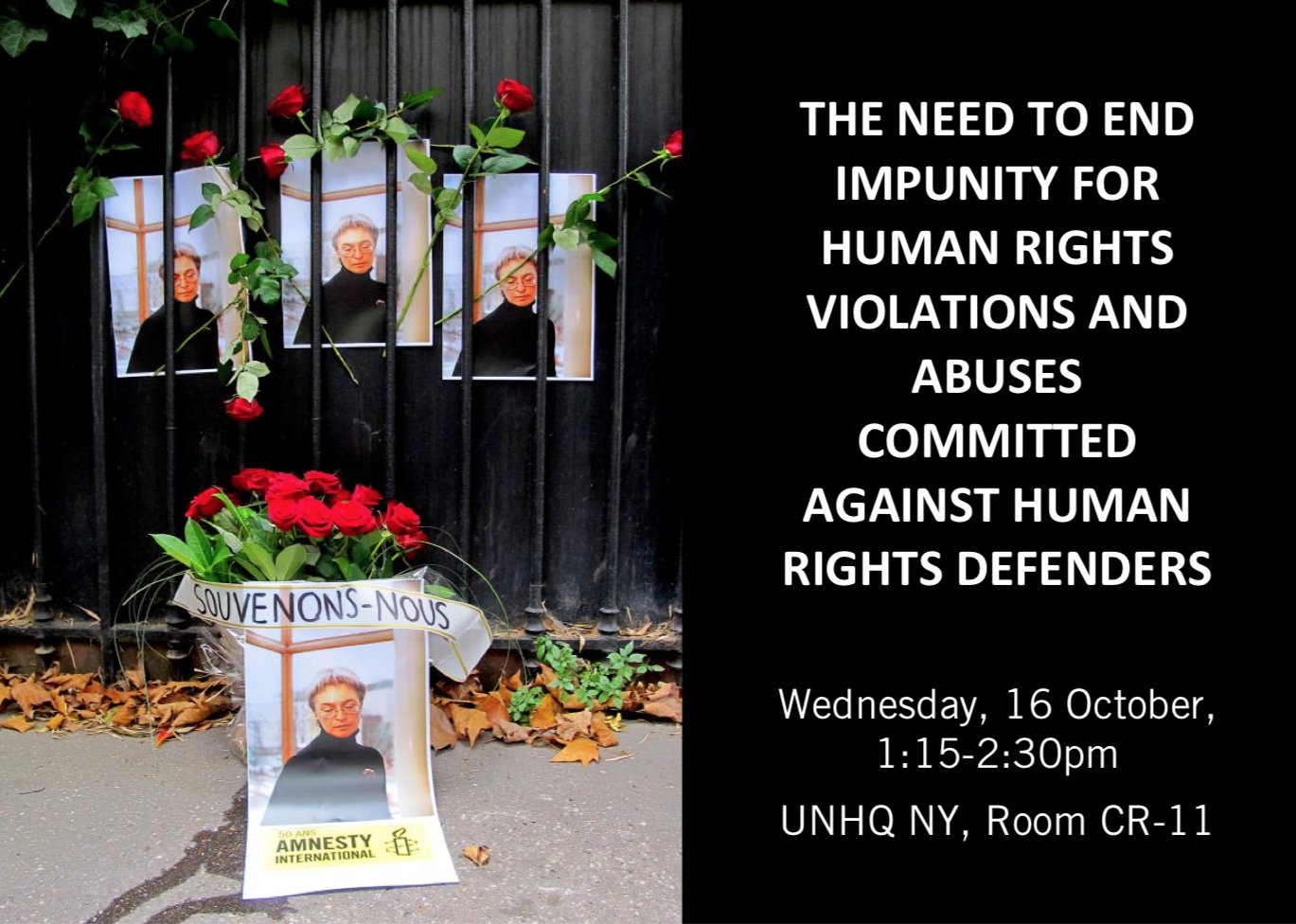
Panel against impunity for abuses against human rights defenders. New York on 16 October

October 9, 2019


Wednesday, 16 October 2019
1:15 pm – 2:30 pm
UN Headquarters, New York
Room CR-11

This event is organised by Amnesty International and the International Service for Human Rights with the kind sponsorship of the Permanent Mission of Norway to the United Nations.

Event with panellists:

  • Michel Forst, Special Rapporteur on the situation of human rights defenders
  • Radya Al-Mutawakel, Mwatana Organization for Human Rights, Yemen
  • Khin Ohmar, Progressive Voice Myanmar, Myanmar

Moderated by:

  • Sherine Tadros, Amnesty International

Welcoming remarks by:

  • Ambassador Mona Juul, Permanent Representative of Norway

Please RSVP by 11 October.

Download the flyer here

What should Michel Forst’s successor as Rapporteur on HRDs look like?

September 11, 2019
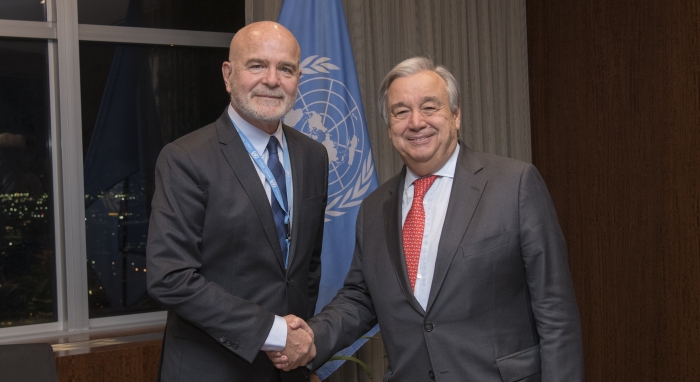
The current Special Rapporteur on human rights defenders shaking hands with the UN Secretary General
Michael Forst (l) with the UN Secretary General

An exceptionally large group of 131 national and international NGOs (for list see: http://www.ishr.ch/sites/default/files/documents/190909_criteria_jt_letter_sr_on_hrds_signatories.pdf) have set out the criteria that should be at the heart of the selection of the next UN Special Rapporteur on the situation of human rights defenders. As Michel Forst’s term as mandate holder comes to an end, candidates have until 17 October 2019 to submit their applications for the position. (If your organisation would like to endorse the criteria, please sign on here)

The document sets out the skills and expertise that should be taken into account in the appointment of the next expert in March 2020. These fit under 4 priorities:

  • qualifications and skills;
  • relevant expertise
  • established competence;
  • and flexibility/ readiness and availability

The document also provides information on the application process, and underlines the importance of independence and impartiality, as well as experience or knowledge of the realities faced by human rights defenders.

ISHR’s Programme Manager Helen Nolan stated: ‘Human rights defenders who are most at risk around the world are often persons with discriminated identities or from communities that are marginalised, so the Special Rapporteur should be able to consider the particular contexts and challenges faced by these individuals and groups with the benefit of insights from the mandate holder’s personal experience’.

The checklist is available here.

http://www.ishr.ch/news/special-procedures-what-skills-do-we-need-next-un-expert-human-rights-defenders-rapporteur

Breitbart tries its hands on the Italian migration situation

May 24, 2019

The screamng headline “Italian media has alleged that pro-migrant activists and leftist politicians are behind an attack by the United Nations on the immigration of policy of populist Italian Interior Minister Matteo Salvini.” is a give away. It is indeed from Breitbart News (24 May 2019). I will not often refer to this source but thought that it would good to see what kind of nonsense is produced and effectivley reaches a lot of people. I will let the piece below speak for itself, including the almost comical notion that UN Rapporteur Michel Forst should not work with Front Line Defedners.

For the migration defenders context in Italy see: https://humanrightsdefenders.blog/2019/05/15/european-governments-should-stop-treating-solidarity-and-compassion-as-a-crime/ and https://humanrightsdefenders.blog/2018/12/02/un-experts-consider-human-rights-defenders-in-italy-under-threat/. Read the rest of this entry »

Special Rapporteur Forst launches campaign: “TOGETHER WE DEFEND HUMAN RIGHTS”

May 8, 2019

“We all can be human rights defenders, as long as we peacefully stand up for other people or speak out against injustice or discrimination” says Michael Forst – the UN Special Rapporteur on human rights defenders – in launching his new campaign #TogetherWeDefend. The campaign promotes human rights defenders worldwide by fully recognising the good they do. 

Follow the link https://togetherwedefend.org  to find out more, subscribe and join the campaign.

For some of my earlier posts on Forst see: https://humanrightsdefenders.blog/tag/michel-forst/

Michel Forst addressed the International Civil Society Week 2019

May 3, 2019
For the International Civil Society Week (ICSW), held  in Belgrade from 8-12 April 2019,  (Special Rapporteur on human rights defenders) contributed through IPS the
following piece: “Human Rights Defenders Need to be Defended as Much as they Defend our Rights”:

They are ordinary people – mothers, fathers, sisters, sons, daughters, brothers, friends. But for me they are extraordinary people – the ones who have the courage to stand up for everyone else’s rights. They are the human rights defenders. Last year, according to reliable sources, 321 of them were killed, in 27 countries. Their murders were directly caused by the work they do to ensure the rest of us enjoy the rights we claim as purely because we are human. Countless others were tortured, raped and threatened, also for the work they do protecting their, and others’ human rights.

In fact, 2018 was deadliest year for human rights defenders since the UN began monitoring the challenges they face through the establishment of a mandate for a Special Rapporteur on the situation of human rights defenders. It shouldn’t be like this.

Last year we marked 70 years since the Universal Declaration of Human Rights and 20 since the UN Declaration on Human Rights Defenders. The latter Declaration provides for the practical support and protection of human rights defenders as they go about their work. It is addressed not just to states and to human rights defenders, but to everyone. It tells us that we all have a role to fulfil as human rights defenders and emphasises that there is a global human rights movement that involves us all. This is a task we are not performing well.

Human rights should not need defenders, and human rights defenders should not need protection from the might of oppressive governments, corrupt multinationals and crooked legal systems. But this is an imperfect, human world.

Since 2000, when we UN Special Rapporteurs on the situation of human rights defenders began our monitoring work, much progress has been made. There has been extensive discussion on how these courageous people should be protected, and there is a Protection Mechanism for Human Rights Defenders and Journalists in a limited number of countries. Sadly, it is often not properly implemented, or funded. It is impossible to canvass each defender’s particular treatment or mistreatment by the authorities they face, or even that of communities of defenders. There are, however, trends.

  • On 23 October last year, Julián Carrillo, an indigenous rights defender from Mexico’s state of Chihuahua told a friend by phone that he believed he was being watched and that he was going into hiding. On the evening of 25 October, his body was found. He had been shot several times.
  • On 22 August last year, Annaliza Dinopol Gallardo, a Filipina land rights defender known to her community as “Ate Liza”, was shot dead outside Sultan Kudarat State University in Tacurong City. She had four children.

Mr Carillo’s murder is indicative of the largest trend. More than two-thirds – a full 77% – of the total number of defenders killed were defending land, environmental or indigenous peoples’ rights, often in the context of extractive industries and state-aligned mega-projects.

Ms Gallardo’s murder represents another trend – the number of attacks on women and girls who are defenders is increasing. In the recent report that I have presented to the UN Human Rights Council I have highlighted that, in addition to the threats experienced by their male colleagues, women human rights defenders face gendered and sexualised attacks from both state and non-state actors, as well as from within their own human rights movements.

This includes smear campaigns questioning their commitment to their families; sexual assault and rape; militarised violence; and the harassment and targeting of their children.

Changing all this is our task for the future. Protection Mechanisms for Human Rights Defenders and Journalists need to be properly implemented and funded, at national level.

We need to empower defenders and increase the abilities of those who are responsible for their protection to keep them safe. We also need to improve the accountability mechanisms these officials operate under.

To properly defend the defenders, we also need to recognise their diversity, and that each one of them faces challenges particular to their individual circumstances. There is no one-size-fits-all answer to ensuring each defender is able to do their work unfettered.

We need to acknowledge that defenders, just like all of us, live in this modern, interconnected world.

Protecting them means covering all aspects of their safety: physical, psychological and digital. It means doing so with flexibility. It also means that our protection needs to extend to their families, and the groups and organisations they belong to. We need to speak to them about what they need to feel safe.

In recent years the world has taken a worrying turn away from respect for human rights. Increasingly, groups are becoming inward-looking, and nations nationalistic. We need human rights defenders now more than ever. They also need us.

See also: https://humanrightsdefenders.blog/tag/2019-international-civil-society-week/

http://www.ipsnews.net/2019/04/human-rights-defenders-need-defended-much-defend-rights/

UN Rapporteurs intervene again for Palestinian human rights defender Issa Amro

April 11, 2019

Israel must fully honour and implement the rights and obligations contained in the UN’s Declaration on human rights defenders, and in particular end the use of criminal, legal and security tools to obstruct the legitimate work of human rights defenders, say two UN rapporteurs: Michael Lynk, the special rapporteur on the situation of human rights in the Palestinian Territory and Michel Forst, the special rapporteur on the situation of human rights defenders .

Their comments come on 11 April 2019 after the latest hearing on 7 April in the case of Issa Amro, a human rights defender and founder of Youth Against Settlements, a Hebron-based group which seeks to end settlement expansion through non-violent civil resistance. “Israel must provide for the protection of human rights defenders in the context of their work and ensure that, if charged with any offence, their right to a fair trial is respected,” said the Rapporteurs “The case of Issa Amro is emblematic of the sophisticated array of obstacles faced by Palestinian human rights defenders who engage in non-violent activities.

Cracking down on individuals whose work is essential to denouncing violations and creating safe and peaceful societies, sends a troubling message that the Israeli authorities make little effort to abide by international human rights standards, including the right to a fair trial.

We are very concerned that in January 2019 Israel did not renew the mandate of the Temporary International Presence in Hebron (TIPH), an international observer force that was instrumental in efforts to avoid violence – a decision which led to a group of human rights defenders, including Issa Amro, deciding to accompany children to school.”

The UN experts also expressed deep concern about the repressive working environment faced by Palestinian human rights organisations in recent years.

See also: https://humanrightsdefenders.blog/2013/08/14/five-un-experts-urge-israel-to-stop-harassment-of-human-rights-activist-issa-amro/ and https://www.frontlinedefenders.org/en/profile/issa-amro

http://www.scoop.co.nz/stories/WO1904/S00078/israel-must-ensure-protection-for-issa-amro.htm

Indian Government accused of harassment of Amnesty and Greenpeace India

February 22, 2019

Shemin Joy, for DH News Service, New Delhi, reported on 21 February 2019 that a letter addressed by 3 UN Rapporteurs to the Indian government has now been made public as no reply was received. The letter will now be part of the report to be discussed in UN Human Rights Council as India has not responded to the charges. In the letter, the Special Rapporteurs referred to the raids and searches conducted at the offices of Amnesty International India and Greenpeace India as well as the blocking of foreign funding to these NGOs. ….concern is expressed at the alleged smear campaign against Amnesty International India, in what seems to be an attempt to tarnish the organization’s reputation in the absence of formal charges

We reaffirm our position that the ability to access foreign funding is an integral part of the right to freedom of association, and reiterate our concerns at the highly detrimental impact of the FCRA, which has been increasingly used to obstruct Indi.reiterate our concerns at the highly detrimental impact of the FCRA, which has been increasingly used to obstruct Indian civil society’s access to international funding,” they said. [see also: https://humanrightsdefenders.blog/2013/11/05/india-should-end-funding-restraints-on-human-rights-defenders-says-hrw/]

The seven-page letter was written by Special Rapporteurs David Kaye (promotion and protection of the right to freedom of opinion and expression), Clement Nyaletsossi Voule (rights to freedom of peaceful assembly and of association) and Michel Forst (situation of human rights defenders) on December 20 last year and had said that they would make public the letter after two months with or without the government’s response.

Read more at: https://www.deccanherald.com/national/smear-campaign-against-amnesty-719547.html

Latest report by Special Rapporteur on (women) human rights defenders is now available

February 17, 2019

“My report on women human rights defenders is out and will be officially presented on 28/02! All over the world women fight so human rights can be a reality for all of us. As a result, they face attacks. Leaders must recognize and protect them....”said UN Special Rapporteur on Human Rights Defenders Michel Forst on Twitter on 11 February 2019

Human Rights Council 40th session
25 February–22 March 2019 Agenda item 3

A/HRC/40/60 – Report of the Special Rapporteur on the situation of human rights defenders

Situation of women human rights defenders

Summary: In the present report, the Special Rapporteur on the situation of human rights defenders, Michel Forst, reviews the situation of women human rights defenders, covering the period since the issuance, in 2011, of the last report by the mandate holder on this topic (A/HRC/16/44 and Corr.1). He focuses in particular on the additional gendered risks and obstacles women human rights defenders face and recognizes their important role in the promotion and protection of human rights. The Special Rapporteur refers to the relevant normative framework for the work of women human rights defenders, describes the challenging environments in which they operate and analyses the impact of patriarchy and heteronormativity, gender ideology, fundamentalisms, militarization, globalization and neoliberal policies on the rights of such defenders. He also refers to the situation of specific groups of women human rights defenders.

The report contains recommendations and examples of good practices to support the building of diverse, inclusive and strong movements of women human rights defenders, and recommendations addressed to all stakeholders to ensure that women defenders are supported and strengthened to promote and protect human rights.

https://documents-dds-ny.un.org/doc/UNDOC/GEN/G19/004/97/PDF/G1900497.pdf?OpenElement

For some of my other posts on women human rights defenders see: https://humanrightsdefenders.blog/tag/women-human-rights-defenders/page/5/

Egypt denounced for reprisals against human rights defenders who talked to visiting UN delegation

December 7, 2018

On 5 December 2018, the North Africa Post reports that two United Nations rights experts have denounced the Egyptian government for its reprisals against human rights defenders who dared to talk to a visiting UN delegation that was enquiring on housing in the North African country a month ago. The reprisals included housing demolitions and arbitrary arrests, against human rights defenders and others.

Special Rapporteur on the right to housing, Leilani Farha, said she had been “shocked” by Egyptian reprisals against the Egyptian human rights defenders she met during her visit. Egypt “failed to adhere” to the assurances it provided to her, that “no person would be harassed, intimidated or subjected to reprisal for meeting or providing information” to her – or others in her official delegation, a UN press release said on Tuesday.

I am shocked that after my mission a number of families from two communities I visited have suffered forced eviction contrary to international human rights law,” she was quoted as saying in the press release. According to the Special Rapporteur, several multi-storey houses have been demolished, furniture thrown into the street, and residents made homeless. Reportedly, adequate notice was not provided to victims, or any compensation, or new accommodation. Excessive force was also allegedly used by security forces against residents when they refused to leave their homes.

Among those targeted were several houses and apartments belonging to family members of community leaders with whom I met while I was on official mission,” said Ms. Farha.

Also voicing concern over the reprisals, Michel Forst, the UN Special Rapporteur on human rights defenders said that the alleged incidents represented a worrying pattern against individuals and communities directly related to Ms. Farha’s visit. [see also: https://humanrightsdefenders.blog/2018/11/06/19-missing-human-rights-defenders-in-egypt/]

Human rights defenders and lawyers working on the right to housing also reported that they have been followed and photographed by persons unknown to them, to have received anonymous and threatening phone calls, or have been summoned to report at police offices for interrogation,” he said, adding that one lawyer Ms. Farha had met, was subsequently slapped with a travel ban. In early November, the two human rights experts raised their concerns and sought clarification regarding the alleged forced evictions and reprisals with the Egyptian Government. They have not yet received an official reply, the UN press release said.

For some of my earlier posts on reprisals: https://humanrightsdefenders.blog/tag/reprisals/

http://northafricapost.com/26594-egypt-forced-evictions-other-reprisals-slap-human-rights-defenders-un-expert.html