Posts Tagged ‘medical treatment’

NGOs call for the release of Mohammed al-Qahtani, detained incommunicado for six months in Saudi Arabia

May 25, 2023

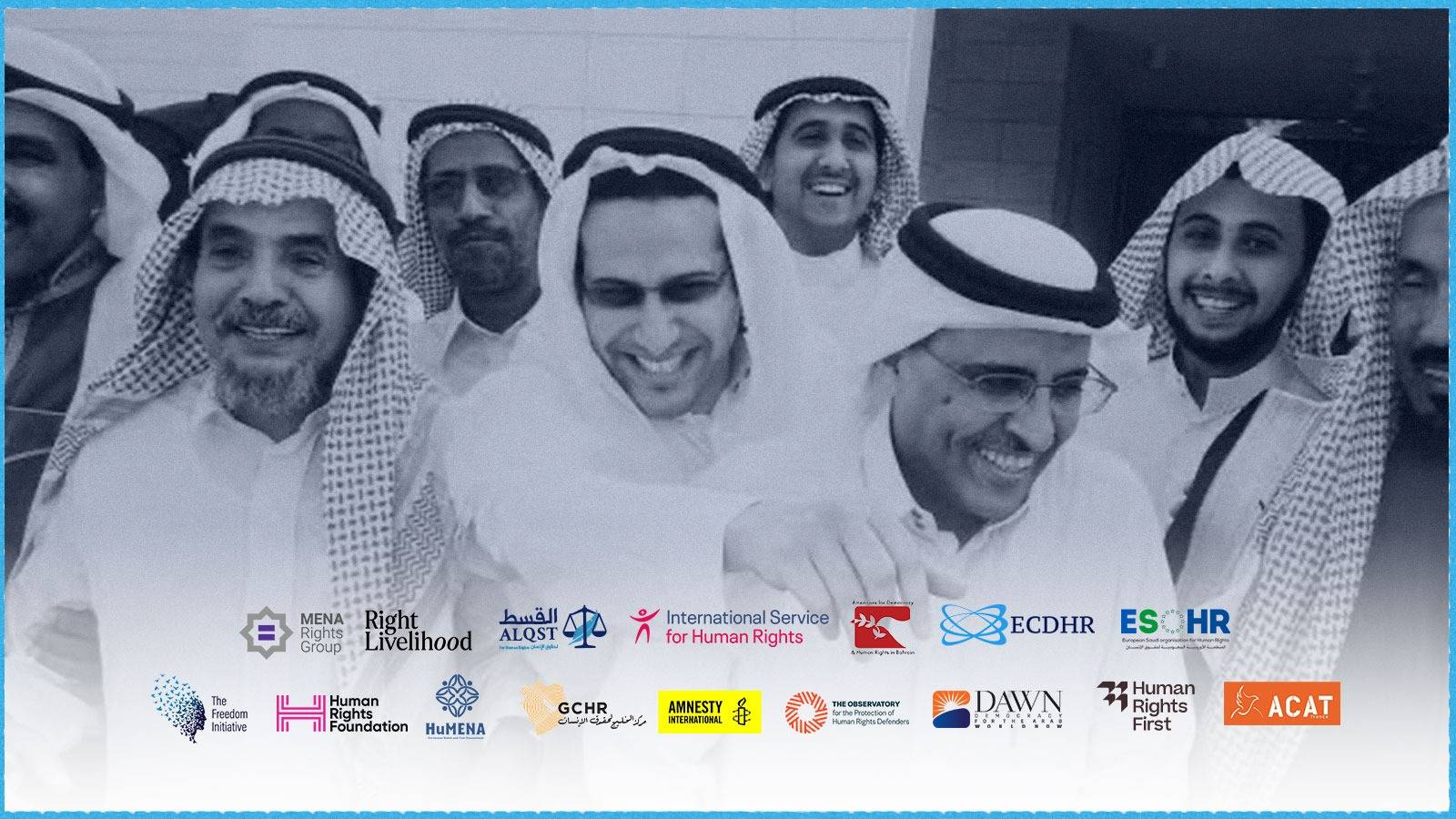
We, the undersigned human rights organisations, call on Saudi authorities to reveal the health condition  of and immediately and unconditionally release prominent Saudi human rights defender and co-founder of the now dissolved Saudi Civil and Political Rights Association (ACPRA)*, Dr. Mohammed al-Qahtani, who has been detained incommunicado for six months. We also call for the immediate and unconditional release of four ACPRA members who remain in arbitrary detention.

Today, 24 April 2023, marks six months since prominent Saudi human rights defender and co-founder of the Saudi Civil and Political Rights Association (ACPRA)* Mohammed al-Qahtani last contacted his family. Since then, the authorities have subjected him to incommunicado detention. Al-Qahtani served his full sentence in November 2022. Five ACPRA members remain imprisoned in reprisal for their peaceful human rights activism: Mohammed al-Qahtani, Essa al-Hamid, Mohammed al-Bajadi, Fawzan al-Harbi, and Abdulaziz al-Shubaili.

Mohammed al-Qahtani was arbitrarily arrested in March 2012 and interrogated regarding his work with ACPRA and his peaceful activism. On 9 March 2013, the Criminal Court in Riyadh sentenced him to 10 years in prison to be followed by a travel ban of equal length on charges including “breaking allegiance to the ruler”, “questioning the integrity of officials”, “seeking to disrupt security and inciting disorder by calling for demonstrations”, and “instigating international organizations against the Kingdom.” The authorities failed to release Al-Qahtani  on 22 November 2022, when he finished serving his prison sentence. However, since 24 October 2022, Saudi authorities have denied him any contact with his family and continue to keep him in incommunicado detention. 

Despite al-Qahtani’s wife making several inquiries about him to al-Ha’ir prison, where al-Qahtani was serving his sentence, prison officers continue to refuse to disclose any information about him. His family has reasons to believe that he has entered into a hunger strike and his health has considerably deteriorated, putting his life at imminent risk. This is not the first time Mohammed al-Qahtani was denied contact with his family. In April 2021, he was held incommunicado after testing positive for Covid-19, raising fears regarding his health and well-being for the duration of his illness. For the past 10 years of imprisonment, security forces  subjected al-Qahtani to inhumane and degrading conditions of detention, and they have also subjected him to torture and ill-treatment, including beatings.

We are all the more concerned about -al-Qahtani’s well-being considering the death of ACPRA co-founder Abdullah al-Hamid in detention on 23 April 2020. Abdullah al-Hamid suffered from hypertension, and his doctor told him three months before he passed away that he needed to undergo heart surgery. He was threatened by prison authorities that if he told his family about his health condition, they would cut his communication with his family. Dr Abdullah al-Hamid had suffered a stroke on 9 April 2020 and remained in detention, despite being in a coma in the intensive care unit at al-Shumaisi Hospital in Riyadh.

Following al-Hamid’s death, the Saudi authorities carried out a wave of arrests against several individuals who expressed sympathy over his passing.

Created in 2009 by 11 human rights defenders and academics, ACPRA was established to promote and protect fundamental rights and freedoms in Saudi Arabia, including through promoting constitutional reforms. While ACPRA was never officially registered by the government, it was formally banned as an organization and dissolved by court order in 2013. As of May 2016, all of its 11 members had been sentenced by the Specialized Criminal Court (SCC) to lengthy prison sentences ranging between seven and 15 years for their human rights activism and cooperation with the United Nations human rights mechanisms.

In light of the above, we, the undersigned organisations, reiterate our call on the Saudi authorities to immediately and unconditionally release Mohammed al-Qahtani and other imprisoned members of ACPRA who are arbitrarily detained solely for their peaceful activism. In the interim, we call on the authorities to disclose the fate and whereabouts of Mohammed al-Qahtani, ensure immediate contact with his family, and provide him with any medical care he may need. Saudi Arabia should ensure a free and enabling environment for all human rights defenders, in order for them to carry out their activities without fear of reprisals and without undue restrictions.See also: https://www.trueheroesfilms.org/thedigest/laureates/78383825-0b3f-4bca-883a-b81e1baecd09

Among the co-founding members of ACPRA, five remain imprisoned today: Dr Mohammed al-Qahtani (sentenced to 10 years in prison followed by a 10-year travel ban. He completed his sentence in November 2022, yet remains in detention incommunicado); Mohammed al-Bajadi (sentenced to four years in prison, four years of suspension followed by a 10-year travel ban, and currently detained since May 2018); Abdulaziz al-Shubaili (sentenced to eight years in prison followed by an eight-year travel ban); Fowzan al-Harbi (sentenced to 10 years in prison followed by a 10-year travel ban); Essa al-Hamid (sentenced to 11 years in prison, followed by an 11-year travel ban). Sheikh Sulaiman al-Rashudi (sentenced to 15 years in prison and a 15-year travel ban. He was released in April 2018 for medical reasons; Abdulkarim al-Khodr (sentenced to 10 years in prison, followed by a 10-year travel ban. He was released in January 2023 upon the completion of his sentence but remains subject to the travel ban);  Abdulrahman al-Hamid sentenced to 9 years in prison, followed by a 9-year travel ban. He was released in January 2023 upon the completion of his sentence but remains subject to a travel ban); Dr Abdullah al-Hamid (sentenced to 11 years in prison followed by an 11-year travel ban), passed away on 23 April 2020 in custody. Abdullah al-Hamid and Mohammed al-Qahtani, alongside Waleed Abu al-Khair, have received the Right Livelihood Award in November 2018.

Signatories:

  • MENA Rights Group
  • Right Livelihood
  • ALQST
  • International Service for Human Rights (ISHR)
  • Americans for Democracy & Human Rights in Bahrain (ADHRB)
  • European Center for Democracy and Human Rights (ECDHR)
  • European Saudi Organization for Human Rights (ESOHR)
  • Freedom Initiative
  • Human Rights Foundation (HRF)
  • HuMENA for Human Rights and Civic Engagement
  • Gulf Centre for Human Rights (GCHR)
  • Amnesty International
  • International Federation for Human Rights (FIDH), in the framework of the Observatory for the Protection of Human Rights Defenders
  • World Organisation Against Torture (OMCT), in the framework of the Observatory for the Protection of Human Rights Defenders
  • Democracy for the Arab World Now (DAWN)
  • Human Rights First
  • Action des Chrétiens pour l’abolition de la torture (ACAT France)

See the full Joint Statement here.
NGOs demand adequate medical treatment and access to Abdulhadi Al-Khawaja in Bahrain

May 25, 2023

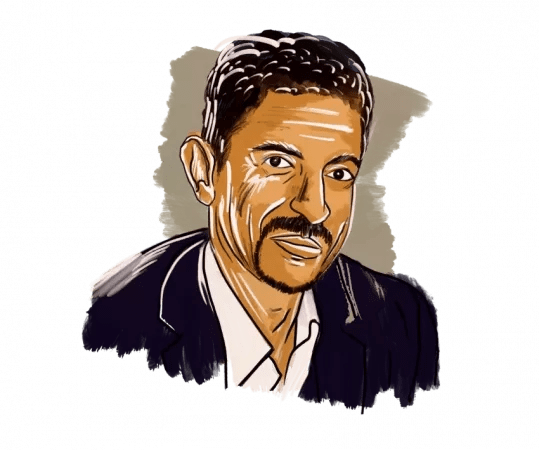
14 NGOs call on Bahrain to ensure that human rights defender Abdulhadi Al-Khawaja is allowed adequate medical treatment, as well as the right to access and respond to allegations made by the Government of Bahrain in a response to a UN communication.

In a joint communication made public on 4 May 2023, six UN experts – including the Special Rapporteur on the situation of human rights defenders, Mary Lawlor, and the Vice-Chair of the Working Group on Arbitrary Detention, Mumba Malila – expressed their utmost concern at the continued arbitrary detention of human rights defender Mr. Al-Khawaja. He is a widely recognised HRD, see: https://www.trueheroesfilms.org/thedigest/laureates/4d45e316-c636-4d02-852d-7bfc2b08b78d

The UN communication addresses troubling allegations of torture, ill treatment and poor prison conditions of Mr. Al-Khawaja, including intimidation, restriction of communication with family, deprivation of basic rights, including his inability to give power of attorney to his lawyer in court, as required, shackling of hands, despite doctors’ orders to the contrary, as well as fabrication of cases against him and other political prisoners in Bahrain.

The UN communication was sent to the Government of Bahrain on 17 February 2023 and remained confidential for 60 days, as is UN protocol. The Government of Bahrain replied to the six UN experts on 17 April 2023, which was recently translated and made publicly available.

The Government of Bahrain’s response denies that Mr. Al-Khawaja has been subject to torture. This is contradicted by findings from the Bahrain Independent Commission of Inquiry (BICI), which was established by the King of Bahrain and medically documented that Al-Khawaja was subjected to torture and sexually assaulted by security forces in 2011. Furthermore, the Government of Bahrain’s response fails to adequately recognize Mr. Al-Khawaja as a human rights defender or acknowledge the arbitrary nature of his detention.

On more than one occasion, Mr. Al-Khawaja attempted to receive information over the phone about the nature of the UN communication, including the Government of Bahrain’s response, but the calls were systematically cut by the authorities. Therefore, Mr. Al-Khawaja officially requested through his lawyer that he be allowed a hard copy of the mentioned documents. The signatories call on Bahrain to ensure that the request is honored.

In addition, Mr. Al-Khawaja has continued to be repeatedly denied access to a cardiologist, as well as other appointments with relevant doctors, despite being at risk of a heart attack or stroke at any time. As recently as the past two weeks, Mr. Al-Khawaja was denied two medical appointments, the most recent being on Thursday 11 May 2023.

Since 9 May 2023, Mr. Al-Khawaja has protested in the yard of Jaw Prison on a daily basis holding up two signs in front of the CCTV cameras stating “Treatment prevention is slow systematic killing” and “You commit torture and prevent treatment” in order for him and his fellow prisoners of conscience to be allowed his necessary medical appointments. He informed his family on 14 May 2023 that he has suspended his protest temporarily due to promises made by the prison administration to improve conditions and allow access to adequate treatment.

The signatories call on the Government of Bahrain to:

  1. Immediately and unconditionally release human rights defender Abdulhadi Al-Khawaja, as well as all other prisoners of conscience.
  2. Ensure that Abdulhadi Al-Khawaja is taken to the necessary medical appointments for diagnostics and treatment.
  3. Ensure that Abdulhadi Al-Khawaja obtains the requested documents related to the UN communication and that he is allowed a written response.

Signatories:

  • The #FreeAlKhawaja Campaign
  • Gulf Centre for Human Rights (GCHR)
  • Americans for Democracy & Human Rights in Bahrain (ADHRB)
  • European Center for Democracy and Human Rights (ECDHR)
  • CIVICUS
  • Global Citizen
  • Rafto Foundation for Human Rights
  • Danish PEN
  • The Martin Ennals Foundation
  • IFEX
  • Bahrain Institute for Rights and Democracy (BIRD)
  • Front Line Defenders
  • DIGNITY – Danish Institute Against Torture
  • Freedom House

Iranian dissident Poet Baktash Abtin dies of Covid in arbitrary detention

January 10, 2022

On 8 January 2022 the Iranian poet Baktash Abtin died in Tehran after contracting COVID-19 in Evin Prison. Abtin, who died after being put into an induced coma while hospitalized, is the second known political prisoner to die in Iran in the first week of 2022. On January 1, Kian Adelpour died after going on hunger strike to protest being imprisoned without a fair trial.

This is a preventable tragedy and more prisoners’ deaths are inevitable because there is no accountability in the Iranian government,” said Hadi Ghaemi, executive director of the Center for Human Rights in Iran (CHRI). “Abtin was imprisoned in Iran because the government wanted to muzzle him with a jail cell; the state killed him.” Abtin had been serving a five-year prison sentence on the charge of “assembly and collusion against national security.

A group of main NGOs had addressed a joint letter to Ayatollah Ali Hosseini Khamenei on 7 January repeating their call that Abtin be given access to the best possible medical care as he battles for his life. In addition, we urge that: he and all those unjustly detained for their writing or expression be immediately and unconditionally released; that authorities refrain from summoning political prisoners to serve their sentences while the conditions inside Evin and other Iranian prisons remain unsafe; and that any who do contract COVID-19 or other serious illnesses while in jail be granted speedy access to all needed medical care or a medical parole on humanitarian grounds.

While offering condolences to Abtin’s family and friends, the Iranian Writers Association (IWA) where Abtin, 48, was a board member, released a statement on January 8 on the “injustice that was committed against Abtin”: “Baktash Abtin is alive because the spirit of freedom-seeking and the fight against tyranny and injustice is alive,” said the statement.

Fellow IWA board member Reza Khandan Mahabadi was also sentenced to five years in prison and Keyvan Bajan to three years and six months. An international chorus has condemned the IWA writers’ imprisonment, with dozens of high-profile writers and artistic figures including Nobel laureates calling for the writers’ acquittal.

At least 11 writers are known to be either currently imprisoned or living with an unserved prison sentence hanging over their heads in Iran as they await an appeal or to be summoned to jail, according to a list compiled by CHRI.

In an interview with CHRI in May 2019 after his trial, Abtin forcefully said the charge of “assembly and collusion against national security” was for statements published by the IWA, articles in the organization’s internal newsletter, and holding memorial ceremonies for IWA members Mohammad Mokhtari and Mohammad Jafar Pouyandeh, who were murdered in 1998 as part of a concerted state policy to eliminate political and cultural dissidents inside and outside of Iran.

“Nowhere in the world is it necessary to get a permit to gather around someone’s grave,” Abtin told CHRI. “But that’s what we’ve been charged with.”

https://www.hrw.org/news/2022/01/07/joint-ngo-letter-khamenei-baktash-abtins-condition

Father Stan’s death: callousness that amounts to murder

July 5, 2021

What many feared has happened, jailed Indian tribal rights activist Stan Swamy has died of a cardiac arrest in Mumbai city. He was 84. He was jailed last year under draconian anti-terror law UAPA in connection with the Elgar Parishad case – his death has triggered a flood of messages on social media from political leaders, intellectuals and other activists. Swamy, the oldest person to be accused of terrorism in India, was arrested in October 2020.

Members of the civil society on Sunday 4 July 2021 had urged the chief justice of the Bombay High Court to intervene and provide relief to ailing activist Stan Swamy. They demanded that the 84-year-old, who suffers from Parkinson’s disease and had been put on ventilator support, should be granted bail immediately and allowed to return to Jharkhand.

Mary Lawlor, Special Rapporteur on Human Rights Defenders shared a similar Tweet, saying it was “horrible news” that Swamy was put on a ventilator: “He’s spent 9 months in jail on unfounded charges. I’m deeply saddened and expect that every possible specialist treatment will be provided to him.”

Mr Gilmore – the European Union’s Special Representative for Human Rights, – re-tweeted Ms Lawlor’s post and added: “India: I am very saddened to hear that Father Stan Swamy has passed away. A defender of indigenous peoples’ rights. He was held in detention for the past 9 months. The EU had been raising his case repeatedly with authorities.”

The Jesuit priest, who suffered from Parkinson’s disease, was moved to a private hospital in May after he tested positive for Covid. As he was very belatedly released on bail into hospital and was denied critical treatment in detention, he should be considered a death in the custody of the state.

Jharkhand Chief Minister Hemant Soren stated on Monday: Shocked to learn about the demise of Father Stan Swamy. He dedicated his life working for tribal rights. I had strongly opposed his arrest & incarceration. The Union Govt should be answerable for absolute apathy & non provision of timely medical services, leading to his death.

See also: https://humanrightsdefenders.blog/2020/10/11/the-indomitable-father-stan-swamy-defending-the-adivasis-and-the-dalits-a-cause-of-arrest/

I understand there will be likely a virtual memorial tomorrow, but no details known yet.

A joint statement by important international NGOs (Amnesty International, CIVICUS: World Alliance for Citizen Participation, CSW, FIDH, in the framework of the Observatory for the Protection of Human Rights Defenders, Front Line Defenders, International Commission of Jurists, International Dalit Solidarity Network, World Organisation Against Torture (OMCT), in the framework of the Observatory for the Protection of Human Rights Defenders)) was issued on 5 July: https://www.fidh.org/en/region/asia/india/india-joint-statement-on-the-death-of-human-rights-defender-father

The Government keeps insisting that all was ‘legal’: https://www.mangalorean.com/govt-rebuts-un-says-stan-swamys-detention-was-lawful/

On 25 November 2021 this: https://thewire.in/rights/bombay-hc-asks-jesuit-group-to-file-new-plea-if-they-want-stan-swamys-name-cleared

https://www.bbc.com/news/world-asia-india-57718356

https://scroll.in/latest/999322/as-activist-stan-swamys-heath-worsens-civil-society-members-call-for-bail-specialised-treatment

https://www.outlookindia.com/website/story/india-news-stan-swamys-death-marks-a-tragic-moment-for-indian-democracy-akhil-gogoi/387163

https://www.ndtv.com/india-news/elgar-parishad-case-stan-swamys-death-devastating-eu-un-human-rights-reps-on-stan-swamys-death-2479792

https://www.hindustantimes.com/india-news/activists-opposition-call-out-custodial-murder-of-stan-swamy-101625494111357-amp.html

https://www.fidh.org/en/region/asia/india/india-joint-statement-on-the-death-of-human-rights-defender-father

https://www.indialegallive.com/column-news/stan-swamy-uapa-unlawful-activities-prevention-act-kanchan-nanaware-varavara-rao-binayak-sen/

https://www.miragenews.com/death-in-custody-of-priest-stan-swamy-is-596431/

https://www.ucanews.com/news/book-tells-story-of-indian-jesuit-who-died-in-custody/94104#

Medical negligence in Egypt’s prisons alarming: another victim

September 4, 2020
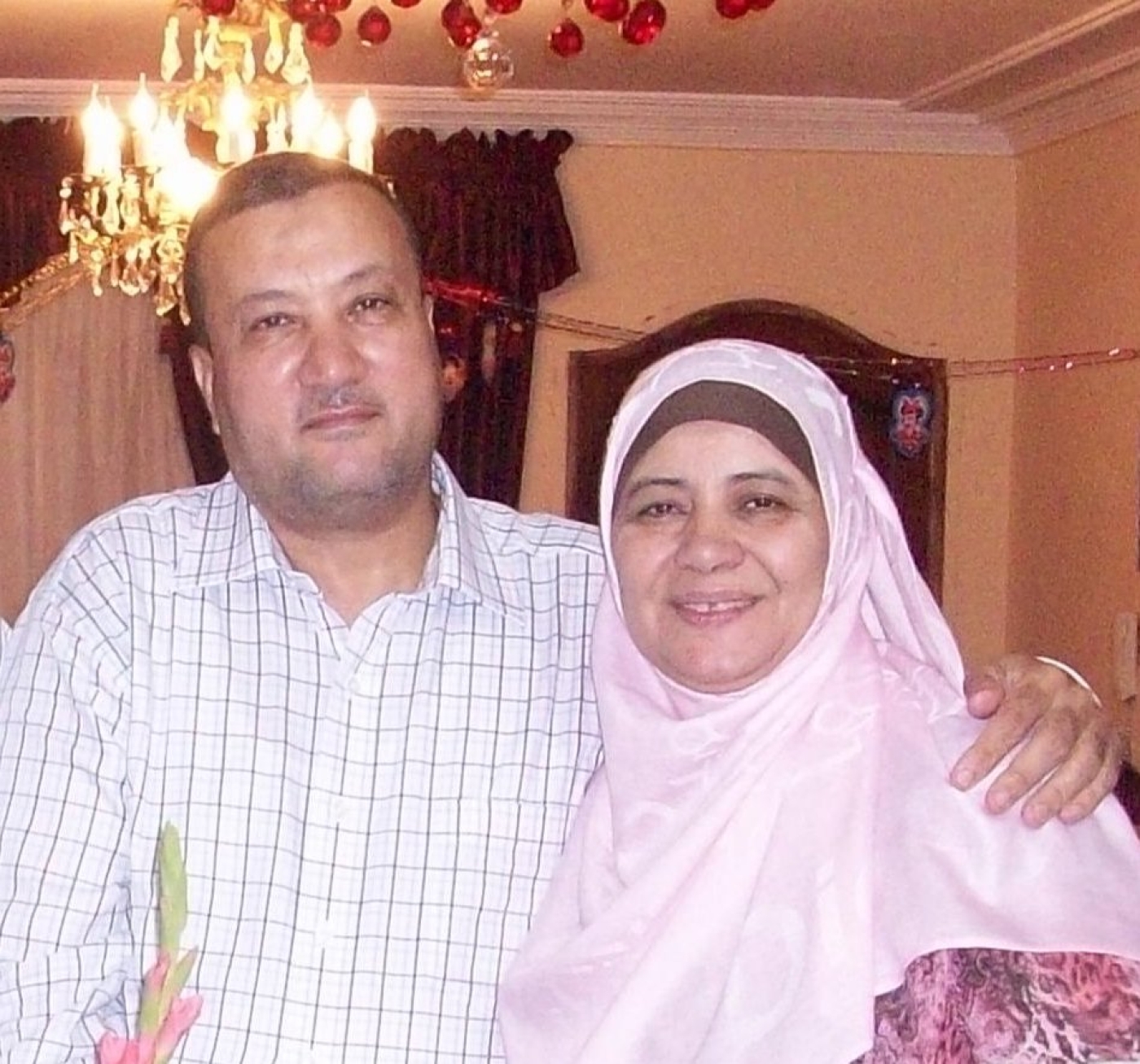
Ahmed Abdrabbu (L) and his wife
Ahmed Abdrabbu, left, and wife were arrested at Cairo International Airport on 23 December 2018 (Twitter/@nosaybaahmed)
On 2 September 2020 the Middle East Eye reported that – according to the Committee for Justice (CFJ )- Egyptian human rights defender Ahmed Abdrabbu became the latest of some 1,000 prisoners to die amid medical negligence since Abdel Fattah el-Sisi assumed presidency.

The Tora prison, also known as “the Scorpion“, has been repeatedly denounced by rights groups and described as “degrading” by Human Rights Watch. “Authorities there have denied inmates contact with their families or lawyers for months at a time, held them in degrading conditions without beds, mattresses or basic hygienic items, humiliated, beaten, and confined them for weeks in cramped ‘discipline’ cells – treatment that probably amounted to torture in some cases,” HRW said in a report in 2016.

According to Abdrabbu’s family, the publisher was arrested on 23 December 2018 at Cairo International Airport and was later charged with “membership in a terrorist organisation” and working to “undermine the constitution”, accusations commonly used by Egyptian authorities against opponents of the government of President Abdel Fattah el-Sisi. His wife, who was with him at the time, was released in June 2019 and is currently serving parole, his daughter Nusaiba wrote on Twitter.

According to Mehreh’s CFJ, which tracks deaths in Egyptian prisons, including those as a result of Covid-19, almost 1,000 prisoners have died in custody since July 2013. The majority of those deaths were because of medical negligence, Mefreh told MEE. In its biannual report, CFJ documented the deaths of 51 prisoners as a result of denial of medical care in detention facilities during the first half of 2020, including 17 people who died of Covid-19. Those whose deaths were attributed to medical negligence in recent years include former President Mohamed Morsi, Egyptian-American prisoner Mustafa Kassem, film director Shadi Habash, and former Muslim Brotherhood MP Essam El-Erian. [see also: https://humanrightsdefenders.blog/2020/05/02/filmmaker-and-human-rights-defender-shady-habash-dies-in-egyptian-pre-trial-detention/]

See also: https://humanrightsdefenders.blog/2020/08/07/update-to-monas-campaign-for-her-sister/

https://www.middleeasteye.net/news/egypt-political-prisoner-father-american-citizen-dies-jail

UN Rapporteurs concerned about detention of Miyan Abdul Qayoom of Kashmir Bar Association

April 28, 2020

Qayoom, who is also a human rights lawyer, was arrested on the night of 4 and 5 August during the clamp down. Qayoom was accused of being a “most staunch advocate of secessionist ideology”. [see also: https://humanrightsdefenders.blog/2020/02/09/forgotten-kashmir-something-has-to-be-done/]

Dated 27 February 2020, the UN has released the letter after 2 months. Qayoom was moved to Agra Central Jail, Uttar Pradesh, on 8 August and was kept in solitary confinement, as per the letter, adding that he is suffering from multiple health issues — including a scheduled open heart surgery at the time of his detention. On 29 January, the letter states, Qayoom suffered a heart attack. Next day, he was taken back to the jail’s dispensary. On 1 February 2020, he was transferred from Agra Central Jail to the All India Institute of Medical Science (AIIMS) in New Delhi, for a medical check-up. “He was then transferred to Tihar Jail, New Delhi,” the letter added.

The Special Rapporteurs also claimed in the letter that Qayoom is being denied “the right to a fair trial… and the right of everyone to hold opinions and to freedom of expression.”

We also express concern that Mr. Qayoom’s deprivation of liberty appears to be a reprisal for his opinions, the legitimate and peaceful exercise of his freedom to express them and his human rights work,” the letter added, citing various previous cases and relevant articles of ICCPR that entitles anyone who is deprived of liberty by arrest or detention to take proceedings before a court. “Arrest or detention as punishment for the legitimate exercise of other rights, as guaranteed by the ICCPR, is arbitrary, including the right to freedom of opinion and expression,” it mentioned.

The Special Rapporteurs stated:

“Please provide detailed information about the factual and legal grounds for the arrest and detention of Mr. Qayoom, including the charges brought against him. Please explain how his arrest and continued detention are in conformity with India’s international human rights obligations under the conventions it has acceded to.

Please provide detailed information on the treatment by the court of the habeas corpus petition initiated by Mr. Qayoom. Please explain how the absence of a decision on his petition more than six months after it was made is compatible with the requirement that the lawfulness of his detention’s petitioner is adjudicated as expeditiously as possible, and with India’s obligations under ICCPR.

Please provide detailed information on the present medical situation of Mr. Qayoom and explain how his medical concerns have been duly taken into account and addressed since he was arrested and placed in detention. Please explain what measures are being taken to ensure Mr. Qayoom’s access to appropriate medical care on a reliable and regular basis.

Please indicate what measures have been taken to ensure that human rights defenders in India are able to carry out their legitimate work in a safe and enabling environment without fear of threats or acts of intimidation and harassment of any sort.

Please provide detailed information, included disaggregated data to the extent possible, as to the number of persons from Jammu and Kashmir who have been detained under the Public Security Act since August 2019.”

https://thekashmirwalla.com/2020/04/un-special-rapporteurs-express-concern-over-detention-of-bar-president-mian-qayoom/

80 Media and Human Rights groups urge African Heads of State to release jailed journalists amid pandemic

April 9, 2020

On 9 April 2020, the Committee to Protect Journalists (CPJ) and 80 other media and human rights NGOs have urged ten African Heads of State to release journalists from detention in the context of the COVID-19 pandemic.

To:

President of Algeria Abdelmadjid Tebboune
President of Benin Patrice Talon
President of Burundi Pierre Nkurunziza
President of Cameroon Paul Biya
President of Chad Idriss Deby
President of Egypt Abdel Fattah el-Sisi
President of Eritrea Isaias Afwerki
Prime Minister of Ethiopia Abiy Ahmed Ali
Prime Minister of Morocco Saad-Eddine El Othmani
President of Rwanda Paul Kagame

Your Excellencies,

We the 81 undersigned media, press freedom, and human rights organizations are writing to call on your respective governments to release all jailed journalists amid the sweeping COVID-19 pandemic. Last week, the Committee to Protect Journalists published an open letter to world leaders urging the immediate release of all journalists imprisoned for their work. Given that a staggering number of these imprisoned journalists are held in jails across the African continent, we are reiterating that call to your respective countries at this time of grave public health concern.

According to CPJ’s most recent annual survey conducted on December 1, 2019, there were at least 73 journalists in prisons in Africa, including 26 in Egypt, 16 in Eritrea, seven in Cameroon, four each in RwandaBurundi, and Morocco, three in Algeria, and one each in BeninNigeriaChadTanzaniaEthiopiaSomaliaComorosDemocratic Republic of the Congo, and South Sudan.

As of March 31, at least 11 of these journalists have been released from jails in Somalia, Ethiopia, Tanzania, Nigeria, DRC, Algeria, Comoros, South Sudan, and Egypt, according to CPJ research. However, at least six more journalists and media workers have been jailed since December 1, and remain in prison as of March 31, including four inEthiopia and one each in Cameroon and Algeria.

Article 16 of the African Charter on Human and Peoples’ Rights states, “Every individual shall have the right to enjoy the best attainable state of physical and mental health.” These rights were extended to prisoners and detainees when the African Commission adopted the 1995 Resolution on Prisons in Africa. According to the World Health Organization, “People deprived of their liberty, and those living or working in enclosed environments in their close proximity, are likely to be more vulnerable to the COVID-19 disease than the general population.”

For journalists jailed in countries affected by the virus, freedom is now a matter of life and death. Imprisoned journalists have no control over their surroundings, cannot choose to isolate, and are often denied necessary medical care. Many of these journalists have been held in detention without trial for lengthy periods and are suffering from ill health exacerbated by underlying health conditions and overcrowded prisons, where they have contracted malaria, tuberculosis, and other diseases.

We urge you to release every jailed journalist in your respective countries and to protect the free press and the free flow of information at this crucial time. Journalism must not carry a death sentence.

Sincerely,

(for names of signing organisations see link below)

See also: https://humanrightsdefenders.blog/2020/03/20/corona-virus-threatens-human-rights-defenders-in-detention-egypt-and-turkey/

European Court rules on Sergei Magnitsky’s death

August 29, 2019

NGOs ask EU to intervene for human rights defender Azimjon Askarov in Kyrgyzstan

July 10, 2019

On 11 June 2019 NGOs wrote a joint Letter to High Representative Mogherini regarding detained Human Rights Defender Azimjon Askarov in Kyrgyzstan. His is a wellknown case, see e.g.: https://humanrightsdefenders.blog/2015/07/23/fury-about-us-award-for-askarov-in-kyrgyzstan-backlash-or-impact/

Breaking: Liu Xiaobo released from Chinese prison with late-stage cancer

June 26, 2017

China’s best-known human rights defender and Nobel peace prize winner Liu Xiaobo, has been released on medical parole after he was diagnosed with terminal liver cancer. Liu, 61, is in the late stages of the disease. Apparently he was diagnosed in May already but no announcement was made then. China has experience with such late intervention, see: https://humanrightsdefenders.blog/2016/03/15/remember-2nd-anniversary-of-the-death-of-cao-shunli/

[Liu was arrested in 2008 after penning a pro-democracy manifesto called Charter 08, where he called for an end to one-party rule and improvements in human rights. Following a year in detention and a two-hour trial, he was sentenced in December 2009 to 11 years in prison for inciting subversion of state power. Little has been heard from him since. When he was awarded the Nobel peace prize in 2010 he was represented by an empty chair.]

Liu Xia, his wife, has been under house arrest since her husband won and has reportedly suffered from depression due to her isolation.

Source: Nobel laureate Liu Xiaobo released from Chinese prison with late-stage cancer | World news | The Guardian

https://humanrightsdefenders.blog/2012/12/06/china-and-its-amazing-sensitivity-on-human-rights-defenders/