Posts Tagged ‘Mary Lawlor’

25 Years Tiananmen ‘celebrated’ with over 100 detentions

June 13, 2014

(A map of all individuals detained in the wake of the Tiananmen anniversary. Some of these persons have already been released. Photo: CHRD)

Yesterday China Human Rights Defenders has released a list of over 100 activists, journalists, lawyers, dissidents and other assorted individuals who are thought to have been detained by the government in the wake of the 25th anniversary of the 1989 Tiananmen Square protests. As of June 11, 116 individuals from various parts of China, including Beijing, Shanghai, Sichuan, Xinjiang and Guangdong are all listed, with an estimated 49 criminal detentions and two confirmed arrests. Many who were not detained were invited by local authorities to “drink tea” – a veiled phrase for questioning – and were warned to avoid participating in any anniversary activities. Chief among the detainees is veteran human rights lawyer Pu Zhiqiang, who was placed in criminal detention on May 6 under charges of “picking quarrels and provoking trouble” after he attended a May 3 Tiananmen commemoration.

(Pu Zhiqiang. Photo: Reuters)

Pu was … a student lawyer in the 1989 protests, [and he] became a prominent human rights lawyer and advocate, taking up some of the most politically sensitive rights-defending cases,” said David Zhao, researcher and representative for CHRD. “He [has made] earlier remarks that he is still ‘deeply emotionally tied to [Tiananmen]’ and has ‘no regrets over his involvements’.”


(Yu Shiwen (left) and Chen Wei (right). Photo: Screenshot via RFA)

Other persons on CHRD’s list include Wang Xiuying, an 83-year-old activist who had her home searched by Beijing police after signing a Tiananmen commemoration petition, Chen Wei and Yu Shiwen, an activist couple who organised Tiananmen memorial services, and Wu Wei, a former South China Morning Post journalist in Beijing who interviewed Pu Zhiqiang in the past. “The clampdown on commemorative events this year is the most severe of all years and this reflects the [government’s] determination to wipe out the memory of Tiananmen,” Zhao said.

View CHRD’s list in full here.

via http://www.scmp.com/news/china-insider/article/1530899/human-rights-group-releases-list-over-100-people-detained-during

A few days earlier, 6 June, Mary Lawlor of Front Line wrote a thoughtful piece on the same issue stating that it “would be fitting that the 25th anniversary of the  Square massacre be marked by a renewed international effort to provide greater support to Chinese human rights defenders.

China-Tiananmen-Square

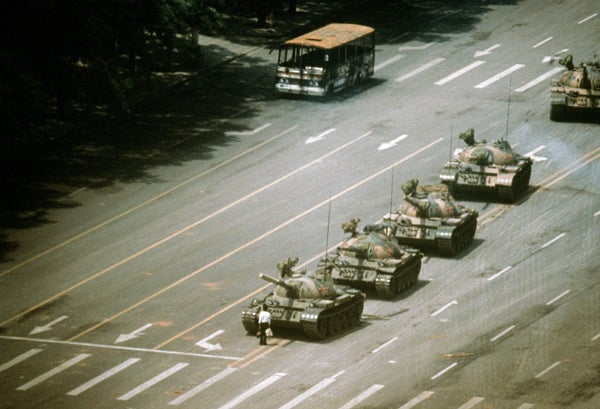
Human rights defenders (HRDs) currently working in China are frequently seen as challenging the Party and as such must be prepared to risk everything, including death, to continue their work. Although the Party’s methods may have changed in the past quarter of a century, its intention to crush dissent at any cost has not. On 3/4 June 1989 hundreds of peaceful demonstrators were killed in the approach roads to Tiananmen Square in Beijing, bringing an end to seven weeks of protests which had drawn up to a million people onto the streets. What started off as a student protest in the capital calling for political reform quickly morphed into a mass movement supported by broad cross-sections of society which spread to dozens of other cities throughout the country.

The legacy of these protests and the massacre that followed is still keenly felt by HRDs in today’s China. The events of 1989 remain a key touchstone to many Chinese HRDs and as the CCP works to erase the memory of what happened that June, HRDs are equally determined to keep that memory alive, and honor those who died. They do this not only through yearly commemorations of the dead, but also through their day-to-day work defending the rights for which the 1989 protesters struggled. These HRDs highlight injustice, campaign against discrimination, defend in court those who have been arrested for expressing themselves freely and shine a spotlight on the myriad of abuses, including corruption, carried out by the CCP.

So threatened does the Party feel by the memory of its actions 25 years ago that it criminalizes the very act of remembering. In early May, five HRDs were arrested following a low-key memorial at a private residence in Beijing. They are being held on charges of “picking quarrels and provoking trouble.” The only “quarrel” these HRDs “picked” was with the CCP’s whitewashed version of history, and the Party’s hysterical overreaction to such a commemoration is as clear an admission of guilt as any signed confession. The author then refers to groups such as the  The Tiananmen Mothers and the New Citizens Movement…

On the surface, the China of today is a much changed place to the China of 1989… Yet beneath the confident exterior lies the reality that the CCP remains a fragile entity, haunted by the possibility that the values of equality, justice and dignity espoused by HRDs in China might threaten its legitimacy, which is based almost solely on an economic growth model…..While various countries trip over each other in a race to secure lucrative trade deals with China, emphasis on human rights gets pushed further and further down the agenda. The CCP knows that no matter how egregious its abuse of rights – as in the recent death of human rights defender Cao Shunli in custody – international reaction will be muted at best. These are the same rights which workers and students died for twenty five years ago and whose deaths were met at the time with a robust international response.

The weakening of such international support for HRDs working today can only be seen as a betrayal of the values espoused in 1989. It would be fitting that the 25th anniversary of the massacre be marked by a renewed international effort to provide greater support to Chinese HRDs as they bravely continue their work in advancing and protecting internationally recognized rights, despite knowing with full certainty that they will be targeted as a result of this work.

Tiananmen 25: More than a Symbolic Legacy | Sharnoffs Global Views.

42 Human Rights Defenders also want to win in World Cup

June 12, 2014

“If just a fraction of the global attention given to football could be given to securing human rights, we would all be celebrating victory.”

Front Line Defenders and Brazilian NGO partners Justiça Global and Terra de Direitos launched today an online and social media campaign to focus attention on the plight of 42 human rights defenders (HRDs) from each of the participating World Cup nations (www.sportshrd.org). The international campaign kicks off  in a few hours just before the first World Cup match between Brazil and Croatia with an event in Dublin.

Front Line Defenders draws attention to these heroes in our societies who work at great personal risk, against seemingly insurmountable odds to secure fundamental rights and freedoms for others,” announced Mary Lawlor, Executive Director of Front Line Defenders.

The campaign site allows visitors to send messages of solidarity, which will be delivered to the HRDs. On Twitter, please use #sportshrd to enlarge the reach of the campaign.

For more information contact adam[at]frontlinedefenders.org 

World Cup Countdown: Front Line Defenders HRD Team | Front Line.

Two more side events on Human Rights Defenders on 10 and 12 March

March 5, 2014

In a post earlier in the day I mentioned that I would restrict myself to announcing Side Events to the UN Human Rights Council in Geneva that are specially focused on Human Rights Defenders, but that seems not be much of a restriction with two more interesting events scheduled for next week:

1.Human Rights Defenders and the Shrinking Space for Civil Society” on Monday 10 March 2014 from 14 to 15h00 in Room XX Palais des Nations. Speakers:

  • Navi Pillay UN High Commissioner for Human Rights
  • Halah Eldoseri – Saudi Arabia [researcher on women’s health services; blogs (Saudi women’s rights) to educate women about the country’s  international obligations towards women; writes and organises lectures and workshops in Saudi Arabia for activists and the public]
  • Maksym Butkevych – Ukraine [radio and TV journalist working with “Hromadske Radio” (“Public Radio”) in Kiev; Co-Founder of “No Borders” project of the NGO “Social Action Centre”, which works on anti-discrimination issues;  organised an independent radio station to directly cover the events in Ukraine; Co-Ordinator of the Independent Civic human rights violations Investigation Commission]
  • Mary Lawlor Director of Front Line Defenders [Chair]Frontline NEWlogos-1 condensed version - cropped

Co sponsors: Troicare, International Commission of Jurists, Permanent Mission of Ireland.

———————————————————

2. “Global Trends for Human Rights Defenders” on Wednesday 12 March from 09h30 -12h00 in the office of International Service for Human Rights (ISHR), Rue de Varembé 1.  This Roundtable brings together human rights defenders, practitioners, academic scholars, intergovernmental officials, government representatives, and donors to discuss innovation and the way forward to improve understanding and protection of HRDs, specially to foster an enabling environments for human rights defenders. This discussion will draw upon:

  1. Recommendations made in the report of the UN Special Rapporteur on the Situation of Human Rights Defenders  to the Human Rights Council on 10 March 2014,
  2. Ideas shared in the Side Eventof the Human Rights Council on ‘Creating a Safe and Enabling Environment for the Protection of Human Rights Defenders’ on 11 March 2014 (see my post:https://thoolen.wordpress.com/2014/02/14/important-human-rights-council-side-event-on-11-march-to-be-followed-on-internet/)
  3. Issues in the Special Issue on the Protection of Human Rights Defenders in the Journal of Human Rights Practice (https://thoolen.wordpress.com/2013/11/28/special-issue-on-human-rights-defenders-of-the-oup-journal-of-human-rights-practice/).

To attend this event, please register by Friday March 7 at 12:00 noon by completing this on-line form:
https://docs.google.com/forms/d/19rJ44GM_VQybtestvtH8gH26vn9B2TLCBQ0VVftpobs/viewform

Mary Lawlor: Making attacks on human rights defenders a “red line”

December 1, 2013

(Nasrin Sotoudeh was recently released from prison in Iran – EPA)

On 1 December Mary Lawlor, Executive Director of Ireland-based Front Line Defenders, published an opinion piece in Al-Jazeera on the place of human rights defenders in the recent developments concerning Iran and Syria. In order not to lose the coherence of the argument I give it here in full: Read the rest of this entry »

For HRDs digital surveillance can mark the difference between life and death says Mary Lawlor

September 22, 2013

This blog has tried to pay regularly attention to the crucial issue of electronic security and referred to the different proposal that aim to redress the situation in favour of human rights defenders. In a column of Friday 20 September the Director of Front Line, Mary Lawlor, writes about the digital security programme “Security in a Box” which her organisation and the Tactical Technology collective started some years ago. For Sunday reading here the whole text:

Mary Lawlor

ARE YOU AWARE that the recording device on your smartphone can be activated remotely and record sensitive conversations? And that the webcam on your PC can film inside your office without you knowing?

For most people, debates about the snooping NSA and GCHQ are little more than great material for a chat down the pub, but for human rights defenders around the world, digital security is synonymous with personal security. For a gay rights campaigner in Honduras or a trade unionist in Colombia, safety from interception of communications or seizure of data can be the difference between freedom or imprisonment, life or death.

Digital surveillance has been described as “connecting the boot to the brain of the repressive regime”. Governments are developing the capacity to manipulate, monitor and subvert electronic information. Surveillance and censorship is growing and the lack of security for digitally stored or communicated information is becoming a major problem for human rights defenders in many countries.

By hacking into the computer system of a human rights organisation, governments or hostile hackers can access sensitive information, including the details of the organisation’s members and supporters. They can also install spyware or viruses to monitor or disrupt the work of the organisation.

Dangerous in the wrong hands

One of the best-documented cyber attacks on an NGO was the hacking of the Political Prisoner’s Solidarity Committee, a Colombian human rights organisation. The organisation’s email account was hacked and used to send malicious viruses and spam messages, and all employee work email accounts were deleted.

The hacked email account was also used to send threatening emails to a member of the organisation based in a different region. Their offices were broken into and the hard disk of one computer was stolen and replaced with a faulty one. Spyware was found on the computer used to maintain the organisation’s website; this recorded all the information on the computer and sent it via the internet to an unknown location. This cyber attack also coincided with a wave of anonymous phone calls and direct threats to staff members.

In this digital age how can human rights defenders make sure their online communications and their data are safe and that they are not putting themselves or colleagues in danger?

This is where Front Line Defenders is able to give practical help. With a security grant from Front Line Defenders, the Political Prisoner’s Solidarity Committee installed a new secured server and router, and upgraded their whole computer security system. We also organised a workshop on digital security for all the members of their organisation.

This was useful for a seriously at-risk organisation. But there are effective steps all of us can take to stay safe. Most of us have a computer or laptop and most have a password. That password is probably a cat’s name or a daughter’s name – which can be broken in about 10 seconds. Simply by changing your password to a longer one which combines upper case, lower case and digits makes the password virtually unbreakable and is a simple, first step to improve your online security.

“Back doors”

Recent revelations have shown that even encrypted communications that were previously thought to be secure have been built with deliberately included “back doors”, so that organisations like the NSA and GCHQ can access information that people think is secret. One protection against these built-in weaknesses is to use open-source software – this is software not provided by a big-name company like Microsoft or Apple, but one in which the workings of the software are made available for all to see, so that any such intended weakness in the encryption would be spotted and exposed by the global community of digital security experts.

Even if authorities or malicious hackers can’t see what you’re communicating, it can still be possible for them to see when you communicate and with whom. The Tactical Technology Collective has said, “If you use a computer, surf the internet, text your friends via a mobile phone or shop online – you leave a digital shadow.” If you want to find out the size of your digital shadow, and more importantly want to know what you can do about it, visit their award-winning website myshadow.org (now: https://privacy.net/analyzer/)

.

Security in-a-box (available onlineis a collaborative effort of the Tactical Technology collective and Front Line Defenders. It was created to meet the digital security and privacy needs of advocates and human rights defenders, but can also be used by members of the public.Security in-a-box includes a how-to booklet  which addresses a number of important digital security issues.

It also provides a collection of Hands-on Guides, each of which includes a particular freeware or open source software tool, as well as instructions on how you can use that tool to secure your computer, protect your information or maintain the privacy of your internet communication.

A clear understanding of the risks

When we started our Digital Security Programme we only ran one or two trainings per year. Now we are organising workshops on digital security all over the world, sometimes in secret locations for human rights defenders from countries where even to use the word “encryption” in an email would bring you under the eagle eye of the security services.

Electronic communication enables human rights defenders to network and cooperate as never before but survival depends on having a clear understanding of the risks involved and the need for a well thought-out digital security strategy.

Column: For some people, digital surveillance can mark the difference between life and death.

Jailed Bahraini doctors should be released now, says Mary Lawlor

March 27, 2013

In a piece in the Irish Times of 27 March 2013 Mary Lawlor, Director of Front Line Defenders, makes a strong plea for the release of the medical staff arrested and ill-treated in Bahrain:

Medical ethics is apparently too sensitive an issue to discuss in Bahrain following the cancelling of an international conference that was being organised by the Royal College of Surgeons of Ireland RCSI and Médecins Sans Frontières. Hardly surprising given that the Bahraini government jails and tortures medical professionals and human rights defenders……………..

….It is a pity that the RCSI did not feel strongly enough on the issue of medical ethics to speak out publicly when colleagues, some of whom had studied in Dublin, were being tortured in police custody in 2011………But the reality is that the government continues to jail those who raise their voices in defence of human rights. At this moment Dr Ali Al Ekri, Dr Saeed Al Samahiji and Ibrahim Al Demistani, a nurse, remain in prison having been convicted of “trying to overthrow the monarchy”, by treating injured demonstrators and speaking out about killings and torture. At the same time another 20 medics and health professionals will find out today whether the charges of participating in illegal gatherings have been upheld against them. They face the possibility of receiving a three-month prison sentence, although in practice, many of them have already spent that time in prison awaiting trial. Even those medics who have been released or who have had charges against them dropped have been removed from their posts. …. Repression in Bahrain is not a secret. Medical ethics would best be served by releasing the medics from prison together with Nabeel Rajab and all those human rights defenders who have had the courage to speak truth to power.”

via Jailed Bahraini doctors and human rights defenders should be released now – Middle East News | Latest News Headlines | The Irish Times – Wed, Mar 27, 2013.

Documentary on Human Rights Defenders on Irish RTÉ One on 8 January

January 7, 2013

Last minute announcement: ‘Lives on the Line’, narrated by Martin Sheen, is to be aired tomorrow on Tuesday, 8th of January on Irish channel RTE1. Written and directed by Nuala Cunningham and narrated by Martin Sheen, this documentary, ‘Lives on the Line’, follows Mary Lawlor, founder of Front Line Defenders, an Irish-based international organisation dedicated to offering practical support to human rights defenders at risk throughout the world, as she goes to Guatemala to visit a number of human rights defenders who are risking their lives every day for their work. One such individual, Dr Yuri Melini, survived an assassination attempt on his life in 2008 but continues to fight for the protection of the environment and the rights of indigenous Mayan communities in Guatemala.

via Documentary On Human Rights Defenders To Air On RTÉ One | The Irish Film & Television Network.