Posts Tagged ‘land rights defender’

Human rights defender: Cressida Kuala from Papua New Guinea

November 22, 2025

Cressida Kuala lives in a small gold mining town in the Highlands Region of Porgera District in the Enga Province of Papua New Guinea. In 2011, Cressida founded the Porgera Red Wara (River) Women’s Association, and she started speaking out about issues such as environmental degradation, chemical waste, pollution, expropriation of land, and the impact on the local community.

Cressida participated in the Women Human Rights Defender Advocacy Week in October 2025.

Global Witness report 2024 documents killings and disappearances of environmental defenders

September 22, 2025

On 17 September 2025 Global Witness published its annual report , documenting killings and long-term disappearances of land and environmental defenders. 2024 shows continuing bad news.

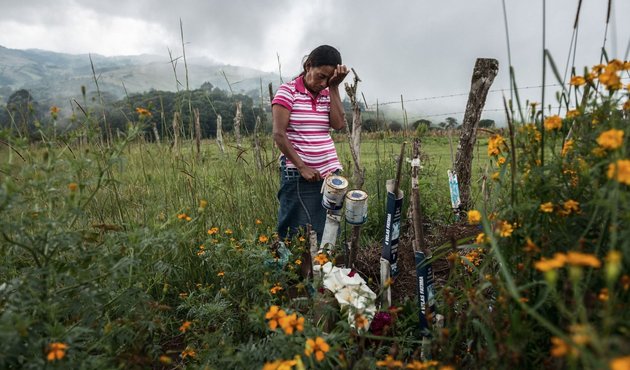
Julia Francisco Martínez stands at the graveside of her husband Juan, a Honduran Indigenous defender who was found murdered in 2015.

Julia Francisco Martínez stands at the graveside of her husband Juan, a Honduran Indigenous defender who was found murdered in 2015. Giles Clarke / Global Witness

Every year, Global Witness works with partners to gather evidence, verify and document every time a land and environmental defender is killed or disappeared. Our methodology follows robust criteria, yet undocumented cases pose challenges when it comes to analysing data

Global Witness documents killings and long-term disappearances of land and environmental defenders globally. In partnership with over 30 local, national and regional organisations in more than 20 countries, we produce an annual report containing these figures, and we have done so since 2012.

Our methodology involves a year-long process of cross-referencing data from different sources to ensure its credibility. Over 2,200 killings or long-term disappearances of defenders appear in our database since 2012 – with 146 cases documented in 2024.

Every year, we maintain a database to keep a record of these crimes and create a comprehensive global picture of the systematic violence defenders face.

The data provides a snapshot of the underlying drivers behind reprisals and indicates how some defenders and their communities face increased risks. Exposing these trends is the first of many steps to ensure that defenders and their communities are protected and can exercise their rights without fearing for their lives.

Killings and disappearances documented between 2012 and 2024

  • 2,253 defenders have been killed or disappeared since 2012 Global Witness
  • 146 of these attacks occurred in 2024 Global Witness

The accompanying press release goes into considerable detail on the methodology used.

For last year’s report see: https://humanrightsdefenders.blog/2024/09/18/global-witness-2023-2024-annual-report-violent-erasure-of-land-and-environmental-defenders/

https://globalwitness.org/en/campaigns/land-and-environmental-defenders/documenting-killings-and-disappearances-of-land-and-environmental-defenders/

https://www.rappler.com/philippines/deadliest-country-asia-environmental-defenders-2024/

Human rights defender’s profile: Lourdes Gómez from Guatemala

April 3, 2024

‘My passion is the defence of the right to land and territory,’ says Lourdes Gómez, a land rights defender and professor working on issues affecting Indigenous women defenders and the impacts of palm oil production.

The ISHR had the chance to meet Lourdes Gómez during her Geneva visit to attend the Human Rights Council’s 55th session. Lourdes, a land right defender and professor working on issues of Indigenous women defenders and the impacts of oil palm production, delivered a powerful statement during the session. She was also one of the speakers at a side event about the human rights situation in Guatemala.

Lourdes recently participated into the ‘artivism’ project by journalist and photographer Teresa Ordás, ‘Paisojos de mujeres defensoras de derechos humanos de Guatemala‘ (‘Landscapes of women human rights defenders from Guatemala’). The project is a collection of beautiful photographs of the real reflections of the subjects’ eyes, where Teresa Ordás highlights ‘the world in people’s eyes.’ [Website: https://www.paisojos.com]

Here is how Lourdes introduces herself in the frame of ‘Paisojos’:

‘I am a Q’eqchi’ Mayan woman of African descent. I inherited my path of defending human rights from my mother Lucia Willis Paau, who since my childhood had joined the movement to defend the rights of Mayan women in the north of Guatemala. My passion is the defense of the right to land and territory. I have dedicated myself to denouncing the violence that the State of Guatemala exerts at the community level on Indigenous, rural and peasant women while they fight for access, use, control and protection of their land. These communities face racism, discrimination and machismo. I have dedicated myself to the defense of land rights, contributing through historical registry and communal research, to the restitution of land rights’.

https://ishr.ch/defender-stories/human-rights-defenders-story-lourdes-gomez-willis-from-guatemala

Global Witness annual report 2022: a land rights defender killed every other day

September 25, 2023

Over the last decade, nearly 2,000 land and environment defenders have been killed around the world, and in 2022, a land defender was killed every other day, according to a report. [for last year’s see: https://humanrightsdefenders.blog/2022/10/05/global-witness-report-2021-continued-disaster/]

The study from Global Witness, a non-profit human rights environmental watchdog, shows that the killings of Indigenous peoples defending their territories and resources represented nearly 34 percent of all lethal attacks despite making up about 5 percent of the world’s population.

Governments where these violations are happening are not acting properly to create a safe environment for defenders and a civic space proper for them to thrive,” said Gabriella Bianchini, senior advisor for the land and environmental defenders team at Global Witness. “They are not reporting or investigating and seeking accountability for reprisals against defenders. And most importantly, they are not promoting legal accountability in the proper manner.”

Latin America has consistently ranked as the deadliest region for land defenders overall and saw almost 9 in every 10 recorded killings in 2022. More than a third of those fatal attacks took place in Colombia. In 2021, Brazil was named the deadliest country for land defenders by Global Witness and now sits at second; In July, activist Bruno Pereira and journalist Dom Phillips were murdered in the Brazilian Amazon.

Growing tensions from agribusiness, mining, and logging have led to consistent lethal attacks in the region. Between 2011 and 2021, for instance, more than 10,000 conflicts related to land rights and territories were recorded in Latin America alone. 

The worsening climate crisis and the ever-increasing demand for agricultural commodities, fuel, and minerals will only intensify the pressure on the environment — and those who risk their lives to defend it,” wrote the authors.

Earlier this year, Frontline Defenders, an international human rights organization, released a similar report to Global Witness’ with corresponding findings — including that Colombia was the most dangerous country for land defenders. [see: https://humanrightsdefenders.blog/2023/04/04/front-line-defenders-just-published-its-global-analysis-2022-new-record-of-over-400-killings-in-one-year/ . While Frontline Defenders reported that there were 186 land defender deaths in Colombia and Global Witness reported 60, Bianchini said differences in statistics are the result of different methodologies, which vary by organization. However, both organizations’ reports were united in findings: Indigenous people make up a disproportionate amount of the deaths among land and environment defenders, Latin America sees the highest rates of violence, and the number of killings is likely underreported.

“I am incredibly grateful and impressed to see the fight of all of these communities who are there living in these areas and who have been acting for thousands of years to protect the array of life,” said Bianchini. “I cannot believe that humanity right now is living in a moment where we are killing those who are protecting their own lands and civil rights.”

https://grist.org/indigenous/in-2022-a-land-defender-was-killed-every-two-days/

https://www.globalwitness.org/en/campaigns/environmental-activists/standing-firm/

Witness publishes video Guide for environmental defenders

April 26, 2023

WITNESS recognizes the great risks that environmental defenders take to stand up to power, and understand that the collection of visual evidence is only one strategy communities use to protect their environmental human rights. It wants to support this movement by sharing information and good practices to help community-based documenters collect visual documentation of environmental human rights crimes and violations so that it can be effectively used in advocacy and accountability processes. This Guide is primarily for community members who:

  • Live where industries that mine, extract oil and gas, build dams, cut timber, clear land for agri-business developments, grab land for high-end real-estate development, and do so in a way that violates the environmental human rights of communities
  • Want to—and can—safely document these violations with phones, cameras, and drones
  • Want to—and can—safely use the documentation to protect human rights
  • Would like to help train others to safely collect relevant and reliable visual documentation for human rights advocacy and accountability.

see also: https://humanrightsdefenders.blog/2022/03/02/human-rights-high-commissioner-bachelet-urges-support-for-environmental-defenders/

Front Line Defenders just published its global analysis 2022: new record of over 400 killings in one year

April 4, 2023

Front Line Defenders launched its Global Analysis 2022 on the situation of human rights defenders (HRDs) at risk around the world, an in-depth annual publication detailing the variety of risks, threats and attacks faced by HRDs around the world. Front Line Defenders’ Global Analysis 2022 gives a panorama of the threats faced by HRDs in all regions of the world. Despite an assault on human rights and the rule of law in many countries, human rights defenders (HRDs) showed remarkable courage and persistence in advocating for more democratic, just and inclusive societies in 2022. [see also https://humanrightsdefenders.blog/2022/01/17/at-least-78-human-rights-defenders-killed-in-colombia-in-2021/]

The report also names 401 HRDs killed in 26 countries in 2022 compared to 358 HRDs killed in 35 countries in 2021 – based on statistics by the HRD Memorial, a collective initiative of human rights organisations working to collect and verify data on the killings of HRDs each year.

“In a grim milestone, for the first time we saw more than 400 targeted killings of human rights defenders in 2022. While Latin America remained the deadliest region in the world for human rights defenders, we also saw a more dangerous landscape for defenders in the context of Russia’s full-scale invasion of Ukraine,” said Olive Moore, Interim Director of Front Line Defenders. ”These human rights defenders were deliberately targeted and killed because of their human rights work. Because they choose to speak out and challenge injustice, they paid for it with their lives.”

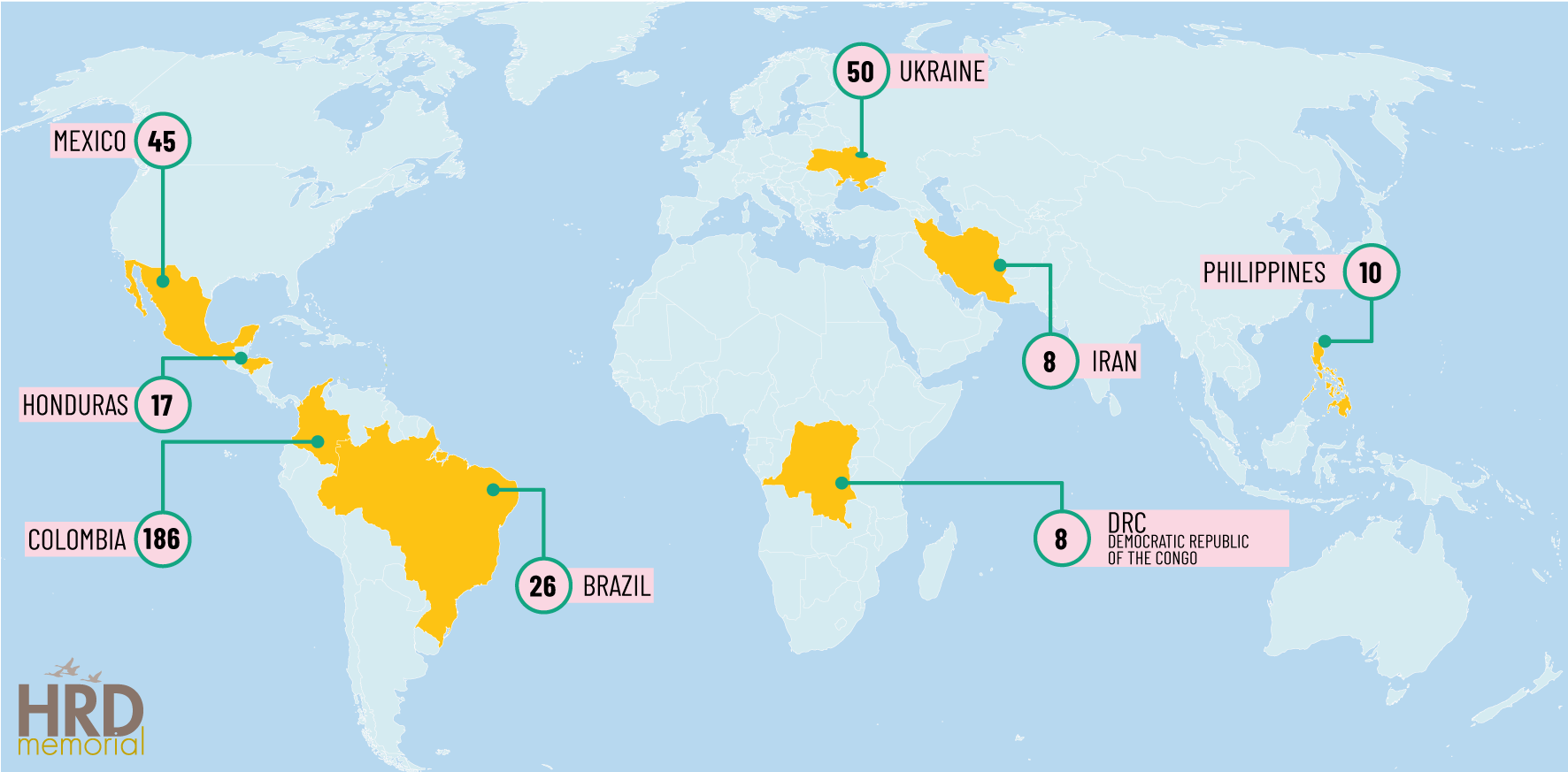
Five countries – Colombia, Ukraine, Mexico, Brazil and Honduras – accounted for over 80% of killings, according to HRD Memorial data. Colombia alone accounted for 46% of the total, with at least 186 killings documented and verified by HRD Memorial partner Somos Defensores to date. Defenders working on land, indigenous peoples’ and environmental rights were the most frequently targeted sector, accounting for almost half (48%) of the total killings.

In the context of Russia’s full-scale invasion of Ukraine, defenders engaged on humanitarian response and human rights journalists were also specifically targeted, with at least 50 documented killings by Russian military forces.

Wide array of threats

Global Analysis 2022 data is based on more than 1,500 threats and violations reported to Front Line Defenders, and is disaggregated by region, type of threat, sector of human rights work and gender.

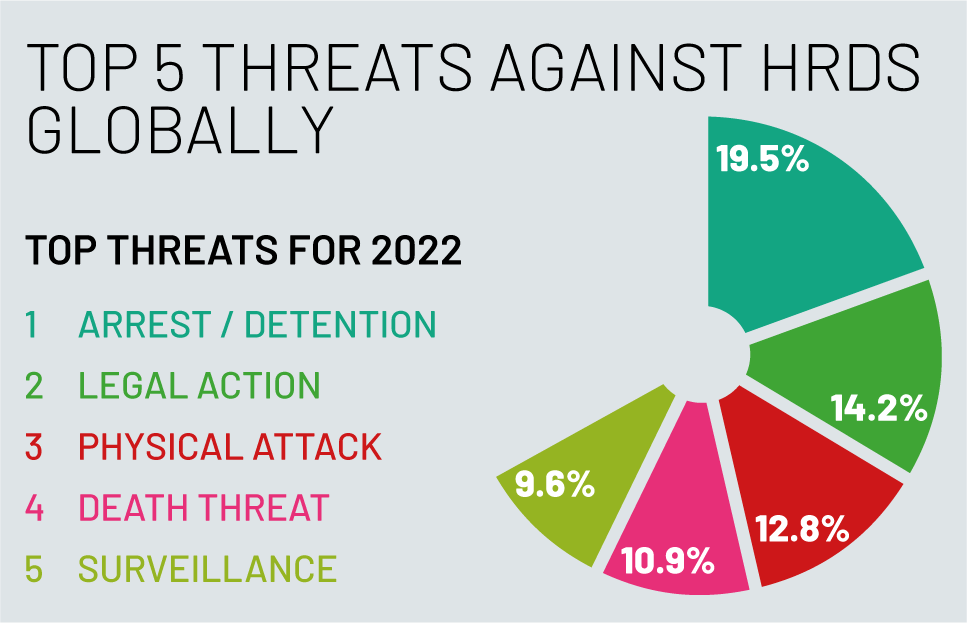
The main threats HRDs reported to Front Line Defenders in 2022 included: arrest or detention (19.5%); legal action (14.2%); physical attack (12.8%); death threats (10.9%); and surveillance (9.6%). In Asia and the Americas, death threats were the most frequent violation against defenders; in Africa it was arrest and detention; while in ECA and MENA it was legal action against HRDs.

Women HRDs (WHRDs) were frequently targeted with death threats, which accounted for the third most common violation against them. Physical violence was the most prevalent violation reported by trans and gender variant/gender nonconforming HRDs.

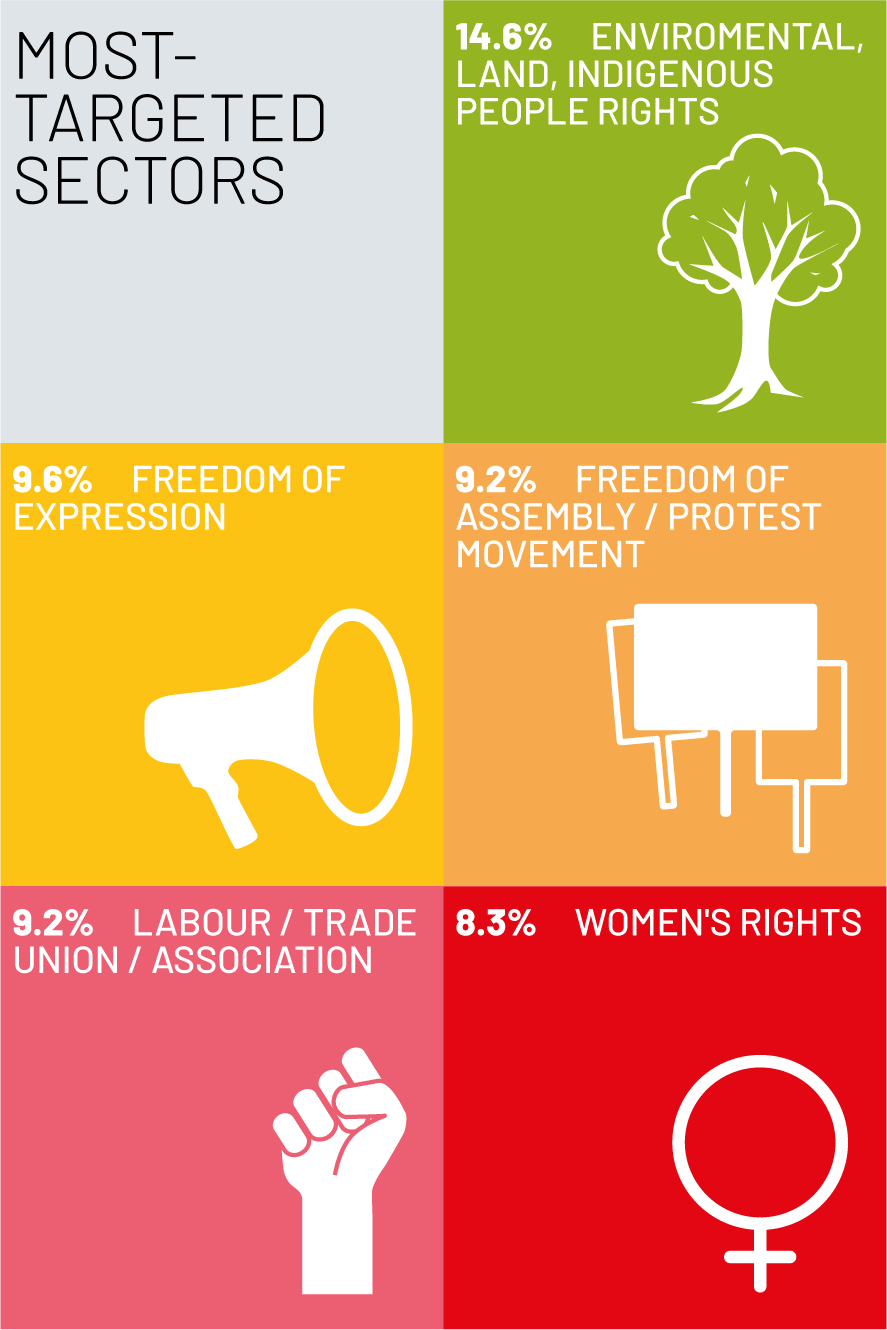
The five most targeted sectors of human rights defence were: environmental, land and indigenous peoples’ rights (11%); freedom of expression (10%); protest movement/ freedom of assembly (9%); women’s rights (7%); and impunity and access to justice (6%).

________________________________________________________________________________________________________________________________

About the data on killings: Front Line Defenders manages the collection of partner-verified data-sets under the HRD Memorial umbrella. The partners in the HRD Memorial are: ACI-Participa (Honduras); Amnesty International; Comité Cerezo (Mexico); FIDH; Front Line Defenders; Global Witness; Human Rights Defenders’ Alert – India; Karapatan (the Philippines); OMCT; El Programa Somos Defensores (Colombia); Red TDT (Mexico); and UDEFEGUA (Guatemala).

About the data on other violations against HRDs: This is derived from 1,583 reported threats and violations, based on Front Line Defenders’ urgent actions and approved grants between 1 January and 31 December 2022. For more details, see the Methodology section of the report.

for last year’s report, see: https://www.frontlinedefenders.org/en/resource-publication/global-analysis-2021-0

Download the Global Analysis 2022

https://www.theguardian.com/world/2023/apr/04/colombia-human-rights-defenders-killings-2022

Vietnam should drop charges against Human Rights Defender Truong Van Dung

March 29, 2023
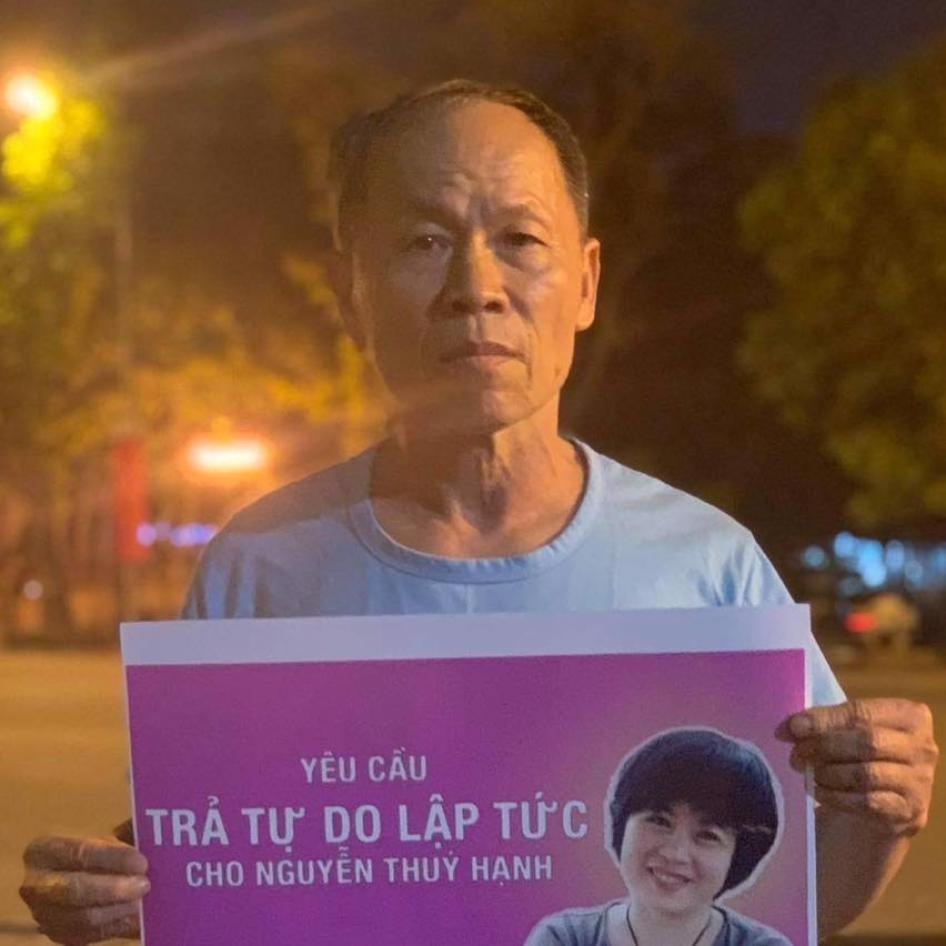
Truong Van Dung hold a sign that says, Request the Immediate Release of Nguyen Thuy Hanh. 

On 27 March 2023 7:00 Human Rights Watch said that the Vietnamese authorities should immediately release land rights activist Truong Van Dung and drop all charges against him. Police in Hanoi arrested Truong Van Dung in May 2022 on charges of “conducting propaganda against the state.” A Hanoi court on March 28, 2023 sentenced him to six years in prison.

Vietnamese authorities have convicted at least 163 people since 2018 for exercising their rights to freedom of expression or association under vague or over broad laws that criminalize protesting or criticizing the government. At least 18 others have been charged and are awaiting trial. The authorities have brought many of these cases using the propaganda charge, criminalized under articles 88 and 117 of Vietnam’s penal code.

“Truong Van Dung is the latest in a long line of human rights defenders silenced by the Vietnamese government for protesting against human rights violations and advocating for reforms,” said Phil Robertson, deputy Asia director at Human Rights Watch. “Democratic governments forging closer ties with Vietnam need to speak out publicly and forcefully in his support and call on Vietnam to release all political prisoners and take genuine steps toward reform.”

Truong Van Dung, 65, first became active in land rights advocacy in the 2000s, campaigning against forced confiscation of his own house. In the early 2010s, he joined other activists and began to advocate for basic rights, including freedom of expression, association, and assembly. Between 2011 and 2018, he also participated in numerous anti-China and pro-environment protests. He joined a protest opposing Vietnam’s problematic 2018 law on cybersecurity and publicly boycotted Vietnam’s national “elections,” a process controlled by the Vietnam Communist Party which is neither free nor fair.

He also publicly voiced support for numerous political prisoners and detainees, including Nguyen Thuy Hanh [see also: https://humanrightsdefenders.blog/2021/04/09/viet-nam-profile-of-human-rights-defender-nguyen-thuy-hanh-arrested-and-charged/], Pham Doan Trang, [see also: https://www.liv.ngo/content/files/2022/04/Pham-Doan-Trang_-UN-experts-call-for-release-of-Vietnamese-human-rights-defender-_-Hans-Thoolen-on-Human-Rights-Defenders-and-their-awards.pdf] Can Thi Theu, Nguyen Thi Tam, Trinh Ba Tu, Trinh Ba Phuong, Le Dinh Luong, Hoang Duc Binh, Nguyen Tuong Thuy, Pham Chi Dung, Le Huu Minh Tuan, Do Nam Trung, and members of Hoi Anh em Dan chu (Brotherhood for Democracy).

In December 2013, Truong Van Dung and other activists founded a humanitarian group, Hoi Bau bi Tuong Than (Association of Gourd and Squash Mutual Assistance), to provide financial and spiritual support for political prisoners, land rights petitioners, and their families.

After his arrest in May 2022, Truong Van Dung was held incommunicado for more than nine months. He was allowed to meet with his lawyer for the first time in March. His family has not been allowed to see him. Vietnam’s courts, controlled by the ruling Communist Party of Vietnam, are not independent and hearings and trials do not meet international standards. “How can Truong Van Dung get a fair trial when Vietnam’s legal system isn’t independent and the laws under which he is charged violate basic international human rights standards – and what he has been accused of shouldn’t even be crimes,” Robertson said.

https://www.hrw.org/news/2023/03/27/vietnam-drop-charges-against-human-rights-activist

CESCR’s General Comment no. 26 on land rights defenders

February 8, 2023

Vincent Ploton leads ISHR’s strategic engagement and litigation with the UN Treaty Bodies, and he drew attention to General Comment N° 26 of the Committee on Economic, Social and Cultural Rights, which spells out the obligations of States parties to the ICESCR in relation to land rights. This constitutes the first guidance wholly dedicated to land rights across the UN Treaty Body system. CESCR’s new resource provides a major opportunity for land rights defenders at a time when the global battle for natural resources is at a historical high, and those who stand to protect their land are on the frontline. In all world regions, people who resist the destruction and exploitation of their land are facing judicial harassment, threats and murders. Indigenous and peasant communities who defend their rights to cultivate and live on their ancestral lands are dispossessed and extorted by powerful actors. CESCR’s General Comment spells out the measures that States parties must take to uphold compliance with the obligations set out in the Covenant.

ISHR welcomes the dedicated section of the General Comment on land rights defenders, which echoes our inputs and calls on States parties to:

  • Publicly recognise … the  importance and legitimacy of the work of human rights defenders and a commitment that no violence or threats against them will be tolerated
  • Repeal of any State legislation or any measures that are intended to penalise or obstruct the work of human rights defenders
  • Strengthen State institutions responsible for safeguarding the work of human rights defenders
  • Investigate and punish any form of violence or threat against human rights defenders
  • Adopt and implement programmes, in consultation with potential beneficiaries, that are well resourced and have inbuilt coordination mechanisms that ensure that adequate protection measures are provided to human rights defenders at risk whenever necessary

Speaking about this groundbreaking new guidance, the Committee’s Co-Rapporteur Rodrigo Uprimny said: “I hope that communities whose land rights are denied, including indigenous communities, can count on the force of international law, and the norms dictated by the International Covenant on Economic, Social and and Cultural Rights. The General Comment reaffirms and reinforces the concept of free, prior and informed consent and also recognizes the fundamental work of defenders of land rights.

See also: https://humanrightsdefenders.blog/2022/04/21/green-economy-and-human-rights-defenders-provide-data-denounce-attacks/

.https://ishr.ch/latest-updates/new-resource-for-land-rights-defenders/

30 November: film screening; women human rights defenders in Latin America

November 23, 2022

The illusion of abundance: Film screening and discussion

In their film, Erika Gonzalez Ramirez and Matthieu Lietaert introduce us to Berta Cáceres, Carolina de Moura and Maxima Acuña, three women from Latin America defending their communities, land and livelihood against transnational corporations. b Fo rmore on Carceres, see: https://humanrightsdefenders.blog/tag/caceres/ as well as https://www.trueheroesfilms.org/thedigest/laureates/2AD0CEE4-80CB-3234-04B4-F2ED7ACBE6C5

Their quest for corporate accountability brought the activists to Geneva, where ISHR accompanied them during the negotiations at the United Nations Palais des Nations on the elaboration of an international legally binding treaty that seeks to regulate, in international human rights law, the activities of transnational corporations. 

  • Wednesday 30 November 2022, 1:20pm-2:40pm
     
  • Room XVIII, Palais des Nations, Geneva
     
  • Languages: movie in original version with English subtitles; discussion in English

https://www.theillusionofabundance.earth/

Global Witness report 2021: continued disaster

October 5, 2022

Stuti Mishra in the Independent of 29 September 2022 summarises and analyses the report “A Decade of Defiance: Ten years of reporting land and environmental activism worldwide” by Global Witness

More than 1,700 environmental defenders have been killed around the world in the last decade with one death reported every other day on average…The report titled A Decade of Defiance: Ten years of reporting land and environmental activism worldwide, released by Global Witness, reveals the increasing threats environmental activists are facing as the climate and biodiversity crisis worsens.

The research states that a total of 1,733 people have been killed over the past 10 years trying to protect their land and resources. That is an average of one defender killed approximately every two days over 10 years.

The report shows Brazil has been the deadliest country for environmental defenders with 342 lethal attacks reported since 2012 with over 85 per cent of killings within the Brazilian Amazon.

The data found within the report also shows that over half of the attacks over the 10-year period have taken place in three countries — Brazil, Colombia, and the Philippines — with around 300 killings reported in these countries.

Mexico and Honduras witnessed over 100 killings while Guatemala and India saw 80 and 79 respectively, remaining one of the most dangerous countries. The report also reports 12 mass killings, including three in India and four in Mexico.

Mexico was the country with the highest recorded number of killings in 2021, totalling 54 killings, up from 30 the previous year. Almost half of those killed were again Indigenous people while over a third were forced disappearances, including at least eight members of the Yaqui community.

The report also reveals that over three-quarters of the attacks recorded in 2021 took place in Latin America. In Brazil, Peru and Venezuela, a big majority of 78 per cent of these attacks occurred in the Amazon.

Meanwhile, the biggest increase in lethal attacks was witnessed in Brazil and India in 2021 with 26 deaths reported in Mexico, up from 20 and 14 in India, up from four.

Both Colombia and the Philippines saw a drop in killings to 33 in 2021 from 65, and 19 from 30 in 2021 respectively. Yet overall they remain two of the countries with the highest numbers of killings in the world since 2012.

2021 Highlights from Global Witness report

  • Around 200 Land and Environmental Defenders were killed in 2021 – nearly four people a week
  • Over three-quarters of the attacks recorded in 2021 took place in Latin America
  • Nearly 40 per cent of all attacks reported were against Indigenous people
  • Mexico recorded the highest number of killings in 2021
  • Brazil and India both saw a rise in lethal attacks in 2021
  • 50 of the victims killed in 2021 were small-scale farmers
  • Around 1 in 10 of the defenders recorded killed in 2021 were women, nearly two-thirds of whom were Indigenous [see also: https://humanrightsdefenders.blog/2021/09/13/global-witness-2020-the-worst-year-on-record-for-environmental-human-rights-defenders/]

In Africa, the Democratic Republic of Congo remained the country with the highest number of attacks — eight defenders were killed there in 2021. All eight of these killings were in Virunga National Park, which remains extremely dangerous for the park rangers protecting it.

The organisation began collecting data on attacks against those defending land and the environment in 2012 and found that the control and use of land and territory is a central issue in countries where defenders are threatened. Much of the increasing killing, violence and repression is linked to territorial conflicts and the pursuit of economic growth based on the extraction of natural resources from the land, it states. The research has also highlighted that Indigenous communities in particular face a disproportionate level of attacks — nearly 40 per cent — even though they make up only 5 per cent of the world’s population.

However, the research found that the figures also do not capture the true scale of the problem, as tightened control on media has led to severe underreporting in some countries where environmental defenders are most vulnerable. Research has also found that few perpetrators of killings are rarely ever brought to justice due to the failures of governments to properly investigate these crimes.

While a majority of these attacks are not properly investigated or reported on, a big proportion of these attacks were linked to sectors like mining and infrastructure, including large-scale agribusiness and hydroelectric dams.

Many authorities ignore or actively impede investigations into these killings often due to alleged collusion between corporate and state interests, the report says.

All over the world, Indigenous peoples, environmental activists and other land and environmental defenders risk their lives for the fight against climate change and biodiversity loss.

They play a crucial role as a first line of defence against ecological collapse, yet are under attack themselves facing violence, criminalisation and harassment perpetuated by repressive governments and companies prioritising profit over human and environmental harm.

a spokesperson for Global Witness said

With democracies increasingly under attack globally and worsening climate and biodiversity crises, this report highlights the critical role of defenders in solving these problems,” a spokesperson for Global Witness said, adding that the organisation makes an “urgent appeal for global efforts to protect and reduce attacks against them.”

Apart from killings, the report also reveals a number of tactics being used to silence them, like death threats, surveillance, sexual violence, or criminalisation – and that these kinds of attacks are even less well reported.

https://www.globalwitness.org/en/campaigns/environmental-activists/decade-defiance/

https://www.independent.co.uk/climate-change/news/global-witness-report-environment-defenders-threat-b2176247.html