Posts Tagged ‘killings’

FORUM-ASIA: human rights defenders face severe risks in Asia

June 4, 2019
The latest report by the Asian Forum for Human Rights and Development (FORUM-ASIA) found that human rights defenders in Asia are at high risks. “In Asia, we are witnessing more and more human rights defenders being subjected to increasingly severe forms of violations, particularly killing, simply for defending human rights,” said Sejin Kim, Programme Manager of FORUM-ASIA.

The report titled “Defending In Numbers: Resistance in the Face of Repression exposes 688 cases of human rights violations affecting 4,854 people across 18 different countries in Asia, and analyses current and emerging trends of violations against human rights defenders, including journalists, civil society organisations, advocates and their family members, throughout 2017-2018.

Besides that, the report also reveals that “violations have become more extreme, and the safe space in which human rights defenders can work have increasingly shrunk”. State and non-state actors openly threatened these defenders, something which played a key role in creating a dangerous climate for them. In fact, according to the report, there were 164 cases where physical violence was used against human rights defenders, and 61 of these cases resulted in death. The majority of these cases occurred in the Philippines (48 per cent) and India (25 per cent). Concerningly, most of the perpetrators of these killings remain unknown, a reality which perpetuates impunity in the region…. In the period under review, a staggering 327 cases of judicial harassment were recorded across 17 countries which include the (arbitrary) arrest and detention of human rights defenders; the misuse of the law and the passage of repressive laws aimed at criminalising human rights defenders; and the denial of a fair trial.

..

Although threats and harassment endanger all defenders, but certain groups are particularly targeted like prodemocracy defenders, who are vocal critics of state repression; and land and environmental rights defenders, who are targeted by state and non-state actors competing to access natural resources and/or implement mega-development projects. Women human rights defenders, who challenge gender norms and power structures, also ranked high among the most affected groups. Gender-based violence, including online attacks and harassment, were common tactics used against women human rights defenders.

Human rights defenders face severe risks including killing in Asia, says FORUM-ASIA

Michel Forst addressed the International Civil Society Week 2019

May 3, 2019
For the International Civil Society Week (ICSW), held  in Belgrade from 8-12 April 2019,  (Special Rapporteur on human rights defenders) contributed through IPS the
following piece: “Human Rights Defenders Need to be Defended as Much as they Defend our Rights”:

They are ordinary people – mothers, fathers, sisters, sons, daughters, brothers, friends. But for me they are extraordinary people – the ones who have the courage to stand up for everyone else’s rights. They are the human rights defenders. Last year, according to reliable sources, 321 of them were killed, in 27 countries. Their murders were directly caused by the work they do to ensure the rest of us enjoy the rights we claim as purely because we are human. Countless others were tortured, raped and threatened, also for the work they do protecting their, and others’ human rights.

In fact, 2018 was deadliest year for human rights defenders since the UN began monitoring the challenges they face through the establishment of a mandate for a Special Rapporteur on the situation of human rights defenders. It shouldn’t be like this.

Last year we marked 70 years since the Universal Declaration of Human Rights and 20 since the UN Declaration on Human Rights Defenders. The latter Declaration provides for the practical support and protection of human rights defenders as they go about their work. It is addressed not just to states and to human rights defenders, but to everyone. It tells us that we all have a role to fulfil as human rights defenders and emphasises that there is a global human rights movement that involves us all. This is a task we are not performing well.

Human rights should not need defenders, and human rights defenders should not need protection from the might of oppressive governments, corrupt multinationals and crooked legal systems. But this is an imperfect, human world.

Since 2000, when we UN Special Rapporteurs on the situation of human rights defenders began our monitoring work, much progress has been made. There has been extensive discussion on how these courageous people should be protected, and there is a Protection Mechanism for Human Rights Defenders and Journalists in a limited number of countries. Sadly, it is often not properly implemented, or funded. It is impossible to canvass each defender’s particular treatment or mistreatment by the authorities they face, or even that of communities of defenders. There are, however, trends.

  • On 23 October last year, Julián Carrillo, an indigenous rights defender from Mexico’s state of Chihuahua told a friend by phone that he believed he was being watched and that he was going into hiding. On the evening of 25 October, his body was found. He had been shot several times.
  • On 22 August last year, Annaliza Dinopol Gallardo, a Filipina land rights defender known to her community as “Ate Liza”, was shot dead outside Sultan Kudarat State University in Tacurong City. She had four children.

Mr Carillo’s murder is indicative of the largest trend. More than two-thirds – a full 77% – of the total number of defenders killed were defending land, environmental or indigenous peoples’ rights, often in the context of extractive industries and state-aligned mega-projects.

Ms Gallardo’s murder represents another trend – the number of attacks on women and girls who are defenders is increasing. In the recent report that I have presented to the UN Human Rights Council I have highlighted that, in addition to the threats experienced by their male colleagues, women human rights defenders face gendered and sexualised attacks from both state and non-state actors, as well as from within their own human rights movements.

This includes smear campaigns questioning their commitment to their families; sexual assault and rape; militarised violence; and the harassment and targeting of their children.

Changing all this is our task for the future. Protection Mechanisms for Human Rights Defenders and Journalists need to be properly implemented and funded, at national level.

We need to empower defenders and increase the abilities of those who are responsible for their protection to keep them safe. We also need to improve the accountability mechanisms these officials operate under.

To properly defend the defenders, we also need to recognise their diversity, and that each one of them faces challenges particular to their individual circumstances. There is no one-size-fits-all answer to ensuring each defender is able to do their work unfettered.

We need to acknowledge that defenders, just like all of us, live in this modern, interconnected world.

Protecting them means covering all aspects of their safety: physical, psychological and digital. It means doing so with flexibility. It also means that our protection needs to extend to their families, and the groups and organisations they belong to. We need to speak to them about what they need to feel safe.

In recent years the world has taken a worrying turn away from respect for human rights. Increasingly, groups are becoming inward-looking, and nations nationalistic. We need human rights defenders now more than ever. They also need us.

See also: https://humanrightsdefenders.blog/tag/2019-international-civil-society-week/

http://www.ipsnews.net/2019/04/human-rights-defenders-need-defended-much-defend-rights/

“Somos Defensores” in Colombia publishes annual report 2018: worst ever

April 26, 2019

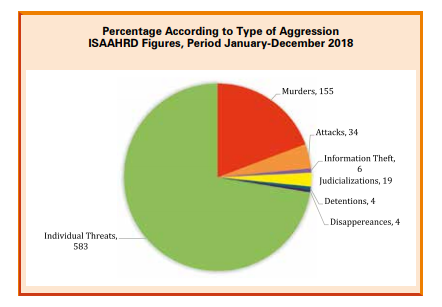
On 23 April 2019 the annual report by “Somos Defensores” in Colombia reveals increase in attacks against human rights defenders in 2018

Attacks against HRDs Colombia

Unfortunately, 2018 was the worst year for human rights defenders, as shown by the data. They recorded the highest aggression figures that have been presented since the beginning of the Information System in 2009. [see also: https://humanrightsdefenders.blog/2018/04/28/2018-latin-america-still-the-graveyard-for-environmental-human-rights-defenders/]

That is, not counting the amount of cases that for different reasons are not included, since we start from accepting the existence of underreporting, which means that the level of violence is much higher than we can imagine…Despite the evident crisis of human rights and the urgent need for intervention to protect the lives of everyone, and in particular, human rights defenders, the current Government of Iván Duque has opted to take opposing positions to its duty to offer guarantees and has left aside the difficult situation that defenders are going through; dedicating his efforts, instead, to putting other issues at the center, such as the orange economy…

See also: https://humanrightsdefenders.blog/2019/02/20/human-rights-defenders-in-latin-america-under-constant-attack/

Read the full post here

Jamal Khashoggi murder: the plot thickens

March 18, 2019

On 17 March 2019, the New York Times reported that the Crown Prince (MBS) authorised a clandestine campaign against Saudi dissenters and human rights defenders well before Jamal Khashoggi’s murder.

The Rapid Intervention Group was authorised by Crown Prince Mohammed bin Salman and overseen by Saud al-Qahtani, a royal court insider, US officials told the NYT [File: Reuters]
The Rapid Intervention Group was authorised by Crown Prince Mohammed bin Salman US officials told the NYT [File: Reuters]

More than a year before the killing of journalist Jamal Khashoggi, Saudi Arabia’s powerful Crown Prince Mohammed bin Salman, also known as MBS, approved a secret campaign to silence dissenters, the New York Times has reported. The campaign included surveillance, kidnapping, detention and torture of Saudis, said the report published on Sunday citing the US officials who have read classified intelligence reports about the effort. American officials referred to it as the Saudi Rapid Intervention Group, the Times said. [see also: https://humanrightsdefenders.blog/2019/03/08/saudi-arabia-for-first-time-openly-criticized-in-un-human-rights-council/]

…..At least some of the clandestine missions were carried out by the members of the team that killed and dismembered Khashoggi in October at the Saudi consulate in Istanbul, suggesting his murder was part of a wider campaign against dissidents, the report said, citing the US officials and associates of some Saudi victims. These members were involved in at least a dozen operations beginning in 2017, the officials said, including forcibly repatriating Saudis from other Arab countries.

According to the New York-based newspaper, the Rapid Intervention Group has been involved in the harassment of arrested prominent human rights activists and women’s rights defenders, including Loujain al-Hathloul, Aziza al-Yousef and Iman al-Najfan.

Alia al-Hathloul says that al-Qahtani attended several such sessions to torture her sister. He also threatened to kill Loujain and throw her body into the sewers, Alia says. According to the newspaper, the women were beaten, subjected to electric shocks, waterboarding, and threatened with death and rape during the interrogations. Loujain’s sister says that at first the Saudi authorities did not send the arrested women to jail, but in a secret location in the Red Sea city of Jeddah. According to US intelligence assessment, the brutal interrogations prompted university professor al-Najfan to attempt suicide. [see also: https://humanrightsdefenders.blog/2019/03/13/saudi-arabia-persist-with-trial-for-women-human-rights-defenders/]

Saudi officials declined to confirm or deny that such a team existed, or answer questions from the Times about its work.

https://www.aljazeera.com/news/2019/03/mbs-approved-intervention-dissidents-nyt-report-190318075621971.html

FIDH dares to publish a report on ‘key human rights issues of concern’ in Kashmir

March 17, 2019

On 15 March 2019 the International Federation for Human Rights and its partner organizations Association of Parents of Disappeared Persons (APDP) and Jammu Kashmir Coalition of Civil Society (JKCCS) published a briefing note detailing key human rights issues of concern in Indian-administered Jammu & Kashmir. I use the term dare in the title as wading in to the issue of Jammu and Kashmir is always tricky and leads to furious reactions from governments and media.

Human rights violations began to be formally reported in Indian-administered Jammu & Kashmir in 1990 in the midst of counter-insurgency operations by the Indian Army to contain an armed struggle against Indian rule. These military operations were marked by excessive and disproportionate use of force. Since 1990, more than 70,000 people have been killed, more than 8,000 have been subjected to enforced disappearances, several thousands have been arrested and detained under repressive laws, and torture and other acts of inhuman and degrading treatment against protestors and detainees have been routinely used by Indian security forces.

ILLUSTRATION: MIR SUHAIL QADRI.

The NGOs have demanded full and unfettered access to Jammu & Kashmir to UN bodies and representatives, foreign and domestic human rights organizations, and foreign and local journalists. The groups also called for establishing a Commission of Inquiry to investigate allegations of all human rights violations perpetrated in Jammu & Kashmir, as recommended in the report by the UN Office of the High Commissioner for Human Rights (OHCHR) and the establishment of a mechanism to monitor the human rights situation in Jammu & Kashmir through diplomatic missions in New Delhi and Islamabad.

The note details “continuing crime of enforced disappearance, extrajudicial killings, torture used as punitive action, systematic impunity for grave crimes, use of arbitrary and administrative detentions to curb dissent, military operations threatening human rights, rights to freedoms of expression, freedom of association, and freedom of religion or belief being curbed, human rights defenders under threat, sexual violence used a tool of repressions, lack of safeguards continue to place children in danger,” among other crimes.

See also: https://humanrightsdefenders.blog/2017/09/30/parveena-ahangar-and-parvez-imroz-in-kashmir-awarded-rafto-prize-2017/

Press Emblem Campaign (PEC) reports to Human Rights Council on media casualties

March 13, 2019

Press Emblem Campaign (PEC), a nongovernmental organization presented a statement on press freedom and journalist killings duringUnited Nations Human Rights Council 40th session in Geneva on 13 March 2019.

The Press Emblem Campaign (PEC) documented last year the killing of 117 journalists, an increase of 17 percent in media casualties compared to the previous year. In five countries journalists paid an unacceptable toll: Afghanistan with 17 killed, Mexico also with 17 killed, Syria with 11 killed, Yemen and India, with 8 journalists killed in each of those countries. The PEC urged the Members of the Human Rights Council to fight more firmly impunity and to bring the responsible of those crimes to justice.

The PEC is also worried by the large number of arrests among journalists in the recent turmoilin Sudan, the repression of press freedom in Nicaragua and Venezuela, the statement reads. PEC expressed itsspecial concern with the continuous judicial harassment of journalists in Turkey in the statement.

PEC was one of the organizers of the panel discussion on human rights violations in Turkey, which the Turkish government mobilized its entire diplomatic corps to prevent during 40th Regular Session of the UN Human Rights Council on 5 March. The move prompted an outcry from human rights defenders.[see: https://stockholmcf.org/erdogan-govt-fails-to-cancel-un-human-rights-council-event-on-turkey/%5D

Turkey is the biggest jailer of journalists in the world. The most recent figures documented by SCF (Stockholm Centre for Freedom) show that 211 journalists and media workers were in jail as of March 11, 2019, most in pretrial detention. Of those in prison 134 were under arrest pending trial while only 77 journalists have been convicted and are serving their time. Detention warrants are outstanding for 167 journalists who are living in exile or remain at large in Turkey. The government also closed down some 200 media outlets.

See also: https://humanrightsdefenders.blog/2019/02/20/european-parliament-rapporteur-on-turkey-kati-piri-it-makes-no-sense-to-continue-talks-on-eu-membership/

Inter-American Commission and Oxfam sign cooperation agreement on human rights in Latin America

March 5, 2019

On 4 March 2019 it was announced that Oxfam and the Inter-American Commission on Human Rights (IACHR) signed a cooperation agreement on February 25, 2019 to promote and protect human rights in Latin America and the Caribbean, with special emphasis on economic, social, cultural and environmental rights and on the crucial role of human rights defenders. The agreement is for five years, to implement a plan including projects on research and the exchange of information linked to the situation of human rights in the region, the protection of human rights defenders and the provision of joint training processes targeting civil society organizations.

Cooperating with the IACHR offers Oxfam a great opportunity to strengthen democracy in our countries and to weakening the current pattern of closing spaces for civil society,” said Simon Ticehurst, Oxfam’s Regional Director for Latin America and the Caribbean.

We are very excited about signing this agreement. The excellent work Oxfam does to find lasting solutions to poverty is extremely interesting for the IACHR and for its Special Rapporteurship on Economic, Social, Cultural and Environmental Rights. Based on that, we will be developing high-impact joint projects to fight that scourge,” said IACHR Executive Secretary Paulo Abrão.

Over the past year, the IACHR has expressed its concern about the lack of guarantees for the exercise of human rights in several countries in the region. The Commission has also held hearings on issues like Central American migrant caravans, legal proceedings on the murder of human rights defender Berta Cáceres in Honduras, and the growing safety problems faced by defenders in Latin America.

In the context of this new deal, Oxfam will join forces with the IACHR to ensure the exercise of human rights.

See also: https://humanrightsdefenders.blog/2019/02/20/human-rights-defenders-in-latin-america-under-constant-attack/

and https://humanrightsdefenders.blog/2019/01/09/front-line-defenders-says-record-number-of-activists-killed-in-2018/

http://www.oas.org/en/iachr/media_center/PReleases/2019/057.asp

Human Rights Defenders in Latin America under constant attack

February 20, 2019

Some 50 human rights defenders from Latin America held a meeting at the Journalists Club in Mexico City to exchange strategies and analyse the challenges they face in the most lethal region for activists. Special rapporteurs on indigenous peoples, displaced persons and freedom of expression attended the meeting. Credit: Emilio Godoy/IPS

Some 50 human rights defenders from Latin America held a meeting at the Journalists Club in Mexico City. Credit: Emilio Godoy/IPS

We’re in a very difficult situation. There is militarisation at a regional level, and gender-based violence. We are at risk, we cannot silence that,Aura Lolita Chávez, an indigenous woman from Guatemala. (Chávez was a finalist for the European Parliament’s Sakharov Prize for Freedom of Thought in 2017, and winner of the Ignacio Ellacuría Prize of the Basque Agency for Development Cooperation that same year). She has received death threats and attacks that forced her to seek refuge in Spain in 2017.

Latin America, the most lethal region for human rights defenders according to different reports, especially activists involved in defending land rights and the environment. Some 50 activists from Brazil, Colombia, Guatemala, Honduras, Mexico, Nicaragua, the United States and Uruguay participated in the International Meeting of Human Rights Defenders and Journalists in Mexico City from 15-18 February under the slogan “Defending does not mean forgetting.”

Guests at the meeting were United Nations Special Rapporteur on the Rights of Indigenous Peoples, Victoria Tauli-Corpuz from the Philippines; UN Special Rapporteur on the Human Rights of Internally Displaced Persons, Cecilia Jiménez-Damary from the Philippines; and the Inter-American Commission on Human Rights (IACHR) Special Rapporteur on Freedom of Expression, Edison Lanza from Uruguay.

The human rights defenders identified common threats such as interference by mining and oil companies in indigenous territories, government campaigns against activists, judicial persecution, gender-based violence, and polarised societies that often fail to recognise the defence of human rights.

Evelia Bahena, an activist from the southern Mexican state of Guerrero, told IPS about “the suffering and destruction” at the hands of “companies that make profits at the cost of the lives of others.”

A number of reports have focused on the plight of human rights defenders in the region. In the report “At what cost? Irresponsible Business and the Murder of Land and Environment Defenders 2017”, published in July 2018, the international organisation Global Witness stated that of the total of 201 murders of human rights defenders in the world in 2017, 60 percent happened in Latin America. [see also: https://humanrightsdefenders.blog/2019/01/09/global-witness-report-2018-on-environmental-defenders-bad-but-2017-was-worse/]

Brazil recorded the highest number of homicides of activists of any country, 57. In Mexico, the number was 15, five times more than the year before, while Nicaragua recorded the highest murder rate of activists relative to its population, with four killings, according to the British-based organisation.

The “Global Analysis 2018”, produced by the international organisation Front Line Defenders, also depicts a grim outlook, counting 321 human rights defenders killed in 27 countries, nine more than in 2017. Of that total, 77 percent involved defenders of the land, the environment and indigenous people. [https://humanrightsdefenders.blog/2019/01/09/front-line-defenders-says-record-number-of-activists-killed-in-2018/]

For Ana María Rodríguez, a representative of the Colombian Commission of Jurists, difficult conditions persist in her country, where 20 human rights activists have been murdered so far in 2019. “There are delays and non-compliance with the peace agreement,” which have contributed to the defencelessness of human rights activists, according to the lawyer.

The rapporteurs present at the meeting, on unofficial visits to Mexico, listened to the accounts given by activists and recalled that governments in the region have international obligations to respect, such as guaranteeing the rights of indigenous people, displaced persons and journalists, as well as protecting human rights defenders…In her October report on Mexico, the special rapporteur criticised the violation of rights of indigenous people, especially the right to prior consultation on energy, land or tourism projects in their territories. [https://humanrightsdefenders.blog/2019/02/16/human-rights-defenders-journalists-in-mexico-in-1919-2-killed-2-released/]

For his part, Lanza, the IACHR special rapporteur, said the recommendations of the joint report released in June 2018 with David Kaye, UN special rapporteur on the promotion and protection of the right to freedom of opinion and expression, should be the starting point for the measures to be adopted by the Mexican government.,,

Guatemala’s slide into violence passes through killings of human rights defenders

January 29, 2019

….Indigenous citizens, many dressed in colorful traditional clothing, came out partly to protest the Guatemalan president’s recent expulsion of a United Nations-backed commission investigating corruption in the country. Since 2007, the International Commission against Impunity in Guatemala, known by its Spanish initials CICIG and funded by the U.N., the United States and the European Union, has worked with Guatemalan justice agencies to target corrupt officials.

In the highly unequal society that is Guatemala, many Maya believe any strengthening of the justice system will protect indigenous rights granted under the country’s constitution and peace accords.

The country’s indigenous people therefore have a strong motivation to lobby for the rule of law. Maya communities bore the brunt of almost four decades of a civil war that ended in 1996, leaving over 200,000 casualties, the majority indigenous Guatemalans, according to the United Nations. Now the mostly Maya organizations and many human rights groups worry that the violence is making a comeback: In just the last year, 26 members of mostly indigenous campesino organizations have been killed.

Guatemala is on the verge of a major human rights catastrophe,” says Jo-Marie Burt, a professor at George Mason University in Fairfax, Va., and a senior fellow at the Washington Office on Latin America, an independent research and advocacy center. According to Burt, the Guatemalan Union of Human Rights Defenders has tallied over 200 attacks against human rights defenders in Guatemala in the last year….Guatemala is close to falling into the violence that gripped the country 30 years ago, which the United Nations and some Guatemala courts say led to a genocide of the country’s indigenous citizens.

One of the killings took place in July, in the province of Quiché, one of the areas hardest hit by the civil war……Hundreds attended her wake and funeral, where a leader of the Campesino Development Committee said the organization would not be intimidated. Indigenous, human rights and international organizations expressed outrage for Raymundo’s murder.

Indigenous scholar and commentator Irma Alicia Velásquez Nimatuj wrote in her column in the newspaper El Periódico, “After having lived through a genocide, we should have learned the lesson that no one in Guatemala, regardless of ethnicity, gender or class, should be killed for thinking differently … or for dreaming of a different future.

According to Velásquez, Guatemala has entered “a new stage of repression”one focused on “assassinating community leaders who defend their territories from invasion by transnational companies bent on depriving indigenous peoples of the resources they have in the soil and the subsoil.

Numerous conflicts over land and mineral rights have surfaced in indigenous communities throughout Guatemala.

…..On Aug. 5, shortly after Raymundo’s killing, the respected sociologist Edelberto Torres-Rivas provided historical context for the attacks on rural leaders in a long opinion piece for El Periódico. …. He went on to warn that “In Guatemala there is a return of those who’ve carried out crimes in the recent past … and if the authorities don’t take care … there could be a reaction.”…..

——-

https://www.npr.org/2019/01/22/685505116/killings-of-guatemalas-indigenous-activists-raise-specter-of-human-rights-crisis?t=1548231003780

https://www.aljazeera.com/indepth/opinion/attacks-indigenous-rights-defenders-181206094334223.html

https://reliefweb.int/report/guatemala/iachr-expresses-alarm-over-increase-murders-and-aggressions-against-human-rights

https://www.telesurenglish.net

First Mexican journalist killed in 2019 – protection mechanism failing

January 22, 2019

The body of 34-year-old Rafael Murua Manriquez was found by the side of a road in Northern Mexico Sunday 20 January 2019, the same day he had been reported missing by his family. The former director of the community radio station, Radiokashana in Santa Rosalia, has become the first Mexican journalist to be killed in 2019.

Within his news reporting, Rafael Murúa Manríquez, is believed to have denounced the aggressions of the municipal president of Mulegé Felipe Prado, according to El Comercio. Following a statement from the Mexican representative of the Committee to Protect Journalists, Jan-Albert Hootsen, it has also been confirmed that the young journalist had already received threats since last year and had been placed under the country’s journalist protection programme since 2016.

It is the second journalist to have been reported as murdered within the presidency of Andres Manuel Lopez Obrador, the first of which was killed just one day after his inauguration. The country’s leading NGOs and media protection agencies have since called upon a thorough investigation into the murder, in hopes of finding the people responsible.

At least ten journalists were killed last year alone, and in 2018 Mexico recorded the highest rate of press disappearances around the globe. The attacks continue on a long line of violence against the press throughout the past decade in Mexico as cartels brush shoulders with politicians creating a violent treat towards the investigation of ‘narcopolitics’.  See also: https://humanrightsdefenders.blog/2018/03/24/new-national-award-to-honor-slain-mexican-journalists/

The Federal Mechanism for the Protection of Human Rights Defenders and Journalists, which is used by Mexicans who have had their lives threatened, came into play in 2012. However, the initiative is believed to already be overwhelmed with recent enrollment. …With both federal and state protection mechanisms, there are also concerns that journalists with state-level support are often seeking protection from the very authorities trusted with guarding them. Last year, Mario Gómez Sanchez was gunned down by armed motorbikers, however, human rights groups could not explain why his protection mechanism was removed before his killing. The State Attorney General’s office declined to comment when contacted by Aztec Reports.

https://aztecreports.com/first-mexican-journalist-killed-in-2019/2359/