The chilling trend of attacking human rights defenders working on environment and land rights continues. The help keep an overview here a summary of a number of relevant items:
On 26 August 2016 Patricia Schaefer of the Center for International Environmental Law posted a blog in the NonProfitQuarterly website under the Title “International Collaboration Reports on Violence against Environmental Activists”, summarizing two recent reports (On Dangerous Ground by Global Witness and a more recent “Deadly Shade of Green” by Center for International Environmental Law (CIEL), British NGO Article 19, and Vermont Law School).
Global Witness stated that worldwide, in 2015, there were 185 individuals killed in 16 countries while defending their land, forests, and rivers against industrial encroachment. At the top of the list were Brazil (50 killings), the Philippines (33), and Colombia (26). Global Witness recounts, “Conflicts over mining were the number one cause of killings in 2015, with agribusiness, hydroelectric dams and logging also key drivers of violence. In 2015, almost 40 percent of victims were from indigenous groups.” [Global Witness’ earlier report: https://thoolen.wordpress.com/2014/04/16/environment-deadly-for-human-rights-defenders-says-global-witness/].
Abdalaziz Alhamza and his team of citizen journalists risk their lives to smuggle video out of Syria to expose the shocking brutality of both the Assad regime and ISIS. Now ISIS has put a price on his head. Abdalaziz took the stage at the 2016 Oslo Freedom Forum of the Human Rights Foundation to talk about his work and his hopes for a brighter future in Syria.
Berta Cáceres, an indigenous environmental human rights defender was killed two months ago. Berta was leading the fight against the Agua Zarca hydroelectric dam project that is an environmental and cultural threat to the Lenca community [see: https://thoolen.wordpress.com/tag/berta-caceres/]. The UN Special Rapporteur is visiting Honduras as from 23 May. One should hope that the NGOs pressure [https://thoolen.wordpress.com/2016/03/07/exceptional-response-from-ngo-world-on-killing-of-berta-caceres/] as well as the short video messages by Peter Gabriel and Susan Sarandon published on 12 May by Witness will help to get justice:
The Special Rapporteur on extrajudicial, summary or arbitrary executions, Christof Heyns, Read the rest of this entry »
The killing of Honduran human rights defender Berta Cáceres [http://wp.me/pQKto-20p] has resonated widely in the media and may (finally) lead to some real action in the world where the dam is being financed. Peter Bosshard, Interim Executive Director, International Rivers, wrote under the heading “Agua Zarca: A Stain on the Dutch and Finnish Human Rights Record” (15 March 2016) that the Dutch government announced that it will send an ambassador to Honduras “to express concern over the killing of human rights activist Berta Cáceres” and presumably assess the state of the Agua Zarca Project. In response to International Rivers’ online action, FMO (the financial arm of development aid) said that it would decide about continued involvement in the dam project on the basis of this visit. Finn fund says that speculation about an exit from Agua Zarca is “at the moment premature,” but the financier would probably follow if FMO pulled out of the project.
On 21 January 2016 a group of United Nations Rapporteurs (Maina Kiai, Special Rapporteur on the rights to freedom of peaceful assembly and of association; David Kaye, Special Rapporteur on the promotion and protection of the right to freedom of opinion and expression;Michel Forst, Special Rapporteur on the situation of human rights defenders; Christof Heyns, Special Rapporteur on extrajudicial, summary or arbitrary executions; and the Working Group on Enforced or Involuntary Disappearances) called on the Ethiopian authorities to end the ongoing crackdown on peaceful protests by the country’s security forces, who have reportedly killed more than 140 demonstrators and arrested scores more in the past nine weeks. “The sheer number of people killed and arrested suggests that the Government of Ethiopia views the citizens as a hindrance, rather than a partner,” the independent experts said, while also expressing deep concern about allegations of enforced disappearances of several protesters.
The current wave of protests began in mid-November, in opposition to the Government’s ‘Addis Ababa Integrated Development Master Plan’ to expand the capital’s municipal boundary. The ‘Master Plan’ could reportedly lead to mass evictions and the seizure of agricultural land in the Oromia region, as well as extensive deforestation. The UN experts welcomed the Government’s announcement on 12 January 2016 suspending the implementation of the ‘Master Plan’, but were concerned about continuous reports of killings, mass arrests, excessive use of force and other abuses by security forces. “The Government’s decision is a positive development, but it cannot be seen as a sincere commitment until the security forces stop their crackdown on peaceful protests,” they said. “The role of security forces should be to protect demonstrators and to facilitate peaceful assemblies, not suppress them.”
“We call on the Government to immediately release protesters who seem to have been arrested for exercising their rights to freedom of peaceful assembly and expression, to reveal the whereabouts of those reportedly disappeared and to carry out an independent, transparent investigation into the security forces’ response to the protests,” the experts said. “Impunity, on the other hand, only perpetuates distrust, violence and more oppression.”
The UN independent experts also expressed grave concern over the Ethiopian Government’s application of the Anti-Terrorism Proclamation 652/2009 to arrest and prosecute protesters, labelling them as ‘terrorists’ without substantiated evidence. This law authorises the use of unrestrained force against suspects and pre-trial detention of up to four months. “Ethiopia’s use of terrorism laws to criminalize peaceful dissent is a disturbing trend, not limited to the current wave of protests,” they experts noted. “The wanton labelling of peaceful activists as terrorists is not only a violation of international human rights law, it also contributes to an erosion of confidence in Ethiopia’s ability to fight real terrorism. This ultimately makes our world a more dangerous place.”
How the law was used recently is clear from the case of the “Zone 9” bloggers. Fortunately, on 16 October 2015 Front Line was able to report that all “Zone 9” bloggers were cleared of terrorism charges by the Federal Court in Addis Ababa. All bloggers and journalists whose terrorism charges have been dropped are members of the “Zone 9” and prominent social media activists. With the exception of Soliana Shimelis, the other human rights defenders, namely Mss Mahlet Fantahun and Edom Kassaye and Messrs Natnael Feleke, Befekadu Hailu, Atnaf Birhane, Zelalem Kibret, Abel Wabela, Tesfalem Weldyes and Asmamaw Haile Giorgis, were arrested on 25 and 26 April 2014 and remained in detention for over a year before being freed. The human rights defenders’ lawyer stated that “all the evidence presented was very weak to prove they were planning any kind of terrorism”. However, charges of inciting violence remain pending against Befekadu Hailu, who might face a ten-year imprisonment sentence if convicted. See: https://www.frontlinedefenders.org/node/29137
Honduras: Killing of LGTBI rights defender Paola Barraza. On 24 January 2016, human rights defender Ms Paola Barraza was assassinated by unknown attackers in front of her house in the neighbourhood of Lempira, in Comayaguela. Paola Barraza, a trans woman, was a member of the board of directors of Asociación LGTB Arcoíris (LGTB Rainbow Association). The human rights defender was at home when unknown persons knocked at her door and called her outside. When Paola Barraza answered the door she was fired upon five times. She died at the scene as a result of her wounds. Paola Barraza was previously attacked in connection with her LGTBI rights work on 15 August 2015 [https://www.frontlinedefenders.org/node/29495] Between 23 June 2015 and 31 August 2015, three other LGTBI rights defenders working in country were killed https://www.frontlinedefenders.org/node/29495. Read the rest of this entry »
The latest statistical report released by Front Line Defenders revealed the appalling reality that human rights defenders all over the world are at great risk to be victims of extreme forms of violence. And based on the organization’s annual report, 157 human rights activists were killed or died in detention in 25 countries in 2015. Latin America, Philippines are named as most dangerous places for Human Rights Defenders. Read the rest of this entry »
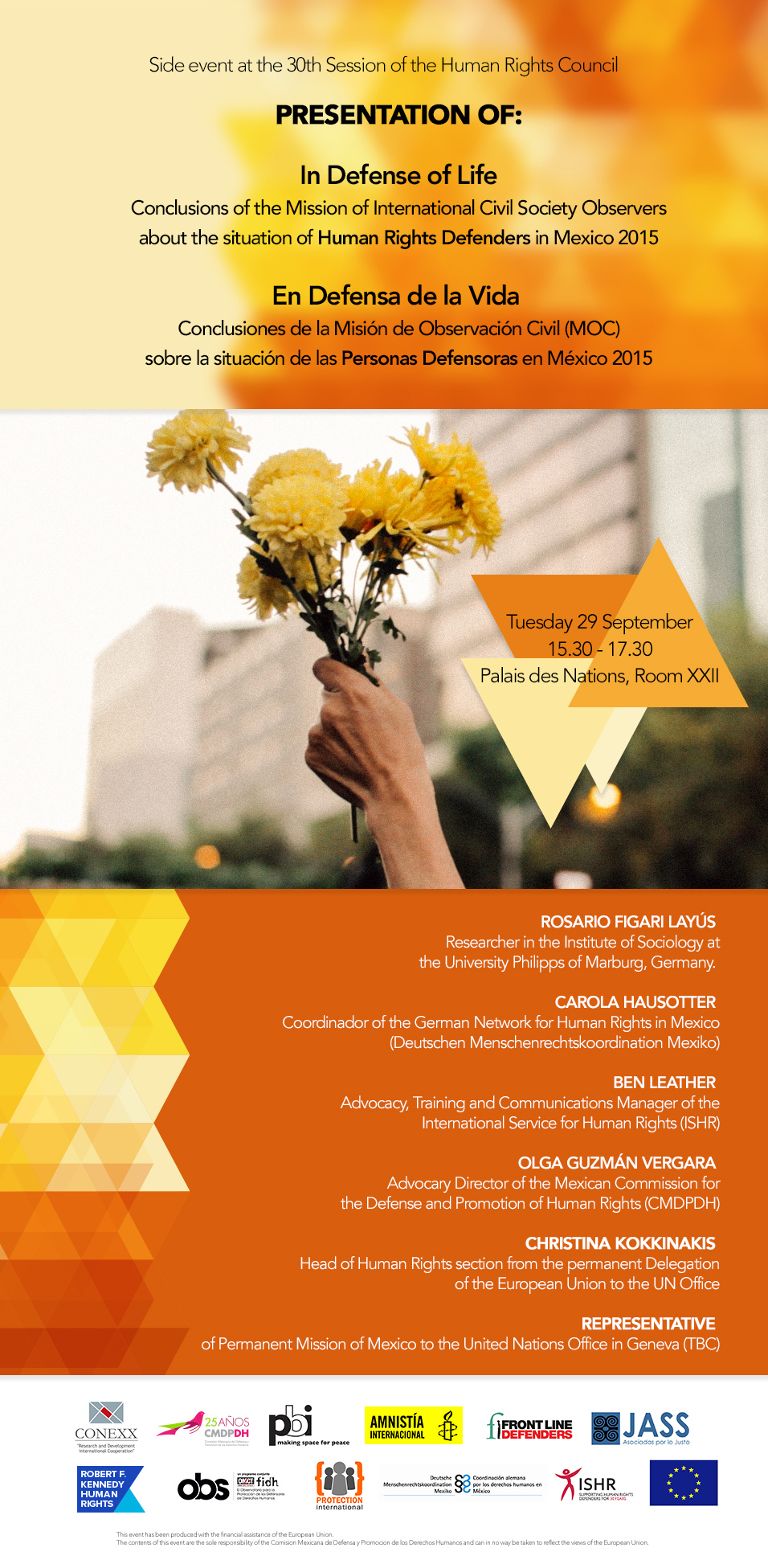
On Tuesday 29 September (15h30 – 17h30, Palais des Nations, Room XXII, Geneva), the CMDPDH, Asociación Civil and ISHR organise a side event about the situation for human rights defenders in Mexico. [A Mission of International Observers visited Mexico in November 2015 and will present its conclusions – under the title “In Defense of Life” – to the Mexican Government within the framework of the 30th session of the Human Rights Council.]
Panelists in the event are::
Rosario Figari Layús – Researcher in the Institute for Interdisciplinary Research on Conflict and Violence (IKG) at the University of Bielefeld, Germany.
Carola Hausotter – Coordinador of the German Network for Human Rights in Mexico (Deutschen Menschenrechtskoordination Mexiko)
Ben Leather – Advocacy, Training and Communications Manager of the International Service for Human Rights (ISHR)
Olga Guzmán Vergara – Advocary Director of the Mexican Commission for the Defense and Promotion of Human Rights (CMDPDH)
Ambassador Jorge Lomónaco Tonda – Permanent Representative of Mexico to the UN in Geneva (TBC)
Christina Kokkinakis – Head of Human Rights section from the Permanent Delegation of the European Union to the UN in Geneva
Health and holidays (in that order) have slowed down my blog production somewhat this summer, but perhaps this was a welcome break for many of my readers for reasons of holiday and health (in that order I hope). Anyway, during these summer months I read quite some instances of HRD repression related to countries involved in major ‘geo-political’ progress and I started wondering whether this is coincidental. Take the following three cases: Colombia, Iran and Cuba. Read the rest of this entry »


 Hans Thoolen on Human Rights Defenders and their awards