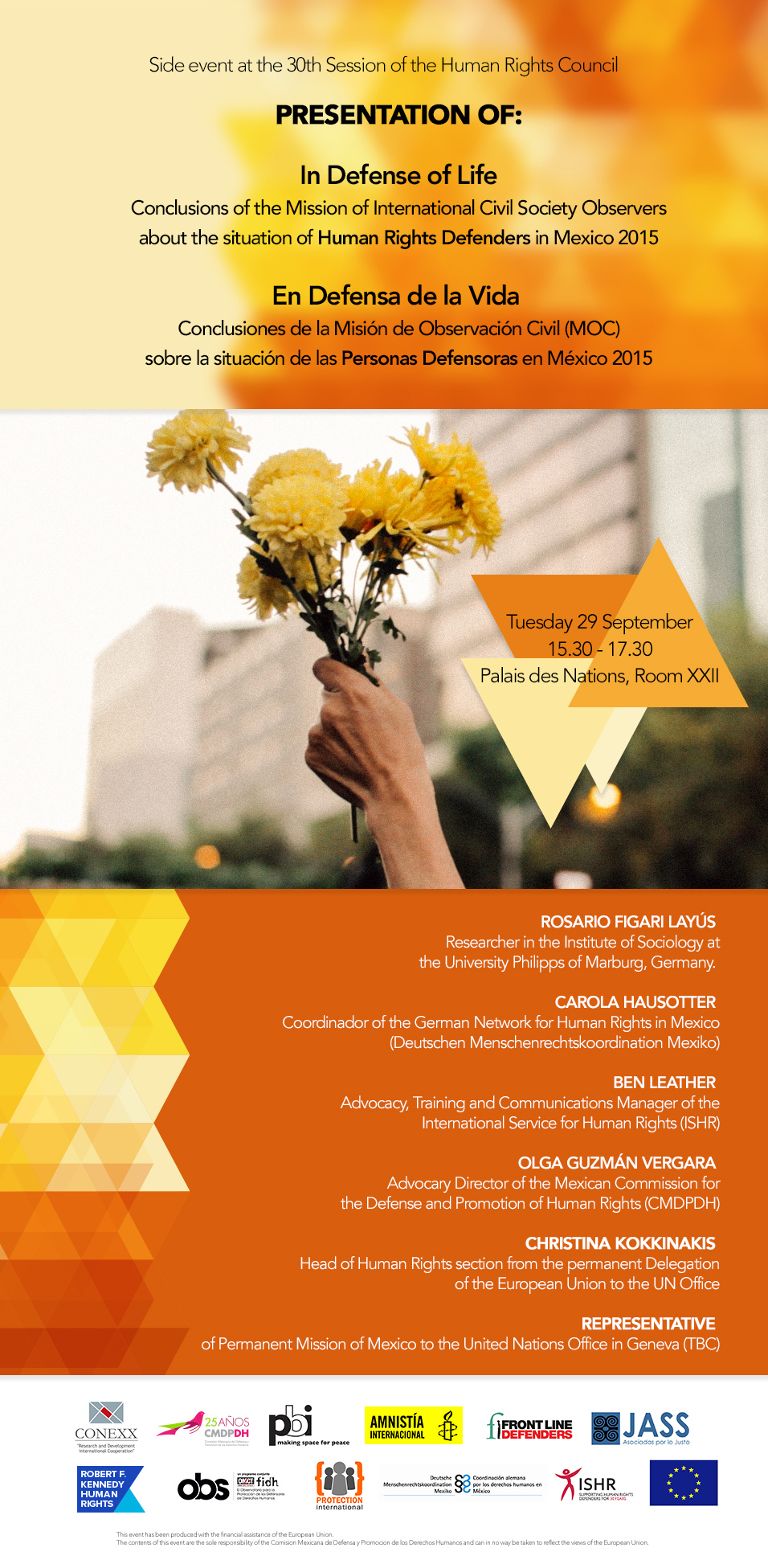
On Tuesday 29 September (15h30 – 17h30, Palais des Nations, Room XXII, Geneva), the CMDPDH, Asociación Civil and ISHR organise a side event about the situation for human rights defenders in Mexico. [A Mission of International Observers visited Mexico in November 2015 and will present its conclusions – under the title “In Defense of Life” – to the Mexican Government within the framework of the 30th session of the Human Rights Council.]
Panelists in the event are::
Rosario Figari Layús – Researcher in the Institute for Interdisciplinary Research on Conflict and Violence (IKG) at the University of Bielefeld, Germany.
Carola Hausotter – Coordinador of the German Network for Human Rights in Mexico (Deutschen Menschenrechtskoordination Mexiko)
Ben Leather – Advocacy, Training and Communications Manager of the International Service for Human Rights (ISHR)
Olga Guzmán Vergara – Advocary Director of the Mexican Commission for the Defense and Promotion of Human Rights (CMDPDH)
Ambassador Jorge Lomónaco Tonda – Permanent Representative of Mexico to the UN in Geneva (TBC)
Christina Kokkinakis – Head of Human Rights section from the Permanent Delegation of the European Union to the UN in Geneva
Health and holidays (in that order) have slowed down my blog production somewhat this summer, but perhaps this was a welcome break for many of my readers for reasons of holiday and health (in that order I hope). Anyway, during these summer months I read quite some instances of HRD repression related to countries involved in major ‘geo-political’ progress and I started wondering whether this is coincidental. Take the following three cases: Colombia, Iran and Cuba. Read the rest of this entry »
Another speaker at the Oslo Freedom Forum (OFF) 2015 was Charlie Hebdo columnist, Zineb El Rhazoui, who paid tribute to her colleagues slain in the January 2015 attacks [she was at the time of the attack abroad] and describes her own experience facing thousands of death threats. In her passionate defense of free speech, El Rhazoui argues that criticism of religion should be encouraged, not avoided. The personal touch in her presentation is moving.
As reported by many newspapers including Al-Jazeera (Asad Hashim on 25 April) Sabeen Mahmud, a prominent Pakistani human rights defender, has been shot dead, shortly after hosting an event on Balochistan’s “disappeared people”, in the southern city of Karachi. Mahmud, 40, was the director of T2F [The Second Floor], a café and arts space that has been a mainstay of Karachi’s activists since it opened its doors in 2007. She was one of the country’s most outspoken human rights advocates. Mahmud was shot four times at close range and pronounced dead on arrival at the National Medical Centre hospital on Friday 24 April at 9.40pm.
Mahmud and her mother were on their way from an event (“Unsilencing Balochistan,” hosted at T2F, with Baloch human rights activists Mama Qadeer, Farzana Majeed and Muhammad Ali Talpur) when her car came under fire from unidentified gunmen, according to police. Her mother was also shot twice, but was out of immediate danger, hospital officials said.
The Voice of Baloch Missing Persons organisation, which both activists belong to, says that more than 2,825 people have “disappeared” in this way since 2005. They allege the disappearances, which are mostly of Baloch rights activists and students, have been carried out by the Pakistani government and its powerful ISI intelligence agency, a charge the agency denies.
“Sabeen was a voice of reason, pluralism and secularism: the kind of creed that endangers the insidious side of constructed Pakistani nationalism,” Raza Rumi, a rights activist who escaped an assassination attempt in March 2014 and now lives in the United States out of fear for his life, told Al Jazeera.
In the morning of 24 February 2015, the bodies of human rights defender Ms Intissar Al Hasairi and her elderly aunt were discovered in the boot of the human rights defender’s car in Tripoli, Libya, by security forces. The human rights defender and her aunt had allegedly been shot by members of an armed group. The human rights defender had been missing since the previous evening. Read the rest of this entry »
reports that on 11 February 2015, land rights defender Mr Chai Bunthonglek was shot and killed at his home in Chaiburi District, Thailand, by an unknown man. Reportedly, the perpetrator fired six bullets at the human rights defender.
[Chai Bunthonglek was a member of the Southern Peasants’ Federation of Thailand – SPFT, a network formed in 2008 to campaign for the right to agricultural land. Chai Bunthonglek is the fourth member of SPFT who has been killed. On 19 November 2012, Ms Montha Chukaew and Ms Pranee Boonrat were shot by unknown individuals near the village of Khlong Sai Pattana in Surat Thani Province. In 2010, Ms Somporn Pattaphum was also shot dead in the area.]
The killing follows the recent incommunicado detention of Mr Pianrat Boonrit, the President of SPFT, on 3 February 2015. The human rights defender was released by the military on 5 February 2015, reportedly on condition that he would mediate between the army and the Premsub Community, and urge the community to leave the area. Allegedly, Pianrat Boonrit was threatened with seven days’ detention if he did not convince the community to leave the land. The human rights defender had been arrested and detained when he presented himself at the Vibhavadi Rangsit Military Camp, Surat Thani Province, in response to a summons to attend an “attitude adjustment camp” for three days.
Front Line Defenders strongly condemns the killing of Chai Bunthonglek, which it believes to be directly linked to his peaceful and legitimate work in the defence of land rights. Front Line Defenders is gravely concerned for the physical and psychological integrity and security of Pianrat Boonrit and other members of SPFT.
The Office of the UN High Commissioner for Human Rights [OHCHR] published today (10 February) a report, which will be formally presented to the Human Rights Council only in March, describing the situation of human rights in Libya during 2014. It paints a bleak picture of increasing turmoil and lawlessness, fanned by a multitude of heavily armed groups amid a broadening political crisis. Rampant violence and fighting, including in the country’s two biggest cities, Tripoli and Benghazi, as well as many other cities and towns across the country, is badly affecting civilians in general and particularly cases of harassment, intimidation, torture, numerous abductions, and summary executions of human rights defenders, civil society activists, journalists and other media professionals, as well as members of the judiciary, politicians and law enforcement officers.
The report, produced in conjunction with the UN Support Mission in Libya (UNSMIL), also describes numerous incidents of violence against women over the past year, including reports of threats, attacks and killings of female human rights defenders, politicians and other women in public positions. Minority groups, including Egyptian Coptic Christians, have also been increasingly targeted. The report also highlights the extremely vulnerable situation of migrants.
Thousands of people remain in detention – mostly under the effective control of armed groups – with no means of challenging their situation as prosecutors and judges are unable or unwilling to confront the armed groups. UN human rights staff have received reports of torture or other ill-treatment in many places of detention. The deteriorating security environment has impacted heavily on the justice system, which is no longer functioning in parts of the country. Prosecutors and judges have frequently been subjected to intimidation and attacks, in the form of court bombings, physical assaults, abduction of individuals or family members and unlawful killings.
The report highlights the need to strengthen State institutions, ensure accountability for human rights violations and support the ongoing political dialogue.
On Wednesday 14 January, Front Line Defenders launched its 2015 Annual Report, “Human Rights Defenders, Lives in the Balance” which examines in detail the deteriorating situation for human rights defenders (HRDs) around the world in the period January – December 2014.
The report was launched at a press conference in Dublin with as keynote speaker Mary Akrami, Co-founder and Director of the Afghan Women Skills Development Centre which was the first safe house for women and children in Afghanistan.
Mary Akrami, Andrea Rocca, and Mary Lawlor from Front Line Defenders launch the report.
Over the last two years Front Line Defenders has documented a growing global backlash against human rights defenders (HRDs) which has now reached crisis point. Against this backdrop, international human rights institutions as well as governments traditionally supportive of human rights defenders appear to be incapable of forcefully and effectively opposing the shutting down of civil society space.
“This is a crucial political moment. If we are to challenge the systematic erosion of human rights standards there needs to be a more consistent and credible political response, which must give the same priority and resources to creating a safe space for HRDs as authoritarian governments give to closing it down” said Front Line Defenders Executive Director, Mary Lawlor. “There can be no human rights progress if those at the forefront of human rights work are not allowed to work”.
The report highlights:
• that over 130 HRDs were killed or died in detention in the first ten months of 2014 as reported to Front Line Defenders
• Colombia accounted for 46 of those 130 HRDs killed in 2014
• The Americas overall claimed 101 of the 130 HRDs killed in 2014
• Globally, deprivation of liberty and court proceedings were the most widely used strategies to silence and intimidate HRDs
• Repressive laws continued their viral spread across the world with the growth of cut and paste repression as governments replicate legislation
• HRDs are exposed to digital attacks.
A staff report in the Daily Times of 13 December 2014 mentions a report by the Democratic Commission for Human Development (DCHD) in Pakistan which concludes that 62% of human rights organisations received threats from one quarter or another, including religious extremist groups, feudal, political groups and law enforcement agencies.
The report on “Human Rights Organizations in Pakistan: Risk & Capacity Assessment” was launched on Friday 12 December 2014 in Lahore in the presence of the Minster for Human Rights Punjab Khalil Tahir Sindhu, journalist Hussain Naqi, Director National Commission for Justice and Peace (NCJP) Peter Jacob, human rights defender Dr Fauzia Waqar, Sandra Petersen from Norwegian Human Rights Fund and large number of civil society representatives.
Women rights, child rights, minority rights (blasphemy cases), labour rights, and gender-based violence emerged as thematic areas increasing risk for HRDs. Human rights defenders generally face high risks, with increasing volatile political climate and growth of religious fundamentalism. Yet, 57% of organizations made no changes in work strategies after being threatened.
Somali News on 7 December reports on a meeting of the National Union of Somali Journalists ahead of the International Human Rights Day 2014 to highlight the violations against the Human Rights Defenders, especially the attacks against the press in Somalia including harassment, intimidation, unlawful or arbitrary arrest and detention. That thinking about the death penalty differs greatly in the world is shown by the satisfaction expressed about the death penalty meted out to the killer of a journalist.