Posts Tagged ‘killing’
May 18, 2016
American Jewish World Service (AJWS) reported that on Friday, 6 May 2016, Salvadoran human rights defender, Angélica Miriam Quintanilla Hernández, was killed. Angélica, a sex worker activist, leader and AJWS grantee, was assassinated just two blocks from her office in El Salvador. Read the rest of this entry »
Posted in human rights, Human Rights Defenders | Leave a Comment »
Tags: American Jewish World Service (AJWS), Angélica Miriam Quintanilla Hernández, El Salvador, in memoriam, killing, murder, profiles, sex workers, woman human rights defender
April 13, 2016

The National Coalition of Human Rights Defenders – Kenya (NCHRD-K) and DefendDefenders (East and Horn of Africa Human Rights Defenders Project) expressed their outrage over the killing of human rights defender John Waweru on Monday 11 April 2016 in Zimmerman, Nairobi. John Waweru was the director of Githunguri Constituency Ranching Company and a committed human rights defender working towards the promotion and protection of economic and social rights. He was at the forefront of advocacy against forced evictions of individuals residing on contested land in Kiambu County.
The killing of John Waweru comes cynically shortly after the UN Human Rights Council adopted a resolution on the protection of human rights defenders addressing economic, social and cultural rights in March 2016 [see: https://thoolen.wordpress.com/2016/03/25/human-rights-council-adoption-landmark-resolution-protection-defenders-economic-social-cultural-rights/]
The NCHRD-K and DefendDefenders recall other cases against human rights defenders in Kenya, such as:
Joel Ogada, a human rights defender in Kilifi County who has been a leading advocate for land rights against the neighbouring Salt farms has faced three criminal charges, one of which resulted in him being sentenced to two years in prison after appeal. He was released in September 2015 and barely six months after his release, in March 2016, he was rearrested and charged with attempting to kill.
In 2013, Hassan Guyo, the Programme Director for Strategies for Northern Development (SND), an organisation that promotes human rights for women and children and works on refugee and human trafficking issues in Moyale was killed by security forces.
In 2009, HRDs Oscar Kingara and Paul Oulu of Oscar Foundation were shot dead in Nairobi.
In all of these matters, no one has been held to account and police investigations have been inconclusive.

For more information, contact Hassan Shire  Executive Director, East and Horn of Africa Human Rights Defenders Project: executiveATdefenddefenders.org.
www.defenddefenders.org
Posted in Human Rights Defenders | Leave a Comment »
Tags: East and Horn of Africa Human Rights Defenders Project, ESC rights, forced evictions, Hassan Guyo, Hassan Shire, Joel Ogada, John Waweru, Kenya, killing, land rights, National Coalition of Human Rights Defenders – Kenya, Oscar Kingara, Paul Oulu, social economic and cultural rights
March 16, 2016
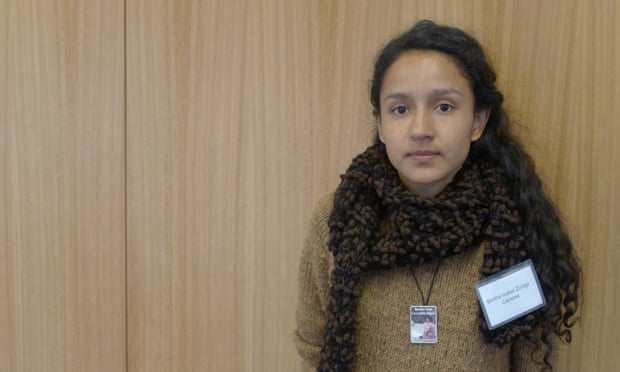
Bertha Cáceres, daughter of murdered Honduran environmental activist Berta Cáceres. Photograph: Liz Ford for the Guardian
This week, Bertha, who is studying for a masters degree in Latin American studies in Mexico, was in New York to speak at side events during the annual Commission on the Status of Women. Here she said “… I will talk about the situation in Honduras. This is not the first assassination, but one of a series of assassinations of human rights defenders … I don’t want another human rights defender to be assassinated”. Even while she spoke with the Guardian journalist a call came through from COPINH’s lawyer (the NGO her mother worked for) to say another member of the organisation had been shot dead ….
According to a statement by Front Line Defenders today, this human rights defender, Nelson Garcia, was returning home following a violent eviction conducted by the Public Order Military Police and the Cobras Special Force in the municipality of Río Lindo when he was intercepted by unidentified men who shot him in the face four times. Read the rest of this entry »
Posted in Front Line, Human Rights Defenders | Leave a Comment »
Tags: Agua Zarca, assassination, Berta Cáceres, COPINH, Development Cooperation, environmental issues, FMO, Front Line (NGO), Honduras, killing, land rights defender, Ministry of Foreign Affairs Netherlands, Nelson Garcia, the Guardian
March 7, 2016
A group of over 50 international organizations has written to the President of Honduras to express their shock over the recent killing of Berta Cáceres [https://thoolen.wordpress.com/2016/03/03/berta-caceres-human-rights-defender-assassinated-today-in-honduras/], to demand an international investigation and the immediate protection of Gustavo Castro Soto, a Mexican activist, who witnessed her assassination. Here is the letter and signatories in full: Read the rest of this entry »
Posted in Human Rights Defenders | 8 Comments »
Tags: assassination, Berta Cáceres, Civil society, environmental activists, Gustavo Castro Soto, Honduras, indigenous groups, investigation, Juan Orlando Hernández, killing, land rights defender, Lenca Indigenous People, NGOs, woman human rights defender
March 3, 2016
A sad day for Honduras and all human rights defenders: today, 3 March 2016, Berta Cáceres was murdered by as yet unknown assailants who broke into her home in the city of La Esperanza in the early hours of the morning. One week prior to her assassination, the defender had denounced the killing of 4 leaders of her community as well as threats against her and other human rights defenders, at a press conference.

Berta Cáceres was one of the most prominent human rights defenders in Honduras and a Lenca indigenous woman who, for the past 20 years, had been defending the territory and rights of the Lenca people. In 1993, she co-founded the Consejo Civico de Organizaciones Populares e Indígenas de Honduras – COPINH (http://www.copinh.org/) (Civic Council of Popular and Indigenous Organisations of Honduras), which led fierce campaigns against illegal logging and mega-projects for their detrimental effects on the rights of indigenous peoples in the country. She faced off – and often won – against illegal loggers, plantation owners, multinational corporations, and dam projects that would cut off food and water supplies to indigenous communities. (e.g. https://thoolen.wordpress.com/2014/01/28/berta-caceres-in-honduras-continues-to-be-harassed-in-spite-of-court-order).
The human rights defender was a finalist for the 2014 Front Line Defenders Award [https://www.frontlinedefenders.org/es/programme/fld-award] and in 2015 she received the Goldman Environmental Prize. She had been a beneficiary of precautionary measures granted by the Inter-American Commission on Human Rights (IACHR) since 2009. Her harassment was followed closely by Front Line and others.
Other human rights defenders (including members of COPINH) have been targeted in the past. The killing of human rights defenders and impunity for the perpetrators have been documented by many organizations. In this blog alone:
https://thoolen.wordpress.com/2016/01/29/assassination-of-human-rights-defenders-proceed-in-honduras-venezuela-peru-colombia-and-the-philippines/
https://thoolen.wordpress.com/2016/02/27/alarming-criminalisation-of-human-rights-defenders-in-latin-america/
“the most dangerous place to be an environmental activist was actually Honduras, according to Global Witness” [https://thoolen.wordpress.com/2015/04/24/killings-of-environmental-human-rights-defenders-up-again-compared-to-last-year/]
Honduras: Berta Caceres, human rights defender & indigenous leader who opposed Agua Zarca dam, assassinated | Business & Human Rights Resource Centre
Posted in awards, Front Line, human rights, Human Rights Defenders | 3 Comments »
Tags: assassination, Berta Cáceres, COPINH, Front Line (NGO), Global Witness, Goldman Environmental Prize, Honduras, indigenous groups, judicial harassment, killing, land rights defender, woman human rights defender
January 13, 2015
Paul Mwilambwe, a major suspect in the
Congolese Chebeya-Bazana case was indicted by a Senegalese court and placed under judicial supervision in Dakar on 8 January 2015. This decision was taken following a criminal complaint based on universal jurisdiction filed on 2 June 2014 by lawyers of the
FIDH Litigation Action Group (LAG) and the families of
Floribert Chebeya and Fidèle Bazana, the two Congolese human rights defenders who were assassinated in June 2010. FIDH hopes that these efforts of the
Senegalese judicial authorities contribute to identifying the persons responsible for these assassinations and the disappearance of these two human rights defenders.

“That Paul Mwilanbwe has been indicted and heard by an independent investigative judge is a fundamental step on the road to truth and, we hope, to the justice which has not been available to the victims’ families in DRC” , said Patrick Baudouin, FIDH Honorary President. “This is the first time since the Hissène Habré case that a case based on extra-territorial jurisdiction is being tried in Senegal, a step which sends a strong, positive signal showing that the Senegalese judiciary intends to play an active role in the fight against impunity for the most serious crimes committed in Africa”.
“Since the Democratic Republic of Congo did not provide for equitable judicial proceedings, we initiated the proceedings in Senegal to ensure that an impartial and independent investigation would be carried out and that full information would be obtained on the murder and the enforced disappearance of the victims, Floribert Chebeya and Fidèle Bazana. We wanted an independent judge to hear Paul Mwilambe, an actor in this tragedy, and this has happened today,” said Assane Dioma Ndiaye, a lawyer for the FIDH LAG and for the Chebeya and Bazana families.
Paul Mwilambwe, a major in the Congolese National Police force (PNC), was in charge of security for the office of General John Numbi, Head of the PNC at the time of the events, in the premises where Floribert Chebeya and Fidèle Bazana were killed. Shortly after these killings, Paul Mwilambwe fled to a country somewhere in Africa before going to Senegal. In a filmed interview with France 24 (in French), whilst still on the run, Mwilambwe testified and denounced his own participation and the role and involvement of senior members of the Congolese police, including General John Numbi in the enforced disappearance and murder of the two human rights defenders.
“For us, this indictment gives us great hope to obtain the truth and justice that was refused to us in Congo where the justice system is bogged down. I want to know where my husband was buried. I want someone to tell me where he is. And I want to be able to bury him with dignity” , said Marie-José Bazana, the wife of Fidèle Bazana whose body has still not been found.
https://thoolen.wordpress.com/2013/06/10/death-of-floribert-chebeya-and-fidele-bazana-in-drc-still-unresolved-after-3-years/
[Background: On 2 June 2010, Floribert Chebeya, Executive Director of the NGO Voix des sans Voix (Voice of the Voiceless – VSV), was found dead in his car in a suburb of Kinshasa. His close associate Fidele Bazana was reported missing. The day before, the two human rights defenders had shown up at PNC headquarters to meet with its Director, the Inspector-General, and General John Numbi. They did not emerge from this meeting alive. Faced with the public outcry triggered by the murder of Mr. Chebeya and disappearance of Mr. Bazana, the Congolese authorities were obliged to open an investigation. This investigation culminated in the precautionary suspension of General John Numbi and the imposition of murder indictments for eight police officers, including Paul Mwilambwe, who fled.
On 23 June 2011, following a trial marked by numerous incidents the military court on 23 June 2011 in Kinshasa acknowledged the civil responsibility of the Congolese state for the murder of Mr. Chebeya, as well as in the abduction and illegal detention of Mr. Bazana by several of its officers. The court convicted five of the eight police officers accused. Four were sentenced to death and one to life imprisonment. Three of those condemned to death are still on the run, and three of the police officers found to have played a role in the disappearance of Mr. Bazana, have since been acquitted. On 7 May 2013, the Military High Court, sitting as a court of appeal, declared itself incompetent to investigate the procedural issues in the case and decided to turn the proceedings over to the Supreme Court, operating as a constitutional court. In practice, this decision suspended the appeal proceedings, which remain deadlocked in DRC to date. In addition, Congolese authorities have never instituted proceedings to investigate the role played by General John Numbi, who has since been replaced as Head of the PNC, despite evidence and the complaints filed by the families of the two human rights defenders.]
The Chebeya-Bazana case: indictment of Paul Mwilambwe in (…).
Posted in FIDH, human rights, Human Rights Defenders | 1 Comment »
Tags: abduction, Congo, Democratic Republic of Congo, Fidèle Bazana, FIDH, Floribert Chebeya, Human Rights Defenders, international jurisdiction, John Numbi, killing, Paul Mwilambwe, security forces, Senegal, Voix des sans Voix
September 26, 2014

The United Nations human rights High Commissioner for human rights today condemned the recent brutal, cold-blooded slaying by the Islamic State of Iraq and the Levant (ISIL) of Iraqi human rights defender Sameera Salih Ali Al-Nuaimy, as well as the continuing detention, sexual exploitation and sale of hundreds of women and girls in areas captured by the militant group. Read the rest of this entry »
Posted in human rights, Human Rights Defenders, OHCHR, UN | Leave a Comment »
Tags: arbitrary execution, conflict, High Commissioner for Human Rights, Human Rights Defenders, human rights of women, Iraq, ISIL, killing, Middle East, Mosul, repression, Sameera Salih Ali Al-Nuaimy, UN, WNN, woman human rights defender, Zeid Ra'ad Al Hussein
September 16, 2014
 just published two recent reports on kidnappings in DRC. The first is that on 13 September 2014, the corpse of human rights defender Mr Mutebwa Kaboko was found in a forest, eight days after he was kidnapped by an armed group. Mutebwa Kaboko was a training facilitator for the organisation Aide Rapide aux Victimes des Catastrophes – ARVC, created in 2008 to help disaster victims, especially women and vulnerable children. Now operating in the territories of Uvira and Fizi Walungu, the association has led a campaign against the phenomenon of forced marriage. He was abducted by men suspected of belonging to an armed group known as Mayi Mayi Yakutumba. [On 20 June 2014, Mutebwa Kaboko was abducted in a similar way by elements of Mayi Mayi Yakutumba. He had apparently denounced their presence in the locality of Katete. They had held Mutebwa Kaboko in the open forest for five days before releasing him.]
On 14 September two other human rights defenders, Ms Neema Bitu and Mr Jacques Muganga, were found back after being kidnapped and held for two days by members of a rebel group. The two defenders are investigators of l’Action des Femmes Contre la Torture – AFCT (Action for Women Against Torture), an organisation defending the rights of women based in the village of Mwaba Kangando/Kiliba, tens of kilometers from the town of Uvira near the border between Burundi and the DRC. The perpetrators are this time suspected of belonging to Forces Nationales de Libération du Burundi, a rebel group composed mostly of Burundian combatants and operating in parts of South Kivu in the DRC. On the night of 13 September 2014, the two defenders were able to escape from their captors while they were firing on the government army. Their colleagues found them at dawn on 14 September 2014 at approximately. During their captivity, they reportedly suffered terrible beatings and now require emergency medical treatment.
This follows the abduction and detention on 1 September 2014, of human rights defenders Mr Célestin Bambone, Ms Marie Amnazo and Ms Kongwa Tulinabo [from the Action Paysanne pour le Développement et la Promotion des Droits de l’Homme (Peasant Action for the Development and Promotion of Human Rights – APDPDH), a human rights organisation based in Mugutu, in the South Kivu province and specialising in the monitoring of human rights violations in Mugutu and surrounding villages].
Posted in Front Line, human rights, Human Rights Defenders | Leave a Comment »
Tags: abduction, conflict, congo drc, DRC, Front Line (NGO), Human Rights Defenders, human rights violations, intimidation, kidnapping, killing, Mayi Mayi Yakutumba, monitoring, murder, Mutebwa Kaboko, rights of women
June 29, 2014
 (Salwa Bugaighis in March 2014. – Photograph: National Dialogue Preparatory Commission/AP)
On 25 June 2014, the human rights lawyer, Salwa Bugaighis was killed in the Libyan city of Benghazi,, reports Jon Lee Anderson in the New Yorker of 27 June. NDERSON. Bugaighis, fifty years old, was fighting for a democratic, open society. “Along with her husband, Issam, and her sister Iman, she was at the forefront of the uprising against Muammar Qaddafi; later, she sat on the hastily declared transitional council that sought to bring order to the excited anarchy that followed Qaddafi’s fall. As that anarchy turned to bedlam, Bugaighis worked to reconcile Libya’s feuding groups—even as her life was threatened, and as other critics of the militias were murdered. She had been spending time abroad, because of such threats, but came home for the elections.Yesterday, just after she returned from voting in parliamentary elections, gunmen surprised her at her house and shot her to death. Issam, who was abducted in the incident, is still missing.
via: A Death in Benghazi: Salwa Bugaighis : The New Yorker.
(Salwa Bugaighis in March 2014. – Photograph: National Dialogue Preparatory Commission/AP)
On 25 June 2014, the human rights lawyer, Salwa Bugaighis was killed in the Libyan city of Benghazi,, reports Jon Lee Anderson in the New Yorker of 27 June. NDERSON. Bugaighis, fifty years old, was fighting for a democratic, open society. “Along with her husband, Issam, and her sister Iman, she was at the forefront of the uprising against Muammar Qaddafi; later, she sat on the hastily declared transitional council that sought to bring order to the excited anarchy that followed Qaddafi’s fall. As that anarchy turned to bedlam, Bugaighis worked to reconcile Libya’s feuding groups—even as her life was threatened, and as other critics of the militias were murdered. She had been spending time abroad, because of such threats, but came home for the elections.Yesterday, just after she returned from voting in parliamentary elections, gunmen surprised her at her house and shot her to death. Issam, who was abducted in the incident, is still missing.
via: A Death in Benghazi: Salwa Bugaighis : The New Yorker.
Posted in human rights, Human Rights Defenders | 3 Comments »
Tags: Arab spring, human rights lawyer, in memoriam, Issam Bugaighis, killing, Libya, Muammar Qaddafi, New Yorker, pro-democracy activists, Qaddafi, Salwa Bugaighis, woman human rights defender
May 27, 2014

(Picture taken May 25 shows the domestic and foreign passports of Russian rights defender Andrei Mironov, reportedly killed near Ukrainian town of Slavyansk. AFP POOL-/AFP/GETTY IMAGES)
“It’s hard for me to believe that Andrei Mironov is dead” writes
Olivia Ward, Foreign Affairs Reporter of the Toronto Star on 25 May 2014. Indeed a terrible shock. I met him for the first time in 2004 when he accompanied the MEA Laureate
Lida Yusupova of
Memorial to the ceremony in Geneva. According to an
Agence France- Presse report from Slavyansk, Ukraine, the veteran
Russian human rights defender and sometime war zone fixer, used up the last of his nine lives on Sunday. He was acting as a translator for Italian photojournalist Andrea Rocchelli, who was also killed. According to a French photographer who escaped with leg wounds, the two men were hit by shrapnel from mortar shells as government troops and pro-Russian separatists continued to battle for territory in eastern Ukraine.
Olivia Ward describes Andrei as a “slight, self-effacing man of 60, with a puckish sense of humour, he belied his frail appearance with an iron will to do good in the world. In 1986, that got him a year in a Soviet labour camp as an “anti Soviet dissident” – a time he used to channel his talent for languages, including French and Italian. Nor did he let up on government abuses after the fall of the Soviet Union. As a human rights campaigner linked with the venerable rights organization Memorial , he snapped at the heels of Boris Yeltsin’s and Vladimir Putin’s governments, especially during the two bloody wars when Russian troops battled Chechen separatist fighters…..“You don’t understand,” he rasped. “I have to go and witness what is happening. If I don’t, who will?”
“Andrei dodged so many bullets in his decades of battling impunity that it is hard to believe he is gone. It would be harder still if the truth were buried along with him” concludes Olivia Ward, who covered the former Soviet Union as bureau chief and correspondent from 1992 to 2002. For the full story see: Death in Ukraine: bitter end for Russian human rights hero | Toronto Star.
Posted in human rights, Human Rights Defenders, MEA | Leave a Comment »
Tags: AFP, Andrei Mironov, conflict, death, dissidents, Human rights defender, in memoriam, killing, Lida Yusupova, MEA 2004, Memorial, monitoring, Olivia Ward, russian, Ukraine


 Hans Thoolen on Human Rights Defenders and their awards