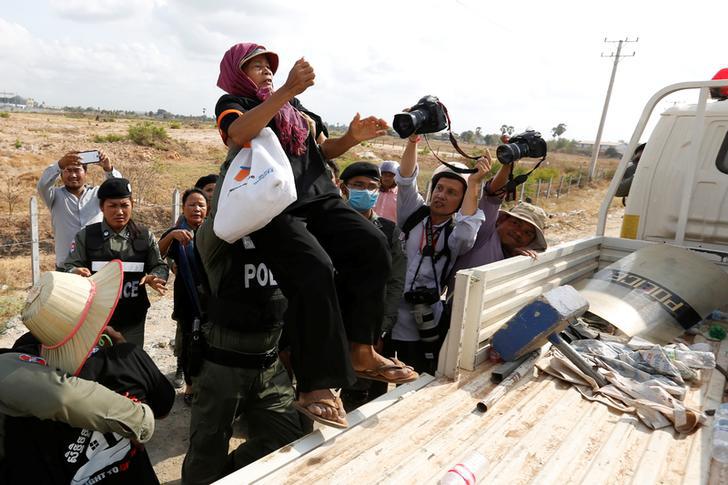
I was reading (belatedly) about the UN Special Rapporteur on the situation of human rights in Cambodia, Rhona Smith, who in January 2017 intervened strongly in the case of the 5 Cambodian human rights defenders of ADHOC (#FreeThe5KH) who have been in detention since April last year. [https://humanrightsdefenders.blog/2016/05/04/civil-society-condemns-charges-human-rights-defenders-cambodia/]Only then did I realize that the case had led a few months earlier to a landmark decision by the United Nations Working Group on Arbitrary Detention (WGAD): the first time that any UN body has referred to HRDs as a protected group.
On 21 November 21, 2016, the WGAD ruled that the ongoing detention of Mr. Ny Chakrya, Deputy Secretary-General of the National Election Committee (NEC), and four staff members of the Cambodian Human Rights and Development Association (ADHOC), Messrs. Ny Sokha, Yi Soksan, Nay Vanda, and Ms. Lim Mony, was “arbitrary.” Following a submission made by the Observatory for the Protection of Human Rights Defenders (OMCT-FIDH partnership), the Cambodian Center for Human Rights (CCHR) and the Cambodian League for the Promotion and Defense of Human Rights (LICADHO) in June 2016, the WGAD’s Opinion No. 45/2016 ruled that the five human rights defenders (HRDs) “have been discriminated against based on their status as human rights defenders, and in violation of their right to equality before the law and equal protection of the law under article 26 of the ICCPR.” This is the first time ever that the WGAD – or any other UN mechanism receiving individual complaints – has referred to HRDs as a protected group that is entitled to equal legal protection under Article 26 of the International Covenant on Civil and Political Rights (ICCPR). The ruling also recognised the violation of the five HRDs’ “rights to offer and provide professionally qualified legal assistance and other relevant advice and assistance in defending human rights.”
In addition, the WGAD found that the targeting of ADHOC staff members for having provided “legitimate legal advice and other assistance” violated the five HRDs’ right to freedom of association. It ruled that violations of fair trial rights (including the fact that the five were denied legal counsel from the beginning of their questioning), unjustified pre-trial detention, and statements made by the Cambodian authorities which denied the five the presumption of innocence – all of which contravene Cambodia’s international human rights obligations in respect to the right to a fair trial – are also serious enough to consider their ongoing detention as arbitrary. The WGAD concluded that “the deprivation of liberty ofNy Sokha, Nay Vanda, Yi Soksan, Lim Monyand Ny Chakrya, being in contravention of articles 7, 9, 10, 11 and 20 of the Universal Declaration of Human Rights and of articles 9, 10, 14, 22 and 26 of the International Covenant on Civil and Political Rights, is arbitrary.”
That Cambodian authorities are not impressed is shown by the continued detention of the 5 ADHOC HRDs and by the press release of 7 February 2017 calling for the cessation of the politically motivated criminal investigation of human rights defenders Am Sam-at and Chan Puthisak. Amnesty International, Civil Rights Defenders, Human Rights Watch, and the International Commission of Jurists signed the statement.
Cambodian officials have accused Sam-at, a respected human rights monitor at the Cambodian League for the Promotion and Defense of Human Rights (LICADHO) for nearly 20 years, and Puthisak, a land rights activist from Boeung Kak Lake and former prisoner of conscience, of instigating violence at an October 10, 2016 demonstration. Para-police forces, who are regularly used to suppress demonstrations, violently dispersed what had been a peaceful protest in Phnom Penh. When Puthisak attempted to prevent para-police from confiscating a drum that was being used by a demonstrator, four or five para-police attacked him, repeatedly beating him on the head with their fists, according to a video of the incident. When Sam-at tried to stop the assault, the para-police attacked him, also beating him on the head. Both men sustained injuries that needed medical attention.
“The investigation of Sam-at and Puthisak by the Cambodian authorities is a typically absurd and undisguised case of judicial harassment,” said Champa Patel, Southeast Asia and Pacific director at Amnesty International. “As usual, unnecessary and excessive use of force by the para-police goes unpunished, and those who work to promote and protect human rights find themselves subject to criminal proceedings.”
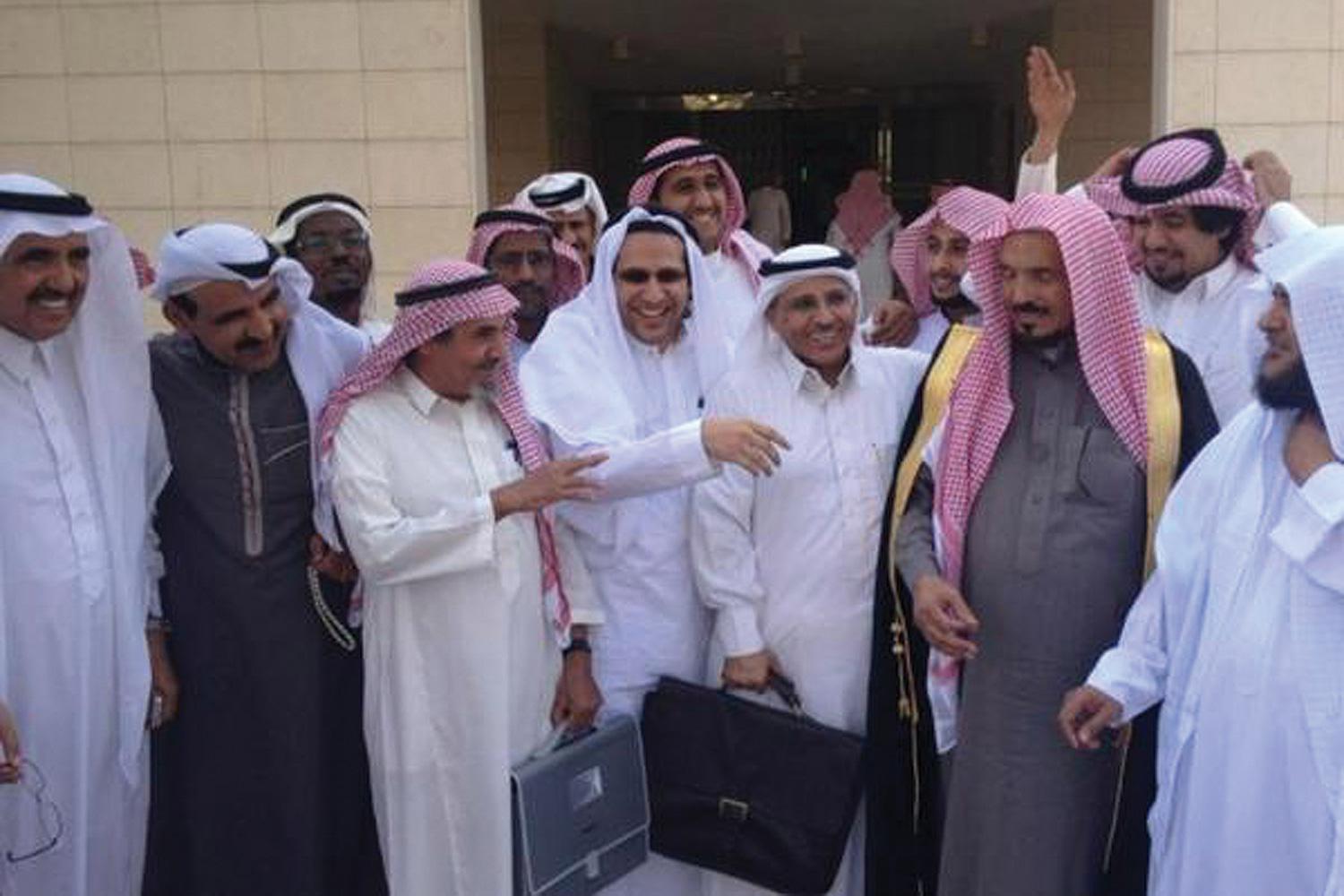
Waleed Abu al-Khair, prominent lawyer and human rights activist, speaks to Human Rights Watch over Skype from Jeddah, Saudi Arabia on September 19, 2013.
Saudi courts have convicted at least 20 prominent peaceful activists and dissidents since 2011. Many, like Abu al-Khair, have faced sentences as long as 10 or 15 years on broad, catch-all charges – such as “breaking allegiance with the ruler” or “participating in protests” – that do not constitute recognizable crimes. “Every day Waleed Abu al-Khair spends in prison compounds the injustice Saudi Arabia has imposed on him and his family,” said Sarah Leah Whitson, Middle East director at Human Rights Watch.
[Abu al-Khair has been one of Saudi Arabia’s leading human rights advocates for years. In July 2014, the Specialized Criminal Court (SCC), Saudi Arabia’s terrorism tribunal, convicted him on a number of broad and vaguely worded charges, including for comments to news outlets and on Twitter criticizing Saudi human rights violations. In addition to sentencing him to prison, the court banned him from traveling abroad for another 15 years. Abu al-Khair played no active part in his trial. He refused to recognize the legitimacy of the court or to defend himself. He also refused to sign a copy of the trial judgment or to appeal either his conviction or sentence. In January 2015, an appeals tribunal within the SCC overturned part of the earlier ruling following a prosecution appeal of the court’s suspension of five years of his term, and ruled instead that Abu al-Khair should serve all 15 years in prison.]
Parallel event on Asian Justice Institutions and Human Rights Defenders to be held on 2 March 2017 2:00 PM in Room: XXIII, Palais de Nations, Geneva, SwitzerlandModerator/Chair: Mr. Bijo Francis, Executive Director, Asian Legal Resource Centre
Speakers in the Panel:
1. Mr. Basil Fernando, Director, Policy and Programme, Asian Human Rights Commission
2. Mr. Mandeep Tiwana, Head of Policy and Research, CIVICUS
3. Mr. Sharan Srinivas, Director, Research and Advocacy, Right Livelihood Award Foundation
contact: Md. Ashrafuzzaman, Main Representative, Asian Legal Resource Centre, Cell: +41 (0) 766 38 26 59, Email: zaman@ahrc.asia .
Background: Human rights defenders across the world today have to overcome restrictive and challenging circumstances to undertake their mandate. These challenges could be broadly classified into three categories. They are: (i) restrictions imposed through statutes or regulatory processes; (ii) false accusations and fabricated cases registered by the state against HRDs and their organisations; and (iii) threats presented against HRDs by non-state actors, including fundamentalist religious forces.
Of the above three categories, the first and second could be overcome to a large degree at the national level, had the criminal justice institutions in Asian states been independent, and are able to decide upon cases that these institutions are called upon to engage upon.
Asian states today often enact legislations to restrict the operations of HRDs and the organisations they represent. China for instance, has legislations that directly impede the operation of HRDs . Indeed, the law does not prohibit the operation of ‘foreign’ NGOs, but stipulates obtaining permissions from different state agencies before commencing work, and has cast a broad net that prohibits organisations from engaging in activities otherwise considered to be human rights work, including: advocacy, legal assistance, labour, religion, and ethnic minority affairs. State agencies are given unbridled powers to interpret an activity as one under any of these prohibited criteria. The situation of domestic NGOs, including lawyers is worse in China even before the enactment of the new ‘foreign NGO’ law. The government has imposed heavy scrutiny and restrictions upon domestic NGOs, and often detain HRDs and lawyers on criminal charges.
China however is not an exception in the Asian region. Thailand for instance has legislations in place even prior to the military coup that restricts HRDs and civil society work. Thai state has spared no resources to oppress HRDs, often using the law against defamation that has penal provisions, interpreted at the will of the state by the country’s courts. After the coup, the National Peace and Reconciliation Council has promulgated ordinances that literally restrict all forms of freedom. HRDs who campaigned against the military’s version of the current Thai constitution, and the namesake referendum that was organised by the military, were arrested and imprisoned.
Bangladesh, against all its obligations under domestic and international law detains HRDs, forces closure of civil society organisations by repeatedly raiding their offices and seizing office equipment and documents, and does not allow these organisations to operate their bank accounts. India too engages in similar tactics against civil society organisations that openly criticise the government and its policies. Similar circumstances exist in most other states in the region, including Singapore, Myanmar, Indonesia, Sri Lanka and the Philippines.
In Pakistan, the state is engaged in a shadow war against the civil society using right-wing religious forces, including right-wing media, that has systematically targeted HRDs who have advocated for democratic governance, and in particular urged the country\’s military from illegally and arbitrarily intervening in civilian administration.
In all the above circumstances, what is witnessed is the increasing role played by the entire criminal justice apparatus in Asian states that collide with the state in repressing HRDs and civil society work. Asian states liberally use their agencies like the police, prosecutor\’s office and other specialised agencies to obstruct HRDs in their work, often alleging false criminal charges against organisations or the staff members of these organisations. On the other hand, Asian judiciary has repeatedly failed to intervene in these cases despite the civil society reaching out to the courts for justice.
In instances where restrictive legislations are enacted or executive orders issued, restricting civil society freedom, the judiciary has the responsibility to intervene, and if necessary, annul the law or the executive order holding it as one against constitutional rights and the state\’s obligation under international human rights law. Instead, the Asian judiciary often support state actions. Instances where cases are adjourned without a decision being made are common.
Improving Asia’s human rights standards is not possible without radical reforms brought into the region’s justice delivery framework, particularly of the criminal justice procedures. The absence of independence and professionalism of Asia’s justice architecture is the cornerstone upon which impunity is built in the region. Asian states are aware of this and has consciously kept their justice institutions under direct control. Today Asian HRDs and the entire civil society in the region suffers due to this. Effective judicial intervention in instances where the state exceeds its mandate and stifle civil society work is an exception than a norm.
The side event organised by the Asian Legal Resource Centre, along with The Right Livelihood Award Foundation is an attempt to expose the dubious role played by Asia’s justice institutions in stifling civil society work in the region. The event is also an attempt to raise awareness about this scenario in the global human rights community and to seek support to address this problem.
A Thai court found British labor activist, Andy Hall, guilty of defaming a fruit canning company, and gave him a suspended prison sentence in a case that has raised serious concerns among human rights workers and free speech advocates. He was found guilty of criminal defamation against Natural Fruit Company Ltd. in connection with a 2013 report he researched for the Finnish consumer organization Finnwatch that alleged labour abuses at the company’s facilities. [https://thoolen.wordpress.com/2013/04/11/defamation-charges-against-hall-will-chill-labor-rights-in-thailand-says-human-rights-watch/]
The case raises questions about Thailand’s punitive criminal defamation laws and the ease of being condemned for violating the Computer Crimes Act because the information was posted on the internet. Hall was given a suspended sentence of three years with a probationary period of two years, and a fine of 150,000 baht ($4,300). He said he will appeal the ruling. He was allowed to go free after his fine was paid. Two civil suits by the company against him are pending, as is an appeal against his acquittal on a previous criminal defamation charge.
“I don’t feel any shame, I don’t feel any regret. But I feel it is an injustice, what’s happened here today,” Hall said. “I respect the decision of the court, but I feel real injustice, not for me, it’s not about me, this case was never about me, it was never about Andy Hall doing research about migrant workers. It was about a human rights activist doing research for the public interest.”
Sonja Vartiala, executive director of Finnwatch, said her organization was “shocked by today’s verdict.” “The report was authored and published by Finnwatch; we take full responsibility for it,” Vartiala said. “Andy has been made a scapegoat in order to stifle other voices that speak out legitimately in support of migrant worker rights.” “This is a sad day for freedom of expression in Thailand,” … “We fear that many other human rights defenders and victims of company abuse will be scared to silence by this ruling.”
Finnwatch was not sued, nor was the Al Jazeera news network, to whom Hall gave an interview that was the basis for part of the cases against him.
Virat Piyapornpaiboon, the owner of Natural Fruit, said justice was done. “I think that it’s not important whether he goes to jail or not, but what’s important is whether or not what he said was true,” Virat said. “This is proof that no matter who you are, if you are not just and you make up stories and cause damage to others, you must be punished.“
According to Front Line Defenders a rather curious case seems to have been construed against a human rights defender in Mongolia. The trial of human rights defender Mr Beejin Khastamur will start on 8 July 2016 at the Songinokhairkhan District Court in Ulan Bator. He was arrested on 16 March 2016 and denied bail on 22 March. He was eventually released pending trial on 31 March. Beejin Khastamur is the founder of a non-governmental organisation Delhiin Mongol Nogoon Negdel (DMNN), which advocates for the protection of environment and the rights of the nomad people of Mongolia. The organisation has exposed many violations of Mongolia’s environmental laws by foreign and domestic mining companies, in which Mongolian politicians had a stake. It has also organised numerous workshops, public gatherings and demonstrations to educate the public on environmental issues. https://www.frontlinedefenders.org/en/profile/beejin-khastamur
According to the police Beejin Khastamur allegedly attacked the driver of another car using a knife. On 6 February 2016, Beejin Khastamur was indeed involved in a car accident, during which no one was killed or injured and the material damage caused was minimal. The human rights defender was driving in Ulan Bator when a Nissan car tried to pass him on the wrong side twice and eventually hit his vehicle. Its driver got out of the car and attacked Beejin Khastamur kicking him and hitting the human rights defender in his head. Subsequently, during the forensic examination it was revealed that Beejin Khastamur sustained bruises all over his body and had a brain concussion, while the second driver had only small scratches on one of his knees. When police arrived at the scene, they concluded that the accident had been the fault of the second driver and left. However, they subsequently returned and brought Beejin Khastamur to the police station for questioning. The actions of the police have given rise to the suspicion that the accident may have been used as a pretext to target Beejin Khastamur for his human rights work.
[On 21-23 December 2015, Beejin Khastamur organised a sit-down strike protesting the illegal permit given to a Canadian and Mongolian joint company enabling it to mine gold right on Onon River. Since then he has received multiple threats. On several occasions people came to his house, banging on his door at night, cutting his electricity, puncturing his car tires, threatening his wife and children. The human rights defender also received death threats on the phone.]
On its 35th Anniversary, Peace Brigades International is holding a conference to celebrate human rights defenders’ contributions to democracy and the rule of law, discuss their protection needs, and explore good practice and obstacles to enabling environments. Keynote speakers include the UN Special Rapporteur on the Situation of Human Rights Defenders, Michel Forst, human rights defenders from Latin America, Nepal and Kenya, UK government officials, NGOs, legal experts & donors There will be four panels:
1: Rule of Law: Uses and Abuses of the Law in relation to Human Rights Defenders
2: Access to Justice: Human Rights Defenders’ Fight for Justice
3: Business and Human Rights: Challenges and Developments
4: Strategies for Confronting Repressive Environments for Land and Environmental Rights Defenders
On Friday 17 June 2016, from 09:00 to 18:00 (BST) – at Canada House ,Trafalgar Square, London
For more information, tickets follow the link below:
reports that on 25 May 2016, the Anti-Corruption Commission of Bangladesh (ACC) questioned human rights defender Mr Adilur Rahman Khan over an allegation of involvement of the human rights organisation Odhikarin money laundering. Similarly the Observatory for the Protection of Human Rights Defenders, a joint programme of the OMCT and FIDH called on 26 May for urgent intervention to step up campaigns in his support.
Adilur Rahman Khan [https://www.frontlinedefenders.org/en/profile/adilur-rahman-khan] is an Advocate of the Supreme Court of Bangladesh, and founder and Secretary of Odhikar. The human rights organisation was established in 1994 with the aim to advance the civil, political, social and economic rights of the citizens of Bangladesh, and to create a wider monitoring and awareness-raising system on the abuse of these rights. Odhikar also carries out advocacy to address the current human rights situation in the country, provides trainings for human rights defenders and conducts fact-finding missions in rural areas of Bangladesh. Adilur was a Final Nominee for the MEA in 2015.
As the links below show it is clearly a case of administrative and judicial harassment against the human rights organisation Odhikar and its Secretary in a further attempt to sanction and silence their human rights activities.
[On 25 May 2016, the ACC’s Deputy Director Mr Jalal Uddin Ahmed questioned Adilur Rahman Khan over Odhikar’s alleged involvement in money laundering as a part of an investigation opened in 2013. The Deputy Director informed the human rights defender that the inquiry into the allegation related to the the sum of € 97 000 that the ACC supposed had been deposited to the Standard Chartered Bank account of Odhikar, as part of money laundering activities. Adilur Rahman Khan denied all accusations made against Odhikar. He explained that the sum of €97 501,07 available on the organisation’s bank account was part of a contribution made by the European Union (EU) to help Odhikar implement a three-year project titled ‘Education on the Convention against Torture (CAT) and Official Protocol to the CAT Awareness Program in Bangladesh’, from 2012 to 2014.]
Also on 27 May the Asian Human Rights Commissionpublished a press release about the members of families of 19 disappeared victims who once again took to the street 26 May 2016. They formed a “human chain” in front of the National Press Club in Dhaka to demand the return of their loved ones within the month of Ramadan. Prominent human rights defenders, members of the civil society, and academic scholars joined the families to express solidarity.
reports that on 16 May 2016, human rights defender Mr Guleid Ahmed Jama received notification from the Somaliland Minister of Justice and Judicial Affairs that his licence to practice law had been terminated. Guleid Ahmed Jama [for profile see: https://frontlinedefenders.org/en/profile/guleid-ahmad-jama] is a lawyer and founder of the Human Rights Center, a human rights watchdog organisation in Somaliland.
He only learned about this when he saw on 16 May a letter (dated 10 April!) which was circulated to members of the Somaliland judiciary from the Minister of Justice and Judicial Affairs, Minister Ahmed Farah Adarre, requesting that the judiciary cease to allow Guleid Ahmed Jama to practice law, as his position as chairperson of the HRC and his work as a lawyer are incompatible. [The termination of the licence by the Minister of Justice is unprecedented as the duty of licensing permissions falls within the mandate of the Advocates Licensing and Disciplining Commission.]
Earlier harassment against him occurred in April 2015 when he was arrested, charged and detained in Hargeisa while working in his capacity as a lawyer at Hargeisa Regional Court. He was accused of ‘subversive or anti-national propaganda’, ‘instigation to disobey the laws’, ‘intimidation of the public’ and ‘publication or circulation of false, exaggerated and tendentious news capable of disturbing public order’. According to the Office of the Attorney General, the human rights defender had allegedly committed these offences through his work at the HRC. This case was later closed. <https://www.frontlinedefenders.org/en/case/case-history-guleid-ahmed-jama>
Seems to me to be a good case for (international) lawyers organizations.
A remarkably large and diversified group of some 500 film makers, writers, professionals in the area of art & culture, academics, activists and social organisations demand the release of Indian filmmaker and human rights defender Deba Rajan Sarangi in an open letter published on 3 April 2016.
They state that they are deeply shocked to hear about his arrest on 18 March, 2016, by plainclothes policemen from the Kucheipadar village of Rayagada District, Odisha. Debaranjan was in Kucheipadar to attend a funeral. He was arrested with a non-bailable warrant issued by the court of JMFC, Kashippur in pursuance of a case registered in Tikri police station of Rayagada district in 2005, when Debaranjan was actively involved in the struggle of the Adivasis in Kashipur to protect their lands from the invasion of the bauxite mining companies…
Deba Ranjan Sarangi has highlighted and critiqued policies of destructive development, unbridled mining practices, displacement, police impunity, atrocities on Dalits, Adivasi issues , growth of communal fascism in Odisha, violence on women and farmers’ suicide in the context of acute agrarian. Deba Ranjan has been put behind bars because he had the courage to show what he witnessed to the world through his expressions of film making, writing and speech. He is neither a Maoist nor a terrorist. We call upon the Odisha government to address the issues raised by the human rights defenders in the State of Odisha rather than imprisoning them and crushing the voices of film makers. We call upon the Odisha government to desist from such disgraceful attempts of violating the Indian Constitution and Indian democracy.
The link below gives a partial list of signatories:
Arutchelvan Subramaniams, known as Arul, is a grassroots human rights defender from Malaysia. He works primarily for the protection of economic, social and cultural rights – including housing rights for the urban poor, the rights of farmers, plantation and industrial workers, as well as the rights of indigenous communities. The ISHR published this profile on 21 March 2016. Read the rest of this entry »