Posts Tagged ‘ISHR’

Result of the 42nd session of the UN Human Rights Council

October 2, 2019

On 27 September 2019 a group of civil society organisations welcomed significant outcomes of the HRC’s 42nd session, including reaffirming its condemnation of reprisals and extending its scrutiny over Yemen, Venezuela, Cambodia, Burundi, Myanmar, and Sudan. This session witnessed heightened scrutiny of Council members by shedding light on the situation in Saudi Arabia, but it missed an opportunity to ensure scrutiny over situations in China, Kashmir and Egypt. [see also: https://humanrightsdefenders.blog/2019/09/05/human-rights-defenders-issues-at-the-42nd-session-of-the-un-human-rights-council/]

The 42nd session also advanced standards on several issues including the right to privacy, administration of justice and the death penalty, but failed to defend the mandate of the Special Rapporteur on counter-terrorism against attempts to dilute and distract its focus. The High Commissioner failed again to present the database on companies facilitating Israel’s illegal settlements.

The Council reaffirmed that reprisals can never be justified. Council members rejected attempts to weaken the text including deleting the references to the roles of the Assistant Secretary-General and the Human Rights Council Presidents. [https://humanrightsdefenders.blog/2019/09/23/andrew-gilmours-2019-report-on-reprisals-it-gets-worse-but-response-remains-mostly-rhetoric/] The resolution listed key trends such as the patterns of reprisals, increasing self-censorship, the use of national security arguments and counter-terrorism strategies by States as justification for blocking access to the UN, acknowledged the specific risks to individuals in vulnerable situations or belonging to marginalized groups, and called on the UN to implement gender-responsive policies to end reprisals. The Council called on States to combat impunity and to report back to it on how they are preventing reprisals, both online and offline.

They welcome the creation of a Fact-Finding Mission (FFM) on Venezuela as an important step towards accountability for the grave human rights violations documented by the High Commissioner.

They welcome the renewal and strengthening of the mandate of the Group of Eminent Experts on Yemen, sending a clear message to parties to the conflict – and to victims – that accountability is at the center of the mandate, and providing a crucial and much-needed deterrent to further violations and abuses. States should support the recommendations made by the GEE in their recent report, including prohibiting the authorization of transfers of, and refraining from providing, arms that could be used in the conflict to such parties; and clarifying the GEE’s role to collect and preserve evidence of abuses.

They welcome the renewal of the mandate of the Special Rapporteur on Cambodia, but regret that calls to strengthen the mandate of the OHCHR to monitor and report on the situation have been ignored. We regret that the resolution fails to accurately depict the continuing crackdowns on civil society and the severity and scale of recent attacks on the political opposition.

They welcome the renewal of the mandate of the Commission of Inquiry on Burundi. Its work is vital as the country heads towards elections in 2020. The Burundian Government should desist from denial and insults, and should cooperate with the Commission and other UN bodies and mechanisms.

They welcome that the EU and OIC have jointly presented a resolution on Myanmar requesting the High Commissioner to report on the implementation of the recommendations of the Fact-Finding Mission at HRC 45. However, the international community needs to take stronger action to ensure accountability for and cessation of grave international crimes, in particular by referring Myanmar to the ICC and imposing a global arms embargo – and by acting on the FFM’s reports, including those on economic interests of the military and on sexual and gender-based violence in Myanmar and the gendered impact of its ethnic conflicts.

On terrorism and human rights, they are deeply disappointed that Mexico and other States have partially acquiesced in attempts by Egypt to dilute or distract the work of the Special Rapporteur on counter-terrorism away from its appropriate focus on human rights violations while countering terrorism and human rights of victims of terrorism. We regret that States have asked the Special Rapporteur to spend the limited time and resources of the mandate, to comment on the overbroad concept of the “effects” of terrorism, by which Egypt and some other States seem primarily to mean macroeconomic, industrial, and investment impacts, rather than the human rights of individual victims. The length to which States seem willing to put the existing Special Rapporteur’s mandate at risk, in the name of protecting it, while failing even to incorporate stronger consensus text on human rights issues included in the most recent merged parallel resolution at the General Assembly, suggests that the merger of the previous Mexican and Egyptian thematic resolutions no longer holds any real promise of positive results for human rights.

They welcome the Council’s renewed attention to the protection of the right to privacy in the digital age: fully integrating human rights into the design, development and deployment of Artificial Intelligence, machine learning technologies, automated decision-making, and biometric systems, is essential to safeguard not only the right to privacy, but also to freedom of expression, peaceful assembly, and association, and economic social and cultural rights.

On human rights in the administration of justice, we welcome the focus in this year’s resolution on concrete measures to prevent and respond to violence, death and serious injury in situations of deprivation of liberty, which illustrates the potential of thematic resolutions to set out specific practical, legal and policy steps that can be drawn on by governments, civil society, and other stakeholders to have real positive impact at the national level.

They commend Australia for its leadership on Saudi Arabia, as well as the other States who stood up for women’s rights activists and accountability. They urge more States to live up to their commitment to defend civil society and sign the statement in the coming 2 weeks.

For five years since the last joint statement in March 2014, the Council has failed to hold Egypt accountable for continuing systematic and widespread gross human rights violations. In the latest crackdown on peaceful protests, reports indicate that more than 2000 people have been arrested in the past week. When will the Council break its silence and convene a Special Session to address the grave and deteriorating human rights situation in Egypt?

Signatories:

  • International Service for Human Rights (ISHR)
  • DefendDefenders (the East and Horn of Africa Human Rights Defenders Project)
  • Commonwealth Human Rights Initiative (CHRI)
  • CIVICUS: World Alliance for Citizen Participation
  • Cairo Institute for Human Rights Studies
  • Asian Legal Resource Centre
  • Asian Forum for Human Rights and Development (FORUM-ASIA)
  • International Commission of Jurists (ICJ)
  • Amnesty International
  • Association for Progressive Communications (APC)
  • Human Rights Watch
  • International Federation for Human Rights (FIDH)
  • Physicians for Human Rights (PHR)

—————

Below the fulll list of 38 texts adopted:

Resolutions

Action on Text under Agenda Item 1 on Organizational and Procedural Matters

In a Presidential Statement (A/HRC/42/L.32) on the reports of the Advisory Committee, adopted without a vote, the Human Rights Council takes note of the reports of the Advisory Committee on its twenty-second and twenty-third sessions.

Action on Texts under Agenda Item 2 on the Report of the High Commissioner and Reports of the Office of the High Commissioner and the Secretary-General

In a resolution (A/HRC/42/L.6) on the composition of staff of the Office of the United Nations High Commissioner for Human Rights, adopted by a vote of 30 in favour, 13 against and four abstentions, the Council requests the United Nations High Commissioner for Human Rights to continue her efforts with a view to redress the current imbalance in the geographical composition of the staff of her Office and requests her to submit a report at the Council’s forty-fifth session.

In a resolution (A/HRC/42/L.16) on the human rights situation in Yemen, adopted by a vote of 22 in favour, 12 against and 11 abstentions, the Council decides to renew the mandate of the Group of Eminent International and Regional Experts for a further period of one year to, inter alia, monitor and report on the situation of human rights and carry out comprehensive investigations into all alleged violations and abuses of international human rights law and all alleged violations of international humanitarian law committed by all parties to the conflict since September 2014. The Council requests the Group of Eminent International and Regional Experts to present a comprehensive written report to the Human Rights Council at its forty-fifth session.

In a resolution ( A/HRC/42/L.21/Rev.1 ) on the situation of human rights of Rohingya Muslims and other minorities in Myanmar, adopted by a vote of 37 in favour, two against and seven abstentions, the Council requests the United Nations High Commissioner for Human Rights to follow up on the implementation of the recommendations made by the independent international fact-finding mission, including those on accountability, and to continue to track progress in the situation of human rights in Myanmar, including of Rohingya Muslims and other minorities, and to present a written report thereon to the Human Rights Council at its forty-fifth session.

In a resolution (A/HRC/42/L.38/Rev.1) on strengthening cooperation and technical assistance in the field of human rights in the Bolivarian Republic of Venezuela, adopted by a vote of 18 in favour, six against and 23 abstentions, the Council welcomes the permanent presence of the Office of the High Commissioner in Venezuela under the terms established in the memorandum of understanding signed on 20 September 2019, including unlimited access to all region and detention centres, and requests the High Commissioner to present to the Council, at its forty-third and forty-fifth sessions, as well as before the end of 2019, an oral update on the situation of human rights in Venezuela. The Council also requests the High Commissioner to submit a comprehensive written report on the situation of human rights in Venezuela at its forty-fourth session, including the outcome of the investigation on the ground into allegations of possible human rights violations to ensure the accountability of perpetrators and redress for victims.

Action on Texts under Agenda Item 3 on the Promotion and Protection of All Human Rights, including the Right to Development

In a resolution (A/HRC/42/L.1) on the human rights to safe drinking water and sanitation, adopted without a vote, the Council decides to extend the mandate of the Special Rapporteur on the human rights to safe drinking water and sanitation for a period of three years and requests the Special Rapporteur to compile good practices at the local, national, regional and international levels in order to promote the progressive realization of the human rights to safe drinking water and sanitation, and to report thereon to the Human Rights Council at its forty-fifth session.

In a resolution (A/HRC/42/L.2) on the role of prevention in the promotion and protection of human rights, adopted without a vote, the Council affirms the importance of effective preventive measures as a part of overall strategies for the promotion and protection of all human rights, and requests the Office of the High Commissioner to prepare a study, to be presented to the Human Rights Council at its forty-fifth session, on the contribution of the special procedures in assisting States and other stakeholders in the prevention of human rights violations and abuses.

In a resolution (A/HRC/42/L.5) on the World Programme for Human Rights Education: adoption of the plan of action for the fourth phase, adopted without a vote, the Council adopts the plan of action for the fourth phase (2020–2024) of the World Programme for Human Rights Education and decides to convene at its forty-eighth session a high-level panel discussion to mark the tenth anniversary of the United Nations Declaration on Human Rights Education and Training, on the theme “The tenth anniversary of the United Nations Declaration on Human Rights Education and Training: good practices, challenges and the way forward”.

In a resolution (A/HRC/42/L.7) on the promotion of a democratic and equitable international order, adopted by a vote of 25 in favour, 14 against and eight abstentions, the Council invites the Independent Expert on the promotion of a democratic and equitable international order to examine the impact of financial and economic policies pursued by international financial institutions on a democratic and equitable international order, in particular those of the World Bank and the International Monetary Fund, and to submit the report to the Human Rights Council at its forty-fifth session.

In a resolution (A/HRC/42/L.8) on the use of mercenaries as a means of violating human rights and impeding the exercise of the right of peoples to self-determination, adopted by a vote of 29 in favour, 14 against and four abstentions, the Council renews for a period of three years the mandate of the Working Group on the use of mercenaries as a means of violating human rights and impeding the exercise of the right of peoples to self-determination, and requests the Working Group to report its findings to the Human Rights Council at its forty-fifth session and to the General Assembly at its seventy-fifth session.

In a resolution (A/HRC/42/L.9) on the Special Rapporteur on contemporary forms of slavery, including its causes and consequences, adopted without a vote, the Council renews the mandate of the Special Rapporteur on contemporary forms of slavery, including its causes and consequences, for a period of three years, and requests the Special Rapporteur to submit reports on the implementation of the mandate to the Human Rights Council and the General Assembly in accordance with their annual programmes of work.

In a resolution (A/HRC/42/L.11) on human rights in the administration of justice, including juvenile justice, adopted without a vote, the Council invites States to take into consideration the issue of human rights in the administration of justice in the context of the Universal Periodic Review and requests the High Commissioner to submit to the Human Rights Council, at its forty-seventh session, an analytical report on human rights in the administration of justice, in particular on current and emerging challenges in the protection of persons deprived of their liberty, including judicial oversight.

In a resolution (A/HRC/42/L.13) on the human rights of older persons, adopted without a vote, the Council decides to extend the mandate of the Independent Expert on the enjoyment of all human rights by older persons for a period of three years, and requests the Secretary-General to ensure that the reports of the Independent Expert are brought to the attention of the Open-ended Working Group on Ageing.

In a resolution (A/HRC/42/L.14) on the right to social security, adopted without a vote, the Council decides to convene, before its forty-fifth session, an intersessional full-day panel discussion on the right to social security in the changing world of work with a view of identifying challenges and best practices. It also requests the High Commissioner for Human Rights to prepare a summary report on the panel discussion and to submit it to the Human Rights Council at its forty-sixth session.

In a resolution (A/HRC/42/L.17) on marking the twenty-fifth anniversary of the Beijing Declaration and Platform for Action, adopted without a vote, the Council decides to convene, during the high-level segment at its forty-third session, a high-level panel discussion to commemorate the twenty-fifth anniversary of the Fourth World Conference on Women, with a particular focus on the implementation of the Beijing Declaration and Platform for Action and the outcome documents of its review conferences, as well as on achievements, best practices and challenges in this regard.

In a resolution (A/HRC/42/L.18) on the right to privacy in the digital age, adopted without a vote, the Council requests the United Nations High Commissioner for Human Rights to organize, before its forty-fourth session, a one-day expert seminar to discuss how artificial intelligence, including profiling, automated decision-making and machine-learning technologies may, without proper safeguards, impact the enjoyment of the right to privacy, to prepare a thematic report on the issue, and to submit it to the Council at its forty-fifth session.

In a resolution (A/HRC/42/L.19) on the right of everyone to the enjoyment of the highest attainable standard of physical and mental health, adopted without a vote, the Council decides to extend the mandate of the Special Rapporteur on the right of everyone to the enjoyment of the highest attainable standard of physical and mental health, as established by the Human Rights Council in paragraph 1 of its resolution 6/29, for a further period of three years.

In a resolution (A/HRC/42/L.20) on human rights and transitional justice, adopted without a vote, the Council requests the Office of the United Nations High Commissioner for Human Rights to examine in a report how addressing a legacy of gross violations and abuses of human rights and serious violations of international humanitarian law through transitional justice measures can contribute to sustaining peace and the realization of Sustainable Development Goal 16, and to present the report to the Human Rights Council at its forty-sixth session.

In a resolution (A/HRC/42/L.23) on terrorism and human rights, adopted without a vote, the Council strongly condemns terrorist acts and all acts of violence committed by terrorist groups and the continued systematic and widespread abuses of human rights perpetrated by such groups, and requests States to refrain from providing support to entities or persons involved in terrorist acts, including support in establishing propaganda platforms advocating hatred that constitutes incitement to discrimination, hostility or violence, including through the Internet and other media.

In a resolution (A/HRC/42/L.24) on human rights and indigenous peoples, adopted without a vote, the Council decides to hold an intersessional round table on possible steps to be taken to enhance the participation of indigenous peoples’ representatives and institutions in meetings of the Human Rights Council on issues affecting them, with the full and effective participation of indigenous peoples’ representatives and institutions from the seven indigenous sociocultural regions represented at the thirteenth session of the Expert Mechanism on the Rights of Indigenous Peoples.

In a resolution (A/HRC/42/L.25) on human rights and indigenous peoples: mandate of the Special Rapporteur on the rights of indigenous peoples, adopted without a vote, the Council decides to renew the mandate of the Special Rapporteur on the rights of indigenous peoples for a period of three years to, inter alia, examine ways and means of overcoming existing obstacles to the full and effective protection of the rights of indigenous peoples, to pay special attention to the human rights and fundamental freedoms of indigenous children and women, and to take into account a gender perspective in the performance of the mandate.

In a resolution (A/HRC/42/L.27) on the protection of the rights of workers exposed to hazardous substances and wastes, adopted without a vote, the Council encourages States, business enterprises and other actors to implement the 15 principles presented by the Special Rapporteur on the implications for human rights of the environmentally sound management and disposal of hazardous substances and wastes through their respective legal and policy frameworks, as well as through initiatives and programmes to strengthen the coherence between human rights and occupational health and safety standards with regard to the exposure of workers to toxic substances.

In a resolution (A/HRC/42/L.34/Rev.1) on arbitrary detention, adopted without a vote, the Council decides to extend the mandate of the Working Group on Arbitrary Detention for a further period of three years, and requests the Working Group to prepare a study on arbitrary detention related to drug policies to ensure that upholding the prohibition thereon is included as part of an effective criminal justice response to drug-related crimes, and that such a response also encompasses legal guarantees and due process safeguards, and to submit to the Council at its forty-seventh session a report thereon, and to bring the report to the attention of the Commission on Narcotic Drugs as the policymaking body of the United Nations with prime responsibility for drug-control matters.

In a resolution (A/HRC/42/L.36) on the right to development, adopted by a vote of 27 in favour, 13 against and 7 abstentions as orally revised, the Council decides that, at its twenty-first session, the Working Group on the Right to Development will commence the elaboration of a draft legally binding instrument on the right to development on the basis of the draft prepared by the Chair-Rapporteur. The Council further decides to extend for a period of three years the mandate of the Special Rapporteur on the right to development, and to organize a biennial panel discussion on the right to development, starting at its forty-fifth session. It also decides to establish a subsidiary expert mechanism to provide the Council with thematic expertise on the right to development that shall consist of five independent experts who shall serve for a three-year period. The expert mechanism shall report annually to the Human Rights Council on its work and shall meet once annually for three days in Geneva and once annually for three days in New York.

In a resolution (A/HRC/42/L.37) on the question of the death penalty, adopted by a vote of 26 in favour, 14 against and 6 abstentions, the Council decides that the upcoming biennial high-level panel discussion to be held at the forty-sixth session of the Human Rights Council will address the human rights violations related to the use of the death penalty, in particular with respect to whether the use of the death penalty has a deterrent effect on crime rate, and requests the Office of the High Commissioner to prepare a summary report on the panel discussion and to submit it to the Human Rights Council at its forty-eighth session.

Action on Resolutions under Agenda Item 4 on Human Rights Situations that Require the Council’s Attention

In a resolution (A/HRC/42/L.4/Rev.1) on the situation of human rights in the Bolivarian Republic of Venezuela, adopted by a vote of 19 in favour, seven against and 21 abstentions, the Council requests the United Nations High Commissioner for Human Rights to prepare a comprehensive written report on the situation of human rights in Venezuela and to present the report to the Council at its forty-fourth session. The Council decides to establish, for a period of one year, an independent international fact-finding mission and to dispatch that mission urgently to Venezuela to investigate extrajudicial executions, enforced disappearances, arbitrary detentions and torture and other cruel, inhumane or degrading treatment since 2014, with a view to ensuring full accountability for perpetrators and justice for victims. The Council requests the mission to present a report on its findings during an interactive dialogue at its forty-fifth session.

In a resolution (A/HRC/42/L.10/Rev.1) on the situation of human rights in Burundi, adopted by a vote of 23 in favour, 11 against and 13 abstentions, the Council decides to extend the mandate of the Commission of Inquiry on Burundi in order for it to deepen its investigations, including into respect for and observance of political, civil, economic and social rights in the electoral context, until it presents a final report to the Human Rights Council during an interactive dialogue at its forty-fifth session and to the General Assembly at its seventy-fifth session. The Council requests the Commission to present an oral briefing to the Council at its forty-third and forty-fourth sessions during an interactive dialogue.

In a resolution (A/HRC/42/L.22) on the human rights situation in the Syrian Arab Republic, adopted by a vote of 27 in favour, six against and 13 abstentions, the Council deplores the fact that the conflict in the Syrian Arab Republic continues in its ninth year with its devastating impact on the civilian population, and urges all parties to the conflict to abstain immediately from any actions that may contribute to the further deterioration of the human rights, security and humanitarian situations. The Council demands that the Syrian authorities cooperate fully with the Human Rights Council and the Commission of Inquiry by granting the Commission immediate, full and unfettered access throughout the Syrian Arab Republic, and expresses deep concern about the grave humanitarian situation in the country and at the plight of the 11.7 million people in need of full, timely, immediate, unhindered and safe humanitarian assistance.

The Council welcomes the work of the International, Impartial and Independent Mechanism to Assist in the Investigation and Prosecution of Persons Responsible for the Most Serious Crimes under International Law Committed in the Syrian Arab Republic since March 2011 and its close cooperation with the Commission of Inquiry and Syrian civil society, and invites Member States to actively support the Mechanism and to provide adequate financial means for its functioning. The Council further welcomes the steps taken by Member States to prosecute the most serious crimes under international law committed in the Syrian Arab Republic in national courts under the principles of universal jurisdiction and extraterritorial jurisdiction as an important contribution to end impunity and ensure justice for victims.

Action on Resolution under Agenda Item 5 on Human Rights Bodies and Mechanisms

In a resolution (A/HRC/42/L.33/Rev.1) on cooperation with the United Nations, its representatives and mechanisms in the field of human rights, adopted by a vote of 36 in favour and 11 against, with no abstentions, as orally revised, the Council calls upon States to combat impunity by conducting prompt, impartial and independent investigations and pursuing accountability for all acts of intimidation or reprisal by State and non-State actors against any individual or group who seeks to cooperate, cooperates or has cooperated with the United Nations, its representatives and mechanisms in the field of human rights, and by condemning publicly all such acts, underlining that these can never be justified.

Action on Resolution under Agenda Item 9 on Racism, Racial Discrimination, Xenophobia and Related Intolerance

In a resolution (A/HRC/42/L.28/Rev.1) From rhetoric to reality: a global call for concrete action against racism, racial discrimination, xenophobia and related intolerance, adopted without a vote as orally revised, the Council requests the Office of the United Nations High Commissioner for Human Rights to organize, before the eleventh session of the Ad Hoc Committee on the Elaboration of Complementary Standards to the International Convention on the Elimination of All Forms of Racial Discrimination, a two-day expert seminar to consider the elements of a draft additional protocol to the Convention. It further requests the Group of Independent Eminent Experts on the Implementation of the Durban Declaration and Programme of Action to convene its seventh session for five working days during 2020 and to submit a report to the General Assembly at its seventy-fifth session.

Action on Resolutions under Agenda Item 10 on Technical Assistance and Capacity Building

In a resolution (A/HRC/42/L.3) on promoting international cooperation to support national mechanisms for implementation, reporting and follow-up, adopted without a vote, the Council requests the Office of the High Commissioner to organize five regional consultations to exchange experiences and good practices relating to the establishment and development of national mechanisms for implementation, reporting and follow-up, and their impact on effective implementation of human rights obligations and commitments.

In a resolution (A/HRC/42/L.12) on technical assistance and capacity-building for Yemen in the field of human rights, adopted without a vote, the Council requests the United Nations High Commissioner for Human Rights to continue to provide substantive capacity-building and technical assistance to the Government of Yemen and technical support to the National Commission of Inquiry to ensure that it continues to investigate allegations of violations and abuses committed by all parties to the conflict in Yemen, and requests the High Commissioner to present a written report on the implementation of technical assistance at the Council’s forty-fifth session.

In a resolution (A/HRC/42/L.15) on the enhancement of technical cooperation and capacity-building in the field of human rights, adopted without a vote, the Council decides that the theme of the annual thematic panel discussion under agenda item 10, to be held during its forty-fourth session, will be “Upholding the human rights of prisoners, including women prisoners and offenders: enhancing technical cooperation and capacity-building in the implementation of the Nelson Mandela Rules and the Bangkok Rules”.

In a resolution (A/HRC/42/L.26/Rev.1) on assistance to Somalia in the field of human rights, adopted without a vote as orally revised, the Council decides to renew the mandate of the Independent Expert on the situation of human rights in Somalia for a period of one year and requests the Independent Expert to report to the Human Rights Council at its forty-fifth session and to the General Assembly at its seventy-fifth session.

In a resolution (A/HRC/42/L.29/Rev.1) on technical assistance and capacity-building in the field of human rights in the Democratic Republic of the Congo, adopted without a vote, the Council requests the United Nations High Commissioner for Human Rights to present an oral update on the situation of human rights in the Democratic Republic of the Congo at its forty-third session and a comprehensive report at its forty-fifth session.

In a resolution (A/HRC/42/L.30) on technical assistance and capacity-building to further improve human rights in the Sudan, adopted without a vote as orally revised, the Council decides to renew the mandate of the Independent Expert on the situation of human rights in the Sudan for period of one year recognising the intention to phase out the mandate and requests the Independent Expert to present a report on the implementation of his mandate to the Human Rights Council at its forty-fifth session. The Council requests the Government of the Sudan and the Office of the High Commissioner to present their oral reports on progress towards the opening of a country office during an enhanced interactive dialogue at the Council’s forty-forth session.

In a resolution (A/HRC/42/L.31) on technical assistance and capacity-building in the field of human rights in the Central African Republic, adopted without a vote, the Council decides to renew, for one year, the mandate of the Independent Expert on the human rights situation in the Central African Republic and to organize, at its forty-third session, a high-level interactive dialogue to assess the evolution of the human rights situation on the ground, placing special emphasis on preventing the recruitment and use of children in the armed conflict and protecting their rights through their demobilization and reintegration.

In a resolution (A/HRC/42/L.35/Rev.1) on the advisory services and technical assistance for Cambodia, adopted without a vote, the Council decides to extend for two years the mandate of the Special Rapporteur on the situation of human rights in Cambodia, and requests the Special Rapporteur to report on the implementation of her mandate to the Human Rights Council at its forty-fifth and forty-eighth sessions.

http://ishr.ch/news/hrc42-civil-society-presents-key-takeaways-human-rights-council

https://reliefweb.int/report/venezuela-bolivarian-republic/human-rights-council-closes-forty-second-regular-session-adopts

Saudi Arabia in the spotlight at the 42nd Sesstion of the Council – hits back wildly

September 25, 2019

The ISHR published a media release on 23 September 2019 about Australia delivering a joint statement on behalf of a cross-regional group of States expressing their concern over the persecution and intimidation of activists, including women human rights defenders, reports of torture, extrajudicial killings, enforced disappearances, unfair trials, arbitrary detention and impunity. It calls on the Saudi government to end impunity including for the murder of Saudi journalist Jamal Khashoggi, accept visits by UN experts, end the death penalty and ratify international human rights treaties.  [see: https://humanrightsdefenders.blog/2019/03/08/saudi-arabia-for-first-time-openly-criticized-in-un-human-rights-council/]

During the same debate, the sister of woman human rights defender Loujain Al-Hathloul, Lina Al-Hathloul called on the UN Human Rights Council to help her hold those who tortured her sister accountable, and secure her immediate and unconditional release.  Since March 2019, the Council has increased its scrutiny of Saudi Arabia, when Iceland delivered the first ever joint statement on the country. In June 2019, the Special Rapporteur on extrajudicial and summary executions Dr. Agnes Callamard presented to the Council her investigation which found the State of Saudi Arabia responsible for the murder of Saudi journalist Jamal Khashoggi in the Saudi consulate in Turkey in October 2018. The UN expert urged States to act immediately to ensure accountability for Khashoggi’s murder and guarantee non-repetition.

Australia, leading a cross-regional group of States, has stood up today for human rights despite the political and economic costs’, said Salma El Hosseiny, ISHR’s Human Rights Council advocate. ‘The international community sent a strong and clear message to the government of Saudi Arabia that its crimes won’t go unanswered and that as a Council member, it will be held to heightened scrunity’. [The States who signed on the joint statement are: Belgium, Canada, Croatia, Denmark, Estonia, Finland, Germany, Iceland, Ireland, Latvia, Liechtenstein, Lithuania, Luxembourg, Monaco, Montenegro, Netherlands, New Zealand, Norway, Peru, Slovakia, Slovenia, Sweden, The United Kingdom].

ISHR, as part of the Coalition of Free Saudi Women Human Rights Defenders has been advocating for the immediate and unconditional release of Saudi women’s rights activists. The statement has set out a list of measures that Saudi Arabia should take to demonstrate its political will to engage in good faith with the Council and improve its human rights record. They include:

  • ending the persecution and intimidation of activists, journalists, dissents and their family members;
  • ending impunity for torture and extrajudicial killings, including establishing the truth and accountability for the murder of Saudi journalist Jamal Khashoggi;
  • ending its use of the death penalty;
  • accepting visits by relevant UN Special Procedures;
  • ratifying the International Covenant on Civil and Political Rights and the International Covenant on Economic, Social and Cultural Rights.

[see also: https://humanrightsdefenders.blog/2019/09/16/rsfs-press-freedom-award-2019-goes-to-three-women-journalists/]

If Saudi Arabia does not meet any of the benchmarks, the Council should follow up with a resolution establishing a monitoring mechanism over the human rights situation in the country in the upcoming session in March 2020′, concluded El Hosseiny.  Read the joint statement here and watch Lina Al-Hathloul’s statement here.

In response the Saudi delegation has accused the Australian government of racism and of supporting anti-Islamic terrorists like the alleged Christchurch shooter.

https://www.theguardian.com/australia-news/2019/sep/25/saudi-arabia-accuses-australia-of-racism-in-extraordinary-un-broadside

https://mailchi.mp/ishr/alert-to-the-human-rights-councils-35th-session-32317?e=d1945ebb90

Andrew Gilmour’s 2019 report on reprisals: it gets worse but response remains mostly rhetoric

September 23, 2019

UN Human Rights Office). The study documents incidents from nearly 50 countries, such as the detention and imprisonment of activists, and the filming of participants at meetings, including on UN premises, without their consent.  Andrew Gilmour, UN Assistant Secretary-General for Human Rights, said there are also cases of authorities threatening and harassing relatives of activists. “Some governments seem prepared to go to almost any lengths to punish people who cooperate with us.  This may actually underscore the justice of the victims’ causes,” he said. The report covers the period from 1 June 2018 to 31 May of this year.  It also notes misuse of online spaces to promote hate speech, cyberbullying and smear campaigns, particularly against women and lesbian, gay, bisexual, transgender and intersex persons. Mr. Gilmour expressed concern over the continued trend in the use of national security arguments and counter-terrorism strategies as justification for blocking access to the United Nations. “Reported cases include individuals or organizations being charged with terrorism, blamed for cooperation with foreign entities or accused of damaging the reputation or security of the State. These have also been used to justify restrictions on foreign funding,” he wrote in the report’s conclusions and recommendations. “A disproportionate number of cases of enforced disappearance or detention, many which have been deemed arbitrary by United Nations experts, relate to these national security arguments. This is a worrisome trend that I have addressed publicly, including in my previous report, and, regrettably, it continues.” He said the UN will continue to strengthen its response to these developments, including through improved reporting on allegations.  However, he added, the onus remains on countries as “Member States must be accountable for their own actions and practices, and provide remedy when reprisals occur. [see also: https://humanrightsdefenders.blog/2019/09/17/intimidation-and-reprisals-on-un-premises-ngos-ask-for-more-action/%5D

However, the ISHR – which has followed the phenomenon much more systematically, made a more detailed and sombre assessment on 19 September: “Beyond rhetoric – States should step up efforts to prevent reprisals”

See also: https://humanrightsdefenders.blog/tag/42nd-session-of-the-un-human-rights-council/] and https://humanrightsdefenders.blog/2019/09/17/intimidation-and-reprisals-on-un-premises-ngos-ask-for-more-action/]

It notes that during the second interactive dialogue on reprisals with the Assistant Secretary-General, only Germany and Costa Rica raised specific cases of reprisals in Egypt and Nicaragua, respectively. The Bahamas and the Maldives shared good practices. Other States condemned reprisals rhetorically, expressing particular concern about reprisals and intimidation against women human rights defenders and LGBTIQ defenders, as well as by Council members.

During the dialogue Germany followed up again on the case of Egyptian lawyer Ebrahim Metwally who was arrested on his way to Geneva to attend a meeting with the Working Group on Enforced and Involuntary Disappearances. He was tortured and has been detained since September 2017. During the first interactive dialogue in September 2018, Germany was the only country to raise concern over an individual victim of reprisals. Costa Rica was the only other country to raise a specific situation of reprisals this year: it expressed particular concern about acts of intimidation and reprisals in Nicaragua.

The Bahamas responded to the allegations of intimidation and reprisals against woman human rights defender Alicia Wallace after she engaged with the Committee on Elimination of all forms of Discrimination against Women (CEDAW). She and her colleagues were subjected to hate speech by a well-known radio personality, the effect of which was to create an unsafe environment for Ms. Wallace and other women human rights defenders. The Bahamas affirmed its commitment to protect human rights defenders and ensure that they can engage freely with the UN. The delegation told the Council that authorities proactively provided assistance to Ms. Wallace to guarantee her safety.

The Maldives also told the Council that it is investigating the deaths of human rights defender Yameen Rashid and journalist Ahmed Rilwan to bring the perpetrators to justice; that the defamation law providing imprisonment sentences for journalists was repealed in November 2018; and that an amendment to the Human Rights Commission Act is currently considered in parliament, which would guarantee that the Commission can communicate with international organizations. The Maldives agreed with the Assistant Secretary-General that the powerful impact of prevention is through a zero tolerance policy for reprisals and committed to condemn all reprisals as a matter of urgency. The Maldives admitted that that they ‘have seen it first hand and do not want to bear witness to it again!’.

In its statement during the interactive dialogue, ISHR asked the Assistant Secretary-General what steps should be taken to ensure a more comprehensive report to the Council. This came in response to notably missing cases that ISHR submitted implicating Brazil, Russia and the United States.  The Assistant Secretary-General acknowledged ISHR’s leading role in efforts to end reprisals, expressed his concern regarding the situations mentioned, but disagreed with ISHR’s statement that Secretary-General Guterres is pandering to certain States, ignoring victims’ legitimate claims and undermining efforts to protect victims from reprisals. He explained that the particular case raised by ISHR concerning remarks made by the then U.S. National Security Adviser, Mr. John R. Bolton, and the U.S. Secretary of State, Mike Pompeo did not fall under the reporting mandate of the Secretary-General as the intimidation related to the International Criminal Court. However, ISHR recalls that the Secretary General’s 2018 reprisals report stated that ‘while recognising the independent judicial character of the International Criminal Court, the Court is regarded as a related organisation in the United Nations’ and cases related to the ICC have been included several times previously, for example:

  • The 2018 reprisals report documented that two defenders in Iraq faced reprisals after attending a preparation meeting for a conference aimed at calling on Iraq to join the Court (para 29).
  • The 2017 reprisals report included Israel in the reprisals report regarding incidents of reprisals and intimidation of defenders engaging with or promoting engagement with the International Criminal Court (para 39).

Read ISHR’s full statement at the interactive dialogue here.

https://moderndiplomacy.eu/2019/09/21/un-human-rights-report-shows-rise-in-reprisals-against-activists-victims/

https://www.ishr.ch/news/hrc42-beyond-rhetoric-states-should-step-efforts-prevent-reprisals


What should Michel Forst’s successor as Rapporteur on HRDs look like?

September 11, 2019
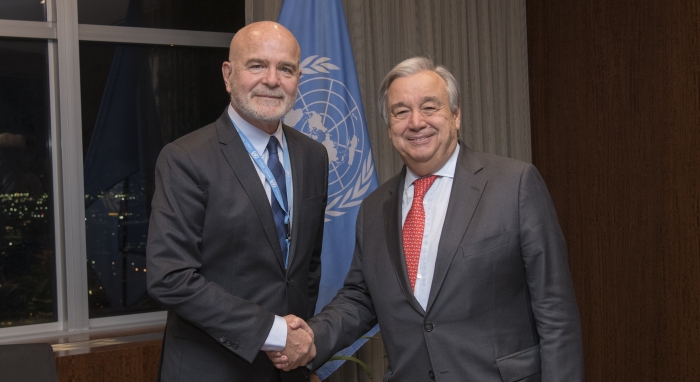
The current Special Rapporteur on human rights defenders shaking hands with the UN Secretary General
Michael Forst (l) with the UN Secretary General

An exceptionally large group of 131 national and international NGOs (for list see: http://www.ishr.ch/sites/default/files/documents/190909_criteria_jt_letter_sr_on_hrds_signatories.pdf) have set out the criteria that should be at the heart of the selection of the next UN Special Rapporteur on the situation of human rights defenders. As Michel Forst’s term as mandate holder comes to an end, candidates have until 17 October 2019 to submit their applications for the position. (If your organisation would like to endorse the criteria, please sign on here)

The document sets out the skills and expertise that should be taken into account in the appointment of the next expert in March 2020. These fit under 4 priorities:

  • qualifications and skills;
  • relevant expertise
  • established competence;
  • and flexibility/ readiness and availability

The document also provides information on the application process, and underlines the importance of independence and impartiality, as well as experience or knowledge of the realities faced by human rights defenders.

ISHR’s Programme Manager Helen Nolan stated: ‘Human rights defenders who are most at risk around the world are often persons with discriminated identities or from communities that are marginalised, so the Special Rapporteur should be able to consider the particular contexts and challenges faced by these individuals and groups with the benefit of insights from the mandate holder’s personal experience’.

The checklist is available here.

http://www.ishr.ch/news/special-procedures-what-skills-do-we-need-next-un-expert-human-rights-defenders-rapporteur

42nd session of the Human Rights Council: list of side events

September 9, 2019

The 42nd session of the UN Human Rights Council started today, 9 September 2019, and as usual is surrounded by a large number of side events. Here a selection with special relevance for human rights defenders:

  • Monday 9 September at 14:30 in Room VIII, Why is a Commission of Inquiry on Venezuela needed? organised by Amnesty International, ISHR, ICJ and Human Rights Watch.
  • Tuesday 10 September at 15:30-16:30 in Room XXII, Situation of the Right to Memory, Truth in Brazil: From the Transitional Policies to Denial organised by Centro de Estudios Legales y Sociales, Conselho Federal da Ordem dos Advogados do Brasil, Instituto Vladimir Herzog and Centro de Estudos sobre Justiça de Transição.
  • Wednesday 11 September, Privacy in the Digital Age: Priorities for Protecting Rights Online organised by Article19.
  • Wednesday 11 September 10:00-11:30, Room XXV. Human Rights Council Elections 2019: discussions of candidate States’ visions for membership, The event is co-sponsored by the Permanent Missions of the Czech Republic, Denmark and Fiji. It is intended to give candidates an opportunity to present their visions for Council membership and to respond to questions from a range of stakeholders on how they propose to realise the pledges and commitments they may have made in seeking election.
  • Thursday 12 September at 12:30-13:30 in Room XVI Ensuring credible HRC action on Sudan organised by Defendefenders.
  • Thursday 12 September at 13:30 to 14:30 in Room XVI Investigating Unlawful Deaths, organised by the International Commission of Jurists (ICJ) and the panel will include the Special Rapporteur on extrajudicial, summary or arbitrary executions (by video link).
  • Monday 16 September at 13:00 in Room IVCivic space restrictions as an early warning of a deteriorating human rights situation organised by CIVICUS.
  • Tuesday 17 September, 10:00-11:00, Room IV, Rule of law in China,  organised by ISHR, International Bar Association, World Uyghur Congress and Tibet Advocacy Coalition.
  • Tuesday 17 September at 13:00-14.30 in Room VIII Indigenous Justice and Human Rights co-organised by the UN Special Rapporteur on Rights of Indigenous Peoples and the International Commission of Jurists (ICJ).
  • Tuesday 17 September at 16:00-17:00, in Room IV Human rights in Myanmar organised by Forum-Asia.
  • Wednesday 18 September, 16:30-17:30, Room VIII, Ending Reprisals,  co-sponsored by the Cairo Institute for Human Rights Studies and Forum-Asia. The panel will include the Assistant Secretary General Andrew Gilmour and human rights defenders. It will discuss and expand on the Secretary-General’s report on cooperation with UN mechanisms, the nature and extent of reprisals and consider efforts to date to address the issue.
  • Thursday 19 September at 13:30 in Room VIII, The situation of human rights in Brazil organised by Conectas.
  • Thursay 19 September at 16:30 in Room XXII Access to Information organised by Article 19 and the Permanent Mission of the Kingdom of the Netherlands.
  • Thursday 19 September at 12:00 to 13:00 in Room XXI, The First Year of the Transitional Justice System in Colombia organised by the Colombian Commission of Jurists and the ICJ.
  • Friday 20 September from 15:00 to 16:30 Libya: How to advance accountability for Human Rights Violations and Abuses in Libya, organised by the Netherlands, the International Commission of Jurists, the Cairo Institute, Human Rights Watch and Lawyers for Justice in Libya.
  • Tuesday 24 September 13:00-14:00 in Room XXV, Human rights in Cambodia, organised by Forum-Asia.
  • Thursday 26 September, 09:30 in Room XXIV, The Continued Silencing and Imprisonment of Saudi women’s rights activists on  organised by CIVICUS, ISHR, Women’s March Global and the Gulf Center for Human Rights. The panel will share the experiences of Saudi women human rights defenders, reflect on the reality they face in prison, and discuss what further efforts can be taken to ensure their immediate release and provide guarantees for a safe and enabling environment for them to continue their work.

You can download the list of NGO events here.

see also: https://humanrightsdefenders.blog/2019/09/05/human-rights-defenders-issues-at-the-42nd-session-of-the-un-human-rights-council/

https://www.ishr.ch/news/hrc42-key-issues-agenda-september-2019-session

Interview with Nfor Hanson Nchanji, human rights defender from Cameroon

July 24, 2019

ISHR interviewed Nfor Hanson Nchanji, award winning Human Rights Journalist from Cameroon. Published on 16 July 2019.

Interview with Cédric Herrou, migrants rights defender who is the central person in the film Libre

July 18, 2019

ISHR had the chance to meet with Cédric Herrou for the Geneva premiere of movie ‘Libre’ where director Michel Toesca follows him in his endeavours in France‘s Roya Valley. During our interview, Herrou, a migrant rights defender and president of association ‘Défends Ta Citoyenneté’, shared his testimony, challenges, aspirations and calls to action.  The interview was published on 22 March 2019.

UN Human Rights Council renews mandate on sexual orientation and gender identity!

July 14, 2019

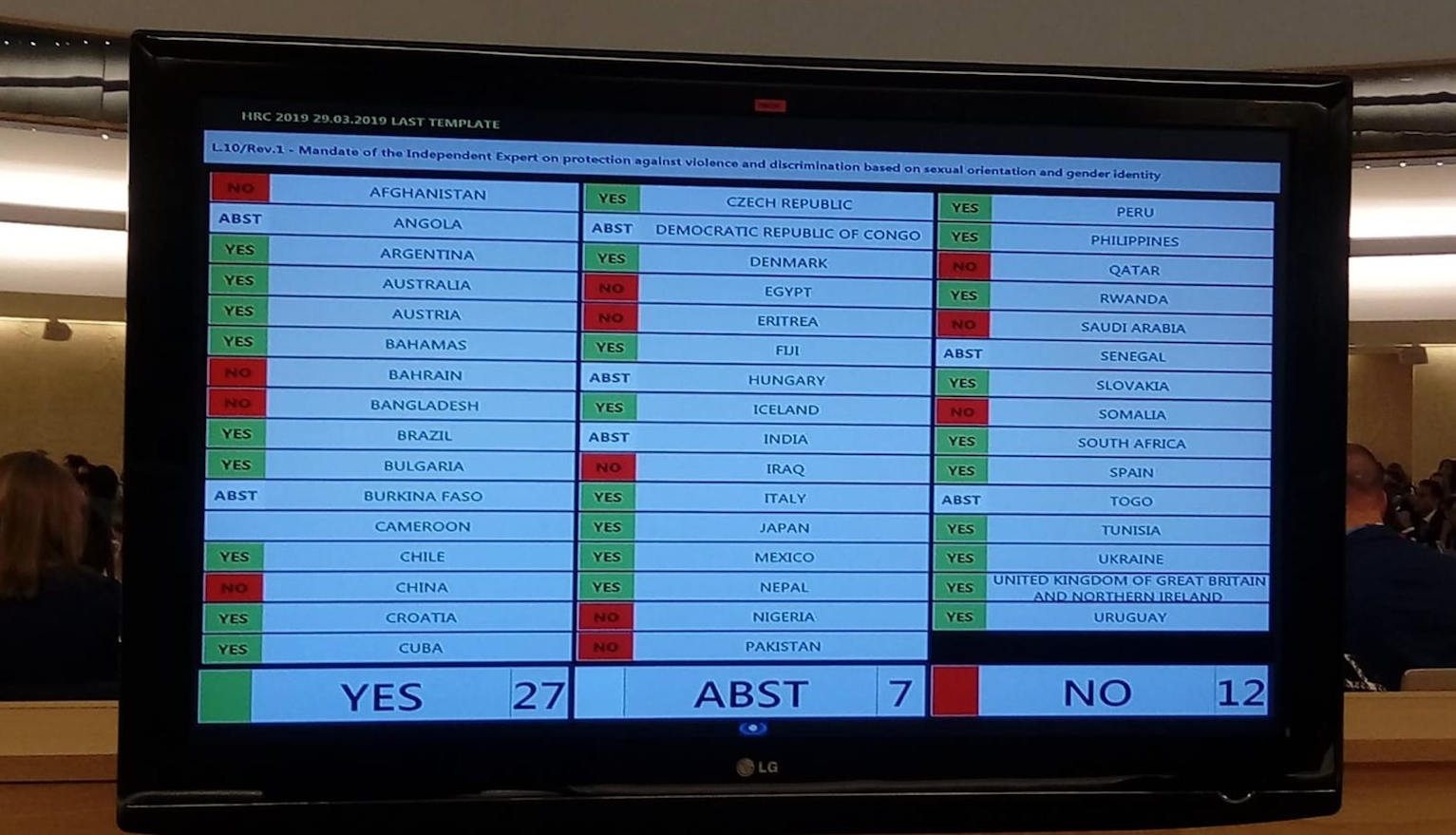
On 12 July the ISHR reports with gusto the renewal of the crucial mandate for protection against violence and discrimination based on sexual orientation and gender identity

It calls it “another historic victory, not only for communities of diverse sexual orientations and gender identities, but for humanity as a whole: In a defining vote, the United Nations Human Rights Council adopted a resolution to renew the mandate of the Independent Expert focusing on the protection against violence and discrimination on the basis of sexual orientation and gender identity.

The resolution was adopted by a vote of 27 in favour, with 12 voting against and 7 abstentions.

The campaign calling on the Council to renew the mandate of the UN Independent Expert on SOGI was supported by 1,312 non-governmental organisations from 174 States and territories.

Created in 2016, the UN Independent Expert on SOGI has been supported by an ever-growing number of States from all regions of the world. The resolution to create and renew the mandate was presented by a Core Group of seven Latin American countries – Argentina, Brazil, Chile, Colombia, Costa Rica, Mexico, and Uruguay. “The renewal of this mandate demonstrates how United Nations States’ support for tackling violence and discrimination against people of diverse sexual orientations and gender identities has grown tremendously,” said UN Trans Advocacy Week campaigners. “The Independent Expert is crucial in bringing international attention to specific violations and challenges faced by trans and gender-diverse persons in all regions.”

Although the renewal process had to overcome 10 hostile amendments, the core of the resolution in affirming the universal nature of international human rights law stands firm.

”A record number of organisations from every region imaginable has been calling for the renewal of the mandate of the Independent Expert,” said Tess McEvoy, Programme manager at ISHR. “His vital work will now continue and help make our societies more fair, equal and inclusive. We at ISHR are very proud to have been part of this process, along with several of our alumni,” continued Helen Nolan, Programme Manager at ISHR.

For more information, please contact Tess McEvoy at t.mcevoy@ishr.ch or Helen Nolan at h.nolan@ishr.ch

See also: https://humanrightsdefenders.blog/2019/06/14/guide-to-human-rights-defenders-issues-at-the-41st-human-rights-council-starting-on-24-june/

Lawyers key to the rule of law – even China agrees but only lip service

June 26, 2019

Lawyers have an essential role in upholding the Constitution and realising the rule of law – at the Human Rights Council 41st session this week, even China agreed. So why does the Chinese government continue to harass, intimidate and persecute lawyers who defend human rights ask 4 NGOs on 25 June 2019: Lawyers for Lawyers, International Bar Association, International Service for Human Rights and Lawyer’s Rights Watch Canada. In a joint statement the NGOs call on the UN expert on independence of judges and lawyers, and the Council and its members, to press for accountability.

‘The Chinese delegation recognised the need for balance in regulation between lawyers’ and judges’ rights, on the one hand, and their professional responsibilities, on the other hand’, says Sarah M Brooks, Asia Advocate at ISHR. ‘But it is hard to take this claim seriously, as Chinese authorities continue to adopt  abusive laws and measures, using them as a “sledgehammer” to restrict fundamental freedoms’.

This includes in particular lawyer Jiang Tianyong, who – since his nominal release from prison on 28 February 2019 – has been subject to invasive surveillance, restrictions on his freedom of movement, and refusal of independent medical exams. Worse, he is unnecessarily and inhumanely kept from joining his family in the U.S. [see also: https://humanrightsdefenders.blog/2017/11/21/jiang-tianyong-chinese-defender-of-defenders-sentenced-to-2-years-jail/]

The statement draws on research conducted by Chinese Human Rights Defenders and other partners into two ‘administrative measures’ that have had far-reaching consequences for lawyers on the ground.  The Measures on the Administration of Law Firms and Administrative Measures for the Practice of Law by Lawyers of Law Firms call on lawyers, law firms and regional bar associations not only to take measures to ensure that lawyers’ freedom of speech, both online and off, in professional and personal capacities, is not critical of the government. Furthermore, language added to one of the measures in 2018 specifically states that  ‘Law firms shall adhere to guidance of Xi Jinping Thought on Socialism with Chinese Characteristics for a New Era, adhere to and strengthen the comprehensive leadership of the Party over the work of lawyers, persist in preserving the authority and uniform leadership of the Party with Comrade Xi Jinping as its core, make support for the Party’s leadership and support for socialist rule of law basic requirements for the profession, and increase the conscientiousness and resoluteness with which lawyers as a group walk the path of socialist rule of law with Chinese characteristics’.

As a result of making comments that were deemed critical of the Chinese Communist Party, from January 2017 to January 2019, groups have documented cases of at least 26 lawyers and three law firms that have been punished for their opinion or expression, or by association with lawyers. This includes well-known rights lawyers such as Yu Wensheng, Wang Yu, Xie Yanyi and, just last week, Liu Xiaoyuan. 

[for the massive crackdown in 2015, see: https://humanrightsdefenders.blog/2015/07/29/the-remarkable-crackdown-on-lawyers-in-china-in-july-2015/]


—-

Full statement

Joint statement under Item 3: Interactive Dialogue with Special Rapporteur on Independence of Judges and Lawyers and the Independent Expert on SOGI

24 June 2019

Mr. Vice President,

We thank the Special Rapporteur for his report. We wish to highlight that many of the trends of restriction he notes also apply to lawyers. For example, across China, repression of human rights lawyers and legal activists continues. They are disappeared, detained, and denied basic rule of law guarantees.

Lawyer Jiang Tianyong is one example. Although he served his sentence for ‘inciting subversion of the State’, he now lives under constant police surveillance and with a serious medical condition.

What was his so-called ‘crime’? Representing fellow lawyers in court, investigating black jails, speaking out for victims of human rights violations and meeting with UN officials.

Mr Special Rapporteur, we are concerned about Chinese government actions to imprison and disbar lawyers who do not adhere to official ideology. The Chinese delegation raised earlier the need to uphold the Constitution – we couldn’t agree more. But problematic regulations passed in 2016 allow authorities to, inter alia, shut down law firms if they refuse to dismiss lawyers who express critical views, or who advocate for clients or causes unpopular with the Communist Party of China.

China’s claims to ‘faithfully uphold the rule of law’ are true only in relation to national laws created to authorize such government action. Chairman Xi has stressed the Communist Party’s control over the legal system, and has used the law to repress and punish those mandated to uphold and protect rights.

Yu Wensheng, Sui Muqing, Zhou Shifeng, Xie Yanyi, Li Heping, Wang Yu, Liu Zhengqing and Liu Xiaoyuan are only 8 out of at least 27 documented cases of human rights lawyers whose licenses have been invalidated or revoked since 2016, simply for fulfilling their professional duties.

In her UPR follow-up letter to the government, the High Commissioner identified key areas for improvement, including ‘guaranteeing an independent judiciary, fair trials, and access to legal counsel, releasing all human rights defenders, including lawyers’.

We call on you, Mr Special Rapporteur, and on this Council, to insist that China immediately stop all forms of harassment and persecution of human rights lawyers, including through administrative means, and unconditionally release those arbitrarily deprived of their liberty.

Thank you.

Guide to Human Rights Defenders issues at the 41st Human Rights Council starting on 24 June

June 14, 2019

Thanks to the – as always very complete and timely – “Alert to the Human Rights Council’s 41st session” (from 24 June to 12 July 2019) issued by the International Service for Human Rights. I am able to give a short guide to the main items that relate to human rights defenders. To Read the full Alert to the session online click here and stay up-to-date with @ISHRglobal and #HRC41 on Twitter.

Thematic areas of interest:

Sexual orientation and gender identity: The interactive dialogue with the Independent Expert on protection against violence and discrimination on the basis of sexual orientation and gender identity (SOGI) will be held on Monday 24 June at 11:00. The Council will consider the new thematic report of the mandate holder as well as the report of the country visits he made to Georgia and Mozambique. The Council will also consider the renewal of the mandate.

Business and human rights: The Council will hold an interactive dialogue with and consider several reports of the Working Group on the issue of human rights and transnational corporations and other business enterprises on 26 June. The Working Group will present a report on the gender dimensions of the Guiding Principles on Business and Human Rights and the reports of country visits to Thailand and Kenya. The Working Group’s report on the gender dimensions of the Guiding Principles integrates clear recognition that women human rights defenders play a vital role in challenging business-related human rights abuses as well as in promoting and protecting human rights in relation to business activity, including the right to an effective remedy. As a result of this work, women human rights defenders often face gender-specific risks including sexual violence, misogynist public shaming and online harassment. Among its recommendations, the Working Group calls on business enterprises to ensure the meaningful participation of women’s organisations, women human rights defenders and gender experts in all stages of human rights due diligence.

Women human rights defenders and women’s rights: The annual full day discussion on the human rights of women will take place on 27 and  28 June. The discussions will focus this year on violence against women in the world of work, the rights of older women and their economic empowerment. A panel focused on women’s rights and climate change will also be organised, focusing on climate action, best practices and lessons learned. States should place due consideration on the role of women human rights defenders and social movements in this regard, in line with the Human Rights Council resolution focused on environmental human rights defenders adopted in March 2019…
The Council will also hold an interactive dialogue with the Working Group on the issue of discrimination against women in law and in practice which focuses on women deprived of liberty (including women human rights defenders in detention, facing travel bans, among other situations), and will consider their reports including a report on the country visits to Honduras and Poland. The Council will hold an interactive dialogue with the Special Rapporteur on violence against women, its causes and consequences on 27 June and will consider her report including the report of her visits to Canada and Nepal.

Reprisals:  In spite of a number of measures, reprisals not only continue, but grow. Item 5 of the Human Rights Council’s agenda provides a key opportunity for States to raise concerns about reprisals, including specific cases, and for relevant governments to provide updates on cases to the Council on any investigation or action taken toward accountability. During the organisational meeting held on 7 June, the President of the Council stressed the importance of ensuring the safety of those participating in the Council’s work, and the obligation of States to prevent intimidation or reprisals. In line with previous calls, ISHR expects the President of the Human Rights Council to publicly identify and denounce specific instances of reprisals by issuing formal statements, conducting press-briefings, corresponding directly with the State concerned, publicly releasing such correspondence, and insisting on undertakings from the State concerned to investigate, hold the perpetrators accountable and report back to the Council on action taken. [see also: https://humanrightsdefenders.blog/2019/05/13/ishr-on-reprisals-un-and-states-must-do-more-to-address-reprisals/]

Other key thematic reports: The Council will hold dedicated debates and consider reports of several mandates relating to civil, political, economic, social and cultural rights, and the role of human rights defenders in that work area, in some instances involving the renewal of the mandate:

  • The Special Rapporteur on independence of judges and lawyers and on the right to health (including country visits report to Canada and Kyrgyzstan) on 24 June
  • The Special Rapporteur on the rights to freedom of peaceful assembly and association (mandate renewal, reports include country visits to Tunisia and Armenia) on 25 June
  • The Special Rapporteur on extrajudicial, summary or arbitrary executions and right to education on 26 June
  • The Special Rapporteur on freedom of opinion and expression (including thematic report on surveillance companies and country visit report to Ecuador) on 25 June
  • The Special Rapporteur on extreme poverty and human rights (including country visits reports to the UK and Laos) on 28 June

In addition, the Council will hold dedicated debates on rights of specific groups including with:

  • The Special Rapporteur on the human rights of migrants (and country visit report to Niger) on 24 June
  • The Special Rapporteur on the human rights of internally displaced persons on 28 June (mandate renewal)
  • The Special Rapporteur on trafficking in persons (and country visit to Nigeria) on 27 June
  • The Special Rapporteur on the elimination of discrimination against persons affected by leprosy and their family members on 24 June

Country-specific developments:

China: For more than a year, the international community has had access to credible reports and first-hand testimony of the harassment, surveillance, and mass detention of more than one million Uyghurs and other Turkic Muslims in Xinjiang. Despite the consistent work of the UN human rights mechanisms to review China, ask questions, and make recommendations, there has been no serious or effective response. The Council should take urgent action to seek access, monitoring and reporting of the situation to inform future actions. ..ISHR urges States to act collectively to advance a resolution calling for China to allow access to the region to independent human rights experts and to end country-wide the arbitrary detention of individuals based on their religious beliefs or political opinions.

Sudan: In response to the gross and systematic human rights violations occurring in Sudan, ISHR andother NGOs have urged Council Member States to urgently hold a Special Session on the human rights situation in Sudan. The Council should urgently establish an international fact-finding mission to document violations, identify perpetrators and push for accountability, in line with calls made by a group of Special Procedures including the Independent Expert on Sudan. Since 3 June, Rapid Security Forces, riot police and national security officers violently dispersed peaceful protesters in Khartoum as well as in different cities across Sudan. The MENA Women Human Rights Defenders’ Coalition reported that at least 113 people have died including women human rights defenders. Civil society documented cases of rape, attacks on hospitals, with hundreds injured and missing.  The Transitional Military Council is enforcing a ban on communication causing an internet black out. The High Commissioner has deplored the killings and proposed ‘the rapid deployment of a UN human rights monitoring team’ to Sudan.

Saudi Arabia: The June session provides an important opportunity for the Council to follow up on the joint statement delivered on behalf of 36 States [see: https://humanrightsdefenders.blog/2019/03/08/saudi-arabia-for-first-time-openly-criticized-in-un-human-rights-council/] .. Seven women’s rights activists have been provisionally released, but they are still facing trial, and other women human rights defenders are still in detention, with the human rights situation on the ground deteriorating markedly on other fronts, including through increased use of the death penalty and the authorities’ continuing crackdown on freedom of expression.  [see also: https://humanrightsdefenders.blog/2019/03/28/3-saudi-women-human-rights-defenders-released-but-for-how-long-and-what-about-the-others/]
The Special Rapporteur on extrajudicial, summary or arbitrary executions will present her findings of the investigation into the killing of Khashoggi. [see: https://humanrightsdefenders.blog/2019/01/26/other-members-of-the-uns-khashoggi-investigation-team-named/%5D…..ISHR calls on States to advance a Human Rights Council resolution establishing a monitoring mechanism over the human rights violations in the country and calling explicitly for the immediate and unconditional release of all human rights defenders including the detained women human rights defenders and to drop all charges against them, including those provisionally released. ISHR considers the March joint statement as a first step towards more sustained and dedicated review by the Council in its efforts to hold its members accountable.

The Philippines: The Philippines is one of the most dangerous countries for human rights defenders. Several NGOs callied on the Council to advance accountability for human rights violations by adopting a resolution establishing an independent international investigation into extrajudicial killings and this call was strongly endorsed by a group of independent UN experts who condemned a ‘sharp deterioration in the situation of human rights across the country, including sustained attacks on people and institutions defending human rights.’ [see also: https://humanrightsdefenders.blog/2019/06/07/philippines-labour-rights-defender-dennis-sequena-shot-dead-while-meeting-with-workers/]

Egypt: Despite the Egyptian government’s assurances to the African Commission civil society faced restrictions, reprisals and intimidation for engaging or seeking to engage with the Commission. These restrictions and reprisals happened in a context where the Government of Egypt crushes dissent, discourages public participation in public affairs and punishes people who dare to claim basic human rights. Individuals and communities who engaged with the Special Rapporteur on the right to housing during her visit in September 2018 faced systematic reprisals. All other scheduled visits by the Special Procedures have been postponed as a result. [see: https://humanrightsdefenders.blog/2018/12/07/egypt-denounced-for-reprisals-against-human-rights-defenders-who-talked-to-visiting-un-delegation/ and https://humanrightsdefenders.blog/2019/05/12/reprisal-against-egyptian-human-rights-defender-mohamed-soltan/]. ISHR calls on States to condemn the acts of intimidation and reprisals for civil society engaging with the African Commission and with the Special Procedures, and recall Egypt’s obligations to prevent acts of intimidation and reprisals, investigate the allegations and provide victims with effective remedy.

Burundi: The Commission of Inquiry on Burundi will present its oral briefing on 2 July. The closing of the office of the High Commissioner for Human Rights is regrettable and worrying. In addition, ISHR remains seriously concerned over the breaches to due process observed in all of human rights defender Germain Rukuki’s legal proceedings since his arrest without warrant on 13 July 2017. [See: https://humanrightsdefenders.blog/2019/03/29/ngo-statement-condemns-new-irregularities-in-the-case-of-germain-rukuki-burundi/]. For more information on the situation of human rights defenders in Burundi, check ISHR Briefing Paper for the UPR here.

Other country situations: The High Commissioner will present her oral update to the Council on 24 June. The Council will hear reports on and is expected to consider resolutions addressing a range of country situations, in some instances involving the renewal of the relevant expert mandates. These include:

  • Interactive dialogue with the Special Rapporteur on the human rights situation in Belarus (mandate renewal) on 1 July
  • Interactive dialogue with the Special Rapporteur on the human rights situation in Eritrea (mandate renewal) on 2 July
  • Interactive dialogue with the Commission of Inquiry on Syria, the Commission of Inquiry on Burundi and the Special Rapporteur on Myanmar on 2 July
  • Enhanced interactive dialogue with the government of Sudan and OHCHR on 9 July
  • Enhanced interactive dialogue on the situation in the Democratic Republic of Congo and interactive dialogue with the team of experts on the situation in the Kasai region on 9 July
  • Interactive dialogue with the High Commissioner on the situation in Ukraine on 10 July
  • Interactive dialogue with the Independent Expert on the Central African Republic on 10 July
  • Enhanced interactive dialogue on the report of the High Commissioner on Venezuela on 10 July
  • Interactive dialogue with the High Commissioner on the situation of Rohingya Muslims and other minorities in Myanmar on 10 July
  • First oral update and enhanced interactive dialogue on the report of the High Commissioner on Nicaragua on 11 July
  • Oral update by the High Commissioner on cooperation with Georgia on 11 July

Adoption of Universal Periodic Review (UPR) reports: During this session, the Council will adopt the UPR working group reports on New Zealand, Afghanistan, Chile, Viet Nam, Uruguay, Yemen, Vanuatu, North Macedonia, Comoros, Slovakia, Eritrea, Cyprus, Dominican Republic and Cambodia.

Resolutions to be presented to the Council’s 41st session: At the organisational meeting resolutions were announced (States sponsoring the resolution in brackets); it is possible that more resolutions could be presented at this session. These include:

  • The human rights situation in Belarus (European Union)
  • Human rights of internally displaced persons (Austria, Honduras, Uganda)
  • Human rights and climate change (Bangladesh, Philippines, Viet Nam)
  • Human rights, sexual orientation and gender identity (Argentina, Brazil, Chile, Colombia, Costa Rica, Mexico, Uruguay).
  • Elimination of discrimination against women and girls (Colombia, Mexico)
  • Rights to freedom of peaceful assembly and of association (Czech Republic, Indonesia, Lithuania, Maldives, Mexico)
  • New and emerging and digital technologies and human rights (Republic of Korea, Austria, Brazil, Denmark, Morocco, Singapore)
  • Accelerating efforts to eliminate all forms of violence against women(Canada)
  • The human rights situation in Syria (France, Germany, Italy, Jordan, Kuwait, Morocco, Netherlands, Qatar, Turkey, United Kingdom of Great Britain and Northern Ireland)

There wil be again many side events at the Council, on which I will report separately.

Read here the three year programme of work of the Council with supplementary information.
Read here ISHR’s recommendations on the the key issues that are or should be on the agenda of the UN Human Rights Council in 2019.