Posts Tagged ‘Indigenous rights’

Amazon: indigenous peoples must have say in anti-crime and environmental policies

July 5, 2025

On 1 July 2025, Raphael Hoetmer and Sofia Jarrín in Amazon Watch report on the U.N. Permanent Forum on Indigenous Issues, staying that governments and UNODC must include Indigenous Peoples in anti-crime and environmental policies

Organized crime now dominates 70% of Amazonian municipalities across Bolivia, Brazil, Colombia, Ecuador, Peru, and Venezuela. Networks of illicit economies – or “Amazon Crime” – have diversified and expanded the territorial control and political power of criminal gangs, posing existential threats to biodiversity, ecological integrity, and Indigenous rights across the Amazon, much like in other critical ecosystems worldwide. [see also: https://humanrightsdefenders.blog/2025/02/17/colombia-and-brazil-the-worlds-deadliest-countries-for-environmental-activists/]

For Indigenous communities, these expanding criminal economies mean more than environmental degradation. They are direct assaults on their lives, health, and sovereignty. Illegal activities such as logging, mining, and coca production for international markets contaminate rivers with mercury, destroy food sources, deteriorate health, and displace communities from their ancestral lands. These burgeoning criminal markets, coupled with weak or complicit state institutions, have led Indigenous leaders to warn that criminal groups are increasingly taking over local government structures and exerting territorial control.

This deepening crisis makes the Amazon one of the most dangerous places in the world for environmental defenders. Indigenous organizations often face these threats alone, without adequate support from governments or international institutions. As Indigenous Peoples themselves underscore, these violent criminal economies kill leaders, recruit their youth, and spread fear through their communities…

This year a delegation of Amazonian Indigenous leaders delivered a clear and urgent message: organized crime and illegal economies are devastating the Amazon and threatening the survival of Indigenous Peoples. They called on the Forum to include strong recommendations urging the international community and governments to step up their efforts to support Indigenous territorial governance, protect human rights defenders, and ensure Indigenous Peoples are included in shaping policies to prevent and contain organized crime.

The Permanent Forum must formally recognize that organized crime and illegal economies such as drug trafficking and illegal mining are an existential threat to our peoples. We must be included in drafting the international protocol on environmental crimes, and protection mechanisms for Indigenous defenders must be created, along with funding for Indigenous-led economic alternatives. If these measures are not taken, ongoing military and police interventions in our territories will continue to put our lives at risk. Without dignified livelihoods, we cannot safeguard our culture or our territories.”

The Permanent Forum’s conclusions this year directly responded to these urgent appeals. Its final document, published earlier this month, presents a wide range of concerns, recommendations, and proposals related to the implementation of the United Nations Declaration on the Rights of Indigenous Peoples, with this session explicitly addressing the impacts and expansion of criminal economies.

In conclusion 87 of the document, the Forum urges governments and the United Nations Office on Drugs and Crime (UNODC) – the leading global institution on anti-crime policies – to integrate Indigenous Peoples meaningfully into the design and implementation of anti-crime and security strategies. This recommendation is particularly relevant in the ongoing process to discuss a new Protocol Against Crimes that Affect the Environment, which must include the voices of Indigenous Peoples – as the principal stewards of global biodiversity and primary victims of the violence tied to these crimes.

The Forum’s conclusions also emphasize the urgent need for the international community and governments to:

  • take necessary measures to ensure the rights, protection, and safety of Indigenous leaders and human rights defenders,
  • end impunity and prosecute those who commit violence against Indigenous Peoples,
  • acknowledge and protect Indigenous women and children from the disproportionate impacts of war and violence on their lives,
  • ensure Indigenous participation in peace negotiations and peace-building processes,
  • assess the impacts of mercury on the health, culture, and livelihoods of Indigenous Peoples under the Minamata Convention,
  • and repair the damage from toxic metals on Indigenous lands and territories, including restoring sites and water sources, with special attention to the severe impact on the health of Indigenous women and children.

Indigenous human rights defender Victoria Maladaeva from Russia

November 6, 2024

Indigenous communities must have better political representations to ensure our rights are protected both constitutionally and in practice,‘ says Victoria Maladaeva, and Indigenous peoples’ rights defender from Russia. Victoria was also a participant in ISHR’s Women Rights Advocacy Week this year. She spoke to ISHR about her work and goals.

Hello Victoria, thanks for accepting to tell us your story. Can you briefly introduce yourself and your work?

Sure! I’m a Buryat anti-war decolonial activist, co-founder of the Indigenous of Russia Foundation.

What inspired you to become involved in the defence of human rights?

Since the full-scale Russian invasion of Ukraine, Indigenous peoples, particularly Buryat, have been hit the hardest. I wanted to help my people, fight the Russian propaganda and raise awareness about systemic colonial oppression and discrimination faced by Indigenous people and ethnic minorities in the Russian Federation.

What would Russia and your community look like in the future if you achieved your goals, if the future you are fighting for became a reality?

The country needs a large-scale transformation— political, economic, and cultural. Indigenous communities must have better political representations to ensure our rights are protected both constitutionally and in practice. Genuine democratic reforms involve fundamental rights for self-determination and autonomy where Indigenous peoples gain control of their land and resources. Putin’s constitution’s amendments to national Republics must be reversed, our languages must be mandatory in all schools, universities, and institutions where Indigenous communities live. 

How do you think your work is helping make that future come true?

I’m advocating for the rights of Indigenous peoples with international stakeholders and institutions to raise awareness about issues faced by our communities and spreading awareness, producing documentaries, and mobilising diasporas. 

Have you been the target of threats or attempts at reprisals because of your work?

Unfortunately, yes. There have been threats because of my anti-war activism and for shedding light on the disproportionate mobilisation in the Republic of Buryatia. For some reason, my colleagues and I were denied participation in the UN Permanent Forum on Indigenous Issues. I would like to believe this was a mistake and that there was no influence from the Russian delegation at the UN.

Do you have a message for the UN and the international community?

Russia needs decolonisation and de-imperialisation. Without revising the past and acknowledging colonial wars (not only in Ukraine) and discrimination, there can be no bright future for Russia—free and democratic. The international and anti-imperialist community should acknowledge that the Russian government is not for any anti-colonial movement. Stand in solidarity with independent Indigenous activists!

https://ishr.ch/defender-stories/human-rights-defenders-story-victoria-maladaeva-from-russia

Global Witness report 2021: continued disaster

October 5, 2022

Stuti Mishra in the Independent of 29 September 2022 summarises and analyses the report “A Decade of Defiance: Ten years of reporting land and environmental activism worldwide” by Global Witness

More than 1,700 environmental defenders have been killed around the world in the last decade with one death reported every other day on average…The report titled A Decade of Defiance: Ten years of reporting land and environmental activism worldwide, released by Global Witness, reveals the increasing threats environmental activists are facing as the climate and biodiversity crisis worsens.

The research states that a total of 1,733 people have been killed over the past 10 years trying to protect their land and resources. That is an average of one defender killed approximately every two days over 10 years.

The report shows Brazil has been the deadliest country for environmental defenders with 342 lethal attacks reported since 2012 with over 85 per cent of killings within the Brazilian Amazon.

The data found within the report also shows that over half of the attacks over the 10-year period have taken place in three countries — Brazil, Colombia, and the Philippines — with around 300 killings reported in these countries.

Mexico and Honduras witnessed over 100 killings while Guatemala and India saw 80 and 79 respectively, remaining one of the most dangerous countries. The report also reports 12 mass killings, including three in India and four in Mexico.

Mexico was the country with the highest recorded number of killings in 2021, totalling 54 killings, up from 30 the previous year. Almost half of those killed were again Indigenous people while over a third were forced disappearances, including at least eight members of the Yaqui community.

The report also reveals that over three-quarters of the attacks recorded in 2021 took place in Latin America. In Brazil, Peru and Venezuela, a big majority of 78 per cent of these attacks occurred in the Amazon.

Meanwhile, the biggest increase in lethal attacks was witnessed in Brazil and India in 2021 with 26 deaths reported in Mexico, up from 20 and 14 in India, up from four.

Both Colombia and the Philippines saw a drop in killings to 33 in 2021 from 65, and 19 from 30 in 2021 respectively. Yet overall they remain two of the countries with the highest numbers of killings in the world since 2012.

2021 Highlights from Global Witness report

  • Around 200 Land and Environmental Defenders were killed in 2021 – nearly four people a week
  • Over three-quarters of the attacks recorded in 2021 took place in Latin America
  • Nearly 40 per cent of all attacks reported were against Indigenous people
  • Mexico recorded the highest number of killings in 2021
  • Brazil and India both saw a rise in lethal attacks in 2021
  • 50 of the victims killed in 2021 were small-scale farmers
  • Around 1 in 10 of the defenders recorded killed in 2021 were women, nearly two-thirds of whom were Indigenous [see also: https://humanrightsdefenders.blog/2021/09/13/global-witness-2020-the-worst-year-on-record-for-environmental-human-rights-defenders/]

In Africa, the Democratic Republic of Congo remained the country with the highest number of attacks — eight defenders were killed there in 2021. All eight of these killings were in Virunga National Park, which remains extremely dangerous for the park rangers protecting it.

The organisation began collecting data on attacks against those defending land and the environment in 2012 and found that the control and use of land and territory is a central issue in countries where defenders are threatened. Much of the increasing killing, violence and repression is linked to territorial conflicts and the pursuit of economic growth based on the extraction of natural resources from the land, it states. The research has also highlighted that Indigenous communities in particular face a disproportionate level of attacks — nearly 40 per cent — even though they make up only 5 per cent of the world’s population.

However, the research found that the figures also do not capture the true scale of the problem, as tightened control on media has led to severe underreporting in some countries where environmental defenders are most vulnerable. Research has also found that few perpetrators of killings are rarely ever brought to justice due to the failures of governments to properly investigate these crimes.

While a majority of these attacks are not properly investigated or reported on, a big proportion of these attacks were linked to sectors like mining and infrastructure, including large-scale agribusiness and hydroelectric dams.

Many authorities ignore or actively impede investigations into these killings often due to alleged collusion between corporate and state interests, the report says.

All over the world, Indigenous peoples, environmental activists and other land and environmental defenders risk their lives for the fight against climate change and biodiversity loss.

They play a crucial role as a first line of defence against ecological collapse, yet are under attack themselves facing violence, criminalisation and harassment perpetuated by repressive governments and companies prioritising profit over human and environmental harm.

a spokesperson for Global Witness said

With democracies increasingly under attack globally and worsening climate and biodiversity crises, this report highlights the critical role of defenders in solving these problems,” a spokesperson for Global Witness said, adding that the organisation makes an “urgent appeal for global efforts to protect and reduce attacks against them.”

Apart from killings, the report also reveals a number of tactics being used to silence them, like death threats, surveillance, sexual violence, or criminalisation – and that these kinds of attacks are even less well reported.

https://www.globalwitness.org/en/campaigns/environmental-activists/decade-defiance/

https://www.independent.co.uk/climate-change/news/global-witness-report-environment-defenders-threat-b2176247.html

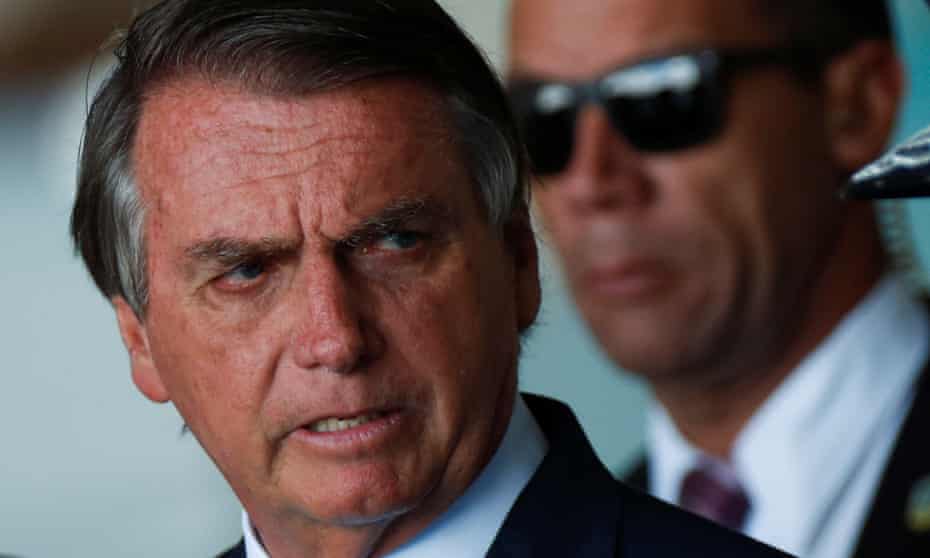
Bolsonaro’s “indigenous medal” is giving awards a bad name.

March 26, 2022
Jair Bolsonaro

Indigenous leaders said Jair Bolsonaro had spent three years promoting legislation that would open their territories to commercial development. Photograph: Adriano Machado/Reuters

Tom Phillips on 17 March 2022 reported how the Brazilian Government honours a president who activists accuse of undermining Indigenous protections.

Brazilian activists are outraged after Jair Bolsonaro – who has been accused of spearheading a cataclysmic attack on Indigenous rights – was honoured by his own government for his supposedly “altruistic” efforts to protect Indigenous lives.

Bolsonaro was granted the Medal of Indigenous Merit on Wednesday in recognition of what the justice ministry called his attempts to defend Indigenous communities in the South American country.

The same honour was bestowed upon key Bolsonaro allies, including his health, defence and agriculture ministers and the hardline institutional security chief, Augusto Heleno, who has accused Indigenous activists of committing crimes against the state by criticising the government’s policies overseas.

Indigenous leaders reacted to the award with disbelief and exasperation, noting how Brazil’s far-right president had spent three years undermining its Indigenous and environmental protection agencies, Funai and Ibama, and promoting legislation that would open Indigenous territories to commercial development.

The Articulation of Indigenous Peoples of Brazil criticised the government’s “contemptuous gesture”. “They want to destroy us at all costs and, as if that wasn’t enough, they now want to pay tribute to themselves in our name?” the group said, claiming Bolsonaro deserved only “the medal of Indigenous genocide”.

Alessandra Korap, an activist from the Amazon’s Munduruku people, said Bolsonaro needed to be arrested, not honoured “for all the destruction he has inflicted on Indigenous people and the forest”. [see also: https://humanrightsdefenders.blog/2020/10/14/brazilian-alessandra-korap-munduruku-wins-2020-robert-f-kennedy-human-rights-award/]

“Now he wants to use the Ukraine war [as justification] for allowing mining, oil and gas exploration, hydroelectric dams and soy plantations on Indigenous lands,” Korap added, in reference to recent moves to fast-track draft legislation allowing such activities.

Alessandro Molon, the lower house leader of Brazil’s opposition, urged Congress to strip Bolsonaro of the medal. “It’s a mockery that the same government that is trying to legalise mining on Indigenous lands – endangering the existence of these utterly persecuted and mistreated people – has the nerve to award itself medals of ‘merit’ for all of the harm it has caused over the past three years,” Molon told the magazine Veja.

“If Congress doesn’t overrule this absurdity it will be associating itself with this unprecedented assault on Indigenous people,” Molon said.

https://www.theguardian.com/world/2022/mar/17/contemptuous-anger-in-brazil-as-bolsonaro-given-indigenous-merit-medal

Father Stan’s death: callousness that amounts to murder

July 5, 2021

What many feared has happened, jailed Indian tribal rights activist Stan Swamy has died of a cardiac arrest in Mumbai city. He was 84. He was jailed last year under draconian anti-terror law UAPA in connection with the Elgar Parishad case – his death has triggered a flood of messages on social media from political leaders, intellectuals and other activists. Swamy, the oldest person to be accused of terrorism in India, was arrested in October 2020.

Members of the civil society on Sunday 4 July 2021 had urged the chief justice of the Bombay High Court to intervene and provide relief to ailing activist Stan Swamy. They demanded that the 84-year-old, who suffers from Parkinson’s disease and had been put on ventilator support, should be granted bail immediately and allowed to return to Jharkhand.

Mary Lawlor, Special Rapporteur on Human Rights Defenders shared a similar Tweet, saying it was “horrible news” that Swamy was put on a ventilator: “He’s spent 9 months in jail on unfounded charges. I’m deeply saddened and expect that every possible specialist treatment will be provided to him.”

Mr Gilmore – the European Union’s Special Representative for Human Rights, – re-tweeted Ms Lawlor’s post and added: “India: I am very saddened to hear that Father Stan Swamy has passed away. A defender of indigenous peoples’ rights. He was held in detention for the past 9 months. The EU had been raising his case repeatedly with authorities.”

The Jesuit priest, who suffered from Parkinson’s disease, was moved to a private hospital in May after he tested positive for Covid. As he was very belatedly released on bail into hospital and was denied critical treatment in detention, he should be considered a death in the custody of the state.

Jharkhand Chief Minister Hemant Soren stated on Monday: Shocked to learn about the demise of Father Stan Swamy. He dedicated his life working for tribal rights. I had strongly opposed his arrest & incarceration. The Union Govt should be answerable for absolute apathy & non provision of timely medical services, leading to his death.

See also: https://humanrightsdefenders.blog/2020/10/11/the-indomitable-father-stan-swamy-defending-the-adivasis-and-the-dalits-a-cause-of-arrest/

I understand there will be likely a virtual memorial tomorrow, but no details known yet.

A joint statement by important international NGOs (Amnesty International, CIVICUS: World Alliance for Citizen Participation, CSW, FIDH, in the framework of the Observatory for the Protection of Human Rights Defenders, Front Line Defenders, International Commission of Jurists, International Dalit Solidarity Network, World Organisation Against Torture (OMCT), in the framework of the Observatory for the Protection of Human Rights Defenders)) was issued on 5 July: https://www.fidh.org/en/region/asia/india/india-joint-statement-on-the-death-of-human-rights-defender-father

The Government keeps insisting that all was ‘legal’: https://www.mangalorean.com/govt-rebuts-un-says-stan-swamys-detention-was-lawful/

On 25 November 2021 this: https://thewire.in/rights/bombay-hc-asks-jesuit-group-to-file-new-plea-if-they-want-stan-swamys-name-cleared

https://www.bbc.com/news/world-asia-india-57718356

https://scroll.in/latest/999322/as-activist-stan-swamys-heath-worsens-civil-society-members-call-for-bail-specialised-treatment

https://www.outlookindia.com/website/story/india-news-stan-swamys-death-marks-a-tragic-moment-for-indian-democracy-akhil-gogoi/387163

https://www.ndtv.com/india-news/elgar-parishad-case-stan-swamys-death-devastating-eu-un-human-rights-reps-on-stan-swamys-death-2479792

https://www.hindustantimes.com/india-news/activists-opposition-call-out-custodial-murder-of-stan-swamy-101625494111357-amp.html

https://www.fidh.org/en/region/asia/india/india-joint-statement-on-the-death-of-human-rights-defender-father

https://www.indialegallive.com/column-news/stan-swamy-uapa-unlawful-activities-prevention-act-kanchan-nanaware-varavara-rao-binayak-sen/

https://www.miragenews.com/death-in-custody-of-priest-stan-swamy-is-596431/

https://www.ucanews.com/news/book-tells-story-of-indian-jesuit-who-died-in-custody/94104#

Goldman Prize laureates express concern about colleague Alberto Curamil in Chile

July 3, 2021
Alberto Curamil. (Vicente Franco/Water For Life)

In the Washington Post of 1 July 2021, Craig Williams and Alfred Brownell (winners of the Goldman Prize in 2006 and 2019 respectively) wrote: He has worked to protect the Earth. Now we must protect him.”

As environmental activists and human rights defenders, we are alarmed by a spike in violent attacks on and killings of land rights activists across the globe and, most recently, in Latin America. The latest in this disturbing trend is a violent assault on Alberto Curamil, a leader of the Indigenous Mapuche people in southern Chile and an activist working to protect his people’s land, water and other resources. As we write, we fear Alberto could become the latest casualty in a global war against Earth’s front-line protectors. [see: https://www.trueheroesfilms.org/thedigest/laureates/4f845ff0-86d2-4b12-97af-1590f6ba8602]

On April 29, Alberto was attending a protest along with his son andnephew, both teenagers. They were there to show support for Elena Paine, another Mapuche leader, and her community a day after her house and crops in Koyam Montre were burned to the ground. Alberto, Paine and members of the Machupe community believe that the threat may have come from far-right-wing groups in the area.

As Alberto and his teenage relatives were driving away from the protest, the back window of their truck was shattered by a tear-gas canister. When they got out of the vehicle, police shot Alberto at point-blank range three times with buckshot, which lodged in his back, side, arm and the back of his leg. Then, police beat the teens with batons while yelling “Pinche Mapuche” (“Lousy Mapuche”). The three were arrested and charged with disorderly conduct at a public event and breach of sanitary provisions. Alberto was taken to a hospital three hours after being brought into custody, bleeding and in excruciating pain. The teens were bruised, battered and traumatized.

This was not the first time Alberto had been a target of the Chilean government. In 2018, he was arrested and jailed for 15 months on false charges of armed robbery based entirely on hearsay evidence. He was acquitted of all charges and released in December 2019. Due to his imprisonment, he had been unable to receive the Goldman Prize — known as the “green Nobel” — at ceremonies in April and May 2019 in D.C. and San Francisco. He was previously arrested after being violently beaten by police in 2014.

Our alarm has led us, along with several dozen of our fellow Goldman Prize winners from across the globe, to demand assurances from Chilean President Sebastián Piñera that Alberto’s safety will be given the highest priority. We are also seeking support through appeals to the U.S. Congress, the European Union and the United Nations.

We believe time is of the essence, especially given the broader context of violence against those who stand up to protect the Earth. In 2016, the internationally celebrated Honduran Indigenous activist and Goldman Prize winner Berta Cáceres was murdered by operatives for the power company Desarrollos Energéticos (Desa) for her opposition to a hydroelectric project on the Rio Gualcarque. Seven men accused of plotting Cáceres’s murder were convicted and sentenced to between 30 and 50 years in prison. An eighth suspect, Roberto David Castillo Mejía, president and chief executive of Desa, is currently on trial, accused of masterminding the murder-conspiracy plot.

In its latest report, Global Witness recorded the highest number of environmental defenders killed in a single year — more than 212 people killed in 2019, a rate of four a week. More than two-thirds of the killings took place in Latin America. [see also: Global]

The killings of and assaults on Earth’s defenders worldwide have accelerated in some of the most fragile pristine landscapes and biodiverse countries, jeopardizing the fight against climate change and species extinction. In Mexico, police are investigating the suspicious killings of two employees at a butterfly reserve in 2020. That same month, six members of an Indigenous community were killed at a nature reserve in Nicaragua. And in South Africa, environmental activist Fikile Ntshangase was killed last year in an attack local activists fear was related to her opposition to disruptive local mining operations.

In Chile, Indigenous communities’ push for human rights go hand in hand with their struggle for land and water rights, as government-backed companies try to run them off their land with threats, harassment and violence.

Attacks on environmental defenders in Latin America and worldwide are not only an affront to human rights, but also a cause for deep alarm at a time when the world must fight climate change and bring about a sustainable future. We are demanding that the Chilean government take immediate steps to stop these aggressive and often deadly attacks on the Mapuche community. There should also be a thorough, independent investigation into the destruction of Paine’s home.

We must act against this brutality, or we threaten the fight for a planet in crisis.

https://www.washingtonpost.com/opinions/2021/07/01/alberto-curamil-chile-environmental-defender-safety/

Escazu treaty comes into force on 22 April but its success will depend on the commitment of governments and big business

April 20, 2021

The Thomson Reuters Foundation on 19 April 2021 wrote about the treaty aimed at protecting activists in Latin America which could be a life-saving watershed in a region where scores are murdered each year. But the pact’s success will depend on the commitment of governments and big business, rights advocates said.

Nicaraguan activist Lottie Cunningham, who described the Escazu treaty as “extremely important”, has come to expect death threats and online abuse as she fights mining and agriculture projects on indigenous lands in the Central American country. [see: https://www.trueheroesfilms.org/thedigest/laureates/87abe411-b3ca-4301-8607-c894d7e4ecce ]

We have suffered intimidation, harassment and death threats defending indigenous rights, and mother earth and its natural resources,” said Cunningham, an indigenous lawyer.

“It’s virtual warfare. ‘War means blood’ was one of the messages I received on Facebook,” said Cunningham, who heads the Centre for Justice and Human Rights of the Atlantic Coast of Nicaragua (CEJUDHCAN).

But in the world’s deadliest region for campaigners such as Cunningham, the Escazu agreement is raising hopes among some that they will be better protected, and cause the perpetrators of crimes to be brought to justice.

The accord, which comes into force on April 22, has been signed by 24 of the region’s 33 countries, so far, and formally ratified by 12. Nicaragua is among the dozen nations that have agreed to make it legally binding.

Beyond the treaty’s safeguards for activists, Cunningham said she hopes it will allow “the effective participation” of indigenous people in decisions about permits and concessions to companies such as mining firms and cattle ranchers.

The treaty also obligates countries to ensure activists can access public information on environmental cases and issues.

David R Boyd, the UN’s special rapporteur on human rights and the environment, said the “groundbreaking” treaty could be “a life-saving game changer”. “It is the first treaty in the world that includes specific obligations on governments to protect environmental and human rights defenders,” he said.

“Globally some Latin American countries have been hotspots of violence against environmental and human right defenders, and this treaty is directly intended to address that by raising the bar and creating obligations on governments.”

It could push countries to tighten their own laws to ensure crimes against environmentalists, which too often go unpunished, are investigated and perpetrators prosecuted, Boyd added.

The agreement comes into effect while attacks against activists are rising in some Latin American countries. See also: https://humanrightsdefenders.blog/2020/11/11/in-3-months-the-escazu-agreement-should-come-into-force/

In the Americas last year, 284 human rights defenders were killed, accounting for 86% of the global tally, according to data published this month by campaign group Front Line Defenders.

Colombia, which has signed the Escazu treaty, was the deadliest country for land rights activists and environmentalists last year, according to a 2020 report by advocacy group Global Witness. It found 64 land rights activists were killed in Colombia last year — up from 25 in 2018 — the highest level Global Witness has yet recorded in the country.

Honduras, which has not yet signed the Escazu pact, is another hotspot for violence, where in one recent attack in December masked men with guns and machetes gunned down an environmentalist activist in front of his family. Brazil is unlikely to ratify.

The treaty orders countries to set up bodies to monitor, report and ensure new rules are adhered to, and specifies the rights of environmentalists, including their right to freedom of expression, free movement and peaceful assembly.

Boyd said much of the conflict that places environmentalists in danger is driven by disagreements over projects led by extractive industries and failing to consult communities about activities on their lands.

For the treaty to work in practice, governments and companies must recognise the right of indigenous people to decide what happens on their lands and to be property informed and consulted about projects to stem violence, he said.

“That straightforward step would actually prevent a lot of the conflicts that are leading to peoples’ lives being placed in jeopardy,” he said.

Government commitment to ensure adequate resources and changes in corporate values will also be key, said Marina Comandulli, a campaigner at advocacy group Global Witness.

“[It will only work] if it is properly funded, if every country in the region commits to implementing it, and if big companies start putting people and planet first,” she said, adding that attitudes must shift, too.

“Defenders are routinely threatened, criminalised and killed in Latin America and the Caribbean. Often, that violence is linked to corporate activity, and governments have been complicit in perpetrating it,” she said.

“Defenders are central in the fight against the climate crisis … we need a zero-tolerance approach to violence and to threats.”

Thomson Reuters Foundation

https://www.sightmagazine.com.au/news/19847-war-means-blood-can-a-treaty-stop-latin-american-activists-being-killed

WEBINAR: Situation of Indigenous Human Rights Defenders in the Asian region

November 26, 2020

One often thinks that indigenous issues play mostly in the Americas but the Webinar on Strengthening the Protection of Indigenous Peoples in Asia: “Situation of Indigenous Human Rights Defenders in the Asian region and the responsibility of Business Enterprises to respect Human Rights” show another picture.

Date and time: 26 November 2020, 14.00 -15.30 ICT
Location: Virtual
Duration: 1 hour and 30 minutes

“Suppression of the right to freedom of association and attacks against and criminalization of indigenous human rights and environmental defenders across the region are closely linked to large-scale development projects and, in certain subregions, to conservation efforts. Threats against indigenous human rights defenders are exacerbated by the intensifying global competition over natural resources and by increasing militarization where State and non-State actors collude to grab indigenous lands for profit.”
– Report of the Special Rapporteur on the rights of indigenous peoples Regional consultation on the rights of indigenous peoples in Asia September 2020

Download for more details information

See also: https://aippnet.org/joint-statement-asia-indigenous-peoples-pact-foundation-networks-indigenous-women-asia-silenced-issues-violence-against-indigenous-women-time-covid-pandemic/

Strengthening the Protection of Indigenous Peoples in Asia: “Land rights, Environment and Climate change in the Asian region”

Front Line Defenders Global Analysis 2019 is out: 304 HRDs killed

January 14, 2020
The most dangerous and deadly sector of human rights defenders remains land, environmental and indigenous rights, according to the Global Analysis report 2019 by Front Line Defenders. 304 people across 31 countries were targeted and killed last year and the document starts by listing their names.

Front Line Defenders said this was due to “the profit driven exploitation of natural resources, combined with corruption, weak governments and poverty“. Speaking to RTÉ News, Executive Director of Front Line Defenders, Andrew Anderson, described the scale of the killings as “horrific” ..almost one person a day is being killed around the world because they are working “peacefully to defend land rights, environmental rights” and to “hold the powerful to account”.  “The true scale of the problem is probably much higher” he said.

In the cases for which the data is available, the report found:

  • 85% of those killed last year had previously been threatened either individually or as part of the community or group in which they worked
  • 13% of those reported killed were women
  • 40% of those killed worked on land, indigenous’ peoples and environmental issues

Last year saw mounting pressure on activists defending LGBTI rights, as well as women’s rights and migrants’ rights. Female activists faced online smear campaigns, trolling and defamation to intimidate, shame or harass in order to push women activists out of online spaces. The statistics show that 13% of human rights defenders killed in 2019 were women. The report also notes some positive developments, including the male guardianship system being revoked in Saudi Arabia, women from the Sulaliyat tribe in Morocco being able to inherit and own land, and Sudan removing a law where women could be arrested if found dancing, wearing trousers or mixing with men who were not their relatives.

With massive protests in Iran, Hong Kong and Chile, Front Line Defenders said that 2019 was characterised by waves of public uprisings of “remarkable magnitude”, which demanded change of how people are governed. However, it said there were restrictions on freedom of expression and authorities often invoked “security” as a justification to ban all peaceful demonstrations Physical assaults, defamation campaigns and digital attacks were major issues.

Internet shutdowns, restricting access or blocking communication tools, such as social media, were common. Messaging app WhatsApp, which is popular for organising and communications, became a “serious threat” when it was used against human rights defenders in a number of cases.

As the role of human rights defenders ranged from organising and mobilising to monitoring and documenting human rights violations, the human rights organisation said it provided more than 620 protection grants to activists at risk in 2019.

For last year’s report see: https://humanrightsdefenders.blog/2019/01/09/front-line-defenders-says-record-number-of-activists-killed-in-2018/

https://www.rte.ie/news/ireland/2020/0114/1107280-front-line-defenders/

https://www.theguardian.com/law/2020/jan/14/300-human-rights-activists-killed-2019-report

Six HRDs from Latin America on PBI’s European tour

November 18, 2019
Whilst the European Union continues to express concern for the increased impact of climate change on the planet, those defending their territories and the environment continue to be attacked for their activism across the world. This alarming trend is present in Latin America where the women defenders of land, territory and the environment are particularly vulnerable. [see e.g. https://humanrightsdefenders.blog/2019/08/06/environmental-human-rights-defenders-more-deadly-than-being-a-soldier-in-a-war-zone/] With this in mind, PBI will be accompanying five women and one man from Mexico, Guatemala, Honduras and Colombia to different parts of Europe in order to exchange experiences and perspectives about protection and self-protection from a holistic perspective. These defenders will share information about their own situation of risk, as well as the cases they are working on.