Posts Tagged ‘Indigenous People’

The impressive story of human rights defender Brandon Lee and the role of APEC

November 22, 2023
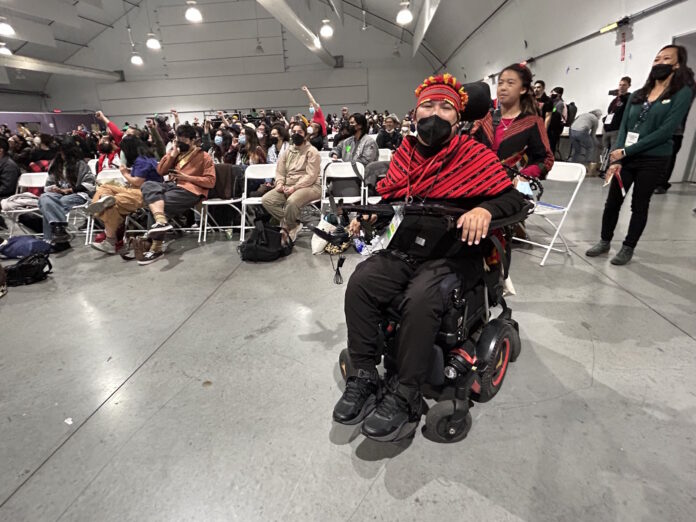
Brandon Lee and his daughter Jesse Jane at the People's Counter Summit of the No To APEC Coalition, Nov. 11, 2023. Photo by Jia H. Jung Ifugao Igorot Environmental Activist Philippine State Violence Anti-APEC
Brandon Lee and his daughter Jesse Jane at the People’s Counter Summit of the No To APEC Coalition, Nov. 11, 2023. Photo by Jia H. Jung

Jia Jung wrote on 20 November, 2023 about Chinese American Bay Area native Brandon Lee who gave the keynote speech at the No to APEC People’s Counter Summit, “People Over Profit and Plunder,” at San Francisco State University on Saturday, Nov. 11, 2023.

Lee was living with his wife and daughter in the Philippines and working as a human rights advocate, land defender, and journalist for the Northern Dispatch when he was shot by Philippine armed forces on Aug. 6, 2019. He survived – as a quadriplegic who remains steadfast in his international activism. Lee said, inter alia:

In high school, I was voted most shyest. I always preferred to work behind the scenes behind the camera, never in front. I was working security during rallies or painting posters the day before.

…In 2003, I transferred to this campus and joined the League of Filipino students at San Francisco State University. That’s where I learned that our country, the United States, continues to dominate and stagnate the Philippine economy, politics, and culture.

Around this time, I also started volunteering for the Chinese Progressive Association. That’s where I learned about the conditions and struggles of immigrant Chinese workers, and tenants. It was at that time I met Pam Tau Lee, the founder of the Chinese Progressive Association.

She was one of my mentors. And that’s where I learned that in the late nineties, San Francisco had 20,000 garment workers. But in less than 10 years, many of the immigrant monolinguistic women workers lost their jobs, with 88% of the workers being offshored to countries with weaker labor protection. It was during these years that I learned how interconnected our struggles are, and I became an internationalist and an anti-imperialist.

In 2007, I went on a life changing exposure trip to the Philippines. I met Youth and Students who are now movement leaders. I joined with workers boycotting Nestlé on their picket line. Ka Fort [Diasdado Fortuna], the chair of their union, was killed in cold blood by state agents. Ka Fort was dearly, dearly loved by the Nestlé workers for his leadership in building the union and his ultimate sacrifice.

So workers also launched a public campaign – “there’s blood in your coffee” – to draw international attention against Nestlé. Nestlé believes that water is a corporate right and not a human right. In this same trip, we visited many sectors, including the most oppressed majority and largest class – the peasants – as well as the Igorot Indigenous people in the northern part of the Philippines.

The Igorots, who live on resource-rich lands, are considered squatters on their own land because the Philippine government considers any land with a slope of 18 degrees Philippine land. The Igorots have been fighting against foreign occupation and colonization for hundreds of years.

And until now, they have continued their fight against government neglect and development aggression, militarization, and for the recognition for the right to ancestral land and self-determination.

On that exposure trip, our group also attended the one-year death anniversary of Alyce Claver, the wife of Chandu [Constancio]Claver, who was the provincial chair of the progressive party, Bayan Muna, and the president of the Red Cross. Chandu and Alyce were driving their kids to school when a motorcycle pulled up and shot at their car. Alyce shielded her husband and was riddled with two dozen bullets. Chandu made it out alive and is now in Canada with his kids after filing for political asylum, but the family today continues to be traumatized.

During this trip, we joined a medical and fact-finding mission to a remotevillage, and thankfully, the military had pulled out. The Indigenous peasants taught us about how the soldiers had blindfoldedthem and pointed a gun to their nape. The soldiers accused the farmers of supporting the land defenders and the resistance fighters known as the New People’s Army. The Philippine militarypretended to have a fake medical mission, giving out expired medicine to the local Indigenous people.

This trip, 16 years ago, changed the direction of my life.

I believe that we are shaped by our experiences, and this exposure program gave me new direction. It fortified my commitment to serving the fight for the Philippine liberation from U.S. imperialism. And to this day, the stories and sacrifices of Alyce Claver, Ka Fort, and so many others continue to fuel my commitment.

Two years later in 2009, I decided to deepen my commitment and decided to do a three-month integration in a remote area deep in the mountains. When I returned, I learned about Melissa Roxas, who was also from the U.S. and was abducted by the Armed Forces of the Philippines. She was conducting a medical mission. After a week, her captors released her as long as she promised to shut up.

She didn’t, though – she didn’t shut up. As she was she was released, she told the world what happened. As a health worker, Melissa diagnosed the Philippines’ societal problems and saw the illness of neoliberal policies from living among the poor. Melissa was brave. Her journey back from the trauma perpetuated by the Philippine military would soon follow for me.

The year following, 2010, I went all in and decided to live and serve the Igorot Indigenous people. I married my girlfriend, who is an Indigenous Ifugao, and we had a daughter, Jesse Jane, who is here with us today. I lived nine years with Indigenous people in the northern part of the Philippines, and I learned how they defended their land rights and lives in the resource-rich area known as the Cordillera region.

I saw firsthand how neoliberal policies promoted by APEC, such as the Philippine Mining Act of 1995, liberalize the mining industry, allowing foreign mining companies to reap 100% profit from the plundering of Indigenous people’s lands, unbridled large-scale destructive mining, dams, energy and other foreign projects, masquerading as development projects, and destroy the environment and forcibly displace Indigenous people who have been living there for generations.

Now, 13 years later, I’m speaking in front of you, a survivor of state violence and war that is spread by APEC and neoliberalism. They say APEC will promote sustainability. The Indigenous community say no. They are robbed of their life, land, culture, and worse, their future. Despite decades of people’s resistance, the plunder the natural resources, of indigenous – of ancestral – domains, continues. The region is blanketed with 176 large-scale mining and more than 100 energy projects, such as hydropower and geothermal projects awarded to private corporations.

One such energy project is the Chevron geothermal power project, which covers a large area in Kalinga. If left unchallenged and unopposed, all these could mean the ethnocide of the Igorots and the massive destruction of the ecosystem in the Cordillera region…

Indigenous communities were militarized, bombed, and strafed with artillery shelling, but they did not cower and they did not back down. They remained steadfast. They took care of each other. And they continued to hold the line.

They say APEC is innovative and will solve our problems. Hell, no.

We know this because the people do not stand to gain anything from APEC. Instead, the people are threatened, harassed, surveilled, abducted, slapped with legal cases based on fabricated evidence, illegally arrested, and even assassinated. I lost two of my dear friends and comrades, William Bugatti in 2014 and Ricardo Mayumi in 2018, at the hands of state agents. [see: https://humanrightsdefenders.blog/2014/03/27/another-human-rights-defender-shot-dead-in-philippines/]

Because I protested alongside the Indigenous communities, and, as a journalist, wrote about the daily attacks they face, I was also threatened and harassed. I was placed under surveillance. Tailed. Followed. They watched our office. They took pictures of us at our office and homes, as well as the tricycle, jeep, and bus terminal. I was red-tagged and politically vilified as a terrorist. I experienced death threats in the form of the burial blanket for the dead. I was detained and had my bag illegally searched at a military checkpoint the week before members of the 54th Infantry Battalion of the Philippine Army shot me in front of my daughter in front of my home on August 6th, 2018.

They had visited me at my house and office looking for me. They said they wanted to partner with my organization, the Ifugao Peasant Movement, but we refused. I told them two names – William Bugatti and Ricardo Mayumi – on why we do not want to partner with them.

While their assassination attempt against me was unsuccessful, I am permanently scarred and paralyzed. I am now quadriplegic, unable to use my hands and legs. I am considered one of the lucky ones. But I live with trauma every day. [see also: SF human rights activist fights for his life after being shot in the Philippines]

I know firsthand that the backdoor trade deals handled by APEC will not benefit the people; they only benefit the corporations and imperialist countries like the United States. That is why the United States sends its military around the world, finance schools, support fascist governments – to open up industries.

In fact, I have no doubt that the bullets lodged in my body today are paid by our taxpayer dollars.

Although I am paralyzed physically, they have failed to shut me up.

Today, I am proud to be standing with you, metaphorically speaking, in fighting back against APEC. Against state and political repression. Against corporate greed and power. Against the wealthy elite. Against the plunder of our planet. Against foreign domination of our peoples.

The Indigenous communities are resilient also. Like millions of people in the Global South, they are fighting back. They continue to protest despite being attacked. They have successfully barricaded several mines, rejecting countless mining and dam projects.

They have been on the frontlines of fighting the WTO [World Trade Organization], dismantling the Chico Dam equipment during the late dictator Marcos, which launched a coordinated people’s response that brought the Indigenous people to the national liberation struggle.

They are also on the frontlines of fighting APEC; a fight has led thousands to take up armed struggle as an appropriate response to defending their land, which is their life.

One of their martyr freedom fighter, Arnold “Ka Mando” Jaramillo, favorite expression ispayt latta! It means fight to the end, or continue to fight, and it’s today emulated by the Cordillera mass movement. Payt latta.

I will continue to fight as long as I breathe. Take a look around – my story is just one of many. There are a thousand people here today, diverse and multigenerational, coming from across the world, each with their own journey, own experiences, and reason for being here. But what unites us all is our opposition to APEC and neoliberal policies. We have so much in common – so much we can unite and rage against. A common enemy – APEC – and the neoliberal policies that prioritize profit and plunder over people and planet.

We will not go gently into that night. Rage. Rage! We will fight!

We will fight for a better future for all. Let us continue to talk, to build and work together, now and after APEC. For now, are you ready? Are you ready to shut down APEC?

https://asamnews.com/2023/11/20/

Global Witness annual report 2022: a land rights defender killed every other day

September 25, 2023

Over the last decade, nearly 2,000 land and environment defenders have been killed around the world, and in 2022, a land defender was killed every other day, according to a report. [for last year’s see: https://humanrightsdefenders.blog/2022/10/05/global-witness-report-2021-continued-disaster/]

The study from Global Witness, a non-profit human rights environmental watchdog, shows that the killings of Indigenous peoples defending their territories and resources represented nearly 34 percent of all lethal attacks despite making up about 5 percent of the world’s population.

Governments where these violations are happening are not acting properly to create a safe environment for defenders and a civic space proper for them to thrive,” said Gabriella Bianchini, senior advisor for the land and environmental defenders team at Global Witness. “They are not reporting or investigating and seeking accountability for reprisals against defenders. And most importantly, they are not promoting legal accountability in the proper manner.”

Latin America has consistently ranked as the deadliest region for land defenders overall and saw almost 9 in every 10 recorded killings in 2022. More than a third of those fatal attacks took place in Colombia. In 2021, Brazil was named the deadliest country for land defenders by Global Witness and now sits at second; In July, activist Bruno Pereira and journalist Dom Phillips were murdered in the Brazilian Amazon.

Growing tensions from agribusiness, mining, and logging have led to consistent lethal attacks in the region. Between 2011 and 2021, for instance, more than 10,000 conflicts related to land rights and territories were recorded in Latin America alone. 

The worsening climate crisis and the ever-increasing demand for agricultural commodities, fuel, and minerals will only intensify the pressure on the environment — and those who risk their lives to defend it,” wrote the authors.

Earlier this year, Frontline Defenders, an international human rights organization, released a similar report to Global Witness’ with corresponding findings — including that Colombia was the most dangerous country for land defenders. [see: https://humanrightsdefenders.blog/2023/04/04/front-line-defenders-just-published-its-global-analysis-2022-new-record-of-over-400-killings-in-one-year/ . While Frontline Defenders reported that there were 186 land defender deaths in Colombia and Global Witness reported 60, Bianchini said differences in statistics are the result of different methodologies, which vary by organization. However, both organizations’ reports were united in findings: Indigenous people make up a disproportionate amount of the deaths among land and environment defenders, Latin America sees the highest rates of violence, and the number of killings is likely underreported.

“I am incredibly grateful and impressed to see the fight of all of these communities who are there living in these areas and who have been acting for thousands of years to protect the array of life,” said Bianchini. “I cannot believe that humanity right now is living in a moment where we are killing those who are protecting their own lands and civil rights.”

https://grist.org/indigenous/in-2022-a-land-defender-was-killed-every-two-days/

https://www.globalwitness.org/en/campaigns/environmental-activists/standing-firm/

Clean energy will not automatically be good for indigenous land defenders

April 7, 2022

Emily Pontecorvo a reporter for GRIST published on 6 April 2022 a piece about a new report by the Business and Human Rights Resource Centre which states that the renewable energy sector is unprepared for the protection of land rights defenders.

In April of last year, José de Jesús Robledo Cruz and his wife Maria de Jesús Gomez Vega were found dead in the desert in Sonora, Mexico. In July, Fernando Vela, a doctor in Coqueta, Columbia, was shot to death by two men on a motorcycle while he was in his truck. In September, Juan Macababbad, an attorney in the Philippines was shot dead outside his home.

In each case, the victims were prominent human rights defenders, known in particular for defending their communities’ natural resources from mining, deforestation, water contamination, and other threats. These were just three of at least 76 such murders that occured in 2021. [see also: https://humanrightsdefenders.blog/2022/03/02/human-rights-high-commissioner-bachelet-urges-support-for-environmental-defenders/]

Business and Human Rights Resource Centre tracks attacks on people who protest or otherwise raise concerns about business-related human rights abuses. It has documented more than 3,800 attacks, including killings, death threats, beatings, arbitrary arrests and detention, and lawsuits, since January 2015, with 615 occurring in 2021 alone.  [see also: https://humanrightsdefenders.blog/2021/09/13/global-witness-2020-the-worst-year-on-record-for-environmental-human-rights-defenders/ as well as: https://news.mongabay.com/2022/04/more-than-half-of-activists-killed-in-2021-were-land-environment-defenders/]

Our data shows almost the tip of the iceberg,” Christen Dobson, senior program manager for the BHRRC and an author of the new report. “Many attacks are not publicly reported. And so we know the problem is much more severe than these figures indicate.”

According to the report, human rights defenders who spoke out against mining projects consistently experienced the greatest number of attacks over the past seven years. The authors say this is especially concerning considering the expansion of mineral production required by a transition to clean energy. All those batteries, solar panels, and wind turbines are going to require a lot of cobalt, nickel, zinc, lithium, and other minerals.

We’re already seeing this level of attack, and we’re not seeing major producers of transition minerals have strong policies or practices in place about protecting defenders,” said Dobson. “There’s a real risk there and I think it’s an area that we’re very concerned about.

The report urges investors to publish a human rights policy and require that companies begin disclosing human rights and environmental-related risks. But Dobson said that voluntary actions from companies and investors was not enough. She said there was some momentum building behind mandating that companies report on measures they are taking to respect human rights, including legislation proposed in the European Union and Canada.

“It is concerning to see a vast majority of companies and investors, including major renewable energy companies, do not have policies expressing zero-tolerance against reprisals in their operations, supply chains and business relationships,” said Dobson in a statement. “It’s time for companies and investors to recognise the energy transition cannot be effective if it is not also rights-respecting.”

https://grist.org/international/land-defenders-face-violence-and-repression-clean-energy-could-make-it-worse

Brazilian Alessandra Korap Munduruku Wins 2020 Robert F. Kennedy Human Rights Award

October 14, 2020

Robert F. Kennedy Human Rights has named Alessandra Korap Munduruku the winner of its 2020 Human Rights Award for her work defending the culture, livelihoods, and rights of Indigenous peoples in Brazil.

Indigenous peoples, including Alessandra’s Munduruku community, have faced tremendous challenges in Brazil in recent years—from gold miners and loggers illegally invading and exploiting Indigenous territories; to widespread fires in the Amazon; and an increased risk to the coronavirus; not to mention a combative president who’s proactively removed protections for Indigenous tribes and insulted them on numerous occasions.

As one of the key leaders and organizers of the Munduruku people, Alessandra has fought to stop construction projects and illegal mining that are infringing upon Munduruku territory, garnering international attention and support. She’s advocated for the demarcation of Indigenous lands and for Indigenous communities to be consulted on decisions that affect their territories. Alessandra has also played an important role in advancing the leadership of women in the Munduruku community and among other Indigenous tribes in Brazil through her involvement in the Wakoborûn Indigenous Women’s Association and the Pariri Indigenous Association. 

I’m humbled to be this year’s Robert F. Kennedy Human Rights Award winner,” said Alessandra Korap Munduruku. “To have the additional backing and support of Kerry Kennedy and her entire organization, especially during the pandemic, will make all the difference as we continue to fight for our rights, including the demarcation of our lands to ensure that Indigenous peoples have their autonomy, and for the fight of women who are also the strength of the resistance.

Throughout history, Indigenous peoples, including the Munduruku, have repeatedly been oppressed, silenced, and subjected to horrific human rights abuses,” said Kerry Kennedy, president of Robert F. Kennedy Human Rights. “Alessandra has heroically faced intimidation and violence for defending Indigenous rights across Brazil—including the ability to oppose projects and developments that affect her peoples and their livelihoods. She is a champion of women’s rights, Indigenous rights, and the foundational right of all human rights—civic space. Civic space protects the right to dissent, to advocate and to defend human rights, free of government reprisal. It is the keystone of a functioning democracy.”

Alessandra will be honored at a virtual ceremony on Thursday, October 22, at 6:00pm EDT. The event is free and open to the public. You can register here

Kerry Kennedy will present the award, followed by a keynote address from former U.S. Secretary of State John Kerry on the countless threats and challenges Indigenous peoples face around the world. Andrew Revkin, director of Columbia University’s Earth Institute, will then moderate a discussion on the pathways forward for Indigenous peoples in Brazil with an esteemed panel of experts:

  • Juarez Saw Munduruku, Chief of the Sawré Muybu village in Brazil 
  • Maria Leusa Cosme Kaba, a Munduruku women’s leader
  • Francisco Calí Tzay, UN Special Rapporteur on the Rights of Indigenous Peoples
  • Sebastião Salgado, Award-winning French-Brazilian documentary photographer 
  • Antonia Urrejola Noguera, Rapporteur on the Rights of Indigenous Peoples and Commissioner of the Inter-American Commission on Human Rights
  • Christian Poirier, Program Director at Amazon Watch 
  • For more on the Robert F. Kennedy Human Rights award, see: https://www.trueheroesfilms.org/thedigest/award/69FD28C0-FE07-4D28-A5E2-2C8077584068

See also: https://humanrightsdefenders.blog/2020/07/29/rfks-ripple-of-hope-award-2020-to-kaepernick-fauci-and-other-us-leaders/

https://www.globenewswire.com/news-release/2020/10/12/2106955/0/en/Alessandra-Korap-Munduruku-Wins-2020-Robert-F-Kennedy-Human-Rights-Award-for-Her-Work-Protecting-Indigenous-Peoples-in-Brazil.html

Berta Cáceres death may lead to reconsidering financing of Agua Zarca dam

March 16, 2016

The killing of Honduran human rights defender Berta Cáceres [http://wp.me/pQKto-20p] has resonated widely in the media and may (finally) lead to some real action in the world where the dam is being financed. Peter Bosshard, Interim Executive Director, International Rivers, wrote under the heading “Agua Zarca: A Stain on the Dutch and Finnish Human Rights Record” (15 March 2016) that the Dutch government announced that it will send an ambassador to Honduras “to express concern over the killing of human rights activist Berta Cáceres” and presumably assess the state of the Agua Zarca Project. In response to International Rivers’ online action, FMO (the financial arm of development aid) said that it would decide about continued involvement in the dam project on the basis of this visit. Finn fund says that speculation about an exit from Agua Zarca is “at the moment premature,” but the financier would probably follow if FMO pulled out of the project. 

Read the rest of this entry »

Profile of Paul Mambrasar: defender of indigenous Papuans

December 28, 2015

OMCT, in its series “10 December – 10 Defenders”, carried the story of Paul Mambrasar from West Papua, the least populous province of Indonesia, where is torture used to crush and silence. Home to the world’s largest gold and third-largest copper mines, West Papua has abundant natural resources including timber and palm oil that make it a coveted region. This has generated continuing conflict and made it one of Asia’s sorest spots in terms of human rights violations. From the 1960s on, Indonesia has maintained heavy military presence, resorting to extrajudicial killings, torture and abuse to crack down on activists in an attempt to crush the Papuan independence movement, whether peaceful or violent, leaving locals deeply resentful and suspicious of the national Government.OMCT-LOGO

Indigenous Papuans marginalized in their homeland, suffer state violence and stigma, while their natural resources are exploited by others and compromise their ancestral way of living. The on-going conflict with separatists merely exacerbates discrimination against Papuans, who have been repressed by decades of institutional racism and Indonesian occupation. This is the vicious cycle of violence that Paul has to deal with in his daily fight for the respect of the human rights. “Torture worsens the distrust West Papuans have in the State which, by failing to uphold the rule of law, merely fuels more separatist sentiments,” sums up Paul, Secretary of the Institute of Human Rights Studies and Advocacy (Elsham), a non-governmental organization defending human rights in Wet Papua.

Paul’s challenging working environment is the result of decades of quasi-institutionalized abuses resulting in many layers of deep-felt and pervasive grievances of West Papuans against the Indonesian Government. He is, however, gradually managing to build networks in his country, also thanks to support from organizations such as OMCT, and gradually drawing attention to the regular violations committed.

Discrimination and marginalization of Papuan have therefore worsened the situation. Government policies have also contributed to the problem. The arrival of migrants, fostered by transmigration programmes, has upset the demographics and social and cultural heritage of the people of West Papua and exacerbated competition over land and resources. Compounded with the socially and environmentally destructive development projects pushed in the region by Indonesia, this has caused widespread social disruption and environmental damage, forcing Papuan tribal groups to relocate, according to researchers from Yale Law School cited by Elsham in a 2003 Sub-Commission on the Promotion and Protection of Human Rights session.

Unreported exactions keep occurring as foreign eyes and independent international observers are barred from West Papua. It is therefore only thanks to the work of local organizations and human rights defenders such as Paul, who runs Elsham’s office in West Papua and attends international advocacy meetings at the Human Rights Council in Geneva communicating regularly with donors, that the world can know what is happening there.

“Impunity has allowed the security force, the police and the army, free access to inflict fear and terror through torture and other physical abuses,” Paul explains his motivation. “In order for torture to end the Indonesia State must take a strong action to punish those involved in its practice.”

Despite these odds and the many challenges of his job including being under Indonesian intelligence surveillance as an “independence sympathizer”, Paul, 51, trusts that the human rights conditions in West Papua will improve.

[When the Dutch Government granted independence to Indonesia in 1949, Papua was not part of it. At the end of the Dutch colonial rule, Papua was first administered, and then absorbed, by Indonesia in 1969, following a sham “referendum” requested by the United Nations. This so‑called “Act of Free Choice” was in fact a vote by just over a thousand selected Papuans (out of a population of 800,000 at the time) who had been pressured to agree to integration within Indonesia. This vote has been the bone of contention between Papuans and the Republic of Indonesian. Papuans have ever since agitated for independence, and have been conducting a still ongoing, low-level guerrilla warfare against Indonesian forces, in turn engaged in bloody repression and unpunished human rights violations. Papuans – who are Melanesian and whose ancestors arrived in the New Guinea region tens of thousands of years ago – do not identify culturally with the Asians. They see their Papuan identity and indigenous culture based on customary subsistence-based agriculture threatened by the arrival of migrants who, in turn, see the traditional Papuan way of life as backward.]

In this context see also the CNN report on the closure of NGO offices: http://freewestpapua.org/2015/12/13/indonesian-government-forces-all-ngos-to-leave-west-papua/

— by Lori Brumat in Geneva

Source: Indonesia: Meet Paul: Restoring the human rights of indigenous Papuans amid on-going conflict / December 10, 2015 / Links / Human rights defenders / OMCT

Solomon Islands: selection of human rights defender for training in Geneva makes news

February 15, 2015
When a human rights defender from a small nation, such as the Solomon islands, is selected for fellowship programme with the United Nations, it makes a story. Teddy Kafo writes in the Solomon Star of 14 February how Watson Puiahi of the local NGO “I Lukim Sustainability Solomon Islands (ISSI)” was chosen to participate in the ‘2015 Indigenous fellowship Program’ of the Office of the High Commissioner for Human Rights in Geneva.

Read the rest of this entry »

Human rights lawyers and indigenous people in the Philippines endangered

January 24, 2015

Human rights lawyers and their clients stage a picket at the Supreme Court to mark the ‘Day of the Endangered Lawyer’ (photo courtesy of NUPL)

Human rights lawyers in the Philippines on Friday 23 January 2015 protested publicly against the growing death toll within their ranks as they marked the “Day of the Endangered Lawyer” by trooping to the Supreme Court. The protest spearheaded by the National Union of Peoples’ Lawyers [NUPL] and joined by the Integrated Bar of the Philippines was joined by lawyers’ and support groups that staged pickets or held dialogues at Philippine embassies and consulates in 23 cities in 11 European countries.

Figures show that, since attacks on legal professionals began being recorded in 1977, “100 lawyers have been attacked (57 since 2001) while 50 lawyers have been killed (41 since 2001).” “Nineteen judges have been murdered, 18 since 2001”

Government must simply do its job: protect its citizens, categorically condemn these attacks on lawyers as human rights defenders; seriously and credibly investigate, prosecute and punish the perpetrators; and uphold human rights because the attacks on lawyers is not only an attack on the individual lawyer, it is an attack on the legal profession, and most fundamentally — in the context of the targeted assaults on human rights and public interest lawyers — an attack itself on the rights and interests of the mostly poor and oppressed in our country” 

http://www.interaksyon.com/article/103685/a-deadly-profession–human-rights-lawyers-count-the-costs-on-day-of-the-endangered-lawyer

A petition <http://www.advocatenvooradvocaten.nl/wp-content/uploads/Petition-Day-of-Endangerd-Lawyer-2015.pdf> signed by lawyers organizations from Asia, Canada Europe and the United States  calls on the Aquino government  to prevent extrajudicial killings and all forms of harassment of lawyers and to end impunity by prosecuting perpetrators of rights violations. The petition also calls on the Aquino government  to protect the safety of lawyers as provided for in the Basic Principles on the Role of Lawyers adopted by the General Assembly of the United Nations in 1990.  Underlying causes for extrajudicial killings. The practice of labeling (classifying victims as ‘enemies of the state’), the involvement of the military in politics, the proliferation of private armies and vigilante groups and the culture of impunity have been identified by national and international fact-finding bodies as the main root causes for the alarming rate of extrajudicial killings, including the extrajudicial killings of lawyers, in the Philippines.

Away from the capital human rights violations against indigenous people and their human rights defenders also continue as demonstrated in 2 film documentaries:

Gikan sa Ngitngit nga Kinailadman” (From the Dark Depths) records grave rights violations using interviews and recollections of the survivors and witnesses. The cases featured in the film remains unresolved; the perpetrators waiting for the next human rights defender to hunt. The film shows the atrocities of the military and paramilitary troops, including the armed agents of the agro-industrial corporations in the hinterlands of Mindanao.

-The first case presented in the film is the assassination of Gilbert Paborada—a Higaonon farmer in Bagocboc, Opol, Misamis Oriental. Daisy Paborada, the wife of Gilbert, and Joseph Paborada, his brother, reiterates how the struggle of their community against the entry of palm oil plantations of A Brown Company led to Gilbert’s death.

-The film also shows interviews about the harassment of the Lumad community in Opol as they suffer from the goons of A Brown Company. The harassments and intimidation breed the culture of fear and terror among the people who opt to protect their ancestral domain vis-à-vis the environment over money.


PHOTO taken during the shooting of “Gikan sa Ngitngit nga Kinailadman” in the mountains of Pantaron in Bukidnon. (RMP-NMR)

Dalena is also the director of Alingawngaw ng mga Punglo (Echo of Bullets) that exposed the criminal acts of the military under the infamous General Jovito Palparan, also known as ‘The Butcher.’ Palparan now is in jail, facing allegations of murder against human rights defenders.

Sr. Maria Famita Somogod, regional coordinator of Rmp-Nmr, said the film highlights political repression. The spate of human rights violations featured in the film is the reaction of the government to quell the legitimate dissent of the lumads against the entry of agro-industrial corporations in their ancestral domain. Somogod said the dissent of the lumads and farmers is legitimate. Their demands are to protect their ancestral domain against the encroachment of foreign corporations in the hinterlands. “Instead of seeds, bullets. Instead of food, bombs. Instead of peace, forcible evacuation. Instead of life, death,” Somogod said, adding this is what the ordinary lumads and farmers get for protecting the land of promise.

In the words of the author Anjo Bacarisas, in Sunstar of 25 January: at the end of the film one asks: How should we stop this appalling cruelty against the lumads and farmers?

http://www.sunstar.com.ph/cagayan-de-oro/feature/2015/01/25/underbelly-land-promise-388461

Canadian Human Rights Museum in Winnipeg a “touching” experience

November 14, 2014

November 11, 2014 - 141111  -  Canadian Journeys gallery opened at the Canadian Museum For Human Rights Tuesday, November 11, 2014. John Woods / Winnipeg Free Press

Winnipeg Free Press of 13 November 13, 2014 asks and answers the question: “Was nearly seven weeks worth the wait?” as the $351-million national museum has now pulled back the curtains on all 11 of its exhibits. Spokeswoman Maureen Fitzhenry would like to request just one thing — come for a visit first. “Before we were open, there were different ideas out there about our content — some were accurate, and some weren’t. Some were misconceptions that evolved into bigger misconceptions. Now, the content is there for full exploration by all the visiting public. People can come and see it and judge it on its actual merits,” she said.

The touchscreens in all of the galleries are fully operational and allow users to get a quick snapshot of whatever topic they’re researching or drill down further to get a full in-depth story.

The emphasis seems (understandably?) to be very  much on the Canadian scene (Galleries such as Canadian Journeys, Protecting Rights in Canada). There is one gallery devoted to the Holocaust.

Both the Turning Points for Humanity and Breaking the Silence galleries are full of innovative technology that helps get stories across. In the former, for example, a screen is activated when a visitor stands on a certain part of the floor. A story is told when a visitor points to it on a screen. In the latter, a study table of 19 human rights stories enables visitors to touch parts of a map or run their finger along a timeline.

The Actions Count is a feel-good gallery that recounts children and youth-led initiatives to combat issues such as bullying. The Rights Today gallery shares stories of human rights defenders such as Buffy Sainte-Marie (whose Academy Award is in a display case).

[Finally, the travelling exhibition, which should be active for about a year, is focused on peace and Canadians’ historic role in promoting peace around the world through organization, negotiation or intervention.]


home page of the museum: https://humanrights.ca/home

via: Museum a touching experience – Winnipeg Free Press.

see also: https://thoolen.wordpress.com/2014/09/19/canadian-human-rights-museum-in-winnipeg-opens-after-14-years/

Yolanda Oquelí – Guatemalan Human Rights Defender in video testimony

February 24, 2014

This video with testimony by Yolanda Oquelí, human rights defender from Guatemala, was posted last year by AI Canada and recently re-issued in French by AI France.

Since March 2013, activists and members of the local community have held an ongoing protest against the mine development by Radius Gold, a company based in Vancouver, Canada, and its wholly owned Guatemalan subsidiary, Exploración Mineras de Guatemala (EXMIGUA).  Some community members claim that they were not consulted about the opening of the mine and fear it will pollute their water supply and damage land in San José del Golfo and San Pedro Ayampuc municipalities. On the evening of 13 June events took a sinister turn. Outspoken anti-mining activist Yolanda Oquelí was driving home from taking part in this ongoing protest when two gunmen on a motorbike cut across in front of her car and fired four shots. Yolanda was hit and a bullet lodged close to her liver. She recovered, continues to be subject to threats.
In February 2011, protesters in north-western Guatemala’s San Marcos region were attacked after speaking out against the local Marlin Mine, owned by Canadian company Goldcorp Inc. Community activist Aniceto López, was taken to the local mayor’s office, where officials allegedly beat him and threatened to kill him if he failed to stop speaking out against the mine.

[In July 2010, another grassroots activist in San Marcos, Deodora Hernández, was shot at close range in her own home by two unknown men. She had spoken out to defend her community’s right to water amidst fears that mining had polluted the local water supply]

When James Anaya, the UN Special Rapporteur on Indigenous Peoples visited Guatemala in June 2010, he received allegations that the Guatemalan government had repeatedly granted licences for the exploration of natural resources in indigenous territories without consulting with local indigenous peoples – or receiving their free, prior and informed consent.