Posts Tagged ‘impunity’

Defending the Monarch Butterfly in Mexico costs lives

February 7, 2020

Mexican authorities are investigating the death of an employee of one of Mexico’s largest butterfly reserves. Raúl Hernández Romero was the second person connected to the reserve found dead in less than a week. The first death was Homero Gómez González — an environmental activist and well-known defender of the Rosario Monarch Butterfly Preserve in the Michoacan state. The deaths have alarmed environmental activists and human rights defenders in the country.

Amnesty International said it is alarmed. Twelve environmental defenders were already killed in Mexico in 2019. [see also: https://humanrightsdefenders.blog/2019/07/30/in-2018-three-murders-per-week-among-environmental-human-rights-defenders/]. The World’s host Marco Werman spoke with Erika Guevara Rosas, director of Amnesty International Americas, about the killings. Marco Werman: Homero Gómez González was very well-known for his protection of the monarch butterfly in Michoacán. He administrated sanctuaries to protect the monarch butterfly. But he was also a protector of the environment. He denounced, many times, illegal logging in the area and the increased presence of groups of organized crime that were trying to take over certain territories and land and threatened the environment where these monarch butterflies arrive every year in Mexico. Erika Guevara Rosas: We get a nice sense of his commitment to what he was doing with a video he posted just last month on Twitter. He’s in his butterfly sanctuary and thousands of butterflies are swirling all around him. He’s pretty happy and proudly declares in his tweet that the sanctuary in Michoacan is the biggest in the world. It’s kind of a sad video in retrospect, shot a couple of weeks before Gomez Gonzalez was killed. [https://twitter.com/miblogestublog/status/1222901129199009798]

Hernández Romero’s death, “along with the death of Homero Gómez, demands immediate investigation and full accountability,” tweeted Richard Pearshouse, head of crisis and environment at Amnesty.

‘Horrific’, adding that Raúl Hernández Romero’s family says he received threats regarding his work campaigning against illegal logging in the weeks before he disappeared. El Rosario sanctuary provides a home for millions of migrating monarch butterflies each year and draws thousands of tourists annually. But the reserve has also drawn the ire of illegal loggers in Mexico, who are banned from cutting down trees in the protected area. Before the ban, more than 1,000 acres of the woodland were lost to the industry between 2005 and 2006.

https://www.wvxu.org/post/killing-environmental-activists-has-become-norm-mexico-activist-says#stream/0

https://www.commondreams.org/news/2020/02/03/horrific-human-rights-advocates-call-investigation-death-second-monarch-butterfly

Shocking: Aluízio Palmar being sued by his torturer in Brazil

January 21, 2020

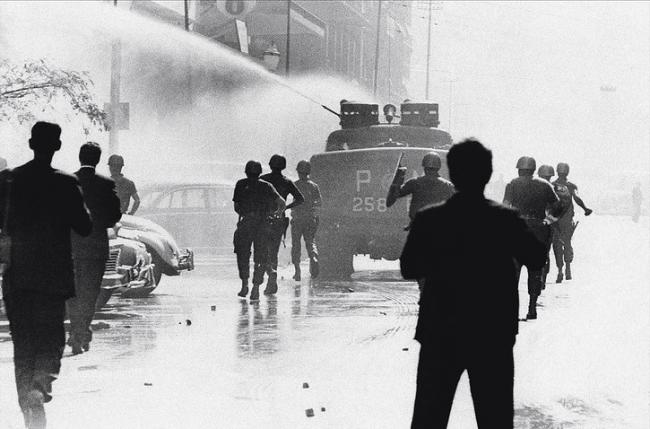
A scene in São Paulo, Brazil, on April 1, 1964, during the military coup against President João Goulart that installed a dictatorship. (Photo via Public Archive of São Paulo State)

A scene in São Paulo, Brazil, on April 1, 1964, during the military coup against President João Goulart that installed a dictatorship. (Photo via Public Archive of São Paulo State)

Jacob Blanc a history professor at the University of Edinburgh – published in Nacia of 20 January 2020 a real ‘horror story’ about Aluízio Palmar, a Brazillian human rights defender and tortutre victim being sued by a dictatorship-era torturer. He puts the blame squarely on the climate created by Bolsonaro.

The physical and psychological torture happened 40 years ago, when Palmar was imprisoned by the military dictatorship that ruled Brazil from 1964 to 1985. But it was only last month, in a climate defined by Brazil’s right-wing president Jair Bolsonaro, that Palmar’s abuser felt emboldened to file the suit….In a cruel twist, it is not a case of the victim seeking justice from his abuser. Instead, Ostrovski—who became a lawyer after his military service—has sued Palmar for defamation of character and “moral damages” over his efforts to bring public attention to Ostrovski’s crimes.

Ostrovski’s human rights abuses have been well-documented, including in the 1984 report on torture titled Brasil: Nunca Mais (Brazil: Never Again) and also in the 2014 National Truth Commission, the largest effort to-date to elucidate the repression of Brazil’s military regime. In these reports, multiple victims testified to Ostrovski’s acts of torture. Despite this evidence, Ostrovski has never stood trial. Nor, for that matter, has anyone in Brazil been held accountable for the cruelty of dictatorship. Unlike in neighboring Chile and Argentina where limited trials did take place, not a single member of the Brazilian military has faced criminal charges.

The lack of legal justice for Brazil’s human rights abusers helps explain the lawsuit against Palmar. Since the 1980s, Palmar has been an ardent human rights activist and journalist. He has co-founded a political newspaper, written a book on the forced disappearances of six Brazilian dissidents, maintained a website that publishes declassified documents, and established the Center for Human Rights and Popular Memory in the city of Foz do Iguaçu. So although there has been a concerted absence of political and institutional justice, Palmar and countless Brazilians like him have fought to keep the memory of the past alive. One of these initiatives took place in 2013 and stands as the crux of the current lawsuit.

As part of the investigations for the National Truth Commission, Palmar and three other torture victims testified in a public hearing. In the aftermath of this testimony, protestors engaged in a political action common in Latin America known as an escrache: to expose Ostrovisky—who had been living in relatively anonymity—the crowd marched to his law office and held a noisy rally to “out” him as a torturer. Palmar himself did not take part in the protest, but he did publicize the event on Facebook. And it is precisely Palmar’s act of sharing the protest on Facebook that Ostroviski is now citing in his claim for legal and financial restitution. But if the event in question took place in 2013, why is the lawsuit only now being brought forth?…The answer ties directly to Brazil’s current political landscape. Since Bolsonaro’s election in October 2018, a long-standing culture of impunity has become even more brazen. An army captain in the final years of the dictatorship, Bolsonaro has built his political career on an unapologetic nostalgia for military rule. Among his many headline-grabbing statements, Bolsonaro invoked the dictatorship’s most notorious torturer in voting to impeach the former president Dilma Rousseff—herself a torture victim—and he has stated that the regime’s murder of some 500 citizens did not go far enough.

“Since 1979, torturers have been protected by a law that is interpreted as impunity for them,” Luciana Silva, a professor of history at the State University of Western Paraná, said. “Now they are sheltered by an irresponsible president, who clearly governs for only a portion of the population. The torturer felt comfortable suing his victim as if nothing were going to happen.”

As both a journalist and a human rights defender, Palmar embodies two of the sectors of civil society most under threat in Bolsonaro’s Brazil. Between early December and early January alone, multiple journalists and media outlets in Brazil have suffered abuse, including two reporters in Rondônia receiving suspended jail time in a defamation case and a radio station’s antennae being destroyed by arson. Bolsonaro himself recently renewed his antagonism against the press: When asked in December about the growing corruption scandal surrounding his family, he deflected by verbally assaulted the journalist: “You look terribly like a homosexual.” These threats contribute to a dangerous reality where since 2010, 22 journalists in Brazil have been killed.

And according to the NGO Frontline Defenders, Brazil is also one of the deadliest places on earth for human rights activists, with a frightening increase in the threats, arrests, and physical attacks on activists, particularly around environmental, Indigenous, and LGBTQI+ rights. In 2019, the number of Indigenous leaders and activists killed reached the highest rate in two decades, and the Bolsonaro regime continues to skirt any responsibility to solve the 2018 assassination of Marielle Franco, a city councilwoman, gay Black feminist, and human rights activist. Bolsonaro also lashed out against the media when evidence emerged of apparent links between his family and Franco’s suspected killers.  [see also: https://humanrightsdefenders.blog/2019/03/13/marielle-franco-one-year-after-her-killing-in-rio/]

Palmar’s situation is symptomatic of how human rights are being inverted in Brazil.  “With Bolsonaro in power, [these abusers] feel free,” Palmar said. “They feel free to go around threatening us, to commit a form of terrorism. And more and more they’re putting Brazilian democracy itself in danger. There is a real enemy, and it’s going to set us back a long time.

https://nacla.org/news/2020/01/20/inversion-human-rights-brazil
In-depth investigative report on journalist Miroslava in Mexico

December 30, 2019

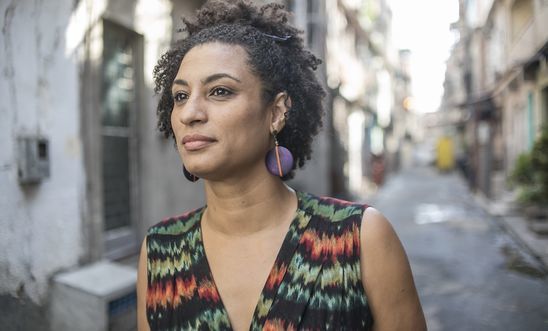
On 6 September, 2019 the  Bellingcat Investigation Team published a piece “Miroslava: The Journalist Who Refused to be Complicit“.  [see also: https://humanrightsdefenders.blog/2018/03/24/new-national-award-to-honor-slain-mexican-journalists/]. It is a very detailed report and worth reading in full:

Miroslava Breach lived under constant threat starting in March 2016, when she began to feel pressure over her publications regarding links between drug cartels and politics. She brought this to the attention of her old friend, the recently elected governor of Chihuahua state Javier Corral, as well as those in charge of the mechanisms at the federal level to protect journalists. The Colectivo 23 de Marzo is made up of Mexican journalists in collaboration with Forbidden Stories, Bellingcat and Centro Latinoamericano de Investigaciones Periodísticas (CLIP). We reconstructed the thread of threats linked to Miroslava’s work, the warnings that she raised about the danger she was in, and the clues that she let in her publications prior to her murder on March 23 2017 that the authorities did not fully investigate.

Miroslava Breach in the Tarahumara sierra. She investigated illegal logging, the effects of megaprojects, and narcopolitics. Source: Colectivo 23 de Marzo

Before her murder, a grey Malibu prowled down José María Mata street in the Granjas neighbourhood of Chihuahua. Security cameras captured the vehicle on the street six times between March 21 and 22 2017 as it passed in front of the two-story house now infamous for the murder: number 1609, with its brown gates and a small garden out front. On the morning of March 23, 2017, journalist Miroslava Breach Velducea was shot to death while waiting inside her car to take her son to school.…….

https://www.bellingcat.com/news/americas/2019/09/06/miroslava-the-journalist-who-refused-to-be-complicit/

Special fund for rural defenders in South Africa

December 25, 2019
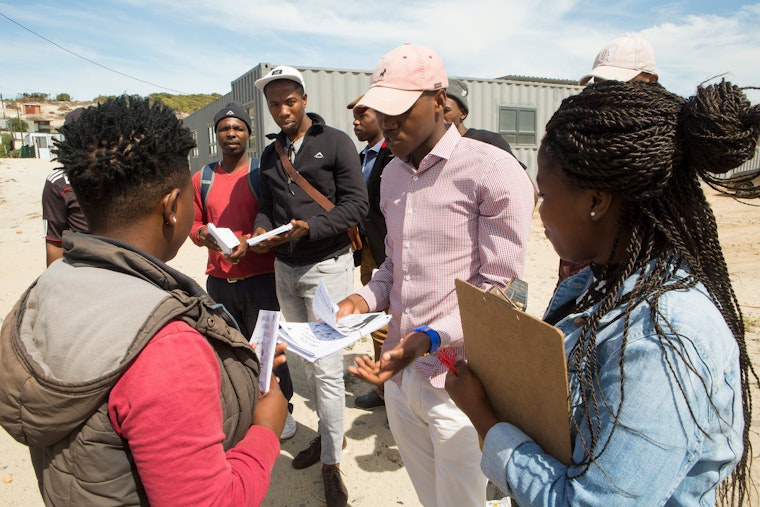
People standing in a circle in a settlement
A group of activists meets before a march for land rights, in Cape Town, South Africa, on March 7, 2018.© Melanie Stetson Freeman/The Christian Science Monitor/Getty

Sharan Srinivas (program officer with the Open Society Human Rights Initiative) wrote on 16 December 2019 about Protecting Civil Society in South Africa. …Before he was gunned down in front of his son, Sikhosiphi “Bazooka” Rhadebe—a leading environmental and housing advocate in Xolobeni, South Africa—telephoned others who had spoken out against mining interests along South Africa’s Wild Coast. He was checking on like-minded activists’ safety and warning them that a “hit list” had been developed targeting human rights defenders in the area who stood up against mining interests. Two hours later, gunmen posing as police officers shot him at his home.

No one has been held accountable in the killing of Rhadebe, which advocates now see as the first data point in a disturbing new trend. Increasingly, those that stand up for environmental, housing, and land rights in South Africa face bitter—and often violent—attacks. To counter this trend, the Open Society Foundations announced recently the creation of a new fund, hosted at the Southern Africa Human Rights Defenders Network, intended to provide support to activists. The fund will provide support services to activists depending on their needs and will include the provision of legal representation; emergency relocation for activists and their families; and physical, psychological, and medical support.

South Africa is rightly commended for its vibrant civil society, robust institutions and progressive constitution, which enshrines the fundamental rights of expression and assembly. But joint research conducted by Human Rights Watch, Earth Justice, GroundWork, and the Center for Environmental Rights reveals that communities who are exercising these fundamental rights have faced vicious reprisals.

  • There is an ongoing pattern of police misconduct during peaceful protests.
  • Local municipalities often impose extralegal restrictions on protest in mining affected communities.
  • An environment of fear has been created among community activists.

Though activists based in South Africa’s major cities are well connected to the international infrastructure built to protect human rights defenders, many attacks against community-based activists located in rural and isolated parts of the country have gone unreported and unnoticed. The fund hopes to serve as a vehicle of solidarity, and to strengthen the resilience of frontline community activists. Sharan Srinivas is a .

The unsatisfactory ‘end’ to the Khashoggi investigation?

December 23, 2019
Main media (here BBC) have reported it but as I have devoted several posts to the Khashoggi case [https://humanrightsdefenders.blog/tag/jamal-khashoggi/], I wanted to be complete:

A court in Saudi Arabia has sentenced five people to death and jailed three others over the murder of the journalist Jamal Khashoggi last year. The Saudi authorities said it was the result of a “rogue operation” and put 11 unnamed individuals on trial. A UN expert said the trial represented “the antithesis of justice”. “Bottom line: the hit-men are guilty, sentenced to death. The masterminds not only walk free. They have barely been touched by the investigation and the trial,” Special Rapporteur Agnes Callamard wrote on Twitter. (A report released by Ms Callamard concluded in June that Khashoggi’s death was an “extrajudicial execution” for which the Saudi state was responsible, and that there was credible evidence warranting further investigation that high-level officials, including Crown Prince Mohammed bin Salman, were individually liable.)

The shadow cast by the grisly murder of Jamal Khashoggi has hung over Saudi Arabia’s international reputation for more than a year now. The ruling princes, especially the all-powerful Crown Prince Mohammed bin Salman, will be hoping Monday’s verdicts draw a line under the whole affair. That may be wishful thinking. The two most senior suspects – dubbed “the masterminds” – have walked free after a trial shrouded in secrecy.

At a news conference in Riyadh on Monday, Mr Shaalan said the public prosecution’s investigations had shown that “there was no premeditation to kill at the beginning of the mission”…Ms Callamard dismissed as “utterly ridiculous” the assertion that the killing was not premeditated, noting that in one of the purported audio recordings from the consulate two Saudi officials were heard discussing how to cut up and transport Khashoggi’s body just minutes before he entered the consulate.

A statement by the Saudi public prosecution said a total of 31 individuals were investigated over the killing and that 21 of them were arrested. Eleven were eventually referred to trial at the Riyadh Criminal Court and the public prosecutor sought the death penalty for five of them. Human Rights Watch said the trial, which took place behind closed doors, did not meet international standards and that the Saudi authorities had “obstructed meaningful accountability”.

ICJ says human rights defenders alarmed over election results in Sri Lanka

November 19, 2019

Sri Lanka’s newly elected president, Gotabaya Rajapaksa and his Government must demonstrate that they will uphold human rights and rule of law, and ensure that Sri Lanka sustains its international obligations and commitments to justice and accountability, said the International Commission of Jurists (ICJ) on 19 November 2019. “The election of Gotabaya Rajapaksa, after a highly polarizing campaign, has alarmed human rights defenders in Sri Lanka and abroad, who have little reason to believe that someone facing such serious allegations of perpetrating human rights violations can be relied upon to meet the country’s obligations under international law,” said Frederick Rawski, ICJ Asia Pacific Director.
Gotabaya Rajapaksa, who won the presidency with 52.25% of votes, served as Sri Lanka’s Secretary of the Ministry of Defence from 2005 to 2015 during the tenure of his brother Mahinda Rajapaksa, at the height of the armed conflict against the Liberation Tigers of Tamil Eelam (LTTE). Gotabaya Rajapaksa faces credible allegations of involvement in war crimes and crimes against humanity that took place during the country’s armed conflict.

International condemnation of atrocities committed during the conflict led to the UN Human Rights Council demanding that the Sri Lankan government commit to a process of transitional justice, in view of the systematic failures of accountability mechanisms in Sri Lanka in the past, as documented by the ICJ in its submission to the Human Rights Council, and others. Despite commitments from the Sri Lankan government, the transitional justice process has effectively stalled and impunity has prevailed.

The ICJ is deeply concerned that even the limited strides made over the past five years in Sri Lanka on transitional justice, positive constitutional amendments and institutional reform will be reversed,” said Rawski. The ICJ urged the Government to deliver on its commitment to the transitional justice process, including by holding those responsible for human rights violations and abuses accountable, and complying with the obligations set out in United Nations Human Rights Council Resolutions 30/1, 34/1 and 40/1.

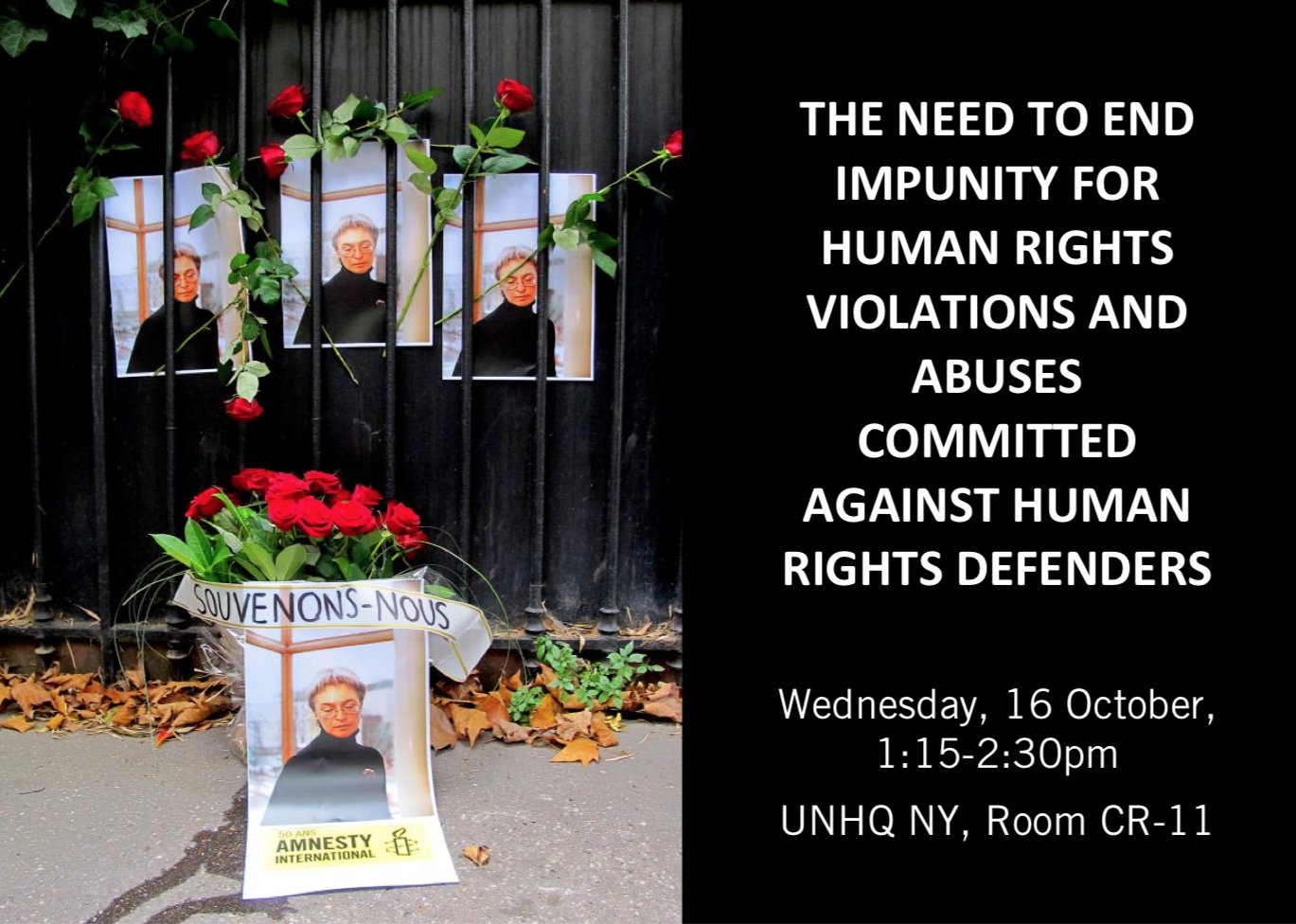
Panel against impunity for abuses against human rights defenders. New York on 16 October

October 9, 2019


Wednesday, 16 October 2019
1:15 pm – 2:30 pm
UN Headquarters, New York
Room CR-11

This event is organised by Amnesty International and the International Service for Human Rights with the kind sponsorship of the Permanent Mission of Norway to the United Nations.

Event with panellists:

  • Michel Forst, Special Rapporteur on the situation of human rights defenders
  • Radya Al-Mutawakel, Mwatana Organization for Human Rights, Yemen
  • Khin Ohmar, Progressive Voice Myanmar, Myanmar

Moderated by:

  • Sherine Tadros, Amnesty International

Welcoming remarks by:

  • Ambassador Mona Juul, Permanent Representative of Norway

Please RSVP by 11 October.

Download the flyer here

In memoriam Louis Joinet: a great human rights defender who deserves more recognition outside France

September 25, 2019

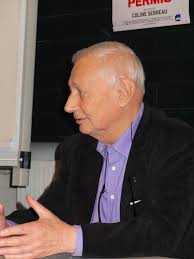
Louis Joinet (born in Nevers on He was a French magistrate, independent expert to the United Nations Human Rights Committee and very active in the NGO human rights world in particular with regard to the dictatorships in Latin America (he was named illustrious citizen of Montevideo).

He co-founded the Union of the Judiciary (Syndicat de la magistrature) in 1968.  At the beginning of his career, he was interested in the early stages of computer sciences in order to evaluate the impact of these technologies on the law. He represented France in the Council of Europe. His report will gave birth to the Data Protection Act. He then participated actively in the drafting of the law relating to computers, files and freedoms of 6 January 1978. He was an adviser on human rights to the succesive Prime Ministers of François Mitterrand between 1981 and 1993.

In the UN context he was the author, in 1997, of the principles against impunity of the Office of the United Nations High Commissioner for Human Rights , also known as the “Joinet Principles” , which are part of the principles of transitional justice. .

He published his memoirs in 2013 (Mes raisons d’État : mémoires d’un épris de justice, Éditions La Découverte). One of the characters of the French television series Sanctuaire , broadcast in 2015, which addresses in particular the role of France in the attempt to negotiate, in the mid-1980s between ETA and Spain, is inspired by Louis Joinet  (“Avec “Sanctuaire” j’ai voulu faire un film sur une gauche qui se perd” [archive], teleobs.nouvelobs.com, 2 mars 2015).

His wife Germaine Joinet, doctor and activist in various associations, died in 2008.


Ciné-ONU and the Goethe Institute screened  “Un certain monsieur Joinet” (52 mn) on 24 October 2012 at the Goethe Institute in Brussels. According to Amnesty International, “the documentary gives an insight into the fifty years of struggle by Louis Joinet for human rights, from the war in Algeria to Pinochet’s Chile, from enforced disappearances to the fight against impunity”.  Language: French with English subtitles. Directed by: Frantz Vaillant. Only the trailer is on the internet and information on how to get hold of the full film is missing.

There is also an interview with him from 2012:

https://www.lemonde.fr/disparitions/article/2019/09/23/la-mort-de-louis-joinet-cofondateur-du-syndicat-de-la-magistrature_6012734_3382.html

https://fr.wikipedia.org/wiki/Louis_Joinet

https://www.unbrussels.org/invitation-to-the-screening-of-un-certain-monsieur-joinet/

European Court rules on Sergei Magnitsky’s death

August 29, 2019

Environmental Human Rights Defenders: “More Deadly Than Being a Soldier in a War Zone”

August 6, 2019

The number of environmental human rights defenders murdered across the world has doubled over the past 15 years, climbing above the number of soldiers killed in some conflict zones, research has revealed. Between 2002 and 2017, as many as 1,558 people across 50 countries were killed while defending the environment, according to a study published in the journal Nature Sustainability,  The supply chain of violence”.

That is more than double the number of U.K. and Australian armed service personnel killed while on active duty in war zones during the same period, the researchers emphasized. Since 2004, the recorded number of environmental defenders dying has risen from two per week to four per week. Most were killed due to conflict over natural resources….

“Environmental defenders currently face a wave of violence that includes threats of physical harm, intimidation and criminalization,” the authors wrote. “Deaths represent the ‘tip of the iceberg’ of the violence that environmental defenders face.”

indigenous woman, Brazil, protest, getty, Brasilia
An indigenous woman holds a Brazilian national flag stained in red representing blood during a march in Brasilia on April 26, 2019, on the last day of a protest to defend indigenous land and rights. CARL DE SOUZA/AFP/Getty Images

In 2017, at least 185 activists were killed, with Indigenous peoples making up the biggest portion at around 30 percent, down from 40 percent in 2015 and 2016. At 36 percent, most deaths happened in Central America, followed by South American at 32 percent, and Asia at 31 percent. The most indigenous peoples died in the Philippines and Colombia between 2015 and 2017, with 36 and 22 deaths respectively. In 2017, 56 environmental defenders were killed in Brazil and 47 in the Philippines.

And the loved ones of victims struggle to seek justice, the authors said. Just over 10 percent of murders result lead to a conviction each year. This is likely due to corrupt police and authorities, who are sometimes involved in environmental devastation, and because murders are often carried out in remote areas. For instance, military and civil police are the main suspects after 10 land rights activists were killed in the city of Pau D’Arco, Brazil.

The researchers said the elections of populist leaders Jair Bolsonaro of Brazil and Rodrigo Duterte of the Philippines are a further cause for concern. Bolsonaro has called activists terrorists, and plans to relax gun and environmental protection laws, while the Philippines’ president “has taken a violent stance toward human rights defenders, Indigenous peoples, environmentalists, women, drug users and others,” the authors wrote.

..

Companies and consumers also have a responsibility to “investigate the sources of products, publish the results and commit to eliminating violence from supply chains,” the authors said. Co-author Dr. Nathalie Butt, a researcher fellow at the University of Queensland, Australia, School of Biological Sciences commented in a statement: “The number of reported deaths of environmental defenders has increased, as well as the number of countries where they occur.” Butt told Newsweek she was surprised that corruption was the key driver of the deaths, rather than the resources themselves. “As a lot of the resource demand is driven by international markets, consumers in countries in the Global North need to make sure they are aware of where their products come from, and how they were obtained, and demand (through pressure on supply companies) ethical and transparent supply chain processes,” she said.

Butt continued: “In many cases they [environmental defenders] are trying to protect environments that are important for everyone on the planet such as the Amazon, which is critical in terms of buffering climate change and carbon emissions.”

….Christopher Jeffords, associate professor in the department of economics at the Indiana University of Pennsylvania, told Newsweek: “These studies help shine a light on known instances of extreme violence committed against environmental defenders and thus help illuminate the notion that there are likely many cases which go unreported.” Eve Bratman, adjunct professorial lecturer at the American University Washington, D.C., School of International Service, told Newsweek: “The study tells us that the most important driving forces behind human rights abuses and the killings of environmental defenders are corruption and rule of law; when governments become more accountable, the benefits will likely be seen across the board. “In Brazil and several other countries, there is reasonable cause for concern that rates of violence will spike even higher given the dangers of today’s political climate.”

https://www.newsweek.com/more-deadly-being-soldier-war-zone-environmental-activists-killed-defending-planet-have-1452277

For the study mentioned see: https://www.nature.com/articles/s41893-019-0349-4